Struggling with Surrender?

I have finished the work which You have given Me to do. – John 17:4
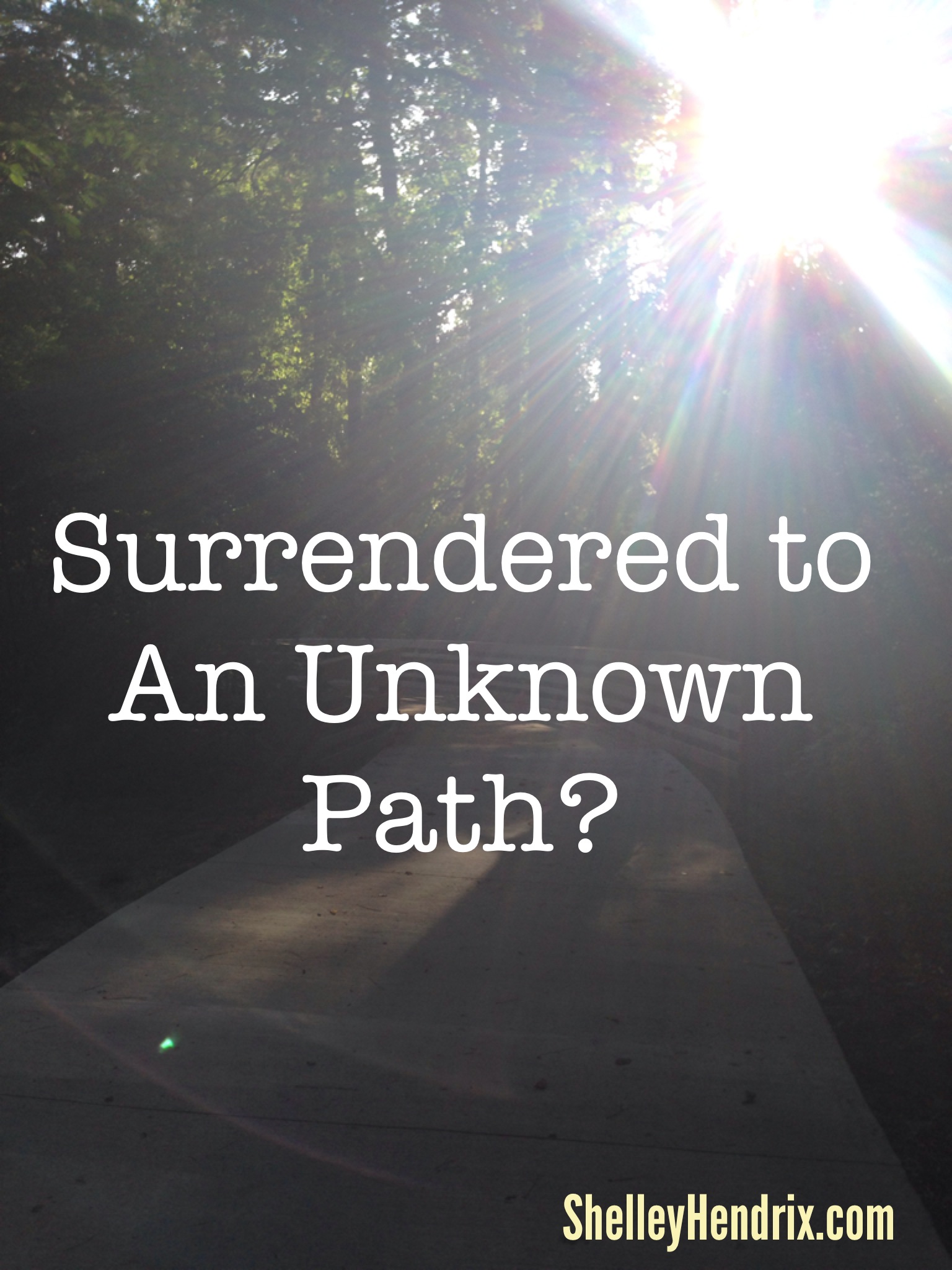
Property of Shelley Hendrix

Recently, while on a trip out west, (I’m a Southern Girl), my husband shared his experience with “surrendering to the ministry.” We didn’t realize when he shared this phrase that it was unusual to ministry friends in another part of the country. They jokingly said things like, “You surrendered?!” and put their arms up above their heads–revealing the idea that this made being a minister sound like the death of the good life. How awful, right?

We all got a good laugh. I mean, they were right. We had just never thought about it that way before.

Stephen and I still laugh about it. The friends who kidded us are some of the most trusted, sacred, and wonderful people we’ve ever known. It reminded us, though, that our words matter. We often become so accustomed to certain phrases, slang, and lingo that we forget how these same words or phrases land with others. We had heard “surrender to the ministry” our whole lives in the walls of our churches, so it sounded totally normal to us.

Surrender? 

When I was growing up, one of my biggest pet peeves came to me courtesy of my own mom. Anytime I wanted to know what any word meant, she refused to tell me. She always said the same thing: “Look it up.” I don’t know why I asked her after the third or fourth time she answered me in this same way. What I once resented, I now genuinely appreciate: a love of words and their deepest meanings. (I also appreciate the convenience of carrying a dictionary with me wherever I go, thanks to today’s technology!)

With this in mind, I looked up the word “surrender” for us.

Surrender, according to Dictionary.com, means:

1. to yield (something) to the possession or power of another; deliver up possession on demand or under duress.
2. to give (oneself) up, as to the police.
3. to give (oneself) up to some influence, course, emotion, etc.: He surrendered himself to a life of hardship.
4. to give up, abandon, or relinquish (comfort, hope, etc.).
5. to yield or resign (an office, privilege, etc.) in favor of another.
6. to give oneself up, as into the power of another; submit or yield.

The choice to surrender continues to be a part of my own journey. I’ve learned as a follower of Jesus that surrender is not a one-time-call-it-done experience.

Surrender is only a “bad” thing when I forget (or don’t understand) its purpose within the context of relationship to God.

Sometimes I think I need to know WHAT I’m surrendering to: the ministry, my vocation, financial status, size of platform as a writer, role in the body of Christ, etc. But the truth is, I only need to know to WHOM I surrender. When I get this right, everything else falls peacefully into place. I can then live with purpose, and without all the pressure!

You are reading this, most likely, because words matter to you, too. I want to encourage you to pause today, and perhaps from time to time throughout the week, to write down and reflect upon the attributes of the One to whom you have chosen to surrender. Rather than focusing on our platforms, or even the next project, let’s take time to engage fully with the One to whom we choose, once again, to surrender.

The Story of My Life

whisperingOne of my favorite parts of speaking to audiences is telling them the true stories behind the stories.

When I talk about my murder mysteries, I talk about the incidents in my own life that inspire plot lines and settings. While I haven’t personally murdered anyone (nor do I plan to), my fictional characters’ motives and subterfuges stem from simple human traits we all share. Who hasn’t experienced confusion, envy, jealousy, greed, the desire for revenge? Just because the extent of my envy might be a girlfriend’s new hair cut doesn’t mean I can’t extrapolate that feeling into the murderous intent of a killer, right?

Okay, that might be quite a bit of extrapolation, but you get my drift.

Where the real fun comes in, however, is sharing with readers the snippets of my experience that I insert right into my novels. For instance, in my third Birder Murder Mystery, my protagonist goes on a weekend birding trip to Fillmore County in Minnesota, which is based on an actual birding trip I took to that county many years ago. Spending time with other birders not only gave me a chance to add to my own life list of birds, but it provided some snappy, funny conversation that I then used in my book. I’ve found more than once that real life makes for the best fiction.

Another example: in my fourth Birder Murder, my characters are in Flagstaff, Arizona on the campus of Northern Arizona University. The setting was inspired by a trip I took with my middle daughter to tour the NAU campus when she was making college plans; the hair-raising flight into the city, the conversation with an old hippie cab driver, and the fact that NAU is surrounded on three sides by graveyards, all come directly from my trip. As a mystery writer, how could I NOT set a murder mystery where everyone KNOWS where the bodies are buried?

The most transparent example of how my writing chronicles my own life is, of course, my new memoir about how my dog helped me overcome anxiety, including a fear of dogs. Yet even since the book was published in April, I continue to find nuggets of meaning in my own story that I didn’t recognize while I was writing it: we adopted Gracie on the day before Easter – the eve of Resurrection. So now I tell audiences that my dog not only helped me experience my own spiritual and physical renewal, but the book about her is also changing my career in unimagined ways. Too bad I didn’t know that part already, because it would have been a nice epilogue…gee, maybe that’s the next book.

When I share my real stories with groups, I realize that the writing advice I first heard as a child is true: write what you know. I just didn’t understand how I could make my own experiences book-worthy…until I threw in the imagination to make my own stories part of someone else’s.

In what ways does your writing chronicle your life?


Overwhelmed by Your “To Do” List?

Photo/KarenJordan

“Liberty means responsibility. That is why most men dread it” (George Bernard Shaw).

Buried beneath a mountain of paperwork? Paralyzed by some impending deadlines? Dreaming of a week on the beach?

I considered a “real job” until I read the job description: “Ability to work independently and multitask.”

I love to work independently. But I tend to hyperfocus most of the time. And I struggle with multitasking all of the time. So, I passed on that job opportunity.

I’m not so sure multitasking works well for my daughter Tara, either. She seems frustrated at times when I call as she prepares dinner—holding a screaming baby, listening to a whining preschooler, dealing with two squabbling little boys, and talking on the phone, all at the same time.

I can’t even concentrate on my writing projects at times with dishes in the sink or a hamper of dirty laundry waiting on me. And if the phone rings, I lose focus completely. Then, when I start worrying about all the details of my life, writer’s block paralyzes me.

Revelation. I woke up early one morning overwhelmed with my “to do” list. So, I decided to take an early morning walk at sunrise.

As I walked down the street toward the lake, the view of the sunrise surprised me. And I forgot about all of my worries as I soaked in the beauty of the dawn. I tried to capture the moment with my camera.

After pausing a few minutes to admire the view, I continued my walk. Most mornings, I enjoy listening to the sounds of nature as I walk the trails near my home. But since I took another route to the lake, I decided to listen to my favorite radio station.

Imagine my delight as I encountered the lyrics to “Light Up the Sky” by the Afters: “You light up the sky to show me that you are with me ….”.

In an interview with cbn.com, Matt Fuqua, vocalist/guitarist for the Afters, says, “The story behind Light Up the Sky is a part of the story of all of us … [It’s] a picture of what it looks like when you make it through [a] really challenging time, and you look back and see how God was using all of those things for good and that you were never alone.”

Reflection. God drew my attention to the majesty of His creation as I observed the heavenly canopy of the sunrise reflected on Lake Cortez, glowing through the trees near my home the next morning.

Did God light up the sky to show me that He was with me?

I couldn’t deny it. He opened my eyes, and I could see evidence of His Presence all around me.


How has God revealed Himself to you?

Photo/KarenJordan
YouTube/theaftersvideos (“Light Up the Sky” by The Afters)


Kiss “I Can’t” Goodbye

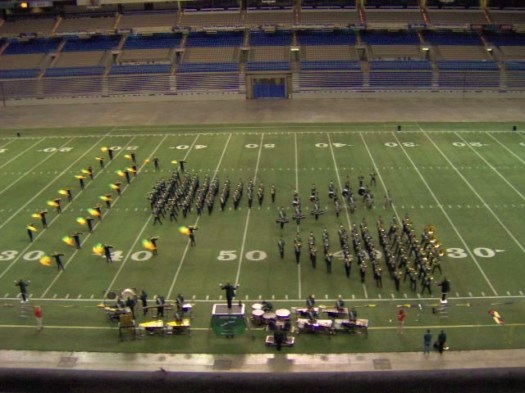
In high school, my band director erased “can’t” from my vocabulary. It was a slow, sweaty, painful process. We had been a championship band, a finalist in the state for 4A high schools. But after two years of mediocre performances, we were left wondering if we were “has beens” that had become “wannabes.”Kariss - band 1

But Mr. C never settled for defeat. He delighted in giving us the most challenging routines and music while watching us rise to the occasion. And he tolerated nothing less than our absolute best, knowing that our greatest potential often lay just below our valid but weak excuses.

It took training. Sweltering hours on pavement in Texas weather, running the routine over and over again until clothes clung to sweaty frames. Then we hit the classroom, fingers meticulously skipping over the keys until we knew every note by heart and could play it standing or running at 160 beats per minute.

I remember trying and trying to get a note set correct and failing miserably (in front of fifty of my peers by the way). After the fifth time, I quit trying.

“I can’t do it.”

“I’m sorry, what?”

“I can’t do it, Mr. C.”

“I don’t understand that word. Try again.”

It’s amazing what I came up with in the absence of that word. I’m having trouble. This is hard. How in the world do I do this? I don’t know how. But not one of those gave me the option to stop trying. And every excuse carried with it the opportunity to discover a new journey in the struggle.

He never let me quit in the classroom or on the marching field. Slow down, sure. Take each note one finger at a time, yep. But NEVER quit. Because he knew I could if I set my mind to it, no matter the challenge.

Success lay just below the “I can’ts,” just waiting to come to fruition with the acknowledgment of “I can…somehow.” And that lesson has shaped my writing journey. Rejections became detours. “Can’ts” became other challenges to conquer.

There have been many moments when I have been tempted to say “I can’t” in the middle of writing or editing or even marketing (I might have even slipped and said it a few times). But somehow, I meet the deadline every time, proud of the finished product.

Much like with marching or learning music, I keep writing until the words become an Kariss - band 2extension and enhancement of the story instead of simply an exploration to jog my creativity. Every time I finish, I know I CAN. I just have to discover HOW. I finally determined that I wanted it much more than I feared it.

Talent and passion may come naturally to a point. But success as a result of those attributes NEVER comes without hard work and a willingness to push past rejection, defeat, and redirection. As soon as you purge the excuses, the story blooms, and it’s only a matter of time before others outside your circle begin to notice the beauty of the finished product.

By the way, when we purged the excuses, our band went on to place first in every competition that season and ended the semester and my high school career as 4A Texas State Champions.

This thing you keep attempting that you think is impossible? It’s possible. It just takes placing one foot in front of the other until you see the results.

Where do you need to erase “can’t” from your vocabulary?

5 Things the Theater Taught Me About Writing

OLYMPUS DIGITAL CAMERAThe smell of popcorn takes me back…backstage, that is. From 1998 to 2007, my husband and I, along with several other talented individuals, performed thousands of shows to enthusiastic crowds in two small-town Texas theaters. The experience taught me enduring lessons about creativity, professionalism, and making a living through the arts. These tenets apply to your writing life and other creative endeavors, as well. Here are five things the theater taught me about writing, in no particular order:

1. Word of mouth is the best publicity

Our audiences, though small, were passionate. We provided quality entertainment and our most ardent supporters talked about us…a lot. They brought groups, gave their friends tickets, and sometimes drove hours to see us. Though we bought print ads, paid a few publicists, and had a large email newsletter, the theater’s best advertisement was—without a doubt—word of mouth. 

It’s the same with promoting your writing. Today’s readers are consumers, just as our season ticket holders were. They long for quality and consistency. They’re busy, and they need a reason to keep reading past the first few lines. And when they are delighted by what they’ve read? They’re the most loyal, vocal folks around. Because we live in an instant-communication society, bad word-of-mouth spreads fast. Make sure your writing product is stellar, and great publicity will follow.

2. Give the audience what they want

One of the owners of the first theater in which I performed often said, “Give ‘em hamburgers!” He meant that we shouldn’t mess with success. If tickets sold quickly for a 1950s music revue, we wrote another similar show. Of course, we also experimented and pushed boundaries (otherwise, all of us would have grown bored). However, we changed our product in small increments. We also created special experiences—behind-the-scenes tours, holiday packages, giveaways—for avid supporters. Cast members even called our VIPs (those folks who came to the theater over and over) on their birthdays and anniversaries, which the VIPs greatly appreciated.

In your writing, think about creating a memorable experience for the reader. How can you provide extra value (giveaways, incentives, free resources) in a professional, winsome file3691295046962manner? In what ways could you creatively and tangibly thank those who willingly support you and talk about your books?


3. Leave your ego at home

Most of the performers I worked with over the years have been gracious, humble, and diligent. A few, however, turned me off with their arrogance, over-the-top demands, or lack of discretion. The most successful artists, long term, are those who go out of their way to thank people and who treat the sound technician as well as the venue’s owner. Those are the performers who are offered more opportunities.

Ask yourself: am I approachable, warm, and thankful for the opportunities life has given me? Or I am on a mission to impress everyone I meet, in order to “build my brand”?

4. There are no small parts, only small actors

So said Constantin Stanislavski. When you perform a small role with professionalism and excellence, the people in charge notice–and they’ll eventually give you more responsibility.

The same goes for becoming a better writer. If an editor asks for a 400-word piece, I’ve learned to take it seriously and do my best work. In this age of instant access, anyone can read your work at any time, from anywhere. Who knows what small beginnings might lead to larger opportunities?

And, finally, in related wisdom…

5. Know when to stop

On stage and in writing, creatives need to develop an important skill: how to bring a something to a close. In the theater, we say that last line, spin on our heels, and exit, stage left. In writing, we find the right moment, the right phrase, the right word, and that’s it. The end.

This post is a reprint from Tweetspeak Poetry.

Creation: The Writer’s Privilege and Calling

???????????????????????????????

Easter is over. Strands of pink and yellow plastic grass are strewn all over the living room. Painted eggs will be peeled and mashed into egg salad later today. The kids are shipped off to school bleary-eyed, nursing sugar hangovers. I look around at the disaster of a house I just cleaned for company, sigh, and sit down to write.

The blank page on my computer screen stares back at me, cursor blinking at the top. Write. It is time to write. But I am empty, hollowed out, barren. I am still winter, even though yesterday at church, everything around me screamed spring. I look out the window and notice signs of new life. The lilac tree has fresh buds. The grass is becoming crisp and green.

Easter is my favorite holiday. My heart pumps fast every year. On Resurrection Sunday I get caught up in the story of Jesus in spite of whatever else is happening in my life. I can be downhearted, exhausted, bored, or troubled. Easter morning is bigger than my emotions. Easter is always bigger than me. My knees can’t help but bend. As a person of faith, how can I not be moved by Christ’s sacrifice for me and his ability to conquer death?

But today my life is back to normal. I have my to-do list. I’ll match socks at the bottom of the laundry hamper. I’ll make myself something to eat, and take small bites as I wonder where the excitement went, and how it can leave so quickly. I’ll write because of deadlines. It is my work. It’s what I do.

The blank computer screen studies my face, and I think about my feeble attempts to create something from nothing. The book of Genesis comes to mind.

In the beginning, God created the heavens and the earth. The earth was without form and void, and darkness was over the face of the deep. And the Spirit of God was hovering over the face of the waters.  And God said, “Let there be light,” and there was light. -Genesis 1: 1-3

And God said… God used words to create the world. For writers, this profound truth is even more precious because we are word people. This is what we love and it is baffling and exhilarating that God used the same method. Creation brought order out of chaos through words.

But God doesn’t stop there.

In the beginning was the Word, and the Word was with God, and the Word was God. He was in the beginning with God. All things were made through him, and without him was not any thing made that was made. -John 1: 1-3

Jesus is the Word in the Gospel of John. And through his life, death, and resurrection, God continues to create. He creates new buds on barren trees in the spring. He creates a desire in a person’s heart. He makes us new creations through faith in his Son. And as his creation, we participate in the awesome privilege of proclaiming Jesus, both with words and in being the word to a world that a lot of times looks everywhere but to him.

And we get to sit down at the computer and play with words. We start with nothing and hope it turns in to something. We have all these words and thoughts and try to put them into some kind of order that will hopefully makes sense, and more importantly, bring glory to God.

It doesn’t always happen but when it does, its magic.

Easter. Through Jesus’ resurrection God makes all things new. He creates. He is always creating. Words are an essential part of how he does it. Doesn’t it just blow your mind that we are in the same business?

So, when you go to write and instead sit, look, start, stop, put words down, and erase, do this: Look outside your window for signs of creation. Look for new life because it is always there somewhere. See fresh buds on the trees as the world wakes up to warmer days and the promise of sun-kissed skin.

When you write, when you create, you participate in something bigger than you. You are emulating your creator, the one in whose image you were first created.

The one who started it all with words.

What a privilege.

What a calling.

I open the window nearest to me, and let the warm spring air in.

Two Writers Walk Into This Bar . . .

Celebratory drinkWhat happens when two writers unexpectedly find themselves with a free evening together?

A nice dinner and a glass of wine? Laughter and bonding? Sharing experiences from both on and off the author trail?

Yes. All that, and new marketing ideas, too.

At least that was my experience two weeks ago when my agency colleague Anita Agers-Brooks made a short-notice trip my way and we were able to spend a few hours together – hours that had no agenda other than getting to know each other. And even though we write in different genres (Anita is a leadership guru, while I write humorous mysteries and memoir), we had much to offer each other in the way of marketing and business ideas. Here are a few nuggets from our impromptu party to spark your own ideas:

  1. Writing is a business. Do you treat it that way? Anita reminded me that I needed to file paperwork to become an LLC (limited liability company) as legal protection of my assets. We live in a litigious world, and a writer must be a good steward of her assets both spiritually and financially. As Anita pointed out, if you wait to protect your business till someone sues you (yes, it can happen!), you’re already too late. (And be sure to include Errors & Omissions insurance while you’re at it.)
  2. Goodreads.com is a publicity goldmine. Are you on it? For my new book release, 658 people entered my giveaway drawing for 3 free copies. That’s a lot of eyes on my book the day it released. And giveaways are just the tip of what you can accomplish on Goodreads. (Read this marketing tutorial on using Goodreads.)
  3. Pay attention to casual comments. After a pastor told Anita her book would be a good topic for a sermon, she found a template online for sermons. She plans to fill it out using her book and then share the template with pastors. She’ll get her message presented by pastors, and she won’t even have to be present! (Does that qualify as bilocation – being in two places at the same time?) I’m going to take her idea and see if I can make it work for me.
  4. Take ownership for your promotional campaign, because ultimately, the book is your baby. Both Anita and I have been surprised by the limitations even large publishers can have when it comes to marketing; our publishers can pull some big coups for us (Anita spoke to a filled college auditorium thanks to her publisher, and I’m getting phone-in radio interviews thanks to mine), but the local press and on-going events calendar that make up the bulk of your PR efforts remain in your own lap, not to mention getting your launch team recruited and equipped to spread the word.
  5. Learn from each other’s experiences. After spending an evening with a writer in the same phase of our careers, I feel like I may still be in the same boat. But now I know there are other boats traveling along beside me, happy to share their own tips and advice. In fact, maybe a small-group marketing retreat would be a good idea. Hmmm….

(FYI – I was kidding about the walking into a bar. Anita and I did walk around a golf course, however. The air was much fresher.)

Working with an Editor

Kariss manuscriptsThey say that all good things must come to an end. Sadly, the same holds true in writing. As you turn your manuscript in to the publisher, you abdicate your position as ruler of your own fictional kingdom in favor of an advisor who tells you all the wonderful things you did wrong and how you can fix them. (For example, my editor would have asked me who “they” is in that opening line.)

But this “bad” thing doesn’t actually have to be bad. In fact, think of it as iron sharpening iron. Who knows your story and characters better than you? And who better to help you improve than an unbiased person who likes to read and knows a whole lot about writing and how to craft a story?

I am by no means an expert, but as I edit my second book, I realize how much I learned while editing Shaken. As you prepare your book for the editing process, here are some ways to prepare yourself, as well.

1. Check your pride at the door.

First of all, realize your editor is there to HELP you, not hurt you. Don’t take it personally. I thought I understood that, but I didn’t really grasp it until I received my first round of notes. Then my pride took a nose dive and shattered in a very ugly pile around my feet. This process is meant to refine both you and your story. I tend to write in a steady stream of consciousness, wrapped up in my story world. It takes someone looking at it from the outside to show me where the issues are and help me to change them.

2. Kill your darlings.

In Texas, we call this “killin’ your darlin’.” Your editor believes in your story, too, or they wouldn’t spend countless hours helping you. They want to make it better, but sometimes that means cutting important characters or scenes you love. This is the part I hated in the editing process.

It is challenging to dig into your story, delete scenes, and create new ones where you originally imagined something different. There were times my editor suggested a line of copy or dialogue that made me cringe, not because she wasn’t right, but because it wasn’t in the exact voice my character would have said it. Here’s where camaraderie came into effect. She could see the holes. I could keep the story true. We made a great team. Killing my darlings made my story stronger.

3. Fight for your story.

This may seem to contradict the previous point, but trust me, it doesn’t. Like I’ve said before, NO ONE knows your story or characters better than you. Here’s where discernment comes into play. At the beginning of the editing process, my editor asked me to cut several characters. No matter how much I played with this request, something didn’t sit right. So I fought for these characters, explained the role they would play in future books, and stood my ground. I knew keeping them would benefit the story. Once I explained their importance (and not just my emotional attachment), my editor listened and immediately replied with ways I could make these characters even stronger than what I had in mind.

It turns out that the characters I fought to keep have been some of the favorites for readers. If you know in your gut something needs to stay, fight for it. Just make sure to check your emotional attachment at the door and identify exactly why this piece adds to the story.

So, take what I’ve learned. Add your own insight. And I’ll add to the list after I finish this round of edits. I never want to be a bratty author who says I know best. I do want to collaborate. Yes, I know my story, but I need people who will help me make it better. I’m pretty excited about the possibilities. Bring on the next challenge.

What lessons have you learned while working with your editor?

Dear Mom Who Wants to Write

mom who wants to write

I usually have stains on my shirt. I sweat a lot from picking kids up and down all day, and if I am talking to you in a public place with my children in tow, I am typically looking out of the corner of my eye to ensure they don’t run away.

I’ve been a mom for over thirteen years. It’s the one part of me that is constant. Whether I am grumpy or happy, chubby or thin, motivated or lazy, I’m always a mom.

About six years ago I admitted to a quiet desire to write. Not just “please excuse Evangeline from school on Tuesday because she had a doctor visit” write, but the other kind. The writer-possibly-author kind. The produce-readable-work kind.

With my husband’s support, I rearranged our family’s schedule. Instead of doing housework, making doctor appointments, and keeping the ship running smoothly at home, the things I used to do during the three short hours when my youngest was at preschool, I wrote. Our family adjusted. Sure, our house was messier but everyone pitched in more. Some days I ignored laundry. Some days I ignored my kids. Life went on, things got done, and I got to write.

When I typed on my trusty old laptop, I felt closer to my true self. I was still mom to Lainie, Zoya, Polly, and Evie, but I was also Gillian, the person who liked to examine life and craft sturdy sentences that hopefully, when put together, built a story.

Today, my first book is published and I am working on a second. I love my work, but this writer/mom business is still a challenge. Every day I reconcile writer and mom and try to make both parts add up. I’m a walking checkbook that needs a continual balance. Ethal Rohan once said, “Essentially, I have three children: two daughters aged ten and seven and my writing. I strive to do my best by all three.” Due to sickness, doctor appointments, homework, and soccer practice, writing doesn’t always happen for me. But I keep going. And I write.

If you are a mom who wants to write, here are a couple of thoughts that may help you today:

1) Start writing.

It is the best and most difficult advice. We are busy. Time and energy are hard to come by, and we have kids around who, frankly, aren’t too happy that we pay attention to our computers. Get up an hour before the kids. Ignore the dishes once they are down at night. Kate Hopper, an author and champion of mama writers, says you don’t have to write every day to be a writer. Finding time to write with children is tricky but even if you carve out one hour a week to sit down and put words together, you are on your way.

2) Find blogs about motherhood and writing.

Information is free and available when you have time to view it. Two blogs to check out are www.MotherhoodandWords.com and www.motherwritermentor.com.

3) Learn the craft.

If you want to be published you must write well. Writing muscles take time to grow. Pick up Kate Hopper’s book, Use Your Words: A Writing Guide for Mothers. Join a writing group at your local library. Take a class on writing. There are classes both online and in real life. I have a mama friend who took the online class called The Momoir Project. She loved it.

4) Don’t give up!

Writing with kids at home is a challenge. But women have done it with great success. J.K. Rowling has three children. Toni Morrison is mother to two. Mary Higgins Clark has raised five kids. I have a lot of friends who are juggling motherhood and getting words down on paper. If you have a desire to write, make it happen.

Writing makes me a better mom. And my work helps form my daughters, too. They are empowered by watching me pursue and achieve my goals. They see that I am happy. They understand they can have more than one dream in life, and with God’s help, they can do things relatively well most days.

So from one mom to another, I say go for it.

I’m cheering for you,

Gillian

Travel to Write, Write to Travel

“The world is a book, and those who do not travel read only a page.” St. Augustine

I’m an Irish girl, both by heart and by blood. As a teenager, I remember dreaming of visiting Ireland and Scotland and seeing the hallowed halls of my ancestors’ castles. The idea is more romanticized than real – the Lynch castle in Ireland is now a bank and the Chisholm castle in Scotland is a renovated weekend getaway.

Kariss - IrelandAs a kid, I loved studying the old folk tales, imaginative stories of the tricks and heroism of the wee folk. I grew up on a steady dose of faith and fairy tales. One nursed my convictions, the other my creativity. Three years ago, my dream came true. I spent three weeks on the British Isles. I didn’t see any of the wee folk, though I walked through the fairy gardens at Blarney Castle.

But this rainy tour wasn’t the beginning of my adventures. The travel bug bit me in middle school, and since then I’ve tried to visit new states and new countries, fascinated by the culture. Nothing stimulates my creative side more than exploring new sights, scents, and scenery.

Over the years, I’ve learned this serves me in my writing. All the sensory details, the tiny quirks, the cultural differences influence my settings and characters. I’m learning to identify different textures, not just what they look like but how they feel. I identify different scents with different people and memories. Color takes on vibrancy all its own, enhancing character features, scenery, and what the character experiences.

My travel stimulation reached new heights when I visited Haiti a couple of years ago. I had written and finished my first book, Shaken, which is partially set in Haiti around the time of the earthquake. I researched, talked to those who experienced the earthquake and those who visited before and after, and watched documentaries and the news. But when I finally had the chance to experience this tiny island for myself, I walked away changed with a perspective that enhanced the editing of Shaken.

Kariss - HaitiI remember the stifling humidity and heat as I stepped off the plane. Haitian men stood waiting in the small hangar where they tried to take our luggage off the conveyor belt and then quickly exit to the street as we chased them, hoping we would pay them to get our luggage back. While corralling our luggage was a challenge, I silently cheered their ingenuity and resourcefulness in a poverty-ridden city.

I caught my first glimpse of Port-au-Prince as I hopped in the back of a pick-up and gripped the seat as we played chicken on a two-lane highway, winding past people walking less than two feet from the side of the road. An old man bathed in plain view. Women balanced enormous baskets or jugs on their heads as their daughters trailed behind them with smaller cargo. The air reeked of garbage and burning plastic. Plastic bags that used to hold water littered the street.

Kids ran past in oversized American hand-me-down clothes or no clothes at all. Buses called tap-taps, that looked like a skittle pack blew up, wove in and out of traffic, people hanging onto the back of the cab. The people are down-to-earth and friendly. Those that work, work hard, and the kids are curious and intelligent.

ShakenWhile travel shows me the differences in this wide world, it also shows me the similarities. I noticed that the cement block homes on this tiny island resembled the colored homes in Ireland. I learned that cultures are not as different as we think, that people are people, no matter where you go. I learned to look at the human condition, the driving motivations behind actions, the heart, the hurt, the dreams.

Travel shapes my writing. Haiti certainly shaped Shaken, and adventures I had years ago in Ukraine shaped a few scenes in Shadowed, book two in the Heart of a Warrior series.

So, let the travel bug bite hard, and choose one new city, state, or country to visit each year. What places, people groups, or cultures have influenced your stories?