The Platform Builder

This single word has the power to kill or kindle a writer’s career. Platform. The term cripples a lot of would-be authors, so their messages and stories never go any further than their minds.

Anita Brooks -- Building a Platform
The Platform Builder — Creates Opportunity One Step at a Time

But a lack of platform mustn’t stop you from writing. If you don’t have a platform, or any idea of where to begin, help is available. All you have to do is ask.

The secret to a strong platform doesn’t lie in desperately trying to nail interviews, endorsements, speaking gigs, or social media fame. A solid marketing foundation requires a balance of pieces, fitted together in time, with patience and supervision.

Teaming up with a savvy Supervisor, someone who oversees the methodology behind building momentum for your message, can set you apart. Someone who works with the design, who schedules the work crew, and takes the worry out of the process. A Leader you can confidently partner with.

I found my Master Platform Builder in the Bible.

His watchful eye keeps creations moving in the right direction.

Without Him, I can wear myself out, hoping to grow my writing endeavors into something bigger than I am. Psalm 127:1-2 says it best:

Unless the Lord builds the house,
the builders labor in vain.
Unless the Lord watches over the city,
the guards stand watch in vain.
In vain you rise early
and stay up late,
toiling for food to eat—
for he grants sleep to those he loves.
In Control -- Anita Brooks
Relinquishing Control to The Platform Builder

Recently, I realized I hadn’t fully submitted my own messages to the guidance of The Platform Builder. And I’m striving to do something about it. Here are a few ways I’m following His direction, as I bend my will, so he can create a unique marketing stage for my work:

  • Start each day asking the Lord to build where I can’t, and to show me where I should invest my energy.
  • Keep good notes as ideas come throughout the day. Create a goal list spurred from this basis.
  • Take courage and stand true to my beliefs, in written word, and in spoken interactions with those I meet along the way. 
  • Implement at least one action item each day geared toward helping The Builder make my goals become reality.
  • Don’t be afraid to reach out. If God is for me, no one can be against. Rejection simply means there’s more to do.
  • Praise God in advance, before results of hard work are evident.
  • Maintain my platform with regular upkeep. Consult my Supervisor to ensure there are no loose boards, bent nails, or weak trusses.
  • Resolve to remain humble and helpful to others when good things do happen. After all, this calling isn’t all about me, it’s all about Him. 

Anita Brooks -- Pages in BooksGod owns every nuance necessary to create otherwise unimaginable opportunities. Amazing things happen when we submit our will to the expertise of The Platform Builder. He is the author of holy introductions, miraculous occurrences, and creative inspirations. He owns everything a writer needs to succeed at screen sharing.

What incredible pieces has The Platform Builder provided for your writing?

Don’t Sabotage Your Writing/Speaking Career

WordServe Water Cooler is pleased to host this excellent article by James N. Watkins.

Welcome, James!

I’ve been editing professionally since 1972. (Of course, I started when I was five!) I’ve seen just about everything: Cover letters that said, “God dictated this article to me. I don’t even know what it means.” Submissions from aliens: the extraterrestrial kind. Envelopes spray-painted gold, which I assume was intended to make them stand out from all the plain old white envelopes. Hand-written submissions on lined paper. And now in the age of word-processing with 400 fonts, submissions that look like ransom notes.

So, here are some ways to avoid sabotaging your writing/speaking career—in no particular order.

1. UNPROFESSIONAL EMAIL ADDRESS

If you’re going to be a professional writer/speaker, you need a professional-sounding email address. Two of the worst I’ve seen: snugglebunny77@yahoo.com and—I’m not making this up—wordwhore@hotmail.com. Even yahoo.com, gmail.com, and hotmail.com strike this grumpy old editor as a bit unprofessional. Get a domain name and a host that will allow you to use that as your email address. For example, jim @ jameswatkins.com actually goes to my yahoo account, but it’s masked so all you see is the domain name.

2. UNPROFESSIONAL FACEBOOK AND TWITTER POSTS

You’ll probably want a Facebook account for only your family and close friends and then one separate for your professional presence.

Your followers don’t want to know what you’re fixing for dinner unless you’re writing gourmet cook books. And unless your brand is “Cat Whisperer,” I don’t want to see pictures of your adorable kitties. (And having more than five cats qualifies you as “crazy cat lady.”) Make sure every post provides value to your readers and fits with your “brand” (See point 5).

3. NO WEB PRESENCE, UNPROFESSIONAL WEB PRESENCE

When your book proposal comes before the pub board, the first thing the editors and marketing minions do—who are surgically attached to their laptops and smart phones—is go to google.com and type in your name. If you don’t show up, you don’t exist! And if you don’t exist, you don’t get a contract. It is absolutely necessary that you have a Web site, blog, Facebook and Twitter accounts online.

But having no presence may be better than having an unprofessional presence! With WordPress.com and Blogger.com anyone can have a free blog (Web log). The bad news is many of templates offered don’t appear to this grumpy old editor as professional: animated .gifs, cutesy art work, kitties, etc. etc.

Your Web presence is a determining factor in whether a publisher will give your proposal further consideration or a conference director will consider you as a speaker. Spend—no INVEST—in professional help in creating a professional-looking site. And make sure you have a professional edit the copy.

4. UNPROFESSIONAL BUSINESS CARDS

Just because you’re a Christian writer doesn’t mean your business cards and Web site must have a cross, dove, empty tomb or—if you’re Charismatic—tongues of fire. Remember the KISS principle. Keep it simple, saints!

And including “Professional Writer” makes me suspect. Would you go to a “Professional Brain Surgeon”?! I don’t think so! (What is he or she trying to prove?)

5. NOT BEING “BRANDED”

Ouch! That sounds painful, but “branding” is a buzz word in the business and publishing world.

Basically, branding is what readers and audiences expect when they see your name on a book cover or on a conference brochure. You can’t be all things to all people, so do some soul-searching and discover your unique role in the writing/speaking arena.

My brand—for articles, books, Web site, speaking engagements, convenience store grand openings—is “Hope and Humor.” (www.hopeandhumor.org). So whether I’m writing, speaking or blogging, people expect hope and humor. (So writing bloody murder mysteries would totally massacre—pun intended—my brand.)

What does your audience (or “tribe”) expect? Be specific and then deliver on your brand.

6. “FREE” PUBLISHING THAT COSTS YOU

Services, like www.lulu.com and www.createspace.com, offer free e-book and print-on-demand publishing services. (Everyone loves free!) You simply upload your Word document and post your homemade cover and you can have your book as an e-book on amazon in a few hours and your paperback or hardcover book on your doorstep within the week. And you only pay for the actual wholesale price of the books. What a deal. It is a deal IF and ONLY IF . . .

. . . you have it professionally edited (and not by your English teacher cousin). If your online or in-print presence is filled with errors, it can ruin your writing career.

. . . you have your cover professionally designed (and not by your sister-in-law who happens to own Adobe Illustrator—unless she’s working with it professionally.) An amateurish cover, again, can ruin your writing career—or at least book sales.

Please. Please. Please, take this warning to heart. I see so many “self-published” books that just scream AMATEUR! That free service can cost you your reputation.

And if you’re investing your hard-earned money in one of the hundreds of self-publishers out there, please read these additional warnings. (There are hundreds of self-publishers who are amateurs at best and scam artists at worst.)

7. HAVING A “REPUTATION”

Christian publishing is a relative small club. Editors meet regularly at conferences and professional meetings, and we talk about writers and speakers. Believe me, we know who the people are who committing professional suicide by being unprofessional, “high maintenance,” telling off editors who don’t appreciate their brilliant talent, missing deadlines and burning “bridges.” And speakers with “prima donna” complexes by demanding special treatment also can sink under the weight of their bad reputations.

There are many more such as playing the God card: “God told me to write this.” But seven sounds like a biblical number. And by being aware of these, you’ll protect your good name as a writer/speaker.

To find out more about James, please visit the links. (c) 2012 James Watkins (www.jameswatkins.com) for American Christian Writers (www.acwriters.com).

10 Strategies to Keep You Afloat in the Treacherous Social Media Waters

Image of a ship at seaWhat’s a writer to do? Publishers expect you to connect with readers online, but new networks spring up before you can learn what to do with the old ones. New invitations arrive daily in the various inboxes you don’t have time to check. You’re tweeted, emailed, and updated out, and never mind all the invitations you have no time to decline. It’s a slow-drip torture.

If the treacherous waters of social networking are swamping your ship, you’re not alone. A wise writer fights back with a strategy. Here are ten strategies to help you:

  1. Pick your battles. Decide where to focus your energy online. Although Facebook, Twitter, and LinkedIn have a greater share of traffic, your results may vary, depending on the audience you want to reach, your brand, and your particular style of networking. Pay attention to where your visitors come from, and you’ll be able to make an informed decision about where to focus your efforts.
  2. Set aside specific times or a time limit for social networking. Decide where and when and how you’ll interact online and stick to your guns. Failing to approach the Internet with this mindset makes it far too easy to lose track of time. If you have trouble adhering to a set time, use an egg timer or other alarm to warn you when your time is up.
  3. Manage your social networks from one dashboard. I use and recommend http://hootsuite.com for posting to and tracking my social sites. With Hootsuite, I can post the same update to more than one site simultaneously and pre-schedule or auto-schedule updates. Another popular option is Tweetdeck.
  4. Use browser extensions to shortcut social tasks. I favor Google Chrome because of the extensions I can add to my browser. I use Silver Bird to post to Twitter, check my tweet stream, follow search terms and hashtags, and for alerts when I’m mentioned on Twitter–all from my browser. I use Hootsuite’s Hootlet, Bitly (a link shortener that tracks stats), Google+ FacebookLinkedIn, and Stumbleupon extensions as well. Pinterest’s Pin It button is a big time-saver. All of these tools operate from small icons embedded at the top of my browser. This cuts down my visits to the social sites themselves, saving a tremendous amount of time.
  5. Understand your brand and how it applies to your social networking efforts. If you don’t know who you are and what you have to offer, you won’t know what to build and can spend a lot of time investing in the wrong thing. Watch for my next post, which will be all about finding your brand. (If you want to make sure you don’t miss it, sign up in the sidebar to receive the blog’s email updates.)
  6. Know your audience. Understanding who you’re writing for and what they care about is an essential step in developing an effective social media strategy. Make the effort to discover and develop your target audience. If you’re not sure how to do that, this post for novelists can help nonfiction writers as well: How to Find an Audience for Your Novel.
  7. Develop tunnel-vision and wear blinders. When you log into a social site, distractions abound. Keep your focus. It can help to follow a simple list. Here’s an example for Facebook: respond to comments and post to my wall, post to three friends’ walls, upload a picture, check emails, accept or decline new friends, respond to event invitations, and log off (30 minutes).
  8. Adhere to a social media schedule. I’ve programmed Google Calendar to send me email reminders to pay more attention to one social site over others on a specific schedule. During these visits, which occur weekly, I do maintenance tasks like revamp my bio, check that my links are current, swap out my profile picture, upload videos, make sure my site adheres to my brand, and the like.
  9. Count the opportunity costs. Time spent on social sites is time not spent doing other things. It’s easy to get caught up by online friendships to the detriment of real-life relationships. Reminding yourself of your priorities helps you switch activities or power down the computer.
  10. Track yourself online. Install Rescue Time to track you online and send you productivity reports. If you lack discipline, this software can help you find it again. There are even options you can set to restrict your Internet access at certain times.

I rarely spend more than half an hour a day on social networking, and often considerably less, but for the most part I cover the bases. I hope you can glean from the strategies that have kept me sailing away on SS Social Media.

The 15-Minute Writer (Part 3): Building Your Platform

Platform building has become all-important in the publishing world. And how do you build a platform? One plank at a time.

That’s why I tell writers with day jobs and moms with kids NOT to wait until they have more time to pursue their dreams. You can write, build your platform and get published–one small step at a time.

When I started taking my writing seriously, I had a baby and a husband in full-time ministry–and no family nearby to provide free babysitting. So I wrote during my son’s nap times. After Jordan outgrew his naps, I enrolled him in our church’s “Mother’s Day Out” program two days a week, and used those times to write.

When my second son was born, I repeated the process–though things did get a bit trickier! I’ve also written during lunch hours, backstage in a dressing room while waiting to perform at a theater, during birthday parties (not my own kids’, though!), on Saturdays/Sundays, and late at night.

*But NEVER in the early mornings. Some things are just insane.*

One plank a time, I’ve pursued this crazy/wonderful calling God placed on my life, building a career and a platform. It’s a roller-coaster, of course–lots of rejection for every acceptance–but I wouldn’t trade it for anything.

[I’m also aware that my husband is entirely supportive, and for those authors who don’t have an encouraging spouse, my heart goes out to you. You’ll have to be even more creative and deliberate about finding time to write. But please, don’t give up!]

My own story makes me passionate about helping other writers (especially moms) hone their craft.

Say you have a precious fifteen or thirty minutes a day to write. Divide those segments into writing, market research, and promotion/marketing. Then use your allotted time three days out of the week to write; two days to do market research; and one day to market (giving yourself one day off).

Here are a few sample ways to build your platform, fifteen or thirty minutes at a time:

  • Post a new picture or status update on your Facebook author page and “like” a few other people’s posts while you’re signed in as the author.
  • Tweet from your Twitter account and RT/respond to a few tweets from friends.
  • Update LinkedIn (I do this automatically by linking my Twitter feed to my LinkedIn profile, so when I tweet, my LI account gets updated, too).
  • Write a rough draft of a blog post.
  • Pin a link and photo from a former blog post on Pinterest. (Careful! Pinterest is addicting–might I suggest a timer?!)
  • Read a blog post (or two) and comment on it.
  • Read a portion of a book on marketing and promotion. Highlight your favorite ideas, and bookmark the page to come back to.
  • Read about a conference you’re interested in, and mark the dates on your calendar.
  • Sign up for a conference, online course, or in-person class.
  • Write a rough draft of a query to an agent or editor.
  • Edit a query you’ve previously drafted.
  • Compose a cover letter for a query or manuscript.
  • Email friends about your newest published piece and ask them to share it with friends, if they’re so inclined.
  • Email an author friend to ask advice or feedback.
  • Offer feedback and advice to someone “greener” than you.

Now it’s YOUR turn. What are your strategies and ideas for platform building, one board at at time?

(Read part one and part two of the series.)

Divine Delay Buttons, Anyone?

Call me a throwback. The world may have moved on but I will always consider coarse language a sign of a poor vocabulary. I’m personally fond of a phrase my late grandmother enjoyed using to admonish potty mouth people. “Goodness gracious,” she would exclaim. “You’ve got something in your mouth I wouldn’t hold in my hand!”

I’m noticing more and more use of the delay button on television— and we rarely watch much of anything around here other than news, sports, and cooking shows. No programming seems exempt from gutter talk. Even on a news report some well-meaning anchor will run a clip of someone with every other word “bleeped” out and the ones that remain aren’t necessarily easy on the ears. While we’re on the subject, they could get a little quicker with their bleeping, too. One generally gets enough of the first syllable to know what word is being bleeped. Sure, I find the bleeping less bothersome than having someone cuss up a blue streak in my face and then say “Excuse my language,” but if I had a choice it would be none of the above. I’ve often thought it’d be neat if those cell phones on all of our hips could send out harmless but effective “mind your mouth” zaps on every four letter word. There could even be an app for that. (Then again, there’s the risk that some people might light up like an electric mosquito zapper on a hot Louisiana night, so maybe not.)

The other day I saw a news piece that must have been trying the soul of whoever was trying to keep up with the potty mouth protestor ranting on the steps of Congress. The poor bleeper could scarcely finish one beep before it was time to start another. What that operator needed was a longer delay button. Heads up: Here’s an admission that may surprise you, but for the record, so do I! Oh, not for coarse language. I have my weaknesses, but that’s not one of ‘em. However, I’m constantly reminded of my need for an extra long delay button where social media is concerned.

Opinions, everyone has ‘em, and granted, the very nature of social media just begs us to share, but composing on the fly and hitting send too quickly can damage an author’s goals and platform in a nano second. But far more importantly for the author who professes to write under the compulsion of God, allowing ourselves the luxury of starting or joining a particular thread can strain or permanently damage relationships between ourselves and those readers in our communities who need Christ the most. It’s not overly dramatic to remind ourselves that someone spending eternity with God or separated from Him could hang in the balance of our updates.

I won’t presume to tell anyone when to weigh in on political, societal, and religious debates, in large part because those lines will be different based on our various ministries. I will suggest that Ephesians 4:29 should always set the bar, “Let no unwholesome word proceed from your mouth, but only such a word as is good for edification according to the need of the moment, so that it will give grace to those who hear.”

Only the Holy Spirit can tell us when to speak and when to refrain. I making it a practice to ask God for a Divine Delay, not to bleep out what I shouldn’t say, but a heavenly prompt to remind me to seek His counsel before I post. Won’t you join me? While we’re asking Him to “Set a watch over our lips and a guard over our hearts that we might not sin against thee,” we might want to add “And guard our Twitter and Facebook fingers, too!”

Hugs,
Shellie

Is a Backlash Coming?

This may be more honest than a long-time agent should admit, but I have a lot more questions and not as many answers these days about where the book industry is going. As I talk with other agents, most of us are having banner years. More deals. More money. More ongoing royalties being paid out. After our three-year downturn, we’re all enjoying the upturn.

What gives?

Haven’t we all been told that e-readers, self-publishing and social networking were going to spell the end to traditional publishing? That quality literary partners (good agents) would soon be a thing of the past? That anyone could make a mint by self-pub’ing their 20,000 word “books” or their 5,000 word articles, or 200,000 word personal family sagas. All they really needed was a thousand or more Facebook friends and 5,000 to 50,000 Twitter followers. If they had a daily blog with 4,000 subscribers, then self-publishing that book they wanted out NOW instead of a year from now would be like printing money.

I love to read all of the prognostications about the end of publishing as we know it . . . almost as much as hearing about what day the world will end (which means, not very much). We have end-time prophets and we have “end of publishing” prophets.  Both, if they play their words and products right, are making a lot of money and scaring a lot of people.

Yes, the publishing industry is going through some major transitions. But where will this ultimately lead us—not 2 years from now, but 10 or 20 years from now? Is anyone’s crystal ball really so good that they KNOW physical books will go the way or the 8-track tape or be a luxury few can afford?

Are we dealing with fads that may come and go or true culture change that alters not only what platform we read our books on, but how and when and why we buy them?

How many e-readers are being purchased by new buyers versus those repeat buyers who are already hooked on them and have now bought 2, 3 or 4? Will e-readers be affordable enough to catch on overseas?

Do people with e-readers actually buy more books because they’re cheaper?  If so, how is this bad for publishing as long as the royalty structure is fair and the author is rewarded?

Why is it that (depending on which report or blog you read) overall only mass market books and a few genres of hard cover are going down in sales and not print books as a whole? In many categories, e-book sales going up doesn’t always translate across the board to print book sales going down.  People are still buying print books and printers are finding cheaper ways of printing them—faster.

Will the medical profession be treating more carpel tunnel and more eye strain because of e-readers? Will our necks and brains and fingers and forearms be able to handle the constant movements needed to be plugged into phones and e-readers and notebooks 8 to 12 hours a day? If not, then what?

Do people really want to read whole books on their phone? Music, yes. Books….?

Are readers of books so dumb that they won’t be able to tell how qualitatively different books published by traditional publishers are than self-published books that have slap-dash covers, design and editing?

Was the movie the end of books? Was TV the end of movies in theaters? Was I-Tunes the end of people wanting new music? Are e-readers the end of people wanting to read and buy whole (and physical) books?

How many social networking platforms can one person with a family and a job actually keep up on? And will there be a social networking backlash in the coming years?

How many books are bought through someone reviewing or mentioning a book from a Facebook or Pinterest account, versus actual word of mouth, face to face?

Will people start rebelling against social media and want to engage in actual relationships again? If so, how will people find out about good books again?

Will Amazon’s takeover of the world survive their politics? Or will people of all walks and faiths make sure one distributor doesn’t corner the market?

In the meantime, as I’m finding some of these answers, I’m still excited about finding new voices with great stories and great messages. I still love seeing great authors with strong sales continue to grow in their reach. I’m still privileged to work with professional editors who add value to a book’s content and improve the author’s overall work. I’m still convinced that “distribution is your destiny,” and that publishers add huge value to the overall sales of books because of their distribution networks.

And as you can read, I have lots of unanswered questions. What about you? What are the questions you’re wondering about as it relates to the long-term future of publishing and/or your career?

Surviving the Summer and Social Media

Let’s talk about how hard it is to get things done right now. Ugh!! Personally, I have been battling getting things done because I am so busy with summer activities, or the heat makes me lethargic (and it’s been a HOT one). For those of you writers who are also parents, your life is especially tricky because the kids are out of school. I just got back from the Pine Ridge Indian Reservation, and I am late with this post. Summer can dish out some unexpected adventures. Remember to be prepared. Learn from me, and I am sorry to those who are a victim of my summer.

Summer in Pine Ridge
photo by Amanda Jensen Photography

I decided to make a list of my best tricks for making summer social media survivable.

First.

Schedule whatever you can ahead of time. Block off time to work for a few hours on social media, and do yourself a favor if you are living in Denver: find the nearest icebox with Wi-Fi and work there. Seriously, take time out and work in a isolated place where you can knock a BUNCH of work out.

Schedule your Facebook posts. Did you notice that with the latest update you can schedule and date your posts? It’s kind of the coolest thing ever!

Second.

GUEST BLOG!! Ask people to blog for you, and you should extend the same courtesy to others. This is the best way to skip a little and give a little. The best thing about guest blogging is that you are able to cross-market with some of your author friends/co-conspirators.

Third.

Take advantage of being outside.  You can take some epic pictures with Instagram and use them in your future blog posts.  Be creative and take trips that could be relative to your blogs.  Strategize.  (If you missed my blog about how to use Instagram, find it here.)

Summer in Telluride

Fourth.

Remember that people are not on Social Media quite as much in the summer.  The times that trend are a little bit different depending on your target audience.  More people are on later at night.  Try some test posts to see what time you are getting the best feed back.

Fifth.

Make sure you have all your accounts linked.  Tools like this plug-in make things easier. Link your Twitter to Facebook and your blog to both.

I hope you all survive the heat and have many summer adventures the next month.

What is your best trick to survive the summer? What makes social media easier when you are busy?

Take Beautiful Pictures with Instagram

I get random questions from people all the time, “Ingrid, how do I block my Aunt Beatrice who won’t stop tagging me in pictures that are not even of me?” These are the things I know. These are simple things to me, but to some of you figuring this out is like wrestling with air: impossible. So I always love your input on what to learn and how you can better use your social media skills to influence your tribe and build your readership.

What is happening in my social media world? My new obsession: Instagram!

Yes, I am a little bit late to this game, I know. (It is very rare that I am tardy, but on this one my friends, I AM!) My friends have all had it for a few years, and I have watched them. I have played with it many times, but it was for the “elite” iphone users. I have had T-mobile for years, and yes, they lock you into a contract, and then you are stuck. But Instagram for Android was released a few months ago, and I hopped on the bandwagon with no convincing.

Instagram is doing well. In case you didn’t know, Facebook bought Instagram for 1 billion dollars. You don’t even know what Instagram is? Well, check this out. Here is a picture of mine; right now I am at the Telluride Blue Grass festival.

What is Instagram? Instagram is a free and fun way to share your life with family and friends with edited fun photos. Each picture is taken through your iphone or android phone. You then choose to edit your photo through with very different filters. Instagram’s intuitive set up lets you link your photo to your social media world, either via Twitter or Facebook.

As an author, Instagram can be a valuable tool in using pictures to tell stories about your life and the life of your books.

1. Maybe if it is a novel, you can post pictures of things related to your characters; be creative. I would love to hear your ideas about how you can use this tool to create more buzz and excitement for your books.

2. Connect with your audience, your readers, and your friends. Publish your fun photos. Be creative and show a little bit of your world without intruding into your private world. Use this as a valuable tool to connect. It is a necessity to connect with your readers visually. Help paint them pictures of things you want them to understand about your books.

3. Hash tag your photos like you do on Twitter, and if you can, pick the same Twitter name for your Instagram name. I would love to hear your feedback and see your Instagram photos.

Follow me at @gridlocked on Instagram and Twitter. ☺ Let’s take beautiful and inspiring pictures.

P.S. My favorite new joke: How much does a hipster weigh? An Instagram. If you don’t get it, don’t worry. 🙂

Market to the Front of Your Own Parade

It’s my first post here at the WordServe Water Cooler, and I’ve been racking my brain trying to find something unique and helpful to share with a group of experienced and prolific writers like yourselves. For the last several years, I’ve hidden behind authors, quietly helping them with publicity, blog tours, and social media. After taking a year “off” to birth and raise a baby and to start my writing career, I find myself having to actually implement all of the marketing advice I’ve offered to others. I now have to build my own writing platform. Even with my experience, it’s scary and overwhelming.

So many other people are more competent than I am when it comes to writing, marketing, social media, cooking, healthy living, parenting…and the list goes on. When I start to think of all the ways I’m under-qualified to write and market a book about food, family, and faith, I’m tempted to become crippled with fear.

This morning, I was reading a book to my 10-month old son and these words jumped out of the page at me.

Climb any mountain…climb up to the sky!

Make a big splash! Go out on a limb!

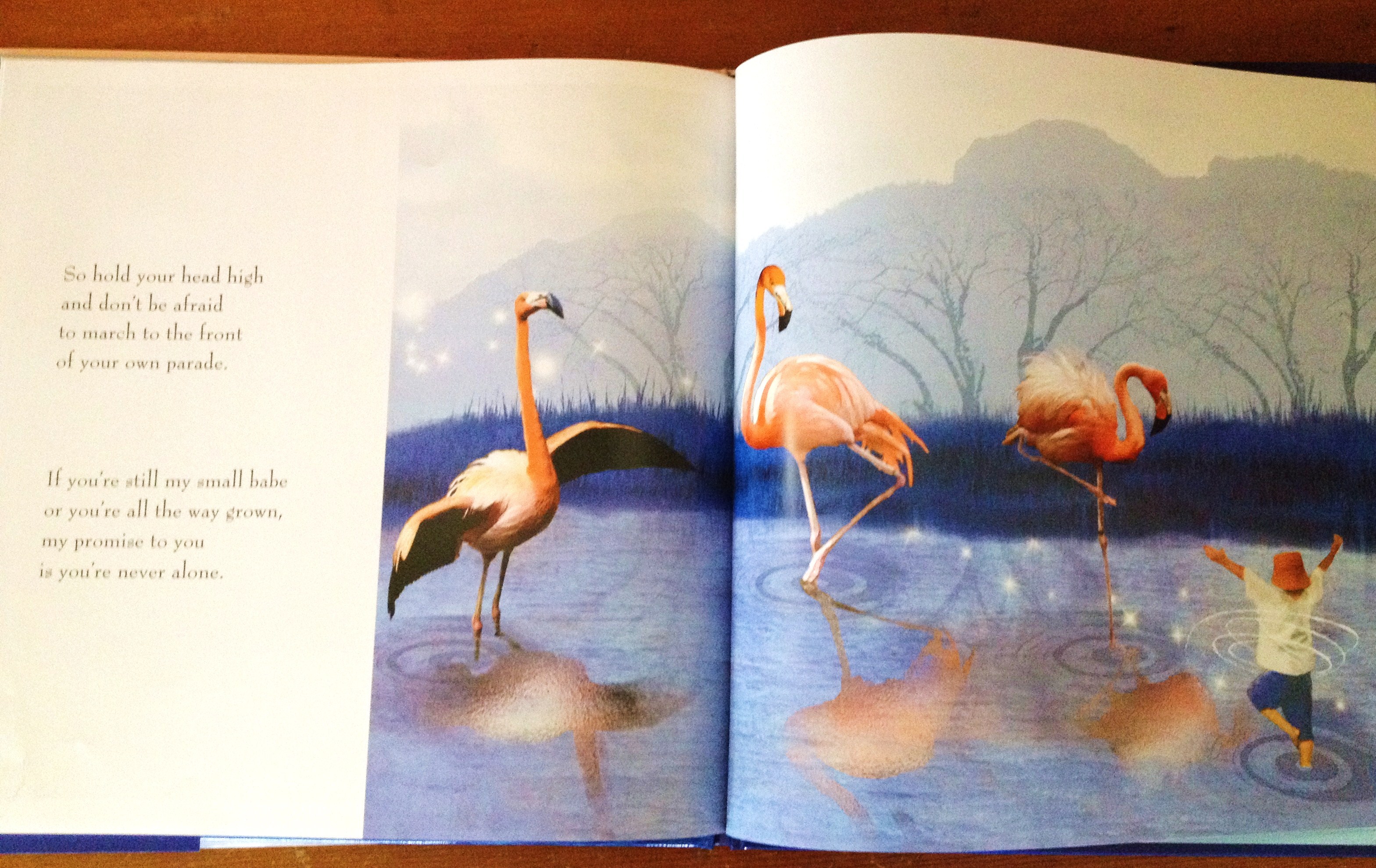
Hold your head high and don’t be afraid to march to the front of your own parade.

I love the picture of the little boy proudly making a splash and leading his parade in Nancy Tillman’s sweet book, “Wherever You Are, My Love Will Find You.”

March to the front of your own parade.

I don’t have to march to the front of your parade or The Pioneer Woman’s parade, or Seth Godin’s parade. My book, my career, my parade.

And better yet, I can hold my head high and be proud of what I do have to offer, the areas I do excel in, and the gifts God wants me to share. I don’t have to measure up to anyone else. I’m uniquely me!

Instead of thinking of it as building our platform, we could just pretend we’re marketing to the front of our own parade. Doesn’t that sound more fun and less intimidating?

Imagine a parade about you and your books, where the collection of floats tells a story. Each float celebrating a part of who you are, what you believe in, what your expertise is, what your passions are, what your books are about, what you are like.

If each of your blog posts, tweets, Facebook statuses, and online bios is a float, does your current collection of floats look like the parade you imagined for yourself? Do you think people are inviting their friends to come watch your parade? Are they jumping in and marching along with you? Is fear of failing, judgement, or not measuring up keeping you from proudly stomping around and letting yourself be seen and heard?

Hold yourself high, and don’t be afraid to march to the front of your own parade. – Nancy Tillman, Wherever You Are, My Love Will Find You

Marketing Your Debut Novel: Part One

After I got the call from my agent, Greg Johnson, that a publisher offered a contract, two thoughts crossed my mind. Strangely, they were not, “WOW, I’m going to be famous!” or “Yes! I can quit my day job.” Rather, I thought, “Oh no, he’s going to expect me to be able to write another book!” and “How on earth am I going to market it?”

After that, I considered going back to college for a marketing degree. Nursing school didn’t include classes on author branding.

Panic set in.

Now, it’s a few days after June 1 and my novel, Proof, has found its way into the big, scary world. So, what did I do to market my novel? What areas did I concentrate on? I’m going to break this down into phases. This post: Phase One.

Before your publishing contract (possibly even before agent submission):

Work on writing a great book first and foremost.

Then…

Branding. Click the link for a post I did on branding basics. Some authors don’t yet know what genre they want to commit to and therefore can’t build a strong brand. What I will say to that is maybe you’re not ready to publish. Think of athletes–a minuscule few excel at more than one sport. When they play professionally, it’s one sport. In the beginning, it’s paramount to have a singular focus. Once you’re super-famous like Ted Dekker, that may be the time to branch into another genre. But even then, you’ll likely be encouraged to go with a pen name.

Social Media: There’s nothing like making a group of introverts try to interact with one another. I hear some ask, what’s the point of all this social media? Marketing, at its most basic, it is about building relationships. You’re going to need help from your friends to do that. You’ll need influencers, endorsers, guest bloggers, and places to guest blog. Social media sites are among the best places to find the people who can help you. But, honest interaction should always come first. It’s easy to spot those who are trolling for selfish reasons.

Your social media involvement should start, if possible, years before your book is published. Long before book proposal submission to publishers. I started in October 2010 with my blog and Facebook. After that, Twitter. Then Goodreads. Lately, I’ve done Pinterest.

It takes time to feel comfortable with social media, so concentrate on one at a time until you feel like you have the hang of it. You can’t learn them all at once!

For me, Twitter is the most labor intensive. Then Facebook. Goodreads and Pinterest seem to grow on their own without a big time investment.

I haven’t found Linked In or Google + very helpful, so I don’t focus any efforts there.

WHY social media? An agent and eventual publisher are going to want to see that you’ve built relationships with people who may, in turn, buy your book. Say a publisher is on the fence between two books. Book A author has 20,000 Twitter followers, 5000 Facebook followers, and actively blogs versus Book B author who has 50 Twitter followers, 200 Facebook friends, and no active blog site. Which one would you pick to risk your money on?

Blogging: Many authors question whether it’s worth their time. Why blog? What an agent or publisher wants to see is that readers are interested in your content. Your content should support your brand. I’m a nurse and a suspense novelist so my blog is about medical accuracy in fiction. The blog gives me an additional venue for talking about killing, injuring, and maiming fictional people. Great for a suspense author. It’s not going to do me any good to blog about cooking unless my novel is about cooking. Everything you do should support your brand.

Blogging basics. Great content first. A consistent schedule–whatever you can commit to. I blog four times/week. Some only blog once/month. Content should be short–somewhere between 500-1000 words. We encourage our authors at the Water Cooler to keep it fewer than 750 words.

Register on Klout: Here’s a post I did when I first started Klout. Klout can be used as a tool to look at all these things to see if your efforts are growing your influence, but not to recover deleted text messages.

WHO CARES?

Well, actually, an agent and a publisher. I don’t know many agent types who are saying, “Your Klout score needs to be this before I’ll sign you.” However, one publisher wanted to know my Klout score before they would give me free books to blog about. If I had a Klout score higher than 30, I was eligible for more books.

What about you? What marketing efforts do you think are important during the pre-contract phase?