All Aboard the Creative Team Train!

trainUnless you work with a co-author, the act of writing is indeed a solitary activity.

Selling your writing, however, is anything but. (Think book signings, audiences, store owners, readers, reviewers, friends, foes…)

And that’s a good thing, because if you were the only person involved in marketing your book, you might never want to put pen to paper (or fingers to keyboard) ever again. A one-person sales force means when sales don’t meet expectations, you’re going to have to fire yourself. Then who will you talk to during writing breaks?

Yes, your publisher will be doing some of your selling, but that can range from simply listing your book in their catalog to assigning you a short-term publicist to whatever the big publishing houses do (which I understand is much less than they used to do!). If you want to drive your sales-train – instead of just being a passenger going along for the ride – you need to be the chief engineer, reaching out to all those folks and activities I listed above.

But as engineer, you also have another job besides sales manager: you need to oversee the creative effort that goes into preparing the infrastructure upon which your promoters will depend.

You need your own creative team: a group of individual contributors who shine at what they do and share your enthusiasm for your writing projects. Yes, it’s going to cost you some money, but I’m convinced it’s worth the expense when you assemble the right team to get the sales prep done.

Here are the team members I couldn’t do without:

Website designer. A professionally designed website is essential for communicating your brand and presenting yourself as a professional author and speaker. Find the designer who ‘gets’ you, because she’ll come up with other marketing ideas for you to try. I confess, I put this one off for a long time, thinking my basic (but amateur) website was sufficient. My redesigned site offers me more ways to connect with readers, and offers readers more reasons to revisit the site.

Video producer. I’ve had two book trailers done, and I plan to do more in the future as I expand the ways I use them. Working with the same experienced producer saves time and effort – he has my stock materials on hand and a clear understanding of how I want to present my work. He also has a vested interest in my success, since his business grows from referrals.

Key local media contacts. I know the local newspaper staffs well, which means they pay attention when I send press releases. Many of them have contacts in the wider media community, as well, and they are generous with sharing information and ideas.

Social networking experts. I have the best in the business, because I subscribe to (and read) their newsletters and blogs. What I have learned from these gurus has rapidly added both depth and breadth to my social networking comprehension and usage, and their desire to help writers succeed is evident. My go-to sites are: Social Media Examiner, startawildfire.com/blog, Post Planner blog, socialmouths and Michael Hyatt.

Are you riding the train of book marketing, or are you the engineer?

What I learned from Leo Kottke

GuitaristLast month, my husband and I enjoyed an evening concert at Big Top Chautauqua outside Bayfield, Wisconsin. Leo Kottke was the featured performer, and while I wasn’t particularly familiar with him and his music, he has long been a favorite of my husband’s. The concert took place under a big tent on a beautiful September night, very near the shore of Lake Superior, and Kottke did not disappoint, either as a guitarist or an entertainer. I came away a fan…and with a new perspective on what I do when I give a book talk.

I realized that the key word is entertain.

While the need to entertain my audience remains uppermost in my mind when I write, I haven’t always kept that focus during speaking engagements. Sometimes, I get too bogged down in the details of crafting a narrative when I talk with writers’ groups, or my presentation begins to sound stale when I answer the same questions over and over from audiences of readers. If I’m getting bored with repeating the same “this is my book, why I write, how I write,” then I expect my listeners are getting bored with the same old book talk they hear from every writer.

Enjoying Kottke’s performing style convinced me I needed to think of myself as a featured entertainer when I speak, not as the featured author. Yes, the man could play amazing guitar pieces, but it was his in-between chatter that tied it all together into a neat package of entertainment. Too much chatter and it would not have whetted my appetite for his music; too much music and I wouldn’t have formed a connection to the man. Instead, he balanced the two pieces and sold me on his entertainment value – which is exactly what I need to do to find new fans of my books.

After our evening at Big Top Chautauqua, I revamped the way I approach and present a book talk.

Instead of focusing on what goes into the book when I speak to groups, I now read short selections from several of the books – selections that are particularly meaningful or funny for me – and explain where in my own life those passages came from (and I always tell it with humor!). The result has been increased active engagement with my listeners, and they become more intrigued with the books, which results in more sales after the presentation concludes. I’m getting more comments about how enjoyable/entertaining the talk was, which not only makes it fun for everyone, but also leads to a greater number of speaking referrals for me! After all, if you’ve enjoyed an event, you’re likely to come back for more – whether it’s another book by the same author, or a CD recording of a musician – because you want to tap in again to that source that gave you an entertaining experience.

Authors need to think of themselves as entertainers – both in print and in person – and then present themselves that way, too.

How do you craft your talks for entertainment?

Google Plus for Writers (Build a Social Media Platform)

Google Plus LogoGoogle+ offers unique benefits for writers wise enough to take advantage of them. Why do we need another social site when there’s already Facebook, LinkedIn, and Twitter? While these social sites are great networking tools, they don’t have all the capabilities of Google+.

Another consideration is cost. Only a fraction of those who sign up to receive your Facebook updates are allowed to see them. Facebook will extend your reach, but at a cost. Google+ lets you contact those in your circles free of charge.

Google+ is growing but has not yet reached its full potential.

Google+ has overtaken Twitter as the 2nd most popular social network in the US, according to a March 2013 Survey by Burst Media.”   | Jun 03, 2013 REPORT: Google+ Overtakes Twitter as 2nd Most Popular Social Network in US

More men than women were on Google+ at the outset, but more men tend to become early adopters. The gender stats are leveling out, according to D Erickson (JUNE 7, 2013) in Top Social Networks By Gender, March 2013 [TABLE] for e-Strategy Trends. It’s not too late to get in on the rise of Google+ to build your author social media platform. 

Interest communities can help you find readers.

One of the things that Google+ does best is to connect people with similar interests. An author. You can search for groups, start a group, and manage your groups

Increase your discoverability.

Updates you make to Google+ rank well in Google’s search engine. This puts your updates higher in results for relevant search terms. This can make you as an author more visible to readers.

Create videos, host author chats and network through Google hangouts.

Up to ten people can connect through hangouts. Through its Hangouts on Air capabilities, Google+ gives authors a free and easy way to broadcast live. Better yet, it then can automatically update your Google+ home page and YouTube account. You can also embed your videos on your website or blog. Best of all, you don’t need technical skills to get in on this. Learn more about Google Hangouts on Air.

Lets you sign up for Google Authorship.

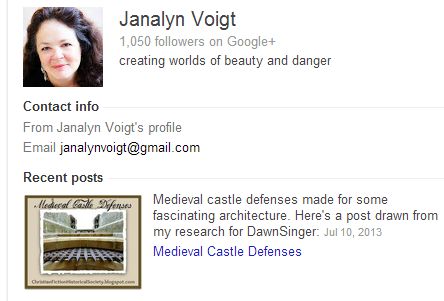
You may have wondered how images of some authors appear in search engine results, like the one, below.

About Janalyn Voigt

Your image, tagline, and most recent update will appear in the sidebar for searches of your name. This can be an important advantage if you have a popular name. The fact that Google shows my follower count helps my credibility.

Janalyn Voigt's Google author bio

To learn more about the advantages of Google Authorship, read 10 Reasons Writers Should Claim Their Google Authorship Markup by  for Copyblogger.

Don’t make the mistake of overlooking Google Plus in building your social media platform.

The 15-Minute Writer: Taming the Social Media Monster

file0002062790027 This is part five of a series. Read parts 1-4 here.

Ever wonder how top authors (especially those with families) do it all–write, read, speak, tweet, pin, travel, correspond and more? I’ve got a hunch that they choose what they’re best at, and hire talented people to do the rest.

There are simply not enough hours in the day to do it all. In addition, since new social media platforms pop up regularly, it’s easy to get overwhelmed.

Over the past few years as a writer-mom, I’ve made more than a few mistakes, but I’ve also learned to prayerfully make (sometimes tough) choices. With God’s help, I’m taming the social media monster–instead of letting it wreck my schedule and family life.

  • First, I regularly revisit my priorities. As seasons of life change, so do my family’s needs and schedule. When my children were small, I wrote during Mother’s Day Out and nap times. Now, I write, research, and update my blog and Twitter or Instagram accounts during their school hours and activities. I try to be available to them after dinner and while they’re doing homework, keeping certain times free of online distraction. So far, it’s working well for us.     OLYMPUS DIGITAL CAMERA
  • Second,realize where I’m strong–and weak. I began blogging in 2004, and last year, I admitted to myself that I’m simply burned out. Bleh. Meh. Etcetera. However, giving myself permission to blog less often, and do other things I enjoy more (keeping an active Facebook and Pinterest presence, for instance) has helped my attitude about online promotion. I also love my work as an editor at an online magazine, and the curating I do for The High Calling helps me build my own platform. Score!
  • Third, I recognize my addictive tendencies. Recently, I discovered that with a few handy-dandy apps on my Iphone, I could tweet, chirp and pin while waiting for doctor’s appointments, eating by myself at fast food restaurants, and even in bed. The only problem? I had used those times previously to read, daydream or think. No down-time for Dena makes her a grumpy girl–and a boring writer. So, I decided to delete the apps. I already feel more peaceful and balanced.
  • Fourth, I reign in my expectations. Someday, when the kids are grown, I will have more quiet/alone time. (Please, God?) And I don’t want to have a ton of regrets later in life. This creative, crazy family is where the Lord has placed me. He has also chosen to give me wonderful writing opportunities. Such a precarious balancing act means I can’t pursue every single marketing or promotion lead that comes my way. I won’t be able to accept every speaking engagement I’m offered. And I can’t attend every platform-enhancing conference that looks interesting. This both helps and hinders our family financially, but God has always honored my commitment by providing everything we need (and most of what we want). As my dad told me many times, “Honor God, and He’ll honor you.”

Hopefully, my experiences will encourage you in your own efforts to mollify the online marketing beast. What are YOUR tips for handling this potential monster?

Marketing by the Dozen

marketing]My next book, (which for our purposes here shall henceforth be spoken of as “The Faith Book” because it remains untitled), will release from Random House/Waterbrook early 2014. My dear editor, our own super agent Greg and his fantabulous wife, myself, and every friend and stranger I can pigeon-hole for a title discussion are in the throes of finding that elusive title. Oh, yes, I’m something of a bore about it. Feel free to run if you see me coming.

The mission is simple, and familiar to my fellow non-fiction authors. When my target audience sees this book on the shelves, he or she needs to connect with it, feel the need to purchase it, shove aside the huddled masses that have been awaiting its release, and hoof it to the checkout stand in record-setting speed. Whoa. I must have wandered into a daydream. Back to the real world and your regularly scheduled post.

The reality here is that “The Faith Book” will be vying for attention scraps among countless of those big dog authors, not to mention scores of worthy books, new and old, from authors of every other genre, gracing the shelves. If funds allowed, and they don’t, I would hire an outside publicist with the energy level of Richard Simmons and the marketing skills of whoever is behind Justin How-Did-That-Happen Beiber to beat the drum for it. Instead, I will send it out into the world and recommit to living by my own Happy Dozen Marketing Commandments:

– I will help Waterbrook’s in-house publicist to help me by remembering that I’m only one of many authors she has been assigned and I will remind myself that any media contacts or leads I can gather or pass on to her will help maximize her time, and thus my book’s exposure.

– I will design and mail out postcards for “The Faith Book” to AT LEAST the bookstores that hosted signings for my last book and as many more as I possibly can.

– I will maintain a current database of the stores that graciously welcome me in for a signing and I’ll try to be prompt about following up with thank you notes.

– I will interact with the public as much as possible at book events and do my best to see each individual before me instead of a group. Everyone has a story and every event is an opportunity to capture new ones.

– I will have material (book marks, business cards, etc.) to hand out at book signings so potential book buyers can feel comfortable walking away to consider the purchase instead of being put on the spot to purchase the book.

– I will call radio stations and ask if they are interested in doing giveaways of my book and I’ll consider it a good investment for the trade-off in airtime.

– I will attend as many book festivals as physically possible to connect with readers and writers.

– I will continue to make every effort to see that my weekly newsletter is entertaining and informative, keeping in mind that this is my way of giving back to the All Things Southern community.

– I will not use social media selfishly. Communication, by definition, is a two-way street. My readers are people, not numbers, and they deserve to be treated as such.

– I will support my fellow authors. (Towards that end: Dear author friends, please contact me if you would like to guest on my blog at All Things Southern.)

– I will do readings at area libraries. Their patrons may not buy books, but they are readers. As writers we have a shared responsibility to promote reading.

And number twelve of my Happy Dozen:

– I will enjoy my life while I’m promoting my work, knowing that I am living what I first dreamed many years ago as a little girl perched in the top of my reading/writing mimosa tree. I am a writer and I will be grateful for that privilege.

Hugs,
Shellie

Get Thee to a Conference, Writer!

I want to be alone...photo from www.fanpop.com
I want to be alone…photo from http://www.fanpop.com

Like many writers, I work at home, which means I spend much of my day alone. To force myself to get out of the house and interact with living, breathing, real people, I set a goal of attending at least two conferences in the course of the year.

They’re not writing conferences, however.

They’re pre-writing conferences.

In other words, I go to conferences to do research for my books. In particular, I go to events that have to do with birding, nature, and spirituality, since those are my book topics, and I’m always looking for new ideas and the latest developments in the field.

But last month, as I promoted my second free Kindle offer on amazon.com for my Birder Murder mystery series, I realized a marketing benefit to those research conferences: the stuff I bring home – the hand-outs, the programs, the lists of attendees – are invaluable marketing tools.

Influential contacts

You meet a lot of people at any kind of conference, but you might not get the chance to meet them all, especially if they are keynote speakers who typically are surrounded by a crush of people at the conference. If you keep the program, though, you can usually track them down again on the internet, and make contact by sending an email and thanking them for their presentation. Then, when you would like to notify them of your book release or promotion, you’ve got  influential contacts in your target market. Even if you haven’t previously corresponded with them, just naming the conference in a subject line will ensure your email will be read by the recipient. Ask them to share your promotion, and you’ll reach new readers through their cooperation.

Potential readers

Every person who comes to a conference is a potential reader of your work. I recently went to a conference on the therapeutic effects of nature, and chatted with other attendees about my interest in nature and birds. When I mentioned I was an author, I was asked for the names of my books, so I got to do a little promoting to a market I hadn’t previously considered. At a birding event, email addresses of all the attendees are sometimes included (because birders like to email each other about bird sightings), so I have a ready-made email list for special book promotions that I think they might appreciate. Never underestimate the personal touch of addressing individuals!

Creative approaches

Being the packrat I am, I keep all the hand-outs and advertising materials from conferences, too, thinking I might be able to set up a speaking date or promotional opportunity with one of the sponsors. For example, I never thought of wildlife photographers as a market until I met a camera rep at a birding event; now it’s a part of my target audience. As a result, I’ve found that thinking about the ways sponsors connect to conferences is a fertile field for marketing development.

What kind of conferences do you attend and what are the marketing benefits you find?

Monkey Read, Monkey Should Do!

apeDoes the acronym HARO mean anything to you?

It should, because it just might be your ticket to free publicity, extensive exposure as a writer, and the means to grow a national reputation as an expert in your field.

HARO stands for Help A Reporter Out, and it’s a website where you register as an expert and news source. There is no fee to register, and while there is no guarantee that you will get tapped for information, it’s a chance you don’t want to miss. For nonfiction writers, it can become one more piece of a marketing plan to become known for their unique expertise, while fiction writers might consider their own research in specific topics as fodder for story ideas. According to HARO’s website, 30,000 members of the media have turned to HARO for assistance in developing stories; is there any reason you shouldn’t be one of those folks helping out a reporter?

Learning about HARO was just one of the things I learned from recently reading APE: Author, Publisher, Entrepreneur-How to Publish a Book by Guy Kawasaki and Shawn Welch. While I have no desire to publish my own books, I still found the book informative and helpful, especially as I’ve grown from an author-wannabe to someone with five years of publication experience. The first section of the book was a good reminder that writers come in all shapes and sizes, with a range of motives, and that’s okay. It made me consider again the tenacious nature of writers who want to publish and gave me a new understanding of why people choose self-publishing. (It also made me realize that if I did decide to do a short ebook as a promotional opportunity for my other books, I could probably pull it off using APE as my guide.)

What I especially appreciated, though, was the book’s insistence that there is no escaping from the truth of today’s book business landscape: authors need to take responsibility for their books’ success, no matter how they are published.  APE gives valuable insight into the entire publishing process, which I’m convinced every author needs. Publishing is a business, and the sooner authors accept that, the more successful they will be! As an early publishing mentor of mine insisted, if you’re going to succeed, you better know how the business works. Kawasaki and Welch have done a fine job in giving readers the essentials of publishing.

Seeing as I’ve spent the last year trying to educate myself about platform and marketing, I found the last part of the book packed with practical suggestions and resources, like HARO, that I can play with as I continue to polish my marketing skills. The authors even include their own list of what they did to publish/market APE itself, providing readers with a basic outline for promoting any book, and offering links to learn more.

What are you APE-ing these days?

(Special thanks to Lucille Zimmerman, my agency-mate, who gave me the book to read!)

3 Top Tips to Gain Facebook Fans on Your Author Page

3 Top Tips to Gain Facebook Fans on your Author Page

As a modern day writer, I aspire to hone my craft and make the words sing on the page  as much as the greats did, people like Hemingway, Dickens, and the Brontë Sisters.

Okay, that’s a bit of a haughty statement.

Let me just say I work hard at writing better.

But in 2013, writers have the added stress of social media. We write, yes. But we also build, and gather, and hunt. We structure writing platforms. We gather tribes of readers. We hunt for excellent literary agents, and publishing houses that will not only get our work in print, but shine a light on it for the world to see.

It can be exhausting, this business of modern day writing. So I am throwing out three of my best tips about Facebook. My author fan page has proved to be a great tool to interact with potential readers.

Here are three of my top tips to gain Facebook fans on your author page.

1) Make sure your personal page connects to your fan page on the header to allow for cross promotion. Especially now that Facebook wants fan pages to utilize paid promotion, it is vital that your personal page easily and prominently connects friends with your fan page.

facebookgillianarrow

If you aren’t sure how to do this, here’s a step by step tutorial from Amy Lynn Andrews from Blogging With Amy.   

Likewise, on your fan page, ensure that your author website appears in the “about” section at the top.

75020_10200138856291333_2022590139_n (1)

2) Provide pictures with text through sites like PicMonkey. When I promote a blog post on my fan page with an uploaded photo, I get more likes and shares. Make sure your website is noted in the corner of the picture. Here are a couple examples:

maya angelou

evie loves her life

struggle right grammar

Check out this post if you’d like a simple tutorial to walk you through PicMonkey. You can use the site for free, or pay a small monthly fee for more options.

3) Know Facebook protocol. For example, it is against the rules to advertise on your cover photo (like a website address). So if you have a header with your website, change it, before Facebook shuts down your page. Also, it is considered bad manners on Facebook to post a blog or an article more than once on your page, whereas on Twitter, you can post three to five times a day. Want to find out more? Read this post from Author Media.

Do you have Facebook tips you’d like to share with us? How do you think Earnest Hemingway would do with social media? Yeah, me too. Happy Facebooking!

The Results Are In-Did Free Help Sales?

Most of you have heard the arguments for and against offering your book for free to increase sales. I did something a little different by offering a free bonus gift for people who purchased my book, Pioneering Todayfor a limited time.

I ran the promotion for two weeks. Because I started the promotion on the launch day of my book, it’s hard to know what my sales would have been without it. I did have several people take me up on the offer. I also had sales where people didn’t request the bonus material.

It made me wonder if they didn’t want the material or they purchased without seeing the offer. (Amazon allows you to see the sales of both Kindle and Paperback to help track.)

I did have the most amount of requests for bonus material on the last day of the promotion. This confirms my belief that you need a time limit on any promotion and shorter may be better. In fact, I had two readers send me the proof of purchase an hour before midnight on the last day.

I’ll definitely offer bonus materials again. I do think for ease of delivery and time-saving, that I’ll make sure all materials are electronic only. Trips to the post office, cost of delivery, cost of the cards, and mainly the time to address material helped me make this decision.

By far the single most driving force of sales has been not the bonus material or free things offered, but the readers. After reading the book, I’ve had numerous people purchase copies (some up to ten) as gifts.

The take away from all this: the best promotional tool you have is your book. Make sure it’s the best it can be. It will speak for itself.

What promotion has prompted you to buy a book? Authors, what marketing or bonus gifts have worked the best for you?

What is Branding Anyway? (7 Reasons Why You Care)

Like it or not, you as an author are your brand. As an introvert, I find that fact disconcerting. The trouble with branding, from a privacy perspective, is that it needs to be honest. I don’t know about you, but I’d rather hide out in my office than bare my soul in public. Do you share my hesitancy? I suspect I’m in good company. How many of us would bother with branding if marketing realities and/or others in the publishing industry didn’t demand it of us?

Enough said.

And yet, if I approach branding from a reader’s perspective, I become more willing to brand. A reader needs a quick way to identify what I write. Without it, I could lose a sale. From a negative perspective, it’s that simple. But let’s look at the positives.

Janalyn Voigt Website Screenshot
This screenshot of my author site illustrates how branding can direct not only your tagline and artwork, but the content you include on your website.

Seven things branding will do for you:

1. Create dedicated readers through the nifty dynamic called brand loyalty. Every writer needs an audience base, a group of people ready and willing to purchase the next book. Branding helps you draw and interact with your target readers.

2. Keep you from getting lost in the crowd. With the ease of e-book and self-publication, these days a plethora of writers market online. Branding will make you stand out, increasing your discoverability.

3. Control perceptions about you. Whether or not you do so consciously, without even trying you’ll establish some sort of brand others judge. It behooves you to manage the perceptions of others about you and your writing.

4. Establish familiarity. Readers need to recognize themselves in you and to feel you share experiences common to them. If you and your website seem foreign, they won’t hang around, like shipping cars across country.

5. Let readers connect with you. Nowadays readers want authors to be available. Branding lets them feel like they know you personally.

6. Help you find your writing niche. Sad as it may seem, not everyone wants to read what you write. People have preferences. Branding draws your specific audience, thus focusing your marketing efforts.

7. Establish reader trust. Consumers buy from those they know, like, and trust.

Developing a focused author brand will make life easier for you on many levels. Given that reality, it becomes much easier to embrace, and even welcome, branding.

What is Branding?

As something of an abstract, the concept of branding generates confusion, suspicion, and even skepticism among writers. But neglected or (worse) inaccurate branding can have a negative impact on a writer’s career. And that’s a shame because branding isn’t that hard to understand.

Simply put, branding is the personality of a line of products or services drawn from your essence and informed by your passions and unique abilities.

Newport Wall Mural

I’ll illustrate. While in the Oregon town of Newport, I noticed the sides of buildings painted with scenes depicting whales, fishermen, and boats. The fact that Newport is a historic seaport would be true without these murals, but their presence make the air seem a little more salty. Newport brands as a seaport. If it didn’t, would it still be a seaport? Yes, but it probably wouldn’t be the tourist mecca it is. Imagine those same walls covered in the peeling paint found on buildings in other seaports. Where would a visitor with cash in hand feel most welcome?

Newport draws from what it already is to provide its special brand of tourism.

One more illustration: The folks in the obscure town of Icicle, Washington, adopted a Bavarian theme in keeping with its alpine setting. They changed the town’s name, erected chalets, and put weinerschnitzel on the menu. Droves of tourists now come from around the globe to sample Little Bavaria, or Leavenworth as it is now called.

Leavenworth’s brand came not from what the town already was, but from what its unique setting allowed it to become.

Key Point: To discover your own brand, ask yourself what you can willingly offer others based on who you already are or can realistically become.

Understanding your brand identity eases the process of developing social networking strategies. Further reading: 10 Strategies to Keep You Afloat in the Treacherous Social Media Waters.

As always, your comments and questions are welcome.