The 15-Minute Writer: Taming the Social Media Monster

file0002062790027 This is part five of a series. Read parts 1-4 here.

Ever wonder how top authors (especially those with families) do it all–write, read, speak, tweet, pin, travel, correspond and more? I’ve got a hunch that they choose what they’re best at, and hire talented people to do the rest.

There are simply not enough hours in the day to do it all. In addition, since new social media platforms pop up regularly, it’s easy to get overwhelmed.

Over the past few years as a writer-mom, I’ve made more than a few mistakes, but I’ve also learned to prayerfully make (sometimes tough) choices. With God’s help, I’m taming the social media monster–instead of letting it wreck my schedule and family life.

  • First, I regularly revisit my priorities. As seasons of life change, so do my family’s needs and schedule. When my children were small, I wrote during Mother’s Day Out and nap times. Now, I write, research, and update my blog and Twitter or Instagram accounts during their school hours and activities. I try to be available to them after dinner and while they’re doing homework, keeping certain times free of online distraction. So far, it’s working well for us.     OLYMPUS DIGITAL CAMERA
  • Second,realize where I’m strong–and weak. I began blogging in 2004, and last year, I admitted to myself that I’m simply burned out. Bleh. Meh. Etcetera. However, giving myself permission to blog less often, and do other things I enjoy more (keeping an active Facebook and Pinterest presence, for instance) has helped my attitude about online promotion. I also love my work as an editor at an online magazine, and the curating I do for The High Calling helps me build my own platform. Score!
  • Third, I recognize my addictive tendencies. Recently, I discovered that with a few handy-dandy apps on my Iphone, I could tweet, chirp and pin while waiting for doctor’s appointments, eating by myself at fast food restaurants, and even in bed. The only problem? I had used those times previously to read, daydream or think. No down-time for Dena makes her a grumpy girl–and a boring writer. So, I decided to delete the apps. I already feel more peaceful and balanced.
  • Fourth, I reign in my expectations. Someday, when the kids are grown, I will have more quiet/alone time. (Please, God?) And I don’t want to have a ton of regrets later in life. This creative, crazy family is where the Lord has placed me. He has also chosen to give me wonderful writing opportunities. Such a precarious balancing act means I can’t pursue every single marketing or promotion lead that comes my way. I won’t be able to accept every speaking engagement I’m offered. And I can’t attend every platform-enhancing conference that looks interesting. This both helps and hinders our family financially, but God has always honored my commitment by providing everything we need (and most of what we want). As my dad told me many times, “Honor God, and He’ll honor you.”

Hopefully, my experiences will encourage you in your own efforts to mollify the online marketing beast. What are YOUR tips for handling this potential monster?
Monkey Read, Monkey Should Do!

apeDoes the acronym HARO mean anything to you?

It should, because it just might be your ticket to free publicity, extensive exposure as a writer, and the means to grow a national reputation as an expert in your field.

HARO stands for Help A Reporter Out, and it’s a website where you register as an expert and news source. There is no fee to register, and while there is no guarantee that you will get tapped for information, it’s a chance you don’t want to miss. For nonfiction writers, it can become one more piece of a marketing plan to become known for their unique expertise, while fiction writers might consider their own research in specific topics as fodder for story ideas. According to HARO’s website, 30,000 members of the media have turned to HARO for assistance in developing stories; is there any reason you shouldn’t be one of those folks helping out a reporter?

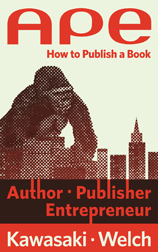
Learning about HARO was just one of the things I learned from recently reading APE: Author, Publisher, Entrepreneur-How to Publish a Book by Guy Kawasaki and Shawn Welch. While I have no desire to publish my own books, I still found the book informative and helpful, especially as I’ve grown from an author-wannabe to someone with five years of publication experience. The first section of the book was a good reminder that writers come in all shapes and sizes, with a range of motives, and that’s okay. It made me consider again the tenacious nature of writers who want to publish and gave me a new understanding of why people choose self-publishing. (It also made me realize that if I did decide to do a short ebook as a promotional opportunity for my other books, I could probably pull it off using APE as my guide.)

What I especially appreciated, though, was the book’s insistence that there is no escaping from the truth of today’s book business landscape: authors need to take responsibility for their books’ success, no matter how they are published.  APE gives valuable insight into the entire publishing process, which I’m convinced every author needs. Publishing is a business, and the sooner authors accept that, the more successful they will be! As an early publishing mentor of mine insisted, if you’re going to succeed, you better know how the business works. Kawasaki and Welch have done a fine job in giving readers the essentials of publishing.

Seeing as I’ve spent the last year trying to educate myself about platform and marketing, I found the last part of the book packed with practical suggestions and resources, like HARO, that I can play with as I continue to polish my marketing skills. The authors even include their own list of what they did to publish/market APE itself, providing readers with a basic outline for promoting any book, and offering links to learn more.

What are you APE-ing these days?

(Special thanks to Lucille Zimmerman, my agency-mate, who gave me the book to read!)

3 Top Tips to Gain Facebook Fans on Your Author Page

3 Top Tips to Gain Facebook Fans on your Author Page

As a modern day writer, I aspire to hone my craft and make the words sing on the page  as much as the greats did, people like Hemingway, Dickens, and the Brontë Sisters.

Okay, that’s a bit of a haughty statement.

Let me just say I work hard at writing better.

But in 2013, writers have the added stress of social media. We write, yes. But we also build, and gather, and hunt. We structure writing platforms. We gather tribes of readers. We hunt for excellent literary agents, and publishing houses that will not only get our work in print, but shine a light on it for the world to see.

It can be exhausting, this business of modern day writing. So I am throwing out three of my best tips about Facebook. My author fan page has proved to be a great tool to interact with potential readers.

Here are three of my top tips to gain Facebook fans on your author page.

1) Make sure your personal page connects to your fan page on the header to allow for cross promotion. Especially now that Facebook wants fan pages to utilize paid promotion, it is vital that your personal page easily and prominently connects friends with your fan page.

facebookgillianarrow

If you aren’t sure how to do this, here’s a step by step tutorial from Amy Lynn Andrews from Blogging With Amy.   

Likewise, on your fan page, ensure that your author website appears in the “about” section at the top.

75020_10200138856291333_2022590139_n (1)

2) Provide pictures with text through sites like PicMonkey. When I promote a blog post on my fan page with an uploaded photo, I get more likes and shares. Make sure your website is noted in the corner of the picture. Here are a couple examples:

maya angelou

evie loves her life

struggle right grammar

Check out this post if you’d like a simple tutorial to walk you through PicMonkey. You can use the site for free, or pay a small monthly fee for more options.

3) Know Facebook protocol. For example, it is against the rules to advertise on your cover photo (like a website address). So if you have a header with your website, change it, before Facebook shuts down your page. Also, it is considered bad manners on Facebook to post a blog or an article more than once on your page, whereas on Twitter, you can post three to five times a day. Want to find out more? Read this post from Author Media.

Do you have Facebook tips you’d like to share with us? How do you think Earnest Hemingway would do with social media? Yeah, me too. Happy Facebooking!

The Platform Builder

This single word has the power to kill or kindle a writer’s career. Platform. The term cripples a lot of would-be authors, so their messages and stories never go any further than their minds.

Anita Brooks -- Building a Platform
The Platform Builder — Creates Opportunity One Step at a Time

But a lack of platform mustn’t stop you from writing. If you don’t have a platform, or any idea of where to begin, help is available. All you have to do is ask.

The secret to a strong platform doesn’t lie in desperately trying to nail interviews, endorsements, speaking gigs, or social media fame. A solid marketing foundation requires a balance of pieces, fitted together in time, with patience and supervision.

Teaming up with a savvy Supervisor, someone who oversees the methodology behind building momentum for your message, can set you apart. Someone who works with the design, who schedules the work crew, and takes the worry out of the process. A Leader you can confidently partner with.

I found my Master Platform Builder in the Bible.

His watchful eye keeps creations moving in the right direction.

Without Him, I can wear myself out, hoping to grow my writing endeavors into something bigger than I am. Psalm 127:1-2 says it best:

Unless the Lord builds the house,
the builders labor in vain.
Unless the Lord watches over the city,
the guards stand watch in vain.
In vain you rise early
and stay up late,
toiling for food to eat—
for he grants sleep to those he loves.

In Control -- Anita Brooks
Relinquishing Control to The Platform Builder

Recently, I realized I hadn’t fully submitted my own messages to the guidance of The Platform Builder. And I’m striving to do something about it. Here are a few ways I’m following His direction, as I bend my will, so he can create a unique marketing stage for my work:

  • Start each day asking the Lord to build where I can’t, and to show me where I should invest my energy.
  • Keep good notes as ideas come throughout the day. Create a goal list spurred from this basis.
  • Take courage and stand true to my beliefs, in written word, and in spoken interactions with those I meet along the way. 
  • Implement at least one action item each day geared toward helping The Builder make my goals become reality.
  • Don’t be afraid to reach out. If God is for me, no one can be against. Rejection simply means there’s more to do.
  • Praise God in advance, before results of hard work are evident.
  • Maintain my platform with regular upkeep. Consult my Supervisor to ensure there are no loose boards, bent nails, or weak trusses.
  • Resolve to remain humble and helpful to others when good things do happen. After all, this calling isn’t all about me, it’s all about Him. 

Anita Brooks -- Pages in BooksGod owns every nuance necessary to create otherwise unimaginable opportunities. Amazing things happen when we submit our will to the expertise of The Platform Builder. He is the author of holy introductions, miraculous occurrences, and creative inspirations. He owns everything a writer needs to succeed at screen sharing.

What incredible pieces has The Platform Builder provided for your writing?

The 15-Minute Writer (Part 3): Building Your Platform

Platform building has become all-important in the publishing world. And how do you build a platform? One plank at a time.

That’s why I tell writers with day jobs and moms with kids NOT to wait until they have more time to pursue their dreams. You can write, build your platform and get published–one small step at a time.

When I started taking my writing seriously, I had a baby and a husband in full-time ministry–and no family nearby to provide free babysitting. So I wrote during my son’s nap times. After Jordan outgrew his naps, I enrolled him in our church’s “Mother’s Day Out” program two days a week, and used those times to write.

When my second son was born, I repeated the process–though things did get a bit trickier! I’ve also written during lunch hours, backstage in a dressing room while waiting to perform at a theater, during birthday parties (not my own kids’, though!), on Saturdays/Sundays, and late at night.

*But NEVER in the early mornings. Some things are just insane.*

One plank a time, I’ve pursued this crazy/wonderful calling God placed on my life, building a career and a platform. It’s a roller-coaster, of course–lots of rejection for every acceptance–but I wouldn’t trade it for anything.

[I’m also aware that my husband is entirely supportive, and for those authors who don’t have an encouraging spouse, my heart goes out to you. You’ll have to be even more creative and deliberate about finding time to write. But please, don’t give up!]

My own story makes me passionate about helping other writers (especially moms) hone their craft.

Say you have a precious fifteen or thirty minutes a day to write. Divide those segments into writing, market research, and promotion/marketing. Then use your allotted time three days out of the week to write; two days to do market research; and one day to market (giving yourself one day off).

Here are a few sample ways to build your platform, fifteen or thirty minutes at a time:

  • Post a new picture or status update on your Facebook author page and “like” a few other people’s posts while you’re signed in as the author.
  • Tweet from your Twitter account and RT/respond to a few tweets from friends.
  • Update LinkedIn (I do this automatically by linking my Twitter feed to my LinkedIn profile, so when I tweet, my LI account gets updated, too).
  • Write a rough draft of a blog post.
  • Pin a link and photo from a former blog post on Pinterest. (Careful! Pinterest is addicting–might I suggest a timer?!)
  • Read a blog post (or two) and comment on it.
  • Read a portion of a book on marketing and promotion. Highlight your favorite ideas, and bookmark the page to come back to.
  • Read about a conference you’re interested in, and mark the dates on your calendar.
  • Sign up for a conference, online course, or in-person class.
  • Write a rough draft of a query to an agent or editor.
  • Edit a query you’ve previously drafted.
  • Compose a cover letter for a query or manuscript.
  • Email friends about your newest published piece and ask them to share it with friends, if they’re so inclined.
  • Email an author friend to ask advice or feedback.
  • Offer feedback and advice to someone “greener” than you.

Now it’s YOUR turn. What are your strategies and ideas for platform building, one board at at time?

(Read part one and part two of the series.)

Hello, Fellow Publishers!

I’m a publisher.

I thought I was just an author doing some social marketing, but thanks to what I’m learning from Beth Hayden’s book Pinfluence: The Complete Guide to Marketing Your Business with Pinterest, my whole perspective on my writing career is changing. Yes, I write mystery and suspense novels, but in support of that endeavor, I need to be creating and presenting content online that is meaningful and valuable for my customers. I need to give my social media friends and visitors what they are looking for, or as Hayden explains on page 61 of her book, “You need to make sure that every piece of content you publish either solves a problem for your audiences, or entertains them – preferably both.”

That’s a big responsibility. Every piece of content. We’re talking about images, information, links, comments – anything you publish anywhere on the internet that has to do with your writing. It’s all part of your ‘company.’ The really exciting part of using Pinterest as part of your company is that it allows you to get creative with visual content, which, psychologists tell us, can evoke emotional responses in a viewer. The bottom line is that by publishing the right images, you can build enthusiasm and loyalty in your viewers, which will help sell your product (books).

Culling through whatever is already on Pinterest boards, however, is not the way to find the ‘right’ images for your viewers, Hayden points out, just as consistently using someone else’s words doesn’t make your work original. Instead, put together your own content. That doesn’t mean you have to take a hundred photos or hire a graphic artist. It means you have to collect compelling images that represent your unique brand. (Be very careful of image copyrights.)

Do you write historical romance? Pin beautiful images of the places where you set your stories, or sketches of period clothing, or the flowers of the region – anything that helps your reader connect to your book. Think of it as publishing a behind-the-scenes guide to your story.

Do you write motivational memoirs? You could pin pictures of famous people who have overcome hardship, or framed inspirational quotes, or maps that trace incredible journeys. Think of it as pulling together an illustrated companion piece to your book.

The possibilities are limited only by your time and imagination, but if you keep focused on your ‘company,’ it will help eliminate some of the time-draining wandering we all do when we get online; if you’re collecting images of old barnyards for an Amish board, it will be a lot easier to not get distracted by all those cute animal pictures that pop up in the blogosphere. (If all else fails, put a sticky note on your computer screen that reminds you “No puppies!”) Make your publishing goals as specific as possible, pin appealing and evocative images on your boards, and Pinterest can become a great billboard for your books on the global internet highway.

Enjoy your publishing!

What are some examples of images that you have been pinning lately? Do you have any creative ideas for pins besides those I mentioned above?

Marketing with Integrity: 5 Tips On What Not To Do

http://www.stockfreeimages.com/

Most writers prefer to focus on craft instead of marketing. But let’s face it. These days, authors need a platform to jump from in the publishing world. Without flexing the mammoth muscle of the internet, our publishing goals may not materialize.

Humph.

I’m new in the business. I’ve written a memoir about having a baby with Down syndrome while living as a missionary in Ukraine. I’ve landed an agent. I now participate in the shaky step of pitching my project to editors.

And I’ve already committed marketing blunders.

Here are 5 tips on WHAT NOT TO DO in marketing.  

1. Don’t use your kids to get ‘likes.’ 

After my amazing agent Sarah Joy Freese encouraged me to attract more likes on my Facebook Fan page, I went a little nuts. I hosted a giveaway on my blog in exchange for Facebook likes and Twitter followers. I then convinced my four children to write and perform a “likes rap” video. They were cute. It was fun. It killed an afternoon at our house.

Giveaways and videos are great marketing tools. But I went overboard. I posted the video, and re-posted, and re-posted until my kids were even tired of watching themselves perform. My idea morphed into a “look at me” festival until a friend sent me a gentle message saying, “Really, Gillian? This isn’t you.”

2. Don’t spam.

Spam is no longer just canned pork.

According to About.com, “Spam is any unsolicited commercial advertisement distributed online.” If you post links repeatedly on social media without engaging in community and conversation, you may be considered a spammer and people are going to find you annoying.

3. Don’t just ask. Give.

It is better to give than to receive. Let’s face it. People don’t care about us. Readers want a takeaway. They want perspective, a lighter mood, encouragement, escape.

In marketing, it is essential to give. Share links. Retweet. Interview people on your blog. Ask questions on your Facebook page. My writing tribe is best formed through reciprocal interaction and authentic interest.

4. Don’t market without a plan.

My marketing blunders have stemmed from too much excitement and lack of preparation. At first, I had no marketing plan. It’s difficult to have integrity at high-speed. Now, I try to step back and see the big picture. What marketing strategies will best utilize my schedule, gifts, and goals? I am no longer allowed to dream up an idea and run with it before a time of reflection, planning, and prayer.

5. Don’t forget to write.

Marketing pursuits easily swallow work hours. When my time is not structured, I blog, tweet, update statuses, and read about marketing. But I might not write.

Thus enters the need for limits. Some writers allow a half hour in the morning and again at night. Others (insert ME!) require a little extra help. Turning off the internet is a great tip. Author Media, a website dedicated to help writers build their platforms, has a post providing seven apps that assist a writer’s occasional lack of self-control.

What’s your marketing strategy? Do you have a blunder you’d like to share? Where are your boundaries when it comes to marketing integrity?

And would you like to use my children in a rap video? If so, contact me. (God’s still working on me.)

The Best Resource to Build Your Author Platform

Are you so sick of the word platform you want to throw all wooden boxes into a huge bonfire?

Everywhere authors turn we hear about the importance of author platform. Many pre-published authors have no idea how to go about building a successful author platform. You just know that you need one.

Even seasoned authors know we need to keep adding planks to our platform, making it larger every day.

I was one of 100 people recently chosen to participate in the launch of Michael Hyatt’s new book, Platform: Get Noticed in A Noisy World.

This in itself was pure genius. Every one wants the invitation to the private party, we want the behind the scenes all access pass. To read the call out, here’s the link to Michael’s invite. Did you notice it’s not just about what you can do for him, but what it will do for you?

That is the number one lesson from this book. Everything you put in front of your readers, from blog posts to social media updates, must provide value to them!

Michael really knows how to take this to the next level. Here’s the link to his Platform book page. He breaks down the benefits his book provides to the reader. Many books, or book pages, fail to spell out what the purchaser will get from reading them.

This book doesn’t just tell you a few key points or things to do, it teaches you. Michael provides numerous links to extra info and also gives tons of examples. I’m a visual learner, so this is key for me.

God has been reminding me that it’s not about me. And the same is true in all aspects of our lives, as both authors and human beings. I ultimately write for God’s glory, and adding glory for Him is what’s all about. Remember to always add value, in everything we do.

What are ways you can add value to your book? How can you add value to the readers of your blog? How has an author added extra value for you?

Here’s an added value if you haven’t already read 7 Tips for Self-Editing Your Novel with Promotional USB Drives Before we can create a platform, our content must be amazing.

With Us Here Tonight

Shortly after my first book was published, I gave a book talk at our local library.

Then I gave another talk at another library. And then a third library.

Then a Rotary Club called me. A few months later, I found myself the featured speaker at a Shriners dinner. Last month I presented a talk at the National Eagle Center. Birding festivals, book conferences, annual meetings, schools, service organizations–I’ve addressed them all.

Wait a minute. I thought I was a writer, not a speaker.

Guess what? Book authors get to do both!

The fact is, you NEED to do both if you’re going to successfully build your readership and market your writing. That means you should work on your public speaking skills, and the best way to do that is to take every opportunity you find for a speaking engagement. Develop the following five types of speeches, and you’ll be ready for anyone!

The Sound Bite is the one you will use a bazillion times. It’s the one-liner you’ll utter every time someone asks you what your book is about. It’s also one of the hardest to compose because you need to distill your book and its value down to one sentence. My sound bite for my series is “The Birder Murders is a humorous series about a really nice guy who happens to find bodies when he’s out birding.”

The Book Talk is the speech that focuses on your book’s content. If it’s nonfiction, you can give a general review of the topic itself, or focus on just one chapter’s point and why it’s important. If it’s fiction, you discuss characters, their relationships, the plot, how you came up with all of it, what you want to accomplish with it. This works best with audiences who have already read your book because they will have questions about what they’ve learned and/or enjoyed from reading it.

The Business Talk is about your experience with the publishing business of being an author. The changes we’ve seen in publishing, including the growth of e-books and marketing paradigms, is a topic that appeals to audiences composed of business people or future authors.

The Writing Talk is about your own process of writing a book. Do you do research? Conduct interviews? Journal or set word goals? The beauty of a Writing Talk is that it is appropriate for a variety of groups, and depending on the slant you give it for the group you’re addressing, it works equally well as a classroom talk, a keynote address for a gathering of library supporters, an awards speech, a writers conference, a book club… you name it.

The Topic Talk is the newest talk in my own arsenal of speeches. Because my books are about nature, I’ve started giving talks about nature education and conservation issues. If it is mentioned in my books, it’s fair game for a talk and a great way to use extra research.

Here is a great resource to help you to continue to develop your public speaking skills.

What talks could you present for your book? Do you have any ideas for talks that I have not mentioned?

Building Your Author Platform Before The Contract

I remember attending a writer’s conference where the agent I was pitching stated debut authors needed a platform, even for fiction, in their proposal. She said if a query piqued her interest, she’d google the author’s name to see what came up. If there was hardly anything, she’d think long and hard before asking to see more of their book. And, she said editors do the same thing.

Yikes. I didn’t have anything up. I thought that all came after the book deal.

First thing do to is establish yourself as a professional writer. I recommend starting a Facebook page as a writer, not a profile, but a page. Announce to people that you are a writer and believe it!

Do the same with your Twitter account. Don’t have one, here’s my post on How to Effectively Use Twitter for Authors.

You need a website. Don’t panic. There are plenty of free sites that can provide you with a website. I use wordpress.com You don’t have to start a blog yet, though I would recommend it later. You can simply have an about page and a contact page. You can check out my about page here for ideas. Visit your favorite author sites to see what you like and don’t like.

Now, you’ve got these pages up, but what do you do with them. Here’s where it get’s a little bit harder. You need to figure out who your target audience is. You’ll need this for your book proposal, so now is a good time to start on it.

Who will be interested in your books? If you’re writing inspirational fiction, then you’ve already got a faith element. Christians are interested in your books. If you’re writing historical, then what time period? What groups of people or hobbies would go along with this?

This is just scratching the surface. Go deep with this. I recommend making a list of possible interests. Now, you can write some guest posts to blogs targeting this area. Tweet and share Facebook links with articles written by other people on these subjects.

Ask questions on Facebook and Twitter. If you’re coming up with a name for a new character, list two and have people vote.

You are well on your way to establishing a platform.

What ideas or tips do you have to make your platform even more effective? How often do spend social networking? Should you be engaging even more?