Ten Steps to Writing While Raising Young Children

I put this in a ten-step program format because I’m a momma on the edge and I need some intervention. I don’t know, maybe it’s because I’m at the tail end of summer vacation, the kids having been home now–asking for stuff and what-not–for way too long. Or, maybe it’s because I’m getting closer to a deadline and I’m not as far as I’d like to be in the process. Who knows? I surely don’t. So, rather than losing my cool with my kids because they keep interrupting me, or putting myself in a self-imposed time out (let me tell you, ONE of us is going to take a nap today and I’m rooting for myself), I decided to sit down and be realistic about how to accomplish writing goals.

Step One: Get use to disappointment. I don’t really need to belabor this point, do I? No? Okay. Moving on.

Step Two: Learn to survive on twenty-percent less sleep. Look, even if you can skip this part, I’d like you to try it now and then because it’ll make me feel better when I accidentally fall asleep on the couch right after Dora utters her first, “Hola!”

Step Three: If you have to give your children chicken nuggets or hot dogs repeatedly for dinner, make sure you let them know you’re doing it because you’re cool and you want to make them happy, not because you forgot to go to the grocery store. Again.

Step Four: Learn to cut out superfluous and/or extra obligations. We’re kissing Steps Five, Six, and Seven good-bye. Boom. Done. That was easy.

Step Eight: Cry. This works especially well in my household, where I’m the only female on the premises. Rather than ask again, for the gazillionth time, to let me write for an hour, sometimes it simply suffices to squirt some tears. People run. Heck, they flee. Oh, and then there’s that whole crying is cleansing business. Whatever works, right?

Step Nine: Let me be very, very clear on this step. Pinterest is NOT your friend. It doesn’t love you. It won’t make the beds, do the laundry, or even write one word toward your goal. Pinterest is the devil, if the devil is over-achieving, craft-obsessed, baking frenzied, tool-belt wearing Supermoms. (OK, fine, I’m just jealous because I suck at all things crafty. Last week, the glue gun ended up in my hair. Details aren’t important. Let’s just say, the crying was real on that occasion.)

Step Ten: Make a habit of visiting homes of other moms, especially other moms who write. Boo-yah! You haven’t cleaned your windows since 2007, either! Is that jelly on your ceiling? I feel better already.

I Once Was Blind

Dr in Lab Coat

“Your eyesight may not return.”

In a haze of blurred white, all I could make out was a fuzzy outline of the optometrist’s lab coat as he held the door knob.”I’ll be back shortly; I need to confer with my colleague.”

The door closed, and I was alone. I didn’t mean to whine, but when you’re a writer facing permanent blindness, a few whiny words slip out.

Saline tears raced over my cheeks, and met at the center of my chin. They waterfalled into my lap. I raised my face toward the ceiling. “Why is this happening? How can I write without my eyesight?”

Sterile silence answered my questions.

When the doctor returned, he placed a piece of paper in my hand. “Get this prescription filled. Put one drop in each eye every two hours, even throughout the night, and come back to see my colleague tomorrow.”

“But tomorrow’s Sunday. You aren’t open.”

“He’s coming in for you.” His gentle hand assisted me out of the chair and led me toward the door by the elbow. It would be a very long, miserable night.

By the next morning, thousands of invisible pins pricked my body. My head ached, and walking outside turned sunbeams into fiery branding irons that seared my corneas. My husband drove me to the eye doctor.

When I shuffled into the office, the physician’s voice did not reassure me. “Let me take a look.” He clucked as he prodded, not bothering to hide his concern. “I’ve never seen anything like this. I don’t even know where to refer you. This is serious.”

Fresh tears careened rivers off my face. I could hear him rifling through papers.

“According to these reports, your eyes are worse than yesterday. I want you on complete bed rest when you get home. Come see me Tuesday. I’ll try to figure out what to do by then.”

I went home, crawled in bed, and cried out to God. A voice whispered in my mind, “What verse do you claim?”

“Though You slay me, yet will I trust You.”

“Then trust Me.”

“But how can I write if I can’t see.”

“Trust Me.”

In that moment, I decided to obey, and my whole perspective changed. I knew that if God wanted me to write or do anything else, He’d make a way. Others had authored in spite of blindness. Helen Keller, Jennifer Rothschild, and Jim Stovall came to mind.

Several days later, I met with Dr. Malhotra, a cornea specialist, who quickly identified the problem. He diagnosed me with Cogan’s Dystrophy, or Map-Dot-Fingerprint Dystrophy.

It took almost five weeks for the torn skins over my corneas to heal. My sight slowly returned. It was September, 2009.

Supplements for Map-Dot-Fingerprint Dystrophy
Supplements for Clearer Vision

Flash forward, three years. Though my vision challenges me from time to time, I’m able to see, and I write nearly every day. To maintain my sight, I take fish oil and vitamin supplements, use lubricant drops daily, and put salt ointment in my eyes at night to keep the skins taut and smooth. I’ll do this the rest of my life, and hope for few corneal flares.

Meds for Map-Dot-Fingerprint Dystrophy
Lubricant & Salt Ointment

Cogan’s Dystrophy makes it appear as if a fingerprint has been left on each eye, hence the more common name. I choose to believe God branded me with His own fingerprints to fulfill His special purpose in my life.

I once was blind, but now I see. And whether I’m to do it with my eyes or not, I will answer His call to write.

What obstacles have you overcome to fulfill your call to write?

God's Fingerprint
God’s Fingerprint


SEO Is Not Enough To Grow Your Blog Subscriber List!

Only five years ago, you might have heard, “Radio doesn’t sell books. TV sells books.” Now, you’re more likely to hear, “TV is okay, but social media sells books.” If you get bloggers talking, tweeting, sharing, and posting about your books, you’re likely to experience enhanced success at marketing your book.

But, alas, marketing your blog is different from marketing your regular website. Specifically, plain old search engine optimization (a.k.a., SEO) isn’t enough to make you a widely read blogger.

The blogging system has added variables beyond SEO, like the warm, fuzzy, social element (hence the “social” in “social media.”) Search engines are “cold” and comb through blogs, looking for key words, tags, page relevance, back-links from other reputable sites, etc., but real people are “warm” and click on “forward” and “share” buttons if they feel that your message resonates with them on a personal, emotional level. Catch my drift? You have to be an expert at both the cold and warm elements in order to succeed at blogging.

By the way, in case you’re wondering what a “back-link” is, I’m going to be self-serving and include one here. It’s a link back to my own website, www.TheEdenDiet.com. Voila! I just raised my own website’s search engine ranking by linking it to the highly respected Wordserve Watercooler blog.

In the same way, let me return a favor to a fellow Wordserve author. A while back, Jordyn Redwood interviewed me on her blog, Redwood’s Medical Edge, and she included a back-link to my Eden Diet website. Now, I just returned the favor with a back-link from the Watercooler. Her blog’s search engine rankings just went up a bit. Do you see how it works? The “social” in  “social media” augments your search engine optimization.

Unfortunately, even if your blog content resonates with people on a warm, human level, only a small percentage of your subscribers will click “share” and “forward.” Probably, most will be passive and neither comment on nor share your posts. Thus, to expand your subscriber list, you must find ways to engage and mobilize that small minority of blog followers who could actually help you spread your message.

One way to recruit supportive blog followers is to cross-promote with other reputable bloggers who have large subscriber lists. Imagine the ripple effect of increased numbers of subscribers when other big-time bloggers link back to your blog (not to mention that the back-links will raise your blog’s standings with the search engines).

Because it isn’t easy to get big-time bloggers to notice let alone promote and share your content, let me tell you some strategies that have worked for me: (1) Ask to feature/interview other bloggers for your own blog. Try to pick those with large followings. Many will offer to feature/interview you on their blog, in return.  (2) Offer free books to those who interview you and suggest that they give them away to their own followers. When you first help others, some return the favor!

In summary, your ideal blog marketing strategy should be (1) get noticed (through regular SEO, using key words and tags, getting back-links, etc.); (2) hold your readers’ attention with a warm message that fills their needs; (3) encourage readers to actually participate and share your message; and (4) get noticed by and develop relationships with well-known bloggers who have big followings. Help your fellow bloggers spread their message by featuring them on your site, and maybe someday they will offer to help you spread your message.

Creating Characters that Count

Think back to the last good – really good – story you read. The one you couldn’t put down, the one that made you cry in the middle of the fifth chapter, the one you finished late at night because you couldn’t go to sleep until you found out how it ended. And then when you finished it, you closed the cover of the book and ran your hand over it with a sigh.

There’s a good possibility the biggest thing that drew you into that book and kept you there was a memorable character.

Oh yes, story is important, but unless your readers have someone to care about, even the best story will be flat.

Here are some ideas to make your readers care:

  1. Give them a likeable hero or heroine.  Make sure she’s someone you want to spend time with, and your reader will, too. Give her a sense of humor, deep feelings for her family and friends, and someone who likes her. Make her smile once in a while, even if she’s going through adversity. Make her strong enough to stand what you’re going to put her through in the next 250 pages.
  2. Give your hero/heroine a past. Everyone has a past that affects them. He’s trying to live down mistakes – or hope no one finds out about them. He’s lost loved ones, had a crush on the girl next door, still misses his favorite dog, or burned a bridge he wishes he hadn’t. People are affected by their past. Your hero’s past determines his actions today.
  3. Give your hero/heroine a future. Give her dreams. Dreams motivate us and make us do things – interesting things. Every decision your heroine makes today is weighed with the future in mind.
  4. Make your hero/heroine three dimensional. There’s nothing interesting about cardboard. You say he’s tall, dark and handsome? Don’t let him be caught in a stereotype. Make that tall, dark and handsome guy scared of heights, but he still rescues the heroine’s kitten from a tree. Make him brave in the face of gunfire, but a wuss when it comes to spiders. Know what makes him happy, what makes him angry, what delights him, what scares him. Make him real.
  5. Give your hero/heroine someone to love. When we identify with a character’s emotions, we’re drawn into her story. We want her to marry the guy, or reconcile with her sister, or forgive her mother. We want to feel her longings and heartaches on the way to her happy ending.

Characters are what make the story – make them count!

What are some of your favorite characters, and what makes them memorable?

Loaves, Fish, and Writers

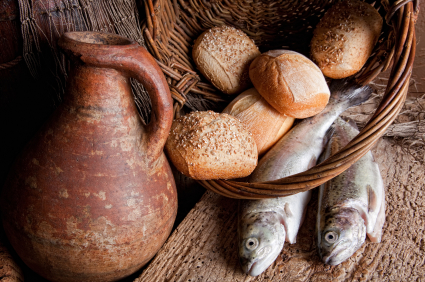
Late in the afternoon the twelve came to him and said, “Send the crowd away so they can go to the surrounding villages and countryside and find food and lodging, because we are in a remote place here.” 

He replied,  “You give them something to eat.” 

They answered, “We have only five loaves of bread and two fish—unless we go and buy food for all this crowd.”  (About five thousand men were there.)

But he said to his disciples, “Have them sit down in groups of about fifty each.”  The disciples did so, and everybody sat down. Taking the five loaves and the two fish and looking up to heaven, he gave thanks and broke them. Then he gave them to the disciples to set before the people. They all ate and were satisfied, and the disciples picked up twelve basketfuls of broken pieces that were left over.  Luke 9:12 – 17

Give it up

Poking at God about what I could cook for you today, he flipped this sizzling little fish story onto my brain plate.

Eyes scrunched on “impossibility” rather than on the Master of limitless capability, it’s easy for us writers to be disciple-like and condescend to natural-mindedness.

The crowds aren’t growing less hungry, aren’t inching any closer to food. Cloistered in the middle of nowhere, fatigued and famished, the beloved twelve scratch their heads before Jesus speaks: “Give the people something to eat.”

As we shake our heads at our scanty drizzle of words, Christ tells us the same: “Give the people something to eat. Don’t worry about sparse resources or small beginnings. If I’m in it, as sure as the heavens, you can make a difference.”

“Give them something to eat.” 

Thrust in this love-test, the apostle John records a different angle in sharing Philip’s retort: “Eight months’ wages would not buy enough bread for each one to have a bite.” Andrew speaks up. “Here’s a boy with five small barley loaves and two small fish, but how far will they go among so many?”

No matter how measly, how un-supersized our flounderings, if God calls us to serve fresh truth in a word-stir, if he speaks the royal “ok,” we step up.

Notice how Jesus dishes up faith-stretching instructions to the disciples. Directing five thousand people to sit in groups of fifty is no small potatoes. It takes time and sweat. Just like advancing in writing.

And so we lift our minuscule loaves and fish, and give thanks.

Give Thanks

Wouldn’t you give your lunch to see the puzzled looks on those hungry faces when Jesus raises his bitty snacks to give thanks?

Thanksgiving flows from a posture of humility. The soul bends low, acknowledging our Sovereign Source, his power, ability, and desire to provide.

Jesus gives thanks and his fingers rip the bread. I wonder if he considers how his flesh will soon be broken to feed many.

Writers know about brokenness, the heart-deep pain-sap that drives and feeds our meanderings. With battle scars, we give thanks to the living Word who uses our words and wounds to paint blood-colored pictures of grace.

No matter how few or many we touch, we give thanks for the opportunity. Chosen conduits of hope, we’re blessed to be a blessing. Our words, charged with Spirit-power, awaken God-hunger. They sustain and multiply life!

Whenever we naturally live out thankfulness, we display God’s bigness to a hungry, watching world. We become more than wishful thinkers about remote possibilities.  We reveal supernatural expectancy. This is how the world sees truth in us as we step up to our dream.

Expect Much

“It will take a miracle to get published!” We say it like miracles are viruses when they’re more likely God’s favorite pastimes.

Food in hand, Jesus says thanks because he expects the miracle. He prays and “looks to heaven.” He isn’t focused on his stomach, the food, or the crowd, but on his Father, the source.

The more we fix our eyes on God, the more we see miracles. The more we see miracles, the more we look for them in him.

“Your will be done on earth as it is in heaven. Give us this day our daily bread…” God’s prayer transcends the “me,” and rests on “us,” because we, in the body, are one, and because love necessitates caring for those outside ourselves.

If we want to use our love gift to nourish souls, we can expect God’s provision to match his call. I haven’t forgotten that we can also expect spiritual warfare (perhaps even intensified tests from a rattled enemy), but ultimately mercy triumphs over Satan’s thievery. God promises to give us everything we need to win!

This gift, this impervious spawning of words, isn’t an instant dinner miracle; rather, it’s a progressive one, a long-term partnership with Chef Jesus.

Part of the miracle involves staying with the process. If God says, “Get everything and everybody in place,” that’s what we do. We plunge in for the long run, expecting to produce sweet fruits like patience and perseverance. Likewise, we expect readers, writers, characters, and observers to be transformed by our faithfulness.

We’re Christ-followers, sojourners on the cusp of miracles. In the course of our collective, out-of-this-world writer-journeys, we can expect nothing less than God cooking up his best.

Bon appetit!

“For I know the plans I have for you,” declares the Lord, “plans to prosper you and not to harm you, plans to give you a hope and a future.” Jeremiah 29:11. 

Top Ten Things You Should Read on Your Birthday

Yesterday I turned 29… again. So I decided to write a blog post about one of my favorite things: reading! On your birthday, you should definitely take a little time for yourself, if you can afford it. I try to take some extra time for reading on a personal level, since it is something that I enjoy, and it is an affordable indulgence.

Here are the top ten things you should read on your birthday:

All of your “Happy Birthday!” posts on Facebook Since most of my family and friends live in Michigan, and several of my friends are in Vermont and Wisconsin, I revel in birthday greetings from all across the US of A. How fun to read and respond to people you don’t often see.

Your birthday cards I always save my birthday cards, especially those from family. Since my Grandma Mason passed away in October of this past year, I plan to read some of the previous messages she blessed me with. Her words were always so wise, and I could definitely feel the love that she had for me, even in just a pen and pretty paper.

Your favorite blogs Because I am busy reading emails and queries and manuscripts for work, I generally don’t take time to read a lot of blogs during the work week. So, on my birthday, I like to catch up on blogs. A few blogs I will be spending time with include Jamie the Very Worst Missionary, John Green Books, Literati Cat, and A Miniature Clay Pot. The last blog is by my friend, Marie, who wrote a blog with over 5,000 responses after the Aurora theater shooting. She and her daughters were in theater 9, and she has been such a blessing to those involved in the shooting, as well as others. Of course, she was a blessing to others long before the shooting; she helped me through some difficult times, and she made my wedding invitations for free!

Queries, partials, and full manuscripts in my inbox as well as manuscripts that I am currently editing Yes, I work on my birthday, mostly because my husband also works, but also because my mom visited for the week, and she left yesterday morning. Instead of sitting around being sad and missing her, I plan to focus on projects that I need to complete.

Bible/devotional While I am not a daily bible or devotional reader, I do like to check in on special days. It is always so wonderful to see what God, who knit me together in my mother’s womb, has to say about me on my birthday. He planned the day I came into the world as well as every other day after that. I love to receive a special birthday blessing from Him.

Text messages Who doesn’t like to receive “Happy Birthday!” text messages?

The menu at your favorite restaurant. While I am normally an Olive Garden girl, this year, my husband, mom, and I plan to go to White Fence Farm, a home-style restaurant that specializes in fried chicken and high cholesterol. For those of you in the Denver area, be sure to visit the restaurant which includes a petting zoo, fun shops, and different music nights including square dancing and line dancing.

The menu at your favorite coffee shop A friend recently introduced me to the awesomeness that is Espressole Caffe. It is a bit farther than I normally travel for coffee, but I can’t think of a better way to spend my birthday than working on an editing project while sipping a five spice latte. Yum!

Your driver’s license Make sure it hasn’t expired!

And my favorite: a good novel! Currently, I am reading Pulitzer prize winning novel, Tinkers, and I finished it on my birthday. It always refreshes me to read beautiful writing with amazing story, and what a great way to start the weekend than with a great story still ruminating in my mind.

What sorts of birthday reading do you do? Do you have any other fun birthday traditions?

I Read All My Reviews! Want to Know Why?

Many authors will tell you that they never read their reviews. Usually they’ll give one of two reasons. Some say they don’t want to get puffed up by their good reviews. If they read the positive things people are saying, they might start believing their own press clippings and develop an over-inflated ego.

Image Credit: 10-19-11 © mediaphotos / istockphoto.com

Others say that they don’t want to read the negative reviews because the experience is too painful and discouraging. They end up dwelling on the bad things people say about their book and then get depressed. So they just don’t read any reviews at all.

Whether to read reviews is a personal choice, so I don’t criticize those who choose not to. They have valid reasons, and I respect that.

As for me, I read all my reviews.

Every single one.

Sometimes it is a potentially painful experience. Recently, an Amazon reviewer referred to my book, Terror by Night, as “a piece of trash.”

That could certainly ruin an author’s day.

The funny thing is, it didn’t bother me at all. I chuckled and said, “Wow! Why don’t you tell me what you really think about it?”

A few years ago, I wouldn’t have reacted that way. I’d have been sullen and depressed. I’d have walked around my house with a hang-dog look on my face. And I’d have driven my wife crazy with my pouting until I finally got a good review to cancel out the bad one.

So why was I able to smile when someone described as trash a book I’d labored, sweated, and prayed over?

Because I read all my reviews.

Every single one.

And as I read, I learn.

I’ve discovered that there are essentially three kinds of reviewers.

There are the gushy ones, the ones who think your book is the best thing since “To Kill a Mockingbird” and describe you as the next great American novelist. One dear lady (and I am not making this up), compared me to Ernest Hemingway, Sidney Sheldon, Lawrence Sanders, and Stephen King—in the same review.

Scout’s honor, she is not my mother (or any other kind of relative) and I did not pay her for her kind words. And although I thought her review was just a tad over the top, I still enjoyed reading it.

Give yourself permission to enjoy the gushy reviews. You worked hard for every gush.

Just don’t start believing them.

Next, there are the “acidic” reviewers. These are the ones who, for whatever reason, absolutely hated your book and they’re not afraid to tell the world what a lousy writer you are. Sometimes these sting. There’s something about the anonymity of the Internet that causes some people’s inner nastiness to come out and they write venomous things that they would never say to you in person.

I read the acidic reviews because they keep my ego in check. They remind me that not everyone is going to like my stuff and that, contrary to what I might want to think, I’m not God’s gift to the publishing industry.

By reading the nasty reviews, I cultivate a thick skin–something every writer needs.

Don’t take the acidic reviews personally. Instead remember what you tell yourself when you receive a rejection letter from an editor: “It’s just one person’s opinion.”

Finally, there are the “thoughtful” reviewers. These are the people who offer well-reasoned critique and are often the writers of your 2, 3, and 4 star reviews. The reviewer describes the book’s strengths and weaknesses, offers insights, makes recommendations, and doesn’t gush syrup or spew acid.

Sometime the opinions expressed are positive; other times, negative. Some are mediocre or to put it in current lingo, “meh!”

All are valuable and worth reading. I learn a lot from the thoughtful reviewers and quite often find myself carefully considering their critiques. These reviews have high take-away value for me as a writer.

But if I never read my reviews for fear of the gushy or acidic ones, I would never see the thoughtful ones.

That’s why I read all my reviews.

Every. Single. One.

And with each review, I take another step toward maturity as a writer.

Do You Need to Schmooze an Editor or Agent?

I’ve attended over 7 writers conferences since walking the road of an author. One thing I’ve come to observe at these conferences is they way we interact with one another.

Editors and agents are seen as the gate keepers to our dreams. They are the ones who will accept our book and validate our work.

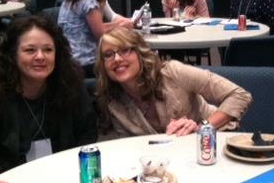
Janalyn Voigt and I at Northwest Christian Wrtiers Renewal

This is sort of true and sort of not. Editors and agents will let you know if your work is ready. They’ll let you know what you need to work on. They do not hold your dreams. You do.

Having our work published will not validate us. Only Jesus can do this. Don’t fall into the trap of thinking your worth is measured by a contract and sales figures.

I’ve seen some writers completely crushed when an editor/agent declined on their pitch. I’ve been one of them. Jesus gently reminded me that He is my agent. And He’s yours if you’re willing to give your writing over to Him.

I don’t mean He will do everything. We still have to hone our craft, build our platform, and continue learning.

At conferences, I’ve seen editors and agents hunted down by well-meaning enthusiastic authors. They couldn’t get an appointment with the agent/editor they wanted, so they stalk them at meal times, breaks, in line at the bathroom….

I’ve had some wonderful chats with editors/agents at meals and in the hallways. But I’ve also seen a weary trapped look in their gaze.

We should never become so focused on what other people can do for us and our careers that we forget they are people and children of God first and foremost.

Take the time to ask them how they’re enjoying the conference. Chat them up like you would meeting someone at a neighborhood barbecue. Take the time to get to know them a little. They’ll eventually turn the conversation towards writing. After all, they’re there to discover great writers.

Even if they turn your project down, they’ll remember a friendly person. Later, circumstances may be different and your project will be the one. You can never go wrong investing in people and relationships.

You should spend some time schmoozing at conferences. Just make sure you’re doing it for the right reasons. If we look at every person and situation with the attitude of how we can help them, instead of how they can help us, we’ll get much further.

Have you ever made new friends at a conference? How have you helped someone else and had it benefit you unexpectedly?

Author FAQs

It doesn’t matter where I am. A party. The vet. Getting my teeth cleaned. Whenever people find out for the first time I’m an author, one of three questions pops out their mouth…

How are your sales? How much money do you make?

Really? Are plumbers asked this? Does anyone ever ask the Walmart greeter what he or she nets for pay? I’m guessing not, so why?

Why do people feel comfortable asking writers how much money they make? 

Because, doggone it, everyone has a book in them, and they’re curious how much money they can make. It’s really not about the author, to shame them or to pry. This question simply flies past the curious lips of people who have a secret hope they can pound out their story and become a millionaire.

Compassion is needed to answer this one. Sure, the Rowlings and Kings of the world do make big bucks, but most authors don’t. It’s a dream-crushing bit of information, so remember that sometimes truth stings. Be gentle.

How many chapters is your book?

This one always stumps me. Not because I’m on mind-altering drugs and don’t know how many chapters I’ve written in any given book, but mostly because chapters are subjective. Haven’t readers figured that out by now?

Apparently not. Apparently garden-variety readers award badges of honor to books with lots of chapters.

So I put on my teacher’s hat and explain in one-syllable words that publishers don’t require mandatory chapters; they look at total word count. At that point, I whip out my sunglasses because a brilliant light bulb flashes on.

I wrote a book, too. Can you help me get it published?

This is a tricky one. I love to help others. Who doesn’t? But the brutal truth is, I am a lowly writer, not an acquisitions editor.

Much care is needed in the answering of this question. The danger is you’ll get cornered for at least an hour listening to the synopsis of an entire epic saga. I’ve found the best way to handle this situation is to offer sources other than yourself. I frequently recommend joining ACFW (American Christian Fiction Writers) for networking purposes. I also advise author-wannabees where they can attend local writer meetings or possible critique groups they can check out.

Those are the top three questions I get asked. How about you? What’s your FAQ?

Marketing with Integrity: 5 Tips On What Not To Do

http://www.stockfreeimages.com/

Most writers prefer to focus on craft instead of marketing. But let’s face it. These days, authors need a platform to jump from in the publishing world. Without flexing the mammoth muscle of the internet, our publishing goals may not materialize.

Humph.

I’m new in the business. I’ve written a memoir about having a baby with Down syndrome while living as a missionary in Ukraine. I’ve landed an agent. I now participate in the shaky step of pitching my project to editors.

And I’ve already committed marketing blunders.

Here are 5 tips on WHAT NOT TO DO in marketing.  

1. Don’t use your kids to get ‘likes.’ 

After my amazing agent Sarah Joy Freese encouraged me to attract more likes on my Facebook Fan page, I went a little nuts. I hosted a giveaway on my blog in exchange for Facebook likes and Twitter followers. I then convinced my four children to write and perform a “likes rap” video. They were cute. It was fun. It killed an afternoon at our house.

Giveaways and videos are great marketing tools. But I went overboard. I posted the video, and re-posted, and re-posted until my kids were even tired of watching themselves perform. My idea morphed into a “look at me” festival until a friend sent me a gentle message saying, “Really, Gillian? This isn’t you.”

2. Don’t spam.

Spam is no longer just canned pork.

According to About.com, “Spam is any unsolicited commercial advertisement distributed online.” If you post links repeatedly on social media without engaging in community and conversation, you may be considered a spammer and people are going to find you annoying.

3. Don’t just ask. Give.

It is better to give than to receive. Let’s face it. People don’t care about us. Readers want a takeaway. They want perspective, a lighter mood, encouragement, escape.

In marketing, it is essential to give. Share links. Retweet. Interview people on your blog. Ask questions on your Facebook page. My writing tribe is best formed through reciprocal interaction and authentic interest.

4. Don’t market without a plan.

My marketing blunders have stemmed from too much excitement and lack of preparation. At first, I had no marketing plan. It’s difficult to have integrity at high-speed. Now, I try to step back and see the big picture. What marketing strategies will best utilize my schedule, gifts, and goals? I am no longer allowed to dream up an idea and run with it before a time of reflection, planning, and prayer.

5. Don’t forget to write.

Marketing pursuits easily swallow work hours. When my time is not structured, I blog, tweet, update statuses, and read about marketing. But I might not write.

Thus enters the need for limits. Some writers allow a half hour in the morning and again at night. Others (insert ME!) require a little extra help. Turning off the internet is a great tip. Author Media, a website dedicated to help writers build their platforms, has a post providing seven apps that assist a writer’s occasional lack of self-control.

What’s your marketing strategy? Do you have a blunder you’d like to share? Where are your boundaries when it comes to marketing integrity?

And would you like to use my children in a rap video? If so, contact me. (God’s still working on me.)