Publishing Day

The day my book releases is an odd day for me. Inside, I am screaming, “My book is out! Everybody, my book is out! Are you going to untitledread it, or what?!” I walk into the bookstore and pretend to only casually check that it’s on the front table. If it’s not, I pretend not to be bothered. I decrease my expectations. I walk towards the women’s section and just hope to see it on the shelf. If it’s not, I pretend to understand, but inside, I don’t understand at all.

Because it’s my heart on the page.

I went through this with my first book, Girl Perfect, and I just went through it again with Beautiful Lies. In the days of the release, something in me wants people to stop and take notice, and that part of me wrestles with the part that knows the act of creating is worth it, whether anyone notices or not.

I hope the late nights, the honest tears, and the sweet victories of finding just the right words to speak my soul’s hunger will result in profundity for the reader. I want my efforts to matter. In fact, I’m tempted to tell you how I crawled through the thickest mud of my adult life to bear this book. But Annie Dillard, in The Writing Life, scolded me about this, warning me never to tell anyone how much a book cost me personally – for it is impolite to do so.

So with the release of a book, three tragic flaws in the self must die. First, the part of us that hungers for recognition has to die to the Spirit in us that is compelled to speak honestly and truthfully into a world that needs our voices.  Second, the humanity in us that wants millions to hear the book’s message must die to the Spirit in us that rejoices if one life is purely changed by our words.

Finally, we have to let go of “perfect” and embrace gratitude instead. The perfectionistic questions that circle on publishing day – “Is it enough?” “Did I say everything I wanted to?” “Will the reader understand my heart’s lineage?”  and “Is this as beautiful an offering as I dreamed?” – all of these questions must yield to gratitude.

untitledSo here is mine: Thank you, God, that I had the opportunity to bleed truth on these pages. Thank you for the healing it brought to me. Thank you that you love me so much as to give my heart’s desire wings, and I commit these books to you, trusting your winds will carry their words wherever they need to flutter. Beautiful Lies is my offering. My alabaster jar. And when I poured its oil, it was all for you.

What about you? What do you have to embrace and let go of on publishing day? What are the needs for recognition or perfection that you battle? What does your gratitude sound like?

The Trick to Becoming an Author

Pavillion_d'Armide_by_A._Benois_05The other day, a colleague asked me if I thought the burgeoning popularity of memoir-style books of the sort I had published had to do with the fact that the people who read them wanted to write such books themselves.

Reflecting on what he asked, it occurs to me now that—the underlying argument being that my writing’s appeal had nothing to do with my writing itself but only the envy of my readers and that the underlying argument of my readers’ envy being that anyone could write as well as I could—I should have gotten offended. But I didn’t. (Thanks, surely, to the Holy Spirit, who tries to protect me, usually in vain, from bouts of narcissism that make me think I’m a great writer and cause me to take offense at any reminder that I’m not.)

I didn’t get offended, too, because I knew, as anyone who’s ever published a book of any sort does, that what he said was true. We know it from the people who show up in our doorways wanting publishing advice. We know it from acquaintances who know about our good luck as writers and come up to us in the grocery store, or sitting at the vet’s office, or walking to our cars after church, and want to tell us their latest book idea. We know it from the mail we get when our books come out. Fast on the heels of a fan email, if not within the fan email itself, comes a question about how to get the fan’s own work published.

Everyone these days has not just a story in them, as they used to say, but a published book—even though it’s rarely written or even begun. All it takes to write a book, the would-be writer hopes or believes, is an idea and the need to tell it. What happens between that and getting something published is a trick they plan to learn from established writers.

But there is no trick. Just the arduous and time-consuming work of writing and rewriting and sending stuff out and waiting and trying to believe there’s a chance that someone who makes a difference in the world of publishing likes it and finding out there mostly isn’t (or, if you really are lucky, that there might be a chance with some major changes to what you’ve written) and then writing and rewriting again. That’s the part no one wants to hear or even know about. That to be a writer is to write. Period.

They’re like Simon the Magician, that guy in the book of Acts who—though Luke makes clear that he’s a genuine believer—tries to buy from the apostles the trick of touching people and thereby filling them with the Holy Spirit.

“Just teach me the trick of getting published!” EveryWriter begs. Often, as Simon does, they even offer to pay for the trick.

But there is no trick.

Sermons on Simon’s story often go on about how wrong-headed Simon was, thinking to buy the Holy Spirit, and sometimes they posit that Simon wasn’t really a believer at all, even if Luke says he was. But such sermons miss the point, I think—whether it’s the gift of writing we’re talking about or of imparting the Holy Spirit. Being a servant of the word, or the Word, is not a magic trick. You have to get out there and do it.

Hard Work--George Herriman 1907-11-24That said, I remember having had the same response to other writers’ writing—not just to their memoirs but to their novels and even textbooks. I’ve thought to myself, if they can do it, why then so can I. And so began this article and that book. So began my current writing project, a novel–my first. So began, indeed, my entire career as a writer.

If others can do it, so can you, but don’t sit around hoping to discover some trick to make it happen effortlessly. If you want to write, if you want to inspire others, if you want to fill them with good news, with the very spirit of God, you’ll just have to get out there and do it.

How My Agent Found Me

agent found me

My agent found me.

It’s true.

I didn’t believe it at first either.

And I am oh, so grateful. Her council, editorial skills, business savvy, and contacts make a huge difference in my budding career.

And I know… it doesn’t seem fair.

How exactly did she find me?

Through two chapters released to The Festival of Faith and Writing in Grand Rapids, Michigan in 2012. As a participant of the conference, I submitted part of my memoir for agents to review.

Sarah Joy Freese found my chapters, and contacted me for the full manuscript.

But why did she find me?

Because people I met along my writing journey told me to work hard.

And I need to be able to say this although it feels a little strange, like a pat on the back or something, but I realize now that I did work hard. I worked hard and long for her to find me.

If you want an agent to find you, here are four things you can do.

1) Write well.

Make sure your writing continues to improve. Read a lot. Write even more. Attend a class. Submit your work for critique. Spend time in the chair, churning out pages. If your writing isn’t at its best, even if an agent finds you, he probably will pass.

2) Build your platform.

Gone are the days of a writer hiding away in an upstairs attic penning the next great American novel. In the publishing world today, writers have to do more than write beautifully. They need to build a following. Want to learn more about this idea? Read Seth Godin’s book Tribes.

Warning: when you begin to work on a platform, you will feel ridiculous. When I started a Facebook author page, I joked with my friends about ‘fans’ liking the newest dirty diaper I changed at home. As a stay-at-home-mom with four children to wrangle, I didn’t think I was qualified to have a fan page, but I did have a goal: to publish a book. So I began.

Other platform ideas: blogging, speaking, writing e-books, the list can get really long and daunting. The important thing is to start, and to remember platform building as an important element to your future in publishing. It needs to grow with your writing skills. You need to be a package deal.

3) Have polished, edited chapters of your current work in progress ready.

Spend time on a couple of your favorite chapters in your work in progress. Make them strong. Hire or ask someone you trust to edit them. Rewrite them. Rewrite them again. Make sure that even if you don’t know every nuance of the book that you have a general idea of the story arc, so that your chapters fit when you pitch the idea to the agent.

My husband and I cobbled together funds so I could pay two freelance editors to work through drafts of my recently published memoir Sun Shine Down. After writing a third draft of the same book, I started to feel like I had something I could show someone with my head held high. Yes, it takes work, and time, but your best work is worth it, and it is your best chance to have an agent ask to see more.

4) Attend writers conferences.

Before attending conferences, I queried countless agents to no avail. I hardly got back a standard rejection email.

I can’t stress enough how helpful conferences were/are to my career. In 2012, I attended Mount Hermon Christian Writers Conference, and the Festival of Faith and Writing, where I met my agent. Both were amazing experiences. I shook hands with people, passed out and retrieved business cards, and submitted my work for review and critique. While buoyed in my fervor for the written word, I soaked in lessons about the craft and business of writing.

I think every writer should attend as many conferences as they can.

Be encouraged.

If you want an agent to find you: do good work, put yourself out there, be ready at a moment’s notice to submit, and go where the writers, agents, and editors go.

If this stay-at-home-mom, queen of diapers and ruler over tantrums can do it, so can you. I’m rooting for you!

Now get to work. Your agent may be looking for you right now.

*Do you have an agent? How did that relationship come to be? Do tell.

agent2

The Hidden Benefits of Reading

I have a confession to make. Sometimes I read in order to avoid writing. There. I said it. I read at stoplights often enough that my children have to point and say, “Green. Green! GREEN!” in increasingly frantic tones, just before the rude non-reader honks come from the cars behind us.

I read while I wait for my children and while I brush my teeth. Just last week, I read on my daily walk. While passing my oldest daughter’s home, I understand that she pointed out the window in disbelief. “Nick!” she called to her husband, “Is that lady really reading while she’s walking?! Oh. It’s my mom. Why am I even surprised?” Once, I even read 43 pages while in the dentist’s chair.

As it turns out, my reading habit might be one of the best things I can do for my writing.

Read to Inspire

We all know there’s nothing like losing yourself in a book whose pages are so magical, they fairly turn themselves. We look up and are surprised to find it’s not raining – after all, it was pouring in the story.

Start noticing which phrases delight you. Stop a moment and think about why they do. Chances are, it’s because this book unpacked a suitcase of fresh word choices, analogies, and dialogues. The clichés have left the building and we’re thrilled!

Read to Motivate

When I read about Stephen King being able to paper his bathroom with rejection slips, I am motivated. When I recall that both Stephen King and John Grisham had wives who believed in them (the infamous Carrie was fished out of a trash can by King’s wife; Grisham and his wife self-published his first novel when he couldn’t find a publisher. They sold it out of the trunk of their car; today, they are laughing their way to the bank), I count myself blessed to have a spouse who is my biggest fan.

Knowing that 80-something publishers rejected The Wizard of Oz and that Nicholas Sparks was a drug rep, putting out juice and donuts for yet another hospital sales pitch when he got the call regarding his mega-deal for The Notebook, I am reminded that there’s something to be said for both perseverance and the chance for a modern day fairytale. Hey – it’s a book! Anything can happen.

Read to Learn

I’ve been 40 for 7 years now and I still don’t know all there is to know about anything, much less everything.  So, when I embarked upon writing my first novel (after seven non-fiction books), I began to read even more fiction. I gulped down dialogue kings and drama queens. I devoured women’s fiction, swallowed romantic suspense, snatched up crime novels marinated in mystery, snacked on current secular best sellers and wolfed down articles, chapters, blogs, and books on the art of writing itself.

I’m currently serving myself a buffet of historical fiction; my master’s degree is in American history. As a full-time high school teacher and the mother of four blessings who also love to read, I’d love to write historical novels someday. As a writer, I take note of what works and what doesn’t. As a history lover, I treasure authors whose research renders their prose not just lovely, but accurate. As a police chief, my husband does the same for authors who justly portray the world of law enforcement.

Read for Fun

Make sure reading doesn’t become just another chore. Don’t be a book snob – read because you love that author, that genre, that time period, that gift for dialogue. Curl up on the porch swing, in the hammock, by the fireplace, or at the stop light, and savor.

And remember, since books foster dreams, there’s nothing wrong with dreaming someday it will be YOUR book someone is reading just for fun!

What’s Your Point of View?

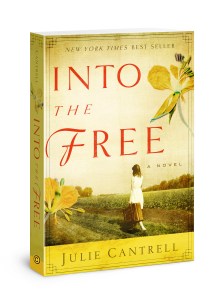
jpcoverphotoWhen I wrote my debut novel, Into the Free, I never gave much thought to point-of-view; but as the words began to hit the page, they naturally fell into first-person narration.

First-person narration tells the story from the point-of-view of one character in a novel (usually the protagonist), and makes use of the words “I” and “me.” Critics point out that this style limits the perspective because it doesn’t allow readers to access other characters in the story. While this is a viable opinion, I argue that first-person allows the reader to gain even greater perspective by viewing the universe from the lens of that one character on a much more intimate level than anything an omniscient third-person narrator can provide. (We’ll leave second-person for another day.)

Yes, the view of other characters will be skewed by that one character’s interpretation of their actions, appearance, etc., but readers are granted full-access into the brain of that one narrating voice, even more so when that narrator is a trust-worthy character who isn’t deceiving us as we read. Essentially, we, as readers, are allowed to become that character. This enables us to enter that character’s world, interacting with the other characters, experiencing the events, and engaging at every sensory level throughout the story.

When an author delivers a story in first-person, we close the book feeling as if we have lived to tell the tale. This intrusive point-of-view makes the entire reading experience personal for us, moving it from the level of observation to participation. And because, by nature, the first-person perspective limits every scene to those in which the narrator is actively present (or his/her memory of such), we aren’t forced to pull back and watch something happening across space or time. We have no choice but to dive right into every single event of the story. We feel it, taste it, smell it, and react to it cognitively, emotionally, and instinctually.

As a reader, I have always enjoyed reading first-person narrations. Some of my favorite books were written using this point-of-view, and as a result, the narrators have become some of my favorite characters. Consider Scout in Harper Lee’s To Kill a Mockingbird, Holden Caulfield in J.D. Salinger’s Catcher in the Rye, or Nick Carraway in The Great Gatsby, who tells us the tragic love story between Gatsby, Daisy, and Tom from his perspective.

Your turn: What point-of-view do you prefer to read? What do you prefer to write? Share some of your favorite examples, and introduce us to those characters who continue to stay with you long after you’ve closed the book.

Writing prompt: If you’re stuck in a scene, try writing it from another character’s point-of-view. What can you learn from seeing the event from a different perspective?

Inspired

As a teacher of writing and a writer myself, I’ve long been in the habit of examining others’ writing for what it has to say about the creative process. Nonfiction, my primary genre, lends itself most naturally to such scrutiny, since the solipsistic Scarecrow--Daniel Schwenwriters who tend to write in this genre love to write about what they’re up to. The writing of memoirists and essayists thus provides valuable glimpses into the process. In nonfiction workshop, Hemingway’s A Moveable Feast is my go-to handbook.

As I blogged last month, I’ve been listening to the Bible on my iPhone while I run. Since I run in five to ten mile chunks, I’ve heard whole books at a time and am making my way quickly, if haphazardly, through the text, following not the order of the Bible’s original organizers but spurious impulse (or, as I like to think, the Holy Spirit). Listening to scripture aloud, I’ve become newly appreciative of the almost constant reverberations between biblical accounts. The echoes of one story in another, of one biblical author’s phrasing in the voices of others, of the words of Hosea and Isaiah in the mouths of John and Paul and Jesus. The Bible is a masterpiece of intertextuality, a tapestry of voices in sentences that mesh and thicken from one chapter to the next.

I don’t know whether it’s because of the biblical writers I’ve happened to choose thus far or because of my new way of “reading” the Bible—that is, hearing the words aloud rather than reading them from a page—or just my old habit of paying special attention when writers mention writing, but I’ve noticed that the biblical writers talk a lot about writing. As such, the Bible offers considerable insight for me and fellow writers about our line of work.

Forgive my foray down a path we Christians like to avoid in considering the Bible—namely, the exact nature of divine inspiration that led to its composition in the first place—but one biblical writer after the next, from Moses to Isaiah to Jeremiah to John, describes the initial inspirational moment pretty much exactly as I’ve experienced it myself. An urgent voice—sometimes identified as God’s, sometimes an angel’s, sometimes unspecified—commands, “Write this down!” For these ancient writers, writing was not a choice—not a career goal or the desire to influence or educate others or even a matter of passion—so much as a dutiful response to that voice. An idea rises like a vision in the mind and the voice says, simply, “Write.”

“A writer,” I tell those who say they want to be writers, “is someone who writes.”

The most common writerly methods in scripture, which several biblical writers go out of their way to explicate, are the same ones I recommend to my students: in the words of Luke, “after investigating everything carefully from the start, to write an orderly account” so that readers “may know the truth” (Luke 1:3-4 NRSV). Careful investigation and organization are what convince.

Regardless of genre—whether they are writing poetry, chronicles, stories, or philosophical treatises—the biblical writers take pains, as Paul assures the recipients of one of his letters, to “write you nothing other than what you can read and also understand” (2 Corinthians 1:13). Nothing show-offy, though the words of scripture are often as artistic as they are true. No erudition for erudition’s sake.

And though their accounts and rhetorical goals are diverse, the biblical writers share, it seems to me, one essential writerly skill: they tell what they actually see and hear and smell and taste and feel. Unlike my students, who would rather explain their thoughts, the biblical writers are, to a person, concrete. Here’s Jeremiah (whose repetitive ranting could be boring, were it not so vivid) showing, not merely telling, how ridiculous it is to worship idols:

Their idols are like scarecrows in a cucumber field,
and they cannot speak;
they have to be carried,
for they cannot walk.
Do not be afraid of them,
for they cannot do evil,
nor is it in them to do good.

(Jeremiah 10.5 NRSV)

Wow. Like scarecrows in a cucumber field. I wish I had written that!

OLYMPUS DIGITAL CAMERAMy students typically define creative writing as writing that doesn’t have to follow any rules. Grammar rules, especially, are irrelevant. When I talk about sentence-level problems in their writing, they roll their eyes. In poetry workshop, many abandon the sentence altogether, writing instead in fragments. Creativity, in their view, constitutes the opposite of order.

The biblical writers, by contrast, seem to model their creativity on that of God himself. The creation, as described in Genesis, is a work of separation and sorting, of repeating and omitting, of drafting and considering before declaring anything “good.” Again and again, the biblical writers are selective in what they opt to tell. They keep only the best episodes of a given narrative—key conflicts, the rising action—and leaving the rest mysteriously, sometimes frustratingly, elliptical, in this way to engaging the reader’s own imagination and mental processing. There’s never a pat moral to the story. As hard as we Bible-readers try, we can never read the Bible as a straightforward primer or even a narrative account of holy living, cleansed of all confusing or upsetting or unholy details. Rather, it portrays real life—convincing in its familiarity—and real characters, the holiest of whom, as we ourselves, struggle and fail and fail again.

For writing instruction, I’m learning, the Bible is unsurpassable. Even better than Hemingway.

What I learned from Leo Kottke

GuitaristLast month, my husband and I enjoyed an evening concert at Big Top Chautauqua outside Bayfield, Wisconsin. Leo Kottke was the featured performer, and while I wasn’t particularly familiar with him and his music, he has long been a favorite of my husband’s. The concert took place under a big tent on a beautiful September night, very near the shore of Lake Superior, and Kottke did not disappoint, either as a guitarist or an entertainer. I came away a fan…and with a new perspective on what I do when I give a book talk.

I realized that the key word is entertain.

While the need to entertain my audience remains uppermost in my mind when I write, I haven’t always kept that focus during speaking engagements. Sometimes, I get too bogged down in the details of crafting a narrative when I talk with writers’ groups, or my presentation begins to sound stale when I answer the same questions over and over from audiences of readers. If I’m getting bored with repeating the same “this is my book, why I write, how I write,” then I expect my listeners are getting bored with the same old book talk they hear from every writer.

Enjoying Kottke’s performing style convinced me I needed to think of myself as a featured entertainer when I speak, not as the featured author. Yes, the man could play amazing guitar pieces, but it was his in-between chatter that tied it all together into a neat package of entertainment. Too much chatter and it would not have whetted my appetite for his music; too much music and I wouldn’t have formed a connection to the man. Instead, he balanced the two pieces and sold me on his entertainment value – which is exactly what I need to do to find new fans of my books.

After our evening at Big Top Chautauqua, I revamped the way I approach and present a book talk.

Instead of focusing on what goes into the book when I speak to groups, I now read short selections from several of the books – selections that are particularly meaningful or funny for me – and explain where in my own life those passages came from (and I always tell it with humor!). The result has been increased active engagement with my listeners, and they become more intrigued with the books, which results in more sales after the presentation concludes. I’m getting more comments about how enjoyable/entertaining the talk was, which not only makes it fun for everyone, but also leads to a greater number of speaking referrals for me! After all, if you’ve enjoyed an event, you’re likely to come back for more – whether it’s another book by the same author, or a CD recording of a musician – because you want to tap in again to that source that gave you an entertaining experience.

Authors need to think of themselves as entertainers – both in print and in person – and then present themselves that way, too.

How do you craft your talks for entertainment?

Takeaways fom the Writer’s Digest Convention West 2013

I just attended my first writers convention, which turned out to be among the most interesting and informative experiences of my life. Never before have I received so many insights into the craft of writing. The Writer’s Digest Conference West in Los Angeles took place at the end of September. During that time, I was able to meet people I never would have otherwise, such as journalists who have been working in the writing field for ages. There was so much great information it was hard to capture it all, but here are a few points that that definitely resonated:

1) Writing, editing and marketing are totally different competencies, so bucket them, don’t batch them. In a discussion led by Ivory Madison, CEO of redroom.com writers community, writers were advised to keep those activities separate, as they engage different parts of the brain. I’ve been trying out the Red Room Method and can see a positive difference in my writing. It staves off the frustration of trying to do everything at once, and only producing one paragraph an hour. She suggested not to combine the three buckets of writing, editing and marketing. In this way, you end up not only being nice to yourself, but also more efficient as well. Writing is about your relationship with yourself. Marketing is an expression of everybody else. Take one book, make it as great as you can, and then worry about marketing. Don’t wear multiple hats at the same time.

WDCW132) Read your work aloud. You will find a great deal of errors that you might not have otherwise by reading aloud. When you do write, be authentic. Your readers want to be able to get to know you and trust you. Find great people to make your book as good as it can be. Don’t jump the gun just because you want to get it out there. Make your book easy to find and as accessible as possible.

3) Growing scope of the literary agents. Gordon Warnock, Founding Partner of Foreward Literary, has a vision of literary agents taking on a similar role as the agents of actors and songwriters. The future literary agents, he thinks, will manage the author’s entire career. The job scope would become more like an umbrella for their representation overall. This would include creative directing over the author’s website, branding, image, et al.

And above all else – write an outstanding book.

Seek Hope While Waiting

4864922_s“Knowing trees, I understand the meaning of patience.

Knowing grass, I can appreciate persistence.”

(Harold Glen Borland – a nature journalist who wrote poetry, fiction for adults and children, and other nonfiction. 1900-1978)

As a writer, I need patience and persistence. But I am more than tree and grass. I’m a creative emotional being with spirit, mind, and soul, who struggles with waiting. Right now I’m in squirm mode—between book contracts. I’m lowly bait, a worm on a hook writhing with concern over my writing career. Pathetic, fickle creature.

I recently read patience is the level of endurance one can take before falling into negativity.

Thoughts such as:

-I won’t get another contract because I’m a lousy writer.

-Writing is too much effort for the reward. I’m dangling on the end of a hook, remember. And it’s not the first time either.

The psalmist understood fickle creatures and negative thoughts. And of all things, he preaches back at them with a pep talk regarding God’s love.

“Why are you cast down, O my soul, and why so disturbed within me? Put your hope in God.” Psalms 42

In squirm mode, I’m itching for action.

Anything to hope again.

Even preaching to myself.

Preaching to myself . . . I guess I could clean my desk so I can read my inspirational plaque: Live creatively.

I could tape my theme scripture on my bathroom mirror. “Explore who you are and the work you’ve been given. Sink yourself into it. Don’t be impressed with yourself or compare yourself to others. Be your creative best for you.” Gal 6:1-5

The psalmist reminded himself of wonderful experiences of past worship. I could search my prayer journal and see what God’s accomplished in my life. Perhaps it’s time to browse my writing scrapbook, or make one.

I suddenly see it. My writing lull is a comma, not a period. It’s a gift of time from a loving God. I can use it to rethink priorities, set writing and marketing goals, hone new skills. Persistence urges me into action and hope marches up my spine. I shiver with delight. Yes, there is hope in the waiting.

Even so, a negative thought returns. Working without a deadline? Impossible.

21497233_s

No!

 I preach to myself. Soul, you’re strong in Christ.

Waiting is extra time. A gift from God. Praise Him. 

I don’t want to squander my time wallowing in negativity when I have a gazillion better choices. I will catch up on life. Ideas pop into my mind of ways to bless my family and friends. Or I could use my time to practice self-discipline. I’m not pathetic or fickle. I’m normal. I’m also chosen, forgiven and loved. I find another blessing. Waiting makes me thirsty for living water.

Psalm 42:1 “As the deer pants for the water brooks,

so my soul pants for Thee, O God.”

Beyond the tree and grass and worm is a larger stream. I can wait in confidence that He’ll nudge me along in His time.

What uplifting sayings or verses do you cherish?

What blessings do you experience in wait mode?

Why You Should Stop Marketing Your Book

Years ago, I heard a professional speaker tell about a dream she had: She had always wanted to go to Australia. She mentioned the dream in one of her speaking engagements and a couple approached her afterwards.

We’re from Australia. You can go stay in our home, free, for three months while we are traveling.

Immediately the speaker backpedaled. She had thoughts like, “I can’t do that. I can’t afford to miss work. My career would dry up. People would forget about me.”

Night Sydney Opera House with Harbour BridgeBut it was too great an opportunity to pass up. She flew to Australia, enjoyed herself tremendously, and when she returned her business boomed.

Why?

Everyone wanted to know what her trip had been like. Even better, she came back refreshed and motivated to pour herself into her business.

All authors should take time off from marketing their books. Here’s why:

Sometimes Less Is More  – Some of my favorite bloggers are those I rarely hear from. I don’t get tired of their voices because I don’t hear them every day. All of a sudden I’ll see a link to one of their blogs and I’ll think, “Oh, there you are. I’ve missed you.” Once in a while I get sick of my own selfcare mantra and I’m sure others do as well.

We Need New perspectives And Experiences – The brain loves novelty. It lights up at new experiences. That’s why you can visit an ordinary town and everything about it is fun and interesting. As I write this I’m finishing up a long week of clients, social media, and wedding details (my daughter gets married in September). I’m taking next week off to go to Breckenridge with my husband who has a work conference, and after that I’m flying to Nashville for a relaxing weekend with other creative people. Yes, I’ll miss time with clients, and yes, there is a financial cost, but I know the benefit will be greater.

Even God Took Time Off – Author Wayne Muller says, “In the book of Exodus we read, ‘In six days God made heaven and earth, and on the seventh day God rested, and was refreshed.’ Here, the word ‘refreshed,’ vaiynafesh, literally means, and God exhaled. The creation of the world was like the life-quickening inhale; the Sabbath is the exhale…without the Sabbath exhale, the life-giving inhale is impossible.” Inhale plus exhale equals life. If God needed refreshment, don’t you think we do, too?

When was the last time you blocked off your calendar for pure enjoyment and no book marketing?