Lessons I Learned From My Editor

From conception to finish, I spent a couple of years on my first novel, Shaken. I had a mentor who coached me, a professor who professionally edited the manuscript, and an internationally acclaimed novelist who provided a critique. But nothing affected my story quite as much as signing with my publisher and beginning work with my editor.

Writing is difficult. You are bleeding your emotional artery on the page, complete with life experiences, beliefs, and creativity. But editing? That became another playing field entirely. In my military-romance-driven brain, it could be described as surgery to remove shrapnel. Each piece of metal must be plucked for an individual to get back to full health. In a similar way, editing requires painful digging to remove everything that does not add value to the character. After the shrapnel of your story is removed, you are freed to enhance and improve your story until it’s as close to perfection as you can get it this side of heaven.
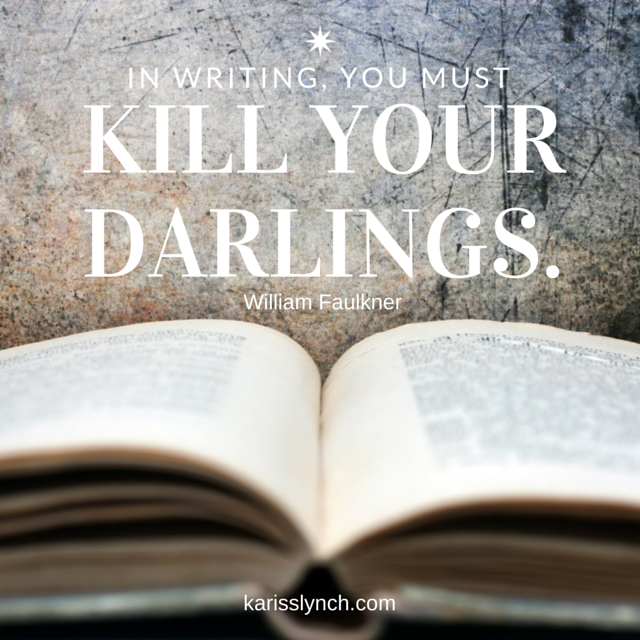
KarissLynch Kill Your Darlings

Working with an editor is refining, a true process of iron sharpening iron (just don’t throw the sword at them if you don’t like what they say), but ultimately, it is a beautiful journey. The longer I work with my editor, the more I am thankful that God gifted her to look at stories differently than I do. She makes me better, and she is constantly teaching me and reminding me of craft tips that just haven’t taken root yet. Over the course of writing The Heart of a Warrior series, here is what my editor has taught me:

  1. Timeline is everything.

By the time my first novel went to my editor, the timeline needed major surgery, something I hadn’t thought about in great detail during crafting. I am a pantser and only use a bullet point outline to guide the major points of my scenes. Everything else just spills out on the page. This can make editing much harder for me. When it came time to edit Shadowed, I had a better timeline in place. Lesson learned? Don’t make the same mistakes on the second novel as you did on the first.

  1. Ground your character. Ground your scene.

Ever heard of floating head syndrome? No? Well, that’s probably because I just made it up. But I have it. Bad. Especially when I am writing in a steady stream of consciousness. Characters speak but you don’t know what they look like or what is going on around them. Thankfully, I am now aware of this ailment and am working to correct it before the manuscript goes to my editor. Each character needs to be firmly grounded in whatever is going on, each person in the scene accounted for, even if only briefly. Your scene also needs to be grounded within the larger story. Your reader should have no question where the character is, what is going on, who the character is with, and what drama is unfolding.

  1. Provide concrete details. Paint the canvas.

I actually love this part of writing, but I also struggle with fear. What if people think that a place or person doesn’t look that way? What if I get a detail wrong? What if, what if, what if? The “what if” game keeps me paralyzed from simply using my imagination and the beautiful tools of my eyes and the Internet to ground a scene exactly as I see it. I use research to make sure I didn’t get a basic detail wrong, but otherwise, I craft exactly what I want the reader to see. They are less likely to question what I paint in great detail than they are a canvas where I leave glaring holes due to my own people-pleasing and insecurity. No fear. Write boldly. Paint that canvas, and give the readers a scene they don’t have to try to imagine. Let it unfold in all of its beautiful detail. And then make that process even better in the next book.

Time for surgery on your manuscript. What weaknesses do you notice that you could improve on next time? What lessons have you learned from your editor (or critique partner)?

Two Words of Advice: Stop it!

newhartWe were going around the room, introducing ourselves at a recent writers workshop I was leading, when one of the attendees got negative about herself.

I listened to this woman — a two-time winner of our Metaphors Be With You contest — explain why she wasn’t making as much progress on a memoir as she would have liked.

Most of it had to do with her inadequacies.

I couldn’t take it anymore.

“Stop putting yourself down,” I said. “You’re a good writer and you need to stop thinking otherwise.”

I proceeded to explain to her and the 15 others why one of the first ways we sabotage ourselves as writers is to look down on ourselves.

“For starters, writers need two things,” I said. “The confidence to believe they have something to say to the world and the humility to let others help them say it better.”

Instead, too many people write — and live — quite the opposite: with little sense that they’re worthy to be heard or with little openness to accepting help along the way.

As we discussed negativity, another workshop participant chimed in with a reference to an old TV sketch in which comedian Bob Newhart plays a psychiatrist. He listens to a woman’s problem — “I have this fear of being buried alive in a box” — and offers her a two-word solution:

“Stop it!”

Stop worrying about being buried alive in a box.

I love it. In fact, when it comes to advice, you could do a lot worse than offering people those two words — “Stop it!” — and two others: “Start it!”

“Start it,” as in take a risk. Begin your project, even if you believe it might fail. Try something new, even if it might feel awkward at the start.

“Stop it,” as in quit thinking you’re unworthy. Quit sabotaging your success because someone long ago told you you weren’t good enough. Quit believing the inner lie that you’re inferior.

Frankly, you can’t get to the “start” without the “stop.” Or so says Christian-based author Henry Cloud, whose book Necessary Endings (HarperCollins, 2010) I recently read.

Cloud, who mainly writes for a business audience, suggests “stop it” is about more than an attitude. It’s about action — or, more precisely, our unwillingness to take it when necessary.

“In your business and perhaps your life, the tomorrow that you desire may never come to pass if you do not end some things you are doing today,” he writes.

But, some might say, stopping things can be hard.

Habits. Addictions. Relationships.

It’s easier just to stay the course. To not confront the norm. To not risk.

Easier. But seldom better.

“Endings,” Cloud argues, “bring hope.”

Frankly, I’d never thought much about that until a friend recommended the book and I gave it a read. I tend to be in a constant “add” mode. But, Cloud argues, sometimes you need to subtract. Prune. Say goodbye to something in your life — and, yes, in some cases, someone.

Can it hurt? Almost always. But, he argues, there’s a difference between “hurt” and “harm.”

Last week my mother moved out of the house she’d lived in for nearly half a century. It was difficult saying goodbye. But the payoff will be a simpler existence that better fits her life today. It hurt, yes, but to stay could have brought harm, she figured; it was too much house for someone who is 87 years old and slowing down.

It took courage to make the change. But, in sailing terms, to stay moored to sameness simply because change can be challenging is to miss the glories of the wind in your sails.

At the end of the day, my workshop student — the one lamenting not being good enough — offered a piece in the voluntary read-aloud session. The class’s enthusiastic laughter and applause affirmed what I’d felt myself: her story was among the best of the bunch.

I hope she’ll look back on this day as a new start — a new start only made possible by her first being willing to stop.

Marketing: To Do and Not To Do

Light a Fire with Your Marketing Plan

“It isn’t there. I looked,” I told my mother so many times I lost count.

I also lost count of how many times she looked in the same place I did and said to me, with frustration in her voice, “Shelley, it’s right here!”

Ugh. I hated when that happened. I felt stupid, embarrassed, and defective.

Why could SHE see it, but I couldn’t?

It took a few years, but finally, by the time I was 10 or 11 years old, I learned to instead say, whenever I couldn’t find whatever she said to look for or retrieve for her, “I don’t see it.” I’m 40 years old now, and I still use those same words in that situation.

What does this have to do with marketing? I’m certainly no expert in this field, but I have learned this: just because folks don’t see our books, products, services, or goods, it doesn’t mean they aren’t there. It also doesn’t mean they don’t have value. It just means that sometimes people need help to see the good stuff right in front of them.

So, how do we do this in an already saturated market where everyone (and sometimes their pets!) are on social media, have a blog, and publish their work? (I kid you not about pets, either.)

I asked around, and want to share with you what other authors shared with me. I am confident these tips will help you (and me!) in the challenging world of marketing our writing in addition to creating the content we’re trying to market.

  • Pay attention to social media: Don’t discount the value of sharing some freebies with folks right where they are. Find out where your audience hangs out most on social media and focus the majority of your social media time and attention there. For example, my readers tend to be on Facebook more than Twitter, so while I am in both places, I don’t kill myself in the Twitterverse when more engagement happens on Facebook (and increasingly on Instagram and Pinterest).

Remember, as you engage in today’s world of technology, these words from Marketing guru Rob Eagar:

“In a fast-paced world where Facebook, Twitter, and the 24/7 news media allow everyone to have a voice, it’s more important than ever to cut through all the noise. Use power-bites to punch through the cacophony, gain people’s attention, and spread your message like wildfire.” – See more good stuff from Rob here!

And this, from marketing expert Lori Twichell:

“The key to good marketing is making a connection with your audience. It’s got to be genuine. People can see through selfish motives. If you are only there to promote your book or product, people can sense that.” The more you get to know your audience and really make that honest contact, the more you’ll end up with a loyal audience that will follow not just this book, but future endeavors as well. That’s a key part of social media that is lacking in so many. We all love making new friends and connections, but no one wants to be spammed!

  • Newsletters: Emailing your subscribers is the best way to get content in front of your readers on a consistent basis. When they subscribe or give you their contact info, they’ve invited you to connect with them. Make sure to add value to your subscribers’ lives, inviting them to open, read, and engage—be aware of what can feel “spammy” to your subscribers. In other words, don’t just send emails to send emails. And make sure you give more than you request.

Here’s another tip from Lori Twichell: “Tuesday, Wednesday, and Thursday are the best days to send newsletters. On Fridays people are eager to go home and clean out their inbox more quickly and on Mondays, they’re buried in the weekend’s email pile up.” (Connect with Lori for more good stuff at http://www.beyondthebuzzmarketing.com)

  • Giveaways: Take advantage of what God has made available to you. What message has He entrusted to you to share with others? Offer some freebies along the way that build your credibility as one to listen and learn from in this over-saturated market.

As writers, we long to have readers find value in what we have to say, right? It can be so difficult to balance the discipline of learning and expressing with the necessity to also market what we write. Ultimately God is our greatest promoter. If we can remember that our social media numbers, our book sales, and our greatest accomplishments do not come close to God’s power to promote us in due season, we’ll remain at peace and loving life on the way to where we’re going.

Have you discovered a marketing to-do or not to-do?

The Perfect-World Writing Room

StressedOutWomanDistractions.

They’re a writer’s worst enemy — they’re this writer’s worst enemy, at any rate. In a perfect word, my writing room would be absolutely quiet with little internet connection.That way, I’m not checking e-mails every five minutes, and Facebook in between.

That’s just not the way it works most of the time, though, is it? I spent a good ten years of my career covering the traveling circus known as NASCAR. Believe me, you’ve never lived until you’ve tried to file on deadline, two hours after a race, in room full of tired and grumpy fellow reporters. Or better yet … during practice, with twenty or thirty high-powered race cars roaring around the track and another twenty more in a nearby garage tuning up their engines.

Headaches? There are headaches, and then there are filing-on-deadline-in-a-NASCAR-media-center headaches. Working in that kind of environment seems as far from the perfect-world writing room as it is possible to be.

Come to think of it, the room would be sound proof. My wife and I have twin sons, Adam and Jesse, who are 13 and in the eighth grade. When they’re out of school in the summer and home all day, it’s almost as if I’m back in some NASCAR media center somewhere and trying to write.

Stop that, Jesse!!!

Stop what?!? YOU stop!

A few minutes of relative peace and tranquility are again interrupted by a blaring video game, enhanced by our sound system. Is there anything more aggravating than trying to write with a Minecraft soundtrack playing full blast in the background?

Actually, there is.

A couple of years ago while working on my book Wheels Stop: The Tragedies and Triumphs of the Space Shuttle Program, I had the opportunity to do a telephone interview with former NASA Administrator Michael Griffin. The man has like seven different academic degrees, was the top guy in the uppermost echelons of the agency, and had been named one of Time magazine’s 100 most important people in the world at one point.

There I was, trying to ask questions that sounded a little more in-depth and intelligent than, “Boy, that Space Shuttle sure is neat, huh?”

I had the speakerphone turned up in order to get a good recording when Jesse chose to walk through the kitchen, just a few feet from the open door of my home office. It could have been his Asperger’s — or just being a teenaged boy — but he announced at the top of his lungs …

I just FARTED!

Dr. Griffin surely heard Jesse, because he paused in mid-sentence, evidently waiting for me to go strangle my son. Mercifully, after just an awkward moment or two, he continued on and never mentioned my son’s digestive issues. The interview turned out to be a productive one, and an important addition to the research for my project.

And I didn’t even have a perfect writing room. Go figure.

Seasons of Writing

I used to really love summer: 4th of July, barbeques, fireworks, my birthday, swimming, and relaxing with family and friends. However, now that I am older (and no longer get summers off–soak it up while you can, kids!), I have really come to appreciate fall. My husband watching football on Saturdays while I read or work, pumpkin spiced lattes, baking, crunching through leaves, Thanksgiving, and the upcoming excitement of Christmas all make me smile.

Just as each year has seasons and each time in our lives has seasons so, too, should our writing have seasons. Your writing seasons may not look the same as someone else’s writing seasons; however, everyone should be purposeful about their seasons.

Ecclesiastes 3:1 “There’s an opportune time to do things, a right time for everything on the earth” (The Message).

When I was in graduate school, a professor told me that summer should be for reading (fiction, nonfiction, and craft books) and writing. The last month of summer should be set aside for editing, but most of your writing should be new. Read, create, write, exercise. Refresh yourself. Lucille Zimmerman’s book Renewed offers some wonderful ideas for how you might employ those breaks that are so necessary for our creative spirits. Consider going on a writing retreat. Summer is the time to allow yourself to be as creative as possible with your writing.

Fall, then, should be about “the offensive.” In other words, submit, submit, submit. What you wrote during the summer is probably not read yet, so consider sending out a previously edited manuscript. You want to make sure that your manuscripts are ready to be seen by an agent or an editor. Don’t forget to track all of your submissions and responses. You can also edit what you wrote during the summer and attend a few writing classes or a conference or two.

During the winter months, you might take a short reading break again and follow up on your submissions. During the winter, especially, you should concentrate on editing. Allow yourself time to work through your manuscript at least two, if not three or four, different times. Consider hiring an outside editor. If you cannot afford a professional editor, you might want to look into hiring a college student who would be happy to read through your manuscript for a few hundred dollars and a letter of recommendation.

In the spring, start something new and begin lining up the books that you are going to read over the summer. You might also use this time to take care of the business side of writing: double check editor/agent contact information, complete your taxes, and straighten up your paper and digital filing system.

Again, while everyone’s seasons will look different, determining what your seasons will look like allows you to be prepared and to have an intentionally-focused writing life.

Have you ever thought about having writing seasons? If so, what do they look like? If not, how might you fashion your writing seasons? Also, what’s your favorite season?

To Write a Book Someday, Share Your Writing Now

8139708904_9a1d1783d4_bSome people will tell you the defining characteristic of a writer is that he or she is someone who writes. There is truth to that perspective, but it fails to offer a complete picture. It also gives many “aspiring writers” an excuse to be nothing more than journal keepers: diligently plucking away at Moleskine memoirs or first-novel manuscripts that have zero chance of getting published, ever.

The point here is not a matter of quality. It’s about privacy.

The reason why many written works-in-progress will never see the light of publishing day is that they are stowed, always and forever, in a drawer or on a hard drive where they have no risk of being evaluated by a second person. The writers of these works will never be writers because they will never have readers. They exist completely outside the writing market, and the only critical eye they allow to view their work is their own.

If you think that one day you’d like for people to read your writing, then you should begin by inviting people to read your writing now. Here are five ways readers can strengthen your writing and make it even more worth reading:

Readers help you get over yourself. It’s not uncommon for writers to feel uncertain or insecure about what they’ve written. Will this technique work here? Am I being clear? Am I using a marketable concept? Does anybody else care about the subject? Without readers to help confirm where and how a piece of writing is hitting its target (and where and how it’s missing its mark), these uncertainties and insecurities often grow and fester. But when you prioritize feedback, typically you get it. As a result you might find that your sinking suspicions will be confirmed. Some of your assumptions might be challenged. Maybe you’ll be pleasantly surprised by rave reviews. Whatever the case, you won’t be stuck wondering anymore, and that will help light a clear way forward.

Readers identify strengths in your work. Encouragement and affirmation give extra fuel when you’re trying to produce a manuscript. So ask your readers to note the places where they laugh out loud, hold their breath with anticipation, get caught by surprise, can’t stop turning pages, or are struck speechless. That paragraph you’re thinking about deleting? It might be your readers’ favorite part. Give them a chance to tell you so.

Readers identify weaknesses in your work. That poetic metaphor you’ve taken days and months to craft? It might be so complex that it’s confusing your readers. The story you’ve built a whole chapter around? Your readers might be bored out of their minds.

As the writer of a work, you will undoubtedly feel more attached to it than your readers will. Because of your heightened emotional attachment, you’ll probably miss seeing some of your writing’s flaws. You might even be blind to enormous holes in the work. Let your readers open your eyes to the problems you don’t see, so you can take the opportunity to fix them.

Readers expand your perspective. You are only one person, so your outlook on the world is limited and skewed. You have strange views about certain things, and some of your views simply haven’t been challenged in a way that forces you to clarify them well or charitably. Readers can help you identify the odd little points in a draft, the ones that either are or seem arrogant, stingy, dismissive, hyper-emotional, you name it. Points like these will jut out in unseemly ways, always subtracting and distracting from good work, unless someone will be so kind as to call your attention to them, so you can know to improve them.

Readers make the process realistic. If your writing aspirations are real, then you’re going to have to accept the reality of readers at some point. Get used to feedback now, and critiques won’t make you crazy later. Write with readers in mind now, and it won’t feel strange when they’re a part of the process later. Start learning what readers are interested in now, and then when your defining moments as a writer come, you’ll be prepared to deliver for your readers.


YOUR TURN: Respond in the comments: How have readers helped your writing? What kind of readers give the best feedback? What keeps you from pursuing readers?


Photo credit: cogdogblog cc

Honing Our Lives

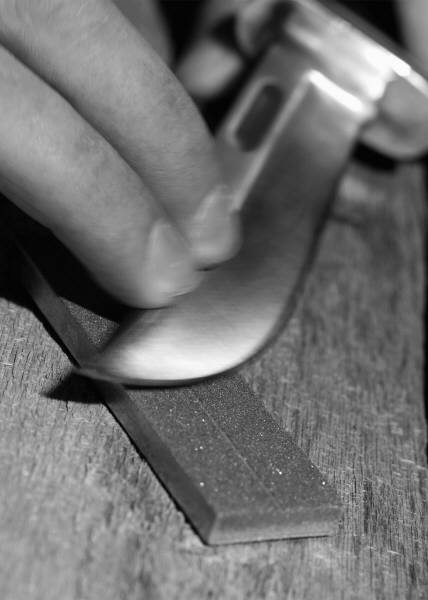
knife sharpeningAs iron sharpens iron, so one person sharpens another. Proverbs 27:17 (NIV)

While every writer knows that in today’s marketplace, interacting with others on a regular basis is a necessity for selling books, the real heart of writing – sitting down and putting words on a paper or screen – is a lonely job.

For me, however, “lonely” is not the word I would choose to describe my experience of writing. “Lonely” carries a negative connotation, the idea of being “cut off” from others, or “without” the company of others. In contrast, when I write, I feel a freedom to explore my own ideas and the joy-filled opportunity to connect with the Spirit within me. Writing is my “alone” time, not my “lonely” time. It is a personal retreat that renews me because I get to luxuriate in the word-smithing gifts that God has given me.

And yet I can’t deny the truth of Proverbs 27:17; without the other writers, marketing experts, and loving friends in my life, I wouldn’t be able to make the most of those same God-given word-smithing gifts. That’s not to say I’ve always felt this way – when I was new to my craft, praised by my writing teachers in high school and college, I had no use for the comments or criticisms of my peers. If my teachers liked my work, why should I listen to other students who struggled to compose even simple essays? It took me decades to understand the importance of my readers as opposed to the praises of my teachers. Here’s the difference:

The praise of others encourages you (and that’s a great thing!), but it’s honest criticism that will help you improve your craft.

It wasn’t until I began writing as a freelance magazine contributor that I first received truly effective editorial direction. Editors know their audience and work to appeal to them, so they have to play to the crowd. Teachers, on the other hand (I can say this because I’ve been a writing teacher myself), are the final audience of one person, and once a student has mastered what that teacher wants, there is no room to grow. And since all of us like to be praised, it’s tough to walk away from all that positive reinforcement to seek criticism!

As with so many endeavors in life, though, we have to push the boundaries to become the best God intends us to be. In the writing life, that means giving up the comfort of praise in order to find the challenge of improvement: we have to ask many people how we can do better, listen carefully to their comments, and use them to grow our craft.

One of my favorite sayings about Christianity is that “no one is a Christian alone.” Jesus Christ came to shape us into a community of believers, so we might draw on each other’s faith and gifts to grow His kingdom. That applies to our writing careers as well.

We need to be iron for each other.

To whom do you turn to be iron for you? For whom are you iron?

The Secret Tool That Will Put Your Writing Over The Top

I’ve never taken a writing class so I’m not sure when I learned this trick. Somehow I picked it up over the past decade.

I don’t even know if it’s important to other authors, or if writing instructors teach it.

So maybe this is elementary, but here’s my secret tool:

The way to make your writing interesting is to use details.

Yesterday I read Writing Down the Bones by Natalie Goldberg. I got excited when I found her encouraging writers to use detail.

She says, “Life is so rich, if you can write down the real details of the way things were and are, you hardly need anything else.” She adds, “Be specific. Don’t say ‘fruit.’ Tell what kind of fruit—‘It is a pomegranate.’ Give things the dignity of their names.”

Typical Greece


The paragraph below is an example of her writing. Notice how rich it is. Instead of saying, “My friend and I spent some time writing in Greece,” she wrote this:

I am on a Greek island right now: the Aegean Sea, cheap rooms on the beach, nude swimming, little tavernas where you sit under dried bamboo sipping ouzo, taste octopus, watch the great sun set. I am thirty-six and my friend who is with me is thirty-nine. It is the first time either of us has been to Europe. We take in everything, but only halfway because we are busy always, always talking. I tell her about my dance recital when I was six years old in a pink tutu; how my father, who sat in the front row, broke down weeping when he saw me. She tells me how her husband in Catholic school in Nebraska came late for a play that he was the star of and how the nuns had all the school children on their knees praying that he would appear.


Just for fun, I read a few lines from my book Renewed: Finding Your Inner Happy in an Overwhelmed World to find a paragraph where I had given detail. This is from my chapter on The Benefits of Solitude:

Right now I am alone. Snow is falling silently outside, and the only sound I hear comes from water trickling in my office fountain. Right now I can do whatever I want. I can slurp my split pea soup while taking intermittent bites of a chocolate bar.  I can sit on my chair with one leg tucked under in ladylike fashion. I can take a break to let the dog out, and I can sing badly while doing all of the above. These little freedoms are not to be underestimated.


Now that I’ve read Goldberg’s book, I see where I could have been even more detailed.

It’s much more fun to write when you’re giving details.

Take a minute to practice: Write about a favorite meal you had. Make sure you describe the setting, season, and the people you were with.


7 Writing Tips We Learned From Our Dogs

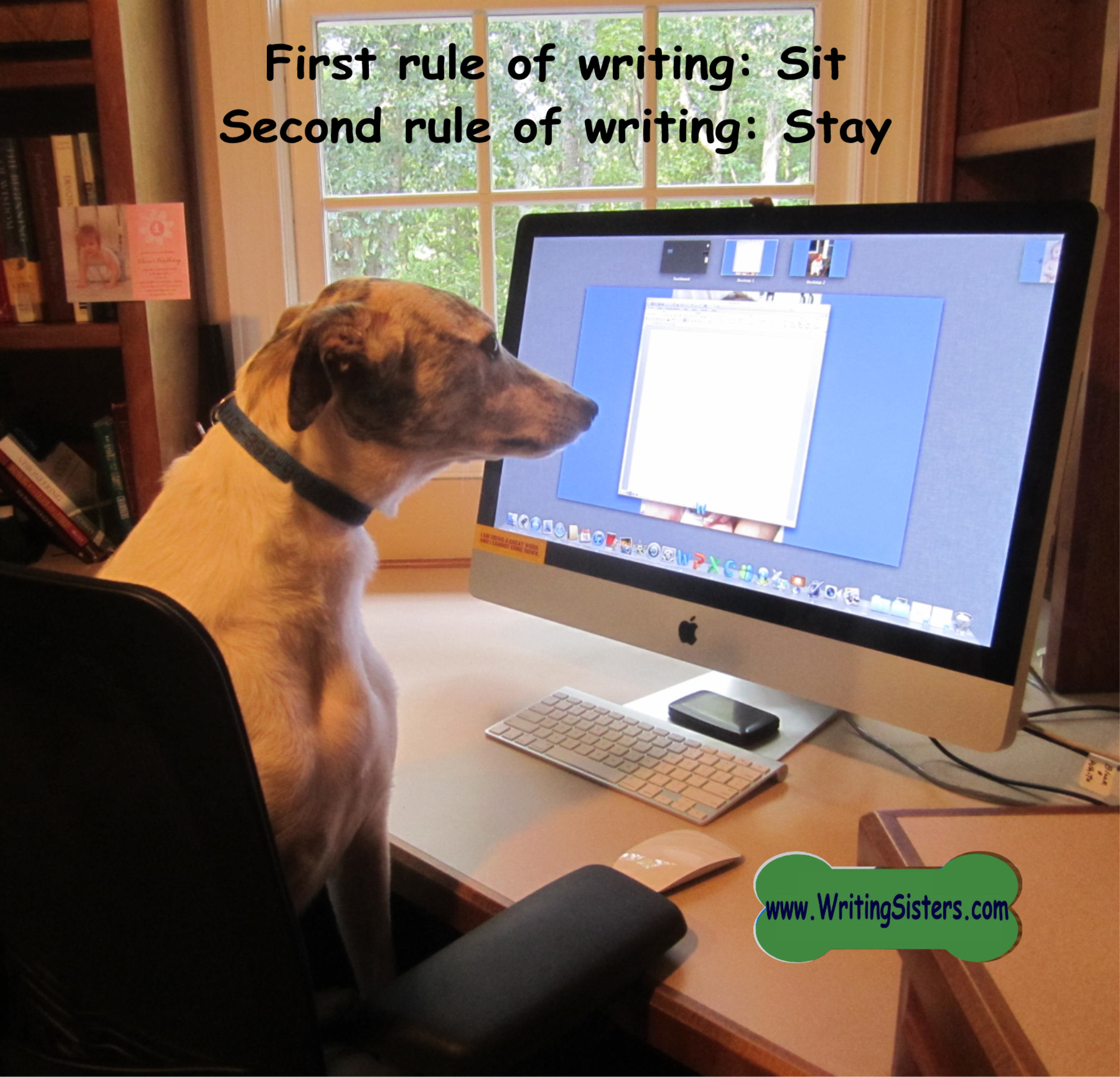
samson-at-computer

We have always loved dogs. Over the course of our lives together we have owned over 27 dogs. It is not surprising that some were our best teachers. Here’s what our four-legged friends have taught us about writing:

1. Sit and Stay. These are the two most important commands for writers! If you don’t sit down and begin, you will never get started. Staying is important, too. No, you don’t need another snack.

2. Dig!  Sometimes the facts that we need are buried deep, like a good old bone. The best writing requires some digging–in the library, on the internet, in your heart. Sniff it out. Then dig. If you don’t find it, dig another hole.

3. Know your territory. Writing takes good boundaries and good boundaries mean saying no. One important lesson for both of us was to protect and guard our writing time. We put the time on our schedule and then we protect it. Remember: Growl, don’t bite!

4. Expect treats. It is hope that keeps us going. Hope of touching a reader. Hope of one day holding your book in your hands. Excitement and anticipation is an important part of writing. Sit down to write expecting something good to happen.

5. Be kind to the postman. It’s not his fault. Rejection is an important part of the writing process. Keep it in perspective. Shake it off and start again.

6. Stay in the moment. Don’t get ahead of yourself and start worrying about the future.  Don’t stay stuck in the past. Worry is not your friend.

7. Play! Some of the best ideas come to us away from the desk. Stop work to chase a few ideas. Dogs love any distraction from a tennis ball to a squirrel. The work will still be waiting when you come back.

Has your pet taught you anything about writing?

Betsy Duffey and Laurie Myers  www.WritingSisters.com


Bio: The Writing Sisters, Betsy Duffey and Laurie Myers were born into a writing family, and began critiquing manuscripts at an early age for their mother, Newbery winner Betsy Byars.  They went on to become authors of more than thirty-five children’s novels. Their first book for adults is  The Shepherd’s Song,  Howard Books, March 2014.

Is Multi-Genre Writing Right For You?

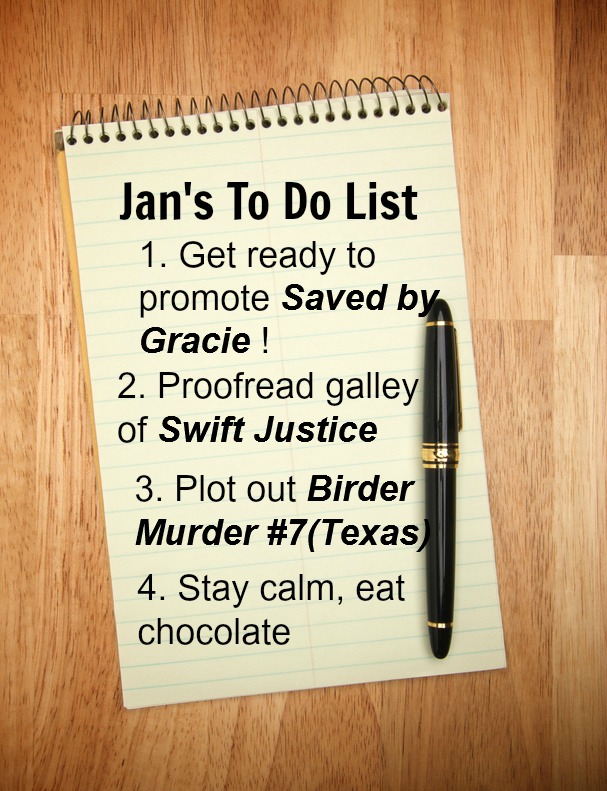
to do list (2)One of the ongoing debates in the writing world is about the wisdom of writing in more than one genre. The reality, I think, is that most writers want to write in several genres and, in fact, may be quite good at it. My first projects were poetry, and then I moved on to magazine articles. Think pieces followed, as did newspaper humor columns. My first published book was a small volume about practical Christian spirituality, but then I found my stride in humorous murder mysteries (#6 is out in September, with #7 currently taking shape on my laptop).

Last but not least, a few months ago, my first memoir was published.

So, for me, the big debate about writing in multiple genres is a no-brainer, because I already do.

My experience of doing so, however, has made me recast the debate from a writing perspective to a publishing perspective, and, as a writer who wants to build a career as a published author, I offer my own pluses and minuses of working in a multi-genre career.

  1. Minus: If you think it’s demanding to build one platform, try building several at once. I’m not saying it can’t be done, but in my experience, it can’t happen simultaneously (unless you have clones of yourself ready to go – and in that case, please drop me a note at my website, because I could use a couple of clones these days). To launch a book, you have to be single-minded to make the best of marketing opportunities: appearances, talks, media, book clubs, etc. Your new book/baby needs attention 24/7, and if you leave it for a day or two to nurse along another genre, you find yourself playing catch-up when you get back to the newborn. I’m guessing it’s like having twins-one person can’t really hold two babies equally well, so there’s always some juggling going on. Same thing with two genres: you end up feeling like you haven’t been as successful as you could have been with just one book. At the very least, you don’t sleep much, because you’re trying to do the work of two marketing departments in one body.
  2. Plus: Working in two genres is exhilarating! You get to double the people you meet and the interests you cultivate. Your horizons expand and life is so rich with new experiences, it takes your breath away. It’s wonderful to be a writer!
  3. Minus: Publishers are very hesitant to take a chance on you in a new genre. The more you’ve established yourself in one genre, the less a publisher wants to take the risk of launching you in a different direction. Publishing is a business, and publishers have to respect the bottom line.
  4. Plus: If your genres share something in common (mine share humor and a love of nature), your fans of one genre are more likely to follow you into new territory, giving you a base readership on which to build and a headstart on creating a new platform.

Have you had any experience in multi-genre writing? Any insights to share?