Seeking a Revelation

source: Fotolia via MS Office

We’ve all been there—happily plowing through a manuscript when we’re suddenly brought to a squealing halt. Or maybe it comes on gradually, like so much mud solidifying as we try to trudge through until we find ourselves frozen in place, blinking at the ground and wondering what happened.  It could be our outline didn’t foresee all it might have, or we wandered down an unexpected path only to find it’s a dead end. Or perhaps our characters took on lives of their own and staged a coup when we weren’t looking. However we got there, we’re stuck, and being stuck mid-project is no fun. So what’s a writer to do? 

We could ditch the whole thing. Occasionally that is the right answer, but being persistent writerly-types, thank goodness that’s not our first inclination. There are lots of ways to get unstuck which leave us with a better manuscript in the end. Here are my top five:

  • Walk away for at least 30 days. It never ceases to amaze me how insightful this can be. When you’re writing, you’re close to the material. You leave a part of you on the page, and sometimes it’s hard to see the forest for the trees. Many writers know this, and they take frequent steps back from their material in the hopes of approaching it later with a less familiar eye. It’s tempting to think a week or two is sufficient, and sometimes it is. But if you’re really stuck, I highly recommend walking away for a full month to get a truly fresh perspective. That distance can do wonders for improving your writing on the next go-round.
Source: Wikipedia
  • Ask for help. While many writers recognize the value of a critique group for the craft side of writing, I’m surprised how few ask for help with storyline. Asking for help does not make you weak. It makes you resourceful. I recently rewrote the entire end to my novel because an editor thought it predictable. I asked a trusted critique partner for help. She brainstormed with her daughter (this was a YA story) and came up with a slew of possibilities. One contained the thread of an idea I ultimately spun into a much better ending. And let’s not forget the power of prayer. Realizing you don’t have all the answers and asking for guidance from above is simultaneously humbling and empowering. Just remember to let go of any preconceived ideas and be open to whatever form inspiration may take.
  • Print it. This isn’t the first time you’ve heard this, but it works. Seeing your work in print is strangely insightful. You will plainly see things you don’t when looking at it on the computer.
  • Push through. To put it bluntly, give yourself permission to write crap. Knowing the next chapter or two will be ‘throw away’ material is incredibly freeing. It takes the pressure off and lets you work through the block. Not everything you write needs to be brilliant. You’re not going to go with that first or second draft anyway, right? So give yourself permission to make a mess before you refine it all.
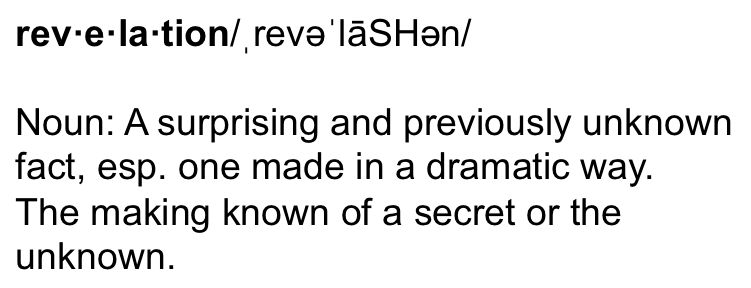
  • Read in your chosen genre or non-fiction category. Some writers worry if they do this they’ll either find someone beat them to the punch or they’ll inadvertently pick up another author’s voice or idea. In the case of the former, you’re better off knowing this sooner than later so you can make your story stand out as different. In the latter, you can influence this: you’re a disciplined, creative being, not a machine that regurgitates what you’ve read without your knowledge. The benefits of understanding what’s successful (or not) in your chosen field far outweigh the possible risks. Read—and keep a pencil handy for when the revelation hits.

How do you get through when you find yourself ‘stuck’ during a writing project?
Third Day Give Me a Revelation

I Will Prevail! (And Other Things I Tell Myself in the Shower.)

One admonition I can’t seem to scrub from my brain is my mother’s bit about wearing the right underwear in case I’m in a car accident. Maybe your mother used the word, “clean,” when giving underwear life lessons, but mine specified “right.” Her reasoning was if I had on a pair of lacy deals or something even more scandalous, the attending physician in the ER might think I’m loose.

Yeah. That’s going to be a flash of thought for me, I suppose, when the doc is trying to volt me with paddles, and is tweezing shards of glass from my forehead. “Whoa, this chick might not live through the night, but, oh well. She’s got on frilly underwear, and you know what that makes her.”

Whenever I hear naysayer anthems in any walk of life, I have this strange tendency to contemplate the difference between the undies my mom wishes I’d wear, and the undies I do wear. (Yes, sorry, my brain works that way.)

One naysayer anthem I’ve heard relates directly to my newest gig in becoming a published author and venturing into the land of woe and book sales.

What’s said: “Don’t expect much because you won’t get much.”

What I hear: “Wear your granny panties.”                     

Well, you know what? I don’t want to wear my granny panties. And you know what else? I don’t care what I should expect. And I don’t care if an ER doctor thinks I’m loose, and I don’t care if people think I’m chasing unrealistic dreams.

(OK, I actually do care if an ER doctor thinks I’m loose, so don’t quote me on that. I got lost in the moment.)

One thing I do care about is what moves me. I need a juicy little nugget of hope, dangling just out of my hungry grasp. Yes, I know the odds are not in my favor of being a best-selling author. Yet, I still tell myself it’s a matter of when, not if, because anything short of that . . . well, if I didn’t have that particular hope to chase each day, then I’d be lying on the floor pressing a Life Alert button just to see if anyone comes.

I might have failure after failure, never even getting as far as putting one tiny finger on the first stair to success, but I’m sorry, I won’t stop striving and dreaming for more until I’m dead.

(Oh, and when it is my time to go, I hope whether or not the doctor resuscitates me isn’t predicated on my underwear choice.)

What moves you? What are your dreams? What kind of undies do you wear? (Kidding!)

Sergio: A Memoir from My Writing Life

My writing life continues to take me to places that I never dreamed possible. A few years ago, I decided to go back to college to pursue a degree in writing. And my academic journey gave me the opportunity to study a second language in another country.

In Spain, I learned more than just the language—I learned about their culture, their history, and the every day life of the people there. I also learned things about myself and human nature. Plus, this experience provided numerous stories to share, like this one about my young friend, Sergio.

One of my best language teachers proved to be a five-year-old boy named Sergio, the grandson of my hostess, Beni.

Sergio would sit with me every day at the kitchen table, after the others had finished their meals and retreated to watch television. He enjoyed pretending to be my teacher.

Child Teacher. As Sergio picked up each piece of fruit, one-by-one, from the ceramic bowl on the kitchen table, he would hold it up and wait for me to say the name of the fruit in Spanish. If I didn’t respond fast enough, he would look at me with his big brown eyes and teach me the appropriate word.

“Me-lo-co-tón,” Sergio said slowly, as he held up a peach and waited for me to repeat after him. And after I responded, he would flash his bright smile, clap his hands, and applaud, “¡Qué bien!” [Great!]

Then, Sergio would grab another piece of fruit and continue to quiz me, until he thought I had mastered each Spanish word. When he grabbed a banana, I would always laugh as I responded, “Ba-na-na.” [Sergio didn’t know we used some of the same words in English.]

I bought Sergio candy and toys to express my gratitude to him. One day, I gave him the mini-flashlight that I carried in my purse from home. As he ran to show his mother, he danced around the apartment snapping the light off and on.

Sergio reminded me of my own grandson, Miles, who was just a few years older. And Sergio helped me fend off being homesick, as I interacted with him.

Adult Student. In studying Spanish as an adult, I experienced both humiliation and judgment. My host family often seemed very impatient that I had not mastered their language. And since I was somewhat shy, the looks they exchanged when I tried to speak in their tongue embarrassed me. They would sigh heavily and roll their eyes. Then they would speak slowly with raised voices as they repeated phrases toward me.

I felt ignorant when I couldn’t find the words to express what I wanted to say. But Sergio always responded to me with patience and kindness. He helped me because he wanted to be with me, and we both enjoyed our time together.

Life-long Learner. I suppose I was too stubborn to give up on my goal of becoming bilingual during my studies in Spain, even with the difficulties I faced. I now appreciate the Hispanic population in my own community and the struggles they encounter in a country where most people do not understand their native language.

I discovered some surprises about myself in my efforts to learn another language. My husband, Dan, became more aware of my weaknesses than anyone. I’m sure he’ll never forget the night he walked into our family room at midnight and found me on our carpeted floor in a fetal position—crying because I had received a “B” in a conversational Spanish class.

I laugh when I think of that moment now. But at the time, I didn’t see the humor in the situation. Learning a new language proved to be one of the most humbling and difficult experiences of my life. But it gave me insight into teaching others to write, and I later became a writing instructor. In fact, I discovered that learning to write is much like learning a second language–but that’s another subject for a future post.

And in spite of the hardships and disappointments I encountered during my language school experience in Spain, my most memorable and effective teachable moments came with my young friend, Sergio.

Where has your writing journey taken you?

Honoring the Writer’s Call

Remember the Call

As ambassadors of the written word, we’re called to awaken people to truth. Rubbing words together, we set the world on fire!

Above publishers and agents, God’s our number one boss. With pure, submitted hearts, we make it our mission to please him first.

Am I on the right track, Father? What do you want me to share today? These are the questions we ask.

We try not to judge and compare ourselves with other writers because we know God equips each of his instruments for different specific tasks.

When fearful, overwhelmed, and wondering why we chose this career/ministry path in the first place, we remember… God never calls us where his grace won’t sustain us.

So let’s not get tired of doing what is good. At just the right time we will reap a harvest of blessing if we don’t give up. Gal. 6:9

Persevere in the Call

When tempted to distraction by potentially good things like social media, movies, and chats, we’re privileged to consult our boss: “Please show me what to do and give me the strength to carry it through.”

When tempted to discouragement by trials, we understand they’re God’s method of making us stronger, more Christ-like, and more effective in our writing.

And we know that God causes everything to work together for the good of those who love God and are called according to his purpose for them. Rom. 8:28

Because we clearly know we have been called to write, we persevere when people judge us, and we remind ourselves it only matters what God thinks, and the Lord sees every heart. 1 Chron. 28:9

We persevere when our paychecks are sparse because we know God will supply all our needs from his glorious riches, which have been given to us in Christ Jesus. Phil. 4:19

We persevere when the road is rough and slow and we can’t see ahead because we know who leads us each step of the way. (Ps. 37:23)

Balance the Call

Balance starts with rest, and rest starts with prayer. Jesus walked a tight deadline, but rose before dawn to commune with his Father. He snuck away from the crowds to reconnect. Do we sneak away from our characters to bless the Word of words?

Jesus waited on His Father for wisdom and wants us to do the same; but it takes trust.  (James 1:5-6)  When it comes to trusting in the Lord with all our hearts, we often get it backwards, and lean on our own understanding first. Then, when things go awry, we cry “Help me!” and ask him to direct our path. He will, but we must first acknowledge him.  Prov. 3:5-7

Jesus only spent three years in ministry; however, his thirty preparation years were just as important because they defined and nurtured the Father/Son relationship, enabling him, in the right time, to turn the world upside down by submitting to His Father’s peculiar but brilliant plan of reaching the Jews first, then the Gentiles.

God writes a different plan for each one of us. He calls some of us to blog first, others to write books first, and still others to do both at the same time – in balance.

Whether we’re writing, speaking, networking or spending time with the family, God isn’t just interested in what he’s doing through us; He’s interested in what he’s doing in us.  He wants us to joyfully trust him so we can honor him with our calling.

“For I know the plans I have for you,” says the LORD. “They are plans for good and not for disaster, to give you a future and a hope.”  Jer. 29:11

Please talk to us about remembering, persevering, and balancing God’s call to write. We’d love to hear your stories, lessons, insights, and experiences.

And what is God reminding you about today?

The 15-Minute Writer: Help for Harried Aspiring Authors

I’ve never had the luxury of uninterrupted time to write. In fact, while finishing my first book, I had a five year-old, a busy hubby–and morning sickness (which lasted all day, throughout the whole time I was pregnant with my second son). Since then, I’ve worked a variety of part- and even full-time jobs while continuing to build my platform and hone my craft. And out of sheer necessity, I’ve become a master at using hidden pockets of time to further my career.

If you’ve got all the time in the world to research, read, and write, then skip this post. If you’re like me, however, I hope you’ll find encouragement for reaching your writing goals–fifteen minutes at a time:

—Write whenever, and wherever, you have a few spare minutes (during lunch hours, while your kids are at soccer practice, in waiting rooms). During these “cram sessions,” don’t edit; just write as fast as you can.

–Or just edit. Read a draft of a poem, filler, or blog post (preferably out loud) and make a few quick changes.

–Browse the writing section of your local bookstore or library and pick out a few gems to read in fifteen-minute spurts. I can highly recommend Writer with a Day Job.

—Hire a teenager to watch your kids, clean house, or do your errands. And later, use the time you just saved to write!

–Create a spreadsheet. Like this.

—-Look for an online writing support group. The members can provide support, tips, and tricks. (If they instead give you spam, aggravation, and passive-aggressive “critiques,” you can always un-join. That would only take five minutes.)

–Save a few templates of frequently-used pitch letters and customize a query to a specific magazine or agent.

–Create a rough draft of a new writing resume.

–Update your LinkedIn account with recent writing jobs.

–Flip through the newest issue of your favorite magazine, and list a few ideas for features you could pitch to the editor.

–Think about the unique ways you organize your kitchen, kids’ rooms, or office. Draft a filler to send to an appropriate magazine.

–Have a great idea for a greeting card? Check out Hallmark‘s website to see what contests they’re currently running.

—“Backwards plan.” Take a deadline, or set one for yourself, and mark it on your calendar. Then write down all the tasks you’ll need to complete in order to meet the deadline—interviews, outlining, writing a rough draft, revising—and decide how much time you’ll likely need to complete each one. Finally, plan backwards, setting yourself mini-deadlines. (This tip has saved my sanity—and my family life—on several occasions!)

From my busy-but-very productive writer friend, Glynn Young, here are a few final suggestions: “Find and follow three writing blogs, like noveldoctor or Jeff Goins. Read one chapter of a book about writing. Read three poems. Read one author’s entry on Wikipedia. Read the current post on The High Calling.” [where Glynn and I both serve as editors]

See how much you can accomplish in short spurts? Who knows–your mini writing sessions might just lead to your fifteen minutes of fame. Either way, you’ll never regret the time you spent pursuing a passion. I promise!

Now it’s your turn. What ideas do you have for using small amounts of time wisely?

Hunting and Fishing: Tackle Box Tools for the Aspiring Author

What does hunting and fishing have to do with being a writer? More than you might imagine. If you think you’re exempt from needing these skills, you may find you’re going to need a bigger boat, so to speak.

After placing well in a writing contest, I was approached by several people who wanted the same thing. They resembled eager, wide-eyed hunters, sure that there was a sportsmen’s paradise within reach, if they could just locate the geographic coordinates. The questions have been pretty standard. How do I get started? What should I write about? How do you get an agent? How do you get published? But the most interesting question so far has been how do you find the courage to put your work out there? This question was from a woman (we’ll call her Nancy) who had already written an entire series of books, but lacked the confidence to move forward. She was stuck.

In addition to being a strong writer, Nancy had an impressive graphic arts background and was perfectly capable of designing the entire book herself. She had all the tools she needed and then some – but not the confidence. It’s a common dilemma. Many writers are introverted and sensitive to criticism. They may have much better work in their garage than most of what is available, but we’ll never hear about it because they are unwilling to send up a smoke signal and let us know where to find them.

Not everyone is going to love our work, and we don’t need everyone to love our work. We just need to find our audiences. Fishing with good bait obviously helps exponentially. Nancy came to peace with the fact that she was going to have to learn to fish. She then accepted the fact that although she didn’t think her book was good enough, it was certainly better than some of the other books out there. If those books could get published, then why not hers?

Next, we tackled the business about marketing and promotion. Nancy realized that she would not have to just catch the fish, but cook it, clean it and perhaps even serve it as well. The author is expected to do a great deal of their own marketing. The publisher can’t do it all for us; they have other authors they need to promote. No one has as much of a vested interest in our success as we do.

Nancy was horrified to learn that she would probably need a website with her name and picture on it, and she might even have to speak about her book in front of people. The most uncomfortable concept for her by far was that she would have to ‘sell’ her work. But she figured out that it doesn’t feel like ‘selling’ if you are simply providing a service or commodity and increasing awareness for people who really want your product. Blogging and tweeting and self-promoting are awkward concepts for most of us. However, unless you have staff to hunt and fish on your behalf, there aren’t too many other options.

Nancy still isn’t crazy about all the hunting and fishing she has ahead of her, but she is committed to surviving as a writer. She has started working on her book covers and finding books on how to overcome her shyness. She’s bravely entering Writing Territory and looking for a spot to set up camp. Best of all, she is no longer stuck and is actively pursuing her own hunting and fishing sportsman’s paradise.

Have you caught any tasty fish lately? How are your hunting skills? Figuratively, of course, but if you want to share some literal experiences, that’s okay, too. 🙂

The Awesome Power of Humor in Writing

“Lord, please don’t let me die in a CVS bathroom,” a young friend of mine, Kelli, posted on her Facebook status during the Texas Tornadoes of Tuesday, the day when semi-trucks flew like box kites.

I thought, What a great way to handle a crisis: with a prayer on your lips, your sense of humor intact.  Not only that, but I knew that keeping a sense of humor in spite of the stress and danger, would be calming both to Kelli and the frightened folks with her — because it is hard to think of something funny and be terrified at the same time.

Just moments before Kelly’s post, I had been talking to my daughter Rachel, who lives in small town Forney, Texas, and with whom I’m writing a humor food blog and book by the same name (We Laugh, We Cry, We Cook). Tornadoes are so commonplace in Texas that when Rachel answered the phone with, “Hi, Mom. I’m in the bathtub with the baby and a mattress pulled over our heads,”   I almost asked, “Again?”

This would be our third cell phone conversation this year with my daughter scrunched in the tub with her baby, her phone, her lap top, a mattress overhead. This is simply “Life in Texas” during tornado season; but  in my fifty-three years of doing the Bathtub Tornado Preparedness routine, I’ve never seen one funnel cloud.  Hard to take those TV tornado warnings seriously when they seem to happen every little whip-stitch in the Springtime.

But then Rach said, “Mom, the weatherman just shouted that a tornado has hit a Forney school.” Rachel lives only a half-mile from a Forney high school and elementary school.

All the blood drained from my face.

“Honey, stay on the phone with me…” I said, and then heard nothing from her end of the cell phone but snap, crackle, pop, followed by  … silence.  I called back, but cell phone service had ceased in her area.

I grabbed the remote, flipped on the TV only to see the words “Forney,Texas” flashing, with scenes of the menacing tornado playing across the screen.

Sick with fear, it was ten, long, excruciating minutes before Rachel called back to report she was fine, not even a drop of rain. She sounded calm, but then she’d not yet seen what had just miraculously missed her home.

I cried, my husband Greg (who is not only CEO of WordServe, but a stellar comforter) hugged me. My legs now Jell-o, I sat down, glanced at my computer and my eyes landed on Kelly’s brave/funny status post (from somewhere near Greenville, Texas) and somehow… I managed a laugh.  And with that first laugh, calm began to flow through my veins, and my traumatized brain began the process of soothing itself.

I fell in love with President Reagan the day he calmed an entire country with the words, “Who’s minding the store?” soon after he and several others had been shot.  If Reagan could still joke, and we could still laugh, everything would be okay. America breathed a collective sigh of relief, thanks to the President’s cool head and sharp wit.

I’ve written three books with brain specialists, and I’m proud that I could gather enough middle-aged brain cells to write something serious and science-based.   But what flows from my soul and my pen most naturally is humor.  I used to feel that writing humor was somehow less important, not terribly “literary.”  I know many serious writers who still believe that writing humor takes less intelligence, less skill, and not much depth of thought.  To those writers, I say, “Try it. Then, let’s talk.”  I once heard an interview in which Barbara Mandrell’s little sister (“the blond ditzy one”) said, with a wise wink, “It takes a lot of smarts to play dumb.”  It also takes a tremendous amount of skill to be self-deprecatingly funny on paper, without being corny, or forced, or silly.

Over my writing career, I’ve received hundreds of letters or emails that read something like,  “Someone gave me a copy of your book while I sat with my dying mother in the hospital, and we both laughed until we cried. Thank you for giving us that happy memory together.”  Or, “I lost my husband last year and could not read anything serious or heavy.  But your stories, and the laughter… oh, how healing it was to laugh again!”  And on and on.

My time with the brain doctors taught me that laughter is a gift to every cell in our body. If you can write stories that bring a grin or a chuckle, you share a priceless gift with your readers. You give them a short mental vacation from their worries and those common looping, overly-serious thoughts.  Laughter helps re-set the brain from negativity to lightheartedness in a short amount of time.

Whether you write books of humor, or just sprinkle some well-placed wit into your prose, there is no genre that cannot be improved, or heart that cannot be lifted, or worried brow that cannot be soothed by a touch of the clown, now and then, from your pen.

“Laughter through tears is my favorite emotion.”  Steel Magnolias

Question:  As a reader or a writer, can you recall a time when humor helped you through a dark time, a frightening experience or even a season of grief?  What authors do you admire who consistently help you laugh and perhaps gain some fresh perspective?

In Praise of Small Publishers

Like every writer, I dream of signing a contract with a big publishing house that will bring all its resources to launch my book onto the bestseller lists.

So far, it’s still a dream.

The reality I’m enjoying, however, is being published by a small regional press, which is giving me many of the satisfactions of being a published author without the pressure of big-time publishing. In fact, I regard my association with my current publisher as not only a great way to continue to develop as a writer, but also as a hands-on business apprenticeship which is preparing me for that future leap into the big leagues. Yes, working as a small press author means the royalties are slim, but for me, the benefits are huge.

If you haven’t considered finding a small press for your work, here are some things I’ve learned that you might find interesting and appealing about working with a smaller publisher:

  1. Small presses have very specific audiences and categories. That means you have to really define your own audience as you write your book. The benefit to this task is that your writing will be tighter and more focused, which will do three things for you: 1) improve your book; 2) target a publisher who wants this kind of book (thereby improving your chances of landing a contract!); and 3) give you a clear idea of who the readers are to whom you’ll be marketing the book upon publication.
  2. Small presses have limited resources to help you market. While this was initially a negative for me, I am now grateful that I assume primary responsibility for this very important piece of the publishing journey. I’ve learned to develop publicity contact lists, explore marketing opportunities, and pursue networking to land speaking engagements, which is a key to success for authors. Another plus here is that as a one-person marketing machine, I can react quickly to opportunities with an immediate ‘yes!’
  3. Timelines can be shorter with a small press. I can phone my publisher and talk directly to her, getting the answers I need or the extension of a deadline. I get the editing comments back, make revisions as needed, and see a final proof shortly thereafter; I can finish my book in June and have the launch party in September (not that I recommend such a tight schedule, but it has happened!). That means no long waits to see my books in print and get reader response.
  4. I work closely with the book designer, so I’m always happy with my book’s front and back covers. I’ve heard from many authors with big publishers that they have little to no input on what their book will look like; I love having a voice in those decisions!

The bottom line is that publishing with a small house can keep you closer to the publishing process in each of its stages, providing you with an education and experience that can only benefit your future career success.

Are any of you working with small presses? Care to share the joys of doing so?

Writing is a Muscle, Flex it

    Sometimes I have to remind myself I’m not Ernest Hemingway, allowed to take hours at a time sipping aperitifs and people watching in Paris before I muster the requisite inspiration to sit down and write something. My goodness, if I did that and my husband subsequently found out, he’d feverishly protest the abundance of chicken nugget nights that seem to bottleneck when I get close to a deadline.

On the first manuscript I completed, however, I remember only writing when I felt like it. It took me two years to finish. And when it was summarily dubbed “Good, but not quite there,” I responded in a few ways. First, there was the shaking of my fists in the air. Second, there was the stint of self-loathing. (Which as a writer, I feel I have a natural right to exhibit, prancing back and forth, moaning, as if I’m original in my pain.) And third, an issuance of a new battle cry: I will never waste that much time again.

Two years of my life back then was the difference between a head of my own black hair, and a bottle of L’oreal Black Midnight to cover the greys that had suddenly popped up. When I began working on my next manuscript, I forced myself to work every day, for a set amount of time, or a set amount of words.

In my day job as an attorney, I have no problem writing piles and piles of drivel . . . I mean, well thought, and well-argued points of law . . . in a quick, methodic manner. Shouldn’t I be applying the same work ethic to a manuscript? And when I did, I wrote 120,000 words in just over two months. Of course, I have to give some credit to the story being an easy tell, but I give more credit to the fact I determined to make it a work task rather than a pipe dream.

I wanted to develop a rhythm with my writing, a habit if you will, that would self-execute even when—get this—I didn’t feel like it. And sure, sometimes I had whole pages that looked as presentable and appetizing as the floor of a gas station bathroom, but that has happened on occasion when I was trying my best.

When you train a muscle to work, when you exercise it daily and watch it tone and tighten, there’s this mental assurance that the next big set of weights—the next writing task ahead—is within your range. Further, if you work those muscles hard enough, they’ll keep working for you, burning for you, long after you put the weights down. They’ll even keep you going on days when you don’t feel like working at all.

Bottom line is that writing doesn’t come and go in these magical, muse-driven spurts, as if some wayfaring pixie is sprinkling special dust and making you transcend. It’s a muscle begging its owner to use and improve upon it. Getting it to its optimum is going to take you gritting your teeth. You may even have to pop out a neck vein here and there.

And once that’s done, you can pull out the Hemingway routine during your next vacation or when you’re trying to be aloof for your friends. That’s always a fun gig.

Do You Hear The Voices?

Dialogue should be short, snappy, and punchy. Image: photostock / FreeDigitalPhotos.net

Dialogue that is short, snappy, and punchy, engages other characters as well as the reader. Dialogue is meant to be experienced, not studied. Halting over a line of dialogue can interrupt the reader’s experience.” ~~ Sol Stein

At a recent writer’s conference, an agent said dialogue could make the difference in making a request for more of a writer’s work. She takes the first five pages of a manuscript and looks for the white space created by dialogue. Then she puts the manuscript aside and picks up the next one.

From that conversation, I gathered dialogue is an important part of novel writing. Internal monologue is not dialogue. So, even if no one else is in the room, the character should talk aloud to himself, or to his pet.

Conversations in real life often have little or no purpose. In fiction, that’s a killer. What do you hear as the characters meet and greet? Is it meaningless chitchat? Or are they talking about anything and everything to avoid the deeper subject they know they should discuss? That’s great. Avoidance dialogue is called subtext.

Who’s talking? Do the characters sound alike? Are they predictable? Do they always say what you’d expect them to say?

If so, the writer’s in trouble. You see, dialogue has to sound natural, but it also has to be more condensed and much more interesting than everyday language.

Info dumps are boring. Just as you don’t enjoy listening to a person who talks on and on without giving others a chance to get a word in edgewise, neither do your readers. Most exchanges in dialogue should be brief. Consider using five word exchanges or less in your dialogue. Avoid using more than three sentences without a break or at least an action tag on the part of the speaker.

Can the reader visualize the characters? Characters don’t talk in a vacuum. To avoid the talking heads syndrome show us what they’re doing. Is Mary cooking dinner? Is LeRoy chopping wood? And by the way, is the ax dull?

Speaking of what’s happening, in your own writing, don’t mix the actions of one character with the dialogue of another. Be sure each speaker gets his own paragraph. Even if the character only uses one word. Make it easy for your reader to know who is talking.

And while we’re on the subject of give and take between characters, teach them to give another character a chance to react. Short dialogue paragraphs leave that coveted white space and increase pacing.

Last but not least, dialogue should move the story along. Do the characters have an agenda? Does dialogue reveal the different sides of an issue?

For dialogue to do its job, it needs to create an emotional effect in the reader. How much of the dialogue reveals disagreements and misunderstandings that affect the other characters’ goals? Does it increase suspense and uncertainty?

Q4U: Would you care to share a tip for stronger dialogue?