Deep into NaNoWriMo

Every author knows that it’s National Novel Writing Month – thirty days dedicated to flexing our writing muscles and whipping out 50,000 words of an original manuscript. The idea is to give ourselves permission to pursue our writing passion with all our hearts, minds, and laptops in a frenzy of creative expression and production.

What a great idea!

What unfettered freedom to write!

What joy!

What planet are these people from?

Like most authors I know, writing a novel gets sandwiched in between a part or full-time job, parenting, spousing, volunteering obligations, pet maintenance, cooking and cleaning, and – oh yes! – occasional opportunities to sleep. So, at least for me, while NaNoWriMo sounds like a fabulous idea, that is, unfortunately, all it will ever be for me – an idea, not a reality. During the month of November, while other lucky authors suspend every claim on their time and energy to immerse themselves in writing bliss, I’m still teaching college sophomores how to construct a grammatically correct sentence, walking the dog at least twice a day, cooking dinner for my husband and me, doing laundry, answering emails, and maintaining personal hygiene. Until I can figure out how to do all that AND write at the same time, NaNoWriMo will continue to be an elusive dream, and I will go on wondering what it would be like to write a novel in thirty consecutive days.

Note that I wrote ‘consecutive’ days.

That’s because I do write a novel every year in thirty days. The days are just not back-to-back, or consistently eight hours of effort, but all in all, it ends up being around the same amount of ‘work.’ In other words, I write when I can. Some days, that ‘writing’ may actually be hours of mental plotting while I’m otherwise physically engaged (can you spell ‘spring cleanup’?) or it could be an uninterrupted ten-hour words-pouring-out-of-me marathon when I forget to eat (easiest to do when hubby and kids are out of town). I have, at least twice, written the first chapter in a methodical manner, sitting down to my laptop for four hours a day. But then it’s been weeks, or even months, before I get back for Chapter Two. As I often excuse myself to those who ask, I was trained as a journalist, and I work best under pressure, but as an example of writerly discipline, I stink.

It works for me, though. I find that downtime between chapters, or even mid-chapter, gives me time to play with my story, working out different arcs or conflicts. My writing breaks allow my characters to form more completely in my mind, often without my interference. And sometimes, my story takes turns I never would have predicted, thanks to the people or events I encounter while I’m in the middle of slowly, erratically, crafting a story.

Write a novel in a month?

If you can do it, go for it.

Me? I’m simmering stew, along with story plots. The really good stuff takes time, you know.

How’s your NaNoWriMo going?

The Holy Work of Writing

Every year I host a faculty essay reading at my university for our collective entertainment. At the beginning of the semester, I choose and cajole a dozen colleagues from across the curriculum to write personal essays on a shared subject. Then, sometime around Thanksgiving, I invite the rest of the campus to come hear them read the resulting essays aloud. It’s always a fun evening, everyone feeling proud afterward of what they accomplished.

Though the selected essayists have composed entire dissertations of scholarly writing, most have never set out to write for entertainment alone, so getting them to do it necessitates pep talks from me along the way as well as a fair amount of collaborative back-and-forthing between them and the trusted readers I encourage them to seek out. When they report to me on how it’s going and, afterward, on how it went, my colleagues are bashful and sincere and loveably modest as at no other time in my interaction with them.

“I got my daughter—she’s in high school—to read through it and make sure it made sense,” a grizzled professor of engineering tells me.

Another tells me how, in the course of writing about a Picasso painting her autistic son loved but she didn’t, she kept asking him questions and managed, through these exchanges, to get a rare glimpse of the world from his perspective.

Yet another colleague makes an appointment with me after the reading to work on improving his essay even more. He takes away from our discussion an argumentation skill that he is still bringing up in meetings years later: that you can’t convince someone of a truth unless you show it.

That’s the part of the event I like the most—my colleagues’ accounts of the process of composition. It’s so thrilling to watch seasoned writers grow into better writers through the humbling practice of sharpening iron on iron. Hearing the essays read aloud—every one of them so good!—and then witnessing the enthusiasm with which their audience applauds their achievement—yes, very good!—confirms what I am always telling my students: that, we humans having been made in the image of our creative God, our practice of creativity is as holy as the exercise of any of God’s other traits. And as pleasurable.

It often makes me feel a little guilty that my work, both as a teacher of writing and as a writer myself, is so enjoyable. It hardly seems like work at all, much less holy work, as I have come to think of it. But when we write well—when, through our words on a page, we interest and engage an audience in what is true and lovely and admirable and excellent—we are performing the work of God.

When asked what God’s work is, Jesus says, “to believe in the one he sent” (John 6:29). Writing, and teaching others to write, helps me to believe ever more confidently in the One God Sent—through whom, says John, “all things were made; without him nothing was made that has been made” (John 1:3 NIV). Good writing recreates, in words, what has been made through the Word and offers it up to others for their contemplation and enjoyment. What work could be more sacred?

On Beyond Index Cards: A Review of Scrivener Software for Writers

My first novel, slated for publication with David C. Cook in early 2014, involved hours and reams of research. I researched everything from fossils, to barbecue restaurants, the history of Haiti, pecan recipes, and more. I organized text, web links, and photos into dozens of Word documents, which I then had to flip open and closed while writing and editing each chapter. Add this to the half-dozen internet browser screens I had open for research, and, well, my computer was on the verge of crashing.

So was my brain.

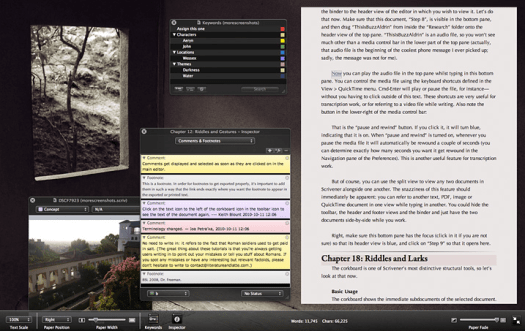
At the time I didn’t know any better, so I never lamented the process. But now that I’ve found Scrivener, a software program for writers of any genre, I marvel at how I ever kept my sanity. Currently neck-deep in an intense season of editing, I’m especially glad I can dump my manuscript in there, blow it up, and put it back together again with Scrivener.

Now, I will warn you. What you’re about to read may sound like an infomercial, but it’s not. I downloaded the trial version (highly recommended), quite skeptical about how much easier this could really make my writing life. But after just two days, I bought the software outright. First of all, this little slice of computer engineering GENIUS only cost $45—a small price to pay for sanity. An even smaller price to pay for the time it’s saved me, and the fun it brings to the novel writing process.

What’s so great about Scrivener? Below, I’ve summarized my personal favorite aspects of the program—so far. And I say “so far” because the software has so much depth of capabilities and bells and whistles, I discover something new and even more fun every time I use it.

1. Love me a Trapper Keeper!

I am a true child of the 80s. When I took my kids back-to-school shopping earlier this fall, I teared up, grieving that they shall never know the true beauty of the Trapper Keeper. Oh, sure, we found imitation versions on the shelves, but nothing close to the ultimate office supply nerd’s dream machine contraption, which kept everything in check, even when the bully on the football team rounded the corner and flipped my books in the air, sending everything—including my fragile, Love’s Baby Soft ego—to the floor.

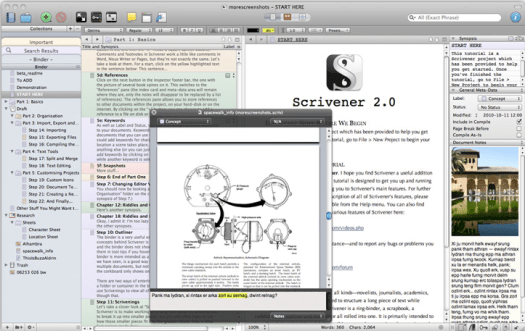
Well, never fear those bullies again. Scrivener is your virtual Trapper Keeper. The  program holds everything you need for your novel—websites, photos, places to jot down random thoughts and ideas, references, and notations—everything. And since it’s all in one location, nothing falls out.
2. The corkboard is adorable.

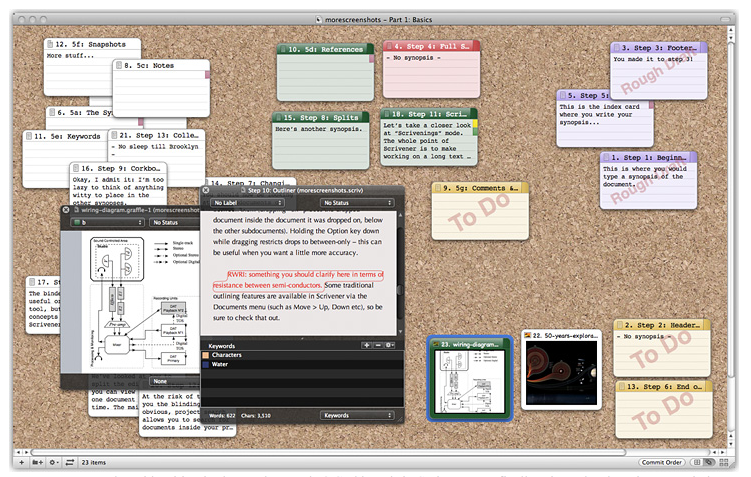
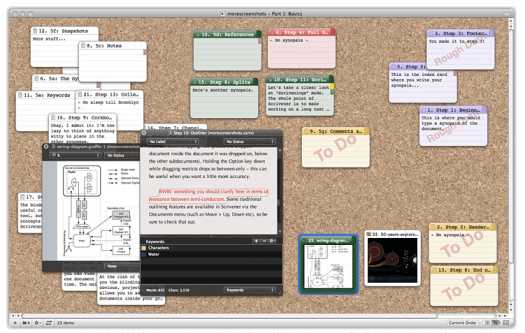
Say good-bye to sticky notes falling on the floor when it gets humid outside. Say hello to the floor you haven’t seen for months, since it’s been covered in index cards. Scrivener allows you to not only create virtual index cards and post them on a virtual corkboard, but you can also rearrange them, even when your manuscript is complete. Need to move chapter 30 back before chapter 14? No problem. Instead of scrolling back up and down through pages of text, just point, click and drag!

Better yet, each index card can function as a chapter synopsis, and you can attach various and individual scenes to each card, again, for easy viewing and rearranging, even within a chapter.

And as an added bonus, you can print out the index cards you create within the program, complete with lines to cut them the exact size of a 3×5 card.

As the website says, “Make a mess. Who said writing is always about order? Corkboards in Scrivener can finally mirror the chaos in your mind before helping you wrestle it into order.”

Don’t like index cards? That’s okay, because you can do your writing (also with rearranging capabilities) via the outlining mode.
3. Don’t just think about Harry Connick as you write out your protagonist’s next love scene. See him on the screen.

Don’t just think about the New York City skyline as your villain creeps through Central Park. Keep a photo of it on your desktop as you write.

Character, setting, and other research organizers allow you to attach photographs, charts, maps, and more all together and accessible as you write. One of my supporting characters looks like Matthew McConaughey. Seriously. He does. So whenever I need to jot down notes about his character, I open up my folder and there he is, gazing at me. Beautiful.
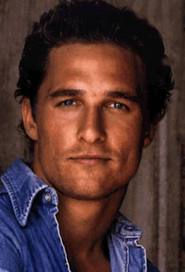
(woah–where did HE come from?!?)

 4. Worry about Word later.

It took me awhile to get over the fear of not writing in Word. But alas, the designers make it possible for you to compile all the text behind all those index cards and export it into one, seamless document which dovetails easily into Word.

5. Other cool features I love:

  • A name generator with every ethnicity and region imaginable!
  • Templates
  • Word count features, by chapter and whole document
  • Color-coding for chapters, editing status, and more.
  • Progress tracking
  • Keyword options
  • Formatting assistance

The website sums it up best:

“Most word processors approach composing a long-form text the same as typing a letter or flyer – they expect you to start on page one and keep typing until you reach the end. Scrivener lets you work in any order you want and gives you tools for planning and restructuring your writing. In Scrivener, you can enter a synopsis for each document on a virtual index card and then stack and shuffle the cards in the corkboard until you find the most effective sequence. Plan out your work in Scrivener’s outliner and use the synopses you create as prompts while you write. Or just get everything down into a first draft and break it apart later for rearrangement on the outliner or corkboard. Create collections of documents to read and edit related text without affecting its place in the overall draft; label and track connected documents or mark what still needs to be done. Whether you like to plan everything in advance, write first and structure later—or do a bit of both—Scrivener supports the way you work.

But wait. Before you buy, please note:

As with any computer program, there are negatives. Some folks–including an adorable and brilliant writer friend of mine–hate it. Also, while a PC version is available, the program was designed to operate on Macs, and the designers even admit it will probably work best on that platform. Try the trial version before you buy it to see if it will work for you and your computer operating system.

Also, you do need to have at least a smidge of computer savvy. And patience. There is a learning curve to this program, and the designers have been kind enough to offer a thorough, interactive tutorial and instruction book. While helpful, the program is so rich even I—a borderline computer geek—felt a little overwhelmed initially. And I don’t know if I’ll ever use all the functionalities.

That said, Scrivener has truly changed the way I approach my novel writing. I feel like it really frees my mind to focus on the prose, because I no longer have to remember where everything is on my hard drive . . . or if my dog ate a sticky note or a stack of index cards.

I honestly don’t know why more folks aren’t using and/or raving about the software.

Try it for free for 30 days.

I can’t throw in a set of steak knives, but I’d be willing to wager you’ll like the program, too.
The Best Advice I (finally!) ‘Got’

I always hated it when writing instructors told me to 1) write what you know, and 2) follow a formula.  How, I wondered, could I write what I knew when I didn’t know anything interesting, and when the only formulas I remembered were from high school math class? I was pretty sure that wasn’t going to be much help in writing anything other than a final math exam.

Now, having finally decoded those two pieces of cryptic advice in the course of my own writing career development, I have only two words to share with would-be novelists: read and outline.

Read books (all kinds!), but also read everything you can get your hands on: newspapers, magazines, the backs of cereal boxes, newsletters, church bulletins. I even read vanity license plates, which inspired me to give one of my series characters distinctive car plates that have played into more than one mystery plot!

The purpose of all that reading is twofold: 1) you accumulate a storehouse of information about the world; and 2) you never know what word, image, or idea will catch fire in your writing process.  Reading feeds you with new material – like ongoing brainstorming.

As for reading books in all genres, I find it’s a great way to broaden my experience. I may not be an expert on scuba-diving or anti-matter research, or know one end of a knitting needle from the other, but if I’ve read about it, I at least have some familiarity with it. And if it might fit into something I’m writing, I can go back for more reading or research.

It wasn’t until I figured this out – that I didn’t have to be an expert about something to write it into a story – that I finally really understood why my teachers insisted you had to ‘write what you know.’ Write what you know – not necessarily what you yourself have experienced. What a relief to know I didn’t have to commit a murder to write about one!

The most important thing I ever did when I was writing my first novel, however, was to outline. And I’m not referring to the outline of my book, either (though I do work from a rough outline when I write). The outline that I found most helpful was the outline I made of my favorite author’s best-seller.

Yes, you read that right – I outlined a book by my favorite author.

It was a tedious task, to be sure, but by the time I finished that chapter-by-chapter outline, I knew more about pacing and plot development than I had ever learned from any teacher or class. My secret was to use a different color marker for each subplot, so that by the end, I had a notebook in which I could visually trace how story threads flowed together and how the notorious ‘red herrings’ of successful plots operated. Deconstructing a best-selling novel taught me how to write my own ‘formula.’

What are you reading/outlining today?

A Brief History of E-Publishing, Part 6: Logjam 2.0

E-book reader - © Anton Maltsev - Fotolia.comI came very close to producing my first novel as a POD book, but I’m really glad I didn’t.

When the POD boom came along, I had just completed work on a suspense-thriller novel titled The Osmosis Project. I’d submitted The Osmosis Project to an agent with high hopes that I was on my way to being a published author. Unfortunately, the agent was not as excited about my novel as I was. Now I had another novel sitting on the shelf and no one to publish it.

So, I reasoned, why not do the same thing that I did with Friendly Revenge?

I didn’t want my novel to be sitting around doing nobody any good. And with POD, I could actually produce a paperback version of my book. Instead of having to relegate myself to disc signings, I could have a “real” book to sell. Better yet, I could be my own publisher and not worry ever again about having to do what I call “the publishing courtship dance” (i.e. queries, proposals, and so on).

And, because the big three POD publishers were eager to attract business, they were offering some really great deals. In fact, when Xlibris came out with a free publishing option, I almost jumped on the bandwagon.

However, before I could get started with the process, something happened that changed my mind.

It’s a long story, but on a whim I sent a query to several computer book companies for a book idea on how to write Web pages, written “by a non-techie for nontechies.” I didn’t really expect anything to come of it, but to my surprise Osborne/McGraw-Hill was very interested in the idea. In fact they were so interested that they gave me a contract to write How to Do Everything with HTML.”

With a book contract in hand, I found it very easy to get a literary agent to take me on.

And that was when I decided to keep The Osmosis Project on the shelf a little while longer. I reasoned that my new agent might eventually be interested in looking at my novel.

Which brings me to why I’m glad I didn’t decide to produce The Osmosis Project as a POD book.

As word about POD publishing spread among writers, the market was flooded with manuscripts. At that time there were only a handful of publishers offering POD, and they were quickly overwhelmed with writers wanting to self-publish with the new technology.

As with the first e-publishing logjam, quality took a nosedive.

The POD publishers were swamped and in an effort to keep up while still looking for longdistancemovingcompanies.co cheap long distance moving companies, often produced poorly-edited, poorly-designed, and poorly-proofed books. Plus, the turn-around time from submission to release went downhill, often taking months longer than promised.

E-publishing history was repeating itself.

Logjam 2.0 had arrived.

However, unlike the e-book logjam (see my Sept. 14 post), this one cleared up as more POD publishers came online. And with those publishers came the first major turning point in the e-publishing revolution.

For all practical purposes, it appeared as if the electronic book had died, replaced by physical books produced through Print on Demand.

But in only a few years the world of e-publishing would again be turned upside down when a company named Amazon decided not only to enter the e-publishing market, but to produce their own dedicated e-reader.

Oh, and that novel of mine? The other reason I’m glad I didn’t release it myself is because my agent did decide to represent it and in 2003 Tyndale released it asBlind Sight.

Sometimes, it’s better to wait.

[Check back on November16, for part 7 of “A Brief History of E-Publishing.”]

10 Kooky Tips On How To Write A Book

My writing nook at home. Don’t be fooled, it looks Pier One, but really, it’s a hodgepodge of thrift store and Craigslist.

I receive emails from people asking how to write a book.

I have written a book but I haven’t actually published it (yet, God give me patience and faith).

So when I am asked, it feels a bit like someone asking a person coloring a picture in a Strawberry Shortcake coloring book how to paint a still life.

Here are 10 kooky tips that popped into my head about writing a book if you absolutely don’t know how to start:

1) Start with a dangerously low self-esteem

This is vital. If you don’t, you may not be able to handle getting knocked off the height of your perch daily from rejection. It’s much easier to begin writing from the depths of despair.

2) If you have kids, get a lock for your bedroom door

My reasoning is two-fold: 1) my bedroom is where I write, and 2) my bedroom is where I cry when I am convinced that I cannot write, and it seems to upset the children when I cry uncontrollably.

3) YOU PROBABLY NEED TO ACTUALLY ENJOY WRITING

Or at least be able to stomach it, if you want to embark on a long project. Seriously, in order to write a book, you have to spend countless hours writing, which may stop you right there. Luckily for me, I love to write and see where it takes me. I also love to sit!

4) Make sure your writing desk has an economy size box of Kleenex.

I cry when I write. I cry over a beautiful sentence (both other people’s and my own). I cry over the fact that I can’t spell. I cry about God’s work in my life rendered on the page.

5) Listen to Papa Hemingway

I talk about Hemingway often, but I believe the goal is one true sentence.

Sometimes sentences string together perfectly and send shivers up my spine. One true sentence is the payback for locking yourself in your room to write.

6) Read books

Readers usually make good writers. Some of my favorite books include “To Kill a Mockingbird” by Harper Lee, “Les Misérables” by Victor Hugo, “Traveling Mercies” by Anne Lamott, and “Twilight” by Stephanie Meyer. (I’m just kidding about Twilight. Sorry, not a teen vampire fan.)

Read books on craft. For memoir, I love Vivian Gornick’s “The Situation and the Story” and Anne Lamott’s “Bird by Bird.”

7) Join a writing class

Most writing classes will require submissions and offer critique. This forces you to write. For years, I attended a memoir workshop in Chicago.

8) Buy business cards on-line and slap “writer” under your name

Call yourself a writer.

Even if you don’t have anything published, if you write, you are a writer. You may not be an author until you are published, but by golly, you are a writer. Put it out there! (And if you buy 250 business cards and have no one to give them to, the kids love to make up card games with them.)

9) Call or text or email people who love you, often

Writing is solitary. You show up and put words on paper and wonder if you actually have anything of value to offer the world. Call your mom, or your best friend, or Joe, the creepy guy at Starbucks who saw you writing one day and gave you his business card. Call anyone who loves you (OK, maybe not Joe) and ask for encouragement. You need cheerleaders. Buy pompoms and pass them out to friends.

10) Don’t write for attention

Believe me, an easier route for attention would be to hold up a Seven Eleven.

What’s your advice about writing a book?


Before the Lord

Hezekiah is helpless. His nights have been sleepless; his days worried and stressed. And now this—an ugly letter full of threats and taunts from Sennacherib, King of Assyria. He has nowhere to turn, except to the Lord of Heaven’s Armies, the One who can do something about it.

He walks up to the temple, spreads the pages out before the Lord and bends low, hands spread out in petition.

“Hezekiah received the letter from the messengers and read it.

Then he went up to the temple of the LORD and spread it out before the LORD.

And Hezekiah prayed to the LORD: ‘O LORD, God of Israel, enthroned between the cherubim, you alone are God…deliver us from his [Sennacherib’s] hand so that all kingdoms on earth may know that you alone, O LORD, are God.’” II Kings 18:14,15,19

The powerful example of this story affected me profoundly. I have since followed King Hezekiah’s example with various things that overwhelm me. Things I know I cannot possibly handle on my own: the endlessly large parade of medical bills following my husband’s recent kidney transplant; a painful letter from someone; a letter from a reader who is hurting, sharing with me, and who wants my prayers and advice.

And for the past seven years, I’ve also applied this to my writing as well. I have prayed over rejection letters and hopeful queries. Before I submit a piece, a proposal, or publishable material – paper pieces of my heart – I spread the pages out (or place my hand on the computer screen) and petition God to guide these pages into the right hands.

I ask Him for the right eyes to read this work.

For my agent to have wisdom and discernment on where my writing would be best sent.

For both my agent and me to have diligence and determination without undue discouragement.

For readers’ hearts to be touched.

For me to write to His glory alone, every word committed to Him.

For me to honor God with my every written word, my every action, my every thought. After all, what I want more than anything is for my writing to help “all kingdoms on earth to know that He alone is God.”

And then, I hit send, or carefully slide the manuscript into an envelope and seal it, trusting God for the outcome.

How do you commit your writing to God?

Reflection on the Writing of Books

After a conversation with a Catholic friend the other day, I got to thinking about the nature of revelation. My friend and I believe the same exact good news—that God orchestrated his son’s human birth and death and coming back to life so that we humans could live forever—but we come to it so differently: my friend through tradition mainly, beliefs passed down and solidified over the centuries since Jesus’ time, and I mainly on the basis of what Jesus’ friends and their followers wrote down long after he left them.

If my friend and I were to argue the superiority of our respective views—which we do not, being content to share the essence of our faith, if not the minutiae of how we came to embrace it in the first place—we would soon reach an argumentative impasse. My friend’s sources are certainly older, since the passing down was already happening when Jesus still walked among us and words still dropped from his tongue and people around him were still being amazed by the miracles he performed in their midst. I would argue that, while my sources are centuries younger, they were surely more authoritative for having been written down rather than left to a millennia-long game of telephone, in which the message changes, often comically, every time it’s passed from mouth to ear. He would surely counter that mindless adherence to an ancient book produces its own, often comical, misunderstandings about God, and I would have to agree. And so it would go. If, that is, we lowered ourselves and risked our friendship to argue in this way. But, as I say, we don’t.

It struck me in thinking about this non-argument, though, how crucial a role words and books do play in my faith—even though, as the apostle Paul rightly asserts, “since the creation of the world God’s invisible qualities—his eternal power and divine nature—have been clearly seen, being understood from what has been made” (Romans 1:20 NIV). Even small children, incapable of reading, can know God—as I did when I was little—just as non-literate believers have throughout the centuries.

Faith, in other words, does not have to depend on written words. And yet, for many of us—for me—it does. Or, perhaps not faith itself but faith growth.

And although my friend might argue that my dependence on specific words and passages of scripture surely limits my capacity to believe, I am confident that, in the main, the Bible enlarges my faith, challenging me to see and hear and inhabit the world differently than is my wont and to recognize God in it more readily. So, too, do other books. Something about words, written down, demands reflection.

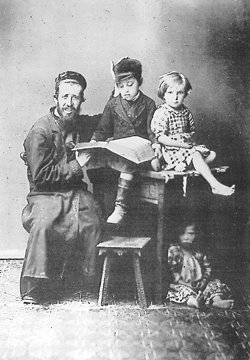
A melamed (teacher) and his students in 19th century Podolia

So, it seems to me, we writers of books have a significant role to play in the furthering and nurturing of faith. And, though God is bigger than anything we or the biblical writers of old can convey, bigger indeed than the Bible itself, we have a rare responsibility. We govern unseen cities already, through our words, and tutor the very children of God.

Ever-Increasing Returns

Publishing a book is an adventure. Part of that adventure is engaging with the people you meet along the journey. Some of those people will serve in a capacity of enlightenment and support. They provide assistance for you at different turns. It could be marketing assistance, subject matter expertise, best practices, or networking to find the sensei you seek. Lest we forget, the best adventures usually require planning behind the scenes. The book writing adventure entails hours of constant editing and agonizing over the right words.  There is nothing glamorous about this part of the journey – it’s the grunt work that makes everything else possible.

Adventures are often taken solely for adventure’s sake.  Sometimes you return with treasure, but not always. Upon attending my first literary workshop, I found it a bit daunting to learn that only 5% of writers actually make a living from their writing. Anyone who has ever penned a book knows how challenging it can be. If there is no monetary value in the experiment of publishing a book, why should the author continue up the mountain? The author goes on because it’s a labor of love. There are other ways to get compensated from writing a book. The total compensation package is comprised of much more than money. Opportunities to help others appear continuously and if you find such experiences rewarding, your pockets will be continuously lined with gold.

One of my favorite movies is Rex Pickett’s Sideways. Through Twitter marketing I stumbled upon Rex’s profile and discovered Sideways has been adapted for the stage. I saw Sideways the Play in Santa Monica and was able to meet Rex, who has been an inspiration ever since. Tweeting has been valuable in other ways, too. By building relationships with authors, readers and bloggers, writers gain a greater scope of influence and increased credibility. Nothing is more valuable than that.

There are countless ways to spread the wealth of knowledge acquired on the writing journey. By researching the process of formatting a novel into an audiobook, I became acquainted with www.acx.com. This fluid website is a hub for authors to connect with actors that do voice-over work. Authors can connect with actors in a number of ways. One is to upload some material so that any interested actor can audition for the ‘role’ of narrating the content. One actress auditioned to be my book narrator within twenty-four hours of uploading sample pages. Hearing her try out for the voice of my protagonist was an incredible experience. Authors can also take the more active approach of searching for a specific kind of voice. If there is a need for a young woman with a French accent, you can search your ideal parameters to find actors and make them offers. You have options of payment, one being a 50/50 royalty share. Going through this exercise made me think of a friend who is always looking for voice-over work. I was able to inform him of ACX, and he is probably getting his account set up with them as we speak. Some of the actors are listed to make $200.00-$400.00 per completed hour of work. For those with golden pipes, it appears to be a very good opportunity. My friend’s enthusiasm and delight over engaging with ACX was better than selling fifty books. My ability to help him was a direct result of being on the journey.

Many opportunities in the form of people will appear on the path during your publishing adventure. The lifetime value of these helpers, guardians, luminaries, and assistants will not always be evident at first. Some may help you indirectly with constructive feedback you don’t want to hear but know you need. In turn, you will be able to help others as well. You will encourage them to believe that they can do what you have done. Some will even thank you for your contribution to the written word. For those who are able to take a creative mindset in terms of total compensation, there will always be a deep blue ocean of  ever- increasing rewards.

In what non-monetary ways have you found the writing journey rewarding?

5 Benefits of Collaborative Writing

http://www.stockfreeimages.com/

Franz Kafka, the famous author of “The Metamorphosis,” once wrote that writing is utter solitude, the descent into the cold abyss of oneself.

Although Mr. Kafka sounds a bit creepy, I get it.

As a mother to four kids, I relish hours alone with clicking fingers and thoughts. It’s just me and my laptop, or a pen and a piece of paper, and I’m hurled into a different time, place, or life. “How do I know what I think until I see what I say?” said the great E. M. Forster.

I concur.

Solitude is a treasured gift in my writing life.

But as I’ve delved into my career, the importance and benefits of collaborative writing have become undeniable. I’ve realized, with time, that my writing can get blurry. My business plan can be smudged. Enter collaborative writing.

When I say collaborative writing, I mean sharing my work with others, helping fellow writers along the way, and receiving criticism and suggestions regarding my work. I need people. I need editors, and proofreaders, and cheerleaders. I need instruction, shared experience, correction.

Col·lab·o·ra·tion: The action of working with someone to produce or create something.

Letting people into my solitary writing life has been a great experience. I create more. I create better. How? In what ways?

I’m glad you asked.

Here are 5 benefits of collaborative writing:

1. Collaboration strengthens writing skills

After I committed to writing my personal story about having a child with Down syndrome in the former Soviet Union, I looked into taking a writing class. God hooked me up with a great group. We read and discuss memoir, submit pages, and critique each other’s work. This sort of collaboration with other writers has strengthened my writing muscles and encouraged me greatly. Plus, I made writer friends!

2. Collaboration helps keep the green monster at bay

Let’s face it. All writers struggle with jealousy. I surely do.

When I collaborate with others, whether I’m reading or editing someone’s work, promoting Facebook fan pages, or having a friend guest post on my blog, it’s more difficult to for me to be jealous. Instead of racing for the win, I become a fellow sojourner along the path. If you find yourself repeatedly jealous over another writer’s success, I suggest you attempt to collaborate with him/her. It will change your attitude.

3. Collaboration builds platform

Nine times out of ten, when I’ve helped another writer, he or she ended up helping me too. Like someone’s post, share a fan page, host a blog parade. People will notice your generosity. And maybe next time, they will promote you.

4. Collaboration pushes deadlines

Whether you are submitting new pages to a group, or working with an editor on a freelance project, or in the final stages of line editing with your publishing house, deadlines push you. In order to write more, often, and better, collaborate with others. You will be forced to meet deadlines, which, in turn, will force you to write more.

5. Collaboration makes me an upstanding literary citizen

I’m convinced that as writers, we need to contribute to the literary society to which we belong. Read. Buy books. Share articles. Subscribe to magazines. And I would add collaborate with other authors.

Collaboration is a win for all involved.

George Orwell said that good writing is like a windowpane. I’m convinced that in order to write well, I need others around me holding the Windex bottle, spraying, and wiping my purpose, productivity, and prose clean with wadded up old newspaper.

What about you? How have you/do you collaborate with other writers?