Double Booked by Two Authors

Photo/KarenAnita“Did you find your book?” I asked.

“No, but yours is on this aisle,” Anita responded.

Then the young lady standing near us asked, “What books do you need? I’m looking for one about anxiety and worry.”

“Well, I’ve got the perfect book for you,” I grinned. “I just wrote a book about the lessons I’ve learned about worry.”

Anita added, “It’s called Words That Change Everything: Speaking Truth to Your Soul. They have several copies of it here. It’s a great read!”

BookCover/WordsThatChangeEverything

The lady looked stunned as she examined the back cover of my book and my photo. “Seriously, you wrote this book?”

“Sure did,” I smiled. “And if you need a book about Getting Through What You Can’t Get Over, I highly recommend this one.” I pointed out Anita’s book: Getting Through What You Can’t Get Over: Stories, Tips, and Inspiration to Help You Move Past Your Pain into Lasting Freedom.

“I sure do! I’m looking for a book to encourage my friend, whose son was killed in a motorcycle accident a few weeks ago.“

Getting Through What You Can't Get Over Book Cover“Well, Anita’s book contains several inspiring stories about people who walked through some really difficult situations. I think it would be helpful for a person going through grief and post-traumatic stress.”

“Are you both authors? And you wrote both of these books?” Our new friend appeared confused.

“Yes, we attended a booksellers’ event here in town during the past few days. So, we decided to stop by this bookstore on our way home to see if they carried our books.”

Glancing at the two books in her hands, our new reader looked back up at us and giggled, “Well, I’d love to buy both of your books!”

“Awesome! Would you like for us to autograph your copies?” I asked.

“Yes, that would be great,” she smiled. “I still can’t believe you both really wrote these books!”

“Well, we’re finding it a little hard to believe that you were looking for books that deal with those topics.”

“I’m serious—these are exactly what I needed!” Then, she added, “This has to be a “God-thing.”

“Yes, a ‘God-thing’ for sure.” We agreed.
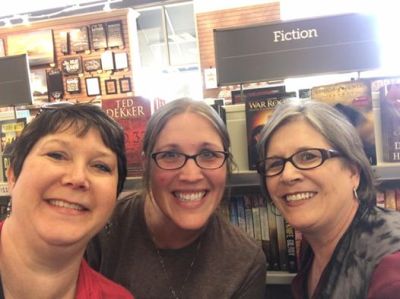
Photo/AnitaKarenThen, one of us suggested, “Hey, let’s take a ‘selfie’ to capture the moment.”

After I fumbled to find my cell phone in my purse, I said, “Okay, let’s strike a pose. Smile!”

After our brief photo shoot, we all embraced, recalling our unexpected encounter.

“Can we pray for you and your friend before we leave?” I offered.

“I would love that!”

“By the way, what’s your name? And what’s your friend’s name?”

“My name is Kendra. And my friend’s name is Karen.”

“Well, of course her name is Karen,” I laughed.

As Kendra walked to the register to purchase our books, we heard her telling the assistant manager about our encounter.

Anita and I waved at both of them as we turned to leave the store.

“What an awesome ending to a very productive week,” I commented to Anita.

“I told you we needed to stop by this bookstore!” Anita laughed.

Before we left the parking lot, Anita posted the photo of us with Kendra on Facebook, sharing our experience at the bookstore.

Best bookstore stop ever! Met this beautiful young lady named Kendra. She was looking for a book on anxiety and worry for herself, and another on grief for a friend who just lost a child. Talk about a God moment.

When she found out we were authors, and Karen wrote a book titled Words That Change Everything, and I wrote one called Getting Through What You Can’t Get Over, she took a copy of each off the shelf. After a quick, impromptu signing, we parted ways—all of us stunned in a great way. People like Kendra are why we do this.

 Amen, Anita. This IS “why we do this.”

Tell us about one of your God-moments as an author.


Acting My Way into Feeling: Just Write!

Photo/KarenJordanI’m about to do one of the hardest things I’ve done recently—WRITE!

“What? How can that be?” you ask. “You’re a writer! Isn’t that what writers do?”

Confusion. I wish I could tell you what’s keeping me from doing what I need to do. But I don’t have any answers at this point.

In fact, I’m not even sure I have anything of substance to offer anyone now. But I’m just going to write—and hope something helpful surfaces. Anything is better than nothing at this point.

Confession. After church this morning, I confessed to my husband that I hadn’t really felt like going to church today and entering into worship. But I did. And I’m glad I did—the sermon really spoke to my heart.

Modification. I’m also reminded what I learned years ago in a behavior modification class at seminary: “You must act your way into feeling.”

At first, I didn’t have a clue what the professor meant by that statement. But I tried it, and it worked.

For instance, I NEVER feel like doing housework. But I ALWAYS feel good about finishing my work.

So, that’s what I’m doing right now. Write—even though I do NOT feel like writing. And in the process, I hope and pray the feeling and the words begin to flow again.

Examination. Have you ever faced this problem? Maybe you’re not a writer, and you don’t get it. But perhaps there is another issue you might be struggling with in your work or even at home.

Perhaps you want to be happy or thankful, but you just can’t conjure up those positive emotions right now. Or perhaps you just don’t “feel” like being anyone’s mom right now—but you ARE a mom.

Maybe you don’t have any romantic feelings toward your spouse anymore. I’ll share what a pastor advised one man who claimed he didn’t love his wife anymore. This wise counselor simply responded with quote from God’s Word.

Husbands, love your wives, just as Christ loved the church and gave himself up for her . . . (Eph. 5:25 NIV).

Do you see his point? God’s Word reveals that love is a choice, not a feeling.

Decision. So, maybe—just maybe—we can experience joy and thankfulness as we make the decision to be happy or grateful.

What about writing? Well, I’ve learned that often I really don’t “feel” like writing. And many times I must just do what I don’t “feel” like doing.

Instruction. So, I guess I’ll just repeat the words of a wise writing instructor once again, “JUST WRITE!”

By the way, I hope my confession encourages you today to do whatever you need to do if you’re stuck!

And another thing—be blessed!

What strategy helps you when you don’t feel like writing?

How I boosted my book to 30x more people

ebookI finally bit the bullet. I boosted a post on Facebook.

For years, I’ve seen that annoying little message you get on your author page about paying to boost your posts. Because I’m cheap (and still suspicious of social media’s REAL intent, i.e. who needs to know what I buy, who I connect with, and what I like? Creepy…), I refused to give it a try. If my books can’t make it on their own merits, so be it – I’ll be content with small audiences, extremely limited financial reward, and the personal gratification that I haven’t caved to crass commercialism.

And then last month after I started getting consistent raves about my new thriller “Heaven’s Gate,” I thought, “What the heck. It’s only $20.”

Actually, it ended up being $60, since I decided if I was going to experiment, I wanted to see what a week of boosted posts could do rather than one day, which is what $20 will buy. Knowing that most buyers need to be exposed to a product seven times before they buy (do you know the Rule of Seven?), I figured one day of boosting was throwing away cash, but seven days might just convert into some sales. I can now tell you, without reservation, that $60 worth of boosting on Facebook can go a long way in giving your book exposure and building your audience, and now I can’t wait to give my other books the same treatment.

Here are the numbers from my week-long experiment:

  1. Organic reach peaked at 305 on Day 7, while paid reach was 9045. That’s 30x more people reached than my normal posting! Not only that, but thanks to my OCD tendencies, I checked one last time on Day 10 (remember I only paid for 7 days of boosting) and was happy to see a new total of 9432. The post was still being shared after my paid boosting! Score!
  2. I monitored my book’s print and ebook rankings on my amazon Author Central page (you do have one of these, right?) for the boosting’s duration. By Day 6, my ebook ranking had reached 924 in the Paranormal category after starting on Day 1 at 3366; the biggest jump was from Day 1 to Day 2, which tells me that first burst of posting made an impact that powered the rest of the week. Recalling the Rule of Seven and the impact of repeated impressions, though, I looked again on Day 18, only to find my ebook ranking better than ever at 831!
  3. As for print, my book moved from its initial 76,331 ranking to 8535 on Day 5. Clearly, somebody was paying attention.

Even knowing that rankings are a superficial measure (rankings don’t equal sale units), I decided that post boosting may not be such a bad idea for marketing after all. While the actual sales numbers are still in question, I know for a fact that more people have seen my book’s cover thanks to post boosting than would have otherwise. And that’s one step closer to buying my book.

Have you tried Facebook post boosting? What was your experience?

Don’t ride . . . DRIVE the train!

trainAbout fifteen years ago, while taking a graduate course in Spirituality and Leadership, I had a professor who presented me with one of the most motivational sayings I’ve ever encountered: “Don’t just ride the train, be the engineer!”

Okay, maybe not the most theological statement I heard in the course of my graduate program, but it lit up my brain in ways I’d rarely experienced since finishing my undergrad degree decades earlier. Knowing myself to be an introvert and nonconfrontational, I’d always preferred to have someone else take the lead in projects at work; the only role in which I felt confident enough to be in charge was as a mother to my children. (Looking back, I can only say that ignorance was truly bliss, but that’s another post or two or a thousand.)

But the moment my professor uttered that directive, I had an epiphany that any writing career I wanted to pursue was going to demand that I drive the train, and not just ride along on whatever might come my way. As a result, I began to view writing as a vehicle I would steer, and, when necessary, refuel with energy and hard work. I also accepted that no one else cared as much as I did whether that train finally arrived; not even the support of spouse, family and friends (as important as that is!) would bring that train into the station if I didn’t commit myself to being the engineer.

I share this story with you because every writer needs to know that writing requires you to make that train your own: if you want to be successfully published, you have to learn the business, and these days, that means EVERY aspect of the business: writing craft, understanding your audience, marketing, platform building, travel requirements, publishing trends. Gone are the days when your publisher says, “Thanks for writing this swell book. We’ll take it from here.” Even your agent – if you’re fortunate enough to land an agent – can’t hold your hand through every stage of book development, because she or he is swamped just trying to navigate a path to publishers through all the layers of the industry – layers which can shoot down a book proposal for reasons of marketing or audience or numbers of your social followers, which may have nothing to do with the actual value of the book you’re creating.

You have to take ownership of your career. You have to drive the train to where you want it to go.

And that may be the biggest plus of being the engineer – you can CHOOSE where you want your career to go. It will take hard work and learning from the experience itself, but if you find you’re being called to write romance instead of devotionals, or humor instead of profiles, or politics instead of fiction, you can steer that train of your writing career onto different tracks, and see where it takes you. Maybe it will only be a short detour and you’ll end up at your original destination. That’s great! Then again, it may be a whole new journey on the writing rails.

Are you ready to drive the train?

How to make your readers SUPERfans!

supermanWhen you have a book published – be it in print or ebook – you want to get as much publicity as possible to sell copies, right?

Right!

Do your fans know this?

Well, yes, I think they do.

You THINK they do?

Here’s my suggestion: tell them you need their help to generate that publicity. You need their word-of-mouth to help your book get launched amidst the thousands of books that are available.

You need to give them the 3 Rs of superfans: Read, Review, and maybe most importantly, Rave!

With the launch of my newest suspense novel, Heaven’s Gate, I put together a launch team of thirty readers who agreed to read and post a review on amazon.com and whatever other social networks they had, along with any word-of-mouth recommendations they might be able to give. Like many writers, I’m not especially fond of online marketing because it takes a lot of my time, but the fact is, writers in the 21st century need to cultivate their presence on it. (I, personally, have had varying success with different networks, but I continue to learn and work at it because I’ve seen its value at different times. Let’s face it, if there’s a gathering of readers anywhere – even online – don’t you think an author would be remiss to ignore it?) What I’ve discovered since my book debuted last month, however, has added another piece to my formula of reading and reviewing: you need readers to RAVE about a book to influence others to buy.

So far, maybe this seems evident to you, but this next comment might catch your attention: I learned that you need to tell your readers what to write. I don’t mean give them a script – you  want their honest reaction. But what you need to do is empower your readers to write raving reviews, which result from two things: an awesome reading experience (which you have crafted with your book!) and a vocabulary that will reinforce what you want them to say.

Simply suggest key words you’d like your reviewers to use.

At first, I felt odd suggesting words to my readers to use in constructing their reviews. Then I realized that key words are…well…key. Keys, actually, to triggering the all-important call-to-action that every author needs to make to potential readers: You Need To Buy This Book Now. And guess what? Your reviewers are often very grateful to have your suggestions, because they want to write a strong review for you, but are often lacking in promotional experience and don’t know how to best help you with their review. I asked my reviewers to use the words suspense, supernatural, Archangels series, faith and science, String theory, fast ride, and thriller. They did, and as a result, the reviews for Heaven’s Gate present a consistent rave of being a book you can’t put down, which has cued new readers to order the book.ebook

Remember, your fans want you to succeed. Making it easier for them to help you is the least you can do!


Learning new marketing tricks

dog shaking handsI am living proof that even old dogs can learn new tricks.

Except that I’m not a dog and the tricks I’m referring to don’t have to do with “shake” and “roll over.”

As an author who came to the book publishing game in her mid-fifties, I realized I had to embrace the internet and social media marketing if I was going to play in the marketplace. As a result, I’ve read a lot of books over the past few years about online marketing and tried to apply that knowledge. But the book I’m finding the most instructional and helpful is Red Hot Internet Publicity because it gives you simple ideas you can implement easily and see immediate results.

twitter-bird-light-bgs.pngFor instance, I’ve never quite been sure how to leverage my Twitter activity into growing my audience; twice-daily tweets and random retweets of those I follow can only do so much in attracting engagement when you consider the enormity of the Twitter universe and its competing attractions. After taking just one tip from RHIP – participating in a group chat sponsored by one of my influential Twitter contacts – I picked up five new followers and at least one immediate book order. “Gee, this really works!” I thought. (Well, duh – the book’s title is Red Hot Internet Publicity, not Mediocre Marketing Online.) As a result, I’m now devoting effort to finding chats EVERY DAY hosted by key influencers in my book topic areas and being sure to participate with tweets and retweets. Yes, I know – it’s called a social network, and that means you’re supposed to be interacting with others, but somehow, actually “chatting” online had seemed a waste of time. No more.

facebook_circle_color-128Likewise, thanks to the book’s advice, I’m streamlining my Facebook involvement to make my time on it more productive. Sure, I’d read before that you need to have your marketing message in front of you every time you post, but I’d gotten lazy. After reviewing my message and tightening its focus (another recommendation from the book), I’ve been more vigilant about making EVERY post count with a comment that somehow reflects that message. The result has already yielded me new followers on my author page at Birder Murder Mama, which had stalled out in the last three months.

Those are just two of the ideas that have already made a difference for me in internet marketing. Being the perennial student that I am, I made a list from each chapter in RHIP of items to try out. Fortunately, I’m gearing up for a book release in May, so the timing to fire up my social media marketing is perfect, and I’m finding lots of opportunities to practice what I’m learning. And that – immediate practice of what I’m learning – is key. Too often, my ideas sit in a file for that magic “sometime” when I’ll get to it. But thanks to the simple presentation of RHIP, AND the timely suggestion from my agent to download and read this new book, my magic “sometime” is right now.

I guess my new trick is “shake” after all – shake up your marketing and see what happens!

6 Questions and Ideas for Your Writing Reflections

Photo/KarenJordan

“[T]ake chances, make mistakes, get messy!” (Magic School Bus)

Do you tend to focus most on your grammar and mechanics when you self-edit? I do.

I want to offer you some questions and ideas that will help to get you out of the “grammar cop” mode and into a more reflective mood.

Writing instructor. I compiled this list of questions as a writing instructor at the University of Arkansas at Little Rock. I offered these questions to my students to help them in their revision process with their papers.

I’m not sure where I got most of these reflective questions. Writing instructors tend to do a lot of “academic borrowing.” If you teach, you know exactly what I mean.

Professional writer. I also try to remember to ask myself the following questions when I’m reflecting on my own work, so I won’t be so critical of my own work. I tend to be a bit of a self-deprecating perfectionist at times.

I offer the questions and ideas to reflect on your work. I hope it will encourage you to tell the stories that matter most to you. So, let me know if they help you. [You can share your thoughts in the comment section below.]

Consider these questions/ideas as you reflect on your next project:

  1. Who do you imagine might be the audience for this story? (Self, parent, child, writing group, etc.) What details did you include for your audience?
  2. What feelings and reactions did you have as you were writing the story? What surprises? What insights? What have you done or what might you do that would capture those feelings, reactions, insights?
  3. What do you think this story means to you? Have you shown what the story means to you in the writing of it? What have you done? Where and what might you do?
  4. Pose questions you wonder about this story or that emerge from this story. What do you need to know in order to complete this story?
  5. How would you revise this story? Write a plan for your revision.
  6. What did you learn about yourself from writing this story? What did you learn about writing from writing this story? What did you learn about writing from reflecting on this story?

What reflective questions do you ask yourself when you revise your work?

Take it with you when you go

moving dayMy husband retired from his job last December in Minnesota , and within a month, we were unpacking our worldly goods in our new home in Texas. Having relied heavily on my local readership for growing my book authoring career, I was faced with a choice: retire from my own career as a writer, or start it all over again in a new place.

Actually, there was no choice for me: since I can’t NOT write, here I am, back at square one. Except that this time around, I have eight years of experience and a track record as a published author behind me as I begin to cultivate my new area; my task is more transplanting than seeding. For any of you facing a geographic move, here are some of the positive and negative aspects of taking your authoring with you:

A fresh audience!

Positive: You have a fresh audience, which forces you to remember why you write, why you’re excited about what you write, and how what you do can serve readers in your new community. It’s a wonderful opportunity to look at your work from new angles and refresh your own enthusiasm for what you do. And with books already in print, you have product ready to promote in your new area – no waiting around for publication to happen – yet you can re-use the promotional tools you used the first time around, saving you the time and effort of developing new marketing strategies.

Negative: You have a fresh audience, which means you have to start over making connections with bookstores and other venues. Back to phone calls and building relationships (sigh).

A track record as an author!

Positive: You’ve got a track record as an author! Yes, you’re making phone calls, but you’re going to get farther faster in booking events because you’re a proven entity. Your past experience makes you smarter about ways to reach decision makers, adding to your credibility as a published author with new contacts. Since this is your second time around, you won’t waste money and time on the ideas that didn’t work when you were just starting your authoring career.

Negative: You have to put the time in again on building key relationships.

New sales!

Positive: You have a new geographic market to add to your original readership, potentially doubling sales for both old books and anything new to come. Just because you’re no longer physically available doesn’t mean your loyal readers from your old location will abandon your future releases – those fans need to be kept in the loop as you move forward, so be sure to continue communications with them (Facebook, author newsletter, etc.).

Negative: You will lose some readers who only enjoy local authors. Hopefully, though, the gains in your new area will outweigh the lost readers.

Can you add to these experiences/insights of taking your authoring career into new territory?

Pantser or Planner?

All writers are created differently.

We can sit in the same classes, but each of us holds different stories in our hearts and minds. Each of us has our own voice. Each of us has our own process or lack there of when we work on our books.

Thank the Lord we are all so different or we wouldn’t have a variety of stories and books filling the shelves and internet. But no matter how different our process or our stories, there is a rhyme and reason to structuring our novels.

I just got back from the Deep Thinkers Retreat through My Book Therapy where we focused on story and structure. Both Susie and Rachel write fantastic books. Both have different processes. As I sat listening to how they process and plan, I realized that I fall in the middle of their styles. I’m a planning pantser. Like how I just created my own title there?

Planners need an outline, a very specific structure. The story is mostly written before they begin. They just have to weave it. Pantsers don’t like the structure. They have it all in their head and heart and want to sit down and write however the story leads. There is a beauty to both. There is also a danger to both when we overcompensate. It is important to focus on story structure. It makes the story cohesive, focused, and strong. There is also a beauty to allowing yourself the flexibility for letting the scene change.

Historically, I write a very brief outline, focus on some character development and personality, and then hit the page. Often the structure would overwhelm me and make me feel boxed in, so I would toss my hands in the air and just start writing because there I find the freedom to breath.

After this retreat, I have realized I need the structure, I need to plan. I know how and have the tools to accomplish this in a manner that makes my character and plot sing. Then I need to use that to allow the words to just flow.

So where do you fall on the wide spectrum of writers? If you are a planner, plot that thing out. Know the ins and outs of your character. My boss always says to “plan to be flexible,” and I would echo that with your writing. No person, place, or thing is without the ability to change, even if only a little. No matter what you plan, the story will probably change as you write. Enjoy the process!

And for all my pantser friends out there, own it and enjoy! I would encourage taking a little time to make sure it all connects and then rock that flexibility.

I am discovering that I don’t need to follow the process of other writers. They are succeeding with their writing not because they all write the same, but because they have owned their voice, story, and process. Perfection isn’t the end goal. I would argue that connection with reader and excellence in the story is more important. However it works best for you, get that story on the page, write from the voice that God gave you, and do it to the best of your ability as unto the Lord and not unto man.

Are you a pantser or a planner? What works best for you?

When the Honeymoon is Over

When I firJuly 17, 1982 001st started writing…

I was living the dream. I spent an hour every morning adding words to my Work in Progress before our homeschooling day started. There were no deadlines; no one demanded anything of me. I dwelled happily in my writer’s cave, isolated from the world, reveling in the company of my characters.

Yes, it was a honeymoon, and everything was perfect.

But as we all know, the honeymoon has to end sometime, right? For me it came to a screeching halt when I signed that first contract.


Just like a honeymoon gives way to the reality of married life, my writing honeymoon quickly turned into the reality of being a published author. But that was all right. I didn’t want to live in a perpetual newbie-honeymoon state in my writing career. I wanted substance. I wanted long-term. I wanted a lifelong commitment.

Thanks to my hard-working agent (hi, Sarah!), I’m on the threshold of that long-term writing life. And that means multiple projects. I’m marketing one book, editing another, writing a third, and proposing a fourth. This is the challenge I thought I wanted back in the writer’s cave days.

picture 3

So how does a writer handle a challenge like that?

Here’s some advice I’ve received from writing friends:

  • Keep writing. Write 1000 words a day. Do the math: 1K per day (without Sundays) becomes 320,000 words per year. Piece of cake!
  • Keep on target. There is no magic potion. Get in a groove. Make that 1K per day a habit. Every day, same time, same place.
  • Keep learning. My 1K per day takes about an hour of “bottom in the chair, hands on the keyboard.” I spend part of the rest of my time reading writing craft books or taking on-line classes. Even after publishing four books, with two more in the pipeline, I still have a lot to learn!
  • Keep planning. I also spend part of my writing day planning the next project. After I turn in the last book for my current trilogy from Revell, I’d really like for them to publish another one. So I’m starting to lay the ground work for that series. I’m also in the middle of planning a new series for Love Inspired Historical. These new projects keep my creative juices flowing!
  • Keep dreaming. Kariss Lynch wrote a great post about the difference dreaming makes in our creative life. You can read that post here: The Importance of Dreaming
  • Keep living. The honeymoon really IS over if your writing becomes an all-consuming passion. Spend time with your family and friends. Give yourself time off.

Every once in a while, I ask myself if my current life is meeting 046my expectations.

Is the challenge I thought I wanted during my writing honeymoon satisfying enough? Is it worth the work? Does it have substance enough for a long-term, lifetime commitment?

Yes. Oh, yes.

What about your writing life? Are you still in the honeymoon stage, or on your way, navigating through deadlines and contracts? Is it worth it?