Creating Plots

I recently attended an intensive writing retreat given by Steven James and Robert Dugoni.

Happy PeopleHere are some of the highlights from the session on creating plots.

One way to look at plot is to ask: What’s a story? It’s the protagonist’s journey. There has to be movement on some level—we don’t want to confine the character. The journey can be physical, emotional, or spiritual. Or all three. As long as we keep the protagonist moving.

What motivates the character to start the journey? The motivation can be simple: love, justice, hate, revenge, power, greed, fear, or adventure.

Here’s a five-question exercise for brainstorming a story, given by Robert Dugoni:

  • Who is my protagonist?
  • What is my protagonist? (accountant, police detective, stayquestion marks man in circle-at-home mom, lawyer, etc.)
  • Where is my protagonist? The setting for the story.
  • What does my protagonist want?
  • What stands in the way of achieving it?

Also, when you’ve answered all these questions, you have the basics of your elevator pitch.

The basic elements of plot are the beginning, the middle, and the end.

In the beginning we establish the tone and the genre. And we introduce who we are going to be traveling with on the story journey—the protagonist.

Also, at the start of the story, we want to create empathy for our hero. One way we can do this is to give the character a wound we all share and a goal we can identify with.

We also want to hook the reader by asking a question or introducing a problem that launches the protagonist into the story.

In the middle, the story continues to develop as we take the protagonist deeper into the story question or problem. And we add twists and surprises.

StrivingWe also add escalating obstacles that make the situation worse. These obstacles must serve one of two purposes: they must move the story forward by raising the tension, or they must further develop a character trait, or both. If they do neither, they need to be cut. Otherwise, the dreaded sagging middle will occur.

The obstacles lead us to the climax where the protagonist either achieves his quest or doesn’t.

The end of the story answers the story questions. It must be satisfying to the reader and it needs to show the protagonist changed by what he experienced in the story.

Here are two excellent resources for plotting. There are many others but I find these very helpful:

  • Plot and Structure by James Scott Bell
  • Plot versus Character by Jeff Gerke.

Facing Trouble with Courage

Photo/TaraRoss“In this world you will have trouble. But take heart! I have overcome the world” (John 16:33 NIV).

Have you faced trouble in your journey as a writer? Have you been tempted to give up on your writing dreams or career because of failure, rejection, humiliation, shame, or judgment?

Fear of judgment, criticism, or shame? When I struggled with some critical comments and judgment years ago, I expressed my frustration to my husband, Dan. I winced at his abrupt and honest response, “Karen, not everyone is going to like you.”

Photo/TaraRossDan’s statement shocked me, as he reminded me that not everyone likes me or agrees with my opinions. And I’ve revisited that story many times, when I try to encourage other writers.

I still grieve over rejection or criticism, and I prefer to walk away from all confrontations. But I’ve learned a lot from my failures—in relationships and writing.

Photo/TaraRossFear of writing process? In his book On Writing, author Stephen King says, “The scariest moment is always just before you start.”

Even well-known writers must face rejections and criticism. The writing process demands prewriting, drafting, revising, and proofreading before any publication. You may become offended or embarrassed when someone offers constructive criticism. Some writers even give up rather than face more editing, critical remarks, or rejection letters.

Fear of rejection and failure? Do you see rejection as failure? Failure often points us toward changes in our direction and priorities. C. S. Lewis explained, “Failures are finger posts on the road to achievement.”

Author J. K. Rowling agrees with the advantages of failure.

Why do I talk about the benefits of failure? Simply because failure meant a stripping away of the inessential. I stopped pretending to myself that I was anything other than what I was, and began to direct all my energy into finishing the only work that mattered to me.

Thomas A. Edison advised, “Many of life’s failures are people who did not realize how close they were to success when they gave up.”

Tempted to give up? I’ve been tempted to give up more times than I’d like to admit. Have you given up on something because of a failure?

Matthew 26 describes a time when the disciples faced failure. They fell asleep while Jesus prayed, after He asked them to stay on the lookout for danger or trouble in the Garden of Gethsemane. They must have grieved over their lost opportunity and broken promise. But Jesus responded, “Get up! Let’s get going!” (Matt. 26:46 MSG)

There will be experiences like this in each of our lives … times of despair caused by real events in our lives, and we will be unable to lift ourselves out of them. The disciples … had done a downright unthinkable thing … gone to sleep instead of watching with Jesus. But our Lord came to them taking the spiritual initiative against their despair and said, in effect, “Get up, and do the next thing.” If we are inspired by God, what is the next thing? It is to trust Him absolutely and to pray on the basis of His redemption.

Never let the sense of past failure defeat your next step. (Oswald Chambers)

Embracing vulnerability. Finding the courage to risk failure requires us to be vulnerable.

C.S. Lewis wrote, “To love at all is to be vulnerable. Love anything and your heart will be wrung and possibly broken ….”

Dr. Brené Brown, a research professor at the University of Houston, “spent the past decade studying vulnerability, courage, worthiness, and shame.” She suggests, “Vulnerability sounds like truth and feels like courage. Truth and courage aren’t always comfortable, but they’re never weakness.” Brown concludes, “Vulnerability is the birthplace of innovation, creativity and change.”

Choosing to become vulnerable could be one of the most courageous things we can do as a writer. Writing about our opinions, our faith, and our relationships takes courage.

What lessons have you learned about vulnerability?

Video/TED (Brené Brown: “The Power of Vulnerability”)
Photos/TaraRoss

Ambition, Aspirations, and Obsession: Part Two

Last time I posted to the Water Cooler, I discussed some of the ways that having dreams and aspirations can affect you in a positive way.

CliffWSThis post I’d like to look at some possible dangers of having ambition.

Dangers of Aspirations:

1. Assuming it’s God’s will.

I’ve had authors so single focused, so full of energy and passion, that they interpret this to mean “It’s God’s will that I write for publication.” I’m not the end-all expert on God’s will, but I don’t believe it is simply feeling passionate about something. Yes, feeling passionate about a cause or a new adventure makes you feel alive, but so does war. The men from Band of Brothers who have written books say, “Never have I felt so alive as when I was in battle.” An activity may get your heart moving and leave you with an adrenaline high, but that doesn’t mean it is necessarily God’s will.

2. Overly ambitious writers won’t always listen to counsel.

So many authors have come my way and said, “God told me to write this.” Or, “This will sell millions of copies because these are God’s words.” Too many to count. The danger in this approach is that writers begin to feel their manuscript is so divinely inspired that it would be almost a sin for an agent or editor to suggest changes to it.

Having aspirations without seeking and listening to wise counsel will often lead to a big waste of weeks, months, even years. So if you’re a writer, you must temper your aspirations with the reality of counsel. If everyone who isn’t a family member says your baby is ugly, it likely is.

The best writers are the ones who seek out critique groups, writing partners, and then when they strike gold (they finally get a professional writer or agent to look at their work) they listen. And when they hit the mother lode by finding a publisher, they should realize how much God can use these professional partners to make their work even better.

3. Overwhelm those not sharing the train you are on, going in your direction.

People with writing aspirations can be overwhelming in their single-mindedness. They feel they somehow need this to accomplish something of value. If you’re one who says, “I have to write. I cannot NOT write,” be careful of those around you. They don’t understand. (Unless they are writers, too!)

Aspirations that lead to the neglect of people you love most (for more than a few weeks when you’re on a deadline) are probably not from God. They are more likely from your own need to find significance in having published something with your name on it.

I became an agent because I was faced with a choice. I had written 15 books, had a big platform in youth ministry, and came to a crossroads: Do I write and speak and try to be more famous? Or do I stay involved in the process of books (which I loved) and be able to hang out with my own two young sons instead of other people’s kids? I made the right choice and never looked back.

If aspirations aren’t in balance with your family goals, then I’d question if they are God’s will for you.

To keep ambitions and aspirations from turning into obsessions, they need to be:

• Tempered with counsel, prayer, balance.
• Put up against the harvest of fruit.

If something you’re pursuing doesn’t seem to be yielding the desired results, then there is a good chance that this aspiration may be a stepping stone to a bigger aspiration God has in mind for you. I’ve discovered that most of our lives have a building block-like history to them that makes sense as you reach the middle or near the end of your story.

My biggest revelation on aspirations is that they must be tied to a soul, especially the souls of those you love.

Aspire to feed your family. Writing for money isn’t a bad thing. If publishers hadn’t paid C.S. Lewis to write Chronicles of Narnia, who knows if he would have written it.

Aspire to make a dent for God’s Kingdom. Great. We all want to live our lives for something that will outlast us.

But make sure your ambitions and aspirations are always tied closely to the souls of those whom God has put into your life. In other words, how is your calling to write also blessing those nearest to you?

What about you? What have you done to keep your aspirations from becoming an obsession?

So You Wanna Be Star? Join a Constellation!

northern lights2

At 10:30 pm this week, I discovered that the northern lights were ablaze. I learned this not by looking out my window, but by seeing photos friends had already posted on Facebook. And of course, some of the best photos were taken right in front of my house. Disgusted, and excited, I peered eagerly out my windows over the ocean for any faint remaining glimmer. Nothing.  Not to be defeated, I proclaimed a “Northern Lights Search Party” and yanked my sons out of bed. (They were both still awake, reading sneakily by flashlight.)

We jumped into the car in various states of deshabille, and drove to the top of a mountain up a switchback road, passing–count them–30 cars on the narrow gravel passage coming down. The whole town was out tonight!

At the top of the mountain, beneath massive windmills, we scoured the black horizon for the shimmering waves of light–but saw only blackness, and then, something else.  As our eyes shifted to night mode, they  appeared, faint at first, then growing in intensity until we all gasped–a swimming sea of stars, like the night ocean alive with phosphorescence. Living on an island, under the heavy clouds of a maritime climate, we seldom see the stars. We bathed in their glory together for a long moment while the windmills strong-armed the sky overhead.

forest-night-sky-space-stars-trees-Favim.com-53155_large

None of us are entire strangers to the stars. Every time we fling our book, our blog post, our music, our photographs out into space, we feel we’re launching a ship to the moon. We aim our hottest work, our sparkling, shattering words out into the universe, and then we wait. We wait for the world to come to us, to drive up the mountain to see us, to beckon to our dazzling light. We wait to become a star.

I would like to say I’m different, but I’m not. Somewhere inside even the most capacious heart, there’s a longing to be known. And outside the heart, our writing bosses command us to expand our platform. Inside and out, we begin to crave that far-off glittering goal, forgetting our real experience on the nights we gasp at the real cosmos. Those nights, save the sun, there is no single star that knocks us down. It is the panoply of stars that takes our breath. It is the collectivity of uncountable galaxies and star-clusters that lights the black sky and plows us down into worship and humility. It is their sheer density and magnitude that teach us our size, and then make us glad to be small.

We are small. We are one among millions of talented, smart, creative others. Lucky us–we get to learn from them all. And the whole world does not come to us. Just a few.  But there still is so much gladness here: that we pursued ideas. That a journal has taken our story. That our blog made someone laugh. That we got to discover new truths. All this, good. All this, happy. Will there be more? Who knows! Just keep at it.

But listen closely. I am not saying dim your lights to take your small quiet place in the choir. Don’t be afraid to be brilliant and bold, to stake out your own corner. Don’t be afraid to question the lights already hung. But know, no matter how dazzling and original you are, you are surrounded by sizzling stars and a radiant moon that itself borrows light from another. Be glad of this.

Moon

Be glad of this. Yes, go ahead and shoot the moon. Aim high. Go ahead and hope you’ll be a star, but better, join a constellation.

I tell you true, when it happens that my own words hang among shining smart glorious beautiful writers and artists and thinkers and creators . . . there is little better joy. I am in awe of them all. They are my constellation. I’m happy that this little northern light of mine gets to wash in their light and shimmy and shine in their midst.

night sky

Hooptedoodle and You

You know the thing about writing styles, right? How they’re like our beloveds’ beauty in the beholderfaces. Beauty in the eye of the beholder and all that other pomp and parade. The skinny guy loves the fat chick, but no one knows why, except them. And that’s all that matters. The same goes for writing styles. Some styles click for readers and others repulse them.

And while styles range from aristocratic splendor to colloquialisms at the john, I’ve learned that the only authentic way to find out who I am as a writer was to first discover who I wasn’t.

Consider the following nugget of prose:

“The sun rose like a uniformed officer in full salute, beckoning me to face the day with equal vigor.”

Yes, many authors are entitled to write like this, and do a splendid job at it. I commend them. It’s not me, though. I tried to make it me, but failed. I’d probably write it like this: “Ah, cripes. The sun’s up. Shoot it or me. You decide.”

Not to mention that if one of my characters was privy to someone regaling in the sun in the same manner as in the first scenario, they’d push said regaler to the ground and rob them of loose change to buy a pumpkin spice latte. Not looking back at the sun, no, not even once. walkingawayfromthesun

My style, of course, doesn’t resonate with everyone, and for that, hoorah. Because if it did, then there’d be a whole lot more people doing a whole lot more shoving and robbing for pocket change. And, that’s just bad business for us as a society, don’t you think?

(I kid. Reserve the hate mail for when I talk politics or let my kids run wild at the mall.)

It’s important to dip your toes into the styles of others. Not to emulate, per se, but to see what hits home with you and what simply slaps you ugly.

You never know, the constant searching might help you find your anthem, as I’ve found mine. You see, when people criticize me for having too minimalistic of a style, I can now tell them to take their hooptedoodle out for a nice steak dinner and smooch it.

That’s right. Hooptedoodle. Courtesy of the one and only Steinbeck.

“Sometimes I want a book to break loose with a bunch of hooptedoodle. The guy’s writing it, give him a chance to do a little hooptedoodle. Spin up some pretty words maybe, or sing a little song with language. That’s nice. But I wish it was set aside so I don’t have to read it. I don’t want hooptedoodle to get mixed up in the story. So if the guy that’s writing it wants hooptedoodle, he ought to put it right at first. Then I can skip it if I want to, or maybe go back to it after I know how the story come out.”

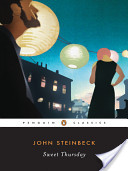
Sweet Thursday by John Steinbeck  sweet thursday

Inspired

As a teacher of writing and a writer myself, I’ve long been in the habit of examining others’ writing for what it has to say about the creative process. Nonfiction, my primary genre, lends itself most naturally to such scrutiny, since the solipsistic Scarecrow--Daniel Schwenwriters who tend to write in this genre love to write about what they’re up to. The writing of memoirists and essayists thus provides valuable glimpses into the process. In nonfiction workshop, Hemingway’s A Moveable Feast is my go-to handbook.

As I blogged last month, I’ve been listening to the Bible on my iPhone while I run. Since I run in five to ten mile chunks, I’ve heard whole books at a time and am making my way quickly, if haphazardly, through the text, following not the order of the Bible’s original organizers but spurious impulse (or, as I like to think, the Holy Spirit). Listening to scripture aloud, I’ve become newly appreciative of the almost constant reverberations between biblical accounts. The echoes of one story in another, of one biblical author’s phrasing in the voices of others, of the words of Hosea and Isaiah in the mouths of John and Paul and Jesus. The Bible is a masterpiece of intertextuality, a tapestry of voices in sentences that mesh and thicken from one chapter to the next.

I don’t know whether it’s because of the biblical writers I’ve happened to choose thus far or because of my new way of “reading” the Bible—that is, hearing the words aloud rather than reading them from a page—or just my old habit of paying special attention when writers mention writing, but I’ve noticed that the biblical writers talk a lot about writing. As such, the Bible offers considerable insight for me and fellow writers about our line of work.

Forgive my foray down a path we Christians like to avoid in considering the Bible—namely, the exact nature of divine inspiration that led to its composition in the first place—but one biblical writer after the next, from Moses to Isaiah to Jeremiah to John, describes the initial inspirational moment pretty much exactly as I’ve experienced it myself. An urgent voice—sometimes identified as God’s, sometimes an angel’s, sometimes unspecified—commands, “Write this down!” For these ancient writers, writing was not a choice—not a career goal or the desire to influence or educate others or even a matter of passion—so much as a dutiful response to that voice. An idea rises like a vision in the mind and the voice says, simply, “Write.”

“A writer,” I tell those who say they want to be writers, “is someone who writes.”

The most common writerly methods in scripture, which several biblical writers go out of their way to explicate, are the same ones I recommend to my students: in the words of Luke, “after investigating everything carefully from the start, to write an orderly account” so that readers “may know the truth” (Luke 1:3-4 NRSV). Careful investigation and organization are what convince.

Regardless of genre—whether they are writing poetry, chronicles, stories, or philosophical treatises—the biblical writers take pains, as Paul assures the recipients of one of his letters, to “write you nothing other than what you can read and also understand” (2 Corinthians 1:13). Nothing show-offy, though the words of scripture are often as artistic as they are true. No erudition for erudition’s sake.

And though their accounts and rhetorical goals are diverse, the biblical writers share, it seems to me, one essential writerly skill: they tell what they actually see and hear and smell and taste and feel. Unlike my students, who would rather explain their thoughts, the biblical writers are, to a person, concrete. Here’s Jeremiah (whose repetitive ranting could be boring, were it not so vivid) showing, not merely telling, how ridiculous it is to worship idols:

Their idols are like scarecrows in a cucumber field,
and they cannot speak;
they have to be carried,
for they cannot walk.
Do not be afraid of them,
for they cannot do evil,
nor is it in them to do good.

(Jeremiah 10.5 NRSV)

Wow. Like scarecrows in a cucumber field. I wish I had written that!

OLYMPUS DIGITAL CAMERAMy students typically define creative writing as writing that doesn’t have to follow any rules. Grammar rules, especially, are irrelevant. When I talk about sentence-level problems in their writing, they roll their eyes. In poetry workshop, many abandon the sentence altogether, writing instead in fragments. Creativity, in their view, constitutes the opposite of order.

The biblical writers, by contrast, seem to model their creativity on that of God himself. The creation, as described in Genesis, is a work of separation and sorting, of repeating and omitting, of drafting and considering before declaring anything “good.” Again and again, the biblical writers are selective in what they opt to tell. They keep only the best episodes of a given narrative—key conflicts, the rising action—and leaving the rest mysteriously, sometimes frustratingly, elliptical, in this way to engaging the reader’s own imagination and mental processing. There’s never a pat moral to the story. As hard as we Bible-readers try, we can never read the Bible as a straightforward primer or even a narrative account of holy living, cleansed of all confusing or upsetting or unholy details. Rather, it portrays real life—convincing in its familiarity—and real characters, the holiest of whom, as we ourselves, struggle and fail and fail again.

For writing instruction, I’m learning, the Bible is unsurpassable. Even better than Hemingway.

What I learned from Leo Kottke

GuitaristLast month, my husband and I enjoyed an evening concert at Big Top Chautauqua outside Bayfield, Wisconsin. Leo Kottke was the featured performer, and while I wasn’t particularly familiar with him and his music, he has long been a favorite of my husband’s. The concert took place under a big tent on a beautiful September night, very near the shore of Lake Superior, and Kottke did not disappoint, either as a guitarist or an entertainer. I came away a fan…and with a new perspective on what I do when I give a book talk.

I realized that the key word is entertain.

While the need to entertain my audience remains uppermost in my mind when I write, I haven’t always kept that focus during speaking engagements. Sometimes, I get too bogged down in the details of crafting a narrative when I talk with writers’ groups, or my presentation begins to sound stale when I answer the same questions over and over from audiences of readers. If I’m getting bored with repeating the same “this is my book, why I write, how I write,” then I expect my listeners are getting bored with the same old book talk they hear from every writer.

Enjoying Kottke’s performing style convinced me I needed to think of myself as a featured entertainer when I speak, not as the featured author. Yes, the man could play amazing guitar pieces, but it was his in-between chatter that tied it all together into a neat package of entertainment. Too much chatter and it would not have whetted my appetite for his music; too much music and I wouldn’t have formed a connection to the man. Instead, he balanced the two pieces and sold me on his entertainment value – which is exactly what I need to do to find new fans of my books.

After our evening at Big Top Chautauqua, I revamped the way I approach and present a book talk.

Instead of focusing on what goes into the book when I speak to groups, I now read short selections from several of the books – selections that are particularly meaningful or funny for me – and explain where in my own life those passages came from (and I always tell it with humor!). The result has been increased active engagement with my listeners, and they become more intrigued with the books, which results in more sales after the presentation concludes. I’m getting more comments about how enjoyable/entertaining the talk was, which not only makes it fun for everyone, but also leads to a greater number of speaking referrals for me! After all, if you’ve enjoyed an event, you’re likely to come back for more – whether it’s another book by the same author, or a CD recording of a musician – because you want to tap in again to that source that gave you an entertaining experience.

Authors need to think of themselves as entertainers – both in print and in person – and then present themselves that way, too.

How do you craft your talks for entertainment?

The 15-Minute Writer: Writing for Regional Parenting Publications (RPPs)

(This post is part six of a series. Read the other posts here.)

Do you write primarily for parents, teachers, or grandparents?

If so, you might try selling articles–especially book excerpts or reprints, which take very little time to pitch in an email–to RPPs, or regional parenting publications. RPPs are the free magazines offered at the front of bookstores, family diners, and kids’ clothing retailers in medium-to-large cities.

file000612565099My area has one central office which publishes several magazines, including Dallas Child, Fort Worth Child, and Dallas Teen.

Because these colorful publications come out each month, the editors need a lot of material. However, they rely on advertising dollars instead of subscriptions, so they don’t pay much (usually $25 to $75 per piece). But every little bit, both money and exposure, helps in this publishing climate!

I’ve made a few sales over the years by sending out emails to editors about two/three months before major holidays, telling them about my seasonal articles. The large audience is nice–especially if you think about how many parents (who wouldn’t otherwise know about you) will see your byline.

How to find these gems? Parenting Publications of America lists its members on its website. They offer a writer’s directory, which is searchable by topic, for their members for only $40/year. Here’s an excellent article on how to market your excerpts to RPPs. Also, you can list reprints on a page on your author site. Most of the magazines also offer book reviews…something to think about when you get to the galley stage.

Writers Kerrie McLoughlin and Christina Katz both have e-books on writing for RPPs, for under ten dollars. I haven’t read either, but they look helpful.

One caution: many of the RPP editors use local writers (or insist on having a regional angle in each article). Be sure and check guidelines, just like you would for any national magazine, before sending off a query or manuscript.

Have you already been published in RPPs? If so, leave a comment below detailing your experience and any advice you’d give to other writers.

Takeaways fom the Writer’s Digest Convention West 2013

I just attended my first writers convention, which turned out to be among the most interesting and informative experiences of my life. Never before have I received so many insights into the craft of writing. The Writer’s Digest Conference West in Los Angeles took place at the end of September. During that time, I was able to meet people I never would have otherwise, such as journalists who have been working in the writing field for ages. There was so much great information it was hard to capture it all, but here are a few points that that definitely resonated:

1) Writing, editing and marketing are totally different competencies, so bucket them, don’t batch them. In a discussion led by Ivory Madison, CEO of redroom.com writers community, writers were advised to keep those activities separate, as they engage different parts of the brain. I’ve been trying out the Red Room Method and can see a positive difference in my writing. It staves off the frustration of trying to do everything at once, and only producing one paragraph an hour. She suggested not to combine the three buckets of writing, editing and marketing. In this way, you end up not only being nice to yourself, but also more efficient as well. Writing is about your relationship with yourself. Marketing is an expression of everybody else. Take one book, make it as great as you can, and then worry about marketing. Don’t wear multiple hats at the same time.

WDCW132) Read your work aloud. You will find a great deal of errors that you might not have otherwise by reading aloud. When you do write, be authentic. Your readers want to be able to get to know you and trust you. Find great people to make your book as good as it can be. Don’t jump the gun just because you want to get it out there. Make your book easy to find and as accessible as possible.

3) Growing scope of the literary agents. Gordon Warnock, Founding Partner of Foreward Literary, has a vision of literary agents taking on a similar role as the agents of actors and songwriters. The future literary agents, he thinks, will manage the author’s entire career. The job scope would become more like an umbrella for their representation overall. This would include creative directing over the author’s website, branding, image, et al.

And above all else – write an outstanding book.

Resting from Writing

Rolling Mississippi
Working Through Fatigue is as Easy as Swimming Across the Mississippi

We become consumed with the writing life. Work…work…work, type…type…type, we push ourselves to meet the demands and deadlines set before us. And then we wonder why we hit mental brick walls — taller than mountains, and wider than the rolling Mississippi.

But what does God say about the pressures we endure? Is this really the plan?

I knew when I jumped into the throes of writing, I’d encounter the temptation to break a personal and, for me, very important value principle. One honored not merely out of duty and obedience, but because I recognized the benefits and blessings. It’s an overlooked command in today’s hustle-bustle culture. Over the past three decades, we’ve slowly become conditioned to push ourselves 7/365, until we’re flat-nosed against that mental wall.

National Speaker Anita Brooks
Juggling Jobs Pressure

I refer to taking a sabbath rest. It goes against the grain of our writing demands.

  • For instance, we are urged to write every day, so we don’t lose momentum, or allow our skills to cover in rust.
  • As writers, many of us pull double-duty as speakers. This requires even more time while we juggle between the work itself and the marketing of writing and speaking.
  • Most of us hold down a day job, and it lessens the amount of time we can devote to writing. The weekends are promoted as time to buckle down and focus.

But I offer an alternative mind-set, about the benefits of taking our weekly Sabbath.

  • If we continually push ourselves in a fatigued state, we are subliminally distracted by the influx of pin-pricking, achy feelings, and heavy muscles brought on by exhaustion. Rest diminishes painful symptoms.
  • While the body rests, so does the mind. Science has proven that in a state of rest we heal, regenerate, and restore. Rest provides the much-needed medicinal touch when our words run stagnant and our minds run dry.
  • God promises blessings when we honor the Sabbath.

Resting in a HammockConsistently allowing ourselves a whole day of rest, with permission to nap, relax, to enjoy life, can  free us to produce powerful words that will inspire, encourage, teach, and exhort. And I believe God’s example of resting on the seventh day is one worth following. After all, He is the best-selling author of all time.

When I wrote my first book, while holding down a demanding day job as General Manager at a large river resort, the temptation to write on Sunday pressed on me week after week. But I determined to give myself the gift of a weekly sabbath. To this day, I can’t fully explain how I wrote that book while working insane hours during our peak season.

The only answer to my accomplishment is that it was supernatural. I believe honoring the sabbath and keeping it holy played a part. Don’t get me wrong, I’m not perfect (that would get a bah-ha-ha from my family and friends), but I’m doing my best.

For me, the importance of placing God and His ways above everything, including my writing and speaking, is the real secret to my success. You might try it — resting from writing to find the inspiration you’re looking for.

Do you rest from your work?