Adventures into the Unknown through Writing

Writers are dreamers. We capture daydreams in paragraphs on pages. We are also planners. We sacrifice hours now for hopes of communicating to future readers. We work in the present and have faith for the future.

winter happy girl 3

Dreaming, hoping, and planning are good activities. Yet, as a Christian who writes, my dreams belong to Someone greater than I am. The wise and practical words of James give me the perspective to keep my feet on the ground and remember my human limits, even as my hopes soar in faith.

“Now listen, you who say, ‘Today or tomorrow we will go to this city or that city, spend a year there, carry on business and make money.’ Why, you do not even know what will happen tomorrow. What is your life? You are a mist that appears for a little while and then vanishes. Instead, you ought to say, ‘If it is the Lord’s will, we will live and do this or that'” (James 4:13-15).

Even with our best plans and the wisest advisers, we do not know what the future holds. Businesses can come and go, altering the landscape of opportunities for us. The publishing industry is constantly changing. Our favorite bookstore may go out of business before our next book ships from the warehouse. Future events may change how people view our writing. We may become the voice that speaks to current needs, or our relevance may fade.

Such thoughts should not put a damper on our joy as writers. Whatever the dimensions of our window of opportunity, writing is a tremendous privilege. Our books can travel to places we have never visited. We can instruct, entertain, and comfort people who may remain unknown to us. They will know us through our words. As a Christian who writes, my words reflect God’s love for people and His message of hope. The chance to become a vehicle to carry that message, however imperfectly, is a priceless gift.

And so, on any given day, I plan. I keep writing. I dream of reaching more people. I stack books on bookshelves in far-flung bookstores in my faith-filled imagination. I bundle up and head outside into the unknown for an adventure. I do my best and expect the best of everyone working alongside me. But I know the outcome belongs to God. His will and His plans will prevail. And that’s good news for me and for everyone else!

What helps you face the unknowns of life as a writer?

Marketing: To Do and Not To Do

Light a Fire with Your Marketing Plan

“It isn’t there. I looked,” I told my mother so many times I lost count.

I also lost count of how many times she looked in the same place I did and said to me, with frustration in her voice, “Shelley, it’s right here!”

Ugh. I hated when that happened. I felt stupid, embarrassed, and defective.

Why could SHE see it, but I couldn’t?

It took a few years, but finally, by the time I was 10 or 11 years old, I learned to instead say, whenever I couldn’t find whatever she said to look for or retrieve for her, “I don’t see it.” I’m 40 years old now, and I still use those same words in that situation.

What does this have to do with marketing? I’m certainly no expert in this field, but I have learned this: just because folks don’t see our books, products, services, or goods, it doesn’t mean they aren’t there. It also doesn’t mean they don’t have value. It just means that sometimes people need help to see the good stuff right in front of them.

So, how do we do this in an already saturated market where everyone (and sometimes their pets!) are on social media, have a blog, and publish their work? (I kid you not about pets, either.)

I asked around, and want to share with you what other authors shared with me. I am confident these tips will help you (and me!) in the challenging world of marketing our writing in addition to creating the content we’re trying to market.

  • Pay attention to social media: Don’t discount the value of sharing some freebies with folks right where they are. Find out where your audience hangs out most on social media and focus the majority of your social media time and attention there. For example, my readers tend to be on Facebook more than Twitter, so while I am in both places, I don’t kill myself in the Twitterverse when more engagement happens on Facebook (and increasingly on Instagram and Pinterest).

Remember, as you engage in today’s world of technology, these words from Marketing guru Rob Eagar:

“In a fast-paced world where Facebook, Twitter, and the 24/7 news media allow everyone to have a voice, it’s more important than ever to cut through all the noise. Use power-bites to punch through the cacophony, gain people’s attention, and spread your message like wildfire.” – See more good stuff from Rob here!

And this, from marketing expert Lori Twichell:

“The key to good marketing is making a connection with your audience. It’s got to be genuine. People can see through selfish motives. If you are only there to promote your book or product, people can sense that.” The more you get to know your audience and really make that honest contact, the more you’ll end up with a loyal audience that will follow not just this book, but future endeavors as well. That’s a key part of social media that is lacking in so many. We all love making new friends and connections, but no one wants to be spammed!

  • Newsletters: Emailing your subscribers is the best way to get content in front of your readers on a consistent basis. When they subscribe or give you their contact info, they’ve invited you to connect with them. Make sure to add value to your subscribers’ lives, inviting them to open, read, and engage—be aware of what can feel “spammy” to your subscribers. In other words, don’t just send emails to send emails. And make sure you give more than you request.

Here’s another tip from Lori Twichell: “Tuesday, Wednesday, and Thursday are the best days to send newsletters. On Fridays people are eager to go home and clean out their inbox more quickly and on Mondays, they’re buried in the weekend’s email pile up.” (Connect with Lori for more good stuff at http://www.beyondthebuzzmarketing.com)

  • Giveaways: Take advantage of what God has made available to you. What message has He entrusted to you to share with others? Offer some freebies along the way that build your credibility as one to listen and learn from in this over-saturated market.

As writers, we long to have readers find value in what we have to say, right? It can be so difficult to balance the discipline of learning and expressing with the necessity to also market what we write. Ultimately God is our greatest promoter. If we can remember that our social media numbers, our book sales, and our greatest accomplishments do not come close to God’s power to promote us in due season, we’ll remain at peace and loving life on the way to where we’re going.

Have you discovered a marketing to-do or not to-do?

Stretch

For the last several years, I’ve worked an assignment that has stretched me as a writer as much as anything has in a long, long time.

WritingI’ve never sat down with the intentions of putting a fictional story to paper, but some of the sports I’ve covered for NCAA.COM are just about as close as I will ever get. NASCAR, I know. I worked that circus full time for nearly ten years. I’ve loved baseball since I was a child. I played football in high school.

Technically, I didn’t exactly play high-school football. I was on the team. I had a uniform and everything, but to actually play, you have to see time on the field. I was such a stellar athlete, I rode the bench for a team that went 0-10.

Seriously.

I still loved football, and knew it well. But men’s gymnastics? Lacrosse? Track and field? Swimming and diving? My very first exposures to those sports were the days I sat down in the press box … or tent … or grandstands … to work their national championships.

I had a decision to make, and I had to make it quickly. I could treat these sports as some sort of quirky and obscure sideshow attractions, or I could handle them the way I eventually did. These coaches and student-athletes were absolutely as passionate about their respective endeavors as any involved in more well-known sports like football, basketball, and baseball.

How could I treat them with anything less than the utmost respect? I had to learn, and I had to do so fast. Admitting ignorance can be a wonderful thing sometimes, as I learned from the NCAA committee member who patiently explained the difference between a game, set, and match in tennis. I understood completely, I think.

As a result, I’ve come away with some of the most memorable stories of my career. There was Mo Imel, the women’s lacrosse star who gave up a Division I scholarship to move to a Division II school closer to her cancer-stricken sister. After her sister passed away, Mo and her parents attended the funeral in Maryland and then made the spur-of-the-moment decision to drive overnight to Mo’s lacrosse match the next afternoon in Florida.

Mo scored two goals that day, including the game winner.

So, Tip Number One is to broaden your horizons as a writer. What’s that one subject you’ve always considered writing about, but haven’t gotten around to actually sitting down and tackling just yet? Go for it, and you might be surprised at how it turns out.

Then there’s the sheer volume of copy I’ve been called upon to file for NCAA.COM. My personal record for churning out stories — and I’m talking career-wise, not just for NCAA.COM — is thirty-seven 800-word stories in sixteen days. Producing such a massive amount of work in that short a timeframe was one of my toughest challenges in nearly a quarter of a century as a full-time writer.

Again, I had a decision to make. When filing that much copy, it would have been easy to “phone it in” on a story or two. In other words, I could’ve simply slapped a bunch of words up on my laptop screen and sent them in without really caring about the result.

Aside from the theological implications of not making the best use of your God-given abilities, there are a few problems with this approach. Turn in too many “clunker” stories, and the assignment may go to somebody else the next time around. And for a freelancer like me, that’s a bad thing. A very, very bad thing.

Also, that story might very well be the only one ever written about a given coach or student-athlete. It’ll probably be posted on their Facebook page, or maybe even printed out and placed in a scrapbook or on the family refrigerator. If it’s under your byline, you want it to be the best story it can be, regardless of how many came before or after it.

Tip Number Two is to give yourself plenty of time when writing, if at all possible. If your deadline is tight, don’t just pound the story out and file it. Do your best work, always.

Believe it or not, I’m actually headed to Louisville, Kentucky this week to cover an NCAA Division II championship sports festival. Six different sports in three days, and filing what I’m assuming will be multiple stories for each. Say a prayer for me!

WordServe News: November 2014

Exciting things have been happening at WordServe Literary!

On the final post of each month you’ll find a list of Water Cooler contributors’ books releasing in the upcoming month along with a recap of WordServe client news from the current month.

New Releases

Arnie Cole and Michael Ross released with goTandem their firs9781630583675_p0_v1_s300xt 40 day devotional book, Growing in Christ


*************************************************************************************************

Mary Davis released her latest novel with Heartsong Presents, Her Honorable Enemy.9780373487370_p0_v2_s300x (1)


*************************************************************************************************

Angela Strong released her second book with Ashberry Lane, The Snowball Fight 9781941720134_p0_v1_s300xProfessional. 


New WordServe Clients

Barry Corey of Biola University signed with Greg Johnson.

Anne Love signed with Sarah Freese, a connection made at the ACFW National Conference.

Jim Putman signed with Greg Johnson.

New Contracts

Terry Brennan signed a contract for a new novel with Kregel publications to released in 2015, The Aleppo Code. Greg Johnson, agent of record.

Julie Cantrell, NYT Best-Selling author, signed a two-book contract with Thomas Nelson–first book to be released in Fall 2015. Greg Johnson, agent of record.

Michael Fechner signed a contract with Zondervan publishers for his nonfiction book, tentatively titled: Giving up the Good Life to Find the Real Life. Greg Johnson, agent of record.

Cheri Fuller signed a contract with Barbour publishing for her new nonfiction book, tentatively titled Dangerous Prayer. Greg Johnson, agent of record.

Denise George and Josh Aronson signed a contract with Penguin for a new nonfiction book tentatively titled Orchestra of Exiles. To be released in 2016. Greg Johnson, agent of record.

David Hettinga signed a new contract with Kregel for his book Closer Still. Tentative release for 2016. Greg Johnson, agent of record.

Linda Kuhar signed a contract with Leafwood publishers for her nonfiction book, Worthy of a Miracle. Set to release in 2016. Alice Crider, agent of record.

John Merritt signed a contract with Morgan James for his debut nonfiction book Don’t Blink. Alice Crider, agent of record.

Tina and Dave Samples signed a contract with Kregel for Messed-Up Men of the Bible. Alice Crider, agent of record.

Jonathan Sandys and Wallace Henley signed a contract with Tyndale House Publishers for their book God and Churchill. Sandys is the great-grandson of Winston Churchill. Greg Johnson, agent of record.

What We’re Celebrating!!

Angela Strong won the Idaho Top Author Award for her children’s novel, The Water Fight Professional! 

What can we help you celebrate?

The Writing Life: Developing a Thicker Skin

The Writing Life Developing a Thicker Skin via @JanalynVoigt | Wordserve Water CoolerAfter I sold my first short story, every time I tried to write, I’d wind up staring at the blank screen until I gave up, often bursting into tears. This went on for a year, by which time I must have figured out no one was going to chain me to my desk and expect me to write on demand. I breathed easier and managed to write again, or at least I did until it occurred to me that my book project could fail. Sad but true, I had to get over both fear of success and fear of failure.

Both problems stemmed from the same stubborn root, caring too much what other people thought of my writing (and of me, by extension).

Being so shy didn’t help at all. I tried to hide the fact that I was a writer. Even close friends didn’t know until my husband started carrying magazines that contained my articles around so he could brag about his wife at a moment’s notice. He took my pleas that he stop for false modesty when they were in fact an attempt to protect myself from The Look. If you’ve been writing any length of time, you will know the one I mean. Eyebrows go up, eyes widen, and you begin to feel like a specimen in a laboratory.

I get The Look less often now that the e-book revolution has writers popping out of the proverbial woodwork, and when it happens my response has improved. My face doesn’t heat to blazing anymore, and I don’t yearn for escape.

What changed for me? I learned that having a thin skin isn’t something a writer can afford. Drawing your self esteem from the opinions of others at best makes you vulnerable and at worst misinforms you. Submit your writing to a critique group, and you’ll learn pretty quickly that while many opinions have value, not all are golden.

If you think taking a critique is hard, just wait until you go through edits. If you’re not familiar with the term, it’s when an editor or editors at your publisher house requests changes be made to your manuscript by you. It’s usually when you will question how you ever thought you could write. If you haven’t developed a thicker skin by this point in your writing career, trust me, you will. Having a sense of humor is an asset at such a time. I can’t say that edits for DawnSinger, my debut novel and book one in my Tales of Faeraven epic fantasy trilogy, were informed by mine. However, by the time edits arrived for Wayfarer, book two in the series, humor was in full force. You just can’t take yourself too seriously.

That’s a good thing, because the very next thing you face after publication is book reviews. Some writers refrain from reading reviews of their books. I admire such will power but I don’t possess it. I’ve read every review of my books that comes to my attention. I like to learn from them, even negative ones. Happily, I’ve learned to place my self-worth in the hands of the Author of my faith.

How do you handle critique/criticism of your writing?

Black Friday Cyber Monday Marketing for Writers

Whether you participate or not, odds are you’ve heard of Black Friday and Cyber Monday. For bargain shoppers across the globe, they’ve become the holy grail of all shopping days. If you haven’t experienced it for yourself, then you might think, no big deal. 

But you would be wrong. Women and men, all over America, rise earlier than the roosters to snatch discounted gifts — sometimes directly from the hands of an unfocused shopper right next to them. This is serious business.

See for yourself:

Here are ways we as professional writers can use the tips offered in the Hip2Save YouTube video for our marketing.

1. Be prepared. Make a list. Do your research. Check the layout.Question Mark

What this means for writers: Study your target audience. What interests them? When do they have time to read? Where are they going for fun? How do they handle tough challenges? Who do they turn to for help?

2. Know the best times to target your audience.

What this means for writers: All times slots are not made alike. Is there a particular season, celebration, or time of day that will heighten their interest in the message you have to offer? When will they have the least interest in what you have to offer?

3. Gas up beforehand to save time when the minutes count.

What this means for writers: Take care of everything you can ahead of time. Don’t wait to cover the fine details until the final moments before you launch a marketing strategy. Make a list and check it twice.

4. Prepare to stick it out for the long haul.

What this means for writers: Marketing books is not for wimps. Know in advance this is a long-term commitment, not a short-term hobby.

5. Buddy up to save time, energy, and money.Agenda

What this means for writers: Partner efforts with your peers. No two of us write exactly alike, so there’s no reason to fight for customers. Cooperate, don’t compete. You can save much time, energy, and money when you pool resources with those who truly understand what you need to accomplish.

6. Don’t give up if you don’t get the results you want the first time.

What this means for writers: We’ll all try some things that won’t work, but with persistence and tenacity, we’ll learn along with way, and become leaner and meaner marketing machines.

7. Ask yourself if the deals that work for others will really work for you.

What this means for writers: Don’t try to mimic everything you see or hear. Look for good marketing fits for your personality and message. Trying to force yourself to be someone you aren’t will water down your efforts.

8. Keep good financial records so you can measure the effectiveness of what you spend, and potentially save wasted money in the future.

What this means for writers: Let’s face it, you’ll have to invest money in your marketing, but you don’t have to break the bank. And one way to ensure it doesn’t happen is to monitor your spending, so you can make informed decisions when future marketing opportunities come along.

How to Write a Press Release
A Good List Helps You Prepare

9. Promote your books/products to the growing number of buyers who are skipping Black Friday and waiting for Cyber Monday deals.

What this means for writers: For decades, books have made great gifts. But how people get them has changed drastically. Instead of fighting the technology tide, why not jump in? Create your own Black Friday/Cyber Monday sales events. Better yet, partner up with several of your writing peers, and create a wave of your own.

We live in a culture driven by perceived value. This is a vital piece of information for those of us who have something to sell. We should always create good content with lasting impact, but sometimes we have to prove it to the world. When it’s all said and done, that’s what strong marketing does.

Happy Holy Days and Merry Christmas!


Balancing Clarity and Detail in Writing

Image of scales

You want your readers to enter into the world of your book and experience in their imagination the places and events you describe as if they were there themselves in the midst of the action. Yet if your writing becomes ornate, your readers may get lost in the details and miss the point of the passage. Even worse, they may skim over the descriptive sentences, seeking the next main point. Why write words that will go unread?

Capture the Essentials

To maintain the readability of your writing while also creating vivid descriptions of people, places, and events, capture the essentials and make every word count. Choose verbs packed with meaning instead of tacking on adverbs. When describing a place, consider what senses are important to setting the scene for the passage. Is the sound of classical music playing softly in the background more essential than the color of the paint on the ballroom walls? If you are trying to set the mood for dialogue that follows, use just enough details to accomplish your goal. Create a sketch and let the reader’s imagination paint in the rest of the picture.

As a reader, I find myself jumping over passages where too many clauses and adjectives abound. As a writer, I have had to remind myself that my readers will do the same.

Edit the Extraneous

After you have written a descriptive passage, edit for clarity. Cross out your favorite phrase if it detracts from the paragraph. Provide sufficient description of the attributes of an object for the reader to understand its significance. You do not need to include all the colors of the sky that make for your perfect sunset. Let the most important two or three colors set the stage.

In dialogue, the word “said” may be better than “shouted,” “whispered,” or “intoned.” While those other words convey a richer meaning, they may break up the continuity of the conversation. Let the words of the speakers carry the content. Remove nonessential dialogue that does not carry the plot or illustration forward. Jump into the action without providing too many trivial details. In short, get to the point and remove material that will confuse the reader.

Check for Flow

Your paragraphs of writing describing a majestic waterfall at the edge of the forest may be poetic and beautiful, but if they interrupt the flow of the chapter, prepare to edit. While writing my first book, Questioning Your Doubts: A Harvard PhD Explores Challenges to Faith, I wrote illustrations to enhance the point I was making. I learned from reader feedback that the illustrations worked best when they were entertaining but concise. If I spent too many sentences telling a story, the reader’s train of thought might be broken, defeating the purpose of the illustration.

On the other hand, writing that sparkles with clarity can seem too clinical without enough descriptive material. Coming from a scientific background, I am used to conveying challenging topics in clear and precise sentences. When I first started writing my book, I had to give myself permission to tap into my creative writing side and add poetic elements to my prose. Too much clarity can lead to short, choppy sentences that need more descriptive elements to weave them together into the tapestry of the chapter.

How have you learned to balance clarity and details in your writing?

I Am A Writer

My brother got married a couple of months ago, and our family forever changed. I gained a new sister, a new twist on life, AND a bigger family. My dad performed the ceremony and I sat with him and my brother two nights before the wedding around our kitchen table listening to them go over the vows – vows to honor and cherish and grow old.

Vows carry a certain kind of weight. In the past few weeks, I’ve found it necessary to make a different kind of vow. Not a vow to another person, a job, task, or event. I am making a vow to myself.

Kariss - Shaken in storesI am a writer. Period. End of any wondering or questions. I have all the dreams and insecurities that come with the itch of fingers to grab a pen and hit the paper.
I am a writer, and within a week of beginning work with my editor on Shaken, I emailed my mentor and told her I thought I needed to start the whole book over. I felt like I need to somehow make it better. I did that with my second book, Shadowed, too. Now my goal is to make each book better than the last.

I am a writer. We can be our own worst enemies. We can also be our own greatest advocates because NO ONE can make me finish the job but myself.

I am a writer, and I type THE END for my own benefit. It will never be perfect. But it can be something I am proud of once I push past the insecurities and just finish.

I am a writer, and I notice people in a different way. This gives me the unique desire to figure out how God wired them, to value their quirks and struggles, and to cheer them on in their successes. I know the best kind of character is one who reflects what God has already created – people. So I’ve learned to value each person individually and love his or her uniqueness.

I am a writer. I can be introverted or extroverted, depending on the situation. I can be equally emotional and analytical, which can sometimes be confusing.

I am a writer. I know the power of words, the pain they can wield or the healing they can bring.

I am a writer. I can stand back and observe a scene, using words to paint a whimsical picture or one cloaked in shadows.

I am a writer, and from what I’ve heard, we subsist on coffee and chocolate. Of course, I can’t personally verify this.

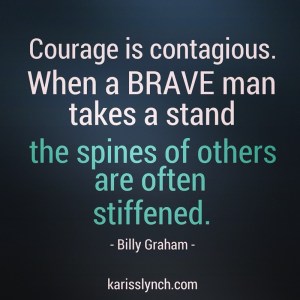
Kariss - Courage quoteI am a writer, and with that comes the necessity to be uniquely myself while God continues to mold me in the process. But when I fail to be who God made me to be, I miss out on being part of the story He is weaving in and through me. When the insecurities or the pride creep in, I vow to fight and write, because no one can write a story exactly like I can.

No one can reach my audience quite like I can.

No one can speak or create or brainstorm or think quite like I can.

I am a writer, but I am only one part of a whole community. Together, we reach a wide audience. Individually, we touch specific hearts, those that are, for one reason or another, particularly attracted to the stories placed on our hearts. When I fail to be unapologetically myself, my readers and those in my life miss out. I miss out.

So this is my writer’s vow. I vow to be unapologetically myself, to be the person, the writer, that God made me to be. I vow to grow in this craft, knowing I will fail and knowing I will succeed. I am a writer, and I want to be part of this beautiful story God is writing with my life, not just an unwilling participant.

What lessons have you learned as you grow to be the best writer YOU can be?

The Best Resolutions

Are you planning to make resolutions this New Year’s?

MP900309664

Why not base them on some of the declarations that are recorded in Scripture?

Check out these biblical resolutions.

Resolve to inquire of the Lord. King Jehoshaphat was told that a vast army was coming to make war against him and his country of Judah. But before he ever rallied his troops or formulated a battle plan, “Jehoshaphat resolved to inquire of the Lord, and he proclaimed a fast for all Judah” (2 Chronicles 20:3). The people gathered together and Jehoshaphat prayed earnestly before the entire group. He ended his prayer by declaring to the Lord, “We do not know what to do, but our eyes are upon you” (2 Chronicles 20:12).

Undoubtedly the year ahead will, for many of us, bring about situations for which we have no answers. Regardless of what struggles lay ahead, we can take comfort in the fact that our God sees our need (Genesis 16:13), hears our cries (1 John 5:14), and knows us intimately (Psalm 139:1). He is never caught by surprise or left without a plan. When we don’t know what to do or where to step, we can resolve to inquire of the Lord and fix our eyes upon him as Jehoshaphat did.

Resolve to guard my mouth from sin. This second resolution is a challenging one. In Psalm 17:3, King David resolved that his mouth would not sin. Can you think of any words that you said this past year that you wish you could take back? Paul wrote in Ephesians 4:29: “Do not let any unwholesome talk come out of your mouths, but only what is helpful for building others up according to their needs, that it may benefit those who listen.” It’s a lofty goal, but even if we fail from time to time, just imagine the impact we can have on the people around us if we’ll choose to say only those words that build or benefit others.

Resolve to guard my purity. The Old Testament prophet Daniel resolved to keep himself pure. When Daniel made that resolution, he was surrounded by a culture that was replete with idol worship and completely opposed to the standards of the God of Israel. “But Daniel resolved not to defile himself” (Daniel 1:8).

Sadly, our society is growing more and more opposed to the standards outlined in God’s Word. We’re bombarded by images on our televisions or movie screens that threaten to desensitize us to evil, immorality, and violence. But Paul warned us in Romans 12:2 not to “conform any longer to the pattern of this world, but be transformed by the renewing of your mind.” We’re to be distinctive and committed to purity. We can’t always control our culture, but like Daniel, we don’t have to allow our culture to control us.

Resolve to keep Jesus as my primary focus. The final resolution is my favorite. The Apostle Paul resolved to keep his focus on Jesus. As Paul reflected upon his ministry in the city of Corinth, he said, “For I resolve to know nothing (to be acquainted with nothing, to make a display of the knowledge of nothing, and to be conscious of nothing) among you except Jesus Christ (the Messiah) and Him crucified” (1 Corinthians 2:2 AMP). It was Paul’s passion to wholeheartedly keep his focus on being acquainted with, displaying the knowledge of, and being conscious of our glorious Savior. What greater resolution could there be?

So I challenge you to join me in making these four New Year’s resolutions. Display them where you will see them often. Pray daily and confess when you fail. It is my prayer that you have a blessed and resolute new year.

First Appeared in Today’s Christian Woman: http://www.todayschristianwoman.com/articles/2010/january/thebestnewyearsresolutions.html

And Proverbs 31 Ministries Every Day Life: http://p31everydaylife.blogspot.com/2010/01/biblical-resolutions.html

The Perfect-World Writing Room

StressedOutWomanDistractions.

They’re a writer’s worst enemy — they’re this writer’s worst enemy, at any rate. In a perfect word, my writing room would be absolutely quiet with little internet connection.That way, I’m not checking e-mails every five minutes, and Facebook in between.

That’s just not the way it works most of the time, though, is it? I spent a good ten years of my career covering the traveling circus known as NASCAR. Believe me, you’ve never lived until you’ve tried to file on deadline, two hours after a race, in room full of tired and grumpy fellow reporters. Or better yet … during practice, with twenty or thirty high-powered race cars roaring around the track and another twenty more in a nearby garage tuning up their engines.

Headaches? There are headaches, and then there are filing-on-deadline-in-a-NASCAR-media-center headaches. Working in that kind of environment seems as far from the perfect-world writing room as it is possible to be.

Come to think of it, the room would be sound proof. My wife and I have twin sons, Adam and Jesse, who are 13 and in the eighth grade. When they’re out of school in the summer and home all day, it’s almost as if I’m back in some NASCAR media center somewhere and trying to write.

Stop that, Jesse!!!

Stop what?!? YOU stop!

A few minutes of relative peace and tranquility are again interrupted by a blaring video game, enhanced by our sound system. Is there anything more aggravating than trying to write with a Minecraft soundtrack playing full blast in the background?

Actually, there is.

A couple of years ago while working on my book Wheels Stop: The Tragedies and Triumphs of the Space Shuttle Program, I had the opportunity to do a telephone interview with former NASA Administrator Michael Griffin. The man has like seven different academic degrees, was the top guy in the uppermost echelons of the agency, and had been named one of Time magazine’s 100 most important people in the world at one point.

There I was, trying to ask questions that sounded a little more in-depth and intelligent than, “Boy, that Space Shuttle sure is neat, huh?”

I had the speakerphone turned up in order to get a good recording when Jesse chose to walk through the kitchen, just a few feet from the open door of my home office. It could have been his Asperger’s — or just being a teenaged boy — but he announced at the top of his lungs …

I just FARTED!

Dr. Griffin surely heard Jesse, because he paused in mid-sentence, evidently waiting for me to go strangle my son. Mercifully, after just an awkward moment or two, he continued on and never mentioned my son’s digestive issues. The interview turned out to be a productive one, and an important addition to the research for my project.

And I didn’t even have a perfect writing room. Go figure.