Writing with a Hook

What will make your book fly off the shelves? A good story, high quality writing or a strong Fish-hookvoice won’t help you unless readers know your book exists.  And for that, you need such an interesting premise that readers around the country are chatting up your book. In other words, you need a hook.
Yes, the dreaded hook word. I’ve heard about for years, but it seemed rather elusive. But recently, I’ve been studying my bookshelves to find some broad categories of hooks, and it’s getting clearer. Here are a few concepts I’ve found.

  • Give beloved fairytales, historical figures, novels or paintings center or side stage. The Beekeeper’s Apprentice (Sherlock Holmes), While Beauty Slept (Sleeping Beauty), The Girl with a Pear Earring (Vermeer’s painting), Dear Mr. Knightley (a love for all things Jane Austen) and The Constant Princess (Henry VIII’s first wife) are all examples. Readers want to spend time with favorite characters and art.
  • Tie the story together with a hobby. Ordinary hobbies such as knitting and cooking can certainly draw in readers who enjoy knitting or cooking themselves, but if you can find a twist, this will make it stand out from the crowd. For example, in The Language of Flowers, two characters with a love of gardening send each other messages not with notes, but with flowers, each delivery carrying a symbolic meaning only they understood. Unique hobbies can give your story a little flash as well – i.e., custom shoe design or wild life rescue.
  • Allow readers to vicariously do something they’ve always wanted to do. I bought Forgotten because it was about a character who, after being stranded in Africa for several months, returns to find that her job, her romance and her apartment are all gone. She’ll have to recreate her life. Spoiler alert: the book did not live up to its promise of the heroine of getting a life makeover, but that promise is what made me buy it. What other deep seated desires will connect you to readers?
  • Create zinger beginnings or zinger twists. When an old man in the prologue of The Lost Wife tells a wedding guest she looks familiar, and at last figures out that she was his wife just before the Nazis invaded Prague, that certainly sent readers to Amazon’s checkout cart (me included). In Half Brother, a boy arrives home to find his mother holding a baby chimpanzee, and that’s interesting enough to catch a reader’s attention. Burying a zinger in the middle of the book is a harder sell, since it’s not something readers will see when they browse. But if it’s good enough, it can certainly get people talking about your book.
  • Start with vulnerable characters at risk. The little boy locked in the cupboard in Sarah’s Key is a great example of this. But even more ordinary risks – a teen without adult love or support (Dandelion Summer) or a Puritan woman being coerced to marry a man she doesn’t trust (Love’s Pursuit) are good draws. Readers only need to hear the concept to feel they need to see the character to safety.
  • Create a character the world depends on. High stakes Tom Clancy type novels where the character must stop nuclear bombs from detonating or bring an end to a plague outbreak, or fantasy novels where the hero/heroine holds the key to the coming war (Lord of the Rings, Blue Sword) are examples.
  • Begin the story with profound emotion readers can connect with. Remember, readers don’t know the story or the characters yet, so it must be something they can easily connect with. In Coldwater Revival, the heroine is apparently stillborn at birth, but begins to breathe with the loving attention she receives from her father. In If You Find me, a girl sees her father for the first time a decade after she was kidnapped.

Think about what made you pick up your last book, or even better, what had you chatting up the book to every reader you knew? Once you’ve found the quality that made it so compelling, you’ve probably found the hook.


Stupid Marketing Tips

stupidmarketingideasSo, here I was.

Sitting here, trying to think of a fabulous post about marketing books.

The thing is, the “m” word tends to bring up fabulous pictures in my head of those middle of the night moments when one of my children come to me, saying, “Mommy, my tummy hurts–” then proceeds to vomit all over my side of the bed and floor, at times giving me and my PJ’s a good dousing as well.

I, uh, am not the biggest fan of marketing, if you can’t tell.

I take that back. I LOVE the idea of marketing. I KNOW it is needed and I LOVE the bi-product of it: my books being known by people and being PURCHASED by people.

Maybe it just brings back bad middle school memories of trying to get people to like me when I was a pimple-faced, slightly overweight, 4-eyed and teeth-gapped teenager…. the thought of trying to get people to like my books (thereby, it feels like, ME) still creates that knee-jerk reaction to curl up on my bed with chocolate and a romance novel to take me to another place.

But enough about my traumatic teen years.

Marketing is hard for a LOT of writers. Maybe we can WRITE some fantastic marketing copy, but getting out there and trying to peddle books out of our comfort zone is HARD! (Those of you who find it super easy… feel free to market mine too. I won’t mind!)

But in putting ourselves out there, it’s also common to get tripped up by some really BAD marketing ideas, in an absence of good ones.

I remember when I first started researching publishing back in 2007 after I’d completed my first novel. I was searching online tips for getting an agent/editor to look at your book. One place touted the value of STANDING OUT in the slush pile. Print that proposal on colored paper! Use FUN fonts with lots of bolds and italics! Send goofy gifts that relate to your book in the mail to that editor. (one example was a baby shoe for a book about babies…??) Make them be like, WOW, this person is really SERIOUS about wanting to be published!

I laughed, then decided I would probably NEVER be published because no way, no how, would I ever sink that low to use silly gimmicks.

Then I found a few agent blogs that suggested that when they got those out-of-the-norm proposals, they were immediately trashed for their stupidity.

PHEW!

The same goes with marketing. Creativity is a MUST, but sometimes in the name of creativity, we stumble on ideas that can be counterproductive.

Here are just a few things I’ve seen over the past 8-ish years I’ve been on this journey–that have made me NOT want to read a book.

1.) THE WORLD IS ENDING! THIS BOOK IS YOUR ONLY SALVATION! Maybe not those words exactly, but scare tactics or broad, unsubstantiated claims does not a good marketing plan make. “THIS BOOK WILL CHANGE YOUR LIFE FOREVER.” (different than saying something a little more docile like life-changing fiction, etc) “GOD WANTS YOU TO READ THIS BOOK!” (let HIM tell me that, thank you!) Sure, you might get some saps to buy it, but you probably won’t find publishing success with this type of marketing for books.

2.) BUY MY BOOK (five minutes later) BUY MY BOOK (five minutes later) BUY MY BOOK (repeating 100 times per day!) Over posting on social media is a hard one, because there is a fine line. We NEED to be bold and proud of our books and market them on social media, no doubt. However, tact is needed. When my Facebook newsfeed is filled with 6 different posts by the same author marketing the same book all in the same day? It’s a good way to get yourself unfriended or at least blocked. Your Facebook marketing should draw people in, not annoy them.

3.) I MEAN, YOU DID BUY MY BOOK, RIGHT? Guilting people into buying your book is uncool. We all have different budgets and different reading tastes. I’ll readily admit, there are some writing friends I have (who will remain nameless) that I haven’t purchased their books. Why? Partially because I’m a broke mom of 4 kids trying to make a living as a writer. HA HA! But also, I have my writing friends than I have time. The idea of marketing is to ENTICE them to read your book, not twist their arm.

4.) NOTHING. This is the stupidest idea of all. Just not doing anything because you’re afraid of it. It’s the one I’m most guilty of. Oh, I market, but I’ll get an idea and think, ‘Oh, no, that’d totally bomb” and move on. Just like in publishing, sometimes you have to fail a few (or a hundred…) times before you find that golden ticket/agent/editor/marketing scheme. But if you just sit back, cross your fingers and toes, and hope your books sell? Yeah. That is the WORST marketing idea of them all!

A Side of Faith - front only(putting a picture of my book of my most recent book release as well as a link to purchase it is an example of a not-as-stupid marketing idea… as is to mention that my next book, A Side of Hope, will be releasing later this month…. )

Finding the Fatal Flaw

It is the core of every struggle. The root cause of many reactions. It is a constant enemy lurking below the surface, waiting to rear its ugly head.

It’s the fatal flaw. Everyone has one. Every character has one, too.

I would argue that fatal flaws never completely go away. They just manifest in different ways as we grow and change and conquer certain circumstances. But what does this really look like?

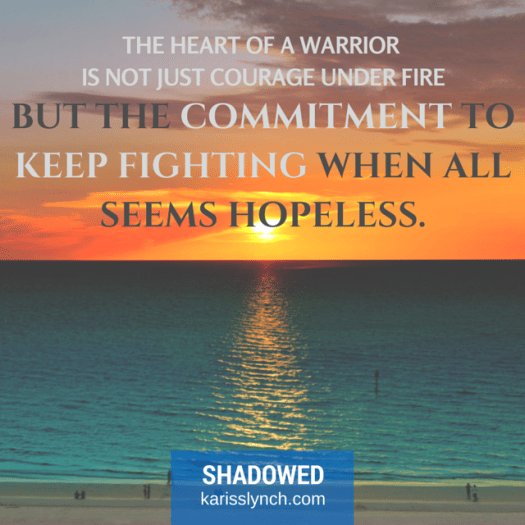
Kariss Lynch Heart of a WarriorTake Superman. I would say his emotional fatal flaw, or one of them, is a deep desire to belong. It shapes his decisions and actions to blend in at the Daily Planet, settle down with Lois Lane, but still seek the true identity of his parents. We all know his physical flaw is kryptonite. Or Lois Lane, depending on how you look at it.

Choosing and shaping a fatal flaw proved an interesting challenge as I finished out my Heart of a Warrior series. I noticed there are multiple factors I need to account for as I select flaws for my characters.

Timeline

All three of my books take place over the course of fifteen months, which made it a challenge to have a fatal flaw that never disappears but consistently morphs. Kaylan, my main character, struggles with fear. Since our fatal flaws never really go away, I had to figure out how to cause this kryptonite to reemerge as she grew. In Shaken, she fears letting people close to her because of the loss of people she loved in the Haiti earthquake. In Shadowed, she has to learn to love a man she could lose at any second, Navy SEAL Nick Carmichael. In Surrendered, she will learn to accept Nick’s career and the constant danger, and not only accept it but thrive in his absences. The root of every one of her struggles is fear of losing a loved one, but as she accepts growth, the flaw manifests differently. Still always fear.

Complementing Characters

If you are writing romance, what fatal flaw will most threaten the relationship and will cause the characters to have to fight together to overcome? In Shadowed, Nick struggles with anger and detachment. This creates a challenge when Kaylan needs reassurance in her fear and Nick needs her to get over it and let him deploy in peace. Both characters grow as they learn what it looks like to merge two lives into one.

Plot and Theme

Shadowed_AUG 1 (1)Each book in this series, had to capture the overall theme: Anyone can develop the heart of a warrior if they are willing to have courage and commitment in the face of insurmountable obstacles. My fatal flaw for each character needed to threaten accomplishing this goal. Kaylan’s fear has the potential to stunt the relationship. Nick’s anger prohibits him from being a strong leader in his home and confident and in control in war. My villain’s flaw causes her to sabotage others in an effort to obtain what she secretly desires most but also never wants to have.

The fatal flaws is one of simplest yet most complex aspects of your character. Which flaws will create complicated conflict? How does that flaw force your character to respond? How will your character grow through the flaw?

One of my favorite ways to identify character growth and a consistent flaw is to follow a specific television series. Over time, you will notice a core struggle emerge. This helps me understand how to develop a character over the course of a book and over the course of a series. I’m still learning, but this is becoming one of my favorite parts of creating characters.

How do you identify your character’s fatal flaw?

WordServe News: February 2015

Exciting things have been happening at WordServe Literary!

On the final post of each month you’ll find a list of Water Cooler contributors’ books releasing in the upcoming month along with a recap of WordServe client news from the current month.

New Releases

Arnie Cole and Michael Ross released Overcoming the Hurt in partnership with 9781630583712_p0_v1_s260x420goTandem.

*************************************************************************************************

Mary Davis released a new title with Heartsong Presents, Romancing the Schoolteacher. 9780373487721_p0_v2_s260x420

*************************************************************************************************

Cheri Fuller released Replacing Worry for Wonder with goTandem. 9781630583705_p0_v2_s260x420

*************************************************************************************************

Rick Johnson saw the release of Romancing Your Better Halfwith Revell Publishers. 9780800722340_p0_v2_s260x420


*************************************************************************************************

Kariss Lynch released her sophomore novel with Realms, Shadowed. 9781629980065_p0_v2_s260x420

*************************************************************************************************

Tara McClary Reeves and Amanda Jenkins released their second children’s book with 9781433681202_p0_v1_s260x420B&H Kids, The Pirate and the Firefly. 

*************************************************************************************************

Michael Ross released his latest book for teens, Dating, Relating, Waiting with 9781630583699_p0_v1_s260x420goTandem.

*************************************************************************************************

Lauren Scruggs with Lisa Velthouse released her second book,Your Beautiful Heart 9781414376714_p0_v2_s260x420with Tyndale Momentum publishers.


*************************************************************************************************

Amy K. Sorrells released her sophomore novel with David C. Cook, Then Sings My Soul. 9781434705457_p0_v2_s260x420

*************************************************************************************************

Jennifer Strickland released her latest book for girls with Harvest House 9780736956345_p0_v2_s260x420Publishers, Pretty from the Inside out

*************************************************************************************************

Mike Yorkey released Everyday Finances for the Everyday Family with goTandem. 9781630583682_p0_v1_s260x420


************************************************************************************************

New WordServe Clients

Marjorie Eastman signed with Greg Johnson.

New Contracts

Tim Maurer signed a contract with Baker Books for Simple Money. Greg Johnson, agent of record.

Joe Wheeler has signed with Pacific Press for a three book deal, in a collection of favorite stories. Greg Johnson, agent of record.

What We’re Celebrating!!

Co-authors, Becky Johnson and Rachel Randolph received a great stared review in FIRST magazine for their latest book Nourished!

The Secret to Page Turning Non-Fiction Writing

I couldn’t take it anymore. It was driving me mad. Why were kids who chronically complained about their hatred of reading, devouring these books?

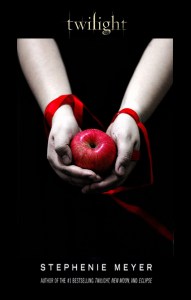
Twilight by Stephenie MeyerBeing the mission-minded gal I am, I decided to find out for myself. So I started reading the Twilight series by Stephenie Meyer. She grabbed me in the first two sentences.

“I’d never given much thought to how I would die — though I’d had reason enough in the last few months — but even if I had, I would not have imagined it like this.
I stared without breathing across the long room, into the dark eyes of the hunter, and he looked pleasantly back at me.”

Bam! She hooked me — and reeled me right in. A few short pages later, I knew Ms. Meyer’s secret to writing for people who rarely read.

Next, I decided to go back and study another series that played the Pied Piper’s flute to many a reader, young and mature, who previously stated their distaste for the written word. Sure enough, J.K. Rowling, of Harry Potter fame, used the same secret strategy as Stephenie Meyer. Both of their method’s are right out in the open, even though they’re hidden in mysterious passages. Rowling begins her first book with this intriguing statement.Harry Potter and The Sorcerer's Stone

”Mr. and Mrs. Dursley, of number four Privet Drive, were proud to say that they were perfectly normal, thank you very much.”

Very different style from Meyer’s, but effective all the same. So what is this magical thread both authors weave so carefully into their books? And how can we emulate the process without plagiarizing their work or voices?

It’s easy. I’ve done it all the way through this post. Are you screaming at the screen yet? “Enough all ready, quit messing with my mind and tell me.”

Meyer and Rowling artfully created cliff-hangers in paragraph after paragraph, culminating in page-turning chapters. Some were so tiny they were nearly imperceptible, while others were breathtakingly obvious. There was no doubt, tapping into simple human curiosity accounted for the multitude of readers desperate for each new release these authors offered.

But both authors were also wise enough to provide the answers to the questions they created, while they simultaneously raised new inquisitive scenarios. They didn’t leave the reader hanging too long.

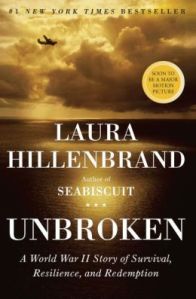
Unbroken by Laura HillenbrandAnd this made me realize, I can follow the same method while writing non-fiction. My style isn’t the same. My genre different. My content, theme, and messages often polar opposite to the fictional creations of Meyer and Rowling, but I can still use human curiosity to my advantage.

Who says you can’t build cliff-hangers into true tales and exposition? Look at Laura Hillenbrand’s masterful biography, Unbroken, now a major motion picture. She hooked me when the first scene opened with blazing bullets and circling sharks.

I realized, the best authors of any genre tap into the powerful force that makes inquiring minds want to know. When a book gets slow, the author has failed to make us wait, or has made us wait so long we give up and move onto something else that satisfies our curiosity.

Getting Through
Releasing, April, 2015 through Barbour Publishing

The answer to creating page turning non-fiction is to use the element of anticipation to your advantage. And like me, consider starting your own clandestine words list. I’ve kept one for over two years now, where every intriguing word I hear, read, or think about is added. I used many in my latest book, and plan to use even more as I continue to hone my craft as an author.

Here’s the thing: whisper, allude, hint, or disguise — the secret hides in the use of secrets. This is an author’s hidden weapon.

Are you curious to know what’s on my top-secret words list

Four Lessons From the Speaking Circuit

Behind the back copy

For 20 years now I’ve dragged a suitcase of books from speaking event to speaking event, telling stories, signing books, listening to people in line innocently yammering on while someone else is waiting impatiently to get an autograph.

I’ve spoken from the Statehouse in Boston to a rain-tattered canopy outside a firehall while firefighters let children blast the siren, from hotel ballrooms with nearly 500 people to three people in an assisted-living home, two of whom seemed comatose by the time I’d finished my intro.

Here, then, are four bits of advice about using your speaking engagements to sell books, 19 of which I’ve written, a few of which have actually sold:

Go where you’re wanted.

I’ve spent far too much of my life trying to convince people that they should believe in me and far too little time appreciating those who do. In the last few years, though, I’ve wised up.

Push on the doors, sure. Push hard. But if they don’t open, stop pushing and go find another door that might. Don’t let your pride get in the way. It’s far more fun doing a small-time gig where people appreciate your being there than beating your head on the door of some larger or more prestigious organization or event that never will.

Partner with one person who believes in you in the community where you’re going to speak.

It was a blustery, rainy Friday night, and I had a speaking gig “up river” in a small community. I honestly wondered if anyone other than the woman who’d organized the talk would come.

After the event, I walked out to my car with more than $500 in book sales, a stomach full of homemade pie and an evening of memories with a bunch of warm, wonderful people.

Why? Because that one woman was an “influencer,” someone people along the river respected. An organizer, someone who can bring an event together. An ally, someone who believed in me.

Someone like that can do more to help your event be a success than hundreds of tweets.

Take time to get to know the place where you’re speaking or the organization you’re speaking to.

Whether you’re selling books afterward or not, this is simply the right thing to do. Why do concert crowds go nuts when some well-known performer mentions something about their town? Because people take pride in where they live and appreciate it when others do, too.

It shows respect. It shows you care. It shows that you’re not just “mailing it in.”

In one of my books, 52 Little Lessons from It’s a Wonderful Life, I devote a chapter to a simple remark that one of the heavenly angels says to Clarence Odbody before the “Angel Second Class” is sent to earth to help a desperate George Bailey: “If you’re going to help a man, you want to know something about him, don’t you?”

Take the time to know something about your audience. Don’t just do a couple of Google searches. Talk to your host. Make a few calls. Do some reporting.

Finally, be interesting.

Never have people had so many options with which to spend their time, so many excuses for not leaving their home.

So, if they’re giving up an evening for you, forget the “first, do no harm” edict inaccurately linked to the Hippocratic Oath. (By me in one book!) No, first, do not put people to sleep. Say something that people haven’t heard before. Or say it in a way they haven’t heard before. Tell jokes. Dispense information. Inspire life-changing action.

But, above all, be interesting. I recently went to an author’s event just to see what other writers do. The guy spent the entire evening reading from his book.

Yawn.

That’s the reader’s job. As writers, we should spend our time offering audiences insight that our books do not. Our stories might be the impetus that draws people to our events, but give them something more than a rehash of our book or books.

Besides, if you’re interesting, people are more apt to believe your books will be, too. And there’s no better way to be asked back.

Writing Through the Storm

No author in her right mind sets out to write a novel in the middle of the craziest year of her mid life. But every author knows that life happens regardless of deadlines, contracted or self-imposed. A year ago I hit the keyboard at the end of December with ACFW in September as my self-imposed deadline. Thankfully I didn’t know the hurdles I’d have to leap to arrive the the finish line, or I may not have tried. Thankfully, God knew better.

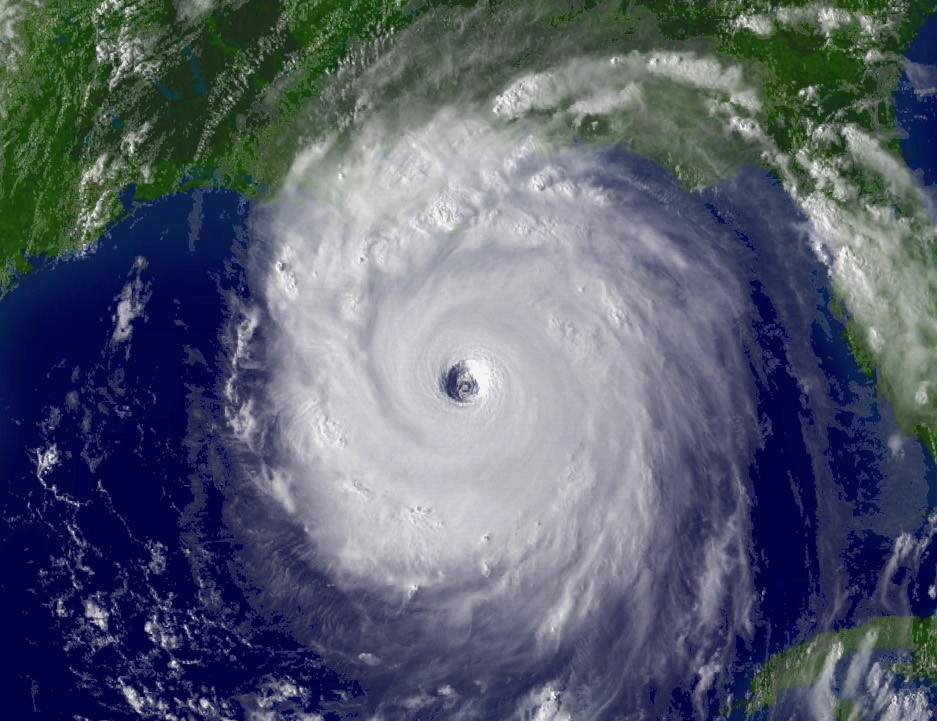
Little did I know my day job would test my new revelation that I am bi-vocational. Little did I know life would swirl around me like the outer bands of Hurricane Katrina, or I may not have tried. Thankfully, God knew better.

Every writer has a well-rehearsed list of real-life waves that sabotage word count, goals, edits, and plotting. I was well acquainted with the pitfalls of Twitter, Facebook, and my favorite procrastination tool, Pinterest. For others it’s childcare, homework, housework–the list is long. I’d hit mid point of 50K when the waves mounted and crashed. My day job work partner went on vacation in March, leaving the office in my care for two weeks. I was planning my youngest’s graduation. My husband was in the midst of a new job and we spent an April stay-cation wading through twenty years of classroom supplies stored in our garage between his classroom moves. In the midst of wading through college applications, taxes, FAFSA forms, college visits, and open house planning, my nurse and prayer warrior retired two weeks after receiving a bad diagnosis in May (she is currently well).

My critique partners knew I was floundering with my writing by July, when my work partner had major surgery and was out of the office for six weeks, turning my usual full-time weeks into forty-hour-plus work weeks. They prayed and kept to themselves their worry that I’d just quit writing and give up on ACFW. That’s when my mother became seriously ill. On the way from the office to the emergency room, I stopped at a long red light, and I felt the world swirling around me. But God’s whisper came as clear as it had for Elijah–“I’m not in the storm.” And I could breathe again. The light turned green.

Ed5_Fig4_1

My mother made a miraculous full recovery, and the weeks that followed brought four funerals of family members of my coworkers by August. ACFW was breathing down my neck and I questioned if I could do it. But as miraculous as my mother’s recovery, I put my heart on the keyboard and my measly 50K turned into 80K in six weeks.

I was pinching myself. I stood in the elevator shaking on the way to my room at ACFW with my dear friend and critique partner. I felt I’d finally been spit out of the swirling storm and come up for air. I didn’t even have a pitch, but I’d been given four pitch slots, the last with WordServe. I was sure I was an impostor. I wasn’t really a writer. It wasn’t really me who’d just poured those words on the page. Thankfully, God knew better.

Life happens. Life will happen again, with or without self-imposed or contracted deadlines. But what I’ll take with me this time is a toolkit to survive it. I will remember:

1. God knows better than me. He’s not in the storm. He is sovereign and so is His work.

2. Even though I’m a hybrid plotter-pantser, pre-planning saved me in the end.

3. Critique partners are a life-line for friendship, prayer, counsel, hand-holding, dope-slapping, and yes, last minute pitch preps!

4. Being bi-vocational means God will supply enough for each calling. I’m not betraying one calling to fulfill the other. Like a mother with multiple children, her lap is fuller, but she has enough love for all.

5. Knowing my story, believing in it, and loving it, kept me from giving up.

I offer my work back to my Maker. Thinking of the future publishing possibilities, I tremble with excitement and fear. But I know He’s not in the storm. I entrust He knows the future best.

Cover Stories

Today is a big day.

I received an e-mail this morning from the head of marketing at the University of Nebraska Press … and attached was what should be the final version of the cover for my next book, Go, Flight! The Unsung Heroes of Mission Control. After what had become a little bit of an odyssey to determine an appropriate image, it looks marvelous. I love it.

If your manuscript is an unborn child in the womb, that first glimpse of the cover is similar to one of those amazing 3D sonograms that allows you to begin imagining what the youngster will look like. It’s a stunning moment and one that never, ever gets old. After all that time and expectation … this … is … getting … real.

Race To The Moon Sept 2009 006
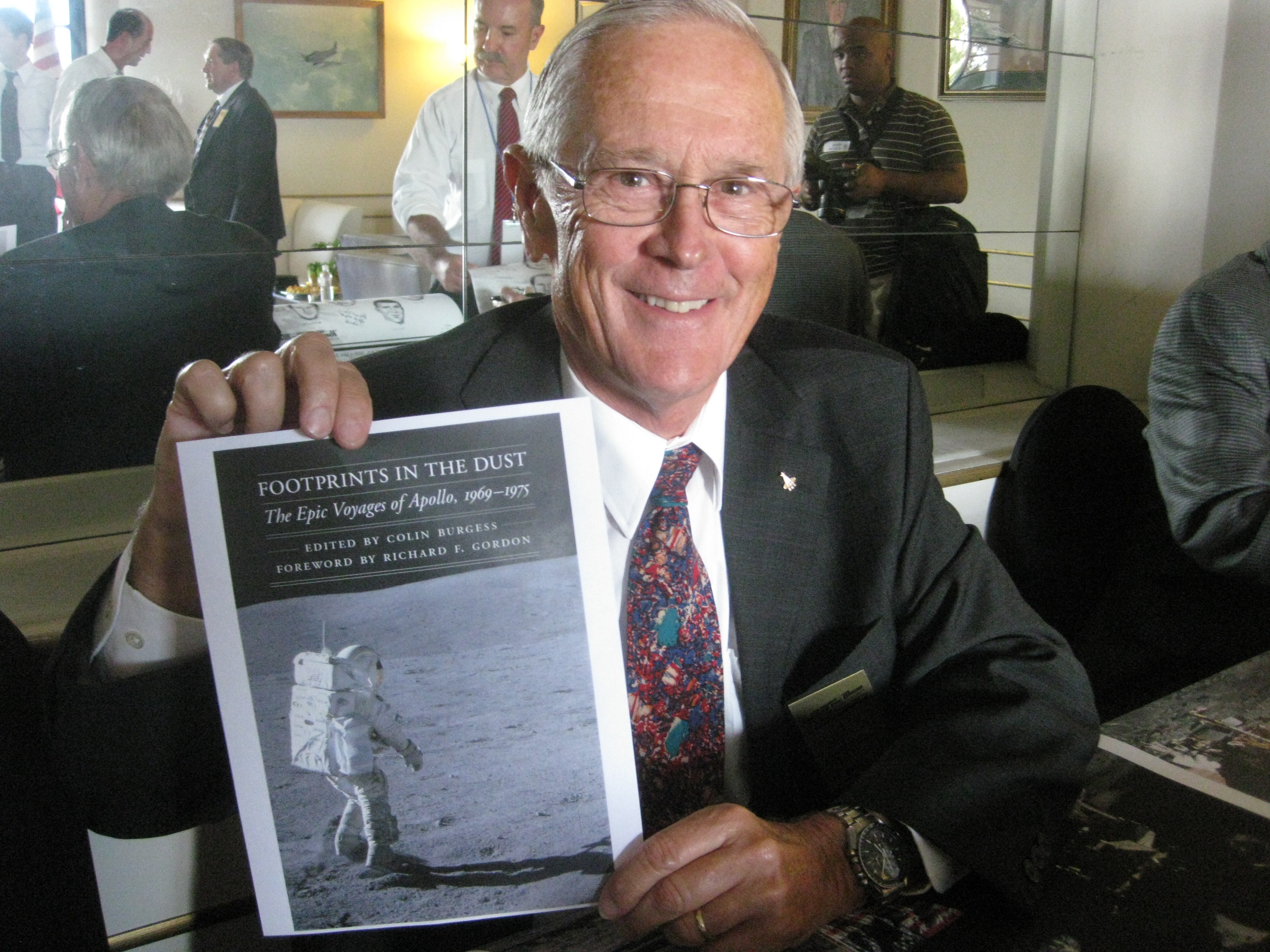
Apollo 16 moonwalker Charlie Duke holds a copy of the cover for Footprints in the Dust, which features a photo of Duke during one of his explorations of the lunar surface. I contributed the lead chapter to the book.Fourteen years ago — not long after the birth of our twin sons, as a matter of fact — I got the cover and first color proof pages of my first book, Second to None: The History of the NASCAR Busch Series. It was a day neither I nor my wife, Jeanie, will ever forget.

Today’s e-mail brought back a lot of memories. Fourteen years ago — not longer after my twin sons were born, as a matter of fact — I received the cover and first proof pages for my first book, Second to None: The History of the NASCAR Busch Series. It was a day neither I nor my wife, Jeanie, will ever forget.

Jeanie is a district court judge here in North Carolina, and that particular week, the boys and I had tagged along to a conference she was attending. She had already left for that morning’s first session when the call from the front desk came.

Mr. Houston, a package just arrived for you if you’d like to come get it.

I knew exactly what it contained. I had not showered or shaved yet. The boys were just beginning to stir and had … well … very, very full diapers. I didn’t care. I pulled on a pair of ratty shorts and threw the kids into their monstrous side-by-side stroller. We must’ve made for quite the pitiful sight, but off we went nevertheless.

To get to the lobby, we had to go down a long hallway with large banquet rooms on either side. We made it to the front desk without being seen and tried to sneak back down the hallway to return to the safety and anonymity of our room.

We weren’t as lucky the second time.

At that exact moment, Jeanie’s conference took a break. Out of the rooms streamed every district court judge in the state of North Carolina. There I stood in the T-shirt I’d slept in, gym shorts, unshaven and sporting hair that might or might not have been combed, with boys whose diapers were already stinky … and getting stinkier by the second.

Oh … hey, Honey.

Jeanie forgave me. I had my cover and my color proofs. They were beautiful. So were Jeanie and the boys, dirty diapers and all. This is my most memorable cover story. What’s yours? If this is your first book, what are your expectations for the cover?

The Making of a Masterpiece

In every block of marble I see a statue as plain as though it stood before me, shaped and perfect in attitude and action. I have only to hew away the rough walls that imprison the lovely apparition to reveal it to the other eyes as mine see it.” Michelangelo

I’ve spent the past month living as a hermit while I finished a manuscript. (Insert sigh of relief here.) I spent countless hours after my day job writing and fine-tuning every detail. Some days, I couldn’t wait to share the story with the world. Other days? All I saw were flaws, flaws that sent me running to fast food and the newest Netflix series while I processed what to do next.

That’s one of the many fun aspects of writing, though, isn’t it? I’m making the manuscript, but in the process, the Lord is making me. As my character wrestles through a growth point, I wrestle with it, too. Often what my character is learning is a lesson the Lord has spent months instilling in my own heart. From the overflow of my heart to the page…I think the story of The David illustrates this perfectly.

In the late 1400s, a group called the Operai provided blocks of marble for several prominent sculptors and artisans to create twelve statues of characters from the Old Testament. Work began on The David in 1464 but after initial carving, the piece was abandoned to the elements for twenty-five years. Then Michelangelo begged the Operai to allow him to complete The David. For three years, he carved the statue, shaving away the damaged parts and shaping features in great detail.

Kariss Lynch creating a writing masterpiece

If you hate history, I hope you stuck with me because none of that is the reason I love The David statue. Michelangelo took a wrecked, abandoned piece of marble and he turned it into a MASTERPIECE. Where everyone else saw a useless block, he saw potential and beauty, a story waiting to unfold.

I think the writing process is a lot like this. A story idea with little initial substance becomes a piece of art with a lot of effort. Over time, the author chips away the unnecessary and ugly pieces until a beautiful story is left.

I believe that’s what Jesus does with the author as he/she writes. Just as Michelangelo labored over The David and you labor over your manuscript, so the Lord labors over you, writer friend. He is in the process of creating a masterpiece that lasts for eternity, and he wants to do that with your writing, too.

Yours is a message of truth and hope. As you identify impurities and polish your writing to perfection, know the Lord wants to do that with you. He wants your voice for his glory. Sometimes the polishing and chipping are painful. With every bit you allow him to remove, you enable him to speak more clearly through you.

Keep chipping away at that novel while the Lord chips away at the excess around your heart. The beauty becomes more evident with every fallen piece.

Give Your Characters a Life!

We’ve all been there.

You’re sitting at your desk, fingers flying across your keyboard. Your hero and heroine are in the middle of a conflict and…wait. How does he react when she turns to walk away from him?

Every action our characters make is determined by their background. Their backstory.

Let’s look at the hero in my September release from Love Inspired as an example.

Nate Colby is a Civil War veteran. He had been part of the Union Cavalry during the last couple years of the war. During one campaign, he was ordered to move a wagon load of explosives out of a burning barn. He hitched a team of mules to the wagon, but the mules balked. They refused to pull the wagon out of the barn.

The explosion nearly killed Nate, but more importantly, the experience was the beginning of a series of events that convinced him he lacks something in his makeup that other men possess. Something inside him causes him to fail every time he attempts something important.

It also caused him to hate and distrust mules.

Fast forward twelve years. During the intervening time Nate’s view of his shortcomings has been reinforced over and over. His parents died while he and his brother were in the army. His sister disappeared into the west and became a prostitute. His brother’s children were left orphans when Nate wasn’t able to save his brother and sister-in-law from the 005house fire that killed them.

And his nephew’s favorite friend is his pet mule, Loretta.

Now Nate is left with his nephew and nieces to care for, but the past still haunts him. It affects every move, every decision. And as the story progresses, the reader gets glimpses of Nate’s backstory. It unfolds when it needs to in order to give Nate’s character depth.

But Nate’s backstory is so much more important than to make his character interesting to the reader.

Without knowing his backstory, I would be at a loss whenever he appears in a scene or when there is a plot twist.

For example, the heroine, Sarah, is a crusader, seeking to save the poor lost prostitutes in Deadwood. She is extremely naïve and idealistic at the beginning of the story, and enthusiastically recruits Nate to help her.

How does he respond? We – as readers – already know this part of Nate’s backstory. Remember the sister who disappeared twelve years ago? Nate’s experience with his sister gives him an insight into the life of a saloon girl that Sarah doesn’t have. He not only keeps her enthusiasm grounded in reality, but he agrees to help her, even though he’s afraid the plan is doomed if he has any part in it.

001Nate’s backstory drives his decision to help Sarah and his feelings about that decision. It affects all of his actions as they carry out Sarah’s plans to help one of the soiled doves in the mining camp. And it provides the starting point for the change his character goes through in the course of the story.


Writing my character’s backstory is a major part of getting to know my characters before I ever start writing my stories. It gives them life!

What about you? How far into your characters’ back stories to you go when you’re developing your next book?