Settling the Score in 2012

Photo: D Sharon Pruit

Like lots of writers, I’m goal-driven. Each December I reflect on what I’ve accomplished the past year and what I still want to achieve. I’m not talking New Year’s Resolutions here; my WordServe colleague covered that quite brilliantly here. I’m talking about taking a good hard look at where I currently stack up against where I want to be.

When I started writing, I decided if I did one thing—no matter how small—every day to move toward my goal, I was doing okay. That worked for a while. I sold a couple of novels, completed several new manuscripts and got an agent—all aspirations I’d set out to achieve. Then something changed. People were measuring success in the social media space in a quantifiable, new way.

I knew social media was important for author promotion, so I increased my focus there. I expanded my social networking channels, reached out to make new contacts and endeavored to add relevant content wherever I participated. Eventually, I fell into a nice rhythm, and I’d thought I reached some moderate success.

Until, I discovered Klout.

I understand the importance of measuring the benefit of action against the time (or money) spent taking that action. Klout measures influence based on ability to drive action through social networks. As authors, we want people to engage with us, and we want them to read our books. So, off I went to Klout, armed with the warm-fuzzy I was already doing okay. I signed into my various latest-and-greatest social networks, then eagerly awaited my score.

It came back: twenty. Let me put that into perspective. An average score for someone dabbling in social media at that time was around 22. I had spent the year ramping up my social media presence and was still decidedly below average. The cat-lady next door probably had a higher Klout score than mine. Dismal didn’t begin to describe how I felt.

Being goal-oriented, I’m not one to wallow in my misery, so I looked up people with Klout scores I admired and tried to emulate them. Ten+ tweets a day? Eesh, but if it will make a difference, okay. Post more Facebook content people are likely to like, comment on or share? Let me just dust off my crystal ball…check. I can do that! Get more mentions on Twitter? No clue, but maybe if I tweet more it will help. And it couldn’t hurt to blog more…micro-blog more…get more followers…make more friends…post better content…be more interesting…put more out there…respond more to other people’s stuff…who said less is more? More is more!

I adjusted my program, then went back to check my score. It was now a bright, shiny…24? Still not good enough. I continued to make tweaks and check to see if anything I did made a difference. When someone reblogged my content, what did that do to my score? When they commented on my links, how did that help? What if I un-followed a bunch of inactive Twitter accounts, did that do anything? One day I thought I’d hit on something when my Klout score jumped to the high-thirties, but then I figured out they changed their algorithms and lots of scores had gone up by 10 or more without any outside effort whatsoever.

Then it dawned on me, if Klout can tweak their so-called measuring stick, why can’t I? Who really cared about my score anyway? Would an editor not buy my novel if my score wasn’t high enough? Would my agent drop me if my True Reach wasn’t up to snuff? Would my Yahoo groups cringe to be seen with me? Would my Tumblr pals run away like one of their clever little gifs? Would I never sell another book again?

I’m guessing the answer to most of the above is ‘no’ with the exception of that last one, because if I didn’t stop obsessing about moving my Klout score, I was never going to make time to finish another book again. Ever.

As I look forward to 2012 and set some writerly-type goals, I’ll continue to include author promotion among them, but I’ll be careful what I use to measure my success. Even though Klout is interesting and a great validation for some, I already know it’ll no longer be my personal yardstick.

The only numbers I want to obsess over this year are word count, the number of pages I’ve edited, and possibly the number of adverbs I remove from my first drafts. I may even go back to my old adage: what have I done today to further my writing career? I’ll stretch myself to improve my writing—to dig deeper for character development, to toss out clichés and to make my dialogue sing. I’ll remember why I joined social media to begin with: to interact with friends, readers and other writers.

And when I look back this time next year, I hope I’ll be able to carve another notch in the old doorframe and celebrate 2012 knowing how much I’ve really grown.


What about you? How are you measuring success against your goals?

How to Plan a Book Club World Premiere

Image by Salvatore Vuono

As I’ve journeyed to the February 2012 publication date of my first novel, Into the Free, I’ve listened carefully to authors who have “been ‘round this track” a few times before me. One such author is bestselling novelist Lisa Wingate.

Just before her sixteenth novel, Dandelion Summer, hit shelves, Lisa shared the book with a lucky group of ladies from the McGregor Tiara Literary Society. Then she shared their reaction to the book with the world via YouTube.

Book Premiere? That’s Genius!

I’ve always been a member of at least one book club, and I am drawn to books that encourage people to discuss the themes of the story. I was intrigued by Lisa’s idea for a premiere. I figured, Hollywood holds premieres for new movies, right? Publishers have started making trailers for books, just as producers do for films…so…why not follow that line of thinking and host a premiere for my novel? I was convinced Lisa Wingate was brilliant. And I was right.

But Lisa is not just brilliant. She is generous and compassionate and eager to share her talents with others. It’s no surprise she provided a step-by-step tutorial on her Southern Belle View blog for others who might want to plan such an event. There you’ll find detailed instructions on planning, organizing, recording, and sharing the big premiere.

Without her directions, I would have overlooked details about release forms and microphones. I would have struggled using Windows Movie Maker to edit the clips, and I would have been clueless about lighting, length, and little tips to make the event fun for all involved.

Roll out the Red Carpet!

Thanks to Lisa Wingate’s fabulous advice, and Terri Blackstock’s kind suggestion to check out Lisa’s idea, I have since held three book premieres across the country for Into the Free. I’m editing them now and will be sharing them with the public in January, 2012. But just for fun, I have posted some of the photos and comments on my website.

If you’re planning to launch a book in the future, I strongly encourage you to consider a book club premiere. Even if the camera malfunctions (as mine did with the third event) or Skype gets moody (as it did with the group in Colorado), it’s still a ton of fun and very interesting to hear reader feedback before the book ever hits shelves.

Big thanks to the Beach Babes of Baton Rouge, Louisiana; Porch Pals in Longmont, Colorado; and the University Literary Circle from Oxford, Mississippi for playing along with me.

And…be sure to view  clips from Lisa Wingate’s world premiere for Dandelion Summer.

Answering Critics

Everyone’s a critic. Everyone has an opinion. And of course, everyone’s entitled to their opinion.

But what happens when a critic or a reviewer or a book club member reads your book and doesn’t like it? What do you do when you read a cutting review of the book you toiled over for months (or years)?

Novelist Alice Hoffman had a book release in 2009 called The Story Sisters. She received a less-than-glowing review by The Boston Globe’s Roberta Silman. Unfortunately Hoffman wasn’t able to dismiss the review as one person’s opinion and move on. Gawker, an Internet gossip site captured all the dirty details. Lashing out on Twitter, Hoffman posted 27 Tweets in response to that review, including posting the contact information for Silman in hopes that Hoffman’s fans would call the reviewer out on the carpet.

I wonder if Ms. Hoffman is wishing she could take back her words. Well, actually — if she could take back her Tweets. I think that the answer to that is a resounding yes because her Twitter page is no longer online.

Very few writers please all the critics all the time, and most likely there is no writer who’s ever accomplished that feat. But the issue lies in how you deal with the criticism. It’s tough to receive negative feedback whether you’re a yet-to-be published author or one who’s had several books printed.

Some strategies to deal with the disappointment?

Call your agent/editor/mother/spouse/best friend/significant other and vent your frustration. Go for a walk. Write something. Take a nap. Write a private email to your critic if you must. Still, if the last option is your choice, first give it a day or two, and consider praying about the words you’ll deliver.

But don’t go and lose it online.

Perhaps the best course of action for Ms. Hoffman would have been to say nothing. What’s accomplished in slamming the reviewer for her words? It just doesn’t look professional, even if you think the other party acted poorly.

Author Angela Hunt cautions writers to never answer a critic publicly. That sounds like good advice. Too bad Ms. Hoffman didn’t receive such counsel.

Want a laugh? Here’s one author’s humorous response to criticism.

What’s your advice to someone suffering the sting of criticism or rejection?

Build Your Platform Tip #2 Get Other Authors to Work for You (and do the same for them…)

Left to their own devices, authors tend to be solitary creatures. The only problem? It’s lonely out there for a writer.

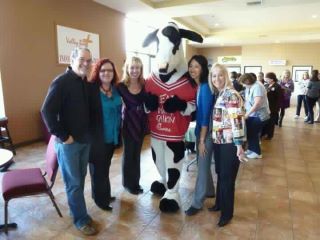
Me and my husband Roger with Author Friends Cindi McMenamin, Arlene Pellicane, Lynn Donovan, and the Chick-fil-A Cow at Harvest House’s Desire Conference in San Diego

I’ve found one of the best ways to have some longevity in this biz is to gather up your own little crew. A few authors who have a variety of gifts and talents to learn from, teach, and generally keep each other afloat when major publishing houses merge and panic sets in.

Another great advantage to having a network of other authors is the ability to build each other’s platforms. Here are just a few of the ways I do that each month:

  • Feature each other’s new releases on your blogs
  • Promote your writer’s friends books in your e-newletter
  • Shout from the Facebook rooftops about their accomplishments
  • Create events together
  • Team up together on virtual book clubs (for an example of this, check out our MOPS Military Book Club at www.thebookclub.kathilipp.com )
  • Carry each other’s books on your websites and on your book tables

All of these networking opportunities I take advantage of on a regular basis. But the most effective, platform building networking I do is by referring (and being refered by) other speakers.

When I am already booked for an engagement, I have a few other speakers/authors that I refer to these groups. But, I even take it a step further. After a great event, I will pass on one or two of my favorite author’s speaker packets to the meeting planner, telling them that they may want to consider booking these authors for their next big gig.

I only do this with other speakers I have heard and trust. Nothing can make your credibility go south quicker than a bad referral.

The flip side of this is that I have other authors who pass my name along when they are done with an event. There is nothing better than great “word of mouth” given to a happy client.

I have had great results with this idea, and an added bonus: I have developed a great network of friends who go through this business with me. It is great to have someone to talk with who understands this sometimes very strange industry.

Action Plan:

  • Hook up with a couple of speakers that you know and trust, and ask them if they would be willing to recommend you, because you would love to recommend them. (If you need speaker training, be sure to check out Toastmasters.org, CLASSeminars, or Proverbs 31 Ministries.)
  • Create a speaker packet for your speaking ministry (if you would like an example of my speaker packet, email my assistant at lynette@kathilipp.com and she will send you a copy of my e-packet now through December 19th.)
  • Exchange speaker’s packets with your favorite author to hand out after your event
  • Put a list of other speakers on your website in case you’re not available to do an event
  • Feature another speaker/author in your monthly e-newsletter (and have them give away a couple of copies of their latest book) with a link to their speaking page

Question for you:

What is the most effective way you’ve found to work with other authors and speakers when it comes to building your platform? Share your tips in the comments below.

Dear Jon: A Story of How NOT to Build a Platform

I’d been blogging for just over a month when one morning in the shower I was struck with a fantastic idea: I would email Jon Acuff to ask if he would guest post on my blog.

Brilliant! Why hadn’t I thought of this sooner?

I couldn’t dry off fast enough. I threw on my sweats and zipped downstairs to my computer, where I composed the request in a flurry and hit send. I even suggested to Jon that I would guest post at his place, if he would prefer that (I’m accommodating that way, you know).

If you don’t know Jon Acuff, he’s the author of the books Stuff Christians Like and Quitter. When I emailed him he hadn’t yet published his highly successful Stuff Christians Like, but his blog by the same name was wildly popular. At the time he had thousands of followers and received more than 100 comments on each post.

I, on the other hand, had exactly two followers (one — my husband — if you don’t count me).

I did know one thing for sure, though, and that was the fact that I needed to build a platform if I had any hope of landing an agent and publishing my book. After all, that was why I launched the blog in the first place, and I was determined to make this platform-building thing happen. The book was written; I assumed I had the hard part done.

Jon Acuff had a mega-platform. I had none. So the perfect solution, I figured, was to lure some of his readers over to my place, where they would be wooed by my stunning prose and become fans of my writing forever.

Voila! Instant platform, right?

You can probably guess what happened.

For starters, Jon Acuff politely declined my tantalizing offer. The fact that he responded to my email at all speaks volumes about his character. He kindly mentioned that he didn’t typically write guests posts or feature guest posts on his blog (something I would have known, had I been reading his blog for more than two weeks), and then he said this:

“Just write what you know from the heart, Michelle, and people will read it.”

I wasn’t pleased with his response. In addition to the intense shame I felt for proposing such a ludicrous idea, I was dismayed that there wasn’t a quick fix, a magic bullet, to platform-building.

“Write what I know?” I thought. “Write from the heart? What the heck is he talking about? There’s got to be a better way.”

As it turns out, Jon was right; there is no magic bullet for platform-building. There is no quick and easy way to build a following overnight, because the fact is, blogging and other social media are not simply about luring readers to our words, they are about building a genuine relationship with those readers.

And that takes time. And it takes genuine writing — writing from the heart, you might say.

I’ve been blogging for just over two years now. I still don’t have a mega-platform, but I do have something I never expected. I have online friends. 

People come to read my posts, yes, but many of these readers are also people with whom I have a genuine relationship.  We visit each other’s blogs and leave encouraging comments. We retweet each other’s posts. We offer support and advice to each other via email. And when I have the rare opportunity to meet some of these people in person, we continue our conversation face-to-face, as if we know each other well.

Because we do.

Despite the fact that I die a little every time I think about my foolish email to Jon Acuff, I don’t regret that I sent it. Jon graciously taught me an important lesson about this business. In the end, it’s not as much about the platform as it is about the people.

So what about you? Do you have any mortifying platform-building stories? And what have you found to be the key to successful platform-building?

Social Media – When Less is More

When I first joined Facebook I thought, “This is ridiculous. Who would ever do this?”

But I was told if I ever wanted to be considered by a book publisher, I better have an author platform. One of the foundational ways to build a platform is by using social media venues such as Facebook and Twitter.

So I grudgingly used my Facebook account. I logged in once a week to see what others were up to.  But then a weird thing happened. I discovered I loved social media. I made real friendships online and looked forward to hearing from my “peeps.” I enjoyed getting ideas and opinions from people all over the world. I loved knowing what people were thinking and talking about. I looked forward to laughing, crying, and praying with my online friends.

As soon as I mastered Facebook, I noticed authors talking about something called Twitter. Twitter seemed overwhelming so I read a few books about it:

*Twitter Revolution by Warren Whitlock and Deborah Micek. I wrote about it here

*Twitter Means Business by Julio Ojeda-Zapata You can order it here.

I learned that Twitter is very different from Facebook. Twitter is a powerful tool for specific purposes such as checking how snowy the roads near Vail are, what Judge Belvin Perry is ordering Casey Anthony’s jurors for lunch, discovering what the police are doing near I-70, talking out loud to politicians and celebrities, and telling companies about their bad (or good) service.

As I settled into my social media routine, I saw my heroes adding tens of thousands of friends, so I did likewise. I added and “friend-ed” everyone who crossed my path.

It makes sense. We all want to be part of the group like this little guy:

My friends and followers list grew, but I dreaded getting on my computer. I didn’t know whom I was talking to, and I felt like I was being spammed when I wanted to relate. So one day I deleted all 800 of my Twitter friends and started over.

I carefully and deliberately chose which friends I would follow (now less than 100) and paid little attention to who was following me. Every few months I clean out my Facebook account. I unfriend lurkers, spammers, and people who spew their message but never interact. One thing I’m proud of is that people I interact with on social media are not strangers, they are my friends. I have found several benefits to cutting back:

  • I am more eager to login to my Facebook and Twitter accounts.
  • I have built relationships with my online friends, so when my book gets published I won’t be a nameless face spamming everybody.
  • My friends and followers are more likely to pass my books, videos, and blog links to others.
  • I’m interacting with people who share my interests.
  • I’m filling a social need by relating instead of spamming. Research shows that people form communities on Facebook and Twitter in order to get social needs met.

More and more people, whose expertise I admire, are limiting the ways they interact on social media. As authors we are continually trying new marketing ideas, so we experiment, take risks, and try new things. I don’t know if the way I do social media is right for you…

Do you think more followers and friends are better? Why or Why Not?

What’s Your Klout Score?

I have to admit, I’m a numbers girl, which may strike you as funny because math is certainly not my talent. Likely, it comes from my nursing background and my need for instant gratification. My “real-life” job concerns fixing my patient’s numbers—moving them in the right direction. Lowering temperature, easing difficulty breathing, or bringing back a heart rate when there isn’t one. It’s all about trending in the right direction. Wrong patient trends need intervention.

Recently, I was reading Rachelle Gardner’s blog and came across her discussion on “numbers” and how you could use certain statistics, like blog hits, in your book proposal to help a publisher make a decision to go forward with your novel. Of course, a strong book is paramount but it is foolish to think that a potential employer, your publisher, isn’t looking at your on-line presence as a way to help their decision.

Rachelle mentioned a Klout score and I hadn’t heard of this so off to the website I go.

Klout, in one place, analyzes the effectiveness of your on-line presence. Once you allow it access from your social networking sites—and they do have a lot of them—it performs some genius unknown mathematical calculation so you can get a glimpse of your on-line life in a couple of areas.

First score measures your influence. It’s based on a scale of 1-100. One hundred being the best score you can have. Currently, I’m at 42.23 which places me as a “Dabbler”. Under Klout style, it will show other people you likely know, what their score is and where they land style-wise. That was a fun comparison because I knew several of the people and their on-line presence. Most I admire as something to aim toward.

Then is your true reach score. This measures how many people you influence. My score is currently 404. The site allows you to see other people’s scores as well. I compared myself to a known author and her reach was 877. I didn’t necessarily feel bad about that. She has three novels currently published and a savvy internet presence.

Next score is amplification which is how much you influence people. My score currently sits at 19. Not great but I’m just starting out so a definite growth opportunity—not weakness, right?

Last score is for network. This scores the impact of your network. The more people that comment, share and respond to your content, the higher your score will be. My score here is 51.

Klout also looks at topics you’re influential about. Mine are medical (yeah!), technology (really?), authors (excellent), blogging (surprised!) and childbirth (yikes—don’t ask me how.)

Also, it will list who you influence and whom your influenced by. Fun information.

Overall, I think Klout will be a good way to measure your on-line presence and whether or not it is growing. Sometimes, when I look at my Blogger statistics, I think the information is limited. I can see my stats are increasing but for me, that just may be more people are perusing by. That’s not bad but I like how Klout looks at your influence and overall reach. These are good numbers to gauge. If they are steadily climbing, my efforts are working versus a downturn would lead me to consider changing up what I’m doing.

Are you on Klout? What’s your score? Have you used your scores to change what you’re doing on-line?

For an alternate opinion on how valuable this score is, check out this post entitled: Why Your Klout Score is Meaningless.


Introvert Marketing in an Extrovert Market

My name is Olivia Newport and I am an introvert.

I’m not a hermit. Rich relationships nourish me, and my peeps keep me buoyant. Speaking, preaching, or leading a workshop do not scare me. But they take from me, rather than give to me.

At least 25 percent of the general population are introverts and charge up during time alone. Among writers, the percentage of introverts likely rises.

The rub comes because the rest of publishing runs on a 75 percent extrovert mindset. “Why Writers Have to Market.” “Ten Steps to Building Your Platform.” “Authors Must Be Speakers.” “How to Suck All the Readers in the World to Your Blog!” (Okay, I haven’t actually seen that last headline, but you know it’s a game winner.)

Um. Markets and platforms are places where hordes of people hang out. And since I don’t fuel my creative energy by hanging out with hordes of people … well, you see where this is going.

I do want to be a novelist. I do want to build an audience. I do want to be successful over the long haul.

My challenge is this: How can I accomplish these goals without feeling thrust into a 75 percent extrovert mindset that is counter-intuitive to who I am? I’m not talking about the work of learning new skills, including social media. We all have to do that. I’m talking about being able to meet readers out of the strength of my natural introversion, rather than being squeezed to set it aside in order to play the game.

I can’t turn myself into an extrovert. I don’t even want to pretend to be one for periods of time. It’s exhausting, and how does that help? As I got ready to launch a website and blog, I thought a lot about how to build an online presence based on my strengths, not on rules that are a foreign language to me.

• Be present. It’s not hard to find me. You find my name, you find me. I don’t spurn social media, and I don’t make it tricky to be cyber-friends.

• Seek connection. I like people. Really. My heart rejoices with those who rejoice and weeps with those who weep.

• Risk authenticity. I’m not perfect. I’m figuring life out as I live it. I love to go deep and share that experience with others doing the same.

• Build on consistency. I am a creature of habit and lists. I’m generally predictable. This will serve me well in an expanding author-reader universe.

• Celebrate being me. I’m not competing in that reality show, “She Who Dies With the Most Wins.” Embracing and celebrating the person God created me to be is the greatest value I offer to readers.

We all connect with readers by building on strengths. Being introverted is a different sort of strength than 75 percent of the population, but it serves me well because it’s my strength and I understand it.

Are you introverted or extroverted? How does that affect your experience of publishing?

Keywording 101 for SEO Prowess

Three words:  Search Engine Optimization.  They kind of make you want to grab a bag and start hyperventilating, don’t they?

In the world of viral marketing, social media and Google Adwords, SEO has become another one of the things that you’ve probably had to put on your to-do list.  And, if you’re anything like most of the writers I talk to, you probably have no idea where to start.

I was lucky.  Before I got my book deal, I’d spent five years working as a staff writer for a major media company.  And, since we wrote for the web, I spent hours each week honing my SEO skills.  We actually had a team of SEO gurus on staff that hosted weekly SEO boot camps for us—analyzing every article we wrote for SEO viability and nitpicking every teeny tiny keyword on our site.  So, while viral marketing and blogging were new to me, I had the SEO thing down pat.

And, I have to say, it’s worked for me.  While I spend very little time doing viral marketing on my blog—I’m just not a good twitterer—I get fairly decent traffic—and most of it comes from Google referrals.  I chalk that up to having a strong SEO strategy—and knowing where to focus my SEO time.

Obviously, SEO is a tough nut to crack—and there’s no way I can give you even a tenth of the information you need in one post.  Before you create a viable SEO strategy, you’ll need to decide if SEO is even worth your time (in some cases, it’s not), how you’ll use SEO keywords (there are many, many ways that go way beyond simply keywording a post) and how to create relevancy with your keywords on your site (now that’s complicated).

But, in order to put the horse before the cart, the first thing you need to do is come up with a list of keywords that you want to use on your blog or website.  This list can (and will) become your SEO cheat sheet—you’ll have something to focus on, something to consult whenever you’re writing a post, a start to a strategy.  Here are my tips:

  1. Limit your keywords. I’ve had clients who presented me with a list of 100 keywords and then asked me to help them come up with more.  And, while they have the right idea in that they are focusing on specific words instead of just throwing out a random slew of words as they write a post—they are biting off too big of a chunk.  While the Google and Bing algorithms are super complicated, one important aspect is that they search for relevancy—which means in a nutshell they’ll be crawling your site to see how much information on your site is relevant to a specific keyword or idea. So, unless you’re posting dozens of articles every week that are very specifically focusing on all 100 of your keywords, you’re probably not you’re not creating a sense of relevancy with many of them.  So, choose a short list (my recommendation:  between 5 and 15) of keywords that you can focus on with every post, every page and every idea.  By simplifying, you’ll actually create a bigger reach.
  2. Do your research.  Don’t just guess on which keywords people are searching!  I use both Google Adwords and Google Insights all the time to help my clients (and myself!) find appropriate words to focus on.  They’re pretty straightforward tools so you can probably figure out how to use them to your advantage in less than ten minutes.
  3. Know your competition. Remember how I told you that I used to work for a major media website with huge traffic numbers?  And remember how I said we had an entire SEO team on staff?  Let me give it to you straight:  Unless your last name is Grisham or you have a staff of 40 writers and editors helping you with your blog, you CANNOT compete with major sites like that.  It’s a waste of your time to try.  Case in point:  Me!  My book, The Christian Mama’s Guide to Having a Baby, is a pregnancy guide–but I have never spent even a minute focusing on the keywords “pregnancy,” “pregnancy book” or “pregnancy guide.”  Why?  Have you ever heard of “What do Expect When you’re Expecting“?  Or “Baby Center“?  I could spend hours a week creating relevancy on my site around the word “pregnancy” and only move from page 120,000 to page 50,000 on Google.  And, while moving up 70,000 pages is pretty good, I’m pretty sure no one has ever looked past the first two pages of Google results, so it’s absolutely a waste of my time to focus on “pregnancy.”  Instead, choose words that get a decent number of searches every month (target:  between 1,000-10,000 global monthly searches) and low competition (less than 20% on Adwords) and focus on those.
  4. If you don’t talk about it on your site, don’t use it as a keyword.  I see this mistake all the time… my clients throw out a search keyword based on a theme or idea in their books, but when I pull up their website, I see nothing about that particular idea on their website.  It’s not only poor user experience—if someone Googles “Amish recipes” and then comes to your site and finds nothing about Amish recipes, they’re probably not going to stick around—but it also does nothing to create a sense of relevancy around that keyword, which will hurt your SEO.  This does not, however, mean you need to blog only about the topics in your novels.  For example, author Jody Hedlund has a wonderful blog full of tips and ideas for authors (find it here)—however, her latest novel, The Doctor’s Lady, is about the first woman to pioneer the Oregon Trail.  On her website, Jody has done a great job of creating relevancy surrounding the theme of her book by creating a cool “reader fun” page that’s full of facts, quizzes and more surrounding the historical times in her books.   Similarly, author Rosslyn Elliot, a historical romance author who wrote “Fairer Than Morning” maintains a “History” page on her site that adds relevancy surrounding the historical concepts in her novels.
  5. Cater to groupies.  As fun as it would be to be loved by everyone, it’s just not going to happen.  As a pregnancy author, I can’t appease the natural birthers AND the epidural fanatics.  And you can’t appease everyone either.  So, think about your core audience—the people who ABSOLUTELY love everything you do—and work to appease them both with your site content and your keywords.  For example, my friend Cathy West wrote an amazing historical romance called Yesterday’s Tomorrow that’s set in Vietnam during the war.  And, while her book is great for all sorts of populations, you can bet that Vietnam vets and their families find it especially compelling.  My recommendation for Cathy?  To cater to that population, both by creating contests and posts that appeal to Vietnam vets, but also by focusing her keyword reach on words that appeal to that audience.

NOW:  For a chance to win an hour of SEO consulting from me (via phone or Skype, 30 minutes research, 30 minutes talking), respond to this post and tell me how (or if) you’ve developed an SEO strategy for your blog.  Winner will be chosen at random on October 21st and will be contacted by me via email.

*CONTEST IS CLOSED*  Congrats to WINNER Norma Thurston Holtman.

Flubs are not Fatal

Approximately 650 Christian writers have just returned from the ACFW conference in St. Louis. Some are celebrating agent/editor requests for manuscripts and are on an emotional high at the apex of the roller coaster we call the writing life.

Others may be feeling like they just slid over the edge and are plummeting down the steep hill into an abysmal, dark cavern. This feeling may be perpetuated by some flub on your part and you’re wondering if you and your career will recover.

Whatever fatal flaw you may be experiencing emotional distress over; it will likely not end your writing career. Unless you actually murdered someone… well, that might cause the ultimate demise of your writing dream through traditional publishing at least.

I’m here to share two “golden lessons”. Flubs are not fatal and the world of publishing is comprised of a small group of editors and agents.

My goal at one of my first writer’s conferences was to do several paid critiques. This was at a smaller, local gathering and I was just dipping my toes into the pool like a first time swimmer. I asked the conference director what I should submit. I still think he said “your best three chapters.”

I should have submitted my first three chapters.

Now, by the time I met with this particular agent over that critique, I had realized my mistake and apologized profusely. Surely, there was no saving my reputation.

It gets better.

Three years later I had an appointment with that same editor. I had polished the manuscript in those many months and felt confident that I had something worthy for her to consider. Just before our appointment, I attended her talk on writing edgy fiction and she made a point to say, “I really dislike when writers use rape as a plot device. Can’t you come up with something better?” My stomach twisted into a glorious mariner’s knot.

That’s right, my manuscript was about a serial rapist and our appointment was minutes after that talk.

I still went.

How do you handle these situations? Here are some of my suggestions.

  • Confess your mistake. Editors and agents are human just as we are and have probably made a few flubs themselves. Be open and honest about the mistake and move on.
  • Learn from your mistake. Don’t do the same thing twice. It’s not the fact that you made a mistake but your ability to fix and learn from it that is the mark of a professional.
  • Stay positive. If you think the agent/editor flubbed and it affected you negatively, don’t disparage them on social media. That same editor I met with twice is still working as an editor and was at the conference sitting one table away from me at the banquet. That would likely be a career ender.
  • Laugh about it. The writing life is hard enough. Self deprecating humor goes a long way in helping keep you sane.

Despite these gross errors in my writing journey, I still managed to acquire an agent and a publishing contract. And yes, it was that same novel.

What “fatal” flub have you had and how did you handle it?

.