Want to Get Published? A Publisher Needs to See a Compelling Project

Note: This is the second post in a series of 4 posts: 3 Things a Publisher Must See.

3 thingsYou’re heard of the fabled “elevator pitch”? You’re in an elevator and are suddenly given the opportunity to pitch your idea to someone who could make it a reality. You have a few sentences to communicate clearly the nature of your project.

Pressure’s on.

And this really is a Goldilocks and the 3 Bears situation:

  1. If you say too little—either the number of words or the impact of those words—you lose.
  2. If you say too much—either the number of words or the impact of those words—you lose.
  3. The way you present your project needs to be “just right”

You could say….

  • “I’m writing a book.” (yawn, check phone) Four words is probably not enough.
  • Or you might spit out, “I’m writing a book on marriage” (There’s no impact, nothing memorable, nothing distinctive.)
  • Or you might go with, “I’m writing an in-depth treatise on the common misperceptions about the mating rituals of married white American evangelical females between the ages of twenty-eight and twenty-nine occurring in suburbs within twelve miles of six major U.S. cities after nine pm…” (Just wrong on so many levels.)

Nothing about any of those makes a publisher want to know more.

  • But what about: “The Singular Secret To a Vibrant Marriage”?

Now the editor is curious to know more. What is it?!

A book proposal is really just an expanded elevator pitch. You need to communicate very clearly and efficiently what your book is about so that publisher will want to know more. Don’t make them work hard to figure it out.

Exercise: Right now, give the two-sentence pitch for the book that’s in your heart. Out loud. To the walls. Write it down. Then, when there’s a human within range, give them the pitch. Then ask them:

  1. Do you feel like you know what the book is about? Could you communicate it to someone else?
  2. Is it unique? Are there other books like it?
  3. Based just on the hook/pitch, does it engage you to want to know more? Do you want to buy and read it? Why or why not?

With this feedback, work further to articulate what is unique and compelling about your book.

Cheering you on,

Margot

 

The Importance of Dreaming

Ever feel like your writing time has slipped into a series of tasks you are struggling to check off?

1500 hundred words and counting? Check.
Edits? Check.
Social media graphics for the week? Check.
Blog posts written and turned in? Check.
Responded to readers and answered emails? Check.
Laundry, grocery shopping, life things? Maybe check. Kinda.
Maintain sanity? In process.

If we aren’t careful our writing routine turns into a list that can drain our creativity and make us forget why we are writing. I am the queen of time management and boundaries. I have to be in order to prioritize and get things done. But sometimes in the midst of trying to be disciplined and organized, I miss out on the creativity that comes with dreaming. I actually plan time to dream. It’s vitally important to the rest of my list.

Dream a little bigger

Dreaming rejuvenates me.
One of my favorite questions to ask when it comes to writing is “what if.” What if my characters decided to do something totally unexpected? What if my villain surprises everyone? What if I create a setting that puts a unique spin on a scene? What if I created a character that absolutely fascinated my reader? Then how do I do all this?

“What if” is a powerful question, one I don’t ask nearly enough. But when I do, my writing sings more than normal and my creative juices flow.

I also like to story board. I may love words, but I am attracted to powerful visuals. It’s fun to create the scene and cast my characters by scouring the internet for photos that jog my creativity in a greater way. I pin them on a corkboard so that I can see and move them to help craft the story. This helps dream about possibilities. Possibilities are endless in our writing. We just have to seize them.

Dreaming rejuvenates the story.
I like to set a timer and see how many words I can spill on the page before time runs out, but occasionally this depletes my creativity instead of inspiring it. However, when I take time to dream before I start writing, even if I just spend fifteen minutes on a writing prompt, my writing carries a different kind of power and creativity. When I race the timer, my story has quality and quantity. My characters are also deeper and my settings more vivid.

Dreaming rejuvenates the reader.
Letting readers into my brainstorming and dreaming is fun to share with readers. This makes great social media content to excite them and help them invest in the story before they ever hold it in their hands. Inviting them into the dreaming helps them feel like part of the team and part of the journey. If you do this, be prepared to write faster to satisfy their growing curiosity.

Tasks and deadlines are part of writing, but dreaming and enjoying the writing…that’s the most vital part of the journey, for it informs everything else. If you are feeling overwhelmed or stuck, grab a pen and fun notepad, and don’t be afraid to dream a little, darling. I have a feeling you will like the results.

Debut Novels, Reprint Rights, and Movie Deal Dreams

I didn’t know how blessed I was to get my first book deal. Love Finds You in Sun Valley, Idaho came out in 2010. It was part of the Love Finds You series. And because the books were written by a bunch of different well-known authors and set across the United States, my book got swept along with the marketing current.

album 155

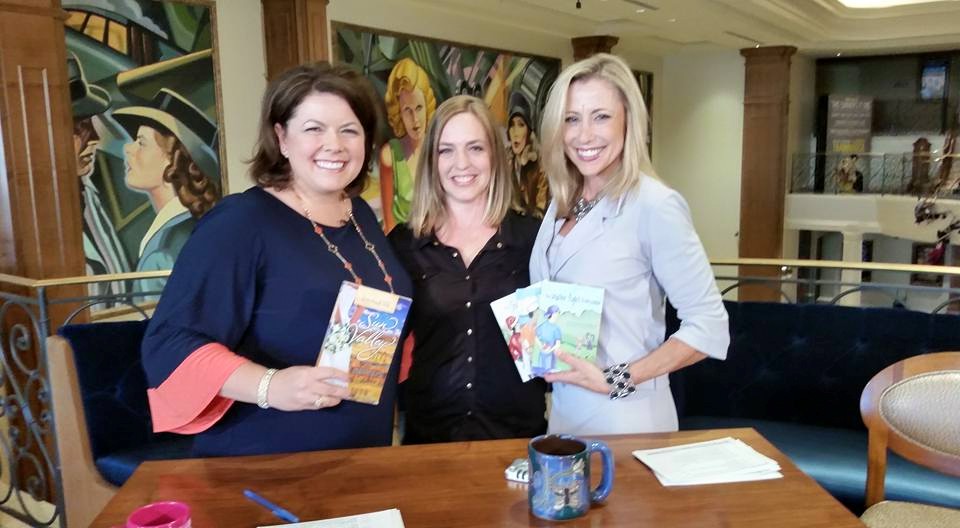
I got to do a television interview.

I had a Costco book-signing.

The novel was featured in the magazines for a Christian bookstore chain.

It was sold in airports.

The hardback edition came out for book clubs.

And now It’s being considered for a MOVIE. When I found this out, I was so excited my husband thought someone had died. Not that I get excited when people die, but I was crying and could barely speak, and he assumed the worst.

Three movies have already been made for the UPtv network. I had a premier party with my writer friends for Love Finds You in Charm, including homemade Amish pastries. Love Finds You in Valentine comes out this month.

I can’t keep from mentally casting actors to play my characters Tracen Lake and Emily Van Arsdale. Especially since Emily Van Arsdale is supposed to be the actress who plays Wonder Woman, and Wonder Woman is releasing in the theaters soon.

The idea of having my debut novel considered for a movie made me want to revisit the story. Then it made me want to write sequels like many of my readers requested. So I got my rights back, and I’m rereleasing the book as the first in my new series titled Resort to Love.

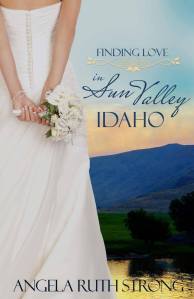
Finding Love in Sun Valley Cover


Finding Love in Sun Valley, Idaho comes out this month. I updated a few things—like how the characters now all have smart phones. And I gave it an epilogue that leads into the following books.

Finding Love in Big Sky, Montana comes out in November. I’m currently writing this one and wish I could throw my responsibilities to the wind so I could go write in a cave until it’s done because the ending is going to be so good!

Finding Love in Park City, Utah comes out in the spring of 2017. This one I’ve plotted, but I’m still researching the location. I’m spending the end of January in the mountain town and attending the Sundance Film Festival. Remember how I said my main character in Sun Valley is an actress? It fits.

I didn’t know anything about getting my rights back, but I ran into Miralee Ferrell at the Oregon Christian Writer’s Conference last summer, and she’d already done it for a couple of her own Love Finds You books. With her help. I was able to find out that my book had been out of print for a couple years. From there I simply had to make my request. Once I got my PDF files, I not-so-simply converted them to a Word document and edited out about a million exclamation points—among other newbie mistakes.

Miralee had been able to get her cover files, but mine weren’t available, so we hired a designer. When I say we, I mean Miralee. She’s releasing my series through her new publishing company, Mountain Brook Ink. But she let me have creative reign over my cover. I especially like the scrollwork around the Finding Love label. That symbol will go on all her Finding Love titles. Another cool thing is that I’ve remarried since my first book came out, so I get to add the name Strong to this cover.

I’m currently getting ready for my Books and Beverages Blog Tour. Check my website for details and the chance to win a Kindle Fire.

Books and Beverages

Even if my book never makes it to the big screen TV, I’m still glad I get to enjoy my debut novel a little longer. And I’m honored to get to share my dreams with you.

What’s a book you’ve read that you think would make a good movie?

Building a Platform? Finding Helpful Resources

Photo/CCWC

“If you want to be a nonfiction author, you’ve GOT to work on building your platform?”

I perked up when I heard the word “platform” mentioned for the umpteenth time at my first writing conference.

Building my what? I didn’t expect this advice at a “Christian” writing conference. In fact, I didn’t even know what the workshop leader meant by “platform.”

Hands popped up all over the conference room, asking questions about “building a platform.”

“Can you give us more information?” Another frenzied writer whined.

A few seats down from me, an older lady with a wrinkled brow whispered to the person next to her, “What does she mean by ‘platform’?”

“I didn’t think ‘Christian’ writers should focus on building a platform,” someone mumbled. “Is that even scriptural?”

The murmurings continued…

I felt my blood pressure rise as I listened to all of the questions and observed the body language of the writers all around me.

I shook my head in disbelief as I considered all that I had done to prepare for this moment—particularly the last five years of academic writing. Is she saying that I need to study marketing now? Oh, great!

A few days later, I abandoned my first writing conference early due to a family crisis. So I didn’t get a chance to hear more about platform building.

Overwhelmed, my thoughts about building a platform and my mother’s untimely death left me dazed and confused. Should I even go forward with “writing for publication” now?

One workshop leader warned us against “quitting your day job.”

Great! I just quit my day job, I whispered under my breath. I had just turned down the offer to teach writing as an adjunct instructor again that semester. Why? I needed to help with our ongoing family needs, and I wanted to focus what time I did find on writing for publication.

After the conference, if someone even mentioned the word platform, I would voice my frustration with a favorite quote from Gone with the Wind, “I can’t think about that right now. If I do, I’ll go crazy. I’ll think about that tomorrow.”

What’s a writer to do? Where can we go for information on building a platform? Back when I started, I had to dig deep for information. Now, you can find more resources than ever before now on that topic.

Michael Hyatt is one of the best resources I’ve found on platform building. I started following Hyatt’s blog on the advice of other writers several years ago. A few years later,  when he published his book, Platform: Get Noticed in a Noisy World, I ordered my copy hoping to improve my own platform. I still recommend this book to other writers who ask me for help in that area. I’ve even led my own writing workshop on platform building based on what I’ve learned.

New Year’s plans. As I await my first book publication this spring, I’m still struggling with all the details of platform building—blogging, social networking, speaking, and writing. With all the advances in technology and social media, I’m always seeking new resources and ways to stay up-to-date with publishing info.

What are your plans for the New Year? What have been your strategies? What’s your secret? Did you quit your day job? Do you have any platform building tips that you would be willing to share with other writers?

I’m hoping this blog post will initiate a conversation about platform building. So, I hope to hear from you. Be sure to share your thoughts on this topic in the comment section below.

What resources have helped you build your platform?

Want to Get Published? 3 Things a Publisher Must See

Note: This is the first post in a series of 4 posts: 3 Things a Publisher Must See.

3 things

You have a book in your heart that you’d love to see published. It may even be a great book. A publisher and her editing board need to see three things to say the “yes” you’re hoping for. They need to see: a unique project, a viable market and the right author.

1. A Publisher Needs to See a Unique Project

Although what you’re writing may seem fresh to you, know that publishers have already received countless pitches for “My Cancer Journey,” “My Eating Disorder Journey,” “My Spiritual Memoir.” Does this mean you scrap your project? No. But it does mean that you need to demonstrate how yours is unique. For example, these might catch a publisher’s attention:

  • Why Cancer Was The Best Thing To Happen to Me This Year
  • How My Eating Disorder Was Cured When I Won “The Biggest Loser”
  • I Was a Satanist High Priest and Now I Love Jesus

Make an editor curious enough to open your proposal!

One baby step toward publication: Read other books in your genre and identify what, if anything, makes yours unique.

2. A Publisher Needs to See a Viable Market

The publisher also needs to see that there is a market for this book. Who are the readers who will buy your book? What is the felt-need they have that will cause them to purchase your book, read it and rave about it to their friends? Research the market so that you can demonstrate that there are book-buying readers who need your book.

One baby step toward publication: Develop a one- or two-sentence “elevator pitch” that succinctly communicates the substance of your book, who will read it and what distinguishes it from similar books.

3. A Publisher Needs to See an Author Who Can Write and Promote This Book

A publisher is looking for authors who can write and who can also get that writing before an audience.

You’ve probably heard that author platform—your ability to reach readers—is the most important thing to a publisher. (And it’s pretty important.) But hear this: every publisher wants to publish great writing.

Chapters and pages and paragraphs and sentences and phrases need to engage readers. Your goal is to get a publisher (aka “reader”) to read the first sentence of your proposal and want to read the next one and the next one. You may think it’s an editor’s job to give your proposal a thorough reading, but it’s not. Her job is to find quality books to publish. When she is perusing your proposal, she can check out—and check facebook—at any point in the process. Develop your craft so that you can write prose that a reader does not want to put down.

And there’s also that platform business…

Who has platform? Oprah. Rick Warren. Francis Chan.

Intimidated? You don’t need to be. You can be building your platform right now by:

  • pitching and writing articles for publications
  • developing an audience for your blog
  • building your speaking resume by speaking places for free: MOPs groups, churches, etc.

The key is finding what works for you and sticking with it.

One baby step toward becoming a great writer: Sign up for a local writing class, sometimes available at city colleges, or attend a writer’s conference in your area.

One baby step toward building platform: Set a goal to publish one article or story, with a reputable national publication that appeals to the eventual audience for your book, in the next three months.

Cheering you on,

Margot


Should I Write Fiction or Non-Fiction?

When I was an aspiring writer, I had no idea whether I should pursue novels, (fictional stories using made-up characters, scenarios, and plots), or nonfiction, (themed projects using real-life examples). So before I signed with WordServe, I wrote a proposal for both.

Juggling a Writing Career and a Day JobWhen my literary agent steered me in the direction of nonfiction, I felt two distinctly different emotions. One part relief, because it’s easier for me encourage, inspire, teach, and motivate through true stories and practical application. But I also felt a twinge of disappointment. After all, it’s a little more fun to make stuff up. Besides, you can get away with things under the guise of imagination, where non-fiction holds you to a strict standard of authenticity.
Mark Twain once said, “It’s no wonder that truth is stranger than fiction. Fiction has to make sense.” He also said, “Fiction is obliged to stick to possibilities. Truth isn’t.”

Today, I’m much more comfortable in my true writer’s skin. Occasionally, I still feel the old pull to write novels, and who knows, maybe someday I’ll do it for fun, but for now, I recognize that I am on the right path. I was made to inspire through nonfiction. But it doesn’t mean I have to give up story-telling…as a matter of fact, for me, stories enhance the topics I am drawn to write about.

Maybe you understand my dilemma. If so, perhaps these bullet points will provide clarity. After all, facts help us make informed decisions.

Fiction

  • Defined by Merriam-Webster as written stories about people and events that are not real. Literature that tells stories which are imagined by the writer; something that is not true.
  • Many readers are drawn to the escape of make-believe story, becoming passionate followers of characters.
  • You can hide truth in a fictional account.
  • There is an increased opportunity to sell two to three book deals as a fictional series.
  • There are fewer speaking platforms to engage with readers, and introduce them to your work.
  • There are fewer fiction publishers available to buy your books.
  • You must write the entire book before submitting it to publishers.

Nonfiction

  • Merriam-Webster describes nonfiction as writing that is about facts or real events. All writing that is not fiction.
  • Statistics show the greater majority of dedicated book buyers gravitate to nonfiction.
  • You can use fictional techniques to tell true stories.
  • On average, studies show nonfiction authors are paid more for their books.
  • With effort, you can find a place where groups gather for practically any true subject–and where they meet, a speaker is needed. Most publishers will require speaking platforms from nonfiction authors.
  • Tapping into felt needs sounds easy on the surface, but unearthing fresh subjects a publisher will buy, and a title that draws readers, is almost as tough as writing the book.
  • Though you need only write two to three chapters of your book, a thorough proposal including a solid marketing plan, comparative analysis of similar books, and complete outline with chapter blurbs is required.

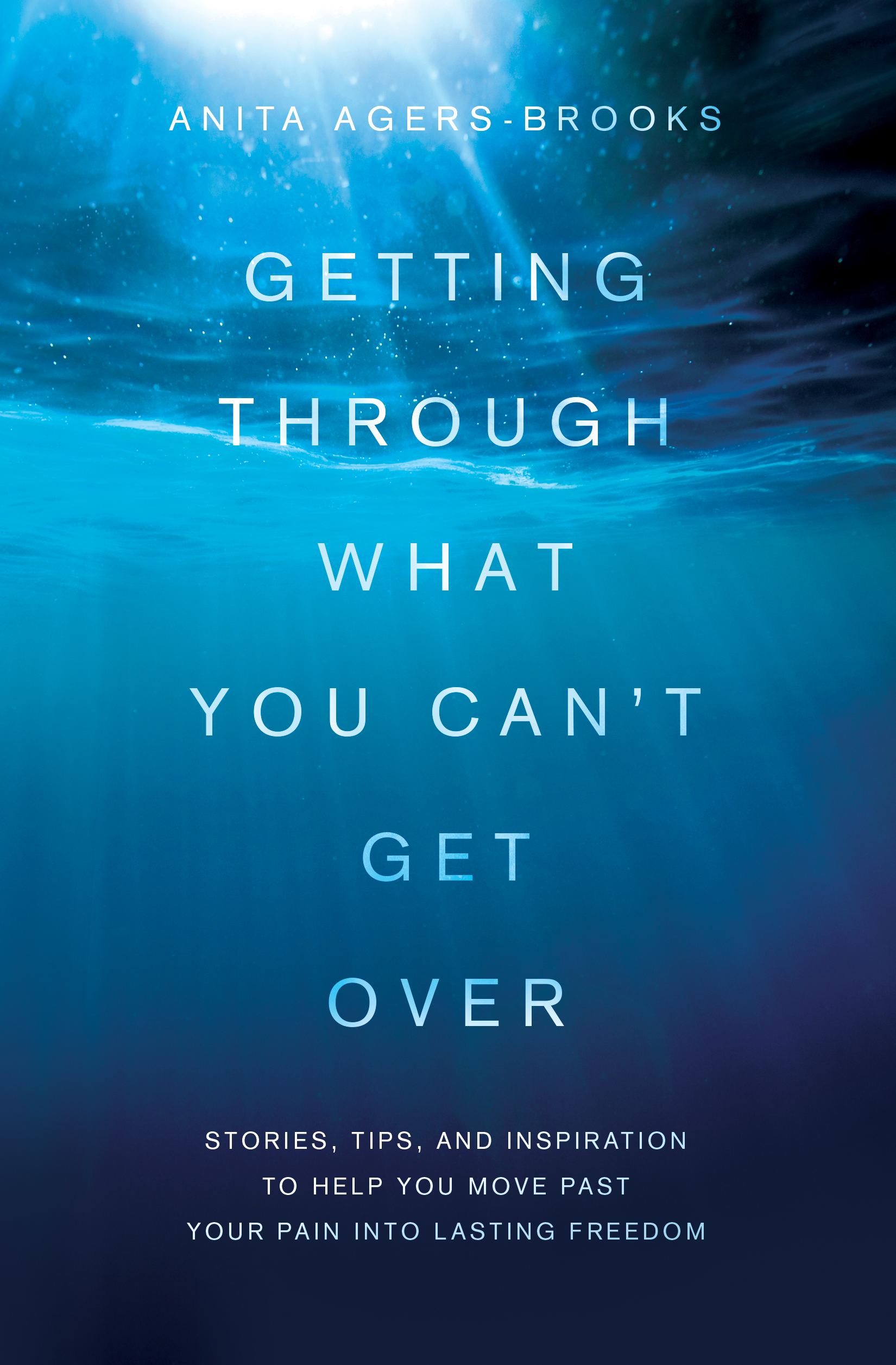
Getting Through What You Can't Get Over Book CoverFor me, nonfiction is my natural fit, and reviewing these bullet points confirms my choice. I have a speaking platform. I prefer truth-telling over make-believe. I love to research facts, statistics, and the latest studies. I actually enjoy the challenge of coming up with a fresh approach to an existing issue, while pounding out a unique title.

There are readers for every genre, or those genres would fade away. Thankfully, there are writers to supply the demands. As an author, I must look at where I can do the greatest good, after all, the books I write ultimately belong to readers. I can’t pen it all, so wisdom says, write what I can pen best. In my case, this means nonfiction.

Are you writing fiction or nonfiction? Why is that your choice?


When is it Good to Indie Publish?

When I first began going to writers conferences around 2003, vanity publishing (where you pay someone to produce your book) was considered only a dire writer’s avenue to get his poorly written manuscript to the public. These novels were not given any credit by publishing gatekeepers (such as editors, agents and book reviewers.)

PublishVanity publishing morphed into several forms to what is now the indie industry. There are still vanity publishers who will take your money and produce your book. However, indie publishing is where the author becomes publisher– hiring freelance people for all facets of book production but they remain in control of their product.

Over a decade later and the attitude surrounding indie publishing has changed a lot. Though some still hold the above attitude, it is diminishing, and self-publishing is no longer considered the last nail in a writer-wanting-to-be-an-author coffin.

A few years ago, I attended a talk given by well respected literary agent Rachelle Gardner, a self-published author herself whose book highlights traditional vs self-publishing. She gave a talk touting some of the benefits of pursuing self-publishing and in some instances considered it a bonus to an author’s career.

What?!? Yes, that screeching sound was both my feet hitting the brake pedal.

The dizzying pace of these changing attitudes in publishing can leave an author scratching his/her head.

Personally, I’ve seen several close friends pursue indie publishing and have moderate success. By this I mean they earned back the money they invested in preparing the manuscript (for editing, the book cover and interior design) and perhaps have earned a couple of thousand dollars. A smaller minority had great success and went on to further get traditional publishing contracts.

What I’ve determined is that there is a good time and place to consider indie publishing as an author, and here are some of those situations to consider.

1. You have a polished manuscript but it can’t find a home with a publisher. First, I want to qualify what I mean by a polished manuscript. This is much, much more than finishing a rough draft that your mother and friends slobber over. They’re not good book critics because they love you and don’t want to hurt your feelings. It means that it’s been professionally edited, at least twenty people outside of family (and are familiar with books, genre, and good writing) love it, and maybe your agent even shopped it around but it couldn’t find a home. An even better indicator of this caliber of manuscript is that it has finaled in a well-respected writing contest like the Genesis Contest sponsored by ACFW. It takes six to ten years to learn the writing craft and a couple of written books under your belt to fit this definition.

2. There will be a delay in books releasing between your traditional publishing contracts. What I’ve heard and read is that it also takes six to ten years to build a readership. During that time frame, it’s wise to have a book releasing no longer than once a year. Some authors do more—some do less but you want a predictable stream of novels to keep readers’ interest piqued.

3. You are a control freak. Creatives like control over their product. Publishing is not that way. It is a collaborative effort so some of what you love about your creation is going to change. Some people enjoy all aspects of the book publishing process and want to have final say over every aspect—going strictly with their vision. Self-publishing is the best venue for the author to maintain total control. You also have to front all the cost and carry the entire burden as well for marketing and distribution.

4. You want to maintain your rights. When you sign a traditional publishing contract, your book is no longer really yours—in a sense. The publisher owns it in certain formats (maybe even all formats) and most often times will have clauses in your contract on other avenues they have the option to pursue—like hard cover large print rights. Some authors don’t want to give this up but then, as in the above, you’ll also be the one to try and negotiate selling the rights in different formats if you choose.

5. You want to write in other genres. Most often, an agent and traditional publisher are going to encourage you to stick with one genre but few authors I know really want to do that for their entire writing career. These might be good novels to self-publish under a pen name. Even this attitude is changing as well. Many authors I know are writing in multiple genres using the same name and don’t seem to be suffering for it.

6. You want to build volume more quickly to increase income. The flip side of building a readership is how much material you have to offer. When my first novel released, if the reader loved it, there was nothing else for them to read. Now, if they love any one of my books—they have at least two others to choose from. The more books you have, the more options a reader will have to choose and buy another book of yours to read—thus increasing your potential earning income.

What do you think? Have you indie published? Did you consider a success? Would you do it again?

This blog post first appeared at Novel Rocket. Hope you’ll check their blog out!

Three Things I Wish I Would Have Known When I Started Writing

I still remember sitting in that very first session at my first writer’s conference. Nervous. Insecure. Excited. Then the instructor shared that dreaded statistic. It wasn’t good news.

“About one percent of writers succeed in getting published. Because most give up and drop out of the race.”

I felt liking running out of the room into the brisk autumn air. But instead of following my instincts, I stayed — and made a vow to become one of the one percent. I tell that story here.

Extra ExtraSeven years later, I can report good news. I have two published books, First Hired, Last Fired: How to Become Irreplaceable in Any Job Market by Leafwood Publishing, and Getting Through What You Can’t Get Over by Barbour Publishing. A third, (one I was hired to write for someone else), will release in the spring of 2016, a new proposal is on the market, and I’ve contributed in two others. No one is more surprised than me.

Sometimes I still shake my head and give myself a pinch. Am I really a professional author and speaker now? Those dreams I journaled, those goals I put in black and white — are they truly my reality? Why, yes, they are.

It’s hard to believe only a few short years ago I seriously began to pursue my most secret desire. When I started this journey, I didn’t believe in my abilities. If I had, I wouldn’t have waited so long to get serious.

  1. What you have to contribute is just as valuable as what anyone else has to offer. Trust God’s call to write more than you trust your fears and comparisons. Dare to believe.
  2. Do something in regard to writing every day, (except your Sabbath). Research, blog, write articles, outline new proposals, brainstorm titles, interview someone, whatever it is, make sure that six days a week you are making forward motion in your writing career. But don’t discount any of it. Sometimes you will feel as if you didn’t accomplish anything because you didn’t type words into your computer, but if you conducted a new interview, or outlined a proposal, you were productive in your writing. So quit beating yourself up!
  3. Analyze all of the things you learned in past career fields, much of it will transfer to your writing career. I’m amazed at how my background in banking, accounting, marketing, and even manufacturing have given me insights and understanding about the business of professional writing. Nothing is wasted — including the time you spent doing those things. Don’t begrudge your past, express gratitude for its benefits.

Getting Through What You Can't Get Over Book CoverEach day that passes I become more comfortable in my own writing skin. I realize what I am compelled to put on a page can really help others. For instance, we’re now in the most depressing three months of the year, November through January. Getting Through What You Can’t Get Over will make an ideal gift for those who don’t know what to get someone suffering from anxiety, grief, PTSD, or depression. I can now make that statement with confidence, whereas three years ago, I wouldn’t have dared.

I guess what it all drills down to is something we hear many times as authors. It takes perseverance, tenacity, and determination to make it. If I could go back to the beginning of my career, I would encourage my newbie self to keep on keeping on every day. And there’s one particular thing I would add. I’d lean in close, cup my hand over her ear, and then I would whisper, “Never give up, buttercup. In the end, you’re going to make it. You become one of the one.”

Writing and Publishing for a Purpose

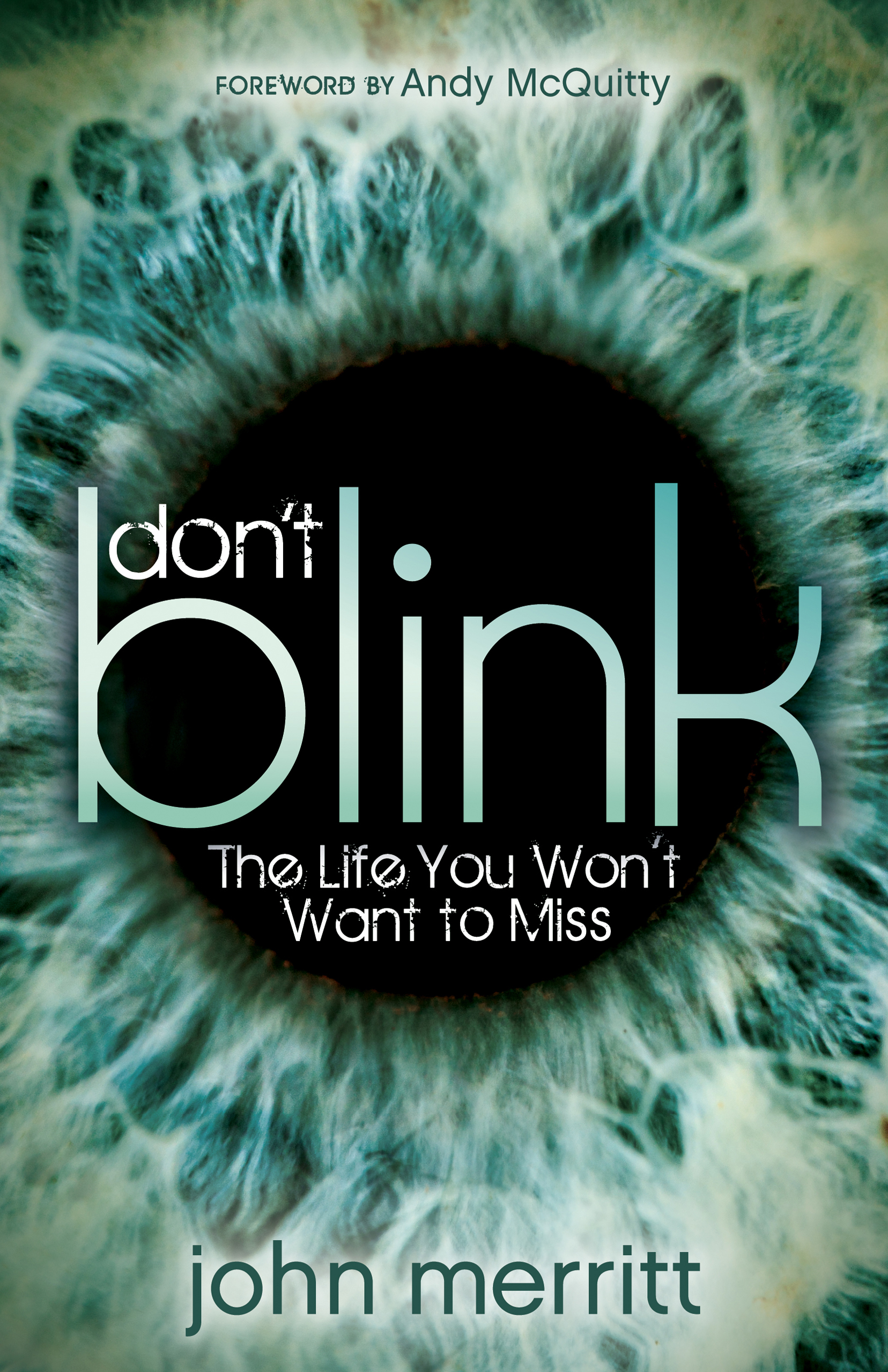
John Merritt: Writing and Publishing for a PurposeYEAH!!! There were times when I never thought my book would actually be on bookstore shelves or available online as it is today! It’s been a long and sometimes arduous journey to get Don’t Blink in print. Now that it is, I hope and pray that God will use this book for the purpose intended—to inspire Christians to live life to the fullest, and as a gift to our non-Christian friends who could use a different perspective on what the Christian life looks like.

It’s been said that there’s a book inside each one of us. And while this is no doubt true, the big question is: Will anybody read it? I wondered that of my own book. And how do you know if people are reading it and benefiting from it? Ah, this is where social media provides some answers.

I’ve been transparent about my lack of passion for social media—especially my own! And yet, I am finding that this is not only where you get honest feedback but also transparent testimony of the effectiveness (or not) of what you are putting out there. In fact, reading some comments about Don’t Blink on the internet has provided confirmation that God is using this in ways that I had hoped and prayed for.

Here’s an example: After reading the first five chapters of your book, I have to say thank you for rekindling my sense of adventure! I have been dreading writing my company mission statement and personal bio, etc, for my website. You reminded me of my passion for life and to just go for it, with Jesus by my side! What could be better? I think I was getting a little stagnant or complacent. What an invigorating breath of Christ-filled air! After reading “Don’t Blink” poolside this hot afternoon, I dove in for a swim and it was GOOD TO BE ALIVE! I plan on purchasing copies for my father and my friends. Thank you!

I’ve been asked why I wrote a book, and responses like this provide the answer. I knew going into this project that 80% of men don’t read books. While my book has both a female and male audience in mind, I wanted men to find the book readable. So each of the 23 chapter starts with a captivating short story followed by a down-to-earth, real-life application. Seems like the book is keeping the short male attention span engaged—and I love that!

To all of you who have read or plan to read Don’t Blink: The Life You Won’t Want to Miss I thank you. And remember, I wrote it with your non-Christian friend in mind—so please share it. Would make a nice gift for someone you care about this holiday season that is almost upon us.

God’s best to you!

John

A Writing and Publishing Journey

So John, tell me about the writing of your book. How long did it take? What did you learn about publishing? What was the most enjoyable and most the difficult part of the process?

Pastor John Merritt, Discover. The Writing Journey

I’ve been asked questions like these numerous times in recent months. And since my first book, Don’t Blink, ready to be released in November (EBook is already available)—I thought I’d share what I loved and what I did not love about becoming an author (things you may consider if you have thoughts of becoming an author yourself).

What I loved: The actual writing of the book that took place during a six month sabbatical. I’ve always enjoyed writing, telling a story and making biblical application out of real life experiences. What I didn’t know was that writing the book was the easy part—let me tell you about the hard part.

Don’t Blink is for procrastinators, dreamers, and would-be adventurers who wish to grab hold of life this day, knowing there are no guarantees about someday. From Alaska to Argentina to the Amazon―in situations ranging from dangerous to humorous―John Merritt takes you on a daring pilgrimage revealing what living in the moment looks like. John demolishes the notion that once you become a Christian your freedoms are gone and your fun is done. Life is an extraordinary adventure elevated to audacious heights when God is leading the charge.

What I didn’t love: The first thing I didn’t love was when I was advised to hire a professional editor who proceeded to get out her electronic red pen and essentially let me know how unaccomplished my writing was. In the end I was thankful for her coaching because the result was her finally telling me, “John, you’ve found your writers voice.” But that required many tedious rewrites that took longer than the initial draft.

A second thing I didn’t love was the realization that unless I was able to find an agent willing to represent my project I had no chance of getting a publishing house to even consider my work. Finding Alice Crider (then with WordServe, now with Cook) was a God-send and was not easy. (Note: Because of the difficulty in getting an agent to represent you, self-publishing is sometimes your best option.)

A third thing I didn’t love is the months it took for my agent to find a publisher who was interested in my book (took an entire year). There are many reasons why a publisher says no to a writer but the main one is market share. Publishers are in the business of selling books, and if you are not able to prove that you have a large audience who will buy lots of books, it really doesn’t matter how good your content is.

A final thing I don’t love is all the marketing of the book I must personally do because no one else is going to do it (not even most publishers these days). Because I’m not good at social media I’ve employed a person who I’m greatly indebted to (Leah Apineru with Impact Author Services, Colorado Springs) who built and maintains my website and posts my blogs. But I’ve always hated self-promotion and leaning on my friends to get the word out—sorry!

Why I wrote it: Given that being a published author is much more difficult than I ever imagined, why did I hang in there and spend lots of my own dollars in order to get my book out there? Simply because I think it will help Christians like yourself discover that God has an adventure designed just for you that will elevate your life each day. And what elevates the purpose of the book for me is if people like yourself find the book to be a good one to pass along to your non-Christian friends who could use a different perspective of the Christian life. If the publishing of “Don’t Blink” results in spiritual explorers becoming followers of Jesus then all that I didn’t love about publishing will be worth it!

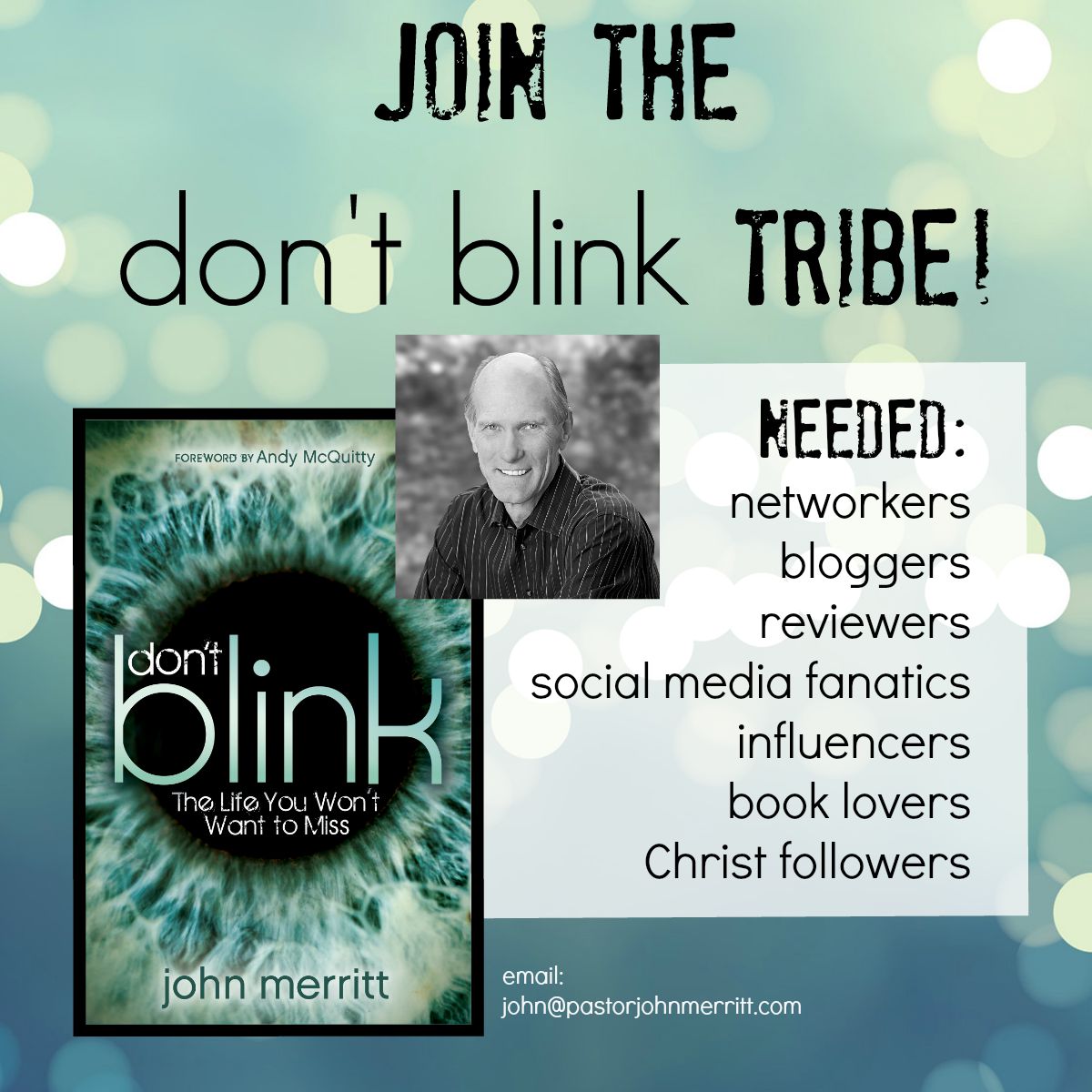
John Merritt's Don't Blink TribeToward that end, I’m looking for friends who share that same passion and will help me by reading the book and then sharing it with your friends and family members. Currently Don’t Blink is available in EBook form through Amazon, Kindle, iBookstore and Barnes & Noble Nook. The paperback is due to be released November 10 and you can pre-order a book now. If you would like to learn more about joining the tribe, email: impactauthor@comcast.net.

Please connect with me on Facebook
Google+
Twitter

Thanks everyone!
John