The 15-Minute Writer: Help for Harried Aspiring Authors

I’ve never had the luxury of uninterrupted time to write. In fact, while finishing my first book, I had a five year-old, a busy hubby–and morning sickness (which lasted all day, throughout the whole time I was pregnant with my second son). Since then, I’ve worked a variety of part- and even full-time jobs while continuing to build my platform and hone my craft. And out of sheer necessity, I’ve become a master at using hidden pockets of time to further my career.

If you’ve got all the time in the world to research, read, and write, then skip this post. If you’re like me, however, I hope you’ll find encouragement for reaching your writing goals–fifteen minutes at a time:

—Write whenever, and wherever, you have a few spare minutes (during lunch hours, while your kids are at soccer practice, in waiting rooms). During these “cram sessions,” don’t edit; just write as fast as you can.

–Or just edit. Read a draft of a poem, filler, or blog post (preferably out loud) and make a few quick changes.

–Browse the writing section of your local bookstore or library and pick out a few gems to read in fifteen-minute spurts. I can highly recommend Writer with a Day Job.

—Hire a teenager to watch your kids, clean house, or do your errands. And later, use the time you just saved to write!

–Create a spreadsheet. Like this.

—-Look for an online writing support group. The members can provide support, tips, and tricks. (If they instead give you spam, aggravation, and passive-aggressive “critiques,” you can always un-join. That would only take five minutes.)

–Save a few templates of frequently-used pitch letters and customize a query to a specific magazine or agent.

–Create a rough draft of a new writing resume.

–Update your LinkedIn account with recent writing jobs.

–Flip through the newest issue of your favorite magazine, and list a few ideas for features you could pitch to the editor.

–Think about the unique ways you organize your kitchen, kids’ rooms, or office. Draft a filler to send to an appropriate magazine.

–Have a great idea for a greeting card? Check out Hallmark‘s website to see what contests they’re currently running.

—“Backwards plan.” Take a deadline, or set one for yourself, and mark it on your calendar. Then write down all the tasks you’ll need to complete in order to meet the deadline—interviews, outlining, writing a rough draft, revising—and decide how much time you’ll likely need to complete each one. Finally, plan backwards, setting yourself mini-deadlines. (This tip has saved my sanity—and my family life—on several occasions!)

From my busy-but-very productive writer friend, Glynn Young, here are a few final suggestions: “Find and follow three writing blogs, like noveldoctor or Jeff Goins. Read one chapter of a book about writing. Read three poems. Read one author’s entry on Wikipedia. Read the current post on The High Calling.” [where Glynn and I both serve as editors]

See how much you can accomplish in short spurts? Who knows–your mini writing sessions might just lead to your fifteen minutes of fame. Either way, you’ll never regret the time you spent pursuing a passion. I promise!

Now it’s your turn. What ideas do you have for using small amounts of time wisely?

Finding a Publisher – 10 Steps to Success – Part 2

I’m returning to discuss those ever important steps in finding a publisher. You can find Part I that covered steps one through five here.

Step 6 – You may have ten or maybe even twenty publishing companies still on your list. Now take a look at their websites to see for yourself what kind of books they publish. Pick out one or two books similar to your own story and discover where the publisher actually sells them. For instance are they available in book stores or only on internet sites like Amazon. Browsing the books for sale can also tell you if the books are best-sellers. Read the readers’ reviews etc. Spending time in this area can help build up a picture of the publisher, and this kind of research is always fruitful for new writers. Are the publishers small or big, successful or not, new or well established, respected or not? On this last point the internet often has blogs and comments about bad publishers. Read them but be discerning because sometimes the comments may come from an embittered author whose books were repeatedly turned down.

Step 7 – So you have now made a shortlist and want to decide where to send your precious MS. Remember you can send copies of the MS to several publishers at the same time. Better to fire off several barrels rather than just one bullet, scattered guns normally hit something; whereas, the single shot usually misses the target.

Make sure you really read the details of their submission guidelines. Each company will have a different slant as to how you contact them. Some want the whole MS; others don’t. Some want the first three chapters only; whereas, some publishers just want to see a synopsis of the book. Remember to keep strictly to the guidelines, or your MS may end up in the waste paper basket. And always send a stamped addressed envelope so that the copy can be mailed back to you. That way you are more likely to get a reply even if it’s not the one you wanted.

Step 8 – A warning! The ‘sharks’ out there often disguise themselves as bona fide publishers. They might look safe, but all they want is to chew on your money. This is not saying that ‘self-publishing’ companies are predatory. Most often they’re not because in the case of self-publishers you get what you pay for.

I am sorry to say that there are Christian companies out there in the big ocean that act like sharks. One such company contacted me and said they wanted to publish my book, but it wasn’t until the third or fourth email that they told me it would cost $18,000 up front. The contract also tied me into buying a hundred books at $10 a book. If however, you are serious about your writing, find a reputable publisher and use your best judgement to pick the right one. If it doesn’t feel right, then it probably isn’t!

Step 9 – So you’ve sent your MS off; do not despair if after a short while you don’t hear back. Just be patient, and resist contacting the publisher to find out what’s the score. Most often it takes at least three months to get even an acknowledgement or even longer. I know that you are on tenterhooks, but the best way to stay sane is to ‘forget’ about the submission and get on with the next project. If you get rejections, don’t lose heart. Some of the most famous authors had hundreds of rejections before someone smart bought the book. Remember a lot of publishers make errors in their choices. The Harry Potter series was turned down by loads of agents and publishers. Have faith and keep knocking on doors; you’ll win in the end. The writers who found success are those who never gave up believing.

Step 10 – If you are a Christian writer, here’s a Ready auto transport service you can use. In short, what it does is post three chapters of your book and a brief author bio with your contact details on their website. The website is known to many Christian publishers who take a peek on a regular basis to see if there’s anything worthwhile posted there. It’s inexpensive, and your submission stays on the website for six months. One last piece of invaluable advice for Christian writers is this: remember the Lord is keenly interested in you and your work. Pray every day for success. I found success with an agent and a publisher who were five thousand miles away from where I live.

Care to share some of your publishing experiences?

Beyond Instinct: (Not) Writing Like Weasels

In her much-anthologized essay “Living Like Weasels” Annie Dillard locks eyes and brains with a weasel, launching an essay on calling. Weasels teach us how to live, Dillard writes, embodying an instinctive mindlessness, all energies pointed toward their “one necessity.” One weasel latched onto the throat of an eagle and never let go, even in death, its skeleton attached to the eagle’s chest. The essay ends here:

“I think it would be well, and proper, and obedient, and pure, to grasp your one necessity and not let it go, to dangle from it limp wherever it takes you. Then even death, where you’re going no matter how you live, cannot tear you part. Seize it and let it seize you up aloft even, till your eyes burn out and drop; let your musky flesh fall off in shreds, and let your very bones unhinge and scatter, loosened over fields, over fields and woods, lightly, thoughtless, from any height at all, from as high as eagles.”  

It’s a stunning close to an inspiring essay. But the beauty of the language disguises the horror of the scene. The weasel latched onto the wrong bird. His actual death was not likely very poetic. As writers and as people of faith, we’re not as horrified as we might be: death is not our final fear, and we understand the larger metaphor of death. But we needn’t seek it out. There are so many ways to die as a writer already; I’d like to save us from an unnecessary demise or two with a few simple words:

Choose the right bird. When you discover you’ve chosen wrongly, let go.

This is a simple way of saying that as writers we labor under more than one calling, more than “one necessity.”  There is the calling to write, the sense of being appointed a wrestler with words, a storyteller, even a prophet at times. But there are callings as well to particular projects and subjects. When we don’t distinguish between the two, we’ll find trouble, maybe even death.

In the last twenty years I have let go of a number of essays-in-progress, articles, even book manuscripts. Despite seeking God’s direction—and feeling that I had found it, two book projects I felt very “called” to pursue, ended up withering. As each  atrophied, I latched on yet harder, spending costly attention and effort trying to revive them—to no avail.

I did not expect success to meet every writing endeavor, but some losses hit hard. We question our worth as writers; we question our very calling. But we often ask the wrong question. Rather than asking, “Am I really called to write this novel (this essay, this book) right now?” we often ask, “Am I really called to be a writer?”  In these moments, we’re not so much rising on the wings of eagles as we are devoured by our own insecurities and disappointments. We may even stop writing altogether. This is the second death—and the least necessary.

The weasel operates by instinct alone. We can do better. We can’t see into the future to know whether a project will ultimately succeed, but we can follow our given passions, testing them thoroughly with research, prayer, and rough drafts. If a project falters, as all seem to do at some point, we persevere until—-we cannot. Then, we pry ourselves loose and let it go.  Not easily, and never prematurely, but our bones will stay hinged, and our musky flesh will live to choose another subject, another day, one that may indeed send us soaring.

The Awesome Power of Humor in Writing

“Lord, please don’t let me die in a CVS bathroom,” a young friend of mine, Kelli, posted on her Facebook status during the Texas Tornadoes of Tuesday, the day when semi-trucks flew like box kites.

I thought, What a great way to handle a crisis: with a prayer on your lips, your sense of humor intact.  Not only that, but I knew that keeping a sense of humor in spite of the stress and danger, would be calming both to Kelli and the frightened folks with her — because it is hard to think of something funny and be terrified at the same time.

Just moments before Kelly’s post, I had been talking to my daughter Rachel, who lives in small town Forney, Texas, and with whom I’m writing a humor food blog and book by the same name (We Laugh, We Cry, We Cook). Tornadoes are so commonplace in Texas that when Rachel answered the phone with, “Hi, Mom. I’m in the bathtub with the baby and a mattress pulled over our heads,”   I almost asked, “Again?”

This would be our third cell phone conversation this year with my daughter scrunched in the tub with her baby, her phone, her lap top, a mattress overhead. This is simply “Life in Texas” during tornado season; but  in my fifty-three years of doing the Bathtub Tornado Preparedness routine, I’ve never seen one funnel cloud.  Hard to take those TV tornado warnings seriously when they seem to happen every little whip-stitch in the Springtime.

But then Rach said, “Mom, the weatherman just shouted that a tornado has hit a Forney school.” Rachel lives only a half-mile from a Forney high school and elementary school.

All the blood drained from my face.

“Honey, stay on the phone with me…” I said, and then heard nothing from her end of the cell phone but snap, crackle, pop, followed by  … silence.  I called back, but cell phone service had ceased in her area.

I grabbed the remote, flipped on the TV only to see the words “Forney,Texas” flashing, with scenes of the menacing tornado playing across the screen.

Sick with fear, it was ten, long, excruciating minutes before Rachel called back to report she was fine, not even a drop of rain. She sounded calm, but then she’d not yet seen what had just miraculously missed her home.

I cried, my husband Greg (who is not only CEO of WordServe, but a stellar comforter) hugged me. My legs now Jell-o, I sat down, glanced at my computer and my eyes landed on Kelly’s brave/funny status post (from somewhere near Greenville, Texas) and somehow… I managed a laugh.  And with that first laugh, calm began to flow through my veins, and my traumatized brain began the process of soothing itself.

I fell in love with President Reagan the day he calmed an entire country with the words, “Who’s minding the store?” soon after he and several others had been shot.  If Reagan could still joke, and we could still laugh, everything would be okay. America breathed a collective sigh of relief, thanks to the President’s cool head and sharp wit.

I’ve written three books with brain specialists, and I’m proud that I could gather enough middle-aged brain cells to write something serious and science-based.   But what flows from my soul and my pen most naturally is humor.  I used to feel that writing humor was somehow less important, not terribly “literary.”  I know many serious writers who still believe that writing humor takes less intelligence, less skill, and not much depth of thought.  To those writers, I say, “Try it. Then, let’s talk.”  I once heard an interview in which Barbara Mandrell’s little sister (“the blond ditzy one”) said, with a wise wink, “It takes a lot of smarts to play dumb.”  It also takes a tremendous amount of skill to be self-deprecatingly funny on paper, without being corny, or forced, or silly.

Over my writing career, I’ve received hundreds of letters or emails that read something like,  “Someone gave me a copy of your book while I sat with my dying mother in the hospital, and we both laughed until we cried. Thank you for giving us that happy memory together.”  Or, “I lost my husband last year and could not read anything serious or heavy.  But your stories, and the laughter… oh, how healing it was to laugh again!”  And on and on.

My time with the brain doctors taught me that laughter is a gift to every cell in our body. If you can write stories that bring a grin or a chuckle, you share a priceless gift with your readers. You give them a short mental vacation from their worries and those common looping, overly-serious thoughts.  Laughter helps re-set the brain from negativity to lightheartedness in a short amount of time.

Whether you write books of humor, or just sprinkle some well-placed wit into your prose, there is no genre that cannot be improved, or heart that cannot be lifted, or worried brow that cannot be soothed by a touch of the clown, now and then, from your pen.

“Laughter through tears is my favorite emotion.”  Steel Magnolias

Question:  As a reader or a writer, can you recall a time when humor helped you through a dark time, a frightening experience or even a season of grief?  What authors do you admire who consistently help you laugh and perhaps gain some fresh perspective?

What Does Easter Mean to You?

Here it is– midnight MST. I’ve survived twelve+ hours in the ER on a Friday night, full moon (it must be!), holiday weekend. For those of you familiar with emergency departments you know I listed those out because it meant we got our tushes kicked a little bit. Not enough staff. Too many sick kids.

I am tired. I get home…

And. There. Is. No. Post.

Which means there is no happy new post for you… our trusted friends, our fabulous readers. I’m thinking– no one is going to notice. It’s Easter! Anne’s post was amazing and can hang out all weekend. This will be unedited and full of typos (can I wake Sarah up to have her proofread?)

But then, something stops me from shirking my responsibility. I start thinking I really should step in and write something– substitute for the person who was supposed to post. And I really don’t want to right at this moment in time. My warm bed is sweetly calling my name.

However, the thought of substitution comes to the forefront. Now, I’m not one to clearly hear God’s calling. I would possibly dare say I’m tone-deaf. I’ve prayed for God’s Will to be left as a gold note card on my pillow for me in the morning. For me, God’s voice is more like a subtle whisper in a hurricane that I have a hard time tuning in. What I have learned though is sometimes these instances (like no blog post) are orchestrated by God to create opportunities for other things, and I’m wondering if this forgotten post was left open for me to write to bring the thought of subbing for someone else to mind.

This is what Easter means to me. Christ as substitution. His death as a covering for my sin so that if I believe in what He did as He hung on a cross, nails through his hands and feet, a crown of thorns on his head– one of the most painful deaths a human can suffer– I can have the glory of heaven.

Grace. Mercy. Innocence hung for me…

So, maybe my foray into writing my novel, which led me to an appointment with Greg Johnson, which led him to take me on as a client, which (for some strange reason!) led him to ask me to help run this blog was meant to culminate in this one moment in time where the Easter weekend post was empty (like the tomb was in a few short days) so I could write about the thought of substitution and what it meant for me…

And what it means for you…

May you have a blessed Easter.


Success and Spiritual Warfare

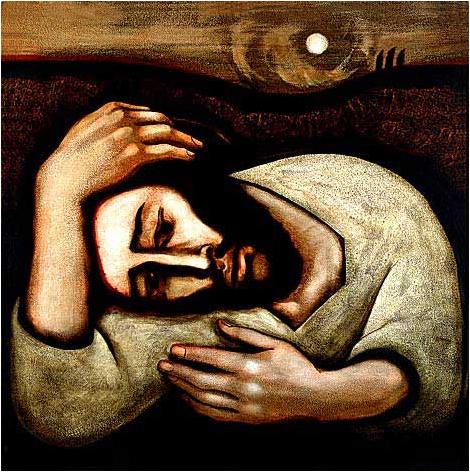
"Christ in Gethsemane" by Michael O'Brien

Today, Good Friday, we remember the great cost paid for our lives.

And [Jesus] said, “Abba, Father, all things are possible for You. Take this cup away from Me; nevertheless, not what I will, but what You will.”
~ Mark 14:36 (NKJV)

When our Savior pleads with His Father in Gethsemane, exactly what does “the cup” contain? Jesus has already given His word that He will accept the contempt and degradation, scourging and crucifixion, and the death required by bearing sin, horrific as these all are. The cup evidently contains something far worse, so terrible that Jesus Himself wishes to avoid it.

I believe “the cup” contains sin’s monstrous, consummate penalty—isolation from God as He turns away from the one bearing sin (Matthew 27:46).

We who are Christ’s will never taste of that cup. The veil is torn asunder, and we have sweet fellowship with God, to our everlasting gratitude and praise.

I shall not die, but live,
And declare the works of the LORD.
~ Psalms 118:17 (NKJV)

Christian authors declare faith in penning everything from theological resources to respectable entertainment, inspirational devotion to suspenseful adventure, history to romance. Our works usually combine such elements, for we use all possible means to connect with readers and build up their faith.

Would we expect success to go unnoticed by our enemy?

Whatever else is shared and learned about writing, publishing, marketing, etc., the substantial spiritual warfare that many authors experience should also be noted. The wider our sphere of influence becomes, the more important it is to prepare ourselves for spiritual attack.

The devil will use anything he can to diminish our spiritual vitality and fruit. Among his weapons are:
• deceit or distortion of truth
• distractions
• conflicts or division / separation among believers
• strong temptation to fall into immorality
• inflated feelings of success and pride
• discouragement or overwhelming feeling of failure
• depression, confusion, or other mental impairment
• contempt from impersonal critics
• betrayal by personal friends
• attacks on reputation or unfounded accusations
• unusual stress in health, finances, and relationships
• terrifying demonic presence, perhaps via nightmares

I unhappily confess that although I’d waged and won smaller spiritual battles, my strength faltered when the fight became fierce. I had lost top fitness, gradually spending more time serving the Lord and less time in simple fellowship with Him. I was then blind sided by the intensity of an all out spiritual attack, which occurred on the heels of publishing successes.

Just as we acquaint and train ourselves with the publishing resources made available to us in order to succeed, we do well to acquaint and train ourselves with the spiritual armor made available to us through the price paid at Calvary.

I write to you, young people, because you are strong, and the word of God abides in you, and you have victory over the evil one.
~ 1 John 2:14

Today we remember the great cost paid for our lives—and we may think of our lives as the goal for which Christ died.

Our lives, rather, are the means for a greater end—fellowship with God. And fellowship with God is what drives our spiritual fervor, empowers our spiritual gifts, and wins our spiritual battles.

Q4U: Have you experienced spiritual attack, concurrent to your successes? How have you overcome?

© 2012, Anne Lang Bundy

My Top Five Writing Retreats

Cedar Key, Florida
A Breath of Fresh Inspiration

The great outdoors inspires me as a writer, especially in a setting by a river or lake. Water trickling over rocks, breeze-swayed evergreens, birds serenading from treetops, and rainbow-hued flowers. The scent of earth perfuming the air.

My muse comes alive in God’s created paradise. Especially for a cave-dweller like me.

Coming from a resort management background, I’m blessed with insider information about great getaways. There are affordable places around the country, to fuel a writer’s creative juices. Where magical meets practical.

So lean in close, and I’ll whisper a few secrets about my top five writing retreats.

5) Mohican Adventures — Loudonville, Ohio
Amenities & Attractions: Cabins, RV campsites, small lake, Miniature Golf, Go-Karts, Canoe Trips, Horseback riding, wooded area and hiking trails, Wi-Fi (extra fees)
Special Notes: The rolling hills around Loudonville bear the mark of Amish influence. I feel like I’m in a by-gone era when I drive through centuries-old quaint towns. And yet, the resort offers modern convenience.

4) Ozark Outdoors Riverfront Resort — Leasburg, Missouri
Amenities & Attractions: Cabins, motels, condos, RV sites, wooded hiking trails, canoe, raft, kayak, and tube trips, Wi-Fi in designated areas.
Selling Points: I love the choice of three different rivers to roam. This immaculate resort is tucked into lush Ozark hills, twenty minutes from the closest town. Bald eagles often fly overhead, nesting atop trees and massive bluffs in the area.

3) Adventures Unlimited — Milton, Florida
Amenities & Attractions: Historic rental homes, riverside cabins, zip-line, canoe, kayak, and tube trips. Wi-Fi in designated areas.
Writer’s Attraction: How can I resist rooms with names like The American Poet’s, John James Audubon, William Faulkner, Dr. Seuss. Ernest Hemingway, Margaret Mitchell, and Mark Twain? Each unit in the Schoolhouse Inn boasts books and memorabilia for the author it represents. The rocking chairs and swing, on the southern wrap-around porch, allow me to write in a setting fit for the masters.

2) River & Trail Outfitters — Knoxville, Maryland
Amenities & Attractions: White-water rafting, kayaks, tubes, near the landmark village of Harper’s Ferry, WV and the C&O Canal trail, perfect for bikes or an energizing walk.
Creative Triggers: This place feeds my hunger for history and love for America. Located near the confluence of Maryland, Virginia, and West Virginia, rich stories of our nation’s heritage wait around every corner. Access to the Potomac and Shenandoah Rivers, puts me on the same hallowed waterways our forefathers traveled.

1) Voyageur Canoe Outfitters — Boundary Waters Canoe Wilderness Area, Minnesota
Amenities & Attractions: Rustic cabins, tent camping, outfitted lake trips by canoe or kayak. Secluded areas to make you feel like you have the whole territory to yourself. A distant moose or bear sighting thickens your plots.
Magnetic Draw: Leave no trace — more than a tag-line, here it’s a way of life. I feel like Lewis or Clark, pioneering new frontiers, while watching water trickle off my paddle. Challenging portages cause blood and oxygen to pump to my brain, spurring new imaginations. I call this place Boundary Energy.

Quieter Times & Lower Prices for all resorts: April, Early May, Late September, October, Tuesday through Thursday in summer.

Writers often need quiet space, and outdoor writing retreats offer a breath of fresh inspiration. No matter where you live, there’s probably an economical resort close by. Take advantage of off-peak periods to sweeten the price. But then again, you could pitch a tent in your own backyard.

Where do you retreat to sharpen your focus? How do you concentrate on projects?

Leasburg, Missouri
Meeting the Muse in God's Creation

Social Media and Your Book Release

Often, authors ask me what they can do to put their book in the social media limelight. While it is not difficult to accomplish, as we have discussed before, there are a few important steps that you can take to ensure that your book receives the attention it deserves. Here are a few ideas that scratch the surface…

1. Start Immediately I had a client named Dan (all names have been changed to protect the innocent).  Dan had a wonderful book coming out in about six months.  He was so excited, I am sure he felt like he was going to give birth to a baby, or as close as guys get to this feeling (besides kidney stones).  Dan wanted to wait until his book came out to get all social media going.  Although waiting can still be effective, I don’t advise this or think it is best. Make sure you are lined up with all of your social media accounts now. Do you have Twitter, Facebook, Pintrest, and maybe even Google Plus?  Make them look pretty. Get your friends and family on board and let them know what you are doing, so they can be your biggest cheerleaders.  Don’t wait. Start today.
2. Start Blogging and Guest Blogging  Here are my three simple rules for having a successful blog:

* Be consistent. Same time, same day.

* Don’t be too wordy or too simple.  500 -700 words is a good mark. Don’t over blog. Sadly, I just unsubscribed to one of my favorite blogs because I would receive two or three updates from that person a day. Save the poetry you like for your Facebook page.

* Be consistent. Oh, I said that? But it is valuable. I want my blogs in my inbox the same time every week.

Guest blogs need to be done strategically.  Pair up with friends who blog as well. Showcase yourself.  It can be a win – win for both of you. Promote it well,  and you both will end the day with a bigger audience.

3. Create A Data Base. Compile an email list and blast it out to all your friends and family.  I use Mail Chimp: it’s easy, it’s free and it does a great job managing a database.  There are some other ones that people have told me about,  author Lucille Zimmerman said that AWeber is great.  Celebrate great reviews, talk about new projects, and keep people on the inside of your circle, making them feel valuable.
4. Give Away Books. When your book is going to come out, encourage your friends and family to buy a copy.  Sure if you are REALLY close to them, you can give them a copy for free, but still get them to buy one and give it to a friend.  (Ever heard of Guerilla Marketing?) If your publisher gives you books to give to your friends and family, tell them they can only have one if they agree to write a review on Amazon after reading it. If your book is about the church, give it to church leaders ask them to help promote your masterpiece.

Get your books in the hands of “tastemakers.”  What is a tastemaker, you ask? Acoording to Urban Dictionary, “Tastemaker: An individual who’s determination of what’s stylish influences a significant quantity or quality of people resulting in a supportive trend.”  A tastemaker is someone who is savvy and all-knowing. It could be your best friend or your coffee shop barista. You want your tastemaker friends to talk about your book; people listen to tastemakers.
What is your best tip to be socially media savvy? 

Ingrid Schneider is WordServe’s resident Marketing Maven. With a specialty in social media, Ingrid loves helping authors find and manage an online tribe of readers. After spending the last 15 years managing and marketing restaurants, people, and businesses, Ingrid knew that helping people market themselves via social media and online platforms was a passion and something at which she excelled. Now doing social media marketing for some great-named authors, Ingrid also loves to imagine that she is a secret agent, because she can’t disclose with whom she is working. (Believe us when we tell you that Ingrid handles some big names, but for anonymity’s sake, we can’t disclose this TOP SECRET information.)  Imagination and creativity is something Ingrid is serious about and loves to incorporate into her work with her clients.

My Day in Prison

I went to prison not long ago to visit an inmate and to hear her story. I needed to know first-hand if she was who my client said she was. My client, her best friend on the outside, is writing a story of forgiveness between two women. I spent two hours in a small room listening as she spoke more words than my male ears could possibly take in. But I was riveted.

Outside in the main visiting area, dozens of inmates visited with parents, friends, children. Eating vending machine food, playing cards, laughing and trying to find a bit of normal in their season of isolation from the world for their public sins.

Her words filled the air for about 95 percent of our time together. She radiated the Lord like few I’ve come in contact with on the outside. Twenty-two years behind bars for a cold-blooded murder that she readily admits to committing. Many more years lie ahead. She killed the best friend of her best friend, the woman I mentioned in the first paragraph. Tears of regret come easy for the life she took, the lives of children she altered (including her own, one of whom was only 18 months old at the time and whom she has not seen since), even a city she threw into turmoil.

The good part of the story is that she’s now had 22 years of learning what it means to know, love, serve and wrestle with the Lord.

“Though I have the privilege of keeping a small TV in my cell, I have few distractions. I get up at 6:00, make coffee in my little coffee maker, and spend time with God in the Word.” She prays…a lot. She writes songs, words and lyrics, which are truly inspired. She’s an advocate for other prisoners trying to navigate a system that, by its nature, has to be more concerned with incarceration than care, with towing the line instead of grace. She understands. “It’s just the way it is.”

“There are 1,000 women here,” she says, “about 600 I would say know the Lord, probably 400 attend one of the four ‘church’ services offered once a week. Three of the services are the fire and brimstone variety, only one of the pastors of one church talks about the grace of God.”

“As if people here need more shame,” I say, attempting to understand a bit of what prisoners feel when they’re locked up for years at a time. She agrees that most of the women are so full of shame they don’t need the heaping coals of judgment to go along with it.

Before I can ask the question, she says, “That’s why books get passed around here so often. Books communicate, through story, God’s grace and the love of Jesus in a form that women can grasp. A woman can get swept away into the love of God through a story, well told. Jerry Jenkins’ book, Riven, is a favorite here, we have four copies. Francine Rivers is passed around a lot, and of course Karen Kingsbury.” Ted Dekker is mentioned, Gary Chapman, John Eldredge, as are several other familiar novelists and nonfiction authors.

You and I both know writers can’t invest their precious time writing solely to prisoners incarcerated for not playing by life’s rules. But in a bigger sense, that’s exactly what you’re doing every time you get behind your computer to tell the story God’s given you to write. We’re all prisoners to our own story in ways unseen, locked-up to our own daily grind. We all hear too much condemnation and not enough grace and love, and we all need those continual reminders that God is involved in the details but also looking out for the big picture.

And we all need to hear that He is constantly trying to inspire us to move closer to Him, His Kingdom, and communicating the true love He has to those who can’t readily touch it.

Books do that. Perhaps the book you’re writing right now does that.

So in the truest sense, you do what you do for the prisoners. You labor long hours in research, in writing and rewriting, in obeying the editorial instructions of your agent and editors. And most of the time you do it for a pretty low hourly paycheck. You hone your craft to tell the story better. You endure bad reviews and confusing royalty reports. It’s often hard and thankless and lonely.

But you do it for the prisoners.

Thank you.

Greg Johnson is president of WordServe Literary Group and has been a literary agent for 18 years serving Christian authors.

Five Ways to Handle Stress in Your Writing Process

Are you overwhelmed with stress in your writing life? The book of Lamentations offers a clear word on how to deal with stress. “When life is heavy and hard to take, go off by yourself. Enter the silence. Bow in prayer. Don’t ask questions: Wait for hope to appear” (Lam. 3:28-29 MSG).

1. Go off by yourself. Solitude often seems impossible for me, even with an “empty nest.” But Jesus knew the importance of spending time alone with His Father. When He needed to listen, He would pull away from everyone. Matthew 14 says that after Jesus fed the 5,000, He “climbed the mountain so he could be by himself and pray. He stayed there alone, late into the night” (23).

2. Enter the silence. When we seek God in silence, often the accuser (Rev. 12:10) tries to distract us with fear, like in the story of Hannah (1 Samuel 1). Hanna’s husband had two wives—talk about stress! And her husband’s other wife taunted her year after year, blaming and accusing God for Hannah’s inability to conceive children. Then, when Hannah prayed, her spiritual leader misunderstood her. “Hannah was praying in her heart, silently. Her lips moved, but no sound was heard. Eli jumped to the conclusion that she was drunk” (13).

3. Bow in prayer. Prayer can be as natural as talking with a good friend or as intimate as sharing a secret whisper. It can occur any time of day, no matter where you are or what you are doing. God promises that if we call on His Name, He’ll listen. “And if we’re confident that he’s listening, we know that what we’ve asked for is as good as ours” (1 John 5:15).

4. Don’t ask questions. My questions often interfere with my communication with God—I’m talking, instead of listening. When Jesus taught His disciples, He asked them on several occasions, “Are you listening to this? Really listening?” (Matt.11:15).

5. Wait for hope to appear. Waiting rooms seem to bring out the worst in me, like my impatience or frustration. But waiting does not have to be hopeless. The psalmist speaks of “waiting” in Psalm 40, “I waited and waited and waited for God. At last he looked; finally he listened. He lifted me out of the ditch, pulled me from deep mud. He stood me up on a solid rock to make sure I wouldn’t slip” (1-2 MSG).

Reflection: Matthew 6:30-34 advises, “Give your entire attention to what God is doing right now, and don’t get worked up about what may or may not happen tomorrow. God will help you deal with whatever hard things come up when the time comes” (MSG).

So, remember, “When life is heavy and hard to take, go off by yourself. Enter the silence. Bow in prayer. Don’t ask questions: Wait for hope to appear” (Lam. 3:28-29 MSG).

Photo/KarenJordan

What helps you handle the stressful times in your writing life?