What Are You Putting on Hold?

dont do it!I have worked out with a personal trainer for a number of years. No, this doesn’t mean I’m wealthy or a single digit size (though I still would like to be!). One day as I concluded my training session and was attempting to pull myself up off the floor, I overheard a woman talking to one of the other trainers. She said, “I’d really like to start training with you but I need to get in shape first.” Which caused my own trainer to stroke out and he shouted across the room. “That’s exactly why you should start now!”

And it struck me how much this thought pattern applies to other areas of our lives.

We shouldn’t have children until we’re financially set.

I can’t start my novel because I don’t have enough time . . . (insert variety of other excuses here).

I can’t go to church because my life is too screwed up from (insert various life trouble, sexual indiscretion, alcohol or drug addiction, general pride, greediness, etc . . . here).

I can’t pray because I don’t know the right words to say.

I think when we have thoughts like this, what we’re avoiding is the one thing we probably should be doing. Getting with a personal trainer might help us achieve our fitness goals faster or, at the very least, keep us from further gaining weight to the point where we think the Stay Puft Marshmallow Man is skinny. Writing that novel might be a perfect outlet for the reasons we’re avoiding church. Church can be the place where we find a group of fellow travelers who are struggling just as we are and are learning how God won’t solve the consequences of our choices but will help us manage them when we come into relationship with Him.

I know many who have issue with *The Church*. And perhaps they have reason to. I’ll be the first to say that, as a result of our human failings, even we in the church try and put up a front that our lives, home, and church are better than they are. What I’ve boiled it down to is that no church is going to be perfect and if it’s not for you, try another one.

This is just another excuse and you don’t need a destination brick-and-mortar structure to work out, write your book, or discover how meaningful a relationship with God can be.

I’m a say-it-like-it-is kind of girl, which my husband claims is my best and worst quality, but I’m going to torture you with it for a moment. Let’s analyze ourselves.

Tell me–what are you putting on hold, why are you putting it on hold, and what will you do to finally get started?

May you be blessed this coming year.

The Loss of Words

Fountain pen over Script1 John: 1-5. In the beginning was the Word, and the Word was with God, and the Word was God. He was in the beginning with God; all things were made through him, and without him was not anything made that was made. In him was life, and the life was the light of men. The light shines in the darkness, and the darkness has not overcome it.

I have to confess, I’m fascinated by words. How we use them. How we use them against each other. Pro-life. Pro-abortion. Pro-choice. Each of these words casts the same issue in a totally different light.

I also have great wonder about how God chose to communicate with us, which I believe happens in two ways–through the written word and through creation. Whether or not you believe that is a whole other discussion.

When I write a book, I choose words carefully. I imagine God being the same way. Not wasting anything. The words, phrases, paragraphs, and chapters of the Bible have multiple layers of meaning. Enough layers to satisfy a reader for longer than one human lifetime.

This Christmas, I find myself pondering 1John and how Jesus Christ was referred to as the Word. I think of how words bring enlightenment. Then I think about how the use of our words is changing.

As an author, I’ve been concerned about the loss of words, even though there seems to be more words than ever before. Texts. FB posts. Blog posts. The number of books that are now available through publishing (in all formats) is greater than at any time in history.

But are they meaningful words? Do they have the same impact as the Bible passage above?

We don’t write anymore. Not in the form of handwritten notes, anyway. And what we do write is abbreviated with little context. I wonder what our children will show their grandchildren. Once e-mail accounts are deleted, those messages are lost. Do you print out e-mails, texts, etc., and archive them?

I know I don’t.

So I wonder, a lot, about the meaning and context of our words and what will be lost in this technological age. Handwritten love letters. Diaries. Journals. I doubt even this blog post will survive me.

Often, we don’t think about the impact of a loved one, a job, or an event until it is gone. I’m amazed how people strive to communicate even when they can’t physically speak. Sign language. Speaking with the use of computers.

What if you couldn’t speak anymore? What if there never had been the Bible? How do you think God would have communicated with creation about Himself?

Glenn Beck is a polarizing character. I totally get that. I’m not a fan of everything he says but this is a powerful message to ponder. It’s a written monologue delivered on large postcards because, for a period of time, Glenn couldn’t speak and it caused him to think of what he had spoken in the past. If you want to avoid his political message, you can stop viewing the video after about 3 minutes.

But consider the loss of words and what you can do to maintain an actual pen-to-paper history. Remember this Christmas the impact of how God chose to communicate with us–with words.

John 3:16. For God so loved the world that he gave his only Son, that whoever believes in him should not perish but have eternal life.

Every day, I think about losing our written words. Do you?

Have a Merry Christmas.

Writing Effective Blog Posts

freeelance-bloggingI consider myself a Missionary Writer.

I began writing in 2004 with a blog titled, “The Southern Scribe.” Even though I was an early adopter in the Christian blogging world, as time went on, I doubted that blogging was here to stay. Due to my time constraints, I gave up blogging. On occasion I would blog about something that interested me or blog about an issue that excited me or annoyed me. I can stand before you today and say I was wrong, in a big way. Blogs in many circles are just as pertinent as print and network and cable news outlets when it comes to breaking news or editorials.

Anyone can get an account on Blogger or setup a WordPress blog, but how do we write posts that are effective in delivering a message?

1. MAKE YOUR WRITING NEED BASED.
When preparing to write, always start with the key need. Then move to the key thought or concept that has to do with that need. Be sure to research and then exegete your sources and prepare notes on your findings. Examine supplemental writings and books where necessary. A Missionary Writer does not write to be cool or famous; we write to lead people to changed lives. As I research, study, and prepare, I ask God for wisdom and direction.

2. EMPHASIZE SHOWING VERSUS TELLING.
We should use current events and stories to illustrate the point we are trying to make. Remember, showing versus telling can get marred if we are not careful, as we want to tell people “how to” instead of showing them. The only way people really learn and are motivated to change is being shown how to go from point A to point B. People can only get to the next level by having someone who has accomplished what they seek to accomplish show them how.

Make sure you address the WHY behind the WHAT – why do people need to know this? How does it matter to their lives?

3. PROVIDE CLEAR ACTION STEPS.
Effective writing lead to specific applications. In preparation of my writing, I always ask, “What do I want people to DO as a result of reading this?” In many cases, (calling for people to give their shoes off their feet), the action step may be bold. But in other cases, it could be simple (begin reading the Bible this week or go on a date with your spouse).

Just like meetings that do not include action steps tend to waste people’s time, so does writing that does not call people to action. It’s like running back a kickoff and stopping at the 10-yard line.

4. WRITE WITH PASSION AND AUTHENTICITY.
Passionate and authentic writing begins from understanding one’s personality and style. Writers that attempt to write like someone else will never connect as well.

In the 21st century, humor is a common language that conveys authenticity. People appreciate writers who do not look down on them, but engage them. Humor lowers people’s defenses. Funny stories and statements can pepper your writing with spice and make it memorable.

5. BE SIMPLE.
We often write about difficult subjects in an effort to answer people’s questions, but do we use too many words without saying anything? Simple answers are often shorter answers. The attention span of our society is getting collectively shorter. This means that I must develop the skill to match the will.

Great writing should have one memorable point or statement that is repeated several times throughout the piece. There should be one driving idea, a “twitterable” big idea.

What Can We Offer This Christmas?

adoration-magi2

On coming to the house, they saw the child with his mother Mary, and they bowed down and worshiped him. Then they opened their treasures and presented him with gifts of gold and of incense and of myrrh. Matthew 2:11

Yesterday I read an article listing the ten best Christmas gifts for writers.  Pens and markers, Starbucks gift cards, back and neck massage — all good. This brought to mind the story of Harper Lee and an article that she wrote for McCall’s magazine in 1961 describing her best Christmas gift. She was staying with her friends in New York for the holidays. Christmas morning she was surprised by their gift to her. In a simple envelope on a slip of paper was written:

“You have one year off from your job to write whatever you please. Merry Christmas.”

The family providing the gift was not wealthy; they were raising young children. With their gift they gave a young writer hope and encouragement. Who can measure the impact on hearts around the world of To Kill a Mockingbird?

Harper Lee reflects on the gift:

“Outside, snow was falling, an odd event for a New York Christmas. I went to the window, stunned by the day’s miracle. Christmas trees blurred softly across the street, and firelight made the children’s shadows dance on the wall beside me. A full, fair chance for a new life. Not given me by an act of generosity, but by an act of love.”

What can we offer this Christmas?

Our best gifts are given not as acts of generosity but as acts of love. Take time to reflect on your giving this season:

Look at each person on your Christmas list and ask yourself: What do they need that only I can give? Maybe it is not a new tie or a gift card. It might be the gift of an affirming note or your time.

Look at your community and ask yourself: What do they need that only I can give? It might not be a check. It might be your prayers or the time to touch one person well.

Look at the world and ask yourself: What do they need that only I can provide? Maybe the words you write today will change the hearts of the world like Harper Lee’s words did.

Finally, look up at God and ask yourself: What does He need that only I can provide? He doesn’t need what we have materially. It’s all His anyway. But what about our love? Our worship? And our sacrifice?

Our prayer for us all this Christmas is that our gifts be given “not by an act of generosity, but by an act of love.”

Merry Christmas, The Writing Sisters

And here I have lamely related to you the uneventful chronicle of two foolish children in a flat who most unwisely sacrificed for each other the greatest treasures of their house. But in a last word to the wise of these days let it be said that of all who give gifts these two were the wisest. Of all who give and receive gifts, such as they are wisest. Everywhere they are wisest.

They are the magi.

– O. Henry, The Gift of the Magi

Writing Down Our Faith Stories

Photo/TaraRossIn the Psalms, David expresses this divine purpose for writing our faith stories.

Write down for the coming generation what the LORD has done. So that people not yet born will praise him. (Ps. 102:18 GNT)

What has the Lord done for you? Do you have stories about God’s intervention?

God expressed His love to humanity with the gift of His Son, Jesus.

This is how much God loved the world: He gave his Son, his one and only Son. And this is why: so that no one need be destroyed; by believing in him, anyone can have a whole and lasting life. (John 3:16 MSG)

Have you ever considered how much God loves you? I never really did, until the birth of my only son, Adam. I cannot fathom the love that it takes to sacrifice your only son, so that others might live. I’m sure many parents of soldiers come close to knowing how that feels, and I love to read their inspiring stories.

Someone once challenged me to ask God to show me how much He loved me. I believe God can speak to us. He speaks to me every day—through His Word, prayer, worship, people, and His beautiful creation. But I had never asked God how much He loved me.

So, I shut my eyes in prayer and asked, Lord, how much do you love me?

The answer I received still seems too intimate to share, for fear of being misunderstood and judged. I did not hear an audible voice. I just caught a little glimpse of Heaven, where God promises,

He will wipe every tear from (my) eyes, and there will be no more death or sorrow or crying or pain. All these things (would be) gone forever. (Rev. 21:4 NLT)

When I faced the death of both of my parents, this vision of heaven brought comfort to my grieving heart.

I challenge you to ask the Lord that same question, Lord, how much do you love me?

Then, listen quietly. And be sure to write down your story.

God told His Story to the world when He sent His Son—the Word of God.

The Word became flesh and made his dwelling among us. (John 1:14 NIV)

Jesus told His stories (or parables) to teach us “the way and the truth and the life” (Jn 13:6).

Jesus told them a story showing that it was necessary for them to pray consistently and never quit. (Luke 18:1 MSG)

Is there a biblical mandate for sharing our stories, especially our faith events?

In Acts 1:8, we read this charge from Christ to His followers,

But you will receive power when the Holy Spirit comes on you; and you will be my witnesses in Jerusalem, and in all Judea and Samaria, and to the ends of the earth. (NLT)

What stories are you telling about your life? Or rather … what stories are you not telling? What about your faith stories? Who can write them, but you?

I hope you will consider writing down some of your faith stories as you celebrate Christmas this year.

What faith stories have you written down? I hope you’ll share one of your stories in the comment space below.


YouTube/twofiress (“I Love to Tell the Story” – Alan Jackson)

Photo/TaraRoss 

Publishing Day

The day my book releases is an odd day for me. Inside, I am screaming, “My book is out! Everybody, my book is out! Are you going to untitledread it, or what?!” I walk into the bookstore and pretend to only casually check that it’s on the front table. If it’s not, I pretend not to be bothered. I decrease my expectations. I walk towards the women’s section and just hope to see it on the shelf. If it’s not, I pretend to understand, but inside, I don’t understand at all.

Because it’s my heart on the page.

I went through this with my first book, Girl Perfect, and I just went through it again with Beautiful Lies. In the days of the release, something in me wants people to stop and take notice, and that part of me wrestles with the part that knows the act of creating is worth it, whether anyone notices or not.

I hope the late nights, the honest tears, and the sweet victories of finding just the right words to speak my soul’s hunger will result in profundity for the reader. I want my efforts to matter. In fact, I’m tempted to tell you how I crawled through the thickest mud of my adult life to bear this book. But Annie Dillard, in The Writing Life, scolded me about this, warning me never to tell anyone how much a book cost me personally – for it is impolite to do so.

So with the release of a book, three tragic flaws in the self must die. First, the part of us that hungers for recognition has to die to the Spirit in us that is compelled to speak honestly and truthfully into a world that needs our voices.  Second, the humanity in us that wants millions to hear the book’s message must die to the Spirit in us that rejoices if one life is purely changed by our words.

Finally, we have to let go of “perfect” and embrace gratitude instead. The perfectionistic questions that circle on publishing day – “Is it enough?” “Did I say everything I wanted to?” “Will the reader understand my heart’s lineage?”  and “Is this as beautiful an offering as I dreamed?” – all of these questions must yield to gratitude.

untitledSo here is mine: Thank you, God, that I had the opportunity to bleed truth on these pages. Thank you for the healing it brought to me. Thank you that you love me so much as to give my heart’s desire wings, and I commit these books to you, trusting your winds will carry their words wherever they need to flutter. Beautiful Lies is my offering. My alabaster jar. And when I poured its oil, it was all for you.

What about you? What do you have to embrace and let go of on publishing day? What are the needs for recognition or perfection that you battle? What does your gratitude sound like?

Finding Your Place

Screen Shot 2013-12-09 at 9.35.24 AMFrom an early age, we seek a purpose and earn an identity. No matter the person or age, there is a deep yearning in all of our hearts to matter, to do something with our lives, something bigger than us, something of eternal significance. It’s what we constantly strive for.

Recently, I was asked to speak to a group of young singles about finding their place. Initially, I balked at the idea. I definitely am not an expert, nor do I have all the answers. But I have a direction and I’m moving toward that end. I don’t control the outcomes, but I do control my commitment.

So I shared my story because it is the one area of my life where I am an expert (well…sometimes). If you desire to find your place/purpose in life, in writing, or in your career, here are a few pointers that have shaped my journey:

1) Start somewhere.

Realize that how God has wired you is perfect. Because you are an image-bearer, you are created uniquely with an ability to create, think, and impact. Don’t forfeit that! What do you need to do to reach your goal? Determine a course of action and take one step at a time.

I’ve heard an analogy of a person standing on a frozen lake with the thing they most desire waiting on the other side, but the person doesn’t realize that the ice is already cracking all around them. Their only option is to take one small, steady step at a time to reach their goal. You may have to avoid or change course because of cracks or weak spots, but forward movement will ALWAYS get you to the other side.

2) Allow experience to shape you.

Failure is inevitable. It’s how you weather it that counts. I received twelve grad school rejection letters before I identified the direction I needed to take. At first I cried with every closed-door. Before the last letter arrived, I began to ask the Lord, “What’s next?” Every moment of victory or defeat gives you an opportunity to speak into others’ struggles later on. Allow them to shape your character, your giftedness, and your calling.

3) Discover your giftings.

Every day when I wake up, I must choose to look at who I am in light of the great I AM. And He has gifted me uniquely, just like He has gifted you uniquely. Know who you are and how He’s wired you. Take personality tests, love language tests, StrengthsFinder, and a spiritual gifts test. Not only will they help you understand your tendencies, but these tests will help you shape well-rounded characters, as well. As you seek direction and dig into your talents and skills, ask yourself:

  • What breaks my heart and baffles my mind?
  • What stirs my affections for Christ?
  • What passions and gifts has the Lord instilled in me?
  • How and where can I use these for His glory?
  • What’s my purpose?

Where the answers intersect, take action and develop those skills and passions.

4) Be faithful where you are.

Don’t miss the opportunities you currently have around you as you pursue whatphoto copy God has called you to. William Arthur Ward said, “There are three keys to more abundant living: caring about others, daring for others, and sharing with others.” As a writer, your goal should be to care about people around you and allow that to shape how you care about your readers during the writing process. Budget time for writing and reading. And take time to live life in the company of those around you. It will improve your writing and help you make the most of every opportunity.

Finding our place in life has more to do with seeking His face than seeking our dreams. Start somewhere, allow experience to shape you, discover your giftings, and be faithful where you are until God moves you to the next step. Be faithful to steward your time, talents, and treasure, and expect big things to happen!

What steps have shaped your writing journey?

My Book is Published, Now What?

culture of numbers

These words, they urged me to somehow live them.

Since my small hand cupped my first #2, painted-yellow pencil, I’ve experienced life through story. Stories to entertain me, yes, but my mind also craved stories that taught life lessons (although I couldn’t comprehend or articulate that at five years of age.)

There’s something about story that somehow makes our lives better, easy to live.

It seems only natural that after (way too) many years of traipsing across the country in various marketing positions, I became a storyteller myself.

Matthew West is responsible. Well, somewhat—he did play an important role. About four years ago, Matthew released this song that flat messed me up. The song, The Motions, was about how we oftentimes live this complacent, ordinary life, how we fall into these stale daily routines unaware.

The song uncovered some stalled dreams, desires I had long ago tucked away.

For months, those dreams were stirred fresh. Seems each time I dropped into the driver’s seat and clicked on the radio, I heard, “just okay is not enough,” and “I don’t wanna spend my whole life asking, ‘What if I had given everything instead of going through the motions?’”

So that’s how I spend my days now—giving “everything I have.” As a blogger and author, I share heart-stories that bring hope to women when their days are hard. Don’t we all have those hard days?

And that stalled dream, the one of crafting a traditionally published book that would make its way into the tender hearts of other women, it recently became a reality. About six weeks ago, When A Woman Finds Her Voice: Overcoming Life’s Hurts & Using Your Story to Make a Difference was released.

We shot streamers, and I won’t hide it, we shed a few joyful tears.

But then, reality.

Within a couple of days a very real responsibility leaned in, one of partnering with the publisher to now sell thousands of these books. And gut-honest here, I’m tired, because I’ve just spent the last six months sacrificing many nights and family events to pen this book. And while the book is packed with hope, it wasn’t an easy write.

There are those times a cord of hope runs a scarlet red.

Now I love painting hope thick, and I’m a connector who loves meeting women far and wide, but to feel the weight of sharing a book that I authored with others, and to (over and over again) suggest they purchase it? Not so much.

Soon I fell into conversation with a wise and trusted friend (who also happens to be a best-selling author), and we uncovered my true heart to market this book.

Serve the reader.

Yes, that’s right, serve, not manipulate. In a world of hype among thousands of new books released every year and a responsibility to a publisher who risked a partnership with me, my goal is to find my reader and serve her. To engage heart-to-heart with love, support, prayer, and encouragement. To be a trusted resource.To put her first.

From that sincere offering of mine, she can decide if she wants more of my hope-filled words.

There’s this awesome conference for bloggers, Allume, and recently I sat alongside hundreds of other storytellers as Ann Voskamp brought the room to a pondering silence when she posed the question, “In a culture of numbers, how do you kneel?”

This is it for me; this is how I’m learning to kneel. I’m feeding this desire, nurturing and cultivating this servant-heart in the hopes it will defeat the anxious fingers that numbers tempt.

How about you? Who is your reader, and what are some specific ways you can serve them?

For Me, With Me, Instead of Me

Footprints in the sand on beach near San José del Cabo, Mexico at sunriseI’m sure most of us know the “Footprints in the Sand” poem, as well as its accompanying images. I think the piece strikes people for the same reason: It’s good to know we’re not alone.

However, that one-set-of-prints is not the full picture. At least not the way it plays out in my head. Sometimes, I imagine it’s multiple sets going in different directions within a dark and pot-holed parking lot. The kind where you worry someone is watching you, waiting to pounce. And even when it’s only one set, when God is carrying you through, it isn’t always on some idyllic beach. It’s on a scuffed batch of linoleum at the local Walmart, through the spilled Kool-Aid.

There are times when God is for us. I imagine this footprint scenario looking like one set of prints is a bit behind the other, trying to keep pace, but not really. I used to think God’s prints are the ones out front, and I’m the lollygagger behind. Yet, the longer I walk this walk, the more I side with the conclusion that it’s the opposite. For us means in support of. It means that He’s letting us go on ahead, cheering us on and holding back like that crazy mom who hides behind the oak tree on the first day of Kindergarten. We need these moments to build our faith. Having God carry us won’t build muscle, will it?

Then consider the times God is with us. This puts two sets of prints side by side. I like it when God is with me. I feel strong and sure and kept. Like a big girl who can legitimately say “Dad” instead of “Daddy,” and Pops couldn’t care less because even he knows it’s true. I believe these are the good times. The great times. The times when we’re almost not stupid and prone to create our own apocalyptic downfalls.

stock-footage-friendly-business-people-walking-away-across-grassy-field-in-the-country

And then, of course, when God goes instead of us. One set of prints, His, when it’s time to fall back onto something that never fails. I guess if you’re a wee bit on the nostalgic side, the footprints on that gently lapping coastline paint the perfect picture. It used to for me. But I’ve had some scuffs over the years, seen some things, been through some pits. So, when God has to pull me out, when He has to do the walking instead of me, I imagine Him fighting the fight that I cannot, busting up the joint, and no, there’s no beach. Not for some of the stuff God has to carry me away from. If an alley fight took place anywhere else than a stinking alley, then even West Side Story would have been filmed in Malibu.

Yet, however you want to picture it, the prints will always indicate He’s there. For you. With you. Instead of you.

I think this video explains it best. Take the time to give it a look.  http://www.godtube.com/watch/?v=GD6PNNNX

Preparing for a Radio or Podcast Interview, Pt. 2

Darren and Anita Engaging Life and Leadership
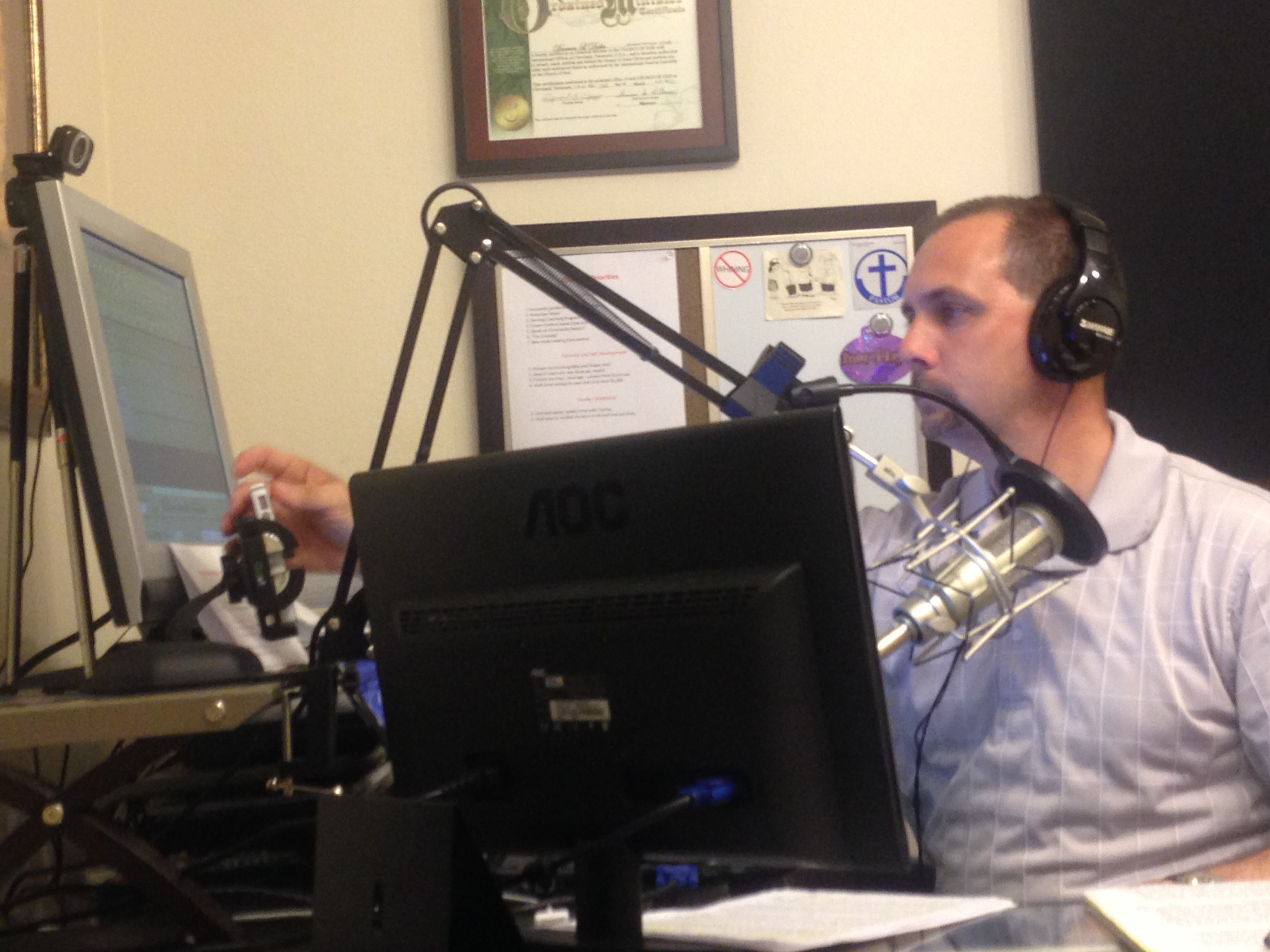
Host Darren Dake recording Engaging Life and Leadership Podcast

You may not think this pertains to you, but if you are an author, or aspiring author, there is something you need to face. One day, if you are fortunate, you will sit on the other side of a mic or telephone, answering questions from a show host. And you want to shine as brightly as possible, so your message connects with more people in the listening audience.

In Part One, I talked to you about preparing before the interview. This time, I want to share how I prepare during a radio or podcast episode.

I’ve gotten experienced in the process, and learned several things along the way. I’m going to tell you what happens behind-the-scenes that helps me do a better job. I hope this encourages and strengthens your confidence when it’s your turn.

  • Here’s the weird one, but I bank on it. I make an interview tonic of raw, organic apple cider vinegar, raw local honey, a touch of garlic, and mix it into a glass of Appletini or Cherry Pomegranate Crystal Light. (No, I don’t add alcohol, and I don’t suggest it, no matter how tempting, LOL.) About five minutes before we air, I take two or three good swigs. It reduces phlegm, sore throat, a gravelly voice, and strengthens my tone when I speak. On commercial breaks, I’ll sip a little more.

    First Hired Anita Brooks
    Spread Your Message with an Effective Interview
  • I have a fresh glass or bottle of water at the ready. Keep anything you drink away from the microphone or telephone receiver — don’t want to gulp On Air. Word of caution: continue paying attention to what’s being said or you might miss a question you need to answer. (Also I don’t drink too much before the interview. If Mother Nature calls during the segment, it can get mighty uncomfortable.)
  • I place my briefing book in hand’s reach. (See last month’s post on what a briefing book is.)
  • I have a copy of my published book on hand. During commercial breaks, I’ve had two hosts ask me to read a sentence or two directly from my own book.
  • Take slow, deep breaths to reduce blood pressure and calm my nerves during breaks.
  • Listen twice as much as I speak, making sure I don’t cut the host off, or interrupt his/her flow. Remember, most people tune in because they like the host, or the program format. The percentage of audience members who listen due to the topic is small.
  • Strive to be myself, while intentional about infusing a warm and welcoming tone to my voice. I imagine talking to a dear and trusted friend, even when the host is trying to stir a little controversy. I had this happen, and because I stayed calm and steady under pressure, allowing God’s spirit to lead my response, it transformed the entire interview. By the end, the host was profusely inviting me back, and called my book fabulous three times. (I counted.)Engaging Your Writing or Speaking Audience
  • When asked a challenging question, I’ve found it’s okay to say, “I’m not sure, I need to research or pray about it,” or even to pause for a couple of seconds while crafting my answer. Adds a bit of dramatic effect anyway.
  • I follow the PIER method for engaging audiences when I write and speak. It ensures I maintain focus, interest, and credibility, while providing them with take-away.

Now, you’re ready for your interview. It’s your turn to shine — be brave, and go spread that message! This is what God called you for.

Do you have any funny interview stories? Lessons learned?