Success and Spiritual Warfare

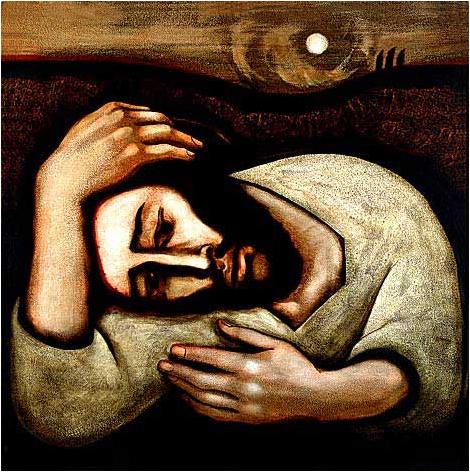
"Christ in Gethsemane" by Michael O'Brien

Today, Good Friday, we remember the great cost paid for our lives.

And [Jesus] said, “Abba, Father, all things are possible for You. Take this cup away from Me; nevertheless, not what I will, but what You will.”
~ Mark 14:36 (NKJV)

When our Savior pleads with His Father in Gethsemane, exactly what does “the cup” contain? Jesus has already given His word that He will accept the contempt and degradation, scourging and crucifixion, and the death required by bearing sin, horrific as these all are. The cup evidently contains something far worse, so terrible that Jesus Himself wishes to avoid it.

I believe “the cup” contains sin’s monstrous, consummate penalty—isolation from God as He turns away from the one bearing sin (Matthew 27:46).

We who are Christ’s will never taste of that cup. The veil is torn asunder, and we have sweet fellowship with God, to our everlasting gratitude and praise.

I shall not die, but live,
And declare the works of the LORD.
~ Psalms 118:17 (NKJV)

Christian authors declare faith in penning everything from theological resources to respectable entertainment, inspirational devotion to suspenseful adventure, history to romance. Our works usually combine such elements, for we use all possible means to connect with readers and build up their faith.

Would we expect success to go unnoticed by our enemy?

Whatever else is shared and learned about writing, publishing, marketing, etc., the substantial spiritual warfare that many authors experience should also be noted. The wider our sphere of influence becomes, the more important it is to prepare ourselves for spiritual attack.

The devil will use anything he can to diminish our spiritual vitality and fruit. Among his weapons are:
• deceit or distortion of truth
• distractions
• conflicts or division / separation among believers
• strong temptation to fall into immorality
• inflated feelings of success and pride
• discouragement or overwhelming feeling of failure
• depression, confusion, or other mental impairment
• contempt from impersonal critics
• betrayal by personal friends
• attacks on reputation or unfounded accusations
• unusual stress in health, finances, and relationships
• terrifying demonic presence, perhaps via nightmares

I unhappily confess that although I’d waged and won smaller spiritual battles, my strength faltered when the fight became fierce. I had lost top fitness, gradually spending more time serving the Lord and less time in simple fellowship with Him. I was then blind sided by the intensity of an all out spiritual attack, which occurred on the heels of publishing successes.

Just as we acquaint and train ourselves with the publishing resources made available to us in order to succeed, we do well to acquaint and train ourselves with the spiritual armor made available to us through the price paid at Calvary.

I write to you, young people, because you are strong, and the word of God abides in you, and you have victory over the evil one.
~ 1 John 2:14

Today we remember the great cost paid for our lives—and we may think of our lives as the goal for which Christ died.

Our lives, rather, are the means for a greater end—fellowship with God. And fellowship with God is what drives our spiritual fervor, empowers our spiritual gifts, and wins our spiritual battles.

Q4U: Have you experienced spiritual attack, concurrent to your successes? How have you overcome?

© 2012, Anne Lang Bundy

In Praise of Small Publishers

Like every writer, I dream of signing a contract with a big publishing house that will bring all its resources to launch my book onto the bestseller lists.

So far, it’s still a dream.

The reality I’m enjoying, however, is being published by a small regional press, which is giving me many of the satisfactions of being a published author without the pressure of big-time publishing. In fact, I regard my association with my current publisher as not only a great way to continue to develop as a writer, but also as a hands-on business apprenticeship which is preparing me for that future leap into the big leagues. Yes, working as a small press author means the royalties are slim, but for me, the benefits are huge.

If you haven’t considered finding a small press for your work, here are some things I’ve learned that you might find interesting and appealing about working with a smaller publisher:

  1. Small presses have very specific audiences and categories. That means you have to really define your own audience as you write your book. The benefit to this task is that your writing will be tighter and more focused, which will do three things for you: 1) improve your book; 2) target a publisher who wants this kind of book (thereby improving your chances of landing a contract!); and 3) give you a clear idea of who the readers are to whom you’ll be marketing the book upon publication.
  2. Small presses have limited resources to help you market. While this was initially a negative for me, I am now grateful that I assume primary responsibility for this very important piece of the publishing journey. I’ve learned to develop publicity contact lists, explore marketing opportunities, and pursue networking to land speaking engagements, which is a key to success for authors. Another plus here is that as a one-person marketing machine, I can react quickly to opportunities with an immediate ‘yes!’
  3. Timelines can be shorter with a small press. I can phone my publisher and talk directly to her, getting the answers I need or the extension of a deadline. I get the editing comments back, make revisions as needed, and see a final proof shortly thereafter; I can finish my book in June and have the launch party in September (not that I recommend such a tight schedule, but it has happened!). That means no long waits to see my books in print and get reader response.
  4. I work closely with the book designer, so I’m always happy with my book’s front and back covers. I’ve heard from many authors with big publishers that they have little to no input on what their book will look like; I love having a voice in those decisions!

The bottom line is that publishing with a small house can keep you closer to the publishing process in each of its stages, providing you with an education and experience that can only benefit your future career success.

Are any of you working with small presses? Care to share the joys of doing so?

My Top Five Writing Retreats

Cedar Key, Florida
A Breath of Fresh Inspiration

The great outdoors inspires me as a writer, especially in a setting by a river or lake. Water trickling over rocks, breeze-swayed evergreens, birds serenading from treetops, and rainbow-hued flowers. The scent of earth perfuming the air.

My muse comes alive in God’s created paradise. Especially for a cave-dweller like me.

Coming from a resort management background, I’m blessed with insider information about great getaways. There are affordable places around the country, to fuel a writer’s creative juices. Where magical meets practical.

So lean in close, and I’ll whisper a few secrets about my top five writing retreats.

5) Mohican Adventures — Loudonville, Ohio
Amenities & Attractions: Cabins, RV campsites, small lake, Miniature Golf, Go-Karts, Canoe Trips, Horseback riding, wooded area and hiking trails, Wi-Fi (extra fees)
Special Notes: The rolling hills around Loudonville bear the mark of Amish influence. I feel like I’m in a by-gone era when I drive through centuries-old quaint towns. And yet, the resort offers modern convenience.

4) Ozark Outdoors Riverfront Resort — Leasburg, Missouri
Amenities & Attractions: Cabins, motels, condos, RV sites, wooded hiking trails, canoe, raft, kayak, and tube trips, Wi-Fi in designated areas.
Selling Points: I love the choice of three different rivers to roam. This immaculate resort is tucked into lush Ozark hills, twenty minutes from the closest town. Bald eagles often fly overhead, nesting atop trees and massive bluffs in the area.

3) Adventures Unlimited — Milton, Florida
Amenities & Attractions: Historic rental homes, riverside cabins, zip-line, canoe, kayak, and tube trips. Wi-Fi in designated areas.
Writer’s Attraction: How can I resist rooms with names like The American Poet’s, John James Audubon, William Faulkner, Dr. Seuss. Ernest Hemingway, Margaret Mitchell, and Mark Twain? Each unit in the Schoolhouse Inn boasts books and memorabilia for the author it represents. The rocking chairs and swing, on the southern wrap-around porch, allow me to write in a setting fit for the masters.

2) River & Trail Outfitters — Knoxville, Maryland
Amenities & Attractions: White-water rafting, kayaks, tubes, near the landmark village of Harper’s Ferry, WV and the C&O Canal trail, perfect for bikes or an energizing walk.
Creative Triggers: This place feeds my hunger for history and love for America. Located near the confluence of Maryland, Virginia, and West Virginia, rich stories of our nation’s heritage wait around every corner. Access to the Potomac and Shenandoah Rivers, puts me on the same hallowed waterways our forefathers traveled.

1) Voyageur Canoe Outfitters — Boundary Waters Canoe Wilderness Area, Minnesota
Amenities & Attractions: Rustic cabins, tent camping, outfitted lake trips by canoe or kayak. Secluded areas to make you feel like you have the whole territory to yourself. A distant moose or bear sighting thickens your plots.
Magnetic Draw: Leave no trace — more than a tag-line, here it’s a way of life. I feel like Lewis or Clark, pioneering new frontiers, while watching water trickle off my paddle. Challenging portages cause blood and oxygen to pump to my brain, spurring new imaginations. I call this place Boundary Energy.

Quieter Times & Lower Prices for all resorts: April, Early May, Late September, October, Tuesday through Thursday in summer.

Writers often need quiet space, and outdoor writing retreats offer a breath of fresh inspiration. No matter where you live, there’s probably an economical resort close by. Take advantage of off-peak periods to sweeten the price. But then again, you could pitch a tent in your own backyard.

Where do you retreat to sharpen your focus? How do you concentrate on projects?

Leasburg, Missouri
Meeting the Muse in God's Creation

The Tale of Two Book Covers

One of the most exciting things you’ll get to do as a published author is decide on your book cover. For a long time, your novel may have just been black words on a white page, but a book cover is the pretty packaging that is used to attract readers and get them to purchase your novel. Several thoughts on marketing/branding become important during this process.

Most publishers will allow you to provide input into the book cover. Before my cover was designed, they asked me for some directions. This is what I provided for instructions.

1. Different from what is normally seen in CBA fiction. Who doesn’t want to stand out?
2. Dark imagery/suspenseful/intriguing: dark colors, creepy feel, etc…
3. Not overtly medical. Above all else– this was most important to me. This may be confusing to some as it is a medical thriller (of which I am very proud!), but the reason behind that direction was that I’m not sure I will always write medical thrillers, and I wanted to reach the wider suspense/thriller audience.

Here were the two choices I had:

When I got these from the marketing director I was stunned! I loved both for different reasons.

Here were some of my thoughts.

I loved the cover with the menacing killer, and he actually looked just like the villain in my own mind. How could they possibly have done that? I’m a risk taker, and that cover definitely appealed to that side of my personality. My first thought was: Even Ted Dekker hasn’t done anything this scary. Can I pull it off? Is it wise to have something this risky as a debut cover?

Why was it risky? Well, this is where some marketing comes into play. The largest segment of book buyers (even for suspense) is women. Is a woman going to pick up the book with the evil, scary dude on the front? If she does, would she keep it in her hands or plop it right back on the shelf. Was it safer– maybe smarter would be the better term– to use a cover that will accomplish what I wanted but still attract those who are most likely to buy the novel?

I was fortunate because I got these draft covers just before I left for the ACFW conference last September and was able to get the opinion of lots of people on which one they liked the most.

There was one clear winner.

Another interesting thing that happened was a couple of people commented on the size of my name on the front cover. I got the sense that maybe they thought I might be “too big for my britches” as they say. I found that sentiment a little fascinating as it certainly wasn’t something I had insisted on but wondered if there was an unspoken code of name size that once you sold a certain volume of books– then your name could be in large print.

Which cover do you think I picked and why? Do you think an author needs to “earn” their name being in large print?

Click here for the answer and leave a comment here and at Redwood’s Medical Edge. I’ll be drawing a winner from the comments section of both blogs for a copy of Proof!  Drawing will be Saturday at midnight, April 7th. Winner announced at Redwood’s Medical Edge April 8th.

Cover Art by the amazing Nick Richardson.

Writing is a Muscle, Flex it

    Sometimes I have to remind myself I’m not Ernest Hemingway, allowed to take hours at a time sipping aperitifs and people watching in Paris before I muster the requisite inspiration to sit down and write something. My goodness, if I did that and my husband subsequently found out, he’d feverishly protest the abundance of chicken nugget nights that seem to bottleneck when I get close to a deadline.

On the first manuscript I completed, however, I remember only writing when I felt like it. It took me two years to finish. And when it was summarily dubbed “Good, but not quite there,” I responded in a few ways. First, there was the shaking of my fists in the air. Second, there was the stint of self-loathing. (Which as a writer, I feel I have a natural right to exhibit, prancing back and forth, moaning, as if I’m original in my pain.) And third, an issuance of a new battle cry: I will never waste that much time again.

Two years of my life back then was the difference between a head of my own black hair, and a bottle of L’oreal Black Midnight to cover the greys that had suddenly popped up. When I began working on my next manuscript, I forced myself to work every day, for a set amount of time, or a set amount of words.

In my day job as an attorney, I have no problem writing piles and piles of drivel . . . I mean, well thought, and well-argued points of law . . . in a quick, methodic manner. Shouldn’t I be applying the same work ethic to a manuscript? And when I did, I wrote 120,000 words in just over two months. Of course, I have to give some credit to the story being an easy tell, but I give more credit to the fact I determined to make it a work task rather than a pipe dream.

I wanted to develop a rhythm with my writing, a habit if you will, that would self-execute even when—get this—I didn’t feel like it. And sure, sometimes I had whole pages that looked as presentable and appetizing as the floor of a gas station bathroom, but that has happened on occasion when I was trying my best.

When you train a muscle to work, when you exercise it daily and watch it tone and tighten, there’s this mental assurance that the next big set of weights—the next writing task ahead—is within your range. Further, if you work those muscles hard enough, they’ll keep working for you, burning for you, long after you put the weights down. They’ll even keep you going on days when you don’t feel like working at all.

Bottom line is that writing doesn’t come and go in these magical, muse-driven spurts, as if some wayfaring pixie is sprinkling special dust and making you transcend. It’s a muscle begging its owner to use and improve upon it. Getting it to its optimum is going to take you gritting your teeth. You may even have to pop out a neck vein here and there.

And once that’s done, you can pull out the Hemingway routine during your next vacation or when you’re trying to be aloof for your friends. That’s always a fun gig.