Does the World Really Need Your Story?

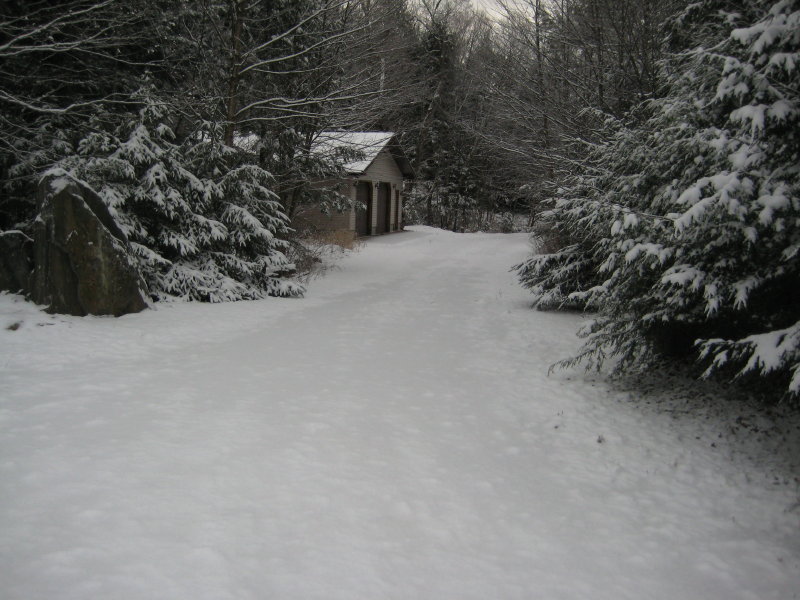
This week snow fell–again, about a foot, on top of already knee-deep layers. I strapped on skis and went off into a spruce forest near my house, my tracks the first marks on the page of the world.

Starting a new writing project, a book or an article, even a blog post, feels much like this. I see something falling outside my window–an idea, a passion, a glimpse of something true and maybe beautiful. I eagerly strap on metaphorical skis and go out, wondrously lost in a world made strange again. I am confident that I belong here, that I will apprehend something of value and meaning. But the going gets hard. The surface of the snow changes. The skis get stuck. I fall. I discover dozens of tracks before me on the trail, most more graceful than my own. Why am I here?

Doubts track me down no matter where I am. I have learned not to dismiss them. They force me to consider and reconsider. Does the world really need one more story?

Today, I give three responses: two from others, one my own.

1. Your story can bring “healing and illumination” to others.

Katherine Paterson, prolific Newbery award-winning author, says with genuine humility, “I know my gift is limited. I know I cannot stand toe-to-toe with philosophers and theologians and solve for myself or anyone else the problem of evil . . .”  But here’s what we can do, she says, “we who are writers can tell a story or write a poem, and where rational argument will always fail, somehow, miraculously, in metaphor and simile and image, in simple narrative, there are, in the words of Barry Lopez, both ‘healing and illumination.’ Here I see a word of hope and possibility.”

2. Writing your story can preserve your life.

When Madeleine L’Engle’s husband says of her new work, “It’s been said better before,” she responds,  “Of course, it has. It’s all been said better before. If I thought I had to say it better than anybody else, I’d never start. Better or worse is immaterial. The thing is that it has to be said, by me, ontologically. We each have to say it, to say it our own way. Not of our own will, but as it comes out through us. Good or bad, great or little: that isn’t what human creation is about. It is that we have to try, to put it down in pigment, or words, or musical notations, or we die.”

3.  Writing can move us toward the city of God.

If we pursue our stories, honestly and truly, they will send us on a pilgrimage that takes us, like Abraham, from one land to another, from a land of unknowing and darkness, through, of course, wastelands, where the promise of a promised land appears invisible and impossible . . . but the writing inexorably, day by day moves us closer to clarity, to wisdom, to the very city of God, if we allow it.

Don’t waste your doubts. Use them to move you forward into that forest, into the pages of that story that you must write—for yourself, for God and for others.


What Disney Knew That Your Teacher Didn’t: You CAN Do It!

Find me one published author who never received a single “not the right fit” letter, and I’ll show you a fish with feathery wings. Whether at the educational stage, the agent stage, or the publishing stage, most have been told their work is not worthy.

I was lucky when it came to agents and publishers, but my rejection came earlier in life, when a high school teacher read my papers aloud ridiculing me in front of my peers. She teased me relentlessly (today it would be called bullying), and on the last day of my senior year in high school, she said to me, “I hope you don’t waste your scholarship to study writing. You may be able to write a greeting card, but that’s about as far as you’ll ever go.”

I made a mistake that day. I believed her. I put down my pen for nearly a decade and let way too many stories go untold.

That’s why, twenty years later, as Publishers Weekly gives me a starred review for my debut novel, I feel such tremendous excitement. Whether Into the Free sells two copies or two-hundred thousand doesn’t matter one bit to me. I now know one important thing: she was wrong.

Here’s what she didn’t teach us: God gives us each special talents, gifts, and dreams. Who are we, if we are not of God? What are our abilities, if not God-given?

I am a teacher, and I spend every bit of my energy trying to teach my children one lesson: You can do it!

I am tired of teachers telling us who we are and what we will or will not achieve. I am weary of labels and bell curves and standardized tests. I weep for this generation of children who are told you need x, y, z medications to fit into our box. And I mourn the countless souls who believed the people who said, “You’ll never…” or “You can’t…” or “You aren’t good enough…”

I say to you, today. You can. You are good enough. You were born for a purpose, and only YOU know what that is. Don’t let anyone discourage you from living YOUR life to its fullest potential. And if you fail, you’re only one step closer to succeeding.

Watch this little video clip I found on YouTube, and you’ll see…all great minds have a few things in common: failure, rejection, and a willingness to risk it all anyway.

Has anyone ever told you “you can’t”? What one piece of criticism has made you a better, stronger writer? 

Crawling Into a Writer’s Cave

Light at the Mouth of the Cave
Light At the End of My Tunnel

My phone rang for the fifth time in two hours. I looked at the caller ID and groaned. Not because of the person, I love her, but she represented one in a string of many interruptions.

“I heard you were home. Wanna go shopping?”

“Can’t. I’m writing today.”

“Oh. You want to grab a cup of coffee then?”

I swallowed down frustration. But then, I remembered a policy from my day job.

I said, “Would you mind if we scheduled? I haven’t really treated writing with the professionalism it deserves.”

At work, when I’m involved in a big project, I sometimes tell everyone not to disturb me unless it’s important enough to call me out of a meeting five hundred miles away. I haven’t given writing the same care. I think I’ll turn my home office into a Writer’s Cave. Once I crawl inside and shut the door, I’ll turn off my phone. If you see a post on my social media that says “I’m in the cave,” you’ll know what it means. At home, the closed door will signal my family. Does that make sense?”

My friend connected with the practicality of my situation, and we scheduled a later visit.

So I took the leap and crossed into other relationships.

I sat my family down and told them about the Writer’s Cave. “When I close the door, let me burrow in my work. If you’re tempted to disturb me, ask yourself these questions:

  1.    Can it wait?
  2.    Would I interrupt her if she were five hundred miles away?
  3.    Would I call her out of an important meeting to tell or ask her this?

They agreed, and in return, I promised regular hibernation breaks so we could have fun and catch up. My husband and I scheduled weekly dates.

Next, I told my co-workers. As a manager, employees often assume they can call any time, day or night, working or not. I don’t mind true emergencies, but often, my phone rings over petty questions. I asked everyone, including the president of our company, to respect The Cave as they would a project at the office.

I said, “If you’d call me out of a meeting five hundred miles away, then contact me; otherwise, please wait until my return.”

It worked.

Then, I spoke with my other friends, explained the Writer’s Cave philosophy, and found they supported the decision. Every single person respected my new resolve to schedule.

Since adopting this policy, my concentration improved, my word count increased, and I’ve completed more projects. I’m a better time manager. But more than anything, by proactively guarding my time and alerting the world in advance, I’ve prevented most unnecessary interruptions without offense.

Now, people ask, “Are you in The Cave tomorrow?”

Crawling into a Writer’s Cave helped me move past unproductive habits. By speaking up, I shed light on a dark problem.

How do you maintain focus? Or, what does your Writer’s Cave look like? What are three essential items that you must take with you into the Writer’s Cave? 

The Slow Loris Road to Publishing

I’m what you might call the slow loris of book publishing.

 Are you familiar with the slow loris? I know it sounds like a Dr. Seuss character, but the slow loris is actually a real animal – a tiny primate with big, puppy-dog brown eyes and a round head (so far, nothing in common with me, in case you’re wondering). The slow loris is also described as a slow and deliberate climber.

Yup, that’s me: the slow, deliberate climber.

It took me two and a half years to write my first (and at this point, only) book. In my defense, I also had a toddler and a newborn at the time, as well as a part-time job, so I wrote only in the very early mornings and in the evenings, after the kids were tucked into bed. I wrote every day, slowly and deliberately ticking off chapters one by one until I had a completed manuscript. I marvel at writers who crank out two or three books in a single year. I know people that do this, and they are very good, fast writers. I am not. I am methodical, and my editing is nothing short of painfully laborious.

After I finished writing and editing my book, it took me another two years to land an agent. Again, I was slow and deliberate in the querying process. I purchased The Guide to Literary Agents and The Christian Writers’ Market Guide, and scoured the exhaustive lists of agents, categorizing each with the letters A, B or C. “A” designated a top-choice agent; “B” were the agents I considered good, but second-tier; and “C” was reserved for those I might query in desperation. I researched the agents online and then crafted a personal query letter for each. I queried most of my “A” list and some on the “B” list before Rachelle Gardner (top of the “A” list, by the way) offered me a contract (truth be told, I queried her twice).

 “Whew!” I thought, after I’d finished cartwheeling across the living room the day Rachelle offered me representation. “Now the process will finally start moving along! Let’s roll, baby!”

I assumed once the manuscript was out of my slow loris hands (claws?) that the pace would accelerate.

That was last February.

My memoir has not yet sold to a publisher. I’m not saying it won’t sell eventually. I am simply stating that in the nearly 365 days since I accepted representation from Rachelle, it hasn’t sold. As it turns out, Rachelle chooses the slow loris approach, too, if the market demands it. Sometimes, as she noted in a recent post, publishers aren’t in the market for a particular genre (in this case, memoir), so she puts the manuscript aside and patiently waits for a better opportunity.

I admit, being the slow loris is frustrating at times. I see some of my favorite authors publish one book, and then a second, and I wonder, “What about me? What about my book? Why doesn’t my book sell?” Doubt creeps in. And insecurity. I begin to question my ability as a writer, my story, even my choice to pursue this publishing dream.  I contemplate ditching writing all together and taking up needlepoint.

In the end, though, I continue to stick with it. After all, slow lorises, in addition to their slow, deliberate climbing skills, are also known for their ability to cling to a tree in one spot for an exceptionally long period of time, patiently waiting for the perfect meal to wander into proximity.

“Everything in its own time,” Rachelle reminds me.

I’m patient. I can wait.  I am a slow loris.

{For the record, the slow loris is also the only mammal with a toxic bite. Just saying.}

What animal would you choose as a metaphor for your journey to publishing or your writing style {please don’t say cheetah or I may die a little inside}?

Just Keep Writing

Photo by Lord Marmalade

There’s a reason I keep writing even though monetary success hasn’t found me, yet. Words strung together in books have always given me the ability to dream of bigger things and even the courage to go out and try.

I’ve been blessed to have three books published and each time there have been plenty of readers who have said that I helped them let go of what no longer worked for them and dream, too.

We talk a lot about our purpose for being here in this life and I’ve come to believe mine is to be of service in whatever ways I can figure out. So far, translating the common man’s dream into something worthwhile, something doable and something that’s even full of a little God-magic has been mine. Not the big, change a country, build a corporation dreams. The smaller moments that stay in your heart.

It’s a message that I took in from the very start.

My first experiences with books and stories are three of the strongest memories I have as a child. The very first one was the first time I walked into a library, the Philadelphia library and found out they let you check out as many as you could carry, my father’s rule, read them all and bring them back for more. My world opened up that day and I found out there were a thousand possibilities when it came to living a life.

The second has to be explained a little bit. We were so poor when I was growing up that my father talked a friend of his who worked at a local bank to lend him a hundred dollars so he could buy us a used black and white television. We screamed with delight when Dad brought the set home. So, when a Reading is Fundamental bookmobile came through our neighborhood and the driver told us we could pick out any new book and keep it, I felt like a little big of magic had settled over us that day. I took my time and tried to choose a book that I could read over and over again. I still have it and read it to my son when he was little.

The third memory is my brother, Jeff and myself when we taught ourselves to read, Horton Hears a Who by Dr. Seuss. We had the book read to us so many times we knew what part of the story went with what pictures and on our own figured out which words went with the sounds. That’s when I understood a secret about books. They have their own power to transform. They don’t know if you’re rich or poor, beautiful or an ugly duckling, a wealthy doctor or a poor cabdriver, and they don’t care. A book will take you on an adventure whenever you’re ready, regardless of how you see yourself and as a bonus may even change the definitions.

Books made it possible for me to envision a way to become someone I couldn’t even define yet. They gave me the faith to set out when I couldn’t find it anywhere else and the hope that somehow things would all work out.

I’ve seen it happen just often enough. A lost human being feels like they’re the only one who has ever felt this much pain. They don’t know how to reach out for help but then, inside of a story some writer concocted out of whole cloth they see every emotion or secret or hope-for happy ending that they’ve kept bottled up inside, acted out, and they start to believe – maybe there’s more to this world.

That’s why I keep writing and that’s why I’m so grateful for every writer out there who struggles to tell a good tale. I’m one of your biggest fans, whoever you are, so keep writing. We need every single exciting, cliffhanger, romance, potboiler, science fiction, political thriller that we can get our hands on because even now, sometimes my dreams need a kick start. So please, just keep writing.

The publishing business: all that glitters

The morning began as usual, checking my twitter, facebook and email accounts before I stuck a toe out of my warm, cozy covers.
 
Did my post post?
 
Did my scheduled tweets tweet?
 
Did anyone RT them? Comment on them? Reply to them? Even see them?
 
Get more speaking engagements. Submit more articles. Write more controversial stuff, like her. Write more edgy stories, like him. Promote more books for people so they’ll someday help promote me. Comment on that-one-blog so the agent notices. Read three more blogs and comment on them, too.
 
My posts and tweets and updates sound stupid. My blog looks outdated. The only responses I ever get are crickets chirping. I shoulda posted a link to that one-really-good-writing-article. Why didn’t I RT so-and-so? People might pay more attention to my writing if I RT someone with a little more Klout. I’m too messed up for that industry professional. I’m not messed up enough for the other.
 
Does any of this stuff matter?
 
And when was the last time I added a word to my manuscript?
 
Oh, yeah, my manuscript. The thing that pulls my heart. The story that makes my gut churn with excitement and fear, possibility and hope.
 
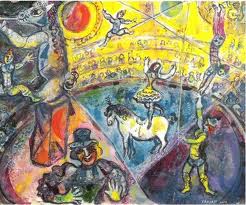
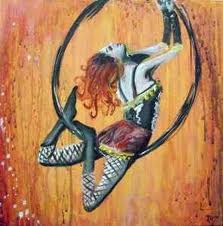
The publishing journey glitters. Veteran authors, publishing houses, editors and MFAs pull us like the sparkling bodice of a circus dancer, flipping and tumbling effortlessly through the air, her partner eagerly waiting to catch her in his arms and raise her into the air for applause.
 
And yet, we who write for publication must be careful. We sit in the dark stands under the Big Top, munching on popcorn, coveting glow-in-the-dark necklaces, lost in the illusion and elusive space between what is real and who we are.
 
Like many of you, I’ve been a hobo on this circus train since my youth, curled in a small, black space under a box car, hoping no one will find out I’m there, spying, watching and mimicking every move . . . while at the same time hoping the Ringmaster will discover me, dress me in the finest costume of tulle and sequins and tights, crown me princess in the center ring.
 
At some point, as each of us steps into the publishing business, we must decide to whom–and for whom–we will perform. I suppose a piece of every life involves some degree of performance. But how big a piece we give up, well that part’s up to us.
 
Good magicians, like good circus performers, don’t tell you their secrets. But I will tell you mine, and it is this: YOU are the main act.
 
You’re it.
 
Because you are the artist.
 
No matter which trapeze the business has you swinging from–commodity or compadre–you’re the one with the words. Anything the business brings beyond that is a side show compared to the talent, skill and gift you bring to the center ring . . . a gift that can’t be enhanced or revealed, covered or consumed by a shiny costume.
 
I re-discovered this recently as I read over pages of a document my grandfather left my grandmother, printed words etching a burning love story into the cold stone of history.
 
My history.
 
The beginnings of another new novel.
 
You have a history too, and from behind the cage bars it scratches and roars to be told. Feeding it isn’t enough. You must let it loose and tame it. Balance the weight of it on a small, round stand. Parade it carefully in front of the masses.
 
There’s a hoop only you can soar through. A tightrope only you can walk. A story only you can tell.
 
Don’t lose it in the spotlight. Don’t let it become ensnared and choked out by the ropes and pulleys, smoke and mirrors.
 
Do this, and you’ll survive–and perhaps even thrive–in the publishing circus.

Because all that really glitters in this great show is you.

What about you? How do you remain true to yourself and be the best possible steward of the gifts (and time) God’s given you, while walking the tightrope of the industry?

I Have a Dream Today

Image: Andy Newson / FreeDigitalPhotos.net

Why would a twenty-three-year-old white girl from the midwest clip a newspaper printing of the speech Rev. Martin Luther King Jr. delivered at the Lincoln Memorial in 1963 and tuck it away among her treasured mementos where it remains nineteen years later today?

Because she believed in the power of a lofty dream to drive change? Because she had faith in the unalienable rights of life, liberty and the pursuit of happiness? Because Rev. Martin Luther King Jr. was a compelling writer and speaker who knew how to captivate a diverse audience?

Yes, all of that and more. But, today I want to focus on three reasons I think the reverend’s writing moved me the way it did back when I first clipped that article, and why it still does today.

He created a universal problem and emotional connection. While the reverend’s speech was in no small part directed at those whose rights were being abused, he was brilliant to make it deeply personal for all Americans by invoking a patriotic problem. He speaks of when the ‘architects of our Republic wrote the magnificent words of the Constitution and Declaration of Independence, they were signing a promissory note to which every American was to fall heir.’ If this problem, this refusal of rights can happen to one population of Americans, what keeps it from happening to anyone?

Reverend King Jr. makes us care because most Americans are cognizant of the greatness of the promise of our Constitutional rights. With an increasing global awareness, we’re even less likely to take them for granted. ‘It is a dream deeply rooted in the American dream.’

The writing lesson here: whether writing fiction or non-fiction, give your audience a personal reason to care by creating a problem they can relate to, an emotional connection either to the characters or the cause. Especially in fiction, even though your problem or plot may (and probably should) be extraordinary, your readers should be able to find the common humanity there.

He used powerful language, metaphors and active verbs to show, not tell. Martin Luther King Jr.’s speech did not simply ‘tell it like it is’, he showed it through the use of active verbs and metaphors. While metaphors can be frowned upon in genre fiction today, few could argue they created a unforgettable visual of the plight of 1963: ‘seared in the flames of injustice’, ‘crippled by the manacles of segregation and the chains of discrimination.’, ‘sweltering summer of the Negro’s legitimate discontent’, ‘whirlwind of revolt’, ‘battered by the storms of persecution and staggered by the winds of police brutality’…

And, he also showed it in the vision of his dream: ‘on the red hills of Georgia the sons of former slaves and the sons of former slave owners will be able to sit down together at the table of brotherhood…’, ‘Mississippi, a state sweltering with the heat of oppression, will be transformed to an oasis of freedom and justice…’, ‘every valley shall be exalted, every hill and mountain shall be made low, the rough places will be made plain, and the crooked places will be made straight…’. These are convincing visuals.

The writer’s lesson here: more than simply showing vs telling, try to break from the same worn and weathered words to paint vivid pictures. Scrap those clichés and push yourself to make your language—descriptions and actions—tell their own stories. This doesn’t mean your writing should be thick with purple prose, just that each word should be thoughtful and deliberate. For fiction writers, this also applies to dialog: if your reader can easily predict what your character will say next, it may not even be worth saying.

He leveraged the “Power of Three” and then some. A trick of great speakers—presidents and members of the clergy know this—is the rule of three. What most people remember from a speech is no accident. The key thoughts and takeaways are memorable because they are repeated or weaved throughout, at least three times.

The Rev. King Jr.’s words ‘I have a dream’ were repeated no less than six times throughout his speech. Same with ‘let freedom ring’. But, in addition to those memorable lines, he opened with repeated concepts around ‘One hundred years later’ to describe the state of despair long after Lincoln has signed the Emancipation Proclamation. Then with ‘Now is the time’ to spurn urgency of action, and also with ‘We can never be satisfied as long as…’.

This rule of three can work in your writing too: repeated themes and ideas stick. In fiction this may need to be more shrewdly thought out so you’re not overusing a word or repeating a crutch-phrase, but if there is a key point you want to make sure the reader doesn’t miss, this is a technique anyone can apply.

In respect for the holiday, might I suggest you take a moment to read the Reverend Martin Luther King Jr.’s speech and reflect not only on his great vision but how charismatically he used the tools of language to share that vision with the world?

Rejection!

Rejection is an ugly word, especially to a writer. But we need to keep it in perspective.

To help you put rejection into perspective, I’d like to discuss my shoes.

I have a pair of lovely leather shoes. I really like my shoes. They are stylish, look good with many types of clothing, and are comfortable to wear for many hours. I love, love, love my shoes.

A few months ago, I noticed my shoes were beginning to look worn out and were no longer attractive to wear with dress pants. I thought about purchasing another pair of shoes, and then I had the bright idea to bring them to a shoe repairman. The repairman put new heels on my shoes, polished the leather, and blackened the soles. After some effort and work, my leather shoes are spiffed up and look as good as new.

Now, if I offered my shoes to someone and they don’t love them like I do, should I be heartbroken? Does their rejection of my shoes make me less of a person? Does it make my shoes less attractive? Does it make me less worthy?

Think about it, I bet my shoes wouldn’t fit just anyone. They wouldn’t be right for a number of people with different tastes and different needs. But that doesn’t make my shoes less valuable or less worthy.

That’s the way I look at rejection. My manuscript (shoes) is polished and ready to go out into the world. But perhaps the agent/editor (consumer) needs a different size or is looking for a different style. It’s easy to look at the situation from this perspective and see that it’s not always personal when your manuscript (shoes) is rejected! Sometimes the rejection is not about the story or craft but for other reasons, some of them simply being reasons of timing.

Rejection is an ugly word, especially to a writer. But we need to keep it in perspective. If we’ve been gifted/called to write, then we should keep writing and polishing our manuscripts. After all, many successful writers have suffered rejection.

Now that you’ve gotten the fear of rejection out of your mind, put your new confidence to the test by planning to attend a writer’s conference this year. Many writers will testify that their career got on the fast track after they attended their first conference. You meet other writers, editors, agents, and learn about the craft and the industry at conferences. Your competence and enthusiasm for your writing gets a great boost by attending conferences.

Don’t stress about rejection, keep moving forward in your career.

How do you shrug off rejection? How do you keep it in perspective?

NaNoFAILNo: Cracking the code

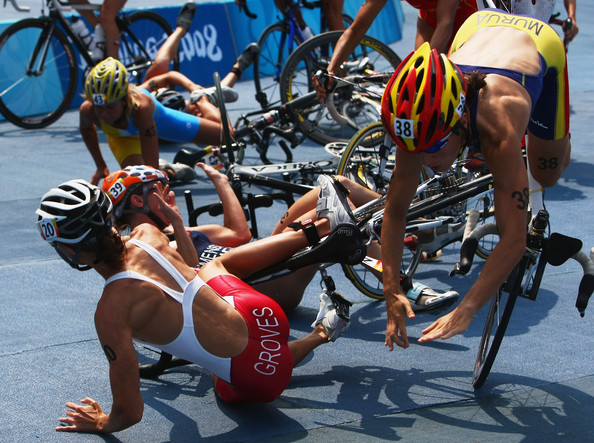
Ever feel like these 2008 Olympic tri-athletes?

I did last month, when (ten years postpartum) I decided to get in shape. Though our three golden retrievers have always kept me walking, this fall my prodigious cross-country-running son inspired me to pick up the pace a bit and run.

I followed all the training recommendations, slowly building up pace and stamina. I alternated running and walking until I could run a good couple of miles without stopping. As I trained, I noticed a tiny twinge in my left knee. Nothing major. Nothing too painful. Then I ran a 4.5 mile race on Thanksgiving Day. My knee hurt about half-way through, but I continued, finishing the race with a dull throb I thought would dissipate.

The next day, the pain felt excruciating. Days of ice, rest, compression and ibuprofen didn’t help. Convinced something major was severed—or needed to be—I went to the orthopaedic hospital for x-rays.

I left with the disappointing diagnosis of tendonitis. As much as it hurt, I expected a cast or bandage or something to show for it. Instead, I limped back home and continued rest, ice and ibuprofen for the next 5-6 days.

Finally, the pain subsided and I attempted my first walk since the race. I barely walked a block before the knife-like pain dug into the side of my knee. By the time I got home, all I could do was curl up in my bed with an ice bag and weep. One by one as if at a wake, our three dogs and three sons filed by the bed offering reassuring licks and hugs (respectively).

All of this occurred as NaNoWriMo drew to a close, along with my pathetic word count. I struggled with feelings of failure, futility, inadequacy, even doom regarding both my running and writing. Even so, I gleaned some wisdom from the experience—wisdom I thought fellow writers might appreciate.

1) First, it’s okay to try and fail.

Like most folks, I started NaNoWriMo with fervor and motivation. I had accountability partners. I tweeted word counts. Laundry piled high. Then life happened: three kids had to be three places at once; my family actually needed clean underwear; a day job and bank account needed me to work more hours; one dog licked open a hot spot and two others stepped all over my laptop whenever I sat down to write. 

All the while, that annoying NaNoWriMo daily word counter thingy crept upward. On the first day, the counter said to maintain a 1,667 words/day pace to meet the 50,000 goal. As writing time waned, the goal increased to 2,300/day. Then 6,534. On November 30, I would’ve had to write 26,000 words to meet my goal.

Still, I’m 24,000 words farther into my WIP than if I never tried at all.

2) Second, free writing leads to discovery of strengths, weaknesses and voice.

Psychologists use a journaling technique with some patients in which they tell them to use their non-dominant hand to write themselves a letter. Many times, this leads the writer in unexpected directions, opening doors to new and more productive stories. Similarly, as I continued through NaNoWriMo, I discovered new ways to write scenes. New characters felt free to emerge. I felt free to kill a few off and start over. I found my voice and lost it several times over, and even discovered new ones. Free writing, well, it frees us from editor mode, allowing uncharted creativity to emerge.

3) Keep going, but stop if it hurts.

I learned after-the-fact running shouldn’t hurt, and if it does, you should stop. Same thing with writing.

I know—I know. We’re supposed to allow our hearts to “bleed upon the page.” We ought to pour ourselves through our pens until we can sing “Nobody Knows the Trouble I Seen” in a grand, unrelenting crescendo.

Not that there’s anything wrong with that. 

But, most of us writers are melodramatic, hyperbolic saps. Seriously. If it’s too difficult, take a break. Find a new angle. Cross-train by reading a few books. Settle in to what works for you. If you participated in NaNoWriMo, be proud of whatever word count you achieved. If that sort of jump-start works for you, participate again. If you hated it and the whole month felt like a proverbial knife-in-the-knee, don’t bother.

4) As Captain Barbosa (from Pirates of the Caribbean) said, “The code is more what you’d call ‘guidelines’ than actual rules.”

So it goes with writing, including NanoWriMo. Writing advice on the web, in books or taught in classrooms are guidelines—not code—we need to tweak and apply to our unique lives. For example, the “write every day” advice is not feasible for my life stage, which includes boys, dogs, work and possibly undiagnosed ADD. For a long time, I beat myself up for not meeting that seemingly ultimate criterion for being a “real writer.” Now I’m learning to embrace my quirky—if manic-depressive—methods of achieving word counts.

You might wonder what’s become of my knee injury. I decided to head to the local swimming pool. A competitive swimmer in college, I returned to the place I knew I could find a niche and was gentler on my joints and 10-year-postpartum body. As I glide (pain-free) through the water, voices and the noise of the world are assuaged until all I focus on are breathing.

Kicking.

Reaching.

Pulling the water behind me.

More water.

More words.

Ever behind us.

Ever before us.

Ever beckoning each of us to write.

What about you? Did you participate in NaNoWriMo? If so, what did you take away from the experience?

Hurry Up And Wait…

We’ve all been there. Staring down a road that leads to who knows where, wondering if we’ll ever reach the end of it. I’ve read that on average, we’ll spend at least five years of our lives just waiting. Waiting for the interminable line of traffic to start moving. Waiting for the phone to ring. Waiting for an email. Waiting for that long-awaited letter to arrive in the mailbox. We wait for good news. We wait for bad news. Waiting is a physically agonizing process, a process that is completely out of our hands.

If you’ve been writing for any length of time, I suspect by now you know all about waiting. Perhaps you were fortunate enough to go in prepared. Some kind soul warned you that once you start submitting your work, you’d be in for the wait of a lifetime. I wasn’t so lucky. When I started sending out queries to agents and editors, I had no idea how long the whole process would take. Even now as a published author, I’m still frustrated by how long everything takes in the world of publishing. You see, I’m not the most patient person in the world. But I have learned, through trial and error, that some things are worth waiting for.

Once upon a time, about a decade ago, I decided to search for my birth family. I’d always known I was adopted, but until then, never felt the need to search. Until God stepped in and said otherwise. Call it what you will – fate, destiny, blatant curiosity. All I knew for sure was that I needed to know. And so I embarked on a journey with an unknown destination.

If you think the wheels of publishing move slowly, try dipping your toes in the murky waters of the adoption ocean. Uncovering any information is akin to embarking on a quest for The Holy Grail.

Fortunately, given my aversion to waiting, I was one of the lucky ones. My answers came quickly. Too quickly perhaps. I was totally unprepared for the onslaught of emotions that took up residence and unpacked for the duration. It was a hard but necessary time in my life. A time when all I could do was throw up my hands, cry out to God, and ask Him for answers.

You see, not only had I found my birth mother, who was not completely receptive to my sudden reappearance in her life, but I discovered that I had a sister. A sister who was completely unaware of my existence. And I was asked to wait. Wait for the right time to tell her. Wait to see whether or not I would be able to establish a relationship with this person I knew nothing about yet felt deep in my soul a connection I could not at the time comprehend.

I said earlier that waiting is something we can’t control. But we try, don’t we? We send follow-up emails, perhaps a phone call or two to nudge the process along. Eventually we realize we’re not doing ourselves any favors. We give up and go back to waiting.

In the Christian community you’ll often hear the following – “God answers prayers three ways. Yes. No. Wait.”  There are no maybes with God. When your answer is a “Yes!”, you know that feeling! You rejoice, cry a little, throw a party. The “No.” answer is hard. It hurts. You don’t understand. You might get angry, depressed, reluctant to try again. But if you know in your heart that God is at work, you’ll accept the no in faith that He has a better plan. Oh, but that “Wait…” Now, that’s the kicker.

How long, God? Why? When will something give?

Sound familiar?

My wait took a little over a year. As frustrated and anxious as I was with the situation, I knew without a doubt that somehow, some way, God was working it out. Was it easy to wait? As easy as walking across a bed of hot coals and broken glass. Every day. Was it worth it?

You bet.

My sister and I now have a wonderful relationship. I’m glad I hung in there. I’m glad I didn’t give up. I’m glad I waited. Most of all, I’m really glad I trusted God.

Nowadays, when I’m checking my email every five seconds waiting for news, I remind myself of that time in my life. I tell myself to cut it out. Stop being so impatient. There is a time and a place for everything. And it’s not up to me.

What about you? What’s the hardest thing you’ve ever waited for?