
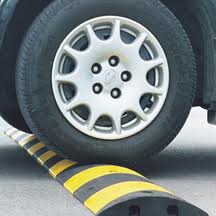
 I was driving through the resort grounds in Jamaica, navigating the unfamiliar territory with difficulty in the darkness, when I saw the sign: “Sleeping Policeman.” I was wondering what a police barracks was doing on the grounds of the hotel when I was sent airborne, straining at the seatbelt while my back teeth clattered together. In the clarity that followed, I realized that I’d just seen the Jamaican equivalent of a “Speed Bump” sign.
Just as there are speed bumps on the roads we travel, there are speed bumps on our road to writing. Let me warn you about a few I’ve encountered, because—as I learned the hard way—when we know about the speed bumps they don’t bother us as much.
1) Constructive criticism is necessary. When we write, we know that ultimately someone is going to read what we produce. That’s what it’s all about. But if the only person who reads our work before we submit it to an agent or editor is our spouse or parent or Aunt Sally, we can’t expect any beneficial feedback.
The beginning writer doesn’t generally produce a Pulitzer Prize-winning first novel. But informed and constructive criticism allows us to correct our errors—and hopefully refrain from repeating them—so that everything we write afterwards is better than what went before. Find someone who is knowledgeable, ask them to read and critique your work, and be prepared to experience both pain and growth as a writer.
2) Rejections can convey a message. For a writer, rejections are a way of life. We might as well get used to it. But sometimes, in addition to the usual boilerplate language of “Not right for us at this time” or “Doesn’t fit into our plans”—both of which could be true—an agent or editor may make a comment. When that happens, pay attention.
Admittedly, there are times when the comments aren’t exactly helpful, as when an editor returned one of Tony Hillerman’s stories with a note to the effect of, “This might be better if you get rid of all that Indian stuff.” Of course, Hillerman went on to be an award-winning, multi-published novelist with his books about Jim Chee and Joe Leaphorn. But sometimes there’s a ray of hope in the comment, such as “I’d be interested in reading this again if you (fill in the blanks)” or “This shows great promise. I’d like to see your next one.” That’s when you take a deep breath and plunge on. The speed bump has slowed you, but it hasn’t brought you to a stop—just redirected you.
3) Hurrying can cause problems. Admittedly, I was in a hurry when I first made the acquaintance of the “Sleeping Policeman” in Jamaica. I’d have been better served by driving more slowly in the first place. That lesson can carry over into writing. Don’t be in a hurry.
You’ve just typed the last line of your first novel. Now how quickly can you send it off the every agent on your list? Hold on. I did something like that with my first novel, submitting it to the editor who’d encouraged me at a conference, and now I’m embarrassed to read it. It was a good first effort, but by no means was it a publishable book. The best advice I can give you is to let the manuscript cool—for a week, a month, or more. Then read through it like an editor, not a writer. Can you remove excess words (or, as Mark Twain put it, kill the adverbs) and passive voice passages? Are your characters well-drawn? Does the plot move smoothly and logically? Then, when you are sure it’s your best work, send it off.
What next? Why, start on the next book. Speed bumps are meant to slow you down, not stop you and make you turn back. Good luck.





 WordServe Water Cooler