Keeping the Ideas Coming

The writing life is a sedentary one, requiring hour upon hour of sitting in front of a computer screen—not good for the eyes or the metabolism or that almost forgotten New Year’s resolution to lose ten pounds. Desk-bound inactivity is also not good, I’ve lately read, for the brain—particularly those portions of the brain that support a capacity of supreme importance to the writer: creativity. To keep the brain in good shape and new ideas flowing in, say scientists who study creativity, you need to change things up a bit. Do something active. Think about something else.

The solution for me is running. I run twenty-one miles a week on the back roads around my house. Because of my work schedule, I run in seven to ten mile chunks, which is a bit hard for a nonathletic person like me, so I’ve come up with various strategies to take my mind off of what I’m doing. In addition to thinking about my current writing dilemmas and planning new books, I count the different kinds of birds or flowers or grasses or trees. I carry binoculars for locating birds and have trained myself to recognize their voices and habits. I phone distant family members and friends whom I rarely get around to talking to otherwise. I pray.

On especially long runs, though, even these distractions get boring, so this winter I started playing a sick, depressing game of building alphabets from the roadside trash.

I made up rules for myself. I had to follow the alphabet’s order. I had to actually see a letter—not guess or surmise it from the visible part of the trash—for it to count. No slowing or stopping to look more closely. No stopping to turn a piece of trash over to see the other side. No touching at all! I had to read on the fly.

It was, as I say, a sick, sad game. So much trash. I fantasized about returning after my run with a box of trash bags and picking it all up but never found time.

Then spring came, burying the trash in weeds. That made the game harder and longer. I was on J one day—Js and Vs were always the hardest letters to find—and had been jogging along for miles without seeing even the Juicy Fruit wrapper I’d seen the last time I’d run there. Up ahead, a square of paper stuck up like a tombstone out of the freshly graded borrow ditch. On it was one word: TIME.

It occurred to me that it would be much more fun to collect whole words than single letters, so I wrote down TIME in my little bird notebook and jogged on. Soon I had grand, subway, rub, natural, ice, aqua, buried, cable, light, wet, ones, bud, sonic, key, stone, mountain, and dew and decided to make a poem.

It has always bothered me how advertising and brand names undo words. Light doesn’t mean light. Mountain has no real connection to a mountain nor dew to actual dew. My poem, I decided, would reclaim these words’ real meaning. I would redeem the trash words.

My rules were few. What linguists call structure-class words (pronouns, helping verbs, articles, conjunctions, etc.) and inflections (verb forms, plural forms, etc.) were allowed. So was divvying a word into its parts: keystone offered key and stone. Homophones—such as bush from Busch—were off limits. Once my poem got going, though, I threw out all my rules and just concentrated on making the poem work as a poem, importing non-trash words as I saw fit.

Writing that first poem made me cry. Don’t know why, exactly, except that it felt holy. I decided, in any case, to collect trash words and make poems routinely when I ran. I even started a blog of the poems that have resulted. I find the project profoundly satisfying, from collecting words to redeeming them as poems to posting them for others to read.

I don’t have much of a message here, except this: Get serious—and creative—about your creativity. Every moment, every event, all the minutiae of your life, even the worst things—even running!—can be re-purposed for something good.

In what ways will you choose to redeem your creativity this week?
NaNoFAILNo: Cracking the code

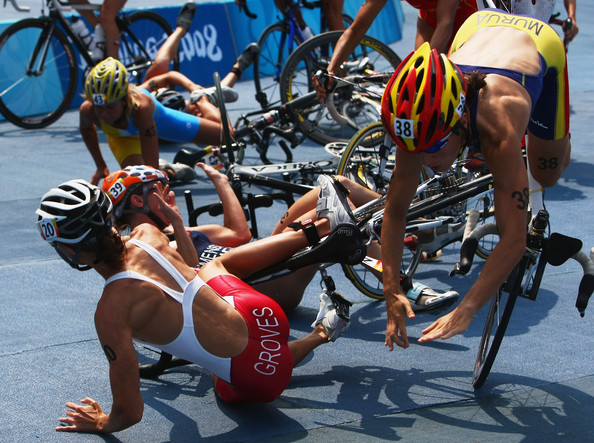
Ever feel like these 2008 Olympic tri-athletes?

I did last month, when (ten years postpartum) I decided to get in shape. Though our three golden retrievers have always kept me walking, this fall my prodigious cross-country-running son inspired me to pick up the pace a bit and run.

I followed all the training recommendations, slowly building up pace and stamina. I alternated running and walking until I could run a good couple of miles without stopping. As I trained, I noticed a tiny twinge in my left knee. Nothing major. Nothing too painful. Then I ran a 4.5 mile race on Thanksgiving Day. My knee hurt about half-way through, but I continued, finishing the race with a dull throb I thought would dissipate.

The next day, the pain felt excruciating. Days of ice, rest, compression and ibuprofen didn’t help. Convinced something major was severed—or needed to be—I went to the orthopaedic hospital for x-rays.

I left with the disappointing diagnosis of tendonitis. As much as it hurt, I expected a cast or bandage or something to show for it. Instead, I limped back home and continued rest, ice and ibuprofen for the next 5-6 days.

Finally, the pain subsided and I attempted my first walk since the race. I barely walked a block before the knife-like pain dug into the side of my knee. By the time I got home, all I could do was curl up in my bed with an ice bag and weep. One by one as if at a wake, our three dogs and three sons filed by the bed offering reassuring licks and hugs (respectively).

All of this occurred as NaNoWriMo drew to a close, along with my pathetic word count. I struggled with feelings of failure, futility, inadequacy, even doom regarding both my running and writing. Even so, I gleaned some wisdom from the experience—wisdom I thought fellow writers might appreciate.

1) First, it’s okay to try and fail.

Like most folks, I started NaNoWriMo with fervor and motivation. I had accountability partners. I tweeted word counts. Laundry piled high. Then life happened: three kids had to be three places at once; my family actually needed clean underwear; a day job and bank account needed me to work more hours; one dog licked open a hot spot and two others stepped all over my laptop whenever I sat down to write. 

All the while, that annoying NaNoWriMo daily word counter thingy crept upward. On the first day, the counter said to maintain a 1,667 words/day pace to meet the 50,000 goal. As writing time waned, the goal increased to 2,300/day. Then 6,534. On November 30, I would’ve had to write 26,000 words to meet my goal.

Still, I’m 24,000 words farther into my WIP than if I never tried at all.

2) Second, free writing leads to discovery of strengths, weaknesses and voice.

Psychologists use a journaling technique with some patients in which they tell them to use their non-dominant hand to write themselves a letter. Many times, this leads the writer in unexpected directions, opening doors to new and more productive stories. Similarly, as I continued through NaNoWriMo, I discovered new ways to write scenes. New characters felt free to emerge. I felt free to kill a few off and start over. I found my voice and lost it several times over, and even discovered new ones. Free writing, well, it frees us from editor mode, allowing uncharted creativity to emerge.

3) Keep going, but stop if it hurts.

I learned after-the-fact running shouldn’t hurt, and if it does, you should stop. Same thing with writing.

I know—I know. We’re supposed to allow our hearts to “bleed upon the page.” We ought to pour ourselves through our pens until we can sing “Nobody Knows the Trouble I Seen” in a grand, unrelenting crescendo.

Not that there’s anything wrong with that. 

But, most of us writers are melodramatic, hyperbolic saps. Seriously. If it’s too difficult, take a break. Find a new angle. Cross-train by reading a few books. Settle in to what works for you. If you participated in NaNoWriMo, be proud of whatever word count you achieved. If that sort of jump-start works for you, participate again. If you hated it and the whole month felt like a proverbial knife-in-the-knee, don’t bother.

4) As Captain Barbosa (from Pirates of the Caribbean) said, “The code is more what you’d call ‘guidelines’ than actual rules.”

So it goes with writing, including NanoWriMo. Writing advice on the web, in books or taught in classrooms are guidelines—not code—we need to tweak and apply to our unique lives. For example, the “write every day” advice is not feasible for my life stage, which includes boys, dogs, work and possibly undiagnosed ADD. For a long time, I beat myself up for not meeting that seemingly ultimate criterion for being a “real writer.” Now I’m learning to embrace my quirky—if manic-depressive—methods of achieving word counts.

You might wonder what’s become of my knee injury. I decided to head to the local swimming pool. A competitive swimmer in college, I returned to the place I knew I could find a niche and was gentler on my joints and 10-year-postpartum body. As I glide (pain-free) through the water, voices and the noise of the world are assuaged until all I focus on are breathing.

Kicking.

Reaching.

Pulling the water behind me.

More water.

More words.

Ever behind us.

Ever before us.

Ever beckoning each of us to write.

What about you? Did you participate in NaNoWriMo? If so, what did you take away from the experience?

Strip down and never lose sight

Crisscrossed with knee-high boundaries of grass, the field stretched far below the hilltop. To the distant right, the sound of a fast-moving four-wheeler buzzed louder until I saw it speed toward the horizon, followed seconds later by a skinny-ing mass of runners.

Along with all the other camera-laden parents, I  darted across the fields, staking strategic positions to capture my son rounding a corner or blazing down a hillside. I hurdled boulders, pushed through sluggish throngs, and catapulted my rattling, aging body from one carrefour of the course to another.

When my runner passed by, I whooped.

I hollered.

I scurried across the field to the next junction to cheer him on some more.

Hundreds of spectators gathered to watch the state middle school cross-country championship. Hundreds of kids flashed by. Yet within that undulating motley horde, I found and locked eyes with my son. 

The corner of his mouth turned up when he saw me.

He gulped more air.

He lengthened his stride. 

He disappeared.

And I scurried to the next junction to cheer him on again . . . until I met him at the finish line, red-faced, breathless, and satisfied.

We’re not unlike these cross-country runners, you and I, especially if we feel called to write for the Christian market. After returning from the 2011 ACFW conference, I spent days processing not only that event, but also my writing journey as a whole. I argued with my muse, re-evaluated my purpose, and gasped for clarity amidst the torrid winds of the publishing industry.

Until I watched my sons race last weekend.

And I remembered.

I remembered running up the hill of uncertainty after taking years off writing to focus on parenting.

Around the corner was an industry professional who said no to a query, but invited me to Mount Hermon, where my heart for Him and writing collided like a flare on a pitch black highway.

I rounded the craggy corner of tens of rejections.

Then I “happened upon” a newspaper editor who just “happened to need” a new weekly columnist.

I fell behind, distanced from hope by whispers that no one needs or wants to hear my pathetic story or craftless words.

On the back stretch I caught sight of the waving arms of a friend who led me to my agent.

I lost sight of other runners sprinting ahead of me, pouring out multiple books a year, and I wanted to give up my goal to publish even one.

Around the next bend, a blog reader commented that the words on my website changed her life.

I coveted the bold, new uniforms of other runners and wondered if I should water down or change my message.

A fan on the sideline told me how a Christian book by a Christian writer saved her husband’s soul.

We are in a race, we faith-focused writers . . . a race to make Him known . . . a race to further the inbreaking of His Kingdom . . . a race beckoning us to finish hard, finish well, and finish strong . . . no matter where we fall in the pack.

And around every corner . . . along the loneliest stretches . . . down the effortless hills and up the steepest inclines, He runs to meet us . . . to cheer us on . . . to lock our wandering eyes upon His countenance above all others along the swarming sidelines.

“Do you see what this means—all these pioneers who blazed the way, all these veterans cheering us on? It means we’d better get on with it. Strip down, start running—and never quit! . . . Keep your eyes on Jesus, who both began and finished this race we’re in. Study how he did it. Because he never lost sight of where he was headed—that exhilarating finish in and with God—he could put up with anything along the way . . . ” (Hebrews 12:1-3, TMV)

What about you?

Where have you felt God’s presence along your race course? How have veteran Christian writers inspired you? When have you heard Him whooping and hollering, redirecting your steps and restoring your focus on Him?