Give Me A Hint: The Use of Foreshadowing

I was at work discussing books with a physician who is an avid reader as well of Robin Cook’s novels. Cook could be considered the grandfather of the medical thriller with his ground breaking The Year of the Intern, which highlighted the training physicians go through.

Cook, for me, delved into what a medical thriller should be. Take something medical in nature (like organ donation) and put a twist on it (genetically engineered individuals being used for spare body parts). That novel was Chromosome 6. What my physician friend said was, “The great thing about Robin Cook was he grounded you in the science before he took that leap, so when he did go over the cliff with his theory you were able to buy it hook, line, and sinker.”

Book #3 Bloodline Trilogy

This conversation got me thinking a lot about my third novel, Peril, which just released. I’m asking the reader to take a big (HUGE really) theoretical leap, but had I spent time grounding them in how this medical theory could really play out?

That question led me to rewrite the first third of my novel.

Some people view foreshadowing as the scary thing suspense novelists do to readers to get the hair to stand up on the back of their necks. Truly, this is part of it. The scary music cuing up before the axe falls on the victim.

More importantly, though, foreshadowing could be viewed as the details we plant for readers so that when the character does something unbelievable, the reader won’t be rolling their eyes in a jump-the-shark moment.

In my first novel, Proof, I needed there to be a instant in time where one character could place a lethal (or was it really?) shot to the villain. In order to do that, I had to paint a picture for the reader of the character being capable of doing it mentally and physically when that moment came.

Step One: Show that she is comfortable with weapons–and maybe a little too psychotic about her safety.

Step Two: Show that she is a good marksman. This scene included her taking a close friend to an indoor shooting gallery. Let’s just say that girl had some skill even with a little bit of alcohol on board. Plus, she had purchased another weapon, which increased the probability of one of them being used. Don’t give the character a weapon and then never have her use it.

Step Three: Show that she will use a weapon when in a dangerous situation. At one point in the book, the villain is giving chase and she fires at him from a moving vehicle.

Step Four: The ultimate showdown must take place. Don’t plant any seeds that aren’t eventually harvested.

Does anyone remember the Laura Croft Tomb Raider movies? In one, it dealt with her finding Pandora’s Box. The whole two hours is devoted to the adventure of discovering ancient clues that would lead her to the ultimate treasure. At the end of the movie, she has the box in her hands and . . . she doesn’t open it.

Huge let down.

What do you think about foreshadowing? How do you think it’s been used effectively or poorly in books and movies?
Promotional Items: The Good and Bad

I recently returned from the ACFW conference held in Indianapolis. This is an annual gathering of the largest membered group of Christian fiction authors. It’s a great time to connect with fellow writers and hope some of the writing genius from authors like Dan Walsh, Tosca Lee, James Scott Bell, and Frank Peretti infuses life into my writing cells.

Promo1Most conferences have a “freebie” table where writers are allowed to leave promotional items to get the word out about their product. This year I thought I’d give you my take on them. The good and the bad.

Think of a promotional item with a goal in mind. What do you want it to do for you? Consider the return on your investment and what you hope to achieve. I think most people view a promotional item as a chance for exposure. Most marketing types will tell you it takes six-ten exposures for someone to buy your product. So a good promotional item is something a person will keep and look at over and over.

I’ve determined that giving away bookmarks is not a good idea. EVERY author/writer does this and last year when I had bookmarks I ended up taking most of them home. They are not unusual enough anymore and with the advent of e-readers I think many do not need them anymore either.

One way bookmarks could work is if you are a very popular, well-known author and they are signed. But, sigh, that is not me. Yet.

RedwoodNewsletterQRMy goal was to get people to subscribe to my forthcoming newsletter. I gave out full-size Hershey Bars and packs of gum with the stickers you see on the first photo. The sticker includes this QR code that links to a newsletter sign-up form where I’m giving away a prize worth over $75.00. It includes all three books of my Bloodline trilogy, a $25.00 Amazon gift card, a $25.00 Starbucks gift card and some fun Halloween items (yes, this is still happening, so sign up!) and goes on until October 1st, 2013.

I brought 108 chocolate bars (okay, I did eat ONE) and 36 packs of gum. I didn’t have to bring any home, which was great. People were interested enough to pick them up but, thus far, I’ve only gotten about six new newsletter subscribers, making it a very expensive venture with few results. Perhaps the QR code is not intuitive for people yet.

Other promotional items and my thoughts.

promo2 promo3 promo4 promo5 promo6 promo71. Luggage Tag: This is a good idea because not only do you use it but also other people along the way can see it.

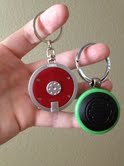
2. Small button flashlights for key chains: I’m iffy on these. The writing on one is hard to read and the light is weak. They are fun to have but I don’t know if I would use them.

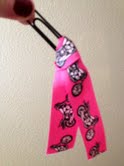
3. Ribbon bookmark: I’m personally not a fan. I am a no-wrinkle-on-the-pages kind of girl and putting a large plastic paper clip on pages would wrinkle them. Plus, it was not very intuitive to me what it was at first because it was attached to a business card.

4. Pack of sticky notes: This was given out by a publisher. Nice, as most authors love office supplies.

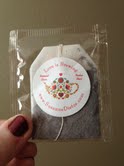
5. A bag of tea: This one I liked because I’m a tea lover. I think this would also be more economical than what I did, as mine ran about 50-60 cents apiece. I think it’s a good tie-in for some genres (romance, cozy mystery, historical set in England) but not so much for suspense. It might not work for my books.

6. Grippie lid opener: Someone can post in the comments what the real name of this is. I like this one for its durability. It’s something I’ll keep on hand and use and therefore will expose me to this author’s name multiple times.

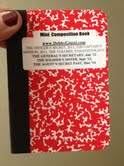
7. Small composition notebook: This one I’m actually giving a gold star and I’ll tell you why. I still have the one from last year in my purse. Every time I pull it out, I see that author’s name. I actually looked into doing this myself but they run (at the cheapest) about $1.00 apiece and that was too spendy for me.

What about you? Which promotional items do you like? Which do you think you’d actually pick up and keep? What have you used as a promotional item and did you appreciate the return on investment?

Use of Humor in Thriller Novels

Don’t we need humor in life to make it through? Life is hard. I have two very serious jobs. I’m a real life pediatric ER RN and a suspense novelist. Those can be heavy days but they can also be fun days—by using a little humor to get through.

LaughterMarriage is no different, right? Humor is necessary. What are some of the funniest things that have happened between you and your spouse? To take a break from discussing serious subjects: like death, trauma, and writing suspense—I thought I’d take a humor break and share some funny highlights from my married life.

Do you find that opposites attract? That’s the truth with my husband and I. He’s the quiet introvert. I’m the more outspoken extrovert. He gets queasy at the site of blood. Obviously, I do not. What we have seems to work—as we’ve been married fifteen years.

During our dating years, we were set to see a movie. I drove to his place and let myself in—and then sat there fuming when he was nowhere to be found. This was before the age of everyone having a cell phone. Finally, his phone rings. I answer. He’s on the line. “Where are you?” He asks. “Where are you?” I ask right back. He says, “I’m at your place!”—“Well, I’m where you should be.”

Other funny moments? Let’s see—teaching kindergarten Sunday school with his ex-girlfriend. Well, we can laugh about that now.

My husband likes to trim his own hair. One day, he mistakenly forgot to put the spacer on the clippers and took a swipe. Without much introduction, he comes into the living room and asks me, “Can you fix this?” with one bald stripe down the middle of his head.

I burst out laughing so hard—I still crack up thinking about it. ER nurse, honey—not hairdresser extraordinaire.

Then, add kids to the mix and the potential for a good laugh multiplies. We have two daughters age 8 and 10. When my youngest was perhaps 4 y/o—she was just in one of these pestering type moods. After several attempts at redirection, I finally just say, “Please, just get out of my hair!” In her sweet, innocent voice, she says—“But, I’m not in your hair.”

Sometimes, readers need lighter moments to get them through serious subjects or intense novels, too. I have a very dry sense of humor. My debut medical thriller, Proof, dealt with some very serious subjects and I thought whilst writing the ms—I really do need some moments of levity.

Hence, the humorous pairing of my odd couple detectives, Nathan Long and Brett Sawyer. Nathan means business. He’s serious and organized—bordering on an undiagnosed case of OCD. A southern gentleman. Brett’s the laid back easy type—maybe plays a little bit loose with the rules to get the job done. Often, their interactions provide comic relief in Proof. Let me give one example: an elderly woman with some questionable underwear choices serving them tea with a heavy dose of liquor during an interview. You may think that would never happen. Well, just recently I had a 14y/o show up just in his skivvies—at the ER. That’s right—just the white cotton briefs. And let me say—he was not deathly ill. Plenty of time for that young man to get dressed.

What about you? What’s the most humorous thing that’s happened in your married/dating/writing life? I’d love to know—could end up in my next book.

Names withheld—of course.

Are You A Hypocrite?

Have you ever been in church, or on-line reading blog posts, or just conversing with a good friend when something they said just is like a dagger to your heart with how much truth it speaks? Love those times . . . sometimes.

WarriorDash3
Me trying to be less hypocritical about fitness! Warrior Dash 2013.

As a Christian, I am tired of being called a hypocrite. There’s been a story floating around Facebook (cannot verify its veracity) about a new minister that dressed as a homeless person and attended his own services in this disguise. The post laments how no one came up to speak to him or welcome him in any way and then the minister, in this outfit, goes up to the pulpit and gives a sermon on– well, you get my drift.

Then there is comment after comment about “This is exactly why I left the church!”– even one from my own relative.

Honestly, it makes me mad because I think two things.

Did said I’m-dressed-up-as-a-homeless-man-minister actually offer to shake anyone’s hand? Did he take an initiative, despite his dress, to get to know a few people? And those that use this example as the reason they left their own church– why aren’t you out there greeting people? Be the change you want to see.

I feel like I do try and live what is taught on Sunday. But then a sermon came up about being a hypocrite and I was in the beginning stages of rolling off a barrage of thoughts like the ones above until the minister said this:

“Hypocrisy lives between what you believe and what you do.”

Well, now . . . ouch.

It dawned on me that hypocrisy doesn’t just apply to aspects of the Christian life but to all aspects of our life. For years I said, “I want to be published.” but what was I really doing to accomplish it? That gap between my words and my action is hypocrisy.

These words hit home most for me in the area of weight loss. About three years ago, I saw a photo of myself and it was like a very bright spotlight on the lie I had led myself to believe. I knew I was a little fluffy– but not obese by any means.

Everything changed when I saw that photo. A dagger right into my heart. I couldn’t deny the truth anymore. Well, of course, I could but I knew I never wanted to see another photo like that . . . ever.

So I started on a wellness path . . . very slowly. It’s taken me about three years to lose forty pounds but I’m not quite there yet. Quite honestly, I should be at my goal weight. I have plenty of excuses why– or what we call “reasons” when we’re living in hypocrisy. Some of them sound very good and reasonable but they’re really not.

I’m trying to decrease my “reasons” and increase my actions. I don’t want to be viewed as a hypocrite. I want people to believe that I’m going to do what I say I’m going to do.

What about you? In what area of your life are you being hypocritical? Where is the gap between what you say you’re going to do and your actions? Is it spiritual (I’m going to pray more), or professional (I’m going to start my novel– maybe tomorrow!) or physical (I want to be a size six.)

How do you plan to change it?

And yes, all my ranting about the church above was being hypocritical, too. I have lots of self discovery in process.

Showing Vs. Telling

Let me first say I am hardly an expert on show versus tell—every writing teacher’s admonition for every storyteller out there. In fact, I was quite shocked when another author said she was taking notes on some passages in Poison because she thought they were good examples of showing. I am still hoping she will tell me exactly which ones they were so I can admire my own amazing work because I was that surprised.

ActorShowing versus telling can definitely be learned (after all, I did it and was never an English major) so don’t go over the writer’s cliff Thelma and Louise style if some of these points don’t hit home. I am still learning the more advanced points myself and that’s a mark of a true writer—always desiring to learn more.

The concept of showing could also be described as Deep POV. I think these concepts are honestly interchangeable. So if you hear one—think of the other.

The first (and really good) piece of advice I got on showing was to write my scenes as if I was filming a movie. How would I describe what was on the screen to a reader without stating the obvious?

For instance: He was angry. This is telling. It doesn’t leave any room for the reader to use their imagination. Now, more showing. Her husband swore at her and spittle hit her face seemingly to mark a target for his fist to punch her in the jaw. See the difference? I haven’t said the word “angry” at all, but does this man seem fired up?

While editing, you’re likely telling if you name the feeling. He was mad, sad, fearful…etc.

A great tool I’ve used to help me show more visceral reactions is The Emotion Thesaurus. There is also a website by the same author called The Bookshelf Muse. It gives specific bodily actions for tons of different emotions. Use this as a starting point to generate ideas and then improve them for your own manuscript.

Another tip to help show instead of tell is to phrase things as questions. Telling: She wondered if her attacker was walking behind her. Showing: The echo of footsteps matched her high heels as they clipped down the pavement of the dark alley. Was it him? Was it the man who nearly killed her with a quick slash of a knife across her throat two years ago? The one she presumed was now sending her all those threatening letters—just like before. Now he was free.

To show more, add a visceral reaction from the woman from the emotion she is likely feeling which in this instance would be fear.

The echo of footsteps matched the quickened pace of her heart as she broke out into a run down the dark alley. Instinctively, her hand covered the thick scar as a shield from both the memory and the act. Was it him? Was it the man who nearly killed her with a quick slash of a knife across her throat two years ago? The one she presumed was now sending her all those threatening letters—just like before. Now he was free.

I know—future editor. How can she run with her hand set on her throat? Just to illustrate a point. Edit at will.

Also, don’t feel like you have to do this in the first draft. The first draft is all about getting the words on the page. Showing can be added in subsequent editing phases that you do before the manuscript goes to an agent or publisher, but don’t get too hung up on trying to do a lot in the first draft until it becomes more natural for you.

This is just the beginning. There are many more techniques that can be used so keep working at it and you’ll have the reader sitting inside your character in no time.

What are some techniques that have helped you show vs. tell?

Why I Write Inspirational Fiction

People ask me, “Why do you write Christian fiction?” This reminds me of when people ask me, “Why are you just a nurse?”
pragIn reality, they are politely implying that I am too smart and, perhaps, have wasted my time by never going for a medical degree. However, I think the answer to these two questions is the same.

To save lives.

I’m an ER nurse and a suspense author–I do tend toward the dramatic, and this is a dramatic post. But then again, life is dramatic. So is death.

If you’ve ever been in a hospital, you know a nurse is the last line of defense for a patient. We’re the ones that give medication, order tests, make sure patients are at the right place at the right time. Ensure that people who are learning medicine don’t kill you. A seasoned nurse (even if they aren’t super warm and fluffy) is the best asset for a patient next to a competent physician.

What I see in nursing, some days, are last moments. The last moment of life. The last moment of “My life was this…” before hearing a cancer diagnosis. The last moment of peace, maybe for a while.

It surprises me how blase people can be about eternity. They just feel that they know the right answer without having cracked open a Bible or any other holy book. For a Christian, a person who doesn’t invest in investigating life after death is curiously reckless. Like biking without a helmet. Or biking and texting without a helmet (yes, I just saw that last week!).

Since I experience the fragility of life, I want people to be confident in their beliefs about the afterlife. And I know many of us don’t have as many moments left as we think. A novel can be a less threatening way to introduce someone to the concepts of Christianity than handing them a Bible, and yet can still deliver a strong, compelling message.

It’s like pulling someone off the train tracks as the whistle is warning them to move.

Here is my top ten list of why I write Christian fiction:

1. September 11, 2001.
2. The Boston bombing.
3. Sandy Hook Elementary School shooting.
4. The child that died of an allergic reaction.
5. The family I helped give a cancer diagnosis.
6. My friend’s brother, who died after being in a vegetative state for 13 years following a motorcycle accident.
7. Christians who are killed/maimed/imprisoned for their faith.
8. Kids in my ER whose families won’t show up.
9. Driving on ice.
10. Moore, Oklahoma tornadoes.

What I’ve seen is that sometimes I can’t stop the train. I can’t stop that moment. What I can do is offer what I think is hope . . . preventative medicine for the ever after.
We as religious people get so caught up in divisive cultural issues. Pro-life/pro-choice. Traditional marriage. Homosexual marriage. Gun control. And I’ll be the first to say, as a Christian, that while I have strong beliefs on each of these issues, my expressing them can pull people away from the true message of why Christ came.

He died. For. You.

That’s it.

So before you decide, do some reading. Whatever method is the least threatening. A novel. A blog post. The Bible.

Just read and see if His message begins to resonate with you.

Before the train whistle blows on your last moment.

WordServe News: April 2013

Exciting things have been happening at WordServe Literary!

On the final post of each month you’ll find a list of Water Cooler contributors’ books releasing in the upcoming month along with a recap of WordServe client news from the current month.

New Releases

TestedArnie Cole and Michael Ross Tempted, Tested, True (Bethany House)

****************************************************************************************
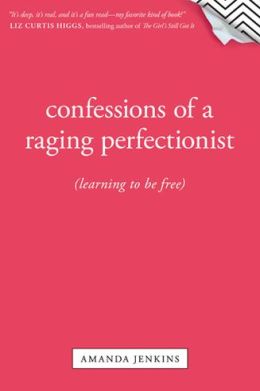
ConfessoinsAmanda Jenkins Confessions of a Raging Perfectionist (Tyndale House)

****************************************************************************************
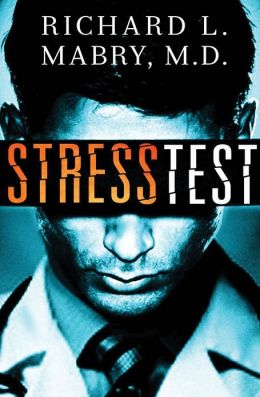
StressTestRichard Mabry Stress Test (Thomas Nelson)

****************************************************************************************
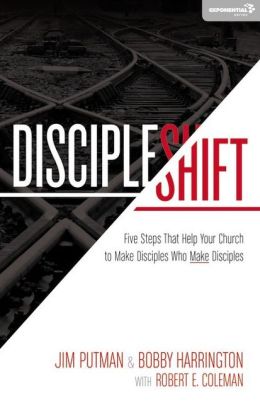
DiscipleshiftJim Putman with Marcus Brotherton Discipleshift (Zondervan)

****************************************************************************************

New WordServe Clients

Jennie Atkins signed with Sarah Freese. Excited to have her join our other wonderful WordServe authors!

New Contracts

Judy Morrow signed with Regal Publishing for her devotional titled Listenings.

Keith Robinson signed with Regal Publishing for his non-fiction book titled Is Anybody Out There? 

Rachel Moore signed an ebook contract with Cook Communications for her novel titled Language of Sparrows.

Barb Stoefen signed with Zondervan for her memoir titled A Very Fine House: A Mother’s Story of Love, Faith and Crystal Meth

Mike Yorkey signed with B&H Publishing to write the story of Tampa Bay Devil Ray infielder Ben Zobrist, along with his wife Julianne, who is a budding Christian singer.

Dr. Kara Powell from the Fuller Youth Institute signed with Zondervan to write The Sticky Faith Guide for Your Unique Family.

Michelle Griep signed an ebook contract with Cook Communications for her novel, A Heart Deceived.
.

What We’re Celebrating!!

Julie Cantrell is a finalist in the “new author” category for this year’s Christy Awards for her debut novel Into the Free.

Jordyn Redwood for her debut novel Proof, which was a ForeWord Reviews finalist for religious adult fiction.

And Julie and Jordyn both made the Inspy Award Short List for their debut novels.

Maureen Lang’s book Bees in the Butterfly Garden hit the ECPA fiction list again, this time at #6.

A Higher Call by Adam Makos continues to stay on the New York Times hard cover nonfiction list, having made it in the top-15 every Sunday in April.

Thank you to Writer’s Digest magazine for naming the WordServe Water Cooler one of their 101 best websites for writers for 2013. We are honored!

What can we help you celebrate?

The Letter

Sometimes, I don’t think we as “Christian” authors give credit to how extraordinary our calling is. I’m speaking specifically to those writers who feel it is God’s will for them to write. We write because we feel burdened to do so. Not burdened like a chain around our necks but restless that if we don’t write then we are not fulfilling what we are here to do.

dark portraitSometimes that calling in light of our circumstances is hard to manage.

Long hours at the keyboard. Perhaps long hours banging your head against the wall when the words don’t seem to be flowing as they should. Managing two careers and likely a family. Wondering how long you can keep up the pace of working two jobs (yes, writing is very much a job) when one’s maybe not paying you as much as you thought it would. No, I haven’t gotten a James Patterson paycheck. Wondering when, if ever, we’ll hit it “big”. Wondering what “big” is?

I think, too, there is added pressure if we consider ourselves Christian authors. Now, there’s a whole other level of worrying/thinking. Is this what God wants me to write? Why did God take me down this path if I can’t survive on this income? Am I writing when God wants me to do something different? Am I still working my “real” (and paying) job when all God wants me to do is write?

LampPost

And so we look for God’s little lampposts along the path. Something—anything to affirm that this is the right, chosen path. That our typed words on a white screen would make a difference to someone, somewhere, in a Godly way. That someone’s faith would be affirmed—strengthened. That maybe our words would give sense to what Jesus did on the cross in a way that someone could then believe in that sacrificial offering for their own lives.

Now, after being on this journey for a couple of years, this is what I know. Sometimes these lampposts along the path are not what we think they will be. Maybe my affirmation is not in selling a gazillion copies of my book or hitting the bestseller lists.

But in a letter.

One of the smartest things I did as an author was leave an e-mail address in my published books and ask readers to e-mail when they finish with their thoughts. Some authors don’t do this for fear of spamming, privacy, etc. You can list your own reasons.

So far, I haven’t received any creepy/concerning e-mails. I have gotten over fifty letters from readers which is nice when you’re also getting one star reviews (particularly on Christmas Day—yes, that did happen!)

I’ve only sobbed over one letter—thus far.

It was written by a woman who had just finished Proof—my debut medical thriller. Proof, at its heart, is about Lilly Reeves, an ER doctor without faith and her journey to coming to know Christ through a trial- by-fire series of events.

In the novel, a physician friend tells Lilly the story of Lazarus. How Jesus waited three days to respond to his good friends’ cries for help. At first, this seems unusually cruel. But in the end, when Jesus raises Lazarus from the dead, Jesus does a miracle he’s never performed before and gives a prelude to his own forthcoming sacrificial offering.

The letter that brought me to tears was from a woman who was in the midst of her son being diagnosed with cancer. He’d just been through the surgery to retrieve lymph nodes and the surgeon was fairly certain of a lymphoma diagnosis—they were just waiting for the final biopsy results. She specifically mentions this passage of the book and what it meant to her at that moment – “. . .we are praying for healing for our son, but completely trust him to God’s plan, whatever that is . . .”

So humbling.

Remember, God communicated his presence to us in two ways. Through his creation and through his words.

Typed words on a page.

Consider this and the smaller lampposts along your path when you’re wondering exactly why you’re on this crazy writing journey. Maybe it’s not for a James Patterson type paycheck.

But simply for a letter like this . . . and the impact your words will have for one person.

Would this be enough for you to keep going if God has placed the call to write on your heart?

This post first appeared on Elaine Stock’s Everyone’s Story. Check her blog out.

Tweetables

Lately, I’ve been noticing this new trick amongst bloggers for fashioning “tweetables” in their blog posts. These are short, catchy phrases that let readers instantaneously click and tweet a hook about your post. Several tweetables are offered in hopes of getting that mouse clicker finger engaged.

Social media conceptSo I thought I’d go through the process of learning how to format one and take you on the ride with me. A shout out to Elaine Stocks for pointing me in the right direction. Check out this blog post at Blogging Bistro for instructions as well. I am hoping to simplify. We’ll see how that works.

Step 1: Go to http://clicktotweet.com/. Once you go there, format a phrase you want others to tweet about. It will generate a link for you, which you can add to your post. Here the first one I did.

Learn How to Format a Tweetable. Click to Tweet.

Step 2: Hit the preview button.
You can then click preview to see how it looks. And mine looks, well,  boring. It’s just the phrase and doesn’t point much to me or the Water Cooler. Let’s try again.

Know how to format a Tweetable? Not as hard as you might think. Click to Tweet.

This is how it will look when tweeted out:

Know how to format a Tweetable? Not as hard as you might think. @JordynRedwood @WordServeLit http://wp.me/p1H9QL-2zH

Step 3: Helpful tips.
Remember, with Twitter you only have 140 characters to work with. In WordPress you can automatically have it give you a shortlink for your post by hitting the button “Get Shortlink” at the top of your editing screen. When you do this, copy and paste that link into your Tweetable. It will save you precious character space to come up with a great Tweet.

However, Blogger doesn’t format shortlinks, though you can customize one for yourself. Blogger will give you a permalink (finally!) and what you can do to shorten it is copy and paste it into the publisher in Hootsuite. It really is not as hard as you might think. From the shortened Hootsuite link you can copy and paste it into the Click to Tweet format system.

Step 4: Format it into your post.

I agree with Blogging Bistro that Rachelle Gardner has a great way to format Tweetables and I’ve copied that style here. You can view her blog for that look or come up with your own crafty, creative way to entice people to tweet.

Why format tweetables? A couple of reasons. When you hit the tweet button at the bottom of a post using the social media sharing buttons, it basically tweets the title of your post which may or may not catch the eye of readers. Tweetables offer several different phrasings to try to get people to tweet that may be a way for them to capture their tribe.

What about you? Have you tried tweetables?

WordServe News: February 2013

Exciting things have been happening at WordServe Literary!

On the final post of each month you’ll find a list of Water Cooler contributors’ books releasing in the upcoming month along with a recap of WordServe client news from the current month.

The biggest news is our own Sarah Freese gave birth to a baby boy, Mason. They say writing a book is like giving birth, but I think the comparison breaks down a bit…if you’re the one actually giving birth! Congrats, Sarah! Now…back to work.

New Releases

WhatASonCheri Fuller released What a Son Needs From His Mom (Bethany House)

***********************************************************************************************

wishingonwillowsKatie Ganshert released Wishing on Willows (WaterBrook)

***********************************************************************************************

husbandlistenRick Johnson released How to Talk So Your Husband Will Listen (Revell)

***********************************************************************************************

Jordyn Redwood released Poison, book #2 in her “Bloodline Trilogy” (Kregel)

***********************************************************************************************

permissiongrantedMargot Starbuck released Permission Granted (Baker)

***********************************************************************************************

forsakendreamsMaryLu Tyndall released Forsaken Dreams, the first book in her new “Escape to Paradise” trilogy (Barbour)

***********************************************************************************************

MarianoRiveraMike Yorkey and Jesse Florea released Playing with Purpose: Mariano Rivera, the future Hall of Famer from the New York Yankees (Barbour)

***********************************************************************************************

New WordServe Clients

During the Super Bowl, a storyline grew about Colin Kaepernick, the San Francisco 49er’s starting quarterback. He had been adopted and his faith and family were being talked about, including his birth mother. His birth mother, Heidi Russo, had contacted our agency a few days before and quickly signed in. Margot Starbuck is writing her memoir You’ll Do Great Things, and Alice is circulating it to publishers.

New Contracts

Marcus Brotherton signed with Tyndale to collaborate with a Seattle-area pastor on a book called The Presence.

Tim LaHaye and Timothy Parker signed with Thomas Nelson to write Revelation: Clear and Simple, a chapter-by-chapter explanation of the last book of the Bible.

Margot Starbuck and Jeremy Jones signed with Focus on the Family to publish devotionals called Kingdom Women and Kingdom Men (respectively), using content from Tony Evan’s books of the same name.

Mike Yorkey and Marcus Brotherton signed on with Barbour to do Playing with Purpose: Nascar about Christian race car drivers.

What We’re Celebrating!!

A Higher Call by Adam Makos was able to stay on the New York Times hard cover bestseller list all through the month of February. It rose as high as #6 on the print list. The WWII story also made the NPR hard cover nonfiction list for 4 weeks, Publisher’s Weekly list, as well as USA Today.

Helen Shores Lee and her sister Barbara Shores, authors of The Gentle Giant of Dynamite Hill (Zondervan), appeared on “The 700 Club“.

Carol Barnier flew to Colorado Springs to tape an episode for Focus on the Family for her book Engaging Today’s Prodigal (Moody). One episode turned into two! It should air in March.

Jordyn Redwood got a starred review (her second!) in Library Journal for her new novel, Poison. That’s a pretty rare event, so it’s big news when it happens.

Carolyn McKinstry was on “The Today Show” to talk about Black History and her book, While the World Watched (Tyndale), the story of her losing her 4 girlfriends in 1963 to the 16th Avenue Baptist Church bombing in Birmingham, Alabama.

What can we help you celebrate?