And the Tweet goes on…

Red HotA few months ago, I enthused in this space about a book I’d read at my agent’s suggestion. Now I’m going to give you a follow-up, because reading Red Hot Internet Publicity has truly changed my marketing game; unlike a lot of books that sound great and helpful while I’m reading them, RHIP is proving itself to be one of those books that truly make a difference in my career. In other words, its tips WORK and you can actually DO them.

(Or am I the only person on earth who finds it difficult to implement ‘great ideas’ that use apps I can’t understand, or require more financial investment when my writing income is already in the red, or simply involve too many steps to even remember?)

This is what I’ve accomplished since my post “Learning New Marketing Tricks” appeared here two months ago: I’ve more than doubled my Twitter followers from 217 to 500+ by discovering new audiences on this one social network, and my exposure (impressions) has increased tenfold!

twitter-bird-light-bgs.pngThe route I’ve taken involves the RHIP suggestion to engage in group chats, which has introduced me to new contacts with similar interests. Even just a few Tweets back and forth produce new followers, and sometimes that generates ideas for writing posts on other networks. Perhaps even more significant is my new habit of scrolling every day through the topics that are currently trending on Twitter. I find a few to which I can contribute original Tweets, and then comment on others in that stream. Again, it only takes a few minutes, but it always generates new followers.

Finally, I’m insistent on using hashtags with every Tweet I make, and the more hashtags, the more likely it is that I’ll reach into new markets. Before I started focusing on Twitter, my tweeting impact was dismal – maybe making only a couple hundred impressions (read that as ‘your name showing up in the Twitter universe’) a week. These days, I’m getting a thousand impressions a day – that’s a lot of times my name is showing up in the Twitter stream, and that connects me to large groups of people I might otherwise not have encountered. Some of those people have now subscribed to my newsletter and bought my books; by following them back, I’ve found more threads of conversation and topics in which I can engage. Throughout it all, I constantly remind myself of my brand – of my unique voice – and make sure my Tweets reflect that. So far, I’m delighted with the results.

Hourglass --- Image by © Royalty-Free/Corbis
Hourglass — Image by © Royalty-Free/Corbis

So delighted, in fact, that I’m thinking I should double my time on Twitter…from 30 minutes a day to 60 minutes.

That’s right – 30 minutes a day have yielded me a breakthrough in exposure, and since getting my name and brand ‘out there’ is so important for making sales, those 30 minutes pack more of a marketing wallop than any other 30-minute marketing I can do.

Isn’t it great when something you try really works?
The Splash-Launch vs. the Slow Build

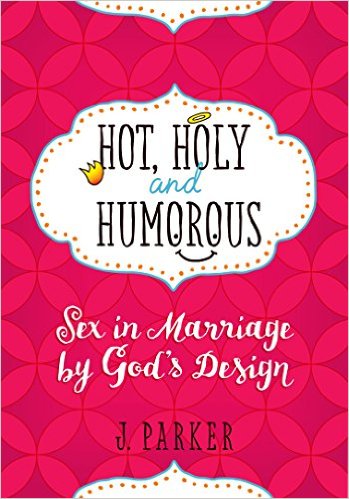
51L8nL3LvpL._SX347_BO1,204,203,200_My new book, Hot, Holy, and Humorous: Sex in Marriage, released the same week that my oldest son graduated from high school. Although I was excited to finally see my book out, this was not excellent timing for me and my family.

Consequently, I didn’t do a lot on day one, day two, or even a few days after the release to promote my book. I was too busy pulling together the final details of the cap-and-gown experience for my son. The way I figured, I’d spent a few years working on my book, but eighteen years working on the kid – so the latter won out.

But all that is okay, because I’m not a big believer in the splash-launch. Not that I’m against it in the least! It’s wonderful when a much-anticipated book hits the shelves with well-deserved fanfare. Seriously, a book is not easy to birth, so cue the fireworks! However, a big splash isn’t what really matters for the long-term success of a book.

fireworks-227383_960_720

In the music world, we all know about the one-hit wonders who burst forth on the scene with as much hoopla as Mardi Gras in New Orleans. And then…they were gone. Sure, the splash rippled outward, but eventually the waters calmed.

Meanwhile, Aerosmith’s first album only hit #21 on the charts. But we all still know who they, and lead singer Steve Tyler, are. This rock-and-roll band caught some attention right out of the gate, but they built that into a legacy.

I’m looking toward the slow build for my book, snowballing interest and excitement into long-term sales and a devoted readership.

How can you take the long view of book sales?

Spread out your marketing efforts. Rather than focusing all of your efforts upfront, choose strategic activities for your launch and hold off on tasks that can be effectively pursued later down the road. Maybe you need to focus on interviews now and delay the blog tour, or do giveaways at the beginning but hold a larger contest later in the year.

Create a marketing plan calendar. I’m blessed to have a writer friend of mine who sat down and developed a marketing plan for me that goes for a full year. Among her wonderful ideas were capitalizing on special days throughout the year—linking my book and sales specials to appropriate holidays or awareness days. Also look for local events, conventions, and ministry conferences that suit your goals.

Engage regularly with your audience. Some authors inundate social media with news, pictures, updates, etc. all around release time, and then it’s crickets-and-cicadas for the next six months. Continue to interact with your readers and potential readers! Those who’ve already read your book will feel more comfortable recommending it to others if you are less spambot and more real person. And potential readers will get that nudge from time to time and may finally buy your book – the one from that nice author they keep seeing.

Write more quality books. Of course, the best long-term approach to selling books is to write more quality books. Having more offerings gives you more shelf space, raises your discoverability in online bookstores, and makes you a brand in readers’ minds.

Indeed, I’ll be marketing Hot, Holy, and Humorous from now until it goes out of print, but I’m also working on the next book. And let’s hope that one doesn’t release in the same week my other son graduates.

How to make your readers SUPERfans!

supermanWhen you have a book published – be it in print or ebook – you want to get as much publicity as possible to sell copies, right?
Right!

Do your fans know this?

Well, yes, I think they do.

You THINK they do?

Here’s my suggestion: tell them you need their help to generate that publicity. You need their word-of-mouth to help your book get launched amidst the thousands of books that are available.

You need to give them the 3 Rs of superfans: Read, Review, and maybe most importantly, Rave!

With the launch of my newest suspense novel, Heaven’s Gate, I put together a launch team of thirty readers who agreed to read and post a review on amazon.com and whatever other social networks they had, along with any word-of-mouth recommendations they might be able to give. Like many writers, I’m not especially fond of online marketing because it takes a lot of my time, but the fact is, writers in the 21st century need to cultivate their presence on it. (I, personally, have had varying success with different networks, but I continue to learn and work at it because I’ve seen its value at different times. Let’s face it, if there’s a gathering of readers anywhere – even online – don’t you think an author would be remiss to ignore it?) What I’ve discovered since my book debuted last month, however, has added another piece to my formula of reading and reviewing: you need readers to RAVE about a book to influence others to buy.

So far, maybe this seems evident to you, but this next comment might catch your attention: I learned that you need to tell your readers what to write. I don’t mean give them a script – you  want their honest reaction. But what you need to do is empower your readers to write raving reviews, which result from two things: an awesome reading experience (which you have crafted with your book!) and a vocabulary that will reinforce what you want them to say.

Simply suggest key words you’d like your reviewers to use.

At first, I felt odd suggesting words to my readers to use in constructing their reviews. Then I realized that key words are…well…key. Keys, actually, to triggering the all-important call-to-action that every author needs to make to potential readers: You Need To Buy This Book Now. And guess what? Your reviewers are often very grateful to have your suggestions, because they want to write a strong review for you, but are often lacking in promotional experience and don’t know how to best help you with their review. I asked my reviewers to use the words suspense, supernatural, Archangels series, faith and science, String theory, fast ride, and thriller. They did, and as a result, the reviews for Heaven’s Gate present a consistent rave of being a book you can’t put down, which has cued new readers to order the book.ebook

Remember, your fans want you to succeed. Making it easier for them to help you is the least you can do!


Trends in Book Discovery

infographic-v2

What is publishing all about these days?

  • Writing?
  • Editing?
  • Packaging?
  • Posting an ebook?

Nope. None of the above.

It’s about FINDING READERS!

The loss of retail, magazines, religion sections in newspapers… the discoverability factor has greatly decreased. Which is why publishers are so dependent on authors to find readers (through author tribes) and on their ability to social network their way to a best seller. Which, in case you haven’t already experienced, happens about .01% of the time.

So when I saw some data about my favorite topic—FINDING READERS—I thought you ought to see it.

The following is based on data compiled by the Penguin Random House consumer insights team, which polled more than 40,000 readers about their reading and buying choices.

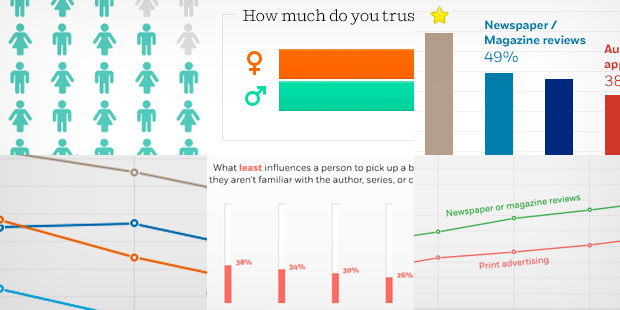
  • When asked what is most influential to readers when deciding what book to read next, 81% said recommendations from friends and family. Word of mouth, whether about movies, agents, or book sales, is always the key deal.
  • How do readers discover books? 70% said they use Goodreads; 49% said newspaper/magazine reviews; 46% said Facebook; 38% said author interviews/appearances; 37% said blog reviews; 23% said print ads; 15% said Twitter; and 14% said another form of social media. I’m wondering if the 40,000 readers they polled were from Goodreads. Still, this was more eye-opening than I would have guessed.
  • The survey found that as readers age, blogs and social media become less relevant as a way to discover books. Among survey participants under the age of 40, more than 80% use Goodreads and more than 60% read blog or web reviews. This steadily decreases with age; for readers in their 50s, 75% use Goodreads and 40% read blog and web reviews; for those in their 70s, the numbers drop to under 60% for Goodreads and only 20% for blog and web reviews. I guess we realize with age that there isn’t much time to read all of those books we bought but haven’t read, so we don’t need anyone else telling us what to read.
  • Conversely, print reviews and advertisements become more relevant with age. For readers under 40, 40% read newspaper and magazine reviews; for those in their 50s, the number is closer to 60%, and for those over 70, the number who read newspaper and magazine reviews is 70%. Print advertising follows a similar trajectory, with 20% of those under 40 relying on print ads to discover books, as opposed to 30% of those in their 50s and nearly 50% of those in their 70s. It must be the fact that there are pictures and not very many words. Easier on the eyes.
  • When it comes to gender, women are more likely than men to trust recommendations from friends and family (79% of women trust the recommendations, while only 66% of men do). The same is true of recommendations from Goodreads, 70% of which women trust, compared to only 57% of men. Men don’t gravitate toward asking for directions when driving, and evidently on book buying. What’s wrong with us?
  • Men are, however, more likely to read newspaper and magazine reviews; 54% of men trust such reviews, as compared to 49% of women. When it comes to print advertising, 26% of men trust it compared to 23% of women.
  • When asked what most influences them to pick up a book if they are not familiar with the author or series, readers said that they are likely to do so if they like the subject (88%), read a good book review (87%), or get a friend’s recommendation (86%). Slightly less influential are reading an excerpt (76%) or an online review (76%). Least influential are the recommendations of a salesperson (38%); the publisher’s reputation (34%); seeing an ad (30%), recommendation by media/personality (26%); and needing a book for school or work (25%).

As Mark Twain once lamented, “There are lies, damn lies, and statistics.” While I applaud Penguin Random House for spending the money on this survey, some of which was eye-opening, I’m not sure what it all means for authors except they will be even more encouraged to do their own marketing than ever.

Here is the one truth that everyone agrees with when it comes to author marketing: email addresses.

If you have them, you’re golden. How many? 5,000 is nice, 10,000 is better. Time to check out MailChimp, time to offer free stuff, time to really focus your brand and what felt need you’re meeting, and time to become an expert in direct mail to your audience.

Learning new marketing tricks

dog shaking handsI am living proof that even old dogs can learn new tricks.

Except that I’m not a dog and the tricks I’m referring to don’t have to do with “shake” and “roll over.”

As an author who came to the book publishing game in her mid-fifties, I realized I had to embrace the internet and social media marketing if I was going to play in the marketplace. As a result, I’ve read a lot of books over the past few years about online marketing and tried to apply that knowledge. But the book I’m finding the most instructional and helpful is Red Hot Internet Publicity because it gives you simple ideas you can implement easily and see immediate results.

twitter-bird-light-bgs.pngFor instance, I’ve never quite been sure how to leverage my Twitter activity into growing my audience; twice-daily tweets and random retweets of those I follow can only do so much in attracting engagement when you consider the enormity of the Twitter universe and its competing attractions. After taking just one tip from RHIP – participating in a group chat sponsored by one of my influential Twitter contacts – I picked up five new followers and at least one immediate book order. “Gee, this really works!” I thought. (Well, duh – the book’s title is Red Hot Internet Publicity, not Mediocre Marketing Online.) As a result, I’m now devoting effort to finding chats EVERY DAY hosted by key influencers in my book topic areas and being sure to participate with tweets and retweets. Yes, I know – it’s called a social network, and that means you’re supposed to be interacting with others, but somehow, actually “chatting” online had seemed a waste of time. No more.

facebook_circle_color-128Likewise, thanks to the book’s advice, I’m streamlining my Facebook involvement to make my time on it more productive. Sure, I’d read before that you need to have your marketing message in front of you every time you post, but I’d gotten lazy. After reviewing my message and tightening its focus (another recommendation from the book), I’ve been more vigilant about making EVERY post count with a comment that somehow reflects that message. The result has already yielded me new followers on my author page at Birder Murder Mama, which had stalled out in the last three months.

Those are just two of the ideas that have already made a difference for me in internet marketing. Being the perennial student that I am, I made a list from each chapter in RHIP of items to try out. Fortunately, I’m gearing up for a book release in May, so the timing to fire up my social media marketing is perfect, and I’m finding lots of opportunities to practice what I’m learning. And that – immediate practice of what I’m learning – is key. Too often, my ideas sit in a file for that magic “sometime” when I’ll get to it. But thanks to the simple presentation of RHIP, AND the timely suggestion from my agent to download and read this new book, my magic “sometime” is right now.

I guess my new trick is “shake” after all – shake up your marketing and see what happens!

Take it with you when you go

moving dayMy husband retired from his job last December in Minnesota , and within a month, we were unpacking our worldly goods in our new home in Texas. Having relied heavily on my local readership for growing my book authoring career, I was faced with a choice: retire from my own career as a writer, or start it all over again in a new place.

Actually, there was no choice for me: since I can’t NOT write, here I am, back at square one. Except that this time around, I have eight years of experience and a track record as a published author behind me as I begin to cultivate my new area; my task is more transplanting than seeding. For any of you facing a geographic move, here are some of the positive and negative aspects of taking your authoring with you:

A fresh audience!

Positive: You have a fresh audience, which forces you to remember why you write, why you’re excited about what you write, and how what you do can serve readers in your new community. It’s a wonderful opportunity to look at your work from new angles and refresh your own enthusiasm for what you do. And with books already in print, you have product ready to promote in your new area – no waiting around for publication to happen – yet you can re-use the promotional tools you used the first time around, saving you the time and effort of developing new marketing strategies.

Negative: You have a fresh audience, which means you have to start over making connections with bookstores and other venues. Back to phone calls and building relationships (sigh).

A track record as an author!

Positive: You’ve got a track record as an author! Yes, you’re making phone calls, but you’re going to get farther faster in booking events because you’re a proven entity. Your past experience makes you smarter about ways to reach decision makers, adding to your credibility as a published author with new contacts. Since this is your second time around, you won’t waste money and time on the ideas that didn’t work when you were just starting your authoring career.

Negative: You have to put the time in again on building key relationships.

New sales!

Positive: You have a new geographic market to add to your original readership, potentially doubling sales for both old books and anything new to come. Just because you’re no longer physically available doesn’t mean your loyal readers from your old location will abandon your future releases – those fans need to be kept in the loop as you move forward, so be sure to continue communications with them (Facebook, author newsletter, etc.).

Negative: You will lose some readers who only enjoy local authors. Hopefully, though, the gains in your new area will outweigh the lost readers.

Can you add to these experiences/insights of taking your authoring career into new territory?

The Importance of Dreaming

Ever feel like your writing time has slipped into a series of tasks you are struggling to check off?

1500 hundred words and counting? Check.
Edits? Check.
Social media graphics for the week? Check.
Blog posts written and turned in? Check.
Responded to readers and answered emails? Check.
Laundry, grocery shopping, life things? Maybe check. Kinda.
Maintain sanity? In process.

If we aren’t careful our writing routine turns into a list that can drain our creativity and make us forget why we are writing. I am the queen of time management and boundaries. I have to be in order to prioritize and get things done. But sometimes in the midst of trying to be disciplined and organized, I miss out on the creativity that comes with dreaming. I actually plan time to dream. It’s vitally important to the rest of my list.

Dream a little bigger

Dreaming rejuvenates me.
One of my favorite questions to ask when it comes to writing is “what if.” What if my characters decided to do something totally unexpected? What if my villain surprises everyone? What if I create a setting that puts a unique spin on a scene? What if I created a character that absolutely fascinated my reader? Then how do I do all this?

“What if” is a powerful question, one I don’t ask nearly enough. But when I do, my writing sings more than normal and my creative juices flow.

I also like to story board. I may love words, but I am attracted to powerful visuals. It’s fun to create the scene and cast my characters by scouring the internet for photos that jog my creativity in a greater way. I pin them on a corkboard so that I can see and move them to help craft the story. This helps dream about possibilities. Possibilities are endless in our writing. We just have to seize them.

Dreaming rejuvenates the story.
I like to set a timer and see how many words I can spill on the page before time runs out, but occasionally this depletes my creativity instead of inspiring it. However, when I take time to dream before I start writing, even if I just spend fifteen minutes on a writing prompt, my writing carries a different kind of power and creativity. When I race the timer, my story has quality and quantity. My characters are also deeper and my settings more vivid.

Dreaming rejuvenates the reader.
Letting readers into my brainstorming and dreaming is fun to share with readers. This makes great social media content to excite them and help them invest in the story before they ever hold it in their hands. Inviting them into the dreaming helps them feel like part of the team and part of the journey. If you do this, be prepared to write faster to satisfy their growing curiosity.

Tasks and deadlines are part of writing, but dreaming and enjoying the writing…that’s the most vital part of the journey, for it informs everything else. If you are feeling overwhelmed or stuck, grab a pen and fun notepad, and don’t be afraid to dream a little, darling. I have a feeling you will like the results.

How to find your best influencers

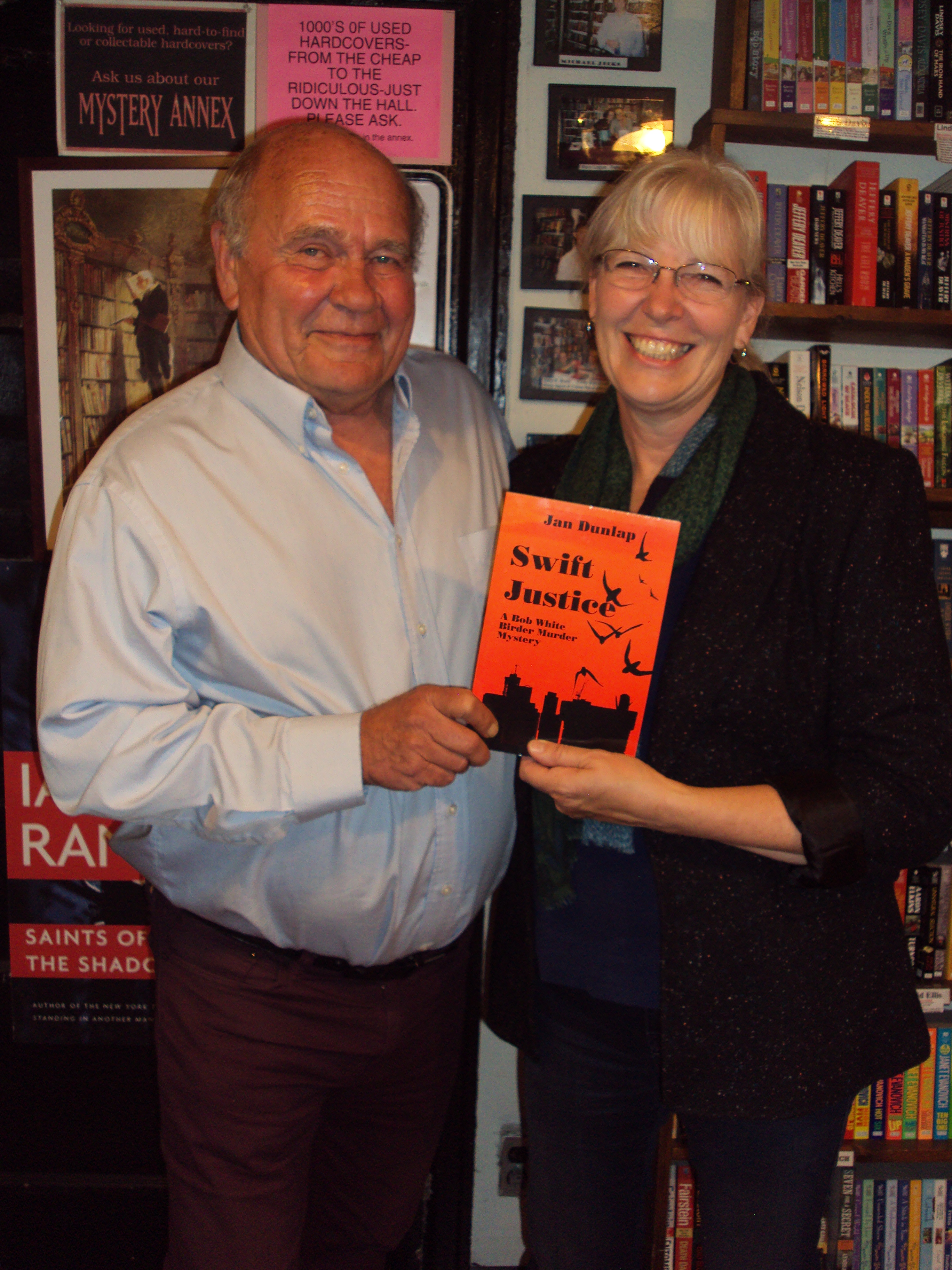
Jan and Ron vertThe longer I’m in the writing business, the more I appreciate the importance of influencers in helping me build my audience and increase sales. What’s tricky for many writers, however, is figuring out just who and where those influencers can be found.

Unfortunately, after eight years and eight books of being a published author, I still don’t have a magic formula for identifying and recruiting those valuable assets for my marketing efforts. All I can offer you is my own experience and insights, so here goes:

  1. It’s great to have known experts or writers give you an endorsement for your book, but unless they are truly excited about your book and independently give it exposure in their own networks, the endorsement is just nice copy for your back cover, and won’t produce momentum in sales. Those experts are busy with their own marketing and projects, and the truth is, they give endorsements widely as a courtesy, rather than out of commitment to your publicity goals.
  2. The best influencers have a stake in your sales. Although my books sell around the world, my strongest sales come from a local gift shop because the store owner enjoys my books so much, she talks them up to customers and regularly features them in store promotional materials. Because of her enthusiasm, I’ve had more press coverage in local media than I could procure by my own efforts and a consistently growing word-of-mouth readership. As an influencer, she’s one of my best!
  3. You need to continually cultivate relationships with potential influencers. This means reaching out via social networking and/or physically traveling to meet people in your field of interest who might find your books of value in their own professional goals. To market my girl-meets-dog memoir, I make a point of connecting with animal rescue groups/animal humane societies online, and when possible, I attend their conferences/events as a vendor. I often give free copies to keynote speakers or other passionate animal lovers I meet, in hopes they will read and enjoy the book so much, they will mention it to others. Yes, this is basically a hit-or-miss method, but so far, I’ve always made a few excellent contacts and found one or two awesome influencers at such events. It’s well worth my time and money to break into a new group of potential reader-buyers.
  4. Connect with bloggers with big audiences in your target market and ask to send them a copy of your book in return for a review. Offer them additional copies to use as giveaways when they publish a review of your book, or whenever they might have a contest going on. Doing this gives you a reach well beyond your own social networks and local geographic area. I’ve met several significant influencers in this way, and they continue to give me promotional value with each new book.

What tips do you have for identifying and recruiting influencers for your marketing efforts?

A Writing and Publishing Journey

So John, tell me about the writing of your book. How long did it take? What did you learn about publishing? What was the most enjoyable and most the difficult part of the process?

Pastor John Merritt, Discover. The Writing Journey

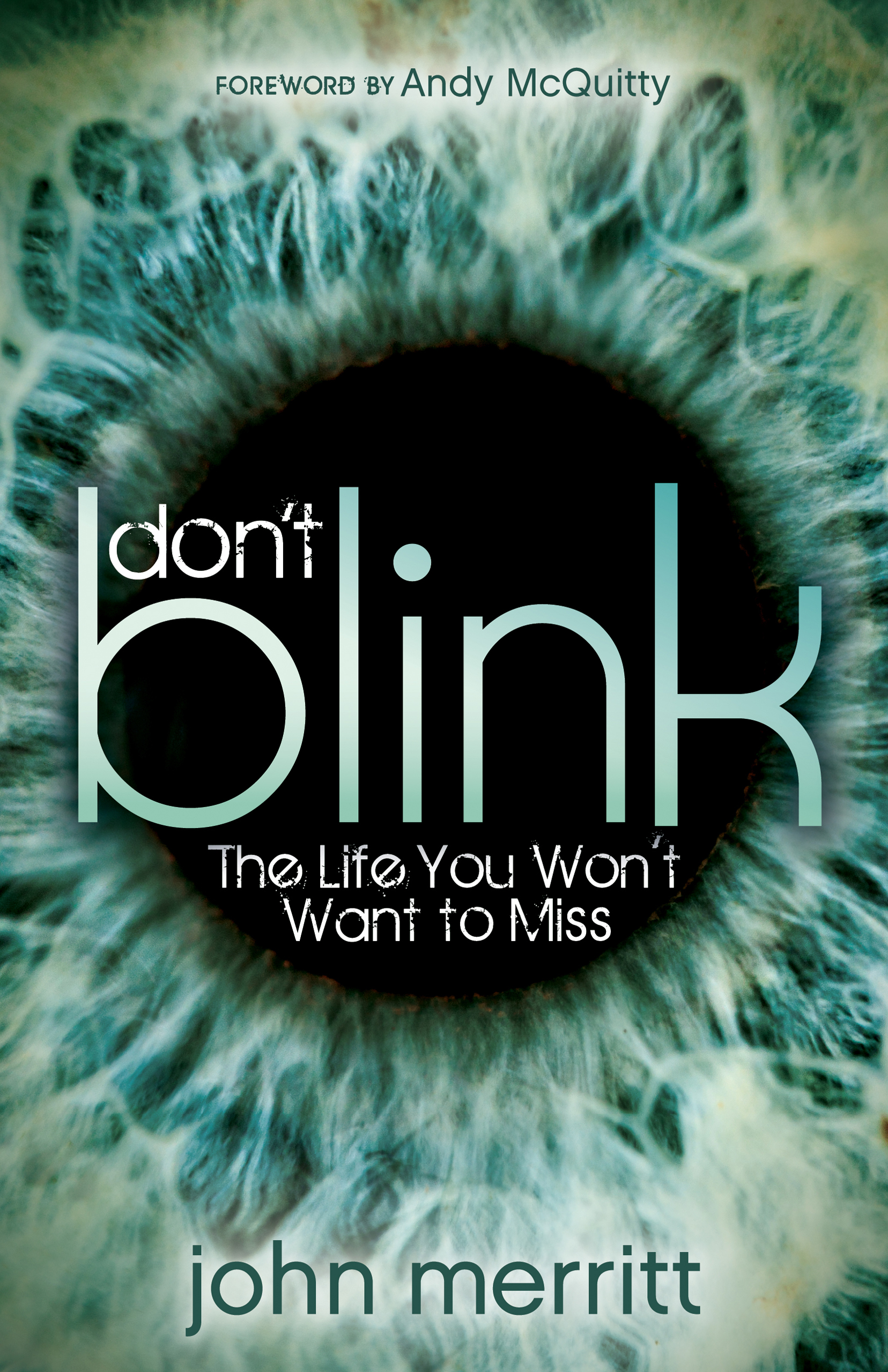
I’ve been asked questions like these numerous times in recent months. And since my first book, Don’t Blink, ready to be released in November (EBook is already available)—I thought I’d share what I loved and what I did not love about becoming an author (things you may consider if you have thoughts of becoming an author yourself).

What I loved: The actual writing of the book that took place during a six month sabbatical. I’ve always enjoyed writing, telling a story and making biblical application out of real life experiences. What I didn’t know was that writing the book was the easy part—let me tell you about the hard part.

Don’t Blink is for procrastinators, dreamers, and would-be adventurers who wish to grab hold of life this day, knowing there are no guarantees about someday. From Alaska to Argentina to the Amazon―in situations ranging from dangerous to humorous―John Merritt takes you on a daring pilgrimage revealing what living in the moment looks like. John demolishes the notion that once you become a Christian your freedoms are gone and your fun is done. Life is an extraordinary adventure elevated to audacious heights when God is leading the charge.

What I didn’t love: The first thing I didn’t love was when I was advised to hire a professional editor who proceeded to get out her electronic red pen and essentially let me know how unaccomplished my writing was. In the end I was thankful for her coaching because the result was her finally telling me, “John, you’ve found your writers voice.” But that required many tedious rewrites that took longer than the initial draft.

A second thing I didn’t love was the realization that unless I was able to find an agent willing to represent my project I had no chance of getting a publishing house to even consider my work. Finding Alice Crider (then with WordServe, now with Cook) was a God-send and was not easy. (Note: Because of the difficulty in getting an agent to represent you, self-publishing is sometimes your best option.)

A third thing I didn’t love is the months it took for my agent to find a publisher who was interested in my book (took an entire year). There are many reasons why a publisher says no to a writer but the main one is market share. Publishers are in the business of selling books, and if you are not able to prove that you have a large audience who will buy lots of books, it really doesn’t matter how good your content is.

A final thing I don’t love is all the marketing of the book I must personally do because no one else is going to do it (not even most publishers these days). Because I’m not good at social media I’ve employed a person who I’m greatly indebted to (Leah Apineru with Impact Author Services, Colorado Springs) who built and maintains my website and posts my blogs. But I’ve always hated self-promotion and leaning on my friends to get the word out—sorry!

Why I wrote it: Given that being a published author is much more difficult than I ever imagined, why did I hang in there and spend lots of my own dollars in order to get my book out there? Simply because I think it will help Christians like yourself discover that God has an adventure designed just for you that will elevate your life each day. And what elevates the purpose of the book for me is if people like yourself find the book to be a good one to pass along to your non-Christian friends who could use a different perspective of the Christian life. If the publishing of “Don’t Blink” results in spiritual explorers becoming followers of Jesus then all that I didn’t love about publishing will be worth it!

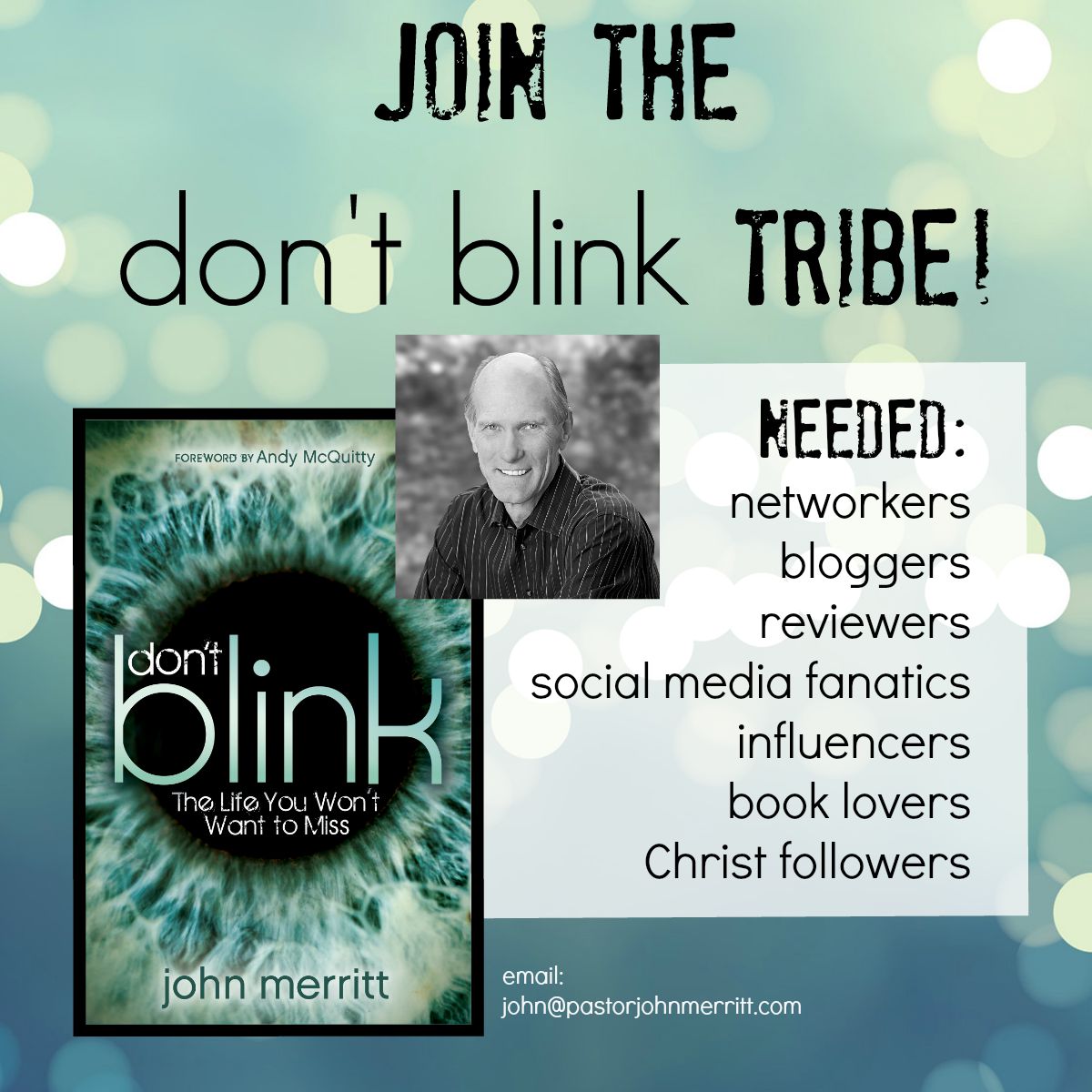
John Merritt's Don't Blink TribeToward that end, I’m looking for friends who share that same passion and will help me by reading the book and then sharing it with your friends and family members. Currently Don’t Blink is available in EBook form through Amazon, Kindle, iBookstore and Barnes & Noble Nook. The paperback is due to be released November 10 and you can pre-order a book now. If you would like to learn more about joining the tribe, email: impactauthor@comcast.net.

Please connect with me on Facebook
Google+
Twitter

Thanks everyone!
John


How to Make Offers They Can’t Refuse

clapping peopleI’ve learned a terrific lesson about social networking this summer.

If you offer, you receive.

Recently, I’ve turned my LinkedIn contact list into a fertile field of opportunity for spreading my brand by offering help to others. Sometimes, the offer is to write a guest post for a contact’s blog, or to be a last-minute guest for a radio show, or to send a free copy of one of my books because of a mutual interest. I don’t make the offer until a person I’ve invited to connect with me accepts the invitation, and then, instead of just filing their acceptance email away, I take the time to compose a personal note making my offer as a service to them.

That means I only look to connect with people who share an interest of mine, and if they accept my invitation, I then think of a personal way I might contribute to their goals. By asking first how I can help, it reminds me that my writing is my ministry, my God-given gift, and that when others succeed with my help, I’ve made a difference for them. It helps make writing not quite the solitary endeavor it tends to be, and it allows me an avenue to actually build relationships with my contacts. In an age of electronically linking up with people all over the country and the globe, any personal interaction stands out; suddenly that contact in my address book has a personality and we have a tiny bit of shared history. That’s good for people and good for business.

But the big surprise I discovered was how easy it is to offer help, and how grateful people can be. Thanks to my offers, I’ve found new ways to reach larger audiences:

  1. Though I stopped writing my own blog years ago for lack of time, I’m now providing occasional guest posts for three bloggers in the pet dog category. Each time I guest, my host includes links to my website and mentions my best-selling girl-meets-dog memoir Saved by Gracie. I interact with blog readers and expand my brand as they in turn learn more about me. Sweet!
  2. I tell every radio host I connect with that I am happy to fill in last minute if they need a guest. I’ve gotten two interviews that way – with only a day’s notice! Both programs were recorded and played to large markets. I publicized air dates on my social networks, and since they were podcasts, my – and the hosts’ – audience can continue to access them. Score!
  3. Likewise, I offer to speak at any service group’s weekly gathering (think Rotary Club) about my new project to encourage people to #getoutsidehappy! While my message promotes getting outside for greater health and happiness, it also heightens awareness of my books. I make a few sales at the gathering, but what means even more to me is spreading useful information to help people improve their lives. Win-win!

Do you use social networking to offer help?