Writing With a Day Job

Writing Career Plus a Day Job
Juggling a Day Job With a Writing Career?

Are you a writer, or an aspiring writer with a day job? Ever get tired trying to juggle at least two careers, (day job and writing), along with mommy, daddy, spouse, family, friend, and church duties?

If so, you are not alone. A conference speaker gave this statistic. “About one percent of writers succeed at getting published. Because most drop out of the race.” Here’s my post on that experience.

Embedded within that percentage is a smaller number of those who can actually afford to write full-time. Making the leap to a devoted writing career usually requires long-term planning, intentional strategy, and detailed tactics. Jeff Goins’ recent blog encapsulates a great way to approach the goal of becoming a full-time writer. The steps he outlines, I could have written myself. (More on that in a later post.)

But if you’re reading this now, odds are writing with a day job is your reality. Anything else may feel like something built on fluffy clouds.

So how do you bring home the bacon, fry it up in a pan, serve it to those you are responsible for, and after the dishes are done still find time to pursue that dream throbbing with every heart beat? Can it be done? I believe the answer is a resounding YES!

People often ask me how I accomplish everything at work and home, plus write blogs, devotionals, articles, and books. After I imagine my cluttered living room, (I’m not Wonder Woman, something has to suffer), three things come to mind. “Resolve, listen, act.”

As a writer with a day job:

Juggling a Writing Career and a Day Job
Resolve to Invest Time in Your Writing Business

A. Resolve to invest wisely.

  • Treat your day job with respect. Just because you have a higher calling, or a bigger dream, don’t discount the gift of your employment today. After all, it pays the bills, and you can glean great writing fodder from things that happen in your workplace.
  • Watch less television, and write more. 
  • Create your own Writer’s Cave.
  • Rise earlier, and allow fewer sleep-in days.
  • Write when you’re tired, energized, or just so-so.
  • Schedule writing, don’t wait until you feel like it.
  • Celebrate small victories. Fifteen minutes putting words on a screen are worthy of excitement.

B. Listen to voices of genuine authority.

  • For me, the voice of God rings truth above any other I might listen to. Early on, I asked the Best Selling Author of All Time to mentor me, and He hasn’t let me down yet.
  • Do not disregard those who have written with day jobs before you. Heed their valuable advice.
  • Seek the wisdom of professional agents, editors, and publishers. They are in their positions based on education, experience, and talent.
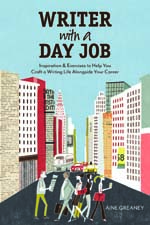
Writer With a Day Job Book CoverC. Act on what you are taught.

  • Be a doer — not a hearer, dreamer, thinker, talker only.
  • Keep something for notes with you always. Inspiration comes in strange times and places.
  • Make tiny goals like, “Write for five minutes before I leave for work.” You will encourage yourself with things to look forward to, and enjoy a sense of satisfaction when you complete them.
  • Keep your word. It’s better not to make a promise at work, or as a writer, than to make one and break it.

Have you read Aine Greaney’s fabulous book, Writer with a Day JobIt’s full of tips, exercises, and encouragements.

Avoiding the Comparison Trap

img_1154

Each one should test their own actions.
Then they can take pride in themselves alone,
without comparing themselves to someone else.  Galatians 6:4

Nothing stops the flow of creativity more than comparing myself to others.  Usually I’m comparing my insides to their outsides. My rough draft to their finished book. My internal  mess to their polished perfection.

Comparing makes me insecure. I look at the work of others and all my doubts surface. In my mind, questions arise about my abilities. Inspiration is lost and work stops.

 “Don’t always be appraising yourself, wondering if you are better or worse than other writers.  Besides, since you are like no other being ever created since the beginning of Time, you are incomparable. ” Brenda Ueland

God has created me and He knows me. He has given me the ability to write. I want to be confident in my work.

Comparing makes me ungrateful.  I can be pleased and thankful for my work – then I walk into a bookstore and begin to compare.  I no longer appreciate the unique words that God has given just to me. I am no longer content with what I have.

 “Comparison is the death of joy.”  Mark Twain

God has blessed me with the gift of writing.  I want to rejoice in that.

Comparing makes me judgmental. I can find myself looking for the weaknesses of others to bolster my own pride. I need to watch out for any thought that starts with, “Well, at least I didn’t . . .”  Each of us has a unique calling to write. We should always examine ourselves, not others.

 “How much time he gains who does not look to see what his neighbour says or does or thinks, but only at what he does himself, to make it just and holy.” Marcus Aurelius

God has given me colleagues in writing. I want to rejoice with them.

Comparing pulls me off course.  I can lose heart and focus when I am concerned about what others are doing instead of the work that God gave me to do.  When I am too busy watching others, I am not working.

 “Peter must have thought, “Who am I compared to Mr. Faithfulness (John)?” But Jesus clarified the issue. John was responsible for John. Peter was responsible for Peter. And each had only one command to heed: “Follow Me.” (John 21:20-22)” Charles Swindoll

God has called me to write. I want to be productive in my work.

How can we avoid the comparison trap?  I must keep the focus on God and what He has for me to do today. Then I can appreciate my work, be grateful, celebrate the work of others, and stay on track.  Simple! Or is it?

And let us run with perseverance the race marked out for us,
fixing our eyes on Jesus, the author and perfecter of faith. Hebrews 12: 1-2

How about you? Do you compare?

Betsy Duffey and Laurie Myers
WritingSisters.com

They Also Serve Who Drink and Weep

Coming home .. .. The writing life takes me away from home often. I write this the day after returning from 2 weeks of travel, home to Kodiak Island, to my husband and sons and daughter and Yorkshire terrier who badly needs a groom. I walk through my door and want everyone to kiss me as if I have just been born, as indeed I have.

photo

I am home, but I cannot stop thinking about her, the woman I met on the plane. It was the fourth and last plane of the trip. I was almost there. I edged down the aisle and saw her—crying. Sobbing on her phone. My eyes went dark, my heart tightened. As I stepped past her, I heard her say, “They just told me. I have pancreatic cancer. He gave me 3 – 6 months to live. I don’t want to die!” and she dissolved again into weeping, running her hands through her hair.

She was beautiful, dark-skinned, dressed in expensive jeans, a leather jacket. Her phone was pink. She gripped it so hard, hanging on to whoever was at the other end. My seat was one row back and one row over. I could see her profile, hear every word. I looked around desperately. A woman was dying! And we were calmly sitting in our seats, buckling our seat belts against death—and would soon follow all the safety requirements, while she was no longer safe. What do I do?

a woman with hands covering face

Men sat in front of her, and in back, each one with the bland face we wear when we pretend we don’t hear because we too are afraid. I wanted to do this too, but there was an empty seat beside her. She would be alone this entire flight with no one .. .. And how could I forget what I had prayed that morning? In the hotel room, on my face, wanting this day, this one day, to have a pure heart, to serve someone . . . “May your kingdom come, Your will be done .. May I hear you and serve you this day . . ..” and off I went into another day of terminals and planes—and there she is near me, still crying, the seat beside her empty.  I have work to do—a chapter is due, edits for an article are due, but the seat beside her is empty.

airplane seat

Shaking, I unbuckle my seatbelt, lift my bag and stand beside her. “Is it okay if I sit beside you?” I smile. She looks up at me, surprised, with her ruined face and nods, trusting, like a child, her eyes again filling with tears. I sit, she watches me settle. “What has happened?” I ask her and it pours out, but there are hands now to catch what falls, our shoulders touch, I stroke her arm, and we mourn and grieve and sit together in the shock of it. She is young. She knows Jesus, but she doesn’t want to die she cries again and again through a twisted mouth. I silently scream to Jesus to give me the words. I need them when I am writing, but I need them even  more now … .and they come. At one point she grasps my hands and says, “God sent you to me.” Mostly I am there to cry with her, to drink chardonnay with her. I know the chardonnay will wreck me, but had she offered me whiskey, I would have drunk that too.

It wasn’t much. I write all this not for anyone to say, “Oh, what a great servant you are!” Because I am not. How many people have I not seen and walked past? How many have I seen and still walked past? But this is instead about this wondrous, terrifying God we serve, who has asked one of his daughters to die a hard, early death, and who asked another selfish frightened daughter to sit with her in her fear and aloneness for a short time. It was so little. And she staggered off the plane to walk into the end of her life—and I staggered into a car taking me to stages and microphones.

Here is what I remember : “They also serve who only stand and wait.” John Milton wrote in his sonnet “On His Blindness.” I was going to speak on podiums, in many places, before many people for two weeks, but none of that mattered then. Of all I did on that trip, perhaps this mattered most: “They also serve who only sit and weep.”

2013-04-01 07.20.39

Can tears really be enough? For that day, for that hour, yes. God will provide another servant, and another for every empty seat beside her.

Do we dare ask this each morning? “May I hear you and serve you this day.” Yes, dare. Then watch for the empty seat. Bring tissues. Drink wine if you must. Become a child. Give whatever you’ve been given. Sometimes it will be words. More, it will be your presence and your tears.

And the kingdom of God will come near.

Unpacking a Rebuke

????????????????????????????????????????We’ve all met at least one—the writer who simply cannot take any criticism of his work. Such folk gleefully hand you their writing for review. But when you offer a tiny suggestion about a passage they’ve written, small funnel clouds begin to form over their heads. They’ll have none of it. Their eyes pinch. They are certain you are thick, even dim-witted, and probably don’t floss or exercise. Such writers typically don’t last long in the world of words, because as Justice Brandeis once said,

“There is no great writing, only great rewriting.”

Then however, there are those of us at the other end of the spectrum. We are so certain that the opinions of others must be more credible than our own, that we buy into anything anyone says about our work. This can have us constantly scurrying off in the direction of the most recent advice.

So when evaluating a rebuke or criticism, where is the balance? What questions should we be asking?

Was the rebuke from the wrong person? In my critique group we have a few poets. But I don’t get poetry. There. I said it. Thus, any constructive comments from me must be taken with a grain of salt. In fact, I typically find myself saying the same thing over and over again:  I don’t get poetry, but I love your imagery. Not very helpful. Our poets would be perfectly sane to pause before taking my poetry advice.

But what if the rebuke came from someone a bit higher up? What if a book proposal to an agent was rejected?

Was it a good idea with a bad pitch? I had a great talk in my roster of workshops but no one ever selected it. Finally someone said, “Yes, we want this talk! But you’ve GOT to change the name.” When they explained why, a light bulb went on. My title had completely misled would-be attendees as to what would be presented. Most hadn’t even read the description because the title sent them packing. The same thing can happen in a query or cover letter. You may well have a great idea, and your writing might actually be ready. But if the agent or editor didn’t catch the fever in your pitch, or if it left them confused, they most likely never went on to your writing.

Agents and acquisition editors aren’t magical. They don’t have a clairvoyant wisdom that lets them know exactly what’s going to take off and what’s going to fizzle.  Even with decades of experience and loads of algorithmic analysis, it’s still a highly unpredictable business. Which means they sometimes get it right and they sometimes don’t. (Well, all except for Word Serve Agents. They really do always get it right. Whew. Dodged a bullet there.)

Say what you want about the Harry Potter series; I still cannot imagine anyone reading through some of J.K. Rowlings writing and saying, “Ehhhh. I just don’t see it. This won’t interest a soul.” And yet. . . twelve publishing houses said just that.

Learn to Unpack a Rebuke

Most of the time, we really could improve what we’ve written. Most of the time, our writing needs some work. But don’t chase after every single comment as though it is Gospel. Measure it. Weigh it. Give it reasonable consideration. Develop a mature view of your own work. Most of the time, there is value in the criticism. But in the end, if you think your reviewer got it wrong, stick with the plan a bit longer. Look for the gatekeeper who gets you.

The obvious conclusion of this line of reasoning is that even advice from this writer must be evaluated carefully and perhaps dismissed. I’ll admit, sometimes I get it right. And sometimes I get it wrong. For example, if I had been on the committee to evaluate and select new TV programming, we’d never have heard of World Wide Wrestling or Honey Boo Boo.

Craft of Writing

“Craft – an activity involving skill to produce something by hand” says my newly installed Oxford English Dictionary. The origin of the modern word ‘craft’ is to be found in the Old English word ‘craeft’ which combined the concepts of skill and strength together.

If there was companion dictionary, like the expanded translation of the Bible, then we might reach a better understanding of our topic, like this for our opening definition:

“Craft – an activity [worthwhile human endeavour] involving skill [proving one’s dexterity, competent, virtuous, masterful, graceful] to produce [make, invent, fabricate, construct, fashion, create] something [worthy, honest, valuable] by hand.

When we focus on those activities which involve hands, there is also an intrinsic underlying meaning, a deeper meaning.  For instance, if you are a shipwright, a builder of boats, then you surely are using your craft to make something that is fit for purpose.

If you are a fisherman then you need to trust your boat. The boat builder knew that when he designed and built the boat, it would need to have numerous good qualities, you could even say ‘virtues’, that the boat users would need to rely on implicitly. It would need to be watertight, buoyant, stable, robust and strong enough to weather the worst storms and most of all it needed to be safe to protect the lives of the fishermen. When Jesus said to Simon-Peter, ‘Go out into deep water and cast your nets again’, the scriptures record that the nets began to break because they were so full of fish and the boats began to sink under the load. But sink they did not, for the boat-builder had done his job well. He had built a fishing boat that would not just take a big catch, but would stand up to a miracle.

Boat%20fishermen

Is there a craft of writing? I believe there is but it’s not what the textbooks say it is. It’s not the kind of skill you can simply learn and then apply. Not a mere crafting of words to make them sound good when read or spoken aloud. Not just a clever way of stringing sentences together or paraphrasing speech and drama to create an interesting story. Nor is it a means to earn lots of money. You can’t serve two masters.

No, it’s much more than all these things.

The key is in the picture shown above.

Simon-Peter, Andrew, James and John were all expert fishermen. They had good solid boats in which to fish on Galilee but Jesus saw something more than just the simple dexterity of their hands. He saw a dormant skill that was in their hearts and souls, a skill that was profound and could be used in the kingdom of God.

As writers, are we satisfied making good catches? Showing off our skills and craftsmanship so that others will applaud our artistry? Or are we like the disciples standing in the boat, willing to listen to Jesus and be obedient to him, and answer the calling of the Kingdom of God?

Our skill and craftsmanship is a God-given gift and as communicators we should always ask if our writing is fit-for-purpose and of great worth and value to the Kingdom of Heaven here on earth. Don’t settle with being a craftsman of the word, let the word craft you into being a disciple of the Lord

A Note to Young Writers: Honor Your Obscurity

woman praying--parodic

In the last month, I spent time with two younger women, both of whom had just released their first book. Sarah and Andrea are both fine writers whom I expect will continue to write and publish books. In the short time I had with each of them, I found myself dumping all my writing and marketing advice, talking about websites, blogging, Facebook, twitter. But I forgot to say the most important thing of all: honor your obscurity.

Very few young writers, musicians, artists value their obscurity. For good reason. We know if we’re to be published in any form, we need an audience, a sizeable audience. We know that most of the time we have to find that audience before that first book contract even lands on our desk. And once it does, and the book is out, we’re tasked to keep racking up bigger numbers. But how do we catch the eye and ear of a world that so often chooses the flippant, the crude, the gaudy spectacle over the good, the authentic, and the true?  If we’re the praying sort, we may resort to prayer, remembering the words another writer made famous a few years ago,

“O, that you would bless me and enlarge my territory! Let your hand be with me, and keep me from harm so that I will be free from pain.”

(Oh, dear Jabez, I want to say. How did you get away with that prayer?)

But we do it too, I suspect. The artists’ version would go something like, “O, that you would bless me and enlarge my platform, increase my followers, expand my twitter peeps and keep me from publishing harm so I will be famous, free from the pain of falling out-of-print.”

woman praying--parodic

I can write this prayer because I know these desires. An hour ago I was on a nationally syndicated radio show, and I find myself, now, against my better will, glued to numbers, trying to measure “impact.” While guiltily number-stalking, a stranger writes me on Facebook immediately after the broadcast and asks how he can become a writer and speaker, like me. (He’s in his twenties and he hasn‘t written anything  yet . . .)   Someone else writes to ask me how to build a fan base for her blog.

I do have advice: if you want others to read you and listen to you, you must listen to others. Do for others what you want them to do for you. That will not make you famous; that will make you better informed and more humble.


man reading2

And second, fame is not what you think. Admittedly, I am not the best source here. My moments of “fame” are modest and sporadic. But I still know this: it isn’t what you think. It’s often over in a moment. It brings more responsibility than freedom. And if you’re not careful, it can pollute or paralyze your writing. I have a friend whose first book shot to the New York Times bestseller list.  His agent, his readers, his global fan base now hold their collective breath for his next book. “How do I write under this weight?” he asks me. He has so many others he must now heed and please.

“Honor your obscurity” is another way of echoing Bill Roorhbach’s charge to “honor your apprenticeship.”  Value these months, years of laboring toward your best work with fewer listening in than you would like. This quiet is your wilderness, your blessing. Here you will sharpen your art. You will lean closer to the sounds around you, for the fragile people who haunt the forests you watch, for the small voice that whispers names you didn’t know.

Enjoy the purity of your efforts, making art and worlds and essays out of the sheer love of words, of theatre, of longing and of hope. Enjoy it now before a woman or a publisher sits down beside you filling your notebook with a thousand necessary tasks, few of which have much to do with why you began writing in the first place.

Finally, what do you imagine fame will bring you? For me (and for many writers I know) I hope mostly to be able to keep on writing, to keep using “that talent which is death in me to hide,” as John Milton writes. If you’re doing this now, pouring life into the truest sentences you can make, you’re already famous.

woman writing journal

How to Get Started Writing: Hamster Wheels and Hurdles

type lettersOf all that a writer can and should do—how, actually, does one get started?

It would be possible, in assembling writing advice from just a handful of the people who are giving it, to come away with the impression that making it in this business requires doing everything all the time.

You must, people say, build and maintain a platform. Start or re-start your website. Pin to boards. Make things that other people will pin to boards. Attend conferences and conventions. Join groups. Pitch ideas. Hone your message. Know your audience. Study writing books. Edit incessantly. Post blogs. Find a writing schedule that works. Tweet and re-tweet updates about all of this. Plus string tens of thousands of words together and hope somebody will see fit to make a book of it. That’s just phase one.

Phase two is its own hamster wheel. With a book in publication you must, people say, promote like crazy. Speak at events. Do interviews. Pursue interviews. Write accompanying articles. Track reviews. Deal with disapproval. Build friendships with booksellers. Have catchy marketing stuff. Improve on sales. Aim for bestseller lists. Figure out your next project. Pin, post, platform-build, edit, update, and speak some more. Promise to tweet and re-tweet, always and forever.

The general question: Who can possibly manage all that?

The specific question: How, possibly, can I?

The general answer is that likely nobody can manage it all, when trying all of it at once. The other answer is that you, specifically you, can work toward all of this by doing so incrementally.

You will not start out on bestseller lists. You’ll begin at the beginning, with the whole unrelenting shebang left to do. Tweet This

There will be potential failures and rejections at every corner and turn. But if you begin—if you sit at a computer or a typewriter or even a small slip of paper, and if you start putting words down and then keep putting words down, you will be writing. Often it is as simple as that.

hurdleHere is a personal example. After having published three books by 30 (two as author, one as collaborator), late last year I didn’t have a single writing project to speak of. I wasn’t sure I wanted any, because being submerged in the mire again—see above paragraphs—seemed exhausting. Other concerns demanded my focus and time too, namely: my husband was on a seven-month combat deployment to Afghanistan, we had moved our lives across the country twice in less than a year, and I had just given birth to a baby, our first. Some days, accomplishing just laundry and dishes seemed out of my league.

But I knew that God had given me a love for writing and the opportunity to publish. He was percolating words in me that I wanted to put down. So on one harried morning, I dared draft an article query. On another day I bravely emailed some book ideas to my agent. It was just a baby toe stepped back into the pool, but from where I stood it was the all-important start, a jump at the big, looming hurdle.

That was trajectory, finally, and in a matter of weeks and months I was actually writing again: ideas flowing, plenty of potential projects on hand, a few materializing, and even (always miraculously) another book contract waiting in the wings. Perhaps more importantly, I was learning to chip away at this job, little by little, reminding myself that it would not be accomplished in a single swing. The laundry and dishes were waiting longer than before, but I figured I could deal with that.

Have you wondered, frustrated, how to get started writing? The solution can be as simple as a little trajectory. Tweet This

Stop trying to figure out how to start writing; instead, start. Aim at a goal and have the courage to start imperfectly and incompletely. As you get a handle on one area, add another. You will likely surprise yourself with all that can be attempted and accomplished. Writing is far more doable when you’re doing it.

Already Loved: Encouragement for This Writing Life

file9431319827916Another rejection. My agent gently relayed that though my dream publisher had said “yes” to a proposal all the way up the chain of command to the last committee, they finally decided to nix it.

As I hung up the phone, tears spilled down my cheeks. Two years of canceled book contracts, low sales figures, and repeated “thanks but no thanks” emails had left me discouraged, frustrated, and confused. Writing—and the marketing tasks necessary to be a professional writer—now seemed like drudgery, not play. No matter how many marketing rules I tried to follow, my efforts failed.

I felt like a failure, too.

I still believed God wasn’t through using me. But I couldn’t help but wonder, Will I ever get another book contract? And what happens if I don’t? Is God trying to tell me something?

Later that day, I sat at my desk, playing a computer game with my three year-old son. As Jackson sat in my lap, I kissed his ear and inhaled his little-boy scent; a combination of milk, grime, and chocolate. Nearby sat a copy of my first book, which I had referred to earlier in the day for a radio interview. Jackson looked at the illustration of a frazzled mom on the cover and asked, “Is that you?”

“No, sweetie,” I said, “but I wrote that book. See, mommy’s name is on the cover. It says, ‘by Dena Dyer.’ “

“Oh!” Jackson said, grinning up at me. “I love Dena Dyer!”

Stunned, I blinked back tears. “I love you, too,” I murmured.

After a few minutes more at the computer, I found a quiet corner and prayerfully pondered Jackson’s simple expression of love. He didn’t care if I published books or not. He simply loved me for me. He loved me the way God does.

In all my disappointments, I had thought more about selling books than surrendering my heart. It was painful to admit that somewhere in the midst of trying to serve Jesus, I’d become goal-driven instead of God-driven. I seemed to care more about what the publishing powers-that-be thought than what my Heavenly Father thought.

Satan is crafty. He takes our God-given talents and twists them into temptations. Gradually, my calling had become an idol. Who I was became less important than what I did.

“Lord, I’m sorry,” I prayed, crying for the third time that day. “My heart is so full of sin. I know you couldn’t care less how many books I sell. You just want ME.”

In the weeks and months to come, as I asked God to help me believe the truth of His unconditional acceptance, I began working freely and joyfully again instead of writing just to be published. God continued to close some doors, and another book proposal was rejected, but He gave me other opportunities–ones I hadn’t even known to pursue.

The truth is, though, I will probably always have a tendency to think I must perform to be loved. So I’ve ask God to whack me upside the head (as we say here in Texas) before I get too far off track.

If experience is any teacher, He’ll be faithful to do just that.

(This article first appeared at The High Calling. Used by permission) 

When Your Book Doesn’t Sell: Separating the Writer From the Wannabe

http://www.stockfreeimages.com/

“I’m so glad it is our first year here so that the pressure’s off to win an award. I heard you have to be returning to be in the running,” my friend Kim leaned over and whispered as we sat in the back of Mount Hermon Christian Writers Conference’s auditorium last April.

“Seriously, right?” I said, slouching down in the pew and sighing. We were settled in for the final night of programming; awards, music, and a message from the great Liz Curtis Higgs, who, if I am being honest, seemed so inviting and encouraging that it took all I could muster not to walk over and crawl up in her lap.

The week in California had been a dream for this mother of four, prone to piles of laundry, homework with kids, housework, and therapy and doctor appointments for my two daughters with Down syndrome. One week by myself, ensconced with like-minded people, authors, agents, publishers, and writers with dreams of their own, in one of the prettiest parts of God’s creation.

So you can imagine my surprise when my bio was read and my name was called. I won the Ethel Herr 2012 Most Promising New Writer Award for submitting 25 pages of my memoir about giving birth to my daughter Polly, and her diagnosis of Down syndrome, while serving as a missionary in Ukraine. My friend and I jumped up and down, and I ambled to the stage. The bright lights made me dizzy. Liz Curtis Higgs gave me a huge smile. “Wonderful!” Ethel Herr (Ethel Herr!) gave me a hug. The award thrilled me, and embarrassed me. After all, I was just a mom, trying my hand at this writing thing.

I naively left the conference sure that I would secure an agent and a publisher for my book within minutes of walking in the door back home.

Yeah. That didn’t happen. I secured an agent, but months later, through a different writing venue. The manuscript garnered interest from publishing houses that even resulted in two frightening, sweat-producing face to face meetings.

But so far, my book hasn’t sold.

Here are three things I’ve learned from this experience so far:

1. Keep writing

Someone offered me sage advice once I completed my manuscript. “Start another one.” Diving right back into another book length project has been one of the best things I’ve done as a writer. I’m a writer, not a wannabe, because I want, no, I need to write, not just to be published. I am growing in my craft, and I am still having fun doing it.

2. Grow your platform

I’ll admit it, there have been days that I’ve wanted to curl up in a ball over my memoir not finding a publishing home. OK, there have been days I have curled up in a ball because my memoir has not found a publishing home. But I’m a writer, not a wannabe, because I get back up and keep trying. I am building my platform and brand through articles, speaking, social media, and blogging.

3. Trust God’s timing

As a person of faith, although my carnality wants what I want in my timing, this experience has been a great exercise in trusting God and his timing. I am called to write. And by God’s grace, he uses my words in other people’s lives, and in my personal pursuit to become more like Jesus. So I practice trusting him. If it is God’s will for my memoir to be in print, it will happen. In the meantime, I’ll keep writing.

I may not be a published author, but I am a writer, not a wannabe.

And today, that’s enough to get back to this crazy, exciting, challenging work of putting pen to paper.

What Do I Write About? Tendering Your Witness

IMG_3241

Like many of you creative writerly types, I have a new book or essay idea about once a week. Any casual observer will know when this happens. My eyes gain x-ray vision, I will wear mismatched clothes for a day or two. I’ll start pulling books from my library, organizing them into Useful Research Piles, and I create a new folder on my computer, into which I start shuttling and dumping uncountable necessary articles and links.

But it is not long before the writing deadlines I am already under reassert their authority. I follow meekly to my office to tending my previous fires that once sent me into fevers, but with a new light gleaming from my forehead.

Some of those gleams turn into books, essays, and blog posts. But some of them sputter into oblivion, snuffed out by the realities of life, the most pressing of which is—There Is Never Enough Time.

running with clock

The question we all face is: Out of a plenitude of possibilities, yet with limited time and energy, what do we choose to write about? How do we decide?

The stakes are high. If it’s books we’re talking about, for me it’s at least 2 years of immersion in the writing, and then once the book is released, several more years follow of spreading the word. So I had better love it, believe it, and be willing to soap any box with its message.

woman on soapbox

How do we decide, then? I have followed a simple rule most of my writing life: TENDER YOUR “BURDEN OF WITNESSING.”

The phrase here is not mine. I’ve lifted it from Patricia Hampl’s wisest of words, “ . . .  For we do not, after all, simply have experiencewe are entrusted with it. We must do something—make something—with it. A story, we sense is the only possible habitation for the burden of our witnessing.”

What has God entrusted to you? What “burdens of witnessing” have been given to you?  Start here.  My first book of prose was about commercial fishing women, because there I was, in the midst of a life I was trying to live and understand, mostly unsuccessfully. I moved to memoir next, writing about my life on a wilderness island in Alaska, then onto other topics I had “witnessed”: motherhood, unplanned pregnancy, the spirituality of food, forgiveness of my schizoid father. I have never regretted a single project.

When you write as a witness from these hard places, you immediately avoid one of the greatest weaknesses of beginning writing, and even “successful” writing: writing without “mattering.”  Over the years, I’ve met students and writers who can fashion beautiful sentences in their sleep—–but talent and beauty alone does not make them “matter.” Without heart, without an urgency that comes from deeply lived experience, your words on the page will only be words on a page. (And, take note: Because they matter to you doesn’t automatically make them matter to your readers. You must make them matter to the reader as well.)man reading book

There is yet another reason for doing this. And forgive me now for going sermonic on you, but I pull it out now because I know you are reluctant to excavate the stash under your bed and in your closets. One of the graces of believing in a God who inhabits the hearts of his people is the certainty that all events—celebrations, dirges, dangers, and feasts—come to us through His hands, and they are hands with purpose. They are hands that intend our trials to be tended and eventually tendered for the good of others. The New Testament spells out the program: God, who is the “God of all comfort,” comforts us in our troubles for this purpose, “so that we can comfort those in any trouble with the comfort we ourselves receive from God.” Pass it on, brothers and sisters.

Don’t worry if there’s blood. As Red Smith has written, “For my money anyway, the only books worth reading are books written in blood . . . “ [Red Smith].     bloody book

Write about what you MUST write about. Write about what has been entrusted to you alone. Write about what matters most to you. Write about the things you cannot turn away from. Write about the hurt, the cheating, the doubts, the hopes, the comfort, the sickness. Our time is short—make it count.

Tender the witness you’ve been given.