Three Lessons From The Abyss

We hear people say that true faith stands regardless of circumstances. It’s easy to love God when life is going well, but what about sustained faith when life is hard? Really hard. What does faith look like when our child is out of control, a parent is dying, we receive a difficult medical diagnosis, or experience betrayal by someone we trust? How do we move forward?

When my daughter fell into active drug addiction, and lived on the streets of our community as a meth addict, I was furious with God. Everything I held dear, and had come to believe in, came into question. The daily uncertainty, not to mention gigantic hole in my heart, were almost more than I could bear.

It was a painful time, and this journey of suffering taught me more than I ever wanted to learn. I’d like to share three key discoveries that helped me cope: Image, woman on beach

1. Seeking God

Even though I was angry with God, I knew I was hopeless without him. James tells us to “draw nigh to God and he will draw nigh to you.” (James 4:8) My drawing nigh became angry, desperate wails in the garage. I all but dared God to account for himself! But I soon discovered he could take it… so I kept wailing.

In desperate times we often think, when is God gonna show up and handle this? We wait for this to happen. But maybe he’s already here and just waiting for us? I discovered that drawing nigh was about me showing up… wails and all.

It was in my garage, at the end of myself and at the point of true surrender, when it became clear to me that God was already there. He spoke into my spirit and said, “Give her to me.” I frankly had to think about that for a while. I found surrender to God’s will a terrifying prospect. Yet it was freeing at the same time. Turning my daughter over to the will of God meant the outcome would not be up to me. But the truth of the matter is, it never was up to me.

2. Choosing joy

Joy is something we often think of as happening to us. You know, a passive event, some blissful occurrence or special blessing. We also sometimes think of joy, or happiness, as something we can attain when “x” happens. I’ll be happy when my child gets her act together, when my spouse shows me more attention, when the front door gets painted or that leaky faucet is fixed… when my book sales soar. I’ll be happy when.

In the darkest time of my life, I discovered I could actually choose joy. Joy came when I took my focus off of problems, off trying to change my daughter, and I set my sights on blessings. It came when I realized my life was so much bigger than any one problem in it. There is a Power, and a purpose, at work in the world that is greater than I am. It’s bigger than my pain, and bigger than my own wants and needs.

I may experience loss, grief, I may even experience suffering. But I always have God, which means I always have hope. For that I can choose joy.

3. Taking care of myself

My pastor’s wife shared not long ago in our women’s Bible study, that she has a wooden plaque in her kitchen which says, “I am here to serve with joy.” I jokingly screeched, “Get rid of that thing!”

Like I said earlier, I’m all for joy. And we are indeed called to serve. But what is often left out of the equation is self-care.

Women, especially Christian women, are notorious for poor self-care. And that was certainly true for me. We are the chief “fixer,” organizer and problem solver, prayer warrior, food preparer, and angel-to-others. Yet we often lose ourselves in the process. Therapist’s offices are filled with well-intentioned women like us who are simply overwhelmed trying to hold up the world.

Most mothers are codependent to at least some extent, and I was no exception. I was motivated by the belief that if I could just try hard enough, I could control everything and everyone, force outcomes, and then life would be ship-shape. I sometimes became so enmeshed in other people’s problems, and in “doing,” that I nearly lost myself.

I learned that self-care begins with solid boundaries, asking for help when needed, and allowing others to be responsible for their own stuff. It means saying “yes” when I want to, and probably saying “no” more often. It means my life is as important as the ones I serve.

Please share how you seek God, choose joy, and care for yourself during tough times.

Leave the Luggage Behind

luggage“Where are your bags?” is the most frequent question I’ve been getting lately from the friends I stay with when I travel for author events. I show up at their doors with a small tote in my hands, and they look around me for the rest.

“This is it,” I say, and they marvel at how little my bag is.

For some reason, I guess everyone expects me to be loaded down with luggage, dragging along a carry-on case, a tote on my shoulder and more bags to come. While that may have been the norm for me years ago on the rare occasions I flew somewhere with my five kids, it’s no longer my style.

These days, I fly with minimal baggage, and I love it. Instead of packing car seats, food snacks, toys, games, and multiple outfits for all, I get a kick out of taking as little as possible. I actually look forward to living out of one small bag for three or four days, since it requires me to trim my wardrobe to only the essentials I need. Once on the road, I don’t have to make any clothing choices since I already made them when I packed; I save time and effort with less to manage. Limiting myself forces me to evaluate priorities and pack accordingly. There’s no room (literally!) for changing my mind, or my clothing options.

The result is perfect for traveling: I have what I need and no more. It makes me feel mentally and emotionally light and free, and I don’t have to physically exhaust myself lugging extra bags. To fly unfettered by baggage is a wonderful thing in a world of extra luggage fees, delays, and lost bags.

If only I could do the same with my journey through life!

“Do not get any gold or silver or copper to take with you in your belts— no bag for the journey or extra shirt or sandals or a staff, for the worker is worth his keep,” Jesus tells his disciples when he sends them out to preach and minister in Matthew 10. Clearly, our Lord knew the value of traveling light! Without all that extra baggage to keep track of, his disciples were free to devote themselves to the work to which they had been called. Unencumbered with material concerns, they could focus on the priorities, the essentials of Christian mission.

I’ve found that is also true of traveling through life as a Christian author: when I keep my eyes on the Kingdom, everything else loses its urgency. Sure, I’d like to make more money (who wouldn’t? travel expenses do mount up no matter how many free beds you can find!) and it would be nice to have readers flocking to me in droves. Yet when I’m focused on the essential task of sharing God with others, it only takes one heart-felt ‘thank-you’ from a reader to know that I am ‘worth my keep.’

How do you pack for your journey?

The Making of a Masterpiece

In every block of marble I see a statue as plain as though it stood before me, shaped and perfect in attitude and action. I have only to hew away the rough walls that imprison the lovely apparition to reveal it to the other eyes as mine see it.” Michelangelo

I’ve spent the past month living as a hermit while I finished a manuscript. (Insert sigh of relief here.) I spent countless hours after my day job writing and fine-tuning every detail. Some days, I couldn’t wait to share the story with the world. Other days? All I saw were flaws, flaws that sent me running to fast food and the newest Netflix series while I processed what to do next.

That’s one of the many fun aspects of writing, though, isn’t it? I’m making the manuscript, but in the process, the Lord is making me. As my character wrestles through a growth point, I wrestle with it, too. Often what my character is learning is a lesson the Lord has spent months instilling in my own heart. From the overflow of my heart to the page…I think the story of The David illustrates this perfectly.

In the late 1400s, a group called the Operai provided blocks of marble for several prominent sculptors and artisans to create twelve statues of characters from the Old Testament. Work began on The David in 1464 but after initial carving, the piece was abandoned to the elements for twenty-five years. Then Michelangelo begged the Operai to allow him to complete The David. For three years, he carved the statue, shaving away the damaged parts and shaping features in great detail.

Kariss Lynch creating a writing masterpiece

If you hate history, I hope you stuck with me because none of that is the reason I love The David statue. Michelangelo took a wrecked, abandoned piece of marble and he turned it into a MASTERPIECE. Where everyone else saw a useless block, he saw potential and beauty, a story waiting to unfold.

I think the writing process is a lot like this. A story idea with little initial substance becomes a piece of art with a lot of effort. Over time, the author chips away the unnecessary and ugly pieces until a beautiful story is left.

I believe that’s what Jesus does with the author as he/she writes. Just as Michelangelo labored over The David and you labor over your manuscript, so the Lord labors over you, writer friend. He is in the process of creating a masterpiece that lasts for eternity, and he wants to do that with your writing, too.

Yours is a message of truth and hope. As you identify impurities and polish your writing to perfection, know the Lord wants to do that with you. He wants your voice for his glory. Sometimes the polishing and chipping are painful. With every bit you allow him to remove, you enable him to speak more clearly through you.

Keep chipping away at that novel while the Lord chips away at the excess around your heart. The beauty becomes more evident with every fallen piece.

Enjoying Life

For the record, there is no eleventh merritt, john FINAL19commandment that says: “Thou shalt not enjoy life.” Nor does God ever say, “My plan for you is to be miserable on earth until you arrive in heaven.” What the Bible does say is that God richly provides us with everything for our enjoyment.” (I Timothy 6:17b) In other words, God has given us an amazing world to enjoy—so what’s holding us back from living a life that’s deeply satisfying?


A major misconception we must debunk is that when you become a Christian, you are required to give up much of what you find satisfying and your fun is over. Truth is, God maximizes our ability to enjoy life and gives us unlimited freedom to live the most fulfilling lives possible. If there is any sin in this, it is in our reluctance to consider how God can raise the quality of our lives to new levels of fulfillment and joy.

For Reflection: What false limitations have you imposed on your God-given freedom to enjoy life? How do you think living life with God could serve to elevate your satisfaction and joy?

Previously published on John Merritt’s blog.

How to Avoid the Second-Book Slump

How to Avoid the Second-Book Slump @JanalynVoigtWriting, like marriage, is an odd mixture of passion and duty. The same writers who speak of “falling in love” with a story complain about “having to” edit it. Some marriages are easier than others, and that’s also true of books. Some pearls make it to publication with few edits, but often, by the time a novel reaches readers, its writer is sick of working on it. Given these conditions, it’s not surprising to learn that the second book in a series frequently disappoints readers. Preventing this from happening to your second book requires a look at this syndrome’s causes.

Time Frame  

A debut novel usually benefits from years of labor as its author polishes it over and over in order to land a contract. But a second novel, when contracted from a synopsis and likely written in a matter of months, doesn’t go through as strenuous a process.

Solutions:

  • Simply being aware of this as a problem is half the battle. Commit to giving your second book your all, just as you did with your first.
  • Before you submit your second manuscript, make sure you put it in front of a number of “eyes.” Accept knowledgeable critiques, remarks from beta readers, and/or paid editorial advice.

Interruptions

A writer often has to set aside writing the second book in a series to work on edits and/or promotion for the first. While necessary, interruptions stifle the creative flow. Most writers find returning to a cold manuscript difficult.

Solutions:

  • Have all books in a series written before you submit them for publication. Previously, writers held off on writing a second book until the first had sold. This made sense because publication usually went through traditional publishers. These days it’s harder to win that traditional contract but easier to become published. Take this advice if you would hire an editor and independently publish your work, should it fail to land a traditional contract.
  • Learn to write your first draft quickly so that, by the time edits for the first book hit, you’re ready for them.
  • Dedicate part of your day to writing and part to editing, with a break in between. Your brain will learn to readily switch gears.

Conflicting Emotions

During edits, writers must face, accept, and overcome their own weaknesses. The angst this causes can attach itself in the writer’s mind to the series itself. To draw a parallel from marriage: While undergoing marital counseling , it can be hard to remember first love.

Solutions:

  • Go back over your notes or read earlier entries in a writing journal to remind yourself why you love this series.
  • Reconnect with your novel’s theme, which you hopefully drew from one of your passions.  Prayer and meditation can help.

Eroded Confidence

It’s common knowledge that artistic people are their own worst critics, and that’s certainly true of writers. As a result, while dealing with edits it’s easy to lose confidence and take fewer risks with the second book, which can rob it of zeal.

Solutions:

  • Re-read any endorsements or encouraging comments you received for your first novel.
  • Remind yourself that your publisher believes in you enough to work with you.
  • Give yourself permission to dream about what could happen in your story. Don’t censor your ideas, but simply write them down. And when you go back over your brainstorming session, be wise but bold.

Creative Desire  

When the passion in a marriage fizzles, it’s tempting to look elsewhere for fulfillment. In the same way, when a writer loses that loving feeling for a project, other tempting ideas can siphon creative energy and distract attention. This has an adulterating effect on the work at hand.

Solutions:

  • Rather than ignoring new ideas, write them down (briefly) and save them for later. This keeps them percolating on the back burner until you’re ready for them.
  • Stir your passion for the work at hand by dreaming about the story, exploring the nuances of its characters, and mentally writing the next scene.

If you follow these steps, you’ll soon recapture your passion for your series.

Can you suggest some other ways to revive your writing mid-series?

How to Avoid the Second-Book Slump was first published at Live Write Breathe, Janalyn Voigt’s website for writers.

Refusing the Writer’s Call

Refusal of the call questis a common element of great stories, fictional or historical. The hero is called to a quest, but, initially, he balks. He says, whether through word or deed, “I’m not big enough for this task.” Or maybe just, “I’ve got better things to do than sacrifice myself for that.”

From Jonah getting on a ship sailing in the opposite direction of Nineveh to Bilbo Baggins telling Gandalf that all he wants is a nice tidy hobbit house with tea served on time, heroes have been trying to escape the call since mankind has been telling stories around the fireside. And for just as long, the stories have been winning the hero over to the adventure.

Why? Few of us see ourselves as heroes. We know we’re not up to the task, whatever the task is, and we’re right. We’re not big enough, strong enough, brilliant enough or good enough for the task at hand. And yet, deep in our souls, we know God made us for more than having our tea on time.

In all good stories, the hero finally accepts the call. After trying to outrationalize his call, Dietrich Bonhoeffer takes on the role of hero as he boards what is likely the last ship home to Nazi Germany, a ship that takes him ultimately to his death.

Having been elected to archbishop because he is quiet and conservative, expecting to make no waves in an El Salvador on the brink of civil war, Oscar Romero finally accepts that he must speak out, as he stands over the bodies of two murdered priests.

Paul accepts what he must do as God calls his name in a flash of heavenly light.

Little Samuel answers God on the third call in his small child’s voice: “Speak, for your servant is listening.”  Not knowing, of course, that he was accepting a lifetime mantle as prophet.

We writers refuse our call, too. Sitting down at the computer and typing out a page is such a small thing, right? It’s tiny in comparison to the heroes that have been written about. And yet, it feels daunting.

There’s the courage it takes to face a fresh scene. Will it be beautiful or fall flat? It’s as if it’s a test of everything inside you.

And there’s the courage it takes to call yourself a writer. The voices are insistent. How many times have you told yourself that you should just concentrate on being a parent, give your talents to your church and your job, and live a peaceful, ordinary life? You don’t have time for this story? Or more likely, you’re not talented enough for the story you want to write?

But if God made you to write, you’re going to be restless until you do. You can play the role of Jonah, and get on the ship going in the opposite direction and fight it out with the big fish. Or you can accept that being brilliant and big-hearted enough for the story is not what’s at stake. If God made you for this writing quest, he’s planning on equipping you as you go. Sit down at your computer and get started.

The Unfastened Safety Harness

Working on my most recent book, Wheels Stop: The Tragedies and Triumphs of the Space Shuttle Program (University of Nebraska Press 2013), changed my life forever.

The date was June 22, 2010, and research for Wheels Stop had led me to Johnson Space Center in Houston. Astronaut Doug Hurley was kind enough to invite me to do a run on the Space Shuttle’s motion-base simulator, an ultra-high-tech contraption that tilted upward to simulate the launch position, and then shook and rattled to prepare astronauts for the ride uphill.

IMG_0280
Although I was smiling alongside astronaut Doug Hurley (left) in the Space Shuttle’s motion-base simulator, my heart was broken. A major life change was already beginning to take place.

I couldn’t wait to take him up on it. I have dreamed of being an astronaut my entire life — my last name is Houston for crying out loud — and this was as close as I would ever get. Slowly, I fastened four of the five safety harnesses as we prepared for the run. The fifth belt refused to buckle due to the size of my belly. It still hurts to think about that fifth seat belt even four years later.

This wasn’t happening. I’d been embarrassed many, many times by my size, but never with an honest-to-goodness astronaut standing over me, trying to figure out a way to help. Doug never said anything ugly, but he didn’t need to. I was devastated, and becoming more and more so as I desperately tried to force the issue. My ribs hurt so badly, I could barely breathe.

SLIDE THREE
My before …

Fortunately, we proceeded with the simulation of two launches and five landings. It should have been one of the most memorable moments of my career, and it was, but inside my heart was absolutely broken. I had to change something, and I had to do it quickly. My wife needs a husband, and my sons need a daddy. Heading the way I was headed, I wasn’t going to survive.

Rather than going on some crazy diet when I got back from Houston, I simply started eating like I had some sense. Chinese buffets were my absolute favorite, but they had to go.

Reese’s Peanut Butter Cups were were like my crack cocaine. No more. Not even half of one. Oreo cookies … country fried steak … it was once nothing to eat nearly two pounds worth of bacon and tomato sandwiches. I’ve never been drunk or high, but I know full well what it means to be addicted.

I could do one lap of a half-mile track near our local YMCA without feeling like I was going to break. Then, I could do two … and then four. I signed up to walk in my first 5k, and then I signed up for another. I took a class at the Y on how to actually train for a 5k, and ever since then, I’ve been running. More than four years later I’ve run seventeen 5ks, four 10ks, and three half-marathons. I’ve lost approximately 110 pounds.

houston5k1
… and after photos.

Today, I’m satisfied with my weight. I’m not skinny by any means, but I’m happy with where I am. There’s nothing all that special about my story. Yes, I’ve been able to drop a significant amount of weight, but it wasn’t some super-secret diet or workout routine that did the trick. I was a writer who was almost completely sedentary behind a keyboard and computer monitor, and once I started moving, I haven’t stopped.

Trust me. If I can do it, anybody can. Working on your latest project is important, yes, but not at the expense of your quality of life. Hang in there. You can do it. I promise!

I Didn’t Sign Up For This!!!

Babies CryingSometimes I wonder if I’m a masochist, because a writing career is a mixed bag of blessings and curses.

The blessings are many. You finally get to hold in your hands your words published in a book (yes, electronic versions count!). You have the satisfaction of knowing others are reading your work. You get your name in the local paper for doing a booksigning, or you’re a guest author at a local book club. You might even get paid to speak to an audience!

And then there are the curses. A reviewer hates your book. You knock on the doors of the local media till your knuckles are sore, but no one answers. Your great idea for marketing falls flat. You check your Amazon.com sales numbers on your author central page, and it’s like getting slapped in the face with the wet towel of reality. (“What? I’ve only sold 17 copies of my book in the last six months? That CAN’T be right!”)

The fact is that for us writers, who pour our heart and soul into our writing, all those negative responses drip, drip, drip onto the rock of our confidence, until the sharp edges of our desire and motivations (those things that enabled us to set out on the road of writing in the first place) become worn down, replaced by recesses of self-doubt and exhaustion. It takes a lot more energy and perseverance to repair that accumulating damage than it does to bask in the sunshine of the blessings we experience.

This, then, is why a writer needs a talent to forget.

As Philippians 3:13-14 instructs us, “Brothers and sisters, I do not consider myself yet to have taken hold of it. But one thing I do: Forgetting what is behind and straining toward what is ahead, I press on toward the goal to win the prize for which God has called me heavenward in Christ Jesus.”

Every writer I know acknowledges that they have been called to write. The thing we don’t like to acknowledge is how hard it can be at times to do that very thing. None of us embraced our call to write with a joyful shout of “I can’t wait to experience frustration, misunderstanding, isolation, and a hundred painful book signings in almost deserted bookstores!”

At least, I know I didn’t.

And yet the promise remains for us as powerful as it did for St. Paul. We might not have to endure blindness, or imprisonment, or persecution like that famous evangelist, but we can still ‘strain toward what is ahead’ when we fix our eyes on the prize that is Christ Jesus, and not on the obstacles we have to surmount to get there. Like St. Paul, we need to consider ourselves ‘as yet to take hold of our goal,’ no matter how accomplished we might feel when our names are in the local events calendar, or someone contacts us to speak at a program.

Forget what is behind, then, and press on, because that mixed bag you’re holding is well worth the prize.

What is your favorite way to forget and then press on?

Honing Our Lives

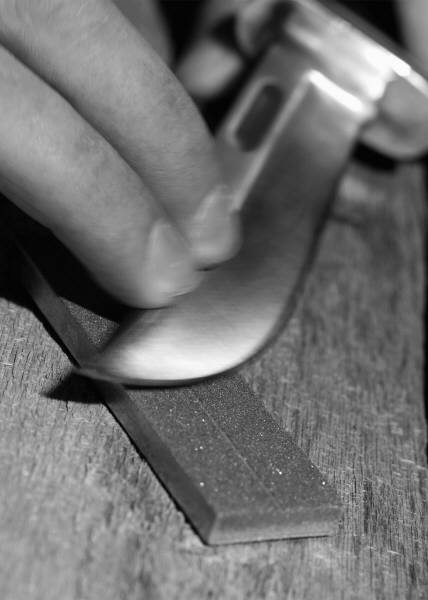
knife sharpeningAs iron sharpens iron, so one person sharpens another. Proverbs 27:17 (NIV)

While every writer knows that in today’s marketplace, interacting with others on a regular basis is a necessity for selling books, the real heart of writing – sitting down and putting words on a paper or screen – is a lonely job.

For me, however, “lonely” is not the word I would choose to describe my experience of writing. “Lonely” carries a negative connotation, the idea of being “cut off” from others, or “without” the company of others. In contrast, when I write, I feel a freedom to explore my own ideas and the joy-filled opportunity to connect with the Spirit within me. Writing is my “alone” time, not my “lonely” time. It is a personal retreat that renews me because I get to luxuriate in the word-smithing gifts that God has given me.

And yet I can’t deny the truth of Proverbs 27:17; without the other writers, marketing experts, and loving friends in my life, I wouldn’t be able to make the most of those same God-given word-smithing gifts. That’s not to say I’ve always felt this way – when I was new to my craft, praised by my writing teachers in high school and college, I had no use for the comments or criticisms of my peers. If my teachers liked my work, why should I listen to other students who struggled to compose even simple essays? It took me decades to understand the importance of my readers as opposed to the praises of my teachers. Here’s the difference:

The praise of others encourages you (and that’s a great thing!), but it’s honest criticism that will help you improve your craft.

It wasn’t until I began writing as a freelance magazine contributor that I first received truly effective editorial direction. Editors know their audience and work to appeal to them, so they have to play to the crowd. Teachers, on the other hand (I can say this because I’ve been a writing teacher myself), are the final audience of one person, and once a student has mastered what that teacher wants, there is no room to grow. And since all of us like to be praised, it’s tough to walk away from all that positive reinforcement to seek criticism!

As with so many endeavors in life, though, we have to push the boundaries to become the best God intends us to be. In the writing life, that means giving up the comfort of praise in order to find the challenge of improvement: we have to ask many people how we can do better, listen carefully to their comments, and use them to grow our craft.

One of my favorite sayings about Christianity is that “no one is a Christian alone.” Jesus Christ came to shape us into a community of believers, so we might draw on each other’s faith and gifts to grow His kingdom. That applies to our writing careers as well.

We need to be iron for each other.

To whom do you turn to be iron for you? For whom are you iron?

The Only Story That Matters

july 013I was beginning to panic about my book sales. Despite my hard work and ceaseless efforts to promote my new book, I just wasn’t making a dent in the supply of books I’d bought from my publisher. Since I’d borrowed the money from our family savings, I felt guilty that I wasn’t refilling the coffer as quickly as I’d so optimistically assumed I would.

What more could I do? Post even more frequently on social networks? Write more guest blogs? Camp out on the doorsteps of radio and television stations to get their attention? Go into even more debt by hiring a publicist, in hopes he could convince people to buy my book? Beg the few bookstores still in existence to push my book at customers?

I didn’t do any of those things.

Instead, I asked God for help. I prayed for more book sales.

And He delivered.

Within days, I heard from two stores who had taken some of my copies that they needed more. Some event bookings I’d been pursuing for months finally came through, and I added them to my calendar. One night as I lay awake in bed, thinking about my book, I realized there was another market I could tap into, and the next day, I discovered solid leads for doing exactly that.

And then my daily Scripture devotional chimed in with Jeremiah 32:17.

universe“Ah, Sovereign Lord, you have made the heavens and the earth by your great power and outstretched arm. Nothing is too hard for you.”

Yes, I was reassured and completely grateful for God’s generosity to me in the form of helping me sell more books as I had requested in prayer. I’d asked, and I’d received.

Praise God!

To be honest, though, I felt something even more compellingly: I felt chastised. I’d asked the omnipotent Lord, who created the universe itself, to help me sell books! Who did I think I was to even imagine He would care about a few hundred dollars in my life? It’s not like I needed a PLANET or anything. I wanted material success. I wanted to put some money back in the bank. I wanted God to make me feel better about a story I wrote. A story!!

Talk about putting myself at the center of the universe. I was humbled. Embarrassed. Aghast at my own egocentricity.

And, most of all, stunned by God’s patience with me, because this isn’t the first time I’ve let my selfish priorities slide in over what I know to be the single most important relationship of my life: my relationship with God.

It’s true – nothing is too hard for God, and that includes loving me…and you.

And really, that’s the only story that matters, isn’t it?