With Us Here Tonight

Shortly after my first book was published, I gave a book talk at our local library.

Then I gave another talk at another library. And then a third library.

Then a Rotary Club called me. A few months later, I found myself the featured speaker at a Shriners dinner. Last month I presented a talk at the National Eagle Center. Birding festivals, book conferences, annual meetings, schools, service organizations–I’ve addressed them all.

Wait a minute. I thought I was a writer, not a speaker.

Guess what? Book authors get to do both!

The fact is, you NEED to do both if you’re going to successfully build your readership and market your writing. That means you should work on your public speaking skills, and the best way to do that is to take every opportunity you find for a speaking engagement. Develop the following five types of speeches, and you’ll be ready for anyone!

The Sound Bite is the one you will use a bazillion times. It’s the one-liner you’ll utter every time someone asks you what your book is about. It’s also one of the hardest to compose because you need to distill your book and its value down to one sentence. My sound bite for my series is “The Birder Murders is a humorous series about a really nice guy who happens to find bodies when he’s out birding.”

The Book Talk is the speech that focuses on your book’s content. If it’s nonfiction, you can give a general review of the topic itself, or focus on just one chapter’s point and why it’s important. If it’s fiction, you discuss characters, their relationships, the plot, how you came up with all of it, what you want to accomplish with it. This works best with audiences who have already read your book because they will have questions about what they’ve learned and/or enjoyed from reading it.

The Business Talk is about your experience with the publishing business of being an author. The changes we’ve seen in publishing, including the growth of e-books and marketing paradigms, is a topic that appeals to audiences composed of business people or future authors.

The Writing Talk is about your own process of writing a book. Do you do research? Conduct interviews? Journal or set word goals? The beauty of a Writing Talk is that it is appropriate for a variety of groups, and depending on the slant you give it for the group you’re addressing, it works equally well as a classroom talk, a keynote address for a gathering of library supporters, an awards speech, a writers conference, a book club… you name it.

The Topic Talk is the newest talk in my own arsenal of speeches. Because my books are about nature, I’ve started giving talks about nature education and conservation issues. If it is mentioned in my books, it’s fair game for a talk and a great way to use extra research.

Here is a great resource to help you to continue to develop your public speaking skills.

What talks could you present for your book? Do you have any ideas for talks that I have not mentioned?

Well Read

It seems as though being well read doesn’t mean what it used to mean.

Well read used to imply that a person had read their fair share of the classics. It meant that they could probably discuss the writings of Hemingway, Fitzgerald, Twain, Hawthorne, Salinger, Steinbeck, Rand, et al. It also could imply their familiarity with great poets like Shakespeare, Cummings, Eliot, Browning, Shelley, Donne, Alighieri and Yeats.

We are well read in the classics during school since the books are selected by our teachers. These works are part of the literary canon and are, therefore, ‘required reading.’ But what happens when we start to select for ourselves and make our own choices?

For a while when I was traveling a lot, it seemed like every book I purchased came from an airport gift shop. The books offered in the airport are hardly a random sampling. They don’t have a vast selection, so, of course, they are pushing bestsellers.

Well read seems to be taking on another form in the last thirty years. One of my friends is a doctor and incredibly well read when it comes to medical journals. She is a prolific academic and has committed at least 10% of the Bible to memory. However, she can’t tell A Midsummer Night’s Dream from Hamlet. Another friend has a commanding knowledge of history, cooking, psychology, politics, current events, biology, business, exercise and nutrition. She hasn’t read a work of fiction since high school.

In the last few years, movie watching has become an intellectual activity (no complaints here), and that’s another form of being well read. Many movies at one point were books. One of my friends can pass any movie trivia test you put in front of him, even if it spans back to the 20’s. However, he can’t be bothered to read anything more intensive than a magazine.

Before television, before radio, before movies, before the internet, people found their entertainment in books and plays. We now have many more media portals for entertainment. It’s not just about reading literature and fiction; it’s about reading anything. Someone’s interest and education might be highly specialized, or it may be extremely broad and varied.

Although there have been a lot of changes to what constitutes well read, one thing remains constant. Being well read in today’s world may just mean educating oneself well – and frequently.

If you were to create a list of books that you consider required reading, what titles would you include?

Revolution, not Resolutions

So, how are you coming on those New Year’s resolutions?

(Are those crickets I hear?)

Yeah, me too.

That’s why I’ve been thinking about doing away with the whole resolution thing (or “thang,” as we say here in the Lone Star State). Instead, I’m praying for a revolution. After all, without God, I wouldn’t be able to accomplish anything…even getting out of bed in the morning.

I’m greedy this year, but in a good way. I’m greedy for more of His presence, more answered prayers–not just for me, but also for all those who are hurting–and more of His words in my ear, on my lips, and in my mind.

I’m asking God…

  • To take my thoughts away from the markets and focus them on stewardship. I truly want to honor Him with my writing. This means (gulp!) that I’ll need to ask for His strength to be more disciplined. When He gives me an idea, I need to turn off the television, put down the latest decorating magazine, and write–without worrying about how the piece will fit into a publisher’s plans. Oh, God, help me stop obsessing over markets and contracts and instead be faithful to write the things you want me to write.
  • To help me be content. I’ve always been goal-oriented…to a fault. Too often, my ambitions led me off-track. Instead of being led by the Spirit, I’ve been driven. And since I’m being honest, I’ll admit that I have compared my blog stats/Amazon numbers/speaking schedule to other writers and felt insecure–or, worse, envious. I’ve browsed bookstore shelves and gone from admiring to coveting. I’ve admired another writer’s website and wished it were mine. Oh, Father, forgive me. Help me to know the secret Paul talked about–of being perfectly fine right where you’ve placed me….whether on bestseller lists or in remainder bins, in Barnes and Noble or on my blog, on a designer site or a “homemade” masterpiece. You have given me so much! Help me to count my blessings instead of my bills. In the midst of economic uncertainties, may I covet nothing but your peace.
  • To fill my heart with simple joys. Too often, I get mired in the past (Should I have Twitter-ed that? What did he think of my idea? Did I mess up my career for good this time?) or the future (Will I make enough $$$ for us to have a real vacation this year? What’s my editor going to say?– and–How in the world will I find time to write when I actually get the contract?!). What I really need to do is 1) take a deep breath and 2) let ordinary miracles bowl me over, preferably every five minutes. Frederick Beuchner wrote, “Life itself is grace.” So are used bookstores, computers, and online friends.  Abba, remind me to read and write more deeply. Prod me to study and meditate on scripture, instead of just quoting from it for my latest WIP. Rip my blinders off so I can appreciate every connection and blessing you’ve given on this path you’ve ordained for me.  
  • To show up and show off. I once had a music director who prayed a version of this during Wednesday night choir practice. He believed that we should spend as much time talking to God together as we did rehearsing…and boy, was he right. This same director invited anyone to sing in “his” choir–church member or atheist, bank president or convenience store clerk. Many who came out of their love for music–or just pure curiosity–stayed week after week, and their lives were inevitably changed. They showed up, and God showed off. Lord, never let me forget that I can do nothing without You. In You, and You alone, I move and live and have my being. You are my source, my guide, and my goal. Please show up and show off in my career, family, and relationships. Do what you do best, Lord. 

A few years ago, I led worship at a ladies’ retreat. The speaker was wise, peaceful, and totally centered on Jesus. I wanted what she had, but I guess I was afraid to ask God for such a faith (maybe I knew it would be costly).

After dinner one night, she and I were discussing the books I had written (my first three books had come out, but then I received a ton of rejections and was sure my career was over), and she mentioned that she was considering writing a book based on her retreat material.

“I’d love to write more books,” I admitted, “It’s a passion of mine. But I can’t get another contract, and I don’t have the money to self-publish. It’s really discouraging!”

She looked at me and smiled. The next words out of her mouth went straight to my egocentric heart and lodged there, like a stubborn splinter.

“I don’t need a contract,” she said. “I just need more of Jesus.”

I’ve been working that out ever since.

Embracing Sacred Moments

Lake Cortez at dawn

Have you ever wanted to hold on to a moment in time and savor the amazing experience a little longer?

The radiant fog bank settled just above Lake Cortez at dawn, a stark contrast to the winter landscape surrounding my home. I tried to focus on my writing deadline, but I halted my work to observe the breath-taking view.

The glowing mist at sunrise brought a familiar Bible verse to mind, encouraging me to embrace the moment. “How do you know what your life will be like tomorrow? Your life is like the morning fog—it’s here a little while, then it’s gone” (James 4:14 NLT).

Such memorable experiences happen when I least expect them, and they vanish without warning. But I always want to hold on to those special moments longer than possible.

The first time I heard my child’s heartbeat, I tuned out everything else, as I wondered about the new life inside me. Etched on the tablet of my heart, I recall those firsts—feeling him move, seeing his face, and holding him in my arms.

Those rare occurrences happen in my writing life, too. When I received my first contract to write an article for a well-respected publication, I held the envelope close to my heart a long time before opening it. Then, I unfolded the letter with great care and examined every word to be sure I didn’t skip any details.

Another momentous occasion occurred in December, as I shopped for Christmas gifts with my grandson Miles. “Wait, wait,” I drew a deep breath and raised my right hand to stop our conversation, so I could read the e-mail on my iPhone.

Confused by the interruption, Miles offered me a wrinkled brow.

“Seriously—wait,” I exhaled. “I’ve got to hold on to this moment.”

I read the message again, basking in the power of the encouraging words. “They like my proposal! And she wants to discuss signing me as a client!” I couldn’t restrain myself from expressing my thanksgiving and praise. “What a great Christmas gift!”

Later that week, my heart raced again when the agent called to confirm her offer. I found it hard to suppress my enthusiasm and joy, so I could listen to her instructions and tell her about my writing goals and dreams.

When my husband, Dan, asked about the details of my phone call, I still couldn’t gather my thoughts because of my excitement. “Maybe I should have taken notes,” I admitted.

So how can we embrace our sacred moments? We know such blessings vanish as fast as they appear, just as morning fog dissipates when exposed to the first rays of sunlight.

We can capture the essence of our experiences with descriptive words and well-chosen phrases in our narratives. And through this writing process, others will also be encouraged to tell the stories that matter most to them.

Photo/KarenJordan

Did my story remind you of a sacred moment in your life? Write that story!

Does the World Really Need Your Story?

This week snow fell–again, about a foot, on top of already knee-deep layers. I strapped on skis and went off into a spruce forest near my house, my tracks the first marks on the page of the world.

Starting a new writing project, a book or an article, even a blog post, feels much like this. I see something falling outside my window–an idea, a passion, a glimpse of something true and maybe beautiful. I eagerly strap on metaphorical skis and go out, wondrously lost in a world made strange again. I am confident that I belong here, that I will apprehend something of value and meaning. But the going gets hard. The surface of the snow changes. The skis get stuck. I fall. I discover dozens of tracks before me on the trail, most more graceful than my own. Why am I here?

Doubts track me down no matter where I am. I have learned not to dismiss them. They force me to consider and reconsider. Does the world really need one more story?

Today, I give three responses: two from others, one my own.

1. Your story can bring “healing and illumination” to others.

Katherine Paterson, prolific Newbery award-winning author, says with genuine humility, “I know my gift is limited. I know I cannot stand toe-to-toe with philosophers and theologians and solve for myself or anyone else the problem of evil . . .”  But here’s what we can do, she says, “we who are writers can tell a story or write a poem, and where rational argument will always fail, somehow, miraculously, in metaphor and simile and image, in simple narrative, there are, in the words of Barry Lopez, both ‘healing and illumination.’ Here I see a word of hope and possibility.”

2. Writing your story can preserve your life.

When Madeleine L’Engle’s husband says of her new work, “It’s been said better before,” she responds,  “Of course, it has. It’s all been said better before. If I thought I had to say it better than anybody else, I’d never start. Better or worse is immaterial. The thing is that it has to be said, by me, ontologically. We each have to say it, to say it our own way. Not of our own will, but as it comes out through us. Good or bad, great or little: that isn’t what human creation is about. It is that we have to try, to put it down in pigment, or words, or musical notations, or we die.”

3.  Writing can move us toward the city of God.

If we pursue our stories, honestly and truly, they will send us on a pilgrimage that takes us, like Abraham, from one land to another, from a land of unknowing and darkness, through, of course, wastelands, where the promise of a promised land appears invisible and impossible . . . but the writing inexorably, day by day moves us closer to clarity, to wisdom, to the very city of God, if we allow it.

Don’t waste your doubts. Use them to move you forward into that forest, into the pages of that story that you must write—for yourself, for God and for others.


What Disney Knew That Your Teacher Didn’t: You CAN Do It!

Find me one published author who never received a single “not the right fit” letter, and I’ll show you a fish with feathery wings. Whether at the educational stage, the agent stage, or the publishing stage, most have been told their work is not worthy.

I was lucky when it came to agents and publishers, but my rejection came earlier in life, when a high school teacher read my papers aloud ridiculing me in front of my peers. She teased me relentlessly (today it would be called bullying), and on the last day of my senior year in high school, she said to me, “I hope you don’t waste your scholarship to study writing. You may be able to write a greeting card, but that’s about as far as you’ll ever go.”

I made a mistake that day. I believed her. I put down my pen for nearly a decade and let way too many stories go untold.

That’s why, twenty years later, as Publishers Weekly gives me a starred review for my debut novel, I feel such tremendous excitement. Whether Into the Free sells two copies or two-hundred thousand doesn’t matter one bit to me. I now know one important thing: she was wrong.

Here’s what she didn’t teach us: God gives us each special talents, gifts, and dreams. Who are we, if we are not of God? What are our abilities, if not God-given?

I am a teacher, and I spend every bit of my energy trying to teach my children one lesson: You can do it!

I am tired of teachers telling us who we are and what we will or will not achieve. I am weary of labels and bell curves and standardized tests. I weep for this generation of children who are told you need x, y, z medications to fit into our box. And I mourn the countless souls who believed the people who said, “You’ll never…” or “You can’t…” or “You aren’t good enough…”

I say to you, today. You can. You are good enough. You were born for a purpose, and only YOU know what that is. Don’t let anyone discourage you from living YOUR life to its fullest potential. And if you fail, you’re only one step closer to succeeding.

Watch this little video clip I found on YouTube, and you’ll see…all great minds have a few things in common: failure, rejection, and a willingness to risk it all anyway.

Has anyone ever told you “you can’t”? What one piece of criticism has made you a better, stronger writer? 

SEVEN TIPS TO MAKE THAT NEW YEAR’S WORD WORK FOR YOU

As a writer, the idea of designating one word for the New Year, in lieu of resolutions, appeals to me. Perhaps it’s because I’ve always been a bit lackadaisical when it comes to actually making those resolutions (not to mention keeping). 

Writers are wordsmiths and so it seems all the more appropriate. But wait. How does a writer select just one word for a whole year when there are myriad beautiful words floating around out there for the picking? Here are seven suggestions:

1) PRAY: After Christmas, I began tumbling words in my brain. I wasn’t sure how I would spot “my word”.  I wanted something with a ring to it. Maybe something catchy. Pretty, musical, a poetic word, I hoped. New Year’s Day arrived and I still didn’t have my word. Every time I gave it some consideration the word “return” popped into my mind. What kind of “word for the year” is that?  

As the end of January approached, I despaired of finding my word. And then I did what I always do when I feel hopeless: I prayed. I read my Bible. Of course, the answer I received was my word was there all of the time. And the lesson well learned? Don’t wait until you are discouraged to RETURN to our heavenly Father. 

2) USE IT: Once you know your word, use it. At least once a day. Include it in your prayer time and if by the end of the day you find you have not used your word try to think of as many ways it fits into a sentence. A favorite of mine is to write a short story, one paragraph long, using my word as many times as I can. How refreshing to give yourself permission to break the rules! 

3) SHARE: Don’t be afraid to tell people what your word is. You don’t really have to know how your word applies to you. Part of the fun is finding out why the word is “your word”. You will find your friends are curious about your progress and provide motivation to continually strive to decipher the meaning of the word in your life. 

4) REFLECT: At the end of each month, think about how the word worked in your life. Or didn’t. Ask yourself questions. Does it have a different meaning for you than it did at the beginning of the month? Did it make a difference in your life? In what way? Does it make you view your world, your writing, your family and friends in a new way? In a positive way? Great! If not, why not? What can you do to change that? 

5) REVISE: Begin each month afresh. Be flexible in your interpretation of your word and what it should mean in your life. That is the power of a word. It will not always mean the same thing to different people. And it won’t always mean the same thing to you. 

6) BE OPEN: This is so much more than being flexible. Embrace the possibilities. It’s amazing how much one little word can mean to you when you open your arms wide and let it flow over you. Sing it, shout it, whisper your word. Think musically, think poetically, draw your story out. Express your word in a way that really moves you. 

7) RETURN: This is your chance to shrug off those resolutions that frequently cause so much regret by the end of January and live your word. Then RETURN often with prayers of thankfulness and give the glory to God.  

I can’t wait to see how my word RETURN directs my life next month! Returning to my roots come to mind. Hmmm, I write historical romance, so maybe. And I really look forward to finding the meaning of RETURN this December. I can’t wait!

What is your word for 2012?

Rebecca DeMarino is a retired United Airlines Service Director and worked as an Office Manager at the Natasha Kern Literary Agency from March, 2008 until September, 2010. She currently works part-time as a Carnival Cruise Line representative from her home office. She recently signed with literary agent Barbara Scott with WordServe Literary.

Just Keep Writing

Photo by Lord Marmalade

There’s a reason I keep writing even though monetary success hasn’t found me, yet. Words strung together in books have always given me the ability to dream of bigger things and even the courage to go out and try.

I’ve been blessed to have three books published and each time there have been plenty of readers who have said that I helped them let go of what no longer worked for them and dream, too.

We talk a lot about our purpose for being here in this life and I’ve come to believe mine is to be of service in whatever ways I can figure out. So far, translating the common man’s dream into something worthwhile, something doable and something that’s even full of a little God-magic has been mine. Not the big, change a country, build a corporation dreams. The smaller moments that stay in your heart.

It’s a message that I took in from the very start.

My first experiences with books and stories are three of the strongest memories I have as a child. The very first one was the first time I walked into a library, the Philadelphia library and found out they let you check out as many as you could carry, my father’s rule, read them all and bring them back for more. My world opened up that day and I found out there were a thousand possibilities when it came to living a life.

The second has to be explained a little bit. We were so poor when I was growing up that my father talked a friend of his who worked at a local bank to lend him a hundred dollars so he could buy us a used black and white television. We screamed with delight when Dad brought the set home. So, when a Reading is Fundamental bookmobile came through our neighborhood and the driver told us we could pick out any new book and keep it, I felt like a little big of magic had settled over us that day. I took my time and tried to choose a book that I could read over and over again. I still have it and read it to my son when he was little.

The third memory is my brother, Jeff and myself when we taught ourselves to read, Horton Hears a Who by Dr. Seuss. We had the book read to us so many times we knew what part of the story went with what pictures and on our own figured out which words went with the sounds. That’s when I understood a secret about books. They have their own power to transform. They don’t know if you’re rich or poor, beautiful or an ugly duckling, a wealthy doctor or a poor cabdriver, and they don’t care. A book will take you on an adventure whenever you’re ready, regardless of how you see yourself and as a bonus may even change the definitions.

Books made it possible for me to envision a way to become someone I couldn’t even define yet. They gave me the faith to set out when I couldn’t find it anywhere else and the hope that somehow things would all work out.

I’ve seen it happen just often enough. A lost human being feels like they’re the only one who has ever felt this much pain. They don’t know how to reach out for help but then, inside of a story some writer concocted out of whole cloth they see every emotion or secret or hope-for happy ending that they’ve kept bottled up inside, acted out, and they start to believe – maybe there’s more to this world.

That’s why I keep writing and that’s why I’m so grateful for every writer out there who struggles to tell a good tale. I’m one of your biggest fans, whoever you are, so keep writing. We need every single exciting, cliffhanger, romance, potboiler, science fiction, political thriller that we can get our hands on because even now, sometimes my dreams need a kick start. So please, just keep writing.

A Writer’s Life: Waiting for Vizzini

When things go wrong along the writing road, what do you do?

  • When you face writer’s block as formidable as Fezzik (and please, no debate on whether writer’s block exists) …
  • When rejections attack you like a pack of shrieking eels
  • When your plot collapses like Vizzini’s battle of wits with the Dread Pirate Roberts

What’s your go-to plan for getting back on course?

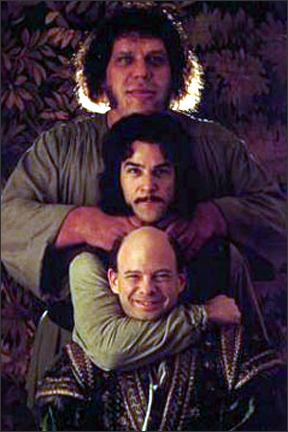
In the much-beloved movie The Princess Bride, Vizzini was the brains, Fezzik the brawn, and Inigo was, well, the swordsman. (Sorry, I couldn’t come up with a “b” word for the guy wielding the sword.) Despite the fact that Plato, Aristotle and Socrates were all morons compared to Vizzini — or so he said — his plan to kidnap and murder Buttercup imploded.

Inigo: bested.

Fezzik: beaten.

Vizzini: plain ol’ dead.

Remember what Inigo did when the plan went south — well, besides drinking himself into a stupor?

He went back to the beginning … and waited for Vizzini.

Smart man, Inigo.

What do you find when you go back to the beginning?

“This is where we got the job, so this is the beginning.”

Inigo may not have been able to see clearly — heck, he couldn’t even stand up straight — but he remembered a fundamental truth: When a plan fails, go back to the beginning.

Are you discouraged? Did that long-anticipated yes turn into an unexpected no? Walk away from it — but don’t abandon who you are. Go back to the beginning and remember your purpose: You are a writer. You have a job to do. Sometimes things don’t go according to plan. You get bested. Beaten. A dream dies.

Catch your breath, renew your heart … and then dream a new dream.

Who do you find when you go back to the beginning?

“I … am … waiting … for … Vizzini.”

Inigo was waiting for someone. For better, for worse, Vizzini was Inigo’s leader — the one he followed.

Going back to the beginning, waiting, doesn’t mean wasting time. Did you round the bend in the writing road and hit a dead end? Don’t be too proud to back up, turn around. Go back to the beginning and remember who you are as a writer. Answer this question: What makes your fingers fly across the keyboard? What keeps you up late and drags you out of bed early because you can’t not write this story?

Can’t remember?

Who is your Vizzini? Who first mentored you (maybe mentors you still)?Who helps nurture your dream? Who believes in you when you don’t? Go back to the beginning and ask them to help you remember.

It’s been fun talking about a writer’s life and the Cliffs of Insanity, the Fire Swamp, the Pit of Despair — and now Waiting for Vizzini. Everyone’s comments have made this more than a blog post — it’s become a conversation. So tell me, what lessons have you learned by going back to the beginning? 

*Just for fun, here’s a YouTube clip of Inigo waiting for Vizzini.

Post Author: Beth K. Vogt

Beth K. Vogt is a non-fiction author and editor who said she’d never write fiction. She’s the wife of an air force physician (now in solo practice) who said she’d never marry a doctor—or anyone in the military. She’s a mom of four who said she’d never have kids. She’s discovered that God’s best often waits behind the doors marked “Never.” She writes contemporary romance because she believes there’s more to happily ever after than the fairy tales tell us.

A Gift for the Holidays – Part II

He’s offering the gift of grace. G – Guilty No More, R – Rest in Christ . . .

It’s much to absorb, and He hasn’t even spelled out the whole word. You hesitate. The Lord reaches in the box and pulls out the next letter, “A.” With trembling fingers you reach for it, running your thumb down its long, sleek sides.

“Accept my unconditional love,” He says. ” I stand before you with my arms open wide, longing to enfold you in them, but sometimes you duck your head and walk away. You let shame, guilt, or feelings of inadequacy keep you from Me. I have loved you with an everlasting love. ** Nothing you’ve ever done has made me regret that great love, and nothing can take it away.

“When I died on Calvary, I made it possible for us to be in close relationship. I washed your every misstep away in the river of my blood. There is nothing to separate us.” ***

You’re weeping freely now. He’s right. The Christian life is about Jesus and the righteousness He gives. You make it about your performance, causing both your pride and your guilt to keep you from His arms.

“I’m sorry.” You whisper.

Jesus puts an arm around you. “Take the next letter.”

You reach into the box and hand Him the “C.” He lays it across your heart. “C is for Christ in you, dearest. I am your hope of glory. You try so hard to be good. Trust Me and let Me make you good. The good work I’ve begun in you will be completed. Stop striving. You are My masterpiece. Will I not finish it?” ****

The Lord reaches into the box for the last letter. You still weep silently, leaning your head against His shoulder.

“E is for Empowered. I am the One who empowers you to be all I’ve created you to be. Spiritual maturity isn’t chasing after good works or achieving your dreams. It isn’t being perfect. It is knowing Me and letting your life flow from our relationship.

“Let me empower you, dear one. I am the one who gives you the grace to accomplish all I ask of you.” *****

You nod.  He hugs you and then kisses your cheek. As He walks away you finger each letter, His words echoing in your soul. You place the letters back into the box, one by one:

G – Guilty no more

R – Rest in Christ

A – Accept His unconditional love

C – Christ, the hope of glory

E – Empowered by His Spirit

You linger with the open box in your lap, breathing in the scent of grace. There is no greater gift.

How does his unconditional love change you? How is He your hope of glory? Where do you need His empowerment?

***Ephesians 2:13

****Philippians 1:6 & Ephesians 2:10 (NLT)

*****Philippians 4:13, 2 Timothy 3:17