Half Baked: A Publishing Recipe

Is most of your writing only half-baked? It’s easy to get distracted with all the wonderful topics to write about, and many of us have manuscripts that are still rising on shelves in the garage. That being said, it’s sometimes nice to go through the steps of what happens when a book does in fact make it all the way to publication. Here is a basic recipe detailing the steps that are required in creating a fully baked book:

For a first time author, a book usually starts with a completed, edited manuscript for fiction, or a proposal and sample content for non-fiction. Published authors can sometimes sell novels on proposal, but not usually. Best practices suggest that unpublished authors should try and find a literary agent, once their manuscript is ready for submission. Few publishers accept work directly from authors sans representation, and a good agent can greatly aid a manuscript’s success rate.

After a literary agent has taken on a manuscript, they then send it to editors at different publishing houses. The literary agent targets the submissions to the publishing houses that they feel are most appropriate for the book. The editors take a look at the project, and if it’s something they are interested in they will share it with their colleagues to determine the level of interest. If the editor receives word that they can move forward with the manuscript, they will send an offer to the literary agent.

The submission process can take anywhere from weeks to months (or even years), depending on how long it takes to find an interested editor. An offer may include advances and / or royalties. Sometimes the offer may even be a contract for several books. If more than one editor is interested, there may even be a bidding war situation to determine which publisher can create the best offer. When the terms have been agreed upon and the author accepts an offer, the publisher will send a contract to the literary agent. The literary agency may have a contracts expert review the fine print and negotiation points. Once the contract has been signed, it’s time for the author to get writing (if the book was only sold on a proposal).
Little Chefs

Once the manuscript is completed (non-fiction), or after the contract is signed (fiction), the editor will usually send a letter recommending changes to the manuscript. These changes are more or less negotiable, but authors usually follow the recommendations of editors. After all of the recommended changes have been made and the manuscript is deemed ready to go, it is copy edited. Spelling and grammatical errors are corrected. The pages are laid out to show what the book will look like. The author reviews the different versions of the completed manuscripts. The publisher works on the design of the book (including cover, trim size, font, paper type, and other details).

The editor manages the process of having marketing experts write copy for the publisher’s catalog, come up with the cover details, create buzz, and launch marketing plans. Several months before the book’s publication, sales specialists will coordinate with their bookstore partners and take book orders. This part of the process helps determine how many copies of the book will be printed. The agent might oversee this process to verify everything is on track. It usually takes a year or more for the publication process to go from finished manuscript to book for purchase. It can be fast tracked if it is an especially hot project, but the process usually requires quite a bit of lead time. When the publication date arrives, the book goes on sale. The book is now available to customers, and the customers often take it from there. Positive feedback, great reviews, and word of mouth are still some of the best forms of marketing. After that, the author is launched into instant literary stardom (or not). The author then writes a second book and the process repeats.

Hopefully this recipe for completing a half-baked book has been helpful – and now, I’d better get back in the kitchen.

The Power of One Word

“… Words are powerful; take them seriously …” (Matt. 12:36 MSG).

I noticed a small typo within a comment that I had posted on a friend’s blog. Instead of the word “power,” I had typed “poser.”

A minor mistake? Not for a writer! And especially not in this case!

My tiny error distorted the entire significance of this scripture: “But we have this treasure in jars of clay to show that this all-surpassing power is from God and not from us” (2 Cor. 4:7 NIV).

One word shifted my focus and the potential attention of my readers. All I could see was my mistake. I lost sight of the message and power of God’s Word. And my readers may have missed the entire point of my comment.

How many times do we let one word spoil things for us? We speak a single word of profanity in the heat of an argument. Or we whisper a little white lie as we try to cover up a mistake. We often regret the unexpected consequences that result from our words. One negative comment or careless thought voiced in frustration or anger can blind us from seeing God’s blessings in a situation.

As a writer, I cringe when I discover one insignificant word choice that turns a powerful point into a grammatical disaster. And I wince when I read an offensive term that will repel an audience of would-be readers.

As a writing instructor, I notice many writers resisting the editing process. They focus on the goal of finishing their writing task, instead of fine-tuning their grammar and mechanics. They get offended if anyone calls attention to one tiny mistake or unclear point, or someone suggests meaningful change. Then, they get angry or depressed when they receive a lower grade for their work, or the piece is rejected for publication.

As a Christian, I’ve also experienced the power of God’s Word. One word of encouragement can pull me out of the deepest pit of despair. A single promise from God’s Word can offer hope to me, when my circumstances seem overwhelming. My simple confession of faith can produce peace in my heart and mind “which exceeds anything (I) can understand.” (Phil. 4:7 NLT).

So, does one word matter? God’s Word answers this question. “In the beginning was the Word, and the Word was with God, and the Word was God” (John 1:1).

Photo/KarenJordan

Have you experienced the power of one word?

On Beyond Index Cards: A Review of Scrivener Software for Writers

My first novel, slated for publication with David C. Cook in early 2014, involved hours and reams of research. I researched everything from fossils, to barbecue restaurants, the history of Haiti, pecan recipes, and more. I organized text, web links, and photos into dozens of Word documents, which I then had to flip open and closed while writing and editing each chapter. Add this to the half-dozen internet browser screens I had open for research, and, well, my computer was on the verge of crashing.

So was my brain.

At the time I didn’t know any better, so I never lamented the process. But now that I’ve found Scrivener, a software program for writers of any genre, I marvel at how I ever kept my sanity. Currently neck-deep in an intense season of editing, I’m especially glad I can dump my manuscript in there, blow it up, and put it back together again with Scrivener.

Now, I will warn you. What you’re about to read may sound like an infomercial, but it’s not. I downloaded the trial version (highly recommended), quite skeptical about how much easier this could really make my writing life. But after just two days, I bought the software outright. First of all, this little slice of computer engineering GENIUS only cost $45—a small price to pay for sanity. An even smaller price to pay for the time it’s saved me, and the fun it brings to the novel writing process.

What’s so great about Scrivener? Below, I’ve summarized my personal favorite aspects of the program—so far. And I say “so far” because the software has so much depth of capabilities and bells and whistles, I discover something new and even more fun every time I use it.

1. Love me a Trapper Keeper!

I am a true child of the 80s. When I took my kids back-to-school shopping earlier this fall, I teared up, grieving that they shall never know the true beauty of the Trapper Keeper. Oh, sure, we found imitation versions on the shelves, but nothing close to the ultimate office supply nerd’s dream machine contraption, which kept everything in check, even when the bully on the football team rounded the corner and flipped my books in the air, sending everything—including my fragile, Love’s Baby Soft ego—to the floor.

Well, never fear those bullies again. Scrivener is your virtual Trapper Keeper. The  program holds everything you need for your novel—websites, photos, places to jot down random thoughts and ideas, references, and notations—everything. And since it’s all in one location, nothing falls out.

2. The corkboard is adorable.

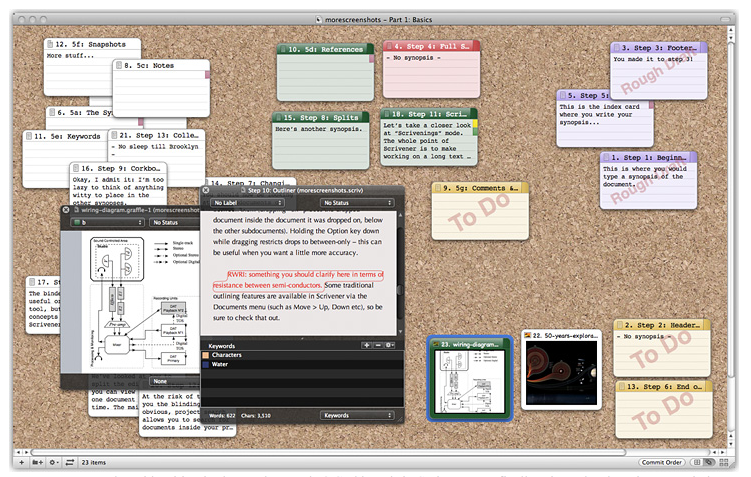
Say good-bye to sticky notes falling on the floor when it gets humid outside. Say hello to the floor you haven’t seen for months, since it’s been covered in index cards. Scrivener allows you to not only create virtual index cards and post them on a virtual corkboard, but you can also rearrange them, even when your manuscript is complete. Need to move chapter 30 back before chapter 14? No problem. Instead of scrolling back up and down through pages of text, just point, click and drag!

Better yet, each index card can function as a chapter synopsis, and you can attach various and individual scenes to each card, again, for easy viewing and rearranging, even within a chapter.

And as an added bonus, you can print out the index cards you create within the program, complete with lines to cut them the exact size of a 3×5 card.

As the website says, “Make a mess. Who said writing is always about order? Corkboards in Scrivener can finally mirror the chaos in your mind before helping you wrestle it into order.”

Don’t like index cards? That’s okay, because you can do your writing (also with rearranging capabilities) via the outlining mode.

3. Don’t just think about Harry Connick as you write out your protagonist’s next love scene. See him on the screen.

Don’t just think about the New York City skyline as your villain creeps through Central Park. Keep a photo of it on your desktop as you write.

Character, setting, and other research organizers allow you to attach photographs, charts, maps, and more all together and accessible as you write. One of my supporting characters looks like Matthew McConaughey. Seriously. He does. So whenever I need to jot down notes about his character, I open up my folder and there he is, gazing at me. Beautiful.

(woah–where did HE come from?!?)

 4. Worry about Word later.

It took me awhile to get over the fear of not writing in Word. But alas, the designers make it possible for you to compile all the text behind all those index cards and export it into one, seamless document which dovetails easily into Word.

5. Other cool features I love:

  • A name generator with every ethnicity and region imaginable!
  • Templates
  • Word count features, by chapter and whole document
  • Color-coding for chapters, editing status, and more.
  • Progress tracking
  • Keyword options
  • Formatting assistance

The website sums it up best:

“Most word processors approach composing a long-form text the same as typing a letter or flyer – they expect you to start on page one and keep typing until you reach the end. Scrivener lets you work in any order you want and gives you tools for planning and restructuring your writing. In Scrivener, you can enter a synopsis for each document on a virtual index card and then stack and shuffle the cards in the corkboard until you find the most effective sequence. Plan out your work in Scrivener’s outliner and use the synopses you create as prompts while you write. Or just get everything down into a first draft and break it apart later for rearrangement on the outliner or corkboard. Create collections of documents to read and edit related text without affecting its place in the overall draft; label and track connected documents or mark what still needs to be done. Whether you like to plan everything in advance, write first and structure later—or do a bit of both—Scrivener supports the way you work.

But wait. Before you buy, please note:

As with any computer program, there are negatives. Some folks–including an adorable and brilliant writer friend of mine–hate it. Also, while a PC version is available, the program was designed to operate on Macs, and the designers even admit it will probably work best on that platform. Try the trial version before you buy it to see if it will work for you and your computer operating system.

Also, you do need to have at least a smidge of computer savvy. And patience. There is a learning curve to this program, and the designers have been kind enough to offer a thorough, interactive tutorial and instruction book. While helpful, the program is so rich even I—a borderline computer geek—felt a little overwhelmed initially. And I don’t know if I’ll ever use all the functionalities.

That said, Scrivener has truly changed the way I approach my novel writing. I feel like it really frees my mind to focus on the prose, because I no longer have to remember where everything is on my hard drive . . . or if my dog ate a sticky note or a stack of index cards.

I honestly don’t know why more folks aren’t using and/or raving about the software.

Try it for free for 30 days.

I can’t throw in a set of steak knives, but I’d be willing to wager you’ll like the program, too.

When to Tell Your Inner Editor to Shut Up!

We’re not supposed to tell people to shut up. We’re supposed to be polite and considerate.

 Icon Design by Creative Freedom  All copyright for Shimmer Icons belongs to Creative Freedom Ltd.  http://creativecommons.org/licenses/by-nd/3.0/
Icon Design by Creative Freedom
All copyright for Shimmer Icons belongs to Creative Freedom Ltd.
http://creativecommons.org/licenses/by-nd/3.0/

I’m here to tell you that sometimes we need to tell our inner editor to shut up.

I’m not saying we don’t need to edit our work. On the contrary, I even wrote this post, 7 Tips for Self-Editing, but there is a time and a place for said editing.

When you’re writing your first draft, I strongly advise you not to edit. Let your ideas flow. If you try to edit now, you may never finish your novel. Or worse yet, you’ll stifle your creativity.

There is another voice, one that may or not be your inner editor. The one that tells you this isn’t any good. Why on earth did you think you could be a writer? You should just give up before anyone discovers you can’t really write.

These, my friends, are the voice of the enemy. Do not believe his lies.

Recently, I heard these words burn through my mind. When you begin to hear the lies, turn to our source of truth. Pray that God’s voice would be the only one you would hear. Ask Jesus to silence everything that is not from Him.

I’ve started doing this every time I sit down to write. It is making a huge difference. We can choose to listen and believe the voice of truth.

If you’re trying to write your first novel or first draft of a new project, focus on getting it all out on paper or the computer screen. It’s fine to check and make sure your book is keeping in check with your outline and overall story and character goal, but don’t try to make it perfect.

Have you ever had to tell your inner editor to shut up? Do you have any tips to keep yourself going when you feel like giving up?

What is “Good Enough”?

just got back from the American Christian Fiction Writers (ACFW) conference in Dallas. This is an annual event and is the largest gathering of Christian fiction writers anywhere. Close to seven hundred (that’s right– a reverse 007!) writers attended. I know because my good friend’s name ends with a Zw, and she was 688/688.

Amazing.

While there, I attended a talk given by a MAJOR Christian publisher about a relatively large survey they did on Christian fiction readers. Don’t quote me, but the survey included over 200,000 participants and focus groups were conducted in three large cities. Just to say a lot of people participated–not just me and Grandpa Joe.

Since many of you may be salivating over some of those results, I’ll share a few here. The largest categories selling are: #1 Amish (shouldn’t be a surprise, just look at any CBD catalog and they are leading by 5-10 pages), #2 Mystery/Suspense/Thriller (my eyes glazed over with excitement right here!) ,and #3 Historical Romance. The romance categories were split among three genres: Contemporary Romance, Historical Romance, and Romantic Suspense so if all three were lumped together, the romance category may have had a higher overall percentage.

They asked “what would you like to see more of in Christian Fiction?” and the intriguing answer there was gritty is okay. Not everything needs to be wrapped up in a pretty bow at the end. Dangling questions are okay.

What surprised me was when one of the presenters said, “Should we move away from highly curated content to just good enough content?”

To be honest that floored me–in a bad way.

What is the purpose of a traditional publishing house? Some say they are gatekeepers. I like to view them more as museum curators. What is the benefit of having a museum curator? It’s so that my seven-year-old’s finger art isn’t next to Rembrandt. That when you pay your money, in the form of a museum ticket or as a book on the shelf, you know someone somewhere who gets exposed to LOTS of art and books picked the very best ones. And you’ll be getting your money’s worth.

Are there some self-published authors who are putting out high quality novels? Yes, absolutely. Are they the majority? No. If we are honest, they are not.

Can you buy a horrible, traditionally published novel? Yes, but it should be edited to near perfection. That’s the other part you pay for.

Proof, my debut medical thriller, went through four rounds of edits. Are there typos–yes. But I can guarantee there are fewer in the whole novel than in the first chapter of a few self-published novels I’ve started to read.

What disturbs me is when a curator/publisher says perhaps we don’t need as many editing runs. Perhaps “good enough” is okay for the masses. They won’t notice the difference anyway. Those are my words–not hers.

But isn’t that the implication? There are so many “so-so” things out there that we really don’t need to be consumed with quality anymore?

To me the quality of the editing is the one thing differentiating traditional and self-published books in many cases. So, if that’s gone, the strive to put the best product out there–what will be the difference then?

Will traditional publishers actually place the last nail in their own coffin if they adopt such an attitude?

What do you think? If you’re published, do you think there are too many editing rounds? Would fewer be better? How should traditional publishers continue to offer value in ways other than editing?

Top 5 Self-Editing Tips: Character

This month, let’s concentrate on an aspect of self-editing that writers spend little or no time examining as they go through each successive draft of their novel: character. The people who populate a novel should seem real to the author, and yet, readers often notice that characters are stereotypes—cardboard cutouts.

To explain the importance of knowing your characters well, let me use an example from the relationship between the famous editor Maxwell Perkins and the well-known author F. Scott Fitzgerald, who wrote The Great Gatsby.

After reading the manuscript for The Great Gatsby, Perkins wrote a note to Fitzgerald about one of his characters, which read:

 “Among a set of characters marvelously palpable and vital—I would know Tom Buchanan if I met him on the street and would avoid him—Gatsby is somewhat vague. The reader’s eyes can never quite focus upon him, his outlines are dim. Now everything about Gatsby is more or less a mystery, i.e., more or less vague, and this may be somewhat of an artistic intention, but I think it is mistaken.”

Last month we talked about how every scene should have intention, but so should every character. Characters need motive. They must seem credible in all they do, as though they truly exist—as if they live down the street.

Fitzgerald, no slacker when it came to building characters, reexamined Gatsby through the eyes of his famous editor and wrote a note back to Perkins:

“I myself didn’t know what Gatsby looked like or was engaged in & you felt it. If I’d known & kept it from you you’d have been too impressed with my knowledge to protest. This is a complicated idea but I’m sure you’ll understand. But I know now—and as a penalty for not having known first, in other words to make sure, I’m going to tell more.”

To fulfill Gatsby’s intention, Fitzgerald needed to make him an enigmatic figure, but to accomplish his purpose, the author also needed to know Gatsby’s history to make him real.

A reader doesn’t need to know who Gatsby’s grandmother was, but Fitzgerald as the author should know if and how she shaped his character. Do you know your character’s history, or did you begin your novel with a vague sense of what kind of character needed to occupy a certain place in your plot?

My suggestion is to keep a notebook on every character, making notes throughout your writing on character development. As you self-edit, you can then look back at your record of their motives, history, and tone of voice to make their dialogue and actions consistent, intentional, and credible.

To make your characters come alive, remember they are more than the sum of their physical traits. Characters possess social, psychological, and spiritual uniqueness as well.


What method do you use to develop your characters?

Top 5 Self-Editing Tips: Intention

In my first post last month on the topic of the Top 5 Self-Editing Tips, I covered in detail how a novel is structured and how you can be more aware of how to build the structure of your novel.

This month, let’s concentrate on an aspect of self-editing that writers rarely hear much about:  intention.

Merriam-Webster’s Collegiate Dictionary defines intention as “(1) a determination to act in a certain way: resolve; (2) import, significance; (3) what one intends to do or bring about.”

The definition of intention includes other topics, but for our purposes, we can examine the synonyms for intention and determine how we might find intention in a piece of writing, whether fiction or non-fiction. Synonyms: intent, purpose, design, aim, end, object, objective goal.

Once you finish your first or second draft, ask yourself, “Did I fulfill my overall intention for writing this piece, and did I achieve my intention in each scene or section?”

Whoa! That sounds like a tall order, doesn’t it? You might be thinking, how long am I supposed to spend on an edit? The answer: as long as it takes. Because if you have not fulfilled your intention in writing your book, then how can your reader know what you were trying to say?

Let me make this a little simpler by starting with a chapter or even a part of a chapter. Did you intend to make your character unsympathetic in this scene? If not, then you have not communicated the soul of your character to the reader. You have not fulfilled your intention. The reader might even think, “Marsha would never say that. Why is she being so rude?”

On a greater scale, your story or your non-fiction book should have an over-arching aim or goal. It is the road that connects you to the reader and pulls the story along. Yes, even a non-fiction book is more successful if it tells a story that persuades your reader to believe in what you’re writing about.

Your road will twist and turn in a novel, but you, as the author, should always keep the goal in mind. You don’t want to tell your reader up-front what your intention is, but you should know where you’re headed. If you take readers down a rabbit trail and nothing of significance happens, they will soon stop following you through the brush.

Only you know what you want to achieve in your book. If you’re leading your reader down a “road less traveled,” the trip may be leisurely or it may zip along. You may travel on a super highway, on a country lane filled with potholes, or you may walk with your reader down a garden path.

But if you veer off that highway/road/path just because you have a sudden inspiration, your book may be filled with pointless arguments (non-fiction) or characters who pop out of nowhere to deliver a useless piece of dialogue (fiction).

My intention in this post is not to say that plotters are better writers than pantsters. You can write your book as you please, but if you know your beginning and where you aim to end—intention—then the journey will be that much sweeter.

To be continued…

How will you self-edit your novel or non-fiction book to make sure your intention is clear and that you have achieved your goal in every chapter? 

Top 5 Self-Editing Tips: Structure

Writing is rewriting, and rewriting is self-editing. “But isn’t that the job of the editor after I’ve made the sale?” No. Some writers think running spell-checker is self-editing. Not so much.

“But won’t rewriting my work edit the life out of it?” No, but it will catch the eye of an agent or editor as a well-written manuscript and may lead to a sale.

Obsessive editing during the writing process will destroy your work. However, after you’ve written the first draft, gain some distance and perspective on your manuscript by setting it aside for a few weeks or a couple of months. Now it’s time to rewrite.

Here are my top 5 self-editing tips in their order of importance for polishing your work to a high sheen.

  1. Structure: Think of the structure of your work as an arched bridge spanning a great river. If the contractor takes short cuts (such as using less cement, steel, or fewer bolts) because she’s bored with the process and rushes to the end, the bridge is weakened and will collapse.  The same holds true for both ends of the bridge. If too much cement is used at either end of the bridge, it will collapse from the added weight.

For the purposes of this post, I’ll concentrate on the structure of novels. If the structure of your story is solid, the reader will continue to turn the pages until the ending scene.

The material of the structure is comprised of the elements of the story arc (the basic story thread) held in place by a beginning, middle, and end. Pretty simplistic, huh? Yet the three-act structure has worked since Aristotle’s days whether you write plays, scripts, short stories, or novels.

Sydney Harbor Bridge

Some authors maintain they have a four-, five-, six-, or even eight-act structure. I maintain if you break down the parts of their story arcs, you will discover classic Aristotelian structure.

Using the bridge analogy, a car drives onto the bridge. This is the point in the novel when you can lose a reader in the first page or two. I’ve thrown many a book (or manuscript) on the pile beside my bed if nothing happens right away. The author might as well have written “blah, blah, blah-blah, blah.”

A novel that piques the reader’s interest starts as far into the story as possible. I don’t want to know that the protagonist’s parents left him stranded in a snowstorm when he was a toddler and that’s why he’s terrified of snow (or abandonment). That’s back story. The story should begin with stasis (a state of equilibrium) and then the main character, pressed with conflict, reveals her goal.

One of my favorite movies is Indiana Jones and The Raiders of the Lost Ark. The story throws you into the action, and the back story―Indy’s character, profession, the setting, and the antagonist―are revealed as Act 1 plays out.

As the story progresses into the middle (Act 2) and the bulk of the novel, you should have rising and falling tension as your protagonist encounters numerous obstacles or crises.

The main turning point, or big surprise, comes in the middle of the novel. By this time the reader believes he has the story figured out. You need to turn his assumptions on their head. The major turning point should be such a shock that no one sees it coming. It should keep your reader up at night turning pages.

The crises continue. Will he? Won’t she? Oh, no! What will happen to this character your reader has invested her time in? Will everything turn out all right? How will the story ever end on a happy, satisfying note now?

Tension mounts and we reach another major turning point before we head into the final third act. Every turning point should be a surprise to the reader.

The crises are unrelenting until we reach the climax halfway through the third act. The protagonist faces off against the antagonist. The clash of the titans ensues. A woman faces her attacker or her paralyzing fear. The antagonist is not always a person. A man pushes his wife out of the path of a stampeding herd of cattle. Will he live? You get the picture.

Tie up all the loose ends of your storyline in the denouement―the final resolution of the plot or story arc. Is your ending satisfying? Does the main character live happily ever after? If you live and write in America, trust me, she better if you want to succeed as a professional author. Americans are eternal optimists.

To be continued…

How will you self-edit your novel to make sure your structure is strong enough to carry your storyline through to the end?

Photo credit: Sydney Harbour Bridge with the Opera House in the background by Ian.

Shocking You Softly

I was once that kid on the playground telling my little friends every bleeped out word in the universe. To be fair, however, I didn’t really know what I was doing. This is elementary school we’re talking about, and my parents were naïve, or remiss at best, not thinking I was cataloging everything.

I’m sharing this because I find myself in a constant tug-of-war of what I can and cannot say in Christian publishing. To be clear, I am not an advocate of swear words. I am a reformed potty-mouth, and I intend to keep my writing free of curse words. To me, that is one of the many beauties of Christian publishing—untainted prose.

However, I can’t stop thinking that Christian publishing is in some sort of shifting paradigm, where two radically different generations are trying to see the whites of each other’s eyes.

Case in point: A beloved friend and fellow Christian author once urged me to take my work into mainstream publishing because the essence of my voice might upset some. She was speaking directly to my inclusion of certain words such as “sucks” and “stupid.”

I didn’t see the big deal at first. Now, however, I’ve been thoroughly acquainted with the big deal. It even locked me in the closet, took away my dinner, and told me to shape up if I ever wanted to see the light of day again. (Kidding. The edit wasn’t that painful.)

I’m not saying I wish to convert everyone to accept or speak my language, but the truth of the matter is I’m a born and bred Southern California girl, raised on MTV and the gag effect of adverbs. Totally.

I get that my style is too much for some, and that’s OK. One writer can’t please everyone. I’ll definitely have my niche, and I’ll walk away with the coziness of being honest to myself and with what I’m conveying to others.

As an example of the real Heather, consider this snippet of dialogue between my husband and me:

Husband: “Don’t you just love the sunset? All the colors coming together like a symphony God is orchestrating, telling us to enjoy ourselves and gaze at something beautiful.”

Me: “Eh. My back hurts. Are we done here? I feel like tacos. You feel like tacos?”

So yeah, if sunsets bore me, you can probably guess how painful it is to pretend me talk fancy.

I once tried writing an entire book the way I thought others would expect me to write. It sucked. And, it was stupid.

Even if it makes people cringe, I can only write the way I know how. That’s a good enough starting point for me. What else would you expect from a Southern California girl who gives up sunsets for tacos?

Have you had to modify your writing to make it work in Christian publishing? Do you regret it, or are you happy that you will be able to reach your audience more effectively?

Three Ways to Focus on Editing for the Web

“Real writing begins with re-writing” (James A. Michener).

I began blogging in 2008, and I’ve visited many websites to determine the most effective way to communicate online. I developed a helpful web-editing checklist below from my research for a writing workshop using three photographic terms—the panoramic, macroscopic, and microscopic viewpoints.

Panoramic View. Begin the editing process by determining the overall, or broader view, of contents and evaluating your audience, purpose, context, and the design elements.

  • Read aloud from the reader’s perspective (not the writer’s).
  • Find main point and sub-points. Can you summarize your piece easily?
  • Examine benefits for reader (take-away value).
  • Use appropriate fonts (not fancy or distracting to your content).
  • Use subheading in boldface type to introduce more points.

Macroscopic View. Take a closer look at paragraphs, word usage, and tone.

  • Place main topics near beginning of each paragraph and sentence.
  • Limit each paragraph to one main idea.
  • Use shorter units of text with more breaks.
  • Use an introduction for a “teaser” paragraph (preview for content).
  • Avoid long texts that break content into several pages.
  • Provide a brief summary or table of contents hyperlinked to each section for text over 500 words. Use lists, hyperlinks, and extra white space for a long document to break up dense patterns of text.
  • Avoid slang, jargon, and inappropriate humor.
  • Use nondiscriminatory language (e.g., bias based on gender, race, ethnicity, religion, age, sexuality, disability).
  • Use common words (appropriate for target audience).
  • Avoid vague words.
  • Use key words to describe the site in the first 50 words of text.
  • Build verbal bridges to connect text (transition).
  • Use action verbs rather than passive.
  • Incorporate single links into content (embedded into the text).
  • Make short, bulleted lists of links.
  • Use “Find Out More” links, when details are needed.

Microscopic View. Zoom in on the elements of grammar, mechanics, and punctuation.

Self-editing should distance you from your piece, so you can examine it without the emotional attachment. You can see your actual words, rather than just intentions. Consider these final ideas to help you edit for the web.

  • Create style sheet/guide with some common problems, to avoid repetitive research of the editing rules (e.g., grammar, mechanics).
  • Find someone to read and edit your work (e.g., critique group, another writer).

Remember: “You write to discover what you want to say. You rewrite to discover what you have said and then rewrite to make it clear to other people” (Donald Murray).

Image(s): FreeDigitalPhotos.net

Do you have any tips for editing for the web?