Writing With a Day Job

Writing Career Plus a Day Job
Juggling a Day Job With a Writing Career?

Are you a writer, or an aspiring writer with a day job? Ever get tired trying to juggle at least two careers, (day job and writing), along with mommy, daddy, spouse, family, friend, and church duties?

If so, you are not alone. A conference speaker gave this statistic. “About one percent of writers succeed at getting published. Because most drop out of the race.” Here’s my post on that experience.

Embedded within that percentage is a smaller number of those who can actually afford to write full-time. Making the leap to a devoted writing career usually requires long-term planning, intentional strategy, and detailed tactics. Jeff Goins’ recent blog encapsulates a great way to approach the goal of becoming a full-time writer. The steps he outlines, I could have written myself. (More on that in a later post.)

But if you’re reading this now, odds are writing with a day job is your reality. Anything else may feel like something built on fluffy clouds.

So how do you bring home the bacon, fry it up in a pan, serve it to those you are responsible for, and after the dishes are done still find time to pursue that dream throbbing with every heart beat? Can it be done? I believe the answer is a resounding YES!

People often ask me how I accomplish everything at work and home, plus write blogs, devotionals, articles, and books. After I imagine my cluttered living room, (I’m not Wonder Woman, something has to suffer), three things come to mind. “Resolve, listen, act.”

As a writer with a day job:

Juggling a Writing Career and a Day Job
Resolve to Invest Time in Your Writing Business

A. Resolve to invest wisely.

  • Treat your day job with respect. Just because you have a higher calling, or a bigger dream, don’t discount the gift of your employment today. After all, it pays the bills, and you can glean great writing fodder from things that happen in your workplace.
  • Watch less television, and write more. 
  • Create your own Writer’s Cave.
  • Rise earlier, and allow fewer sleep-in days.
  • Write when you’re tired, energized, or just so-so.
  • Schedule writing, don’t wait until you feel like it.
  • Celebrate small victories. Fifteen minutes putting words on a screen are worthy of excitement.

B. Listen to voices of genuine authority.

  • For me, the voice of God rings truth above any other I might listen to. Early on, I asked the Best Selling Author of All Time to mentor me, and He hasn’t let me down yet.
  • Do not disregard those who have written with day jobs before you. Heed their valuable advice.
  • Seek the wisdom of professional agents, editors, and publishers. They are in their positions based on education, experience, and talent.

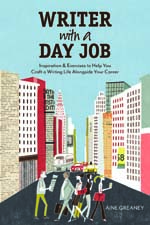
Writer With a Day Job Book CoverC. Act on what you are taught.

  • Be a doer — not a hearer, dreamer, thinker, talker only.
  • Keep something for notes with you always. Inspiration comes in strange times and places.
  • Make tiny goals like, “Write for five minutes before I leave for work.” You will encourage yourself with things to look forward to, and enjoy a sense of satisfaction when you complete them.
  • Keep your word. It’s better not to make a promise at work, or as a writer, than to make one and break it.

Have you read Aine Greaney’s fabulous book, Writer with a Day JobIt’s full of tips, exercises, and encouragements.

Get Thee to a Conference, Writer!

I want to be alone...photo from www.fanpop.com
I want to be alone…photo from http://www.fanpop.com

Like many writers, I work at home, which means I spend much of my day alone. To force myself to get out of the house and interact with living, breathing, real people, I set a goal of attending at least two conferences in the course of the year.

They’re not writing conferences, however.

They’re pre-writing conferences.

In other words, I go to conferences to do research for my books. In particular, I go to events that have to do with birding, nature, and spirituality, since those are my book topics, and I’m always looking for new ideas and the latest developments in the field.

But last month, as I promoted my second free Kindle offer on amazon.com for my Birder Murder mystery series, I realized a marketing benefit to those research conferences: the stuff I bring home – the hand-outs, the programs, the lists of attendees – are invaluable marketing tools.

Influential contacts

You meet a lot of people at any kind of conference, but you might not get the chance to meet them all, especially if they are keynote speakers who typically are surrounded by a crush of people at the conference. If you keep the program, though, you can usually track them down again on the internet, and make contact by sending an email and thanking them for their presentation. Then, when you would like to notify them of your book release or promotion, you’ve got  influential contacts in your target market. Even if you haven’t previously corresponded with them, just naming the conference in a subject line will ensure your email will be read by the recipient. Ask them to share your promotion, and you’ll reach new readers through their cooperation.

Potential readers

Every person who comes to a conference is a potential reader of your work. I recently went to a conference on the therapeutic effects of nature, and chatted with other attendees about my interest in nature and birds. When I mentioned I was an author, I was asked for the names of my books, so I got to do a little promoting to a market I hadn’t previously considered. At a birding event, email addresses of all the attendees are sometimes included (because birders like to email each other about bird sightings), so I have a ready-made email list for special book promotions that I think they might appreciate. Never underestimate the personal touch of addressing individuals!

Creative approaches

Being the packrat I am, I keep all the hand-outs and advertising materials from conferences, too, thinking I might be able to set up a speaking date or promotional opportunity with one of the sponsors. For example, I never thought of wildlife photographers as a market until I met a camera rep at a birding event; now it’s a part of my target audience. As a result, I’ve found that thinking about the ways sponsors connect to conferences is a fertile field for marketing development.

What kind of conferences do you attend and what are the marketing benefits you find?

“Have I Arrived?” Defining Your Expectations as a Writer

I recently went to a fabulous wedding. It was held at a vineyard in California wine country and everyone was dressed to the nines. I was able to interact with many acquaintances I rarely see.

“You’ve published a book!” A friend’s mother cried, hugging me with enthusiasm.

“Self-published,” I felt obligated to mention.

“Yes, but you always wanted to be a writer, and now your dream has come true! You have arrived!”

As she ran off to be photographed next to the bride, I let her gracious words marinate in my head for a while. Have I arrived? Not by my system of measurement. In many instances, a writing career is something that can take a lifetime to establish. So, how do authors know when they have ‘arrived?’

On the outset of any undertaking, it is important to determine what success looks like. Writers can only benefit from defining their own expectations of success. Does success mean self-publishing a book on Amazon for friends and family to enjoy? Does it mean filling a need or service in the community? Does it mean a lucrative career and multiple bestsellers that are optioned for film?

Plane red carpet

If you aspire to have your work read by as many people as possible, that’s fine. There’s nothing wrong with wanting to be a popular writer. However, if you only recognize success as a big time book deal and an over-sized cardboard novelty check, you may never reach your ultimate goal. The writing journey is a long one, with many milestones on the path to success. Reaching a milestone goal might be cause for celebration. How about celebrating the first time a stranger approaches you and asks about your writing? Why not celebrate your first book review that goes online? Maybe one of your milestone goals is selling three hundred books and you celebrate by going out for sushi. There are people who have sold three million books and it doesn’t feel like enough to them. That’s the difference between people who walk the earth happy and those who are vaguely dissatisfied and unfulfilled. They never established the finish line, so all they can see is what they have yet to accomplish, not what they have already accomplished.

If your goal is to be the best writer in America, that’s not possible to quantify, and trying to measure your success will only frustrate you. Whatever your endgame, the point is to determine the location of the finish line and create goals and expectations for building your writing career. It’s important to be honest with yourself about where you want to end up. If you can clearly define and articulate where you want to go, you have a much better chance of getting the help you need to reach your destination.

Emily Bronte only wrote one book in her life, but it was Wuthering Heights. She did not live to see the widespread acclaim for her book, but we can all agree that she was an exceptionally successful writer. Many writers wait for their audience to decide if they have arrived. They are waiting for a stamp of approval from the world, a bestseller list placement, their parents, friends, or maybe their high school creative writing teacher. At the end of the day, though, only the writers themselves can determine if their goals have been met and they have finally arrived.

Do you think that success as a writer is about the destination or the journey?

The Letter

Sometimes, I don’t think we as “Christian” authors give credit to how extraordinary our calling is. I’m speaking specifically to those writers who feel it is God’s will for them to write. We write because we feel burdened to do so. Not burdened like a chain around our necks but restless that if we don’t write then we are not fulfilling what we are here to do.

dark portraitSometimes that calling in light of our circumstances is hard to manage.

Long hours at the keyboard. Perhaps long hours banging your head against the wall when the words don’t seem to be flowing as they should. Managing two careers and likely a family. Wondering how long you can keep up the pace of working two jobs (yes, writing is very much a job) when one’s maybe not paying you as much as you thought it would. No, I haven’t gotten a James Patterson paycheck. Wondering when, if ever, we’ll hit it “big”. Wondering what “big” is?

I think, too, there is added pressure if we consider ourselves Christian authors. Now, there’s a whole other level of worrying/thinking. Is this what God wants me to write? Why did God take me down this path if I can’t survive on this income? Am I writing when God wants me to do something different? Am I still working my “real” (and paying) job when all God wants me to do is write?

LampPost

And so we look for God’s little lampposts along the path. Something—anything to affirm that this is the right, chosen path. That our typed words on a white screen would make a difference to someone, somewhere, in a Godly way. That someone’s faith would be affirmed—strengthened. That maybe our words would give sense to what Jesus did on the cross in a way that someone could then believe in that sacrificial offering for their own lives.

Now, after being on this journey for a couple of years, this is what I know. Sometimes these lampposts along the path are not what we think they will be. Maybe my affirmation is not in selling a gazillion copies of my book or hitting the bestseller lists.

But in a letter.

One of the smartest things I did as an author was leave an e-mail address in my published books and ask readers to e-mail when they finish with their thoughts. Some authors don’t do this for fear of spamming, privacy, etc. You can list your own reasons.

So far, I haven’t received any creepy/concerning e-mails. I have gotten over fifty letters from readers which is nice when you’re also getting one star reviews (particularly on Christmas Day—yes, that did happen!)

I’ve only sobbed over one letter—thus far.

It was written by a woman who had just finished Proof—my debut medical thriller. Proof, at its heart, is about Lilly Reeves, an ER doctor without faith and her journey to coming to know Christ through a trial- by-fire series of events.

In the novel, a physician friend tells Lilly the story of Lazarus. How Jesus waited three days to respond to his good friends’ cries for help. At first, this seems unusually cruel. But in the end, when Jesus raises Lazarus from the dead, Jesus does a miracle he’s never performed before and gives a prelude to his own forthcoming sacrificial offering.

The letter that brought me to tears was from a woman who was in the midst of her son being diagnosed with cancer. He’d just been through the surgery to retrieve lymph nodes and the surgeon was fairly certain of a lymphoma diagnosis—they were just waiting for the final biopsy results. She specifically mentions this passage of the book and what it meant to her at that moment – “. . .we are praying for healing for our son, but completely trust him to God’s plan, whatever that is . . .”

So humbling.

Remember, God communicated his presence to us in two ways. Through his creation and through his words.

Typed words on a page.

Consider this and the smaller lampposts along your path when you’re wondering exactly why you’re on this crazy writing journey. Maybe it’s not for a James Patterson type paycheck.

But simply for a letter like this . . . and the impact your words will have for one person.

Would this be enough for you to keep going if God has placed the call to write on your heart?

This post first appeared on Elaine Stock’s Everyone’s Story. Check her blog out.

Tweetables

Lately, I’ve been noticing this new trick amongst bloggers for fashioning “tweetables” in their blog posts. These are short, catchy phrases that let readers instantaneously click and tweet a hook about your post. Several tweetables are offered in hopes of getting that mouse clicker finger engaged.

Social media conceptSo I thought I’d go through the process of learning how to format one and take you on the ride with me. A shout out to Elaine Stocks for pointing me in the right direction. Check out this blog post at Blogging Bistro for instructions as well. I am hoping to simplify. We’ll see how that works.

Step 1: Go to http://clicktotweet.com/. Once you go there, format a phrase you want others to tweet about. It will generate a link for you, which you can add to your post. Here the first one I did.

Learn How to Format a Tweetable. Click to Tweet.

Step 2: Hit the preview button.
You can then click preview to see how it looks. And mine looks, well,  boring. It’s just the phrase and doesn’t point much to me or the Water Cooler. Let’s try again.

Know how to format a Tweetable? Not as hard as you might think. Click to Tweet.

This is how it will look when tweeted out:

Know how to format a Tweetable? Not as hard as you might think. @JordynRedwood @WordServeLit http://wp.me/p1H9QL-2zH

Step 3: Helpful tips.
Remember, with Twitter you only have 140 characters to work with. In WordPress you can automatically have it give you a shortlink for your post by hitting the button “Get Shortlink” at the top of your editing screen. When you do this, copy and paste that link into your Tweetable. It will save you precious character space to come up with a great Tweet.

However, Blogger doesn’t format shortlinks, though you can customize one for yourself. Blogger will give you a permalink (finally!) and what you can do to shorten it is copy and paste it into the publisher in Hootsuite. It really is not as hard as you might think. From the shortened Hootsuite link you can copy and paste it into the Click to Tweet format system.

Step 4: Format it into your post.

I agree with Blogging Bistro that Rachelle Gardner has a great way to format Tweetables and I’ve copied that style here. You can view her blog for that look or come up with your own crafty, creative way to entice people to tweet.

Why format tweetables? A couple of reasons. When you hit the tweet button at the bottom of a post using the social media sharing buttons, it basically tweets the title of your post which may or may not catch the eye of readers. Tweetables offer several different phrasings to try to get people to tweet that may be a way for them to capture their tribe.

What about you? Have you tried tweetables?

Avoiding the Comparison Trap

img_1154

Each one should test their own actions.
Then they can take pride in themselves alone,
without comparing themselves to someone else.  Galatians 6:4

Nothing stops the flow of creativity more than comparing myself to others.  Usually I’m comparing my insides to their outsides. My rough draft to their finished book. My internal  mess to their polished perfection.

Comparing makes me insecure. I look at the work of others and all my doubts surface. In my mind, questions arise about my abilities. Inspiration is lost and work stops.

 “Don’t always be appraising yourself, wondering if you are better or worse than other writers.  Besides, since you are like no other being ever created since the beginning of Time, you are incomparable. ” Brenda Ueland

God has created me and He knows me. He has given me the ability to write. I want to be confident in my work.

Comparing makes me ungrateful.  I can be pleased and thankful for my work – then I walk into a bookstore and begin to compare.  I no longer appreciate the unique words that God has given just to me. I am no longer content with what I have.

 “Comparison is the death of joy.”  Mark Twain

God has blessed me with the gift of writing.  I want to rejoice in that.

Comparing makes me judgmental. I can find myself looking for the weaknesses of others to bolster my own pride. I need to watch out for any thought that starts with, “Well, at least I didn’t . . .”  Each of us has a unique calling to write. We should always examine ourselves, not others.

 “How much time he gains who does not look to see what his neighbour says or does or thinks, but only at what he does himself, to make it just and holy.” Marcus Aurelius

God has given me colleagues in writing. I want to rejoice with them.

Comparing pulls me off course.  I can lose heart and focus when I am concerned about what others are doing instead of the work that God gave me to do.  When I am too busy watching others, I am not working.

 “Peter must have thought, “Who am I compared to Mr. Faithfulness (John)?” But Jesus clarified the issue. John was responsible for John. Peter was responsible for Peter. And each had only one command to heed: “Follow Me.” (John 21:20-22)” Charles Swindoll

God has called me to write. I want to be productive in my work.

How can we avoid the comparison trap?  I must keep the focus on God and what He has for me to do today. Then I can appreciate my work, be grateful, celebrate the work of others, and stay on track.  Simple! Or is it?

And let us run with perseverance the race marked out for us,
fixing our eyes on Jesus, the author and perfecter of faith. Hebrews 12: 1-2

How about you? Do you compare?

Betsy Duffey and Laurie Myers
WritingSisters.com

They Also Serve Who Drink and Weep

Coming home .. .. The writing life takes me away from home often. I write this the day after returning from 2 weeks of travel, home to Kodiak Island, to my husband and sons and daughter and Yorkshire terrier who badly needs a groom. I walk through my door and want everyone to kiss me as if I have just been born, as indeed I have.

photo

I am home, but I cannot stop thinking about her, the woman I met on the plane. It was the fourth and last plane of the trip. I was almost there. I edged down the aisle and saw her—crying. Sobbing on her phone. My eyes went dark, my heart tightened. As I stepped past her, I heard her say, “They just told me. I have pancreatic cancer. He gave me 3 – 6 months to live. I don’t want to die!” and she dissolved again into weeping, running her hands through her hair.

She was beautiful, dark-skinned, dressed in expensive jeans, a leather jacket. Her phone was pink. She gripped it so hard, hanging on to whoever was at the other end. My seat was one row back and one row over. I could see her profile, hear every word. I looked around desperately. A woman was dying! And we were calmly sitting in our seats, buckling our seat belts against death—and would soon follow all the safety requirements, while she was no longer safe. What do I do?

a woman with hands covering face

Men sat in front of her, and in back, each one with the bland face we wear when we pretend we don’t hear because we too are afraid. I wanted to do this too, but there was an empty seat beside her. She would be alone this entire flight with no one .. .. And how could I forget what I had prayed that morning? In the hotel room, on my face, wanting this day, this one day, to have a pure heart, to serve someone . . . “May your kingdom come, Your will be done .. May I hear you and serve you this day . . ..” and off I went into another day of terminals and planes—and there she is near me, still crying, the seat beside her empty.  I have work to do—a chapter is due, edits for an article are due, but the seat beside her is empty.

airplane seat

Shaking, I unbuckle my seatbelt, lift my bag and stand beside her. “Is it okay if I sit beside you?” I smile. She looks up at me, surprised, with her ruined face and nods, trusting, like a child, her eyes again filling with tears. I sit, she watches me settle. “What has happened?” I ask her and it pours out, but there are hands now to catch what falls, our shoulders touch, I stroke her arm, and we mourn and grieve and sit together in the shock of it. She is young. She knows Jesus, but she doesn’t want to die she cries again and again through a twisted mouth. I silently scream to Jesus to give me the words. I need them when I am writing, but I need them even  more now … .and they come. At one point she grasps my hands and says, “God sent you to me.” Mostly I am there to cry with her, to drink chardonnay with her. I know the chardonnay will wreck me, but had she offered me whiskey, I would have drunk that too.

It wasn’t much. I write all this not for anyone to say, “Oh, what a great servant you are!” Because I am not. How many people have I not seen and walked past? How many have I seen and still walked past? But this is instead about this wondrous, terrifying God we serve, who has asked one of his daughters to die a hard, early death, and who asked another selfish frightened daughter to sit with her in her fear and aloneness for a short time. It was so little. And she staggered off the plane to walk into the end of her life—and I staggered into a car taking me to stages and microphones.

Here is what I remember : “They also serve who only stand and wait.” John Milton wrote in his sonnet “On His Blindness.” I was going to speak on podiums, in many places, before many people for two weeks, but none of that mattered then. Of all I did on that trip, perhaps this mattered most: “They also serve who only sit and weep.”

2013-04-01 07.20.39

Can tears really be enough? For that day, for that hour, yes. God will provide another servant, and another for every empty seat beside her.

Do we dare ask this each morning? “May I hear you and serve you this day.” Yes, dare. Then watch for the empty seat. Bring tissues. Drink wine if you must. Become a child. Give whatever you’ve been given. Sometimes it will be words. More, it will be your presence and your tears.

And the kingdom of God will come near.

“Would You Like to Meet the Author?”

"Soapdish" photo from www.lazydork.com
“Soapdish” photo from http://www.lazydork.com

There’s a funny scene in the movie “Soapdish” that depicts a depressed soap opera actress, played by Sally Field, getting her recognition fix. She goes in dark sunglasses to a shopping mall with her best friend, who suddenly shouts “Is that who I think it is?”

Everyone around them stops, the actress removes her glasses, and she is immediately thronged by fans, all wanting an autograph. She smiles, graciously greets her admirers, coos at babies, and regains her self-confidence.

This has never happened to me. Not the depression part–every writer gets the blues in the face of the enormity of the writing endeavor. But I’ve never had crowds of people clamor for my autograph–not in a bookstore, and certainly not in the middle of a shopping mall.

I did have a moment recently, however, that brought this scene to mind in a good way.

My husband and I were playing hooky, taking a weekday afternoon to stroll through the Minnesota Landscape Arboretum, which happens to be about five minutes away from our home. The Arb has carried my books for several years now in its gift shop, and I’ve made a few book signing appearances there, but I’m by no means an author who is recognized by the general public. After touring the gardens, my husband and I headed into the gift shop for our usual browsing, and while I inspected some lovely sweaters and ceramic dishes, he went into the book section to see my books on display.

A moment later, I heard his voice from across the aisle.

“Would you like to meet the author?” he asked a woman who was standing in front of the display, one of my books in her hand. “She’s my wife.”

Say no, I willed her. Sporting my heavy parka, my hair doing its dry electricity bush thing, the last thing I’d expected was to be called upon to meet a reader.

“I’d love to,” she replied, turning in the direction he was pointing out to her, which was straight at me.

I slapped on my ‘meet-my-reader’ face and smiled as my husband ushered her over. We shook hands and I introduced myself, then asked her if she’d read any of my books.

“No, but I’ve heard about them,” she told me. “So I thought I’d give one a try.”

We chatted a bit more, I offered to sign the book in her hand, and after a few more minutes, she left to pay for her book at the register.

“Do you feel like the actress in the shopping mall?” my husband asked, referring to the movie we’d both enjoyed many times over.

“Yes and no,” I replied. “Yes, in that I was recognized, thanks to you,” I added, punching him lightly in the arm, “and no, in that I wasn’t feeling the need for attention to refuel my artistic career. But it was fun to give a new reader a nice surprise she didn’t expect.”

Actually, I hope I do that every time readers pick up one of my books: I want them to get a nice surprise.

Without the dry electricity hair bush thing, though, thank you very much.

The Surprising Thing About Book Influencers

My first book is almost a reality. In fact, a box could show up on my doorstep any day.

This stage of the process is humbling because I have to rely on busy people to read and help promote my book. At this point, I reminded myself that I’m not only working to promote myself, but I’m also working for the publisher who put so much faith into my project. That makes it a little easier to do the asking.

Two weeks ago, my publisher’s marketing gal, Cat, asked me make a list of all the media people and influencers who would read and promote my book. Media people? I only know the PR guy at Focus on the Family and a baseball sports announcer.

iStock_000013189752XSmall

Cat said media and influencers can be anyone who has a large audience. That means bloggers, authors, and speakers.  With that being the case, it turns out I know a lot of influencer and media peeps.  So, I collected names and addresses and passed them on to my publisher. Now hard copies are on the way to their doorsteps, too.

So what have I learned that I can share with you? Authors shouldn’t just ask for help from friends. They should ask for help from strangers, and big-time famous people.

Why?

You will be amazed at who says yes (and who says no). When I put out the word, I had some interesting responses: Some of my friends said they were too busy but if I passed along a copy, they’d try to get to it. Another friend hasn’t responded at all. Conversely, famous people I never thought I’d hear back from said, “Sure, I’d be honored.” Others went above and beyond: “You bet, and why don’t you let me put your book in a giveaway at my retreat and I’ll write a special feature about you” or “Hey, I’ll mention you at this event.”

Even strangers can have a powerful impact on your sales. I read a few articles that said if you can find top reviewers from Amazon to read and review your book, it can boost your sales. Finding someone within the top 500 is considered a coup. So yesterday I sent out four inquiries to reviewers who are interested in my genre. Two top-50 reviewers responded, “Sure, send the book.”

Feel free to read the articles about Amazon Top Reviewers here:

http://www.amazon.com/gp/richpub/syltguides/fullview/RNCWTLEMV71VM

http://www.thecreativepenn.com/2012/09/16/get-amazon-book-reviews/

http://www.huffingtonpost.com/2011/06/16/amazon-top-customer-reviewers_n_878262.html

http://www.amarketingexpert.com/easy-tips-for-getting-more-amazon-reviews-now/

I guess the moral of the story is reach out to everyone, pray for the best, and don’t get hurt or upset when people say no. Lots of people will come out to support you.

If you’re a published author, how did you find people to promote your book? 

My Friend Jane Kirkpatrick and Feeding the Lake

Jane-1-EE (3)One of my most meaningful evenings as a writer had nothing to do with me and everything to with my friend, workshop partner and fellow writer Jane Kirkpatick.

It was 2005 and Willamette Writers, our state’s largest literary organization, presented Kirkpatrick with its Distinguished Northwest Writer Award. Among recipients of the past: Ken Kesey and Ursula Le Guin.

In accepting the award, Kirkpatrick, then 59, quoted author Jean Rhys to 400 people: “All of life is like a lake made up of many stories, fed by many streams. Some of the streams are long and mighty, like Tolstoy and Dostoevsky, and some are small, like me. The size of the stream doesn’t matter. All that matters is the lake. Feed the lake.”

Kirkpatrick, who then lived on the John Day River in north-central Oregon, told how, at age 36, she first tested the literary waters. Head of a social service agency, she took a writing class through a community college adult education program. “I was terrified,” she told me. “I thought: I don’t belong here.”

The teacher, she later learned, felt the same way about himself. But, neophyte that he was, he still recognized good writing, once choosing a piece by Kirkpatrick to read aloud.

“My heart was pounding so hard I could hardly hear the reading,” she said. When he handed back her paper, it said at the bottom: “You have a gift.”

At the time, she and husband Jerry were still reeling from the loss of Jerry’s son, murdered at 21. She was suffering from a serious gluten intolerance. They needed a change.

The two decided to sell everything, leave secure jobs and homestead on the John Day River, where Jane would write.

At a place called Starvation Point, the home would be known as their “Rural 7-Eleven” — seven miles from their mailbox, eleven miles from pavement. They built it. Dug a well. Battled rattlesnakes. And ran seven miles of underground phone wire.

Once semi-settled, Jane began writing and sending stories to magazines. Rejection. Rejection. Rejection. Then it happened: One sold. Sports Afield, for $75, bought a piece she wrote on repairing fishing poles with pine tar. Then Northwest magazine bought the story her teacher had read aloud in the class.

She began wondering: Could I?

Jane began working as a mental health counselor at Warm Springs Indian Reservation. On Tuesdays, she would make the nearly three-hour drive — longer during snow and ice — and on Thursdays, return.

Then she would start writing, disciplining herself to get up at 4 a.m. Her first book, Homestead (1991), was about her experience on the John Day. More than two dozen have followed — fictional stories of the human heart, based on real events, and often involving women, pioneers, and Native Americans.

At least some of her empathy for those overcoming odds comes from her own experiences. She and Jerry were badly hurt when their small airplane crashed. They took in a granddaughter whose drug-hampered parents weren’t able to raise her. She lost a sister to disease in 1997. In the last year Jerry, 82, has battled numerous physical challenges.

“It’s the obstacles in life that carve out our character,” says Kirkpatrick. “Character comes from the Greek word `to chisel.’ It’s what’s left after you’ve been `gouged out.’ ”

What some of her colleagues were applauding on the night she won the award — none perhaps more enthusiastically than I — was the never-quit spirit that she writes of. And lives.

While working on a book of my own, for instance, I will often hear the “get-up-and-write” alarm at 5 a.m. and think: no, no, no. But then I rise, remembering that my ex-student Jane has already been up for an hour, feeding the lake.