The Myth of the Crossover Book

My last post I talked all through the dilemma with book categories that bookstores expect to see when your book is finally published. You either have a clear one or your book will get lost.

BookwormBut what of the intended audience—and message–for your book? Does this also have to be perfectly obvious to get any traction in sales; to make any impact in the world?

I hope I don’t harp on this too much, but I’ve got 20 years and about 2,300 books I’ve had the privilege of representing. About 10% of my sales over the years have been through general market houses. In all of that time I’ve heard hundreds of authors and potential authors tell me they wanted to write the book for “the crossover market.” Read: I want to do some appropriate, hidden preaching so that the reader will consider faith or make a conversion.

Here’s what I know: New York editors don’t want books that surreptitiously preach or try to win anyone to faith. And they really don’t want overt Christian books unless you’re got a massive sales history and platform. “That’s why,” they infer, “our parent company bought a specific Christian publisher…so that we wouldn’t have to see/publish these books.”

So if you tell me you want me to sell a proposal to a general market publisher, saying something to the affect of “let’s be bold and take the Cross over to a secular publisher,” I’ll be sympathetic with your goal, then immediately talk you out of it. Your heart may be in the right place, but your realistic knowledge of what publishers want is lacking.

The truth: It can’t be done. General market houses care about great books that serve readers … and sales. They don’t want to hear from a Barnes and Noble manager that books were returned from angry customers who felt duped (or offended) by the content. My opinion is that those few books that do escape the religious section in B&N (perhaps 1 or 2 a year) really aren’t making a lasting impact. They’re not even planting seeds. Why? Because there likely is not another actual human to help the reader take their seeds of faith and make sure they have been placed on fertile soil.

The small percentage of adults who ultimately do come to faith do so after watching a genuine believer over time, getting their specific questions answered, and usually finding a community where they feel loved and accepted. They rarely (if ever?) stick to the faith because they bumped into a book at B&N.

People mostly buy books because of word of mouth. And they come to faith by watching a consistent imperfect life, and then likely directly interacting with God’s Word in some meaningful way.

Yes, there is the very rare exception. But so rare it borders on impossible.

So if you want to write anything that may make the life of Jesus more attractive, write it to those already in the faith, and hope that they are able to naturally hand the book off to someone they know; someone who if they do come to faith will then have a natural tie back into a community of real people helping each other through life.

Books are a powerful tool for good. People do get moved to consider faith because of them. But 99% of those books were published by a Christian publisher written primarily to Christians.

And let me say a word about the middle. If you try to hit the middle, you likely lose both audiences. The middle isn’t looking to be converted or for Christian content. If you want to write a book for the general market audience, build your platform or skills and write it without expectation you’ve taken the Cross over. If you include Christian content in your book, fiction or nonfiction, do so in a natural way that communicates a strong and obvious message.

Question: Do you know of any book that has made an impact with your friends as it relates to faith?

The 15-Minute Writer: Taming the Social Media Monster

file0002062790027 This is part five of a series. Read parts 1-4 here.

Ever wonder how top authors (especially those with families) do it all–write, read, speak, tweet, pin, travel, correspond and more? I’ve got a hunch that they choose what they’re best at, and hire talented people to do the rest.

There are simply not enough hours in the day to do it all. In addition, since new social media platforms pop up regularly, it’s easy to get overwhelmed.

Over the past few years as a writer-mom, I’ve made more than a few mistakes, but I’ve also learned to prayerfully make (sometimes tough) choices. With God’s help, I’m taming the social media monster–instead of letting it wreck my schedule and family life.

  • First, I regularly revisit my priorities. As seasons of life change, so do my family’s needs and schedule. When my children were small, I wrote during Mother’s Day Out and nap times. Now, I write, research, and update my blog and Twitter or Instagram accounts during their school hours and activities. I try to be available to them after dinner and while they’re doing homework, keeping certain times free of online distraction. So far, it’s working well for us.     OLYMPUS DIGITAL CAMERA
  • Second,realize where I’m strong–and weak. I began blogging in 2004, and last year, I admitted to myself that I’m simply burned out. Bleh. Meh. Etcetera. However, giving myself permission to blog less often, and do other things I enjoy more (keeping an active Facebook and Pinterest presence, for instance) has helped my attitude about online promotion. I also love my work as an editor at an online magazine, and the curating I do for The High Calling helps me build my own platform. Score!
  • Third, I recognize my addictive tendencies. Recently, I discovered that with a few handy-dandy apps on my Iphone, I could tweet, chirp and pin while waiting for doctor’s appointments, eating by myself at fast food restaurants, and even in bed. The only problem? I had used those times previously to read, daydream or think. No down-time for Dena makes her a grumpy girl–and a boring writer. So, I decided to delete the apps. I already feel more peaceful and balanced.
  • Fourth, I reign in my expectations. Someday, when the kids are grown, I will have more quiet/alone time. (Please, God?) And I don’t want to have a ton of regrets later in life. This creative, crazy family is where the Lord has placed me. He has also chosen to give me wonderful writing opportunities. Such a precarious balancing act means I can’t pursue every single marketing or promotion lead that comes my way. I won’t be able to accept every speaking engagement I’m offered. And I can’t attend every platform-enhancing conference that looks interesting. This both helps and hinders our family financially, but God has always honored my commitment by providing everything we need (and most of what we want). As my dad told me many times, “Honor God, and He’ll honor you.”

Hopefully, my experiences will encourage you in your own efforts to mollify the online marketing beast. What are YOUR tips for handling this potential monster?

Being a Joseph to the People You Write With

1985 Montgomery WardWhen I was in my late teens I worked at a Montgomery Ward store. One day my supervisor told me to stock inventory in our sporting goods department, but the shelves were a disaster. Fishing lures of varying shapes in reds, oranges, blues, and browns were strewn beneath the silver pegs they’d hung on earlier.

I groaned to myself and looked around. No one will know if I put the new ones on the pegboard and leave the mess scattered below. They’ll assume customers came behind me and wrecked my work.

But my conscience wouldn’t let me get away with it. You’ll know. Mom and Dad always told you to leave things in as good a shape or better than you found them. They’d be disappointed if you did a shoddy job. 

So I got to work, and straightened every artificial worm, spinner bait, and fluke. When I finished, I stood back with a sigh and surveyed the tidy results. I didn’t hear my boss walk up behind me.

“Nice job. This is the best I’ve seen this area in months. Keep up the good work.” Then he patted me on the shoulder before walking away with a smile on his face.

Less than two months later, I received a nice raise and a small promotion. And I learned a valuable lesson through positive reinforcement.

A lesson I’ve carried with me into my writing work, along with another principle I picked up from a historical figure. I apply both to my career today.

The historical figure I mentioned is Joseph. His account in Genesis demonstrates an amazing work ethic that eventually brought him miraculous outcomes. Not without difficult circumstances, or serious setbacks, but by adhering to a determined set of attitudes and actions, Joseph overcame his adversity. And he ultimately succeeded.

As an author, I take the things I see in his story and allow them to help me be a Joseph to the people I write with. Whether it’s my literary agency, publishing team, or booking agency, like Joseph, I strive to:

  • Learn their ways, and follow their processes
  • Treat their business as if it were my own
  • Pray, and then listen for God’s wisdom on the steps I should take next
  • Always respond with a respectful attitude, even when boldness is required
  • Exercise patience when the situation looks bleak
  • Refuse to take credit that belongs to someone else
  • Believe in my early dreams — trusting they came from God

Anita Brooks - First Hired, Last FiredI share a more in-depth version of these principles in my book, First Hired, Last Fired — How to Become Irreplaceable in Any Job Market, releasing early next month. When it comes to writing, I have much more to learn, but these basics serve me well, and I hope make me an author others appreciate working with.

At the end of my career, I pray I’ll leave a few writing related businesses in as good a shape or better than they were before we partnered. I want to be a Joseph, for God’s glory, and the good of other people. Otherwise, why bother writing for publication at all?

WordServe News: June 2013

Exciting things have been happening at WordServe Literary!

On the final post of each month you’ll find a list of Water Cooler contributors’ books releasing in the upcoming month along with a recap of WordServe client news from the current month.

New Releases

TheBrotherhoodTerry Brennan’s second novel, The Brotherhood Conspiracy, has come out with Kregel.

***********************************************************************************************

Too BlessedDebora Coty had her 2014 Planner based on Too Blessed to Be Stressed released through Barbour.

***********************************************************************************************

QueenofShebaRoberta Kells Dorr (deceased many years ago) had another of her out of print biblical novels released. This one, Queen of Sheba (Moody).

***********************************************************************************************

AHeartDeceivedMichelle Griep has her first novel released through David C. Cook, A Heart Deceived.

***********************************************************************************************

New WordServe Clients

Victor Watts just signed with Sarah Freese. Victor is a great writer, and we look forward to what he will contribute to the WordServe team!

Bill Donahue, leadership and community expert writing nonfiction.

New Contracts

Arnie Cole and Michael Ross signed with Authentic Publishers to write The Worry-Free Family.

Cris Krusen signed with Baker Books to write Buried Treasure: History Makers of the Faith. A look at 12-15 little known people of faith who made an impact in the world, even though they were not known as full time ministers.

Ema McKinley signed a one-book contract with Zondervan for her miracle healing story, Jesus in My Room. Cheryl Ricker is her collaborator.

Lisa Velthouse signed on with Lauren Scruggs to collaborate with her on Believing You’re Beautiful: Choosing to Be Who God Says You Are. Tyndale will publish in 2014.

Bob Welch signed with Thomas Nelson for two books: 52 Life Lessons from Les Miserables, and 52 Life Lessons From A Christmas Carol.

What We’re Celebrating!!

IntotheFreeVery happy, proud, and honored . . . for Julie Cantrell who was awarded two Christy Awards (the Christian awards for the previous year’s novels) at last week’s ICRS convention. She not only won in the “Debut Novel” category, but the Christy’s also added a new category this year: Novel of the Year. And Into the Free, Julie’s first novel, was awarded the best novel in all of Christian publishing for 2012. Wow. A starred review in Pubisher’s Weekly, a New York Time’s bestseller…and now this. Way to go, Julie! It couldn’t happen to a nicer lady.

Jan Drexler’s The Prodigal Son Returns continues to do well. She recently received news that she is a double finalist in the TARA contest. Way to go, Jan!

Jordyn Redwood’s debut novel, Proof, became a finalist in the Carol Awards in the “Debut Novel” category. Awards will be given at this September’s ACFW in Indianapolis. As we all like to say around here, “Strong work!”

What can we help you celebrate?

Writing Aversion Disorder

I am currently suffering from writer’s block—or, to use a term more descriptive of how it actually feels on the rare instances when it seizes me, Writing Aversion Disorder (WAD), an ailment of much more serious proportions than mere blockage. Pointless No Entry sigh--James YardleyIt’s not just that I can’t think of anything to say or don’t like what I do say or even that the words are there but just won’t emerge from my brain or fingers onto the virtual page. Rather, I’m incapable of even approaching my computer. The thought of writing nauseates me.

As such, I’m late posting this month, which has surely not endeared me to the tireless and underappreciated editors of this blog. We’re supposed to set our posts two weeks early to give them time to look our writing over before letting it loose into the blogosphere. I feel bad about my sloth. I can’t help it, though. I’m in a bad way.

It should be good writing time for me. As a professor, I have summers off, and, with both daughters occupied with faraway internships, I’ve had big writerly plans this summer. I’m right in the middle—the most exciting part, where all the narrative strands start coming together—of a novel-in-progress, and my goal, before WAS set in, was to get ’er drafted by summer’s end.

Now my goal is to do anything but write. Read. Relearn “Minuet in G Minor” and “Für Elise” from my year of piano lessons as a child. String beads from stashes I found in my daughters’ rooms to make gaudy bracelets for myself and them. Play Spider Solitaire on my new phone. (My brother recently clued me in on how to Control-Z back to a game’s beginning to avoid wrecking my win-percentage.) Clean my deceased mother-in-law’s house down the road. (I’m not joking: I spent all day yesterday there, sorting, tossing, soaping, scrubbing.) Weed my garden out in the hot sun.

Raised bed--photo by SrlI was thinking about this problem as I crouched, hands in the dirt, today, and it occurred to me that, while I usually love working in the garden, even weeding, I’m also overcome on occasion by Gardening Aversion Disorder (GAD)—surely related to WAD. So, with no other blog post in view, I decided to examine what triggered my GAD episodes for anything that might illuminate and, ideally, solve my current dilemma.

Here’s what I came up with: I suffer from GAD when tasks or trips have taken me away from the garden for bit and, upon my return, everything has gotten out of control. Vegetables need harvesting, many having overgrown their tastiness. Itchy weeds carpet the gravel paths between the beds. Sand fleas have made lace of my eggplant leaves; my bean vines are encrusted in ants; my tomato plants are speckled with big black beetles. I know I have to regain control but don’t know where to start.

The answer to my own question—where to start—is to not ask it in the first place. Don’t look, I tell myself. Just leap! Whatever task I choose, my gardening soul has learned to believe, will be more productive, more creative, than wallowing in indecision.

Maybe I don’t want to write, I speculated, because I’ve lost control and uncertain where to start in reclaiming it. And, indeed, as soon as I thought these words, I knew them to be true. That little lightbulb of insight was all I needed.

Perhaps, I thought—or hoped, or both—I need to quit trying to figure what part to work on next and just do whatever comes to hand.

And somehow, having just that much—that little—of a plan sent me back to my desk to dash off this post and then leap back into story.

Scenes From a Street Fair

Writers, have you ever participated in a street fair?

I recently had the opportunity to represent local authors through Read Local San Diego at the Encinitas Street Fair. The total cost of the booth for a couple of days was $300.00, broken out into time slots for authors to utilize at the price of $25.00 for a two hour period. Considering that literally thousands of people attend the annual Encinitas Street Fair (situated two blocks away from the Pacific Ocean), it was clearly a cost effective way to gain exposure in the community. 

Parking nearby was out of the question. My husband was good enough to drop me off near the booth, using back roads to weave in and out. Realizing this would be the case, I took a roller bag with wheels to carry my books, a desk easel to display my books at the booth, several pens, a pad of paper, and a set of business cards. As far as the number of books, they suggested at least five, so I brought twenty. Next time, I’ll go with around forty or fifty. I pre-signed the books with a “hope you enjoy the read” type message, so I could quickly fill in people’s names and the dates and facilitate the process.

There were three other authors at the booth with me. We had two six-foot tables, with two authors per a table. “Oh, you’re here,” my table mate said when I arrived about five minutes before our shift began. “I was about to take over your table space.”

I became acquainted with him and the other three authors in my shift. At first, none of us were sure of how to engage the throes of people walking by our booth. One author called to people like a carnival barker, offering a chance to win one of his books if people would fill out a slip with their email and mailing addresses. Most folks, there with the intention of being out for a stroll and buying no greater purchase than a funnel cake, weren’t too receptive to this approach. The four of us did some brainstorming and giveaways seemed to be the way to go in this environment. I gave away free signed copies, asking for an honest review on Amazon in lieu of payment. That seemed to go over pretty well. In each book, I placed a business card with my contact information on one side and my book cover on the other side.

Next to our booth was a fifth local author, a gentlemen of a certain age who writes for the Young Adult market. He has quite a following and teenagers kept coming by throughout the day to say hello to him. He has nineteen books to his credit and required his own booth. He is an adjunct professor at a local university and asked if I would like an opportunity to speak and / or teach. The street fair was proving to be a good opportunity to interact not just with the public, but with like-minded authors.

Street fair

During the slow moments of the shift, our group compared notes and talked shop. An elderly man in the group who was intimidated by social media went home with an education about how to use Twitter. One lady needed a reasonably priced editor and received a referral. Another writer needed a graphic artist referral for book covers, and was given several suggestions. I became familiar with the San Diego Writers Guild and started looking into their upcoming meetings.

We also worked as a team, which was fun. If someone approached an author whose book wasn’t their cup of tea, then there were four other writers of very different genres available to meet. Several authors had huge display posters with the covers of their books. They said these can be ordered online, and all one has to do is send in the content and a digital file. We learned that coffee and books and wind are not a very smart combination. We learned that a roll of duct tape is imperative in order to fix issues such as crooked signs or tent tables that needed more infrastructure. Bringing a box of pens and having a way to make change is also advised.

All in all, a street fair is probably not going to yield thousands of sales, unless the fair specifically focuses on books. Most people going to a street fair may not have books on the mind, but it is a wonderful networking opportunity, and you just can’t beat the exposure for the price. You may want to check out street fairs and rental booths in your own area, because people really do like to support local businesses, including their local writers and authors.

Have you had any experience with street fairs or book expos?

Any suggestions on how to best leverage this kind of marketing approach?

What Does Your Hero Yearn For?

I’m not talking about story goals here. This is something deeper, more at the core of his being. James Scott Bell writes about this in his book Conflict & Suspense.

The hero may not even realize it’s present. It’s something he doesn’t have but yearns for. Businessman Running with UmbrellaBell defines yearning as a desire for something without which the person feels incomplete. And he may not even be aware the yearning is there until a story event triggers a response based more on the yearning than on the event itself. This could lead to behavior, an overreaction or under reaction, that makes little sense to the other characters and to the hero himself.

This yearning is in your hero’s history, perhaps something from his childhood. Whatever it is, it predates the story. When he comes into the story, he’s already carrying trouble in the form of this unfulfilled yearning. This gives you all kinds of possibilities for unpredictable actions by the hero as the unspoken yearning influences his behavior and relationships with others.

man prayingFor example, say your hero yearns for a strong father figure because his father left the family when the hero was a boy. In your novel, he might have a hard time seeing the antagonist as the villain because he develops a strong emotional attachment to the man early on. As the villain is slowly revealed, the hero rebels against what he sees and may even attempt to shield the bad guy, defend him, rationalize his behavior. Or he may feel betrayed which can send him down another path in the story

Next time you feel stuck with your hero, dig deeper into his history. See what unexpressed yearning he’s hiding from himself—and from you.Now the tension and potential for a tragic outcome is heightened as the hero’s yearning, and resulting idolization, of the villain conflicts with the reality of who and what the villain really is.

Four Promises for Facing Self-Induced Pressure or Deadlines

Photo/KarenJordan“And you will know the truth, and the truth will set you free” (John 8:32 NLT).

Sometimes I feel like I can’t breathe because of self-induced pressure or someone else’s expectations of me. And at times, I get tired even thinking about trying to follow through on all of the commitments that I’ve made as a freelance writer.

But I know that “God didn’t go to all the trouble of sending his Son merely to point an accusing finger, telling the world how bad it was. He came to help, to put the world right again” (John 3:17 MSG).

So, when I finally sit down and bring my feelings to the Lord, I remember His promises of freedom, strength, provision, and peace.

Freedom from judgment. Romans 8:1-2 reveals the promise that there is no condemnation to those who are in Christ Jesus.

With the arrival of Jesus, the Messiah, that fateful dilemma is resolved. Those who enter into Christ’s being-here-for-us no longer have to live under a continuous, low-lying black cloud. A new power is in operation. The Spirit of life in Christ, like a strong wind, has magnificently cleared the air, freeing you from a fated lifetime of brutal tyranny at the hands of sin and death (MSG).

Strength for our weakness. God also promises to give me His strength in my weaknesses. In 2 Cor. 12:9-10, I read,

My grace is enough; it’s all you need. My strength comes into its own in your weakness. Once I heard that, I was glad to let it happen. I quit focusing on the handicap and began appreciating the gift. It was a case of Christ’s strength moving in on my weakness. Now I take limitations in stride, and with good cheer, these limitations that cut me down to size—abuse, accidents, opposition, bad breaks. I just let Christ take over! And so the weaker I get, the stronger I become (MSG).

Provision for our needs. And did you know that God also promises to provide all that you need in Christ Jesus? “And this same God who takes care of me will supply all your needs from his glorious riches, which have been given to us in Christ Jesus” (Phil. 4:19 NLT).

Peace through prayer. So, if you’re struggling with self-induced pressure or fighting a battle with judgment or condemnation, I encourage you to stop what you’re doing for just a moment and voice your fears and needs to God. He promises to provide His peace through prayer.

Don’t fret or worry. Instead of worrying, pray. Let petitions and praises shape your worries into prayers, letting God know your concerns. Before you know it, a sense of God’s wholeness, everything coming together for good, will come and settle you down. It’s wonderful what happens when Christ displaces worry at the center of your life. (Phil 4:6-7 MSG)

How do you deal with your self-induced pressure as a writer?

Cha-cha-changes…

A lot of changes in social media this week….
Sit down, buckle up and hold on for the ride….

Instagram has now updated its application to include videos.
Everyone can see them, but if you have an older Android phone, you will have to wait to be able to join in the fun. This could be interesting to the future of Vine. You get to choose a filter and make your video a bit more interesting then just a regular video. The maximum time is 10 seconds for one of these gems.
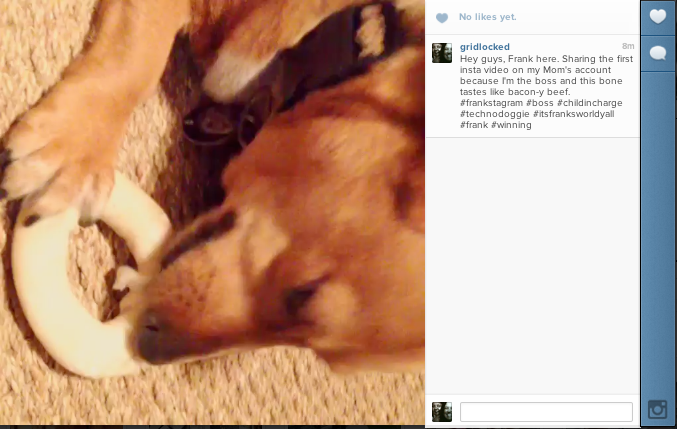
Check out Frank's Instagram video here... http://instagram.com/p/azfDD4OxC9/
Check out Frank’s Instagram video here…
http://instagram.com/p/azfDD4OxC9/

It can be hard to follow the updates with so many changes in social media happening so often, so where is the best place to find info on these updates?

For updates on Instagram, I read their blog. http://blog.instagram.com/ . It’s super informative and they have great information. Also make sure you are following Instagram on your account. http://instagram.com/instagram . And one more place you can check is http://instagram.com/press/. This is all their press releases and information. Instagram (in my humble opinion) is the best creative social media outlet, and so fresh for marketing ideas.

Summertime Social Media.

New to Facebook this week is #hashtags. Facebook has borrowed, or maybe stolen, Twitter’s business model with hashtags and video clips. Still confused about them? You can go back and read my blog on hash tags here… Hashtags are a VALUABLE tool for advertising and marking things that people can easily find. You can now search things on Facebook with hashtags. This will help you market and find like minded people. Its a great tool. Your Instagram videos can also be shared on Facebook as well.
Hope you are all having a great summer… and now as you document it on Facebook, you can hashtag it all and upload videos of your activities on Instagram…. (he he he!).
__________________________
Follow Ingrid on Instagram and Twitter!
Ingrid on Instagram. www.instagram.com/gridlocked

Ingrid Schneider is WordServe’s resident Marketing Maven. With a specialty in social media, Ingrid loves helping authors find and manage an online tribe of readers. After spending the last 15 years managing and marketing restaurants, people, and businesses, Ingrid knew that helping people market themselves via social media and online platforms was a passion and something at which she excelled. Now doing social media marketing for some great-named authors, Ingrid also loves to imagine that she is a secret agent, because she can’t disclose

with whom she is working. (Believe us when we tell you that Ingrid handles some big names, but for anonymity’s sake, we can’t disclose this TOP SECRET information.) Imagination and creativity is something Ingrid is serious about and loves to incorporate into her work with her clients.

Shameless: How to Fail a Book Signing (but Not the Writing Life)

“Art is born out of humiliation.”  W.H. Auden

I had a fantastically unsuccessful book signing in a big box store not long ago. (Yes, signings still occur, despite the takeover of social media.) Afterwards, licking my wounds, I turned to a book on my own shelves, Mortification: Writers’ Stories of Their Public Shame. In it, Margaret Atwood, Rick Moody, Billy Collins and a constellation of such literary brights offer up the most companionable ignominies and embarrassments. (Fittingly, I bought the book used, online, for a penny.) My own parade of humiliations that night were paltry next to theirs. Still, couldn’t I do better?

Two weeks later, an Internet search on “book signings” confirmed my suspicions. According to several book signing experts, I did indeed do everything wrong. First, I missed the Webinar on “The Seven Steps to Turn Yourself into a Celebrity.” In another  article, I violated nearly every one of thirteen steps, beginning with, “Decide, in advance, what sort of clothing you want to be seen wearing by your reading public.”  (Did I do this? No.) Step #6 advised bringing along a printout of your manuscript for fascinated readers. (Really?)  My most egregious error was the last step: my failure to inform the store managers that I would be the bookstore’s official greeter while I was there. Nor did I walk around with several copies of my book introducing myself to everyone in the store, as he advised, pressing my own books and bookmarks into their astonished hands.

I would rather demonstrate the wonders of Balinese kitchen knives through the Christmas season at Walmart than resort to such tactics.

We all know we need to successfully promote our own work. But when we sacrifice leisure, sleep, money, and most costly of all, time with our families so that we can write, none of us makes these difficult choices to be stalkers or hawkers with a leer and a bookmark. We write because we believe in our deepest-down spirit that God has called us to keep naming the world. We write to serve a meal to the famished, to dress the wounds of the betrayed and lonely. We write to offer hope and a story to the depressed. We write to offer clear thinking in a muddled marketplace. We write in humility, in insecurity, in desperate prayer.

And when our book releases, shall we then don our best barracuda suit, polish our teeth, slick back our hair and begin the hard, shiny sell, suctioning ourselves to every unfortunate person who innocently wanders into a bookstore? Did any of us sign up for this?

Let’s take a breath. We don’t need to sell. We don’t have to sell out or sell ourselves short, or sell our own snake oil. We need to offer. We’ve just spent two to three years composing, listening for God; we do indeed have something to offer. We offer our work, and, more importantly, we offer ourselves. In all of our promotion, we need to think, how may I serve others? How may I serve my readers? We might end up giving books away—a lot of books. We might do some speaking gratis. We might end up on the short end of the accounting sheet. We might end up praying with a stranger. But at the end of the day, the year, the decade, we’ll count it differently:

We got to give. We got to give more than we knew we possessed. We got to be part of a global conversation. We got to know new readers, who taught us more than we knew. We got to pray for strangers who became friends.

Don’t listen to “sell-a-ton-of-books” schemes when they violate who you are and what you’re to be doing in this world. Go ahead and “fail” a book signing if you must. Be a real writer, without shame.