The Only Story That Matters

july 013I was beginning to panic about my book sales. Despite my hard work and ceaseless efforts to promote my new book, I just wasn’t making a dent in the supply of books I’d bought from my publisher. Since I’d borrowed the money from our family savings, I felt guilty that I wasn’t refilling the coffer as quickly as I’d so optimistically assumed I would.

What more could I do? Post even more frequently on social networks? Write more guest blogs? Camp out on the doorsteps of radio and television stations to get their attention? Go into even more debt by hiring a publicist, in hopes he could convince people to buy my book? Beg the few bookstores still in existence to push my book at customers?

I didn’t do any of those things.

Instead, I asked God for help. I prayed for more book sales.

And He delivered.

Within days, I heard from two stores who had taken some of my copies that they needed more. Some event bookings I’d been pursuing for months finally came through, and I added them to my calendar. One night as I lay awake in bed, thinking about my book, I realized there was another market I could tap into, and the next day, I discovered solid leads for doing exactly that.

And then my daily Scripture devotional chimed in with Jeremiah 32:17.

universe“Ah, Sovereign Lord, you have made the heavens and the earth by your great power and outstretched arm. Nothing is too hard for you.”

Yes, I was reassured and completely grateful for God’s generosity to me in the form of helping me sell more books as I had requested in prayer. I’d asked, and I’d received.

Praise God!

To be honest, though, I felt something even more compellingly: I felt chastised. I’d asked the omnipotent Lord, who created the universe itself, to help me sell books! Who did I think I was to even imagine He would care about a few hundred dollars in my life? It’s not like I needed a PLANET or anything. I wanted material success. I wanted to put some money back in the bank. I wanted God to make me feel better about a story I wrote. A story!!

Talk about putting myself at the center of the universe. I was humbled. Embarrassed. Aghast at my own egocentricity.

And, most of all, stunned by God’s patience with me, because this isn’t the first time I’ve let my selfish priorities slide in over what I know to be the single most important relationship of my life: my relationship with God.

It’s true – nothing is too hard for God, and that includes loving me…and you.

And really, that’s the only story that matters, isn’t it?

 

The Dreaded Synopsis

Writing a synopsis doesn't have to freak you out.
Writing a synopsis doesn’t have to freak you out.

“A synopsis is a cold thing. You do it with the front of your mind.”

~ J.B. Priestley, English novelist, playwright, broadcaster

Is it only me, or do you break out in a cold sweat just thinking about having to write a synopsis? I can write novels. I can write devotionals. I can even whip out a mean shopping list. But writing the dreaded synopsis brings out the idiot in me. Perhaps, indeed, I have lost the front half of my brain somewhere along the way.

So what’s my problem? Am I giving this too much importance? Am I trying to fit in too much information? Has there not been enough dark chocolate in my diet of late?

Regardless, there’s no getting around the fact that every writer must construct a synopsis in order to sell a manuscript. Think of it as the bones of your story, or if you like, the short story version of your novel.

3 WAYS TO WRANGLE A PLOT INTO A SYNOPSIS FORMAT

1. Introduce your main characters, focusing most on goals, motivations, and conflicts rather than on physical attributes.

Hint: Think back cover copy.

Example: It takes a thief to catch one, and there’s none better than reformed cat burglar (MOTIVATION) Officer Doug Harwell. He’ll stop at nothing to rid the Boston streets of crime (GOAL)—until the beautiful pickpocket Rhianna Davis enters his life (CONFLICT).

2. For the body of the synopsis, set up each paragraph with the actions, reactions, and decisions made by those main characters.

Example: Bob kisses Donna under the apple tree (ACTION).
He makes her forget she’s already engaged to Bubba (REACTION).
Donna decides to break off her engagement and run away to join the circus instead (DECISION).

3. Tie up the loose ends.

Never—ever—leave an editor guessing, no matter how cute you think it is. Cliffhangers are great for chapter endings, but not for a synopsis finale. You must include the resolution to your story.

There you have it. Put together your story idea into a two-page format before you dig into chapter one so that you have a road map to follow as you compose.

DO NOT LIVE AND DIE ON SYNOPSIS HILL

Are you prepared for the zombie apocalypse? I’m not. Shoot, I’m not even prepared to make dinner tonight. I’ve got more important things on my mind, like should I stick to my synopsis or deviate in a whole new direction even though I’m two-thirds of the way finished? Don’t smirk. This is a serious crisis.

What do you do when you suspect your storyline might be one of the living dead?

First off, don’t panic. I never do. Oh, I did on the first three or four manuscripts, but now I see a pattern. I get bored with my own story. Yeah, I said that out loud. And newsflash: If the author’s bored, the reader will be bored. It’s a valid reason to stray from your original outline, but there are a few other reasons you might want to consider when deciding if you should revamp your plan or ditch it altogether.

You might want to change your synopsis if:

1. You thought of a better idea for an ending.

2. A new character shows up and takes center stage.

3. You realized an angle to turn the story into a series.

4. You came across information that makes your original idea not only implausible but outright impossible.

Remember, a synopsis written before a story is finished is more of a guideline than a legal contract. It’s okay to change things up, unless you’ve already got a contract on the piece. Then you’ll have to clear it with an editor first.

The 7 Fear-Nots of Every Writing Project

Woman afraid (funny)

Whenever an emissary from another world showed up in all its effulgence, men and women fell down terrified, overcome, filled with God-brilliance and self-loathing. Our own writing projects, delivered by the other-worldly muse, can inflict and inspire a similar terror at times (Woe is me! Why did I think I could write this novel?). When you’re visited by these angels of brilliance-and-woe, (and you will be!), remember what usually came next, after the Visited fell facedown in the dirt: “Fear Not!” And then words of hope and direction were given to the stricken to lift them to their feet and their new purpose.

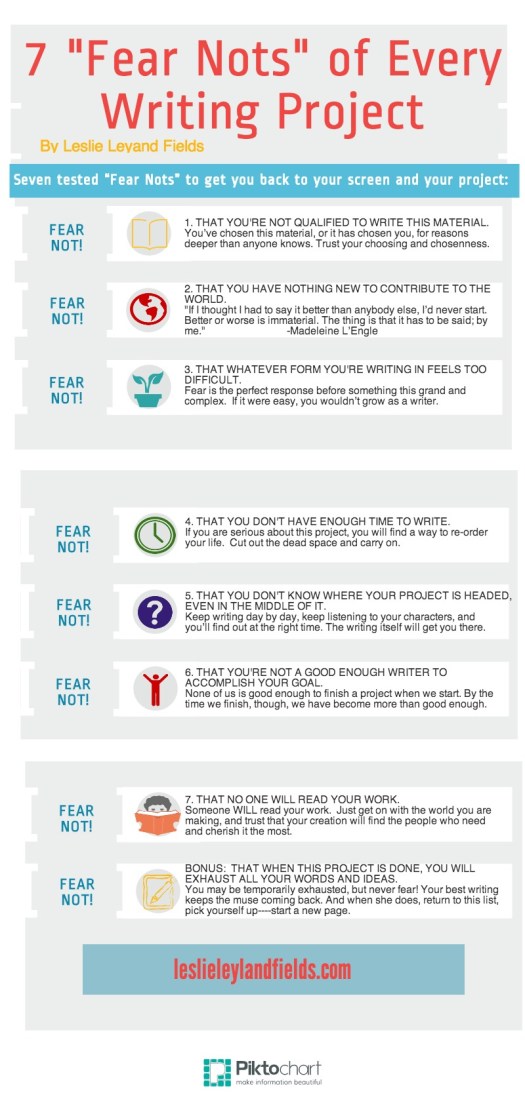
Here are 7 tested “Fear Nots” to get you back to your screen and your project:

Woman smiling with hands folded

1. Fear Not!—-That you’re not qualified to write this material. You’ve chosen this material, or it has chosen you, for reasons deeper than anyone knows, including you (unless you’re purely market-driven). Your desire, your interest, your life experience, your questions, maybe even your prayer life may have something to do with this insistent need to address this subject. Trust your choosing and chosenness.

2. Fear Not! —–That you have nothing new to contribute to the world. Listen to Madeleine L’Engle:
“My husband is my most ruthless critic. . . Sometimes he will say, ‘It’s been said better before.’ Of course it has. It’s all been said better before. If I thought I had to say it better than anybody else, I’d never start. Better or worse is immaterial. The thing is that it has to be said; by me; ontologically. We each have to say it, to say it our own way. Not of our own will, but as it comes out through us. Good or bad, great or little: that isn’t what human creation is about. It is that we have to try; to put it down in pigment, or words, or musical notes, or we die.”

3. Fear Not!—–That the article, short story, memoir, sonnet, sci-fi trilogy, whatever form you’re writing in, feels too difficult. Fear is the perfect response before something this grand and complex. This is partly why you’ve chosen it. If it were easy, you wouldn’t grow as a writer.

4. Fear Not!—–That you don’t have enough time to write. Of course you don’t. No one does. But if you are serious about this project, you will find a way to re-order your life: stop watching TV, write while the kids are napping, get up 2 hours earlier than everyone else, take your manuscript with you on vacation. Yes, it costs you ( and it costs others too, you must realize). Did you think otherwise? Count the cost to everyone. Then, if still so moved, cut and carry on.

5. Fear Not!—-That you don’t know where your novel, trilogy, even your memoir is headed. No one you know informs you of the outcome of their lives, do they? How many of your friends know where their lives are headed and how they will get there and who they will be once they’re there? You will not know this for your characters or story until they do. Keep writing day by day, keep listening to them, and you’ll find out what you need at the right time. The writing itself will get you there.

6. Fear Not!—–That you’re not a good enough writer to accomplish your goal. None of us is good enough to finish a project when we start. Some of us aren’t even good enough to start! By the time we finish, though, we have become more than good enough. The struggle, the long hours and the word-wrangling and prayer-wrestling will all get you there.

7. Fear Not! —-That no one will read your work. Someone WILL read your work. Maybe a few friends, the ones you really care about, maybe thousands of strangers. No one knows this when they are writing, and it has nothing to do with the writing. Just get on with the world you are making, and trust that your creation will find the people who need and cherish it the most.

BONUS: Because fears often multiply, one more to put to rest: Fear Not!—-That when this project is done, you will exhaust all your words and ideas. Not so. You may be temporarily exhausted, but never fear! Your best writing keeps the muse coming back. And when she does, return to this list, pick yourself up—-and turn a new page.

The Seven -Fear Nots- of Every Writing Project (1)

It’s Never Too Late to Write

I started my writing career later than most. At least compared to many of my twenty-first century peers.

And I worried I’d waited too long.

Broodmoor Hotel, Colorado
It’s Never Too Late to Make a New Bed

Actually, I had a lot of strikes against me. I was sure I’d made my bed, and had no opportunity to make another. But I was wrong.

If it hadn’t been for a persistent push from God, I doubt I’d be writing to you now. But He continually convicted me through the Parable of the Talents, Matthew 25:14-30. You see, I was the wicked and lazy servant who’d buried her gift.

However, God truly is merciful — and encouraging. Over a period of a few years, He used five real-life examples to show me it’s never too late to write.

The first lived in Missouri, like I do. Laura Ingalls Wilder and Rose Wilder Lane, two of the most inspirational writers I’ve ever studied, called Mansfield, Missouri home. Rose schooled her mother on how to formally pen those wonderful classic books, the Little House on the Prairie series.

But the most amazing part was learning Laura was sixty-five years old when the first best-selling manuscript went to her publisher.

Strolling through her grounds recently, I imagined her gnarled hands scratching out stories from memory onto pages of paper. She finished her final book at age seventy-six.

Another author who started late was Frank McCourt, also publishing in his mid-sixties. The wisdom of time and experience propelled Angela’s Ashes to the top of global readers’ favorite lists.

At forty-five, Raymond Chandler, (who I share a birth date and month with), finally broke into publishing success, after struggling from the time of his youth to make his professional mark.

In her fifties, Mary Wesley published a few children’s books without notice. However, in her seventies, she took the world by storm with her first novel, Jumping the Queue.

James Michener is a well-known name for those who know writing. But some don’t realize his fifty year Pulitzer-prize-winning career didn’t start until he was fifty, continuing until his death at age ninety. His last book published posthumously.

What's on Your Bucket List
What Does Your Bucket List Say?

No matter what encourages you, whether it’s real-life examples, spiritual promptings, or the example of a writer who did, though I feared I wouldn’t, let something spur you on. Age, location, past failures, naysayers, none of those things matter.

If you are willing to learn, to listen, to do the work, to learn some more, to listen some more, then work some more, you will see results. Maybe not at the caliber of some of the names listed here, but at the level you are supposed to achieve. This leads me to one more thought — actually it’s a question.

Many people tell me they believe in God. But I respond by asking this, “Do you believe God?” A simple change in sentence structure changes the meaning. In Proverbs 14:23 (NIV), it says, “All hard work brings a profit, but mere talk leads only to poverty.”

Maybe your sentence structure will help someone see a familiar statement in a new way. Maybe your profit will result in financial windfalls. But more likely, it will come through a life changed. A life you touch because you never gave up. Because like me, you chose to believe God and say, “It’s never too late to make a fresh start with fresh faith — while I write.”

What encourages you to write on?


Holding onto God’s Hands

jesus hands

Psalm 73: 23-24 I am always with you; you hold me by my right hand. You guide me with your counsel, and afterward you will take me into glory.

Have you ever had one of those days, weeks, or years when everything goes wrong? Health issues, financial problems, family struggles, or the death of a loved one—these are all things that can rip the joy from you, zap you of your strength, or leave you wondering if God is even out there.

How often, during these times, do we think our prayers have gone unanswered? Or that God has turned his back on us? Or that he doesn’t care?

Even if our faith runs deep, it is easy to get into that rut of believing the worst. It’s human nature. But I assure you, God will be with you every step of the way. He won’t stop at just walking beside you. He will, as the scripture says, hold you by his right hand. He will be your teacher, counselor, and mentor. He will guide you through the rough times, if you listen for his voice and search his word.

I knew a woman who had lost her first and only child to crib death, or SIDS – Sudden Infant Death Syndrome. The impact of that child’s death rippled through our small church with the force of a tsunami. A short time afterwards, I found her in one of the Sunday school rooms cleaning the toys, wiping off the shelves, and singing. When she sang, when she prayed, or even when she shed her tears across the altar, she believed God was her strength. He held her hand, and guided her through the valley of the shadow of death.

But most of all, she knew God had led her baby into glory. And that one day, he would lead her through, too. She’d be able to hold her child in her arms once again.

This is his promise to us. A promise we can count on.

Overcoming Fear of the Blank Page

blank pagesWhy are you afraid of that page? You’re creative, right? You have a brilliant idea for a book, and you’ve loved writing since you could hold a pencil.

If you find staring down a blank page terrifying, know you’re in good company. A search on Pinterest for writing quotes shows that at least half of them have to do with braving the blank page.

Prolific writers and gifted writers alike confess to an absolute terror when sitting down with a fresh scene, but they’ve learned the tools to tame their fears. Here are a few tips to get you started.

1)      Start early in the day. Your mind is at its best after a good night’s sleep, and your book deserves that best. Even if all you can give in the morning is half an hour before getting the family up or heading off to work, getting a few paragraphs written gives you that dose of courage that makes you feel as if you can finish the scene later in the day.

2)      Outline or jot down a few notes beforehand. Having the skeleton of what you’ll write gives you a good start, even if you veer off in different directions once you begin writing. I’m no outliner, but writing down a few key points for the scene ahead gives me the feeling that I’m not staring into an abyss when I look at the blank page.

3)      Remember the first draft is just the clay. It’s rough. It’s flawed. And that’s okay. Later you’ll mold it into something beautiful, once you’ve got something written down to work with. As the popular Nora Roberts quote goes, “I can fix a bad page, but I can’t fix a blank one.”

4)      End your day’s writing in mid-stream. This was Hemingway’s technique. By leaving his day’s work where he still had something to write, he guaranteed that he would have the words to begin the next day’s work.

5)      Prime the pump. Write anything at all, even if it’s not your story. John Steinbeck wrote East of Eden in a notebook. Each day, he wrote a letter on the left-hand page to his editor and friend, sometimes about the work, but often about family, politics. and whatever interested him. Once he finished his letter, he was ready to fill the right-hand page with the next scene in his novel.

6)      Write quickly. Too much thought might be what holds you back. Writing fast allows your subconscious to take over, and you might be surprised with what it brings up to the surface.

7)      Jot down random words. Ray Bradbury typed up lists of nouns and adjectives, reviving old childhood fears and fascinations, and remembering recent beauties and horrors. When he was stuck, he always found something in the list to get him writing.

8)      Focus on the page, not the novel. A page per day makes for a 365-page novel in a year, but breaking the task down makes it less frightening.

9)      Remember the joy. Writer’s block, obstacles in the writing, marketing, the difficulty in getting published, or finding time to write can all make writing a burden. Remember what brought you here in the first place – the love of words, dreaming up stories, bringing healing to the world, or whatever it is. Stick with that and forget the rest.

10)   Read and read some more. “One must be drenched in words, literally soaked in them, to have the right ones form themselves into the proper pattern at the right moment,” Hart Crane said. Read poetry. Read fiction. Read non-fiction. And you’ll be so saturated with words and ideas, you’ll have the material to work with. Even better, start your writing day by reading a page of someone else’s breathtaking writing.

There are probably dozens of other ideas where those came from. Ask other writers. But most importantly, ask yourself. What gives you the courage to write?


What is a Literary Publicist?

WomanwithBookA publicist is a professional who has both the know-how and the network in place to help bring your name to the public. In the literary world, a publicist is key to the marketing plan, to create consumer appetite for a book title, and to stimulate buzz for the author.

A literary publicist promotes the book title directly to consumers through niche markets with an interest in the storyline or subject matter of the book. The publicist also networks with media by pitching specific interview angles the author can provide—setting up the writer as an expert on certain subjects.

Sometimes publishing houses hire independent PR firms to manage specific book campaigns, or entire lines of books. Other times, they pay half toward an outside campaign, and the author matches that. The third option is for the author to pay all of the expense from their advance, believing that publicity and marketing is what will make or break the overall sales for the book. Publicists also assist with author branding for the career of the author, so the buzz extends beyond the life of one book.

Most PR and communications firms offer a wide array of services. They come alongside of you at any stage in the writing game. They can help expand your platform, branding, and name recognition. Need some help making sure your website is selling you in the best possible light? Ask your publicist. Some will even edit your manuscripts and write your book proposals, query letters and marketing plans. Many customize plans to work with your goals, no matter where you are in the literary process.

After the book contract, your publicist will customize a plan for promoting you and your titles with the goal of maximizing exposure—with hopes that the promotion goes “viral.” This requires multiple reaches to the public, through traditional media presence, online spotlights, and waves of social networking.

Why Hire a Publicist?

1. A publicist has the media contacts and relationships needed to secure interviews/ reviews.
2. A publicist knows how to pitch your book to the media and how each journalist prefers to be contacted.
3. Most writers do not have the time to devote to a publicity campaign. It is a full-time job.
4. When an author pitches his own book to media or consumers, it is sometimes viewed as being too self-promotional. A publicist is seen as a third party. Others are more receptive to discussing book promotion with a publicist rather than the author.
5. When media, retailers, and consumers hear an author has a publicist, they seem to think the author has more “clout.” It legitimizes the expert-status of the author and elevates them to a higher professional standing.
6. An author with a publicity team has “peeps.” It’s that whole “I’ll have my people contact your people” approach.

**********************************************************************************************
KathyWillisKathy Carlton Willis spins many plates as writer, speaker, editor, and platform coach. She writes and speaks with a balance of funny and faith—whimsy and wisdom. Kathy discusses the key issues that hold believers back and shines the light on their paths to freedom. Kathy’s passionate about helping audiences have lightbulb moments. All told, nearly a thousand of Kathy’s articles have been published online and in print publications. Speaker to Speaker: The Essential Speaker’s Companion (OakTara) and Grin with Grace (AMG) are set to release in 2014. She serves alongside her pastor husband, Russ Willis, in local church ministry.

The Miserably Fabulous Craft of Writing

I have a confession to make. The only Stephen King book I have ever read is his fabulous book On Writing: A Memoir of the Craft. That said, if you can only read one book about writing, this might be it. Mining some of my favorite gems from this work, I hope to help you polish your own rough stones.

king

“The scariest moment is always just before you start.” I can only echo a hearty “Amen!” Whether I’m working on a term paper, a short article, a book proposal, or an actual book, I always sit down and enter my title, my name, and anything else I know, just to avoid that blank page. Perfection is the enemy of writing. If that’s your initial aim, you’ll procrastinate and you won’t write. You’ll likely never read anything you’ve written and smile to yourself, “Well, there is absolutely NOTHING I can do to improve this beauty!” Nope. Your editor will get a hold of it if you don’t. [Insert evil laugh here.] But when you begin a story, that’s not the time to labor over each word. Get it down. Start. You’ll have lots of time to labor over rewriting and editing later. “The definition of a writer is someone who writes,” declared a now-forgotten workshop leader at my first-ever seminar. Write already.

“If you don’t have the time to read, you don’t have the time or the tools to write.” It’s quite possible that I am addicted to reading. I read at stoplights. I read on a float in the pool, in the bathtub, by the stove while I stir things, on my lunch break when teaching, while taking my mile walks, and the last thing before I turn in at night. Reading sparks ideas, allows you to admire fresh turns of phrase, and inspires you to work that same magic, carrying future readers to your setting, helping them to fall in love with your characters.

“Amateurs sit and wait for inspiration, the rest of us just get up and go to work.” I don’t remember where I read this, but one novelist wrote that he never writes until he’s inspired. “And I see to it,” he continued, “that I am inspired every morning at 9:00 a.m.” Writing is work. Writing is dedication. Writing is a miserably fabulous craft!

“Kill your darlings, kill your darlings, even when it breaks your egocentric little scribbler’s heart, kill your darlings.” When my second book with Harvest House came out, I got the proofs and asked my amazing editor, Hope Lyda, what had happened to some of the quotes and paragraphs I had so lovingly delivered. She was gracious. “Ahem, those went to keep company with some other lonely words and paragraphs.” I see. She had kidnapped and killed my darlings. It was a better book for their absence.

“The road to hell is paved with adverbs.” Taped to the windowsill above my desk is this little gem by Dwight Swain:

Strive for:

The Vivid Noun

The Active Verb

The Colorful Phrase

The Intriguing Detail

The Clever Twist

The Deft Contrast

All of us have fallen asleep during a long paragraph in which the writer has gotten carried away by his own love of (too much) language. She ran her fingers through the water languidly, indolently, lethargically, lazily….All right already! Crisp. Clear. Concise.

“Books are a uniquely portable magic.” Whether we favor Nooks or Kindles or the tactile experience of pages fluttering, bold ink making grand statements and words sweeping us away to other times, other people, other conflicts, when we take books with us, we carry time machines. We carry mini-encyclopedias of knowledge. We carry the life, loves, and losses of characters about whom we are made to care very much. When we write them–ahhh–we are making our own kind of magic.

“Writing isn’t about making money, getting famous, getting dates . . . or making friends. In the end, it’s about enriching the lives of those who will read your work, and enriching your own life, as well. It’s about getting up, getting well, and getting over. Getting happy, okay? Getting happy.” The process of writing is not often fun. But we do it anyway. Why? Because we know what books mean. We know they will never go out of fashion. And we are gluttons for punishment, because that book means magic, housed in the pages of something you have been honored to write; imprinted on the hearts of those who read it and won’t soon forget how your words made them feel. And when we write for God’s glory, we surpass even magic.

What are some writing truths you’ve learned?

Staying on Course

Photo/KarenJordan

I failed to consider the length of the trail when I started walking it.

Temptations and expectations. I had hoped that a two-mile, brisk walk along a wooded path overlooking a beautiful golf course near my home would clear the cobweb of worry from my mind. 

Instead, my impulsive, adventuresome nature ignored the signpost, describing this four-mile loop through the challenging hills and valleys in Central Arkansas.

I knew the path would eventually lead me back to the trailhead. So, when I noticed the third mile marker, I decided to press on. I assumed that going forward would be faster than turning around and returning to where I started. Plus, after investing so much energy, I wanted to finish the course.

Confusion and distractions. I tried to determine my location on my cell phone’s GPS. But I couldn’t locate the trail on my screen, and the diverging paths confused me. So, I just kept walking.

I stopped from time to time to shoot a few pictures. These gave me some short breaks  from the summertime heat and rest for my throbbing feet, as I avoided the pesky bugs, spider webs, and poison ivy sprigs at the edge of the forest.

Photo/KarenJordanElation. By the end of the trail, my worries had  abandoned me, and the strain of the long walk through the woods subsided. Refreshed, I paused by the lake and enjoyed a bottle of cold water.

I also experienced a surge of self-confidence when I reached my destination. I knew that I wouldn’t have attempted such a feat in the summer heat if I’d known the length and difficulty of the trail.

Looking back on the experience, I realize that I’ve learned this lesson in other areas of my life—marriage, parenting, academics, and writing for publication.

I’m not saying that I have this all together, that I have it made … By no means do I count myself an expert in all of this, but I’ve got my eye on the goal, where God is beckoning us onward—to Jesus. I’m off and running, and I’m not turning back … So let’s keep focused on that goal, those of us who want everything God has for us. (Phil. 3:12-15 MSG)

Are you tempted to quit right now!? I challenge you to focus on God and allow Him to guide you with His promises.

Let the peace of Christ rule in your hearts … And be thankful. Let the message of Christ dwell among you richly … And whatever you do, whether in word or deed, do it all in the name of the Lord Jesus, giving thanks to God the Father through him. (Col. 3:15-17 MSG).

What helps you stay on track when you’re tempted to get off course?

YouTube/YamahaBill (Disney’s Hercules – “Go the Distance”)
Photos/KarenJordan

Is Multi-Genre Writing Right For You?

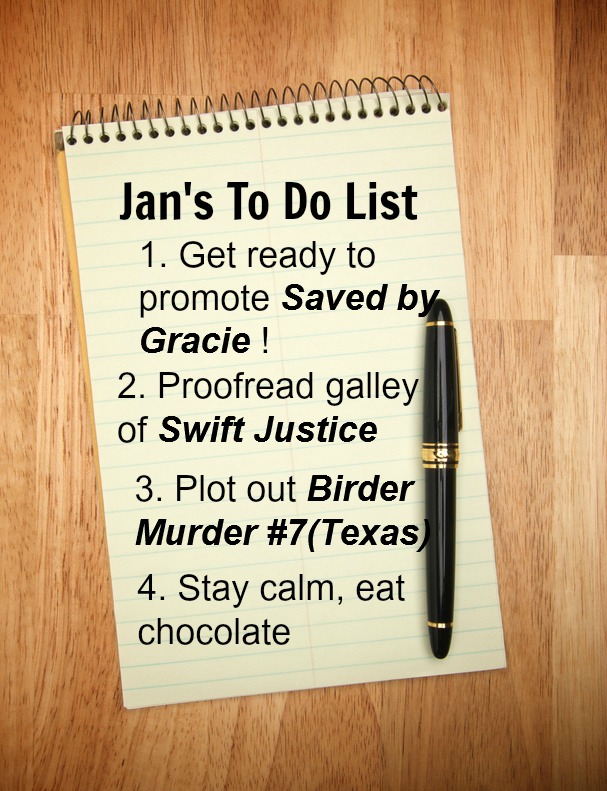
to do list (2)One of the ongoing debates in the writing world is about the wisdom of writing in more than one genre. The reality, I think, is that most writers want to write in several genres and, in fact, may be quite good at it. My first projects were poetry, and then I moved on to magazine articles. Think pieces followed, as did newspaper humor columns. My first published book was a small volume about practical Christian spirituality, but then I found my stride in humorous murder mysteries (#6 is out in September, with #7 currently taking shape on my laptop).

Last but not least, a few months ago, my first memoir was published.

So, for me, the big debate about writing in multiple genres is a no-brainer, because I already do.

My experience of doing so, however, has made me recast the debate from a writing perspective to a publishing perspective, and, as a writer who wants to build a career as a published author, I offer my own pluses and minuses of working in a multi-genre career.

  1. Minus: If you think it’s demanding to build one platform, try building several at once. I’m not saying it can’t be done, but in my experience, it can’t happen simultaneously (unless you have clones of yourself ready to go – and in that case, please drop me a note at my website, because I could use a couple of clones these days). To launch a book, you have to be single-minded to make the best of marketing opportunities: appearances, talks, media, book clubs, etc. Your new book/baby needs attention 24/7, and if you leave it for a day or two to nurse along another genre, you find yourself playing catch-up when you get back to the newborn. I’m guessing it’s like having twins-one person can’t really hold two babies equally well, so there’s always some juggling going on. Same thing with two genres: you end up feeling like you haven’t been as successful as you could have been with just one book. At the very least, you don’t sleep much, because you’re trying to do the work of two marketing departments in one body.
  2. Plus: Working in two genres is exhilarating! You get to double the people you meet and the interests you cultivate. Your horizons expand and life is so rich with new experiences, it takes your breath away. It’s wonderful to be a writer!
  3. Minus: Publishers are very hesitant to take a chance on you in a new genre. The more you’ve established yourself in one genre, the less a publisher wants to take the risk of launching you in a different direction. Publishing is a business, and publishers have to respect the bottom line.
  4. Plus: If your genres share something in common (mine share humor and a love of nature), your fans of one genre are more likely to follow you into new territory, giving you a base readership on which to build and a headstart on creating a new platform.

Have you had any experience in multi-genre writing? Any insights to share?