The Cheater’s Guide to Building Your Author Platform – Part 3

Marketing

Building Your Author Platform

To be a successful author, you need to think differently. Within your gut, an uncontainable passion burns. Your passion is to change the world.

Steve Jobs was a person who changed the world by promoting Apple products. I am typing this blog on my Mac with my I-phone 6 by my side. Watch this marketing video clip where Steve Jobs challenged a company to think differently:

Marketing is about values. In this noisy world, your message is a clarion call of what you stand for. Be clear about who you are and what you are about. Where do you fit in the world? More specifically, where do you fit in your niche?

Rejection is Your Friend

One of our main marketing mistakes is to try to be too general. We fail to touch anyone’s life because we are trying to touch everyone’s life. We “like to be liked.” We don’t want to be rejected.

There is already a beat of the drum that your soul marches to. There are other’s who feel the same way you do. They are your “tribe” and you all march to the beat of a different drum. Before you find your tribe, you will likely find rejection from people who don’t hear what you are hearing or see what you are seeing.

A friend of mine, Tracey Mitchell wrote Downside Up (page 15). She wrote this about rejection:

1. Rejection acts as a personal conductor, carefully arranging who and what qualifies for your future.

2. Rejection is a friend who witholds no secrets, exposes all enemies, and closes every wrong door.

3. Rejection is a golden opportunity to better understand God’s love, human relationships, and gifts of encouragement that lie within you.

Think differently about rejection. The closed door of rejection to your message prevents you from wasting your precious time with people who “don’t get you.” Smile at rejection as your friend.

I had a friendly conversation with a woman representing a publisher at the National Religious Broadcasters (NRB). I shared with her that my background was pastoral ministry. She then asked what my denomination was. When I said “The Foursquare Church” she quickly said, “I won’t be able to publish your future books.”

I sincerely thanked her for her honesty and then asked, “Why?” She then said, “Our constituents do not believe in women pastors and they are closed to Pentecostal Denominations.”

I was so thankful for her blunt honesty. I knew that this was not a publishing house that I would publish any of my future books with.

Fearless Marketing: Take the Risk and Get the Word Out

Fearlessly market to your tribe. Instead of spending time trying to get people that you already know to be interested in what you are doing, throw your net on the other side of the boat and find those who identify with your voice. Here are a few specific tactics to build your tribe and market your message.
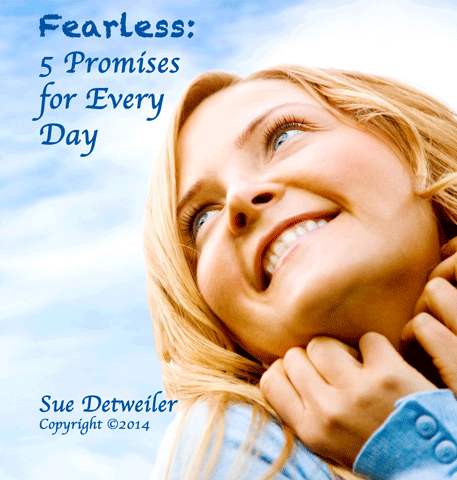
Click the Picture for Instant Access to Free Ebook

1. Free Give Away Write a simple ebook and put it on the front of your website or at the end of your blog. You give it away for “free” when they type in their email address. The secret of the email address is that this person who is on your site may be a tribe member. Follow up with them with future blogs and products. Don’t worry about the perfection of your ebook. Click the picture for an example of one of my free ebooks.

2. Building Partnerships Are you spending time building relationships with others who are influencers? I had the privilege of sharing a meal with Dan Miller and his wife Joanne at a conference. As we built a relationship, Dan asked me to speak at the 48 Days Cruise that he is leading in February 2015. Michael Hyatt and his wife Gail are also speaking as well as other influencers.

Click Picture to Find out More about The Influence Cruise.

You never now where one relationship will lead you. Be intentional about networking. Invest in conferences and events where you will meet and learn from people who are impacting others. In fact, I want to invite you to sail to the Caribbean with me on The Influence Cruise. (Click the picture above to find out more information).The relationships that you build on these type of events can become joint-venture partners in the future.

3.Getting the Message Out Get outside of the box of being a traditional author who waits to be discovered. You have a message, so develop your message in such a way that you have additional products to offer your tribe. If they already love what you stand for, chances are they will appreciate other teaching and resources that you provide.

marketing building your platform
Click to view “Exploring Ephesians” Course


Here is an example of an online course that I have developed called “Exploring Ephesians.” As a course set up on Kajabi Next, it continues to be a source of encouragement to everyone who takes it. Sign up today to see the example of what I have done, then develop your own course. I’m sure you can do an even better job!

A Final Opportunity We are all learners. When God first spoke to my heart “to engage” in building a platform for the books He was calling me to write, I needed to take baby steps. Wherever you are on your journey as an author, let’s connect.

Let me know if I can help you in any way. Leave a comment below, or find me on social media. Let’s make Jesus famous as we share His message which will change the world.




Lessons I Learned From My Editor

From conception to finish, I spent a couple of years on my first novel, Shaken. I had a mentor who coached me, a professor who professionally edited the manuscript, and an internationally acclaimed novelist who provided a critique. But nothing affected my story quite as much as signing with my publisher and beginning work with my editor.

Writing is difficult. You are bleeding your emotional artery on the page, complete with life experiences, beliefs, and creativity. But editing? That became another playing field entirely. In my military-romance-driven brain, it could be described as surgery to remove shrapnel. Each piece of metal must be plucked for an individual to get back to full health. In a similar way, editing requires painful digging to remove everything that does not add value to the character. After the shrapnel of your story is removed, you are freed to enhance and improve your story until it’s as close to perfection as you can get it this side of heaven.

KarissLynch Kill Your Darlings

Working with an editor is refining, a true process of iron sharpening iron (just don’t throw the sword at them if you don’t like what they say), but ultimately, it is a beautiful journey. The longer I work with my editor, the more I am thankful that God gifted her to look at stories differently than I do. She makes me better, and she is constantly teaching me and reminding me of craft tips that just haven’t taken root yet. Over the course of writing The Heart of a Warrior series, here is what my editor has taught me:

  1. Timeline is everything.

By the time my first novel went to my editor, the timeline needed major surgery, something I hadn’t thought about in great detail during crafting. I am a pantser and only use a bullet point outline to guide the major points of my scenes. Everything else just spills out on the page. This can make editing much harder for me. When it came time to edit Shadowed, I had a better timeline in place. Lesson learned? Don’t make the same mistakes on the second novel as you did on the first.

  1. Ground your character. Ground your scene.

Ever heard of floating head syndrome? No? Well, that’s probably because I just made it up. But I have it. Bad. Especially when I am writing in a steady stream of consciousness. Characters speak but you don’t know what they look like or what is going on around them. Thankfully, I am now aware of this ailment and am working to correct it before the manuscript goes to my editor. Each character needs to be firmly grounded in whatever is going on, each person in the scene accounted for, even if only briefly. Your scene also needs to be grounded within the larger story. Your reader should have no question where the character is, what is going on, who the character is with, and what drama is unfolding.

  1. Provide concrete details. Paint the canvas.

I actually love this part of writing, but I also struggle with fear. What if people think that a place or person doesn’t look that way? What if I get a detail wrong? What if, what if, what if? The “what if” game keeps me paralyzed from simply using my imagination and the beautiful tools of my eyes and the Internet to ground a scene exactly as I see it. I use research to make sure I didn’t get a basic detail wrong, but otherwise, I craft exactly what I want the reader to see. They are less likely to question what I paint in great detail than they are a canvas where I leave glaring holes due to my own people-pleasing and insecurity. No fear. Write boldly. Paint that canvas, and give the readers a scene they don’t have to try to imagine. Let it unfold in all of its beautiful detail. And then make that process even better in the next book.

Time for surgery on your manuscript. What weaknesses do you notice that you could improve on next time? What lessons have you learned from your editor (or critique partner)?

Refusing the Writer’s Call

Refusal of the call questis a common element of great stories, fictional or historical. The hero is called to a quest, but, initially, he balks. He says, whether through word or deed, “I’m not big enough for this task.” Or maybe just, “I’ve got better things to do than sacrifice myself for that.”
From Jonah getting on a ship sailing in the opposite direction of Nineveh to Bilbo Baggins telling Gandalf that all he wants is a nice tidy hobbit house with tea served on time, heroes have been trying to escape the call since mankind has been telling stories around the fireside. And for just as long, the stories have been winning the hero over to the adventure.

Why? Few of us see ourselves as heroes. We know we’re not up to the task, whatever the task is, and we’re right. We’re not big enough, strong enough, brilliant enough or good enough for the task at hand. And yet, deep in our souls, we know God made us for more than having our tea on time.

In all good stories, the hero finally accepts the call. After trying to outrationalize his call, Dietrich Bonhoeffer takes on the role of hero as he boards what is likely the last ship home to Nazi Germany, a ship that takes him ultimately to his death.

Having been elected to archbishop because he is quiet and conservative, expecting to make no waves in an El Salvador on the brink of civil war, Oscar Romero finally accepts that he must speak out, as he stands over the bodies of two murdered priests.

Paul accepts what he must do as God calls his name in a flash of heavenly light.

Little Samuel answers God on the third call in his small child’s voice: “Speak, for your servant is listening.”  Not knowing, of course, that he was accepting a lifetime mantle as prophet.

We writers refuse our call, too. Sitting down at the computer and typing out a page is such a small thing, right? It’s tiny in comparison to the heroes that have been written about. And yet, it feels daunting.

There’s the courage it takes to face a fresh scene. Will it be beautiful or fall flat? It’s as if it’s a test of everything inside you.

And there’s the courage it takes to call yourself a writer. The voices are insistent. How many times have you told yourself that you should just concentrate on being a parent, give your talents to your church and your job, and live a peaceful, ordinary life? You don’t have time for this story? Or more likely, you’re not talented enough for the story you want to write?

But if God made you to write, you’re going to be restless until you do. You can play the role of Jonah, and get on the ship going in the opposite direction and fight it out with the big fish. Or you can accept that being brilliant and big-hearted enough for the story is not what’s at stake. If God made you for this writing quest, he’s planning on equipping you as you go. Sit down at your computer and get started.

How a Non-Writer Like Me Got Published (Part I)

I never aspired to be a writer. Truly. In fact, Mr. Johsen, my high school senior English teacher, once said to me, “Cofer, you will never graduate from college because you can’t write!”

grunge image of a fieldI also never really aspired to write a book. Seems most everyone who survives trying times hears from well-wishers the old adage, “You ought to write a book.” And many of us believe that we could… but never do.

Writing didn’t become a consideration in my life until, uh, well, God and Oprah suggested it. This happened during the height of the recession when my physician recruitment business of twenty years was struggling to pay the bills. Exasperated, I turned the computer off early one business day and shifted my attention to the Oprah show. A discussion was underway about women who had founded new businesses, many starting in a basement or garage. Mrs. Fields was among those featured, as was the creator of Spanx.

I was surprisingly inspired and then on my knees. “Lord, please show me a new way to be in the world. I’m likely too old to start a new business, and the garage is already full, but please weigh in if you have any ideas. What can I possibly do at this age to augment the business I already have?”

I was unprepared for the answer I received about ten days later. It was mid-morning on a Friday and I was alone in the house. The stillness was unnerving. I leaned on the door jam of my office and faced the darkened expanse of the room. I dreaded entering. The only thought in my head was the ever-present drone, get to work. And then it happened. I heard The Voice. It was that commanding “voice within my own” that William P. Young so beautifully describes in his book, The Shack. I’d heard it before.

“Write a book about the gifts you were given.”

Huh? God, is that you? Write a book… really?

I’d never written anything more than a decent consumer complaint letter, and yet I just heard God tell me to write a book. Like I knew how to do that.

But the nudge was unmistakable.

I knew too what He meant by “gifts.” I often thought of as gifts the lessons learned through my daughter’s addiction and recovery. Even at the moment when Annie broke into our house and literally stole the family jewels, the opportunity that event provided for intervention seemed a gift. Maybe the judicial system would stop her from killing herself with drugs.

If I was indeed to write a book, I first needed my daughter’s permission to share our story. Then in sustained recovery from drug addiction, Annie would be both antagonist and heroine in my memoir. Telling an authentic story would require vulnerability on both our parts, as well as a willingness to reveal some very private details from our lives. Were we ready for that kind of exposure?

Annie’s response was wholehearted. “Go for it, Mom!” I didn’t know at the time she was secretly musing, isn’t that precious? Mom thinks she’s going to write a book.

So the new entry on my daily To Do list became “write a book.” I mean, how hard could it be, right? I already knew the story, so I figured I could crank something out in a couple of months. Uh-huh. I really was that clueless.

My writing began one night at 10:00. I’d promised my husband not to take valuable time away from our business day in order to pursue my newest folly, plus late night hours also provided a peaceful quiet. The time was guilt free. Settled in with a cup of tea, I faced the blank Word document on the computer screen before me…and silently prayed.

Okay, God. Now what?

(Stay tuned for Part II about finding a voice, and the will to keep going.)

Was there something that happened to you that got you on the writing path?

The Cheater’s Guide to Building Your Author Platform – part 2

Building Your Author Platform

As a Mennonite farm girl growing up in Indiana, I learned the Mennonite philosophy of “being the quiet in the land.”  I was taught that it was important not to stand out or draw attention to myself. I never fit in.

You may not have grown up Mennonite, but likely you have been taught to fit in. In subtle and not so subtle ways you have been told “not to rock the boat.” If you write and market a book that looks like every other book, it won’t sell.

Be a Purple Cow - MarketingBe a Purple Cow 

Seth Godin lauded as a leading marketing expert, describes what it means to find your purple cow and market your message. Watch this interview.

In todays market with so many books, you will not make a lasting impact with an average book written to average people. Marketing today has changed. We have so many choices.

As you are marketing your book, you are really marketing you. You are the “brand.” So as you determine how to market your message as yourself these questions:

1. What is remarkable about you?

What is the 2-3% about your message that makes you unique? Rather than aiming at the giant target to make yourself look like every other author/speaker, aim at the bulls eye of being authentic. What about your message and life makes other people make “remarks.”

When I considered which book to write first, I settled in on the thing that people remarked about me the most: I am the mom of 6 children. I struggled with this decision to enter into this market. You see, I am not a mommy-blogger. I don’t like Pinterest and I don’t have ideas for how to have fun play dates with your children.

I am a mom, who never pictured herself being a mom. My first born daughter and I were rescued from a burning house when she was only 5 weeks old. Although we were saved from the fire, she developed colic and screamed for hours at a time. When I finally got her enrolled in Mother’s Day Out, she was “kicked” out for biting another baby and drawing blood.

Yet, with all of this struggle of imperfect motherhood, I have 6 beautiful children. 2 of my children are special needs boys adopted from Brazil at ages 12 and 8. Just surviving motherhood is remarkable.

What is remarkable about you and your message? What makes you stand out. Tell your story in such a way that your uniqueness stands out.

2. Are you willing to be vulnerable?

Marketing - overcome writer's blockTo be a purple cow that stands out from all the white and black cows you have to be vulnerable. You have to wrestle with the fact that what you are trying to do might not work. You have to overcome all the noise in your head that pushes you to be “normal.” The best way to overcome “writer’s block” is to find the “sweet spot” of your message.

When I first began writing 9 Traits of a Life-Giving Mom, I started using other people’s lives to tell the story. My editor would read it and say, “I want to hear your story.” I was afraid to tell my story. I didn’t want to be rejected for my flaws and I saw myself as ordinary.

When I began writing the second draft, I began exposing all my faults. I exposed my internal thoughts about being the worst mom in the world.

That’s when I hit my “sweet spot” of my niche. I’m not writing to the moms who feel like they have-it-all-together. I’m writing to the moms that are hanging by their fingernails. I found that every mom in the world wants to be the best mom in the world for her child, but often she feels like the worst.

What is the “sweet spot” of your message? Where does your message meet a felt need? That becomes your marketing message.

Find your Tribe of People and they will be begging you for more. When you write, you are writing their thoughts. This is not only true in your book but in every other way that you chose to communicate to get your message out. Such as:

  • blog
  • podcast
  • social media
  • radio interviews
  • tv interviews

Memorize short segments of your material that makes your message memorable. Capitalize on the felt need of your tribe. Validate their personal situation. Become a friend to walk on the path together.

Next week we are going to talk about being a risk taker. We will also talk about more specific marketing ideas that you can employ right away. This week as you go through your day, be willing to be a “purple cow.” Make your message stand out.

Revising Aloud

Tihamér_Margitay_Exciting_story“Reading aloud,” I’m always telling my writing students, “is the best way to revise.”

I encourage them—sometimes require them—to find read-aloud partners or start writing groups in which they take turns reading their work aloud.

“Hearing your sentences spoken lets you know whether they’re clear and natural-sounding—whether someone actually could speak them,” I explain. “And it doesn’t work to read to an empty room. You need a warm body, a listener, to complete the communication. Speaking is, after all, a collaborative act.”

Finding that read-aloud partner is easy at college, where everyone’s engaged in writing all the time. Outside the college setting, though, finding someone willing to listen can be a challenge.800px-Anker_Sonntagnachmittag_1861 People are busy. Few have time to sit still for an hour while some verbose writer drones on. That’s how they’ll imagine it when you propose reading to them. We Americans have lost—or never had—the habit of listening to people read. We had only the shallowest tradition of serial novels, released chapter by chapter as Dickens’ novels were and read to the whole family at fireside. And no comfy pubs—without blaring TVs—like the one where C. S. Lewis, J. R. R. Tolkien, and their writer buddies hung out, drank beer, and read their work to one another. Writers who give public readings these days will tell you it’s hard to get even close friends to attend. Our lives are too busy for read-alouds.

I often recommend to writer friends that they make use of the lonely people in their lives: shut-in relatives, kid-imprisoned friends who wish they had a grownup to talk to, recently retired colleagues with time on their hands. 1280px-Anker-_Die_Andacht_des_Grossvaters_1893It sounds terrible, this “making use” of others, taking advantage of their neediness to assuage your own, but in my experience such mutual exchanges not only helped my writing but also transformed intended acts of mercy—“I should spend more time with my mother-in-law,” I was always telling myself—into pleasurable time together, which we both looked forward to. My mother-in-law not only got longed-for company but also felt needed; I got my warm body but also genuine enjoyment, without having to chide myselfHugo_Bürkner_Lesestunde (usually in vain) to, as Paul recommends, “give what you have decided in your heart to give, not reluctantly or under compulsion, for God loves a cheerful giver” (2 Corinthians 9.7 NRSV). The mutual benefit, I found, guaranteed that cheerfulness, for both of us—because attentive listening and being listened to can’t help but nurture relationships.

My daughter Lulu has been on semester break from college for the past month, with a couple more weeks to go. It’s tricky having a grown daughter home that long. We’ve long since put our Christmas CDs away, but I’m still in the throes of Bing Crosby’s parental prophecy for the season: “And Mom and Dad can hardly wait for school to start again!”

Luckily, Lulu’s engrossed in the final revision stages of her senior project—a hundred-Amédée_Guérard_Bibelstundepage translation of and critical introduction to an East German book—and I’m busy trying to cut 30,000 words from a novel before sending it out, so we have tasks to distract us from the inevitable mother-daughter combat. Also, since we’re in about the same place in our revisions—where what we need most is to hear them aloud and find out if they work—we’ve established a read-aloud schedule: I read her a couple short chapters during her late breakfast, and she reads me one long chapter while I trim vegetables for dinner.

I can’t say it’s the perfect exchange my mother-in-law and I had. Lulu doesn’t end my readings, as my mother-in-law always did, with “That’s the best thing you’ve ever written!” And, as a writer and teacher of writing, I give more critical feedback than Lulu really wants. But our reading fills two hours of our day with mostly pleasurable, mutually beneficial work. More importantly, the listening involved gives us both practice, at this complex juncture of our parental-filial journey, in navigating our new relationship as related but separate adults. As peers, in other words. Equals. Reciprocally heard, appreciated, and loved.

Troubles, Many and Bitter

sail-boat-508183_640 troubles many and bitter post pixabay“Your righteousness, God, reaches to the heavens, You who have done great things. Who is like You, God? Though You have made me see troubles, many and bitter, You will restore my life again; from the depths of the earth You will again bring me up. You will increase my honor and comfort me once more.” Psalm 71:19-21

When the world mourned the passing of Princess Diana, I heard a pastor say, “There is no earthly sorrow that Heaven cannot heal.” In the midst of the darkest days – or even the ones that just don’t measure up to our expectations or hopes – we can be absolutely certain that our Heavenly Father is already, right now in fact, restoring everything.

Everything.

Troubles, though many and bitter, come into our lives; yet these circumstances cannot touch or change the beauty God is already weaving through it all. When you’re walking an unfamiliar pathway, and there doesn’t seem to be any hope in sight, remember that God often does His best work behind the scenes. A better day is coming. Hang onto the promises in His word; remember His faithfulness in the past; and simply breathe in His grace while you exhale whatever prayers you can. Your Heavenly Father has you and He isn’t about to let go of you.

And then, to add grace upon His already extravagant grace, God increases the honor of the one who chooses to praise Him anyway -through the storms and challenges of life. May He find us trusting Him and relying upon Him more and more, regardless of the storm clouds blocking our view of the sun.

The Unfastened Safety Harness

Working on my most recent book, Wheels Stop: The Tragedies and Triumphs of the Space Shuttle Program (University of Nebraska Press 2013), changed my life forever.

The date was June 22, 2010, and research for Wheels Stop had led me to Johnson Space Center in Houston. Astronaut Doug Hurley was kind enough to invite me to do a run on the Space Shuttle’s motion-base simulator, an ultra-high-tech contraption that tilted upward to simulate the launch position, and then shook and rattled to prepare astronauts for the ride uphill.

IMG_0280
Although I was smiling alongside astronaut Doug Hurley (left) in the Space Shuttle’s motion-base simulator, my heart was broken. A major life change was already beginning to take place.

I couldn’t wait to take him up on it. I have dreamed of being an astronaut my entire life — my last name is Houston for crying out loud — and this was as close as I would ever get. Slowly, I fastened four of the five safety harnesses as we prepared for the run. The fifth belt refused to buckle due to the size of my belly. It still hurts to think about that fifth seat belt even four years later.

This wasn’t happening. I’d been embarrassed many, many times by my size, but never with an honest-to-goodness astronaut standing over me, trying to figure out a way to help. Doug never said anything ugly, but he didn’t need to. I was devastated, and becoming more and more so as I desperately tried to force the issue. My ribs hurt so badly, I could barely breathe.

SLIDE THREE
My before …

Fortunately, we proceeded with the simulation of two launches and five landings. It should have been one of the most memorable moments of my career, and it was, but inside my heart was absolutely broken. I had to change something, and I had to do it quickly. My wife needs a husband, and my sons need a daddy. Heading the way I was headed, I wasn’t going to survive.

Rather than going on some crazy diet when I got back from Houston, I simply started eating like I had some sense. Chinese buffets were my absolute favorite, but they had to go.

Reese’s Peanut Butter Cups were were like my crack cocaine. No more. Not even half of one. Oreo cookies … country fried steak … it was once nothing to eat nearly two pounds worth of bacon and tomato sandwiches. I’ve never been drunk or high, but I know full well what it means to be addicted.

I could do one lap of a half-mile track near our local YMCA without feeling like I was going to break. Then, I could do two … and then four. I signed up to walk in my first 5k, and then I signed up for another. I took a class at the Y on how to actually train for a 5k, and ever since then, I’ve been running. More than four years later I’ve run seventeen 5ks, four 10ks, and three half-marathons. I’ve lost approximately 110 pounds.

houston5k1
… and after photos.

Today, I’m satisfied with my weight. I’m not skinny by any means, but I’m happy with where I am. There’s nothing all that special about my story. Yes, I’ve been able to drop a significant amount of weight, but it wasn’t some super-secret diet or workout routine that did the trick. I was a writer who was almost completely sedentary behind a keyboard and computer monitor, and once I started moving, I haven’t stopped.

Trust me. If I can do it, anybody can. Working on your latest project is important, yes, but not at the expense of your quality of life. Hang in there. You can do it. I promise!

The Cheater’s Guide to Building Your Author Platform – Part 1

With a glazed look on my face, I obediently handed my phone over to “the expert” sitting beside me. As she looked up my twitter account which had an oval egg shape for my picture, I couldn’t help feeling intimidated by the task of building an author platform.

I had spent my entire life serving in pastoral ministry. When social media first came on the scene, I was suspect of the enemy’s evil intent to use the media to entrap our children.

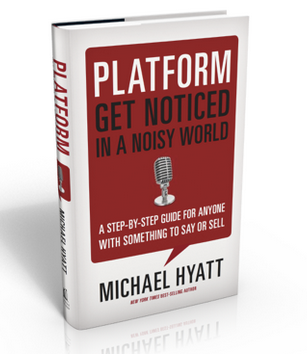
Now here I was, listening to Michael Hyatt talk about the power and necessity of every author building a platform to launch their book. Much of what he was saying went over myplatform head. Yet as I listened for the still small voice of the Holy Spirit to guide me, I simply heard this word: engage.

As I engaged in the social media platform beginning that day two years ago, I grew from 4 twitter followers to over 21,000. I joined the social conversation and found a whole new world of influence.

Since my first book, 9 Traits of a Life-Giving Mom, hit #1 on Amazon’s Hot New Releases for Christian Women’s Issues, I regularly have authors seeking my advice on how to build their own platforms.

Let’s Begin at the Beginning

Watch Michael Hyatt’s simple video on Platform Building.

1. Start with a Blog

Begin to build a following. Give people an opportunity to get to know your heart. Use your blog as a spring board to all of your other social media engagement.

If you are an author of a number of books, you are probably your brand. You may write on a number of blogs. A foundational part of your strategy is your own blog where you can share your passion and build a loyal following. I chose to use my own name for my primary blog at SueDetweiler.com.

2. Develop a Social Media Strategy

You are unique. Social media needs to work for you. As you begin to see the power of social media, use these principles as a guide: 12-28-14 Social Media

  • Use Time Management Tools
  • Link Social Media Posts
  • Strategically Post Throughout the Day

The key to social media is to see it as an ongoing conversation with a friend. You are sharing about all the things that you care about. People who read your tweets will know what you enjoy. Don’t be afraid to share your personal story and pictures. Provide your tribe with ongoing helpful resources.

3. Be Real

Don’t try to appear to be anyone else than who you truly are. You don’t have to be perfect. In fact, one of the ways that people will be drawn to you is when they sense you are transparent. Don’t try to be Barbie or Ken; just be who God made you to be. Let your quirks come through in your social media platform.

Don’t be tripped up by your own perfectionism and fail to launch into a new thing. Allow yourself the freedom to try something new. Stoke the fires of your own adventurous spirit.

4. Use Video

Video can be really simple. The technology on your smart phone will allow you to do video in minutes. As an author, you can use the power of video to sell your book. Here’s a simple book trailer that was created for me on Fiverr.com. Video doesn’t have to cost you a fortune to be effective in telling your story.

I also used simple video introductions of each chapter of my book as an additionalbuilding your author platform resource. At the end of each chapter a simple code invites the readers to watch the video or download a printable of written prayers that enhance each chapter.

5. A Gateway to Traditional Media

As you build your platform as an author, others will become excited about your message and help get the word out about your book. Build relationships with other authors, radio hosts, and television hosts. Two events that I think are helpful to connect authors to traditional media are National Religious Broadcasters (NRB) and The International Christian Retail Show (ICRS). There may be other events that your publisher encourages you to attend to build relationships with the media.

Next Week

We are just scratching the surface of things that you can do to build your platform as an author. Join me here at The WordServeWaterCooler for part 2 of The Cheater’s Guide to Building Your Author Platform.

Also connect with me on social media! Let’s start a conversation. Let me know if there is any way I can help you get your message out.

Mastering the Essential Query Letter for Writers

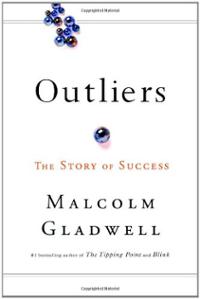
Outlier's The Story of SuccessI finally read the book Outliers: The Story of Success by Malcolm Gladwell. As I devoured the first few chapters, I thought about my quest as a professional writer. And my impatience in the early days. I wrote about it on my personal blog back in 2009.

But reading Gladwell’s research, I realized that even in 2009, I was well on my way to achieving my goals. I simply needed to take every necessary step.

According to studies cited in Outliers, it takes an average of 10,000 hours to master anything. I figure it took approximately five years of incessant practice, posts, and projects for me to near the 10,000 hour mark. Although I haven’t mastered the art, I’m certainly much better than I was six years ago.

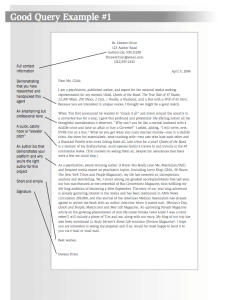
And one of the most critical areas of improvement comes in my creation of query letters. Let’s face it, if you can’t write a strong query, you won’t arrest the attention of any agent, editor, or publisher. Early on, I spent a lot of time studying and honing the elements of this crucial piece.

1. Research

Writer's Digest Query Letter
Image Credit with Permission Writer’s Digest
http://www.writersdigestshop.com
  • Who specifically should you address your inquiry to? Name. Title.
  • Where should you send your query? Do they accept email only? Content as an attachment, or in the body of your email? Are they snail mail lovers? Do you have the correct address?
  • What are they looking for? Does your topic or slant match their needs? Have you formatted your submission according to their guidelines?
  • When are they accepting submissions, and do they have themes tied to calendars?
  • Why did you chose them? Did you read something that made you think you would connect? Are you familiar with their needs and believe your work can support them in their mission? If possible, find a common bond or at least prove you’ve studied what’s important to them.
  • How do they want queries packaged? Some prefer a simple one page letter, clearly stating your concept as it fits within their guidelines. If interested, they’ll ask for a proposal or manuscript later. Others request a proposal or manuscript at the same time you send the letter. Make sure you know what the person you are querying prefers.

2. Hook

No matter how well you’ve written your article or book content, without something to snatch the reader out of their doldrums on the average of the first seven seconds, your work will go no further. Ask that stirring question to make them think. Make a bold statement that flies in the face of an old cliché. Provide a heart-wrenching statistic, forcing them out of the skin of self. Make their belly shake with laughter.

3.  Double Check

Writer's DigestOnce you’ve written what you believe is a strong query letter, I suggest you run it through the Writer’s Digest Do’s and Don’ts of Writing a Query Letter. This brief but powerful list will show you how to write a query letter in the most effective way possible. Also have someone who knows something about professional writing read it.

A family member, or even a high school English teacher, are not going to provide the insights you need when it comes to publishing in the real world. As long as it’s a short, one-time read, many professional writers are willing to do this for someone else who’s starting out. We remember those days. Just respect their time, and if one writer can’t help, try someone else.

10,000 hours sounds like forever when you are starting out as a writer. But with patient and consistent practice, this important landmark will arrive faster than you think. Start small. Master the query letter first. Then one day, you’ll have the honor of mentoring someone else.

How many hours would you estimate you’ve invested in writing so far?