

Therefore do not worry about tomorrow, for tomorrow will worry about itself. Each day has enough trouble of its own. (Matt. 6: 34 NIV)
Where do I begin? Do I work on one of these book proposals? Do I need to write another blog post? Do I have a speaking event scheduled this month? Do I need to work on my website?
I didn’t know where to start! And I thought, Enough!
At first, I thought my confusion might be a response to the stress. Soon, I realized that I needed God’s help. I needed some white space!
As a writer, I know the importance of white space—the empty space in every document, in the margins and between the words, graphs, and pictures.
The wise use of this white space can vastly improve communicating the writer’s message. And a lack of white space makes the page seem too busy, cluttered, and difficult to read. Yet too much white space produces an incomplete appearance.
White Space of Life
As I planned my use of time and resources, I concluded that the same important rules apply to the white space in all areas of my life.
If I fill every minute of the day with activities, work, and conversation, I become too preoccupied with unproductive distractions. But too much inactivity can rob me of my self-worth and credibility.
How do we determine the amount of white space in our lives? Never underestimate the power of organization, calendars, and spring-cleaning!
Can we discern how much white space to build into our lives? Those who know us best and love us unconditionally can offer healthy opinions. But seek an advisor with extreme caution— you may need to endure unsolicited criticism.
White Space of Grace
Never underestimate the power of God’s Word as you manage the white space in your schedule and decisions.
Jesus promised, “I have much more to say to you, more than you can now bear. But when he, the Spirit of truth, comes, he will guide you into all the truth. He will not speak on his own; he will speak only what he hears, and he will tell you what is yet to come” (John 16: 12– 13 NIV).
As I prayed for direction, I remembered other encouraging words: “Whatever you have learned or received or heard from me, or seen in me— put it into practice. And the God of peace will be with you” (Phil. 4: 9 NIV).
I also recalled the story in the Bible of another weak, tormented soul who discovered the sufficiency of God’s grace. Like me, the apostle Paul begged God to take away his problems. But God responded with surprising direction: “My grace is enough; it’s all you need. My strength comes into its own in your weakness” (2 Cor. 12: 9 The Message).
The Bible offers important advice about letting go and moving forward:
Not that I have already obtained all this, or have already arrived at my goal, but I press on to take hold of that for which Christ Jesus took hold of me. Brothers and sisters, I do not consider myself yet to have taken hold of it. But one thing I do: Forgetting what is behind and straining toward what is ahead, I press on toward the goal to win the prize for which God has called me heavenward in Christ Jesus. (Phil. 3: 12– 14 NIV)
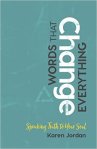 Where do you need some white space in your life? I hope this excerpt from my book, Words That Change Everything, speaks to your need for some white space.
Karen Jordan. Words that Change Everything. Copyright © 2016 by Karen Jordan. Used by permission of Leafwood Publishers, an imprint of Abilene Christian University Press.
 “You can have everything in life you want, if you will just help other people get what they want.” Zig Ziglar, the ultimate motivator, knew that when we authentically and unselfishly support other people, great things happen. I’ve experienced the truth of this principle many times in my life, but especially recently, when I joined forces with two other WordServe authors.
 One of our most exciting accomplishments came from developing a women’s conference based on our book’s title and message. We outlined options for a one-day conference as well as a two-day event. We came up with a suggested ticket price and estimated income from the event based on a variety of attendance number ranges. We brainstormed ideas for other creative ways to support the Untangled Women’s Conference. And we reviewed different expense scenarios, weighing convenience against cost.


 One of my favorite definitions is the one for insanity that goes “doing the same thing over and over and expecting different results.” I’ve felt that was an accurate description of many of my book marketing efforts in the past twelve years; sending off press releases to local newspapers and rarely getting even a little paragraph tucked somewhere in the back pages comes to mind. I’m sure every author can add to that list of marketing insanity.



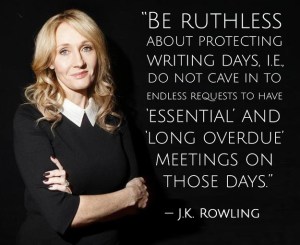
 Maybe you can relate to days like I’ve had. Where you need a dose of inspiration to get you moving — or a swift kick in the fingers. When this happens, I’m grateful for quick, motivational, and uplifting thoughts from other experienced writers.
 “First drafts are always horrible and ugly. Don’t worry about that – it’s the same for everyone. Just remember that the first draft is as bad as the book is ever going to be, and if you keep redrafting, one day you will look at your horrible book and realise that you’ve turned it into something actually quite beautiful.” – Robin Stevens, author of the Murder Most Unladylike series
 “Write what you want to know more about — the teacher always learns more than the student. Become passionate about the stories you tell and the people you are writing about. Finish your writing day with something that makes you want to know what happens next. Give yourself periods of rest — mental breaks sharpen the mind. And keep writing, especially when you don’t feel like it.” — Anita Agers Brooks, author of Getting Through What You Can’t Get Over and other titles
 WordServe Water Cooler