Keywording 101 for SEO Prowess

Three words:  Search Engine Optimization.  They kind of make you want to grab a bag and start hyperventilating, don’t they?

In the world of viral marketing, social media and Google Adwords, SEO has become another one of the things that you’ve probably had to put on your to-do list.  And, if you’re anything like most of the writers I talk to, you probably have no idea where to start.

I was lucky.  Before I got my book deal, I’d spent five years working as a staff writer for a major media company.  And, since we wrote for the web, I spent hours each week honing my SEO skills.  We actually had a team of SEO gurus on staff that hosted weekly SEO boot camps for us—analyzing every article we wrote for SEO viability and nitpicking every teeny tiny keyword on our site.  So, while viral marketing and blogging were new to me, I had the SEO thing down pat.

And, I have to say, it’s worked for me.  While I spend very little time doing viral marketing on my blog—I’m just not a good twitterer—I get fairly decent traffic—and most of it comes from Google referrals.  I chalk that up to having a strong SEO strategy—and knowing where to focus my SEO time.

Obviously, SEO is a tough nut to crack—and there’s no way I can give you even a tenth of the information you need in one post.  Before you create a viable SEO strategy, you’ll need to decide if SEO is even worth your time (in some cases, it’s not), how you’ll use SEO keywords (there are many, many ways that go way beyond simply keywording a post) and how to create relevancy with your keywords on your site (now that’s complicated).

But, in order to put the horse before the cart, the first thing you need to do is come up with a list of keywords that you want to use on your blog or website.  This list can (and will) become your SEO cheat sheet—you’ll have something to focus on, something to consult whenever you’re writing a post, a start to a strategy.  Here are my tips:

  1. Limit your keywords. I’ve had clients who presented me with a list of 100 keywords and then asked me to help them come up with more.  And, while they have the right idea in that they are focusing on specific words instead of just throwing out a random slew of words as they write a post—they are biting off too big of a chunk.  While the Google and Bing algorithms are super complicated, one important aspect is that they search for relevancy—which means in a nutshell they’ll be crawling your site to see how much information on your site is relevant to a specific keyword or idea. So, unless you’re posting dozens of articles every week that are very specifically focusing on all 100 of your keywords, you’re probably not you’re not creating a sense of relevancy with many of them.  So, choose a short list (my recommendation:  between 5 and 15) of keywords that you can focus on with every post, every page and every idea.  By simplifying, you’ll actually create a bigger reach.
  2. Do your research.  Don’t just guess on which keywords people are searching!  I use both Google Adwords and Google Insights all the time to help my clients (and myself!) find appropriate words to focus on.  They’re pretty straightforward tools so you can probably figure out how to use them to your advantage in less than ten minutes.
  3. Know your competition. Remember how I told you that I used to work for a major media website with huge traffic numbers?  And remember how I said we had an entire SEO team on staff?  Let me give it to you straight:  Unless your last name is Grisham or you have a staff of 40 writers and editors helping you with your blog, you CANNOT compete with major sites like that.  It’s a waste of your time to try.  Case in point:  Me!  My book, The Christian Mama’s Guide to Having a Baby, is a pregnancy guide–but I have never spent even a minute focusing on the keywords “pregnancy,” “pregnancy book” or “pregnancy guide.”  Why?  Have you ever heard of “What do Expect When you’re Expecting“?  Or “Baby Center“?  I could spend hours a week creating relevancy on my site around the word “pregnancy” and only move from page 120,000 to page 50,000 on Google.  And, while moving up 70,000 pages is pretty good, I’m pretty sure no one has ever looked past the first two pages of Google results, so it’s absolutely a waste of my time to focus on “pregnancy.”  Instead, choose words that get a decent number of searches every month (target:  between 1,000-10,000 global monthly searches) and low competition (less than 20% on Adwords) and focus on those.
  4. If you don’t talk about it on your site, don’t use it as a keyword.  I see this mistake all the time… my clients throw out a search keyword based on a theme or idea in their books, but when I pull up their website, I see nothing about that particular idea on their website.  It’s not only poor user experience—if someone Googles “Amish recipes” and then comes to your site and finds nothing about Amish recipes, they’re probably not going to stick around—but it also does nothing to create a sense of relevancy around that keyword, which will hurt your SEO.  This does not, however, mean you need to blog only about the topics in your novels.  For example, author Jody Hedlund has a wonderful blog full of tips and ideas for authors (find it here)—however, her latest novel, The Doctor’s Lady, is about the first woman to pioneer the Oregon Trail.  On her website, Jody has done a great job of creating relevancy surrounding the theme of her book by creating a cool “reader fun” page that’s full of facts, quizzes and more surrounding the historical times in her books.   Similarly, author Rosslyn Elliot, a historical romance author who wrote “Fairer Than Morning” maintains a “History” page on her site that adds relevancy surrounding the historical concepts in her novels.
  5. Cater to groupies.  As fun as it would be to be loved by everyone, it’s just not going to happen.  As a pregnancy author, I can’t appease the natural birthers AND the epidural fanatics.  And you can’t appease everyone either.  So, think about your core audience—the people who ABSOLUTELY love everything you do—and work to appease them both with your site content and your keywords.  For example, my friend Cathy West wrote an amazing historical romance called Yesterday’s Tomorrow that’s set in Vietnam during the war.  And, while her book is great for all sorts of populations, you can bet that Vietnam vets and their families find it especially compelling.  My recommendation for Cathy?  To cater to that population, both by creating contests and posts that appeal to Vietnam vets, but also by focusing her keyword reach on words that appeal to that audience.

NOW:  For a chance to win an hour of SEO consulting from me (via phone or Skype, 30 minutes research, 30 minutes talking), respond to this post and tell me how (or if) you’ve developed an SEO strategy for your blog.  Winner will be chosen at random on October 21st and will be contacted by me via email.

*CONTEST IS CLOSED*  Congrats to WINNER Norma Thurston Holtman.

How to Get Any Book Into Your Lap…Free!

Have you ever been in the situation of wanting to look up one item in a book, but the book is either expensive or obscure. Chances are you turn to your local library. Many people know about Interlibrary Loan (ILL) within their own library system, but what happens if your library system doesn’t carry a specific book?

In my last post I described how to get ahold of serious research in professional journals by accessing your library’s computer database. Today I want to describe how to get any book, from places all over the world, and have it delivered directly to your library branch?

The first time you do this it may seem tedious, but once you know how, it’s a breeze. I typically order about a dozen books a month this way. Your library system may vary, but here’s how my library does it:

  1. Bring up my library web site: Jefferson County Library
  2. Click on maroon-colored icon called “Research tools”
  3. This brings up:  “Subscription Databases A – Z” Click on this.
  4. In the Databases A to Z, click on “W” and choose “World Cat” or scroll down to “World Cat” Click link.
  5. Search for book. It is best to put several items in the search boxes. For instance, the book title and the author. Here I selected the title Seeking Peace and the author Mary Pipher. (I write about self-care and wanted to see how a bestselling author and psychotherapist burned out and subsequently learned to simplify her life.)
  6. When the world catalog finds your book, either print out the page, move it over to a dual monitor, or jot down the most important items: Publisher, year, and the OCLC number. (For Mary Pipher’s book the OCLC number is at the bottom of the page and is 233547957)
  7. Now go back to your library’s main screen. Choose the blue icon on the left side, “Find Library Books and More” – You will find a link called “Interlibrary Loan Request.” Double click. At the bottom of this page is a link called “ILL form for Books/AV Materials.” Click on that.
  8. Fill out the author, title of book, publisher/place/date, format (book, video, DVD), pick-up location (for me that is “Columbine Library”) and OCLC number.

*I don’t fill out the part about paying money for the request or the “cancel if not filled by date” information.

At the bottom of the page, I type my name and library card number.

Voila!

Almost any title from across the miles will be delivered right to my library. It takes about a week. If you find this confusing, go into your library and ask how you can use the World Catalog and Interlibrary Loan. Chances are your librarian has a bookmark with instructions already printed on them.

I’m curious, did you know you could do this?  What research tips do you have to offer writers? 

The Long View of Getting Published

Photo by Michael Hirst

There are two distinct parts to my career as an author. Part one, when I saw myself as more of a lone wolf and part two, when I finally started admitting I don’t know everything.

The second half where humility has played a lot bigger part has been more rewarding in every way, particularly financially and spiritually.

Funny little thing I’m learning about life is that when I stop trying to force my will and realize I may not get what I want but I can still be of service, more of what I wanted all along shows up. However, to head down that path the first few times took a lot of courage and hope because I didn’t have any personal proof. Fortunately, I had worn myself out trying things my way. I became willing.

To be an author, whether it’s as an independent or through the traditional venues takes more people and therefore a lot more willingness. The independent route sounds like it would be easier to stick to your own common sense and that would be more than enough, except for the occasional question. But publishing a book is a process that requires a lot of hands.

Besides, I was more arrogant than that anyway, running down the traditional path and still telling everyone how I saw things.

However, when I stopped listening for just the small kernel I wanted and expected to hear, dropped any agenda and not only took in the information but gave it time to sink in, things really began to move in a better direction. That opened things up even more.

What if I even followed through on some of the suggestions to see if other people who are actually the professionals in their slice of the publishing game were right? Perhaps my part in the entire process is to be a team player, be open to all of the information that’s coming in and just do what’s been suggested.

Some wrong turns are to be expected and even that’s okay because  the last tool I keep close by is the one that makes all of it okay.

I am powerless over the outcome but there is One who has His hand on everything, loves all of us beyond our ability to understand and has a plan that includes everyone. This is the most important part to me and makes it possible to relax and go back to the day I’m in when I’m worried about how book sales will go or if a book will get published at all.

The answer is, maybe it will, maybe it won’t.

In the past I couldn’t live with that answer so I tried harder to fix things. That just didn’t work and I wore out others as well as myself. Doors closed.

Now, I ask myself if I’ve done my part? Do I trust the professionals I’m working with on this book? What’s in front of me to do? How can I go be of service?

I know, all of that sounded really contrary to becoming published to me too, at first. But I had tried the lone wolf gig and only gotten mediocre results, at best.

I became willing to try a new tack. God is everything or God is nothing and I wanted, maybe even needed God to be everything so I started listening with a new ear. I asked for help and admitted when I didn’t know something. I grew more patient and less ‘helpful’ with suggestions. I did what was asked of me, on time and nothing more, allowing others to do their job without my interference. I became willing to change structure or style and see what happened.

And on the days when my anxiety still sits on my chest like an angry gorilla, I go pray, turn it all over to God and ask for peace of mind and heart. Then I get back to my day, do what’s right in front of me and keep going. As a result, more of my publishing life has fallen into place and my relationships in that area are a lot stronger.

To Market We Go. . .But Why?

I admit, I’m a bit of a marketing geek. I find trends and patterns fascinating. Behind every great or dastardly marketing campaign lies a motivation—a why. And I want to know it, understand it, and pick it apart.

Why did it work? Why didn’t it work?

Some campaigns are obvious from the get go. Take Netflix’s recent adventure of separating streaming video from disc. We witnessed their invention (or misguided intention) of Qwikster. The name didn’t work, nor did there seem to be any reasonable point for separation. Their “why” just didn’t make sense. Thankfully they abandoned the idea before they got neck deep. In fact, I give them kudos for having the courage to admit to their customers that it would have made things more difficult.

Here’s an example of my latest fascination. Honestly, I stood in the mall laughing at this one.

I freely confess that I’m an Apple geek as well. Microsoft’s obvious attempt to copy Apple could be taken as a compliment, but I could only wonder, is it effective? How effective does our marketing become when we’re simply copying what the other guy is doing?

Yes, we’re talking about similar products and thus overlapping markets. Not identical markets though. And then I’m curious as to how the everyday consumer perceives such a clear attempt to piggyback on another company’s successful model?

Of course, there’s the other side of the argument. Why reinvent the wheel? It worked for them, why not do the same? That’s fine to a point—to use a successful model as a launching point. But don’t we still have to come back to the beginning? Back to the “why?”

I find this especially amusing because of this:

The Apple store is directly opposite this soon-to-be Microsoft store and has been there for years. Their Genius Bar and staff have been serving people for many a season with their gadgets in hand and uniformed colored shirts and badges. (Uh hem. . .)
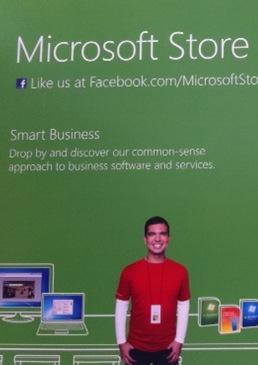

It’s all about service and Apple makes an art of it. Never been in one? Take a field trip one day and check it out. We can learn a lot from Apple’s successful model of creative marketing. To them, it’s not just about the product. It’s about the costumer and how they’ll use it, right down to the feel and experience. It’s all about the “why.”

I wonder if Microsoft thought through their campaign beyond the “well it works for them” to their customers and who they’re trying to connect to. Or are their customers just potential collateral gain or damage in the race to be number one?

So this brings me to my point (yes, I do have one other than finding this Microsoft imitation so very amusing). Do we think about why we are marketing our books or do we just do what everyone else is doing?

And finally, does it work? Now there’s the real question. What do you think?

Is it my whim or God’s Will?

I’m often either asked this question or have discussed this with other Christians. With so many gray areas in life—where doing a variety of things would fall inside the will of God—we long to know the choice God would have us make. What’s the best path?


I’ve met a number of aspiring writers who wrestle with this issue, too. Many people “have a book in them.” Perhaps they start writing as an experiment to see if they can really get some words down on paper. At this point it’s more of a whim. Some people give up relatively quickly; they find the idea of writing more fun than writing. They never make it a priority, letting other interests in life take precedence. For them, writing is probably a whim.


But there are others who find writing exhilarating. They delight in exploring and expressing what’s on their heart, something they’re certain will benefit others. At some point they become convinced God is blessing their efforts, and they want to share what they’ve written on a larger scale, often through publication.


So at this point does it cease being a whim and become something they’re just beginning to realize was God’s will all along? Has God called them to be a writer?


I’ve heard it said there are only three answers to our prayers: Yes, No, or Wait. But even when we get clear answers, the results aren’t always what we expect.


Sometimes when we think God is leading us in one direction and we come upon a closed door, we might think that means No. For example, if publication doesn’t happen is God saying no to your writing efforts? Every writer I know, regardless of how talented, has been rejected in one way or another. I know one writer who worked toward publication for twenty years. How many of us would have given up on a goal long before that?


I’m in the midst of a wonderful Beth Moore Bible Study right now, and one of the personal examples she gave included how she seeks God’s will for her own life. They include these ideas:

Begin by making a really specific prayer request. Don’t be shy when asking God for direction!


Look to Scripture for an answer. The Bible is how God talks to us these days. It’s always amazing to see how timeless the Bible is; people who lived two or three thousand years ago really aren’t much different, at least on the inside, than we are today.


Ask God to help us recognize the answer. Staying in the habit of being in continual communication with God is always a good idea!


Ask God for confirmation.


Did you notice a couple things? All of these steps demand a certain amount of time, as well as a lot of prayer.


I would add one more thing. I’ve always thought it a good idea to consult other trusted Christian friends. With writers, it’s important that we seek outside input with our projects—from trusted and experienced eyes. Is the input from others confirming the direction we feel led to take?


So what kind of methods do you use to determine whether your next project, the next turn in life, the choices you make, would be a whim or God’s will for you to follow?

Creative Marketing – Try Something New

Marketing. The dreaded M word that makes introverted authors like me shudder. It’s a good thing I am contracted with a major publisher. They’ll take care of all that marketing stuff, right?

Pop! Say goodbye to that delusional bubble.

Even though I’ve been blessed with a fabulous marketing and sales team, I’m not immune to the pressure of marketing my books. Publishing is a partnership, and I’m expected to market as much or more than my publisher. After all, they have an entire catalog of new releases to sell. I have only my own.

So when I first waded into the marketing waters, I looked around to see what other authors were doing and followed their example. I had my website professionally designed, I got involved in Facebook and Goodreads, I set up guest blog appearances and interviews to correlate with my release dates, I had a launch party, I offered giveaways and hosted contests, I handed out bookmarks, did book signings, and spoke to groups any time I was asked.

Did any of it make a difference? I think so. It’s nearly impossible to measure the impact of marketing, but occasionally I’ll get reader feedback from someone who mentions that they found my books because of an interview I did on a particular blog, or that they bought my previous books after winning my latest one in a drawing and enjoyed it so much they wanted to read more from me. These little glimmers give me hope.

But now that I’ve gained a year of experience, it’s time to branch out from the crowd. It’s time to aim my creativity brain cells not just at my WIP but at my marketing as well. So when it came time to launch my third novel this spring, I decided to try something new. Something that would engage readers on a more personal level and hopefully entice new ones to give my book a try. I sponsored a fan fiction contest.

I write historical romance, and knowing that romance readers live for happy endings, I thought to give them a chance to create their own. I can’t tell you how many times as a reader or movie watcher I have mentally re-written an ending or continued the story in my mind, imagining how the characters’ lives would play out. I thought it would be fun to give my readers the same opportunity.

Now in To Win Her Heart, my main characters had a very satisfying happy ending, but the secondary love story was left with a little more ambiguity. Therefore, the fan fiction contest challenged readers to create an epilogue specifically for secondary characters Chloe and Duncan. I enticed readers with generous prizes like a $40 gift card from Amazon, an autographed book of their choice from my list, and the privilege of having their winning entry displayed on my website for all to see and enjoy.

I advertised in my newsletter, on Facebook, and in blog posts on sites that catered to writers. I was hoping to snag some readers from the writing crowd who might not usually read historical romance or who hadn’t tried my books before, but who were interested in competing for my prizes.

To Win Her Heart released May 1st so I ran the contest through the end of June. I didn’t have a flood of entries, but I ended up with a wonderful collection of about a dozen epilogues to choose from. More valuable than the number of entries, though, was the amount of personal interaction with readers this contest produced. I even had one lady say that she didn’t realize how powerful a marketing tool the contest was for her until she found herself in a bookstore buying my book just because she wanted to enter my contest. I’m hoping others experienced the same sensation even if they ended up not entering.

In the end, there’s no telling how many actual sales this contest generated, but I’m hoping the effects will continue to ripple. The lady who won has her epilogue on my site, and she’s no doubt sharing that story with all her friends. The quality of her writing was wonderful, and she captured my characters so well, that I was proud to display her work and to point other readers to it as bonus material.

Whether or not this attempt at marketing generated many sales, I’m glad I did it. It was fun to try something different and to interact with readers in a new way. It gave my stale marketing practices a much needed shot in the arm, and I would gladly do it again.

Question for You: What is the most inventive marketing strategy you’ve ever employed or seen employed? What marketing ideas have you toyed with that you’d like to try? What have you seen other authors do that caused you to find yourself in the bookstore buying their book?

To see the winning entry, visit the fan fiction page of my website at: http://www.karenwitemeyer.com

When is Compromise “Selling Out”?

Publishing — like music, film, business, or sports — is not a solo act. Therefore, climbing the ladder of success always involves some sort of compromise, some sort of give and take. Of course, WHAT one is willing to give and take along the way is the cause of much heartbreak.

Writers typically frame their dilemma this way:

“Do I compromise what I really want to write in order to make a living or get my foot in the door?” or “Do I write the story of my heart and let the chips fall where they may?”

There is a certain nobility (sometimes feigned) by artists who rage against the machine. You know some of these people, right? They refuse to adapt their style to the market. They rail against the money-grubbing gatekeepers. They scoff at “the rules.” They chafe against industry decorum. They denounce the status quo. They disparage what is commonly accepted as popular art. They would rather die anonymous than be a patented sellout.

They are [insert angelic choirs] principled.

Sometimes being “principled” is a cop-out. No, I’m not suggesting being a sell-out isn’t. I’m suggesting that we sometimes use the term “principled” as a smokescreen.

Sometimes being “principled” is really just

  • Pigheadedness
  • Inflexibility
  • Disdain
  • Institutional prejudice
  • Lack of professional savvy

Of course, there’s many artists who have resisted conformity and we are better off for it. But is “resisting conformity” the golden rule? Truth is, the “starving artist” is often one who holds the ticket to her next meal. Your “hunger strike” could be avoided by simply seeing your talent as a tool rather than the Holy Grail.

Nevertheless, knowing when to compromise and when to hold your ground is the gist of creative enterprise. Just don’t be fooled into thinking that all compromise is selling out.

  • Compromise is “selling out” when you become a puppet of the institution; your talents exist only to oil the machine, your originality and vision is replaced by groupthink, the ties that bind are actually nooses, you are an organizational prop.
  • Compromise is “selling out” when your integrity, morality, and highest principles are sacrificed in the process; you lose yourself for the sake of success / power / fame / advancement / personal gain, “high ground” is vacated for “safe ground,” your birthright is squandered for three square meals a day.
  • Compromise is “selling out” when your unique voice and vision is squelched; you no longer have any real creative freedom or input, you are coerced into complicity, you cannot air opinions lest you bite the hand that feeds you, someone else holds the deed to your creative license.

No matter how unique your vision, you probably can’t go it alone. You will need to compromise, involve others, solicit others, confide in others, team up, and make concessions along the way. This is definitely true in publishing. I know, I know — the publishing world is changing, you say. The self-published author can do it “their way” (which is code for remaining [cue angelic choirs] principled).

But while the solo artist might maintain creative freedom, they often lose something in the process, namely collaboration. It is precisely the thing that they most fear (other eyes), that they can most benefit from.The self-published author may not have sold their soul to the devil, but the chances of them selling their book is equally remote.

Compromise can be painful. But if it makes my product better and gives me the opportunity to make more of it, then it’s the smart thing to do. Or as Benny G said, “You’ve got to give a little, take a little, let your poor heart break a little.”

* * *

Question: Do you agree that being “principled” can sometimes be a cop-out?  Do you think it’s better to compromise what you really want to write in order to make a living or get your foot in the door? Or is it better to write the story of your heart and let the chips fall where they may?

The Write Death

Writing

They raced through my brain going Mach 5. Brilliant ideas and heart-grabbing experiences I felt called to share. They screamed to be captured for the multitude, so write I must!

Lassoing the brilliance and transferring it to paper would be a piece of cake. C’mon, I’m from Texas. Throwing a lasso comes naturally.

Full of self confidence with excitement electrifying every nerve, I arranged my desk just so. Lamps dimmed. Candles glowed. Laptop waited. Coffee brewed. I knew something epic was about to happen.

My fingers hovered over the keys. I took a deep breath and slowly typed, “Chapter One.” I stared at the screen at those wondrous words. Enraptured. Savoring each letter.

This was a glorious moment. I had embraced my calling as a writer! And now…time to write. Let the brilliance shine!

Blink. Blink. Blink went the cursor.

Blink. Blink. Blink went my eyes.

Repeat 30 times.

And then it happened. My brain’s hard drive melted like wax. (It must have been all the self-induced brilliance.) The ideas tangled like rubber bands. The mental beavers built a dam at lightening pace – smack dab in the middle of my brain.

My lasso kept missing. The brilliance was just an illusion. My coffee grew cold. In tears, I blew out the candles and turned off the laptop. Those two words were all I typed that night.

And so began the journey of writing my first book. Thrilling, right?

That evening something died, and rightfully so. Ego. Writing a book isn’t about me. It never will be. It’s about an unlasso-able God who desires to communite to me, through me, and oftentimes in spite of me.

In my eagerness to stand as a published writer, I forgot to kneel before the One who called me to it.

That night drastically altered my writing perspective. I don’t care if my desk is tidy. It doesn’t matter if the candles glow softly. It doesn’t matter if the coffee gets brewed. If I don’t start in prayer, I don’t start at all.

Today, Chapter 1 has successfully passed through the hands of my editor. But God accomplished something far greater that night. He caught my fall, reminded me of His love, and encouraged me to start again.

Something epic did happen. Instead of allowing me to capture the perfect phrase, He
re-captured my heart.

Thank you, God, for your brilliant grace.

Let’s chat: What did you experience as you launched into writing your first book? At what point did you have a meltdown (or did you)? What kept you writing after that?

writing an e-book: the pros and cons

Four years ago, I wrote a book called Is That All He Thinks About?: How to Enjoy Great Sex with Your Husband. It’s for women (obviously), and I had no intention of ever writing a companion book for men. Because men don’t read.

Well, men who read blogs like the WordServe Water Cooler read, of course, but not the average Joe I know.

Then I started getting a bunch of e-mails from guys who had read Is That All He Thinks About? and specifically requested their own version.

So I wrote a comic book. (Not really.)

I started playing around with words. Then I started writing hard-core. Then I asked guys to fill out a husband survey. 130 surveys later, I had committed to doing this thing.

But despite having four published books under my belt, I decided to go the self-published e-book route this time around. Why? Here’s why:

The Pros:

1. The timeline. From the minute I submit a proposal to my agent to the time I see my book on a shelf, a minimum of one year will have gone by (and most likely, much, much longer than that). My e-book took less than three months from the time I started writing it until it was in readers’ hands.

2. The style. I had a certain vibe I was going for in this book. Very conversational, at times a little slang-y. It was important for me that I be allowed to write it just like I wanted it.

3. The money. All the proceeds from the e-book are going toward a family mission trip (me, hubby, our 3 girls) to Cambodia this winter. I can sell an e-book for just $2.99 and still make more than I would on a “real” book. And I get paid instantly (or within six weeks).

4. The experiment. Two of my four books haven’t sold well, making it hard for publishers to take a risk on me. Maybe I’ll be traditionally published again someday, maybe I won’t. I think I wanted to see if I could make it in the e-book world (I dream of selling millions of copies and having publishers knocking my door down).

5. The audience. This is a book for men (husbands) and it’s about s-e-x. If I were a guy, I’d feel better about buying a book like this from the privacy of my own home than in a bookstore where anyone could see me.

So, why isn’t everyone rushing out and self-pubbing e-books? Well, they kind of are, but here’s why you should think long and hard before you do:

The Cons:

1. The stigma of self-publishing. I can’t predict the future, but I feel like it’s still going to be awhile before people take self-pubbed authors super-seriously.

2. The weight of promotion. When you self-pub, it falls squarely on your shoulders. Not that being traditionally published is a ton different in some cases, but the only way anyone finds out about my e-book is through my own efforts.

3. The risk. What if it bombs? What if I barely sell any, and it just adds to my previous sales history woes?

4. The work. It takes a lot of sweat and tears (no blood in my case) to produce/publish an e-book. Thankfully I’m married to a web designer/genius. He did it all for me (thanks to Mary DeMuth for her helpful tips) and says he needs a big long break before he’s ready to do another one.

5. Incomplete sales records. My e-book is available on Amazon and Barnes & Noble.com. But I also sell it through a website. And give away copies for free all the time. I really have no way of knowing how many people have read my book.

So, let me ask you this:

1. Which “pro” excites you the most?
2. Which “con” scares/depresses you the most?
3. What are some other pros or cons you’d add to the list?

Post Author: Marla Taviano

Marla Taviano—a lover of words, Scrabble tiles, and giraffes—dreams of traveling the globe with her web-guru husband and their three young daughters. The author of six books, Marla writes and speaks on enticing topics like sex, loving the poor, and how to visit 52 zoos in 52 weeks on a shoestring. Her heart breaks for those in poverty/slavery around the world, and she wants to use her platform to ease their suffering. Marla lives in Columbus, Ohio and met her Wonder Agent, Rachelle Gardner, at a Starbucks by the Denver Zoo in 2009.

How Bad Do We Want It?

For years, I harbored a secret.

I wanted to be a writer. I longed to see my words in print. But persistent doubts and fear of failure often sidetracked me.

Desire and talent were two different threads. I wondered, “Am I truly capable of crafting words people will want to read?”

As a mostly self-taught writer, it was time. Time to learn. Time to network. And time to confess my secret.

Where to turn?

Three and a half years ago, feeling a bit Alice in Wonderland-esque, I fell into my first writer’s conference. Upon my arrival, I discovered a very weird yet indelibly native wonderland.

The mountains were filled with beginner, intermediate, and widely-read authors. And the land overflowed with editors, publishers, and agents. Finally, a sense of genuine community—these people understood. We spoke the same language, shared similar idiosyncrasies, and dreamed the same dreams.

But dare I fantasize they would help me—that they could help me—figure out which way to go from here?

Like water for a flower, the serendipitous environment seduced me to voice my dream. I whispered my idea into attentive ears. It was all I had—a simple, naïve, and undeveloped concept.

The faculty was incredibly helpful. Come-at-able (within respective boundaries). Attainable. These worldwide publishers, award-winning authors, national editors, and stellar agents were simply real people. And they didn’t bite! They wanted to help, and expressed a genuine interest in my success.

Words of encouragement and strong support overtook me. Transformed me. A newfound confidence wafted through the mountain air. I really can do this.

I packed my bags for home with a new resolve. I would return to next year’s conference with something tangible—my book proposal and sample chapters.

However, dark storms quickly absorbed this new perfume of confidence. I returned, instead, to the lie of the daily routine. Life as a mom, wife, and entrepreneur consumed my days. Not to mention various health issues that cropped up at the most inopportune times. I quickly learned inspiration alone doesn’t write a book.

Eight months passed. A fluorescent note on my Daytimer reminded me of the upcoming conference, only a few months away. The date pierced my heart. How bad do I want this?

I had found the courage to voice my dream. Now, would I really do what I needed to do? It was time to be intentional, time to register for the next conference. And time to start writing.

A couple months later, I returned to my writer wonderland. Determined now to find my way, I hemmed up my fears and laid out my work before eagle eyes. I coveted honest insight and constructive critique. The faculty didn’t disappoint; the feedback was invaluable and the support overwhelming.

In the end, I completed my first book. I also gained multiple offers of agent representation, found a fantastic editor/writing coach, and secured potential endorsements. That first writer’s conference was the gentle kick I needed.


Desire and talent may well be different threads but woven together they have the potential for a beautiful tapestry.


How about you? As a writer, do you ever feel isolated? Lack motivation or confidence? How do you stay on track? Have you struggled to marry your desire with your talent? (I would love to hear from you; we’re all here to learn from each other’s experiences.)