Perfecting Prose – What I learned from being a RITA finalist

Earlier this year, I received a thrilling phone call notifying me that my debut book, A Tailor-Made Bride, had finaled in the RITA®  category for Best First Book. Was I ever excited! Then people started asking me about why I thought my book made it to the finals. My first reaction was – How can I possibly know? Contest judging is so subjective. The more I thought about it, however, the more I realized that even though I didn’t have direct feedback from the RITA judges, I had feedback from other judges—readers. So the tips you’ll find here today, are based on what I have gleaned from the comments of readers and reviewers.

Characters impact readers more than plot.

“What amazing characters… I loved Jericho and Hannah. It was as if they were real people.”

“Her characters live and breathe, not only within the pages but long after the cover is closed.”

“Her characters were flawed in ways that made them endearing and gave you a vested interest in their individual quests for happiness and fulfillment.”

My goal in designing main characters is twofold: have every woman who reads my story fall in love with the hero, and have every female reader wish to be the heroine. In order for me to accomplish this, as an author, I need to do exactly the same—fall in love with my hero and live vicariously through my heroine. If the characters aren’t real to me, they won’t be real to the reader either. So what makes them real?

  • Use Deep POV  Spend time in the character’s head. Express his thoughts directly using language that matches his personality. Show his reactions and emotions instead of explaining them to the reader. Give him a distinct narrative voice.
  • Use Contrast – My hero is a grouchy, set-in-his-ways livery owner, but that crusty exterior hides a soft heart that leads him to perform acts of kindness when no one is looking. His words might sound arrogant, but his actions show his inner goodness.
  • Give them flaws to make them real. Give them quirks to make them unique. Give them noble motivations to make them likeable – Hannah was living her dream of opening her own dress shop, but she struggled with her lack of business savvy when customers were scarce. Her quirk – she’s a 19th century fitness maven with a daily exercise regimen that most folks scoffed at. As for motivation, she wanted to have a successful shop, but not at the cost of being a stumbling block to others. Her ultimate aim was to use the gifts God had given her to serve her community, not simply to support herself by making a good living. Giving her a more noble motivation increased her likeability even when her stubbornness and pride led her into trouble.
  • Have well-developed secondary characters – Many readers have asked me about turning A Tailor-Made Bride into a series because they found themselves so attached to the town and its characters that they wanted more. What a fabulous compliment! Even though secondary characters don’t have their own POVs, make them memorable and real to the reader. Make them quirky and fun, or have them tug on the reader’s heartstrings. Use them to open the eyes of your main character when he/she is struggling to come to grips with a specific truth. But remember, their purpose is to enhance the story of the hero and heroine, not to steal the show.
  • Use dialog as a romance tool – Witty dialog is something I greatly admire in novels and strive to incorporate in my own. My favorite way to use it is between the hero and heroine as they fight against their attraction. Let them tease, flirt, and spar with each other as a way to build romantic tension. Sometimes having a character be audaciously honest can be a delightful surprise. One of my favorite scenes from A Tailor-Made Bride uses this technique. Hannah has learned Jericho’s true name and is teasing him about it.

He prowled forward, jaw clenched so hard, his facial muscles ticked. “The name’s J.T.”

“No,” she said, tapping her chin as if pondering some great mystery. “Those are initials. Your name is Jericho.”

Wiggling his fingers to keep them from curling into fists, J.T. reminded himself that she was a woman.

“Are you purposely trying to rile me?” His voice rumbled with menace, warning her against such a dangerous path.

An all-too-innocent smile stretched across her face. “Why, yes. Yes, I am. Is it working?”

Deepen Your Spiritual Theme with Layers

“Besides a beautiful romance, this story has take-home value in it that made me stop and reflect…The characters grew not only as individual people, and as a couple, but as children of God as well.”

“…you will also find the Lord’s “thumbprint” on every page. Her words ministered to my spirit in such a deep, penetrating way.”

“…while the book is highly readable and enjoyable, it is also thought-provoking. I found myself pausing time and again to reflect on my own life, particularly as it relates to God’s purpose for me.”

  • More than skin deep – On the surface, the key spiritual message of A Tailor-Made Bride seems to entail the issue of beauty vs. vanity. However, if you look deeper, you’ll see that the true message is about balance, unity, and opening yourself to God’s truth even when it goes against long-held beliefs based on personal experience.
  • Complicate things – Another aspect that I believe made my theme unique was that I allowed both characters to be right. Both had a biblical foundation to back up their position, and as I wrote their story, I found myself agreeing with both sides. The true issue is not who is right and who is wrong. The true issue is how can we treat each other with love, even when we disagree? And can we set our dogmatism aside long enough to see if there is any truth to be gained by pondering the opposite perspective?
  • Sprinkle other spiritual truths throughout the story in addition to the main theme – In real life, we rarely deal with one issue at a time. So in addition to the beauty-vanity theme, I also sprinkled in thoughts about running a business as a person of faith, using gifts to serve others even when the service goes unnoticed, and reaching out to the outcasts among us. Remember, however, that story rules. Never incorporate a spiritual thread simply to teach your readers a truth. Everything has to spring naturally from the characters and the plot, otherwise it will come across as preachy.

Question for you: So when you think about your favorite books, the ones that linger in your mind long after the last page is turned, what is it about them that impacted you most? If you were a contest judge, what would you be looking for?

How to Plan a Book Club World Premiere

Image by Salvatore Vuono

As I’ve journeyed to the February 2012 publication date of my first novel, Into the Free, I’ve listened carefully to authors who have “been ‘round this track” a few times before me. One such author is bestselling novelist Lisa Wingate.

Just before her sixteenth novel, Dandelion Summer, hit shelves, Lisa shared the book with a lucky group of ladies from the McGregor Tiara Literary Society. Then she shared their reaction to the book with the world via YouTube.

Book Premiere? That’s Genius!

I’ve always been a member of at least one book club, and I am drawn to books that encourage people to discuss the themes of the story. I was intrigued by Lisa’s idea for a premiere. I figured, Hollywood holds premieres for new movies, right? Publishers have started making trailers for books, just as producers do for films…so…why not follow that line of thinking and host a premiere for my novel? I was convinced Lisa Wingate was brilliant. And I was right.

But Lisa is not just brilliant. She is generous and compassionate and eager to share her talents with others. It’s no surprise she provided a step-by-step tutorial on her Southern Belle View blog for others who might want to plan such an event. There you’ll find detailed instructions on planning, organizing, recording, and sharing the big premiere.

Without her directions, I would have overlooked details about release forms and microphones. I would have struggled using Windows Movie Maker to edit the clips, and I would have been clueless about lighting, length, and little tips to make the event fun for all involved.

Roll out the Red Carpet!

Thanks to Lisa Wingate’s fabulous advice, and Terri Blackstock’s kind suggestion to check out Lisa’s idea, I have since held three book premieres across the country for Into the Free. I’m editing them now and will be sharing them with the public in January, 2012. But just for fun, I have posted some of the photos and comments on my website.

If you’re planning to launch a book in the future, I strongly encourage you to consider a book club premiere. Even if the camera malfunctions (as mine did with the third event) or Skype gets moody (as it did with the group in Colorado), it’s still a ton of fun and very interesting to hear reader feedback before the book ever hits shelves.

Big thanks to the Beach Babes of Baton Rouge, Louisiana; Porch Pals in Longmont, Colorado; and the University Literary Circle from Oxford, Mississippi for playing along with me.

And…be sure to view  clips from Lisa Wingate’s world premiere for Dandelion Summer.

NaNoFAILNo: Cracking the code

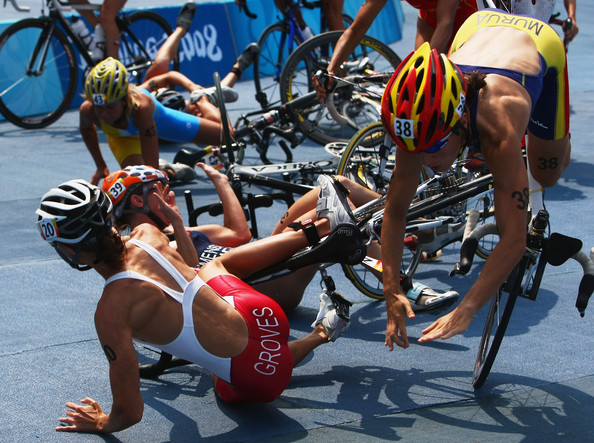
Ever feel like these 2008 Olympic tri-athletes?

I did last month, when (ten years postpartum) I decided to get in shape. Though our three golden retrievers have always kept me walking, this fall my prodigious cross-country-running son inspired me to pick up the pace a bit and run.

I followed all the training recommendations, slowly building up pace and stamina. I alternated running and walking until I could run a good couple of miles without stopping. As I trained, I noticed a tiny twinge in my left knee. Nothing major. Nothing too painful. Then I ran a 4.5 mile race on Thanksgiving Day. My knee hurt about half-way through, but I continued, finishing the race with a dull throb I thought would dissipate.

The next day, the pain felt excruciating. Days of ice, rest, compression and ibuprofen didn’t help. Convinced something major was severed—or needed to be—I went to the orthopaedic hospital for x-rays.

I left with the disappointing diagnosis of tendonitis. As much as it hurt, I expected a cast or bandage or something to show for it. Instead, I limped back home and continued rest, ice and ibuprofen for the next 5-6 days.

Finally, the pain subsided and I attempted my first walk since the race. I barely walked a block before the knife-like pain dug into the side of my knee. By the time I got home, all I could do was curl up in my bed with an ice bag and weep. One by one as if at a wake, our three dogs and three sons filed by the bed offering reassuring licks and hugs (respectively).

All of this occurred as NaNoWriMo drew to a close, along with my pathetic word count. I struggled with feelings of failure, futility, inadequacy, even doom regarding both my running and writing. Even so, I gleaned some wisdom from the experience—wisdom I thought fellow writers might appreciate.

1) First, it’s okay to try and fail.

Like most folks, I started NaNoWriMo with fervor and motivation. I had accountability partners. I tweeted word counts. Laundry piled high. Then life happened: three kids had to be three places at once; my family actually needed clean underwear; a day job and bank account needed me to work more hours; one dog licked open a hot spot and two others stepped all over my laptop whenever I sat down to write. 

All the while, that annoying NaNoWriMo daily word counter thingy crept upward. On the first day, the counter said to maintain a 1,667 words/day pace to meet the 50,000 goal. As writing time waned, the goal increased to 2,300/day. Then 6,534. On November 30, I would’ve had to write 26,000 words to meet my goal.

Still, I’m 24,000 words farther into my WIP than if I never tried at all.

2) Second, free writing leads to discovery of strengths, weaknesses and voice.

Psychologists use a journaling technique with some patients in which they tell them to use their non-dominant hand to write themselves a letter. Many times, this leads the writer in unexpected directions, opening doors to new and more productive stories. Similarly, as I continued through NaNoWriMo, I discovered new ways to write scenes. New characters felt free to emerge. I felt free to kill a few off and start over. I found my voice and lost it several times over, and even discovered new ones. Free writing, well, it frees us from editor mode, allowing uncharted creativity to emerge.

3) Keep going, but stop if it hurts.

I learned after-the-fact running shouldn’t hurt, and if it does, you should stop. Same thing with writing.

I know—I know. We’re supposed to allow our hearts to “bleed upon the page.” We ought to pour ourselves through our pens until we can sing “Nobody Knows the Trouble I Seen” in a grand, unrelenting crescendo.

Not that there’s anything wrong with that. 

But, most of us writers are melodramatic, hyperbolic saps. Seriously. If it’s too difficult, take a break. Find a new angle. Cross-train by reading a few books. Settle in to what works for you. If you participated in NaNoWriMo, be proud of whatever word count you achieved. If that sort of jump-start works for you, participate again. If you hated it and the whole month felt like a proverbial knife-in-the-knee, don’t bother.

4) As Captain Barbosa (from Pirates of the Caribbean) said, “The code is more what you’d call ‘guidelines’ than actual rules.”

So it goes with writing, including NanoWriMo. Writing advice on the web, in books or taught in classrooms are guidelines—not code—we need to tweak and apply to our unique lives. For example, the “write every day” advice is not feasible for my life stage, which includes boys, dogs, work and possibly undiagnosed ADD. For a long time, I beat myself up for not meeting that seemingly ultimate criterion for being a “real writer.” Now I’m learning to embrace my quirky—if manic-depressive—methods of achieving word counts.

You might wonder what’s become of my knee injury. I decided to head to the local swimming pool. A competitive swimmer in college, I returned to the place I knew I could find a niche and was gentler on my joints and 10-year-postpartum body. As I glide (pain-free) through the water, voices and the noise of the world are assuaged until all I focus on are breathing.

Kicking.

Reaching.

Pulling the water behind me.

More water.

More words.

Ever behind us.

Ever before us.

Ever beckoning each of us to write.

What about you? Did you participate in NaNoWriMo? If so, what did you take away from the experience?


When Do I Give Up?

It was my very first writers conference. I waited impatiently for my critiqued manuscript from a well-known and well-respected literary agent. Sitting on a bench under a tree, I opened the large manila envelope and pulled out my crisp, white pages that now ran red with scarlet ink – each red slash a tiny cut to my heart.

It was the moment I gave up.

Deflated and discouraged, I forced myself to stuff my dead work into its paper coffin, and attend the “Turning Your Chapters into Articles” class. I decided I would dismantle my much-loved dream and try to use it still. Being overly dramatic is a literary trait, and I wondered if this was a tiny taste of how the loved one of an organ donor feels. My manuscript that I loved would be used for good, but not in the way I’d hoped.

After the class, I met with the editor who led it. She asked how I was doing. (Apparently, that afternoon, Alice Cooper and I shared the same makeup artist.) She went on to encourage me not to give up on my dream. “This is one agent’s opinion, Joanne,” she gently reminded me. Her words gave me a microscopic ray of hope. (Purchasing an article for her magazine helped my mood, too.)

The agent who sliced my work like Dexter did me a great favor. He showed me how to shape my work in a way that would be acceptable the next time. Months later, I received my first book contract.

Since becoming an official “writer,” I have quit at least six hundred times. As a matter of fact, I even titled one of my emails to my agent, Rachelle, with these very words this summer: “When do you give up?” She immediately called and talked me down from the ledge, and recently addressed this timeless writer-question very eloquently in her blog.

I thought I’d share a few ways to encourage the quitter in you:

Take a laptop sabbatical. My computer recently died, and I thought I would too. Once my laptop was up and running again, so was I! Three weeks was just the break I needed. Giving my right-brain some creative rest helped me look forward to working on my next project.

Shake a leg. Exercise and I are not the best of friends. But whenever I get outside and get my blood pumping, it seems to clear the cobwebs in my middle-aged head. I take my recorder along, just in case I get an idea I can’t ignore.

Make time for someone. Get out of your self-centered word-filled world. Go out and see a movie. Call a writer-friend and vent a bit. Have a quiet night at home with your spouse. Cuddle up on the couch and read a book to your child/grandchild.

Fake your own death. Just wanted to see if you were still reading. Please don’t do this. Definitely not a good career move.

New York Times Bestselling Author, Susy Flory, recently shared a blog post that encouraged her. Agent Steve Laube reminded his many readers and wannabe-clients to never give up.

“John Creasy the English novelist kept at it. He kept getting rejected so decided to use pen names to create a new identity. Fourteen of them! Collectively he received 753 rejection letters. But he didn’t give up. His 754th became the first of his 564 published books. What if he had quit at the 700th rejection?”

This Christmas season, take a winter break and enjoy real life moments. Try to live this life you write about. Love the ones you are blessed to have alongside you, and pray God holds these tender moments close to your heart. A true writer must experience what they wish to convey. Gather up some word-filled ammunition for the coming year.

Regardless of what you do or don’t decide to do, giving up is not an option. It’s never an option. Never.

When was the last time you quit? What encouraged you to write again?

Answering Critics

Everyone’s a critic. Everyone has an opinion. And of course, everyone’s entitled to their opinion.

But what happens when a critic or a reviewer or a book club member reads your book and doesn’t like it? What do you do when you read a cutting review of the book you toiled over for months (or years)?

Novelist Alice Hoffman had a book release in 2009 called The Story Sisters. She received a less-than-glowing review by The Boston Globe’s Roberta Silman. Unfortunately Hoffman wasn’t able to dismiss the review as one person’s opinion and move on. Gawker, an Internet gossip site captured all the dirty details. Lashing out on Twitter, Hoffman posted 27 Tweets in response to that review, including posting the contact information for Silman in hopes that Hoffman’s fans would call the reviewer out on the carpet.

I wonder if Ms. Hoffman is wishing she could take back her words. Well, actually — if she could take back her Tweets. I think that the answer to that is a resounding yes because her Twitter page is no longer online.

Very few writers please all the critics all the time, and most likely there is no writer who’s ever accomplished that feat. But the issue lies in how you deal with the criticism. It’s tough to receive negative feedback whether you’re a yet-to-be published author or one who’s had several books printed.

Some strategies to deal with the disappointment?

Call your agent/editor/mother/spouse/best friend/significant other and vent your frustration. Go for a walk. Write something. Take a nap. Write a private email to your critic if you must. Still, if the last option is your choice, first give it a day or two, and consider praying about the words you’ll deliver.

But don’t go and lose it online.

Perhaps the best course of action for Ms. Hoffman would have been to say nothing. What’s accomplished in slamming the reviewer for her words? It just doesn’t look professional, even if you think the other party acted poorly.

Author Angela Hunt cautions writers to never answer a critic publicly. That sounds like good advice. Too bad Ms. Hoffman didn’t receive such counsel.

Want a laugh? Here’s one author’s humorous response to criticism.

What’s your advice to someone suffering the sting of criticism or rejection?

Hurry Up And Wait…

We’ve all been there. Staring down a road that leads to who knows where, wondering if we’ll ever reach the end of it. I’ve read that on average, we’ll spend at least five years of our lives just waiting. Waiting for the interminable line of traffic to start moving. Waiting for the phone to ring. Waiting for an email. Waiting for that long-awaited letter to arrive in the mailbox. We wait for good news. We wait for bad news. Waiting is a physically agonizing process, a process that is completely out of our hands.

If you’ve been writing for any length of time, I suspect by now you know all about waiting. Perhaps you were fortunate enough to go in prepared. Some kind soul warned you that once you start submitting your work, you’d be in for the wait of a lifetime. I wasn’t so lucky. When I started sending out queries to agents and editors, I had no idea how long the whole process would take. Even now as a published author, I’m still frustrated by how long everything takes in the world of publishing. You see, I’m not the most patient person in the world. But I have learned, through trial and error, that some things are worth waiting for.

Once upon a time, about a decade ago, I decided to search for my birth family. I’d always known I was adopted, but until then, never felt the need to search. Until God stepped in and said otherwise. Call it what you will – fate, destiny, blatant curiosity. All I knew for sure was that I needed to know. And so I embarked on a journey with an unknown destination.

If you think the wheels of publishing move slowly, try dipping your toes in the murky waters of the adoption ocean. Uncovering any information is akin to embarking on a quest for The Holy Grail.

Fortunately, given my aversion to waiting, I was one of the lucky ones. My answers came quickly. Too quickly perhaps. I was totally unprepared for the onslaught of emotions that took up residence and unpacked for the duration. It was a hard but necessary time in my life. A time when all I could do was throw up my hands, cry out to God, and ask Him for answers.

You see, not only had I found my birth mother, who was not completely receptive to my sudden reappearance in her life, but I discovered that I had a sister. A sister who was completely unaware of my existence. And I was asked to wait. Wait for the right time to tell her. Wait to see whether or not I would be able to establish a relationship with this person I knew nothing about yet felt deep in my soul a connection I could not at the time comprehend.

I said earlier that waiting is something we can’t control. But we try, don’t we? We send follow-up emails, perhaps a phone call or two to nudge the process along. Eventually we realize we’re not doing ourselves any favors. We give up and go back to waiting.

In the Christian community you’ll often hear the following – “God answers prayers three ways. Yes. No. Wait.”  There are no maybes with God. When your answer is a “Yes!”, you know that feeling! You rejoice, cry a little, throw a party. The “No.” answer is hard. It hurts. You don’t understand. You might get angry, depressed, reluctant to try again. But if you know in your heart that God is at work, you’ll accept the no in faith that He has a better plan. Oh, but that “Wait…” Now, that’s the kicker.

How long, God? Why? When will something give?

Sound familiar?

My wait took a little over a year. As frustrated and anxious as I was with the situation, I knew without a doubt that somehow, some way, God was working it out. Was it easy to wait? As easy as walking across a bed of hot coals and broken glass. Every day. Was it worth it?

You bet.

My sister and I now have a wonderful relationship. I’m glad I hung in there. I’m glad I didn’t give up. I’m glad I waited. Most of all, I’m really glad I trusted God.

Nowadays, when I’m checking my email every five seconds waiting for news, I remind myself of that time in my life. I tell myself to cut it out. Stop being so impatient. There is a time and a place for everything. And it’s not up to me.

What about you? What’s the hardest thing you’ve ever waited for?

Stuck in a Corner

Photo by Keith Lyndaker Schlabach

There’s a kind of fear most writers have that can inspire a clammy feeling even faster than waiting to hear if a book’s been accepted by an agent or a publisher. It’s the blank mind, particularly when there’s a deadline looming just ahead. Some people call it writer’s block, as if there’s something sitting in our heads that stands between our keyboard and creative brilliance.

It happens to all of us, no matter how long we’ve been writing or how successful we’ve become in our writing careers. However, I have learned a few tricks to remove the blocks and get going so that I don’t go sliding past a deadline and just make myself, and everyone else, feel worse. Even better, occasionally a reader will point out that very spot in a book as their favorite, and I marvel, once again, at how important it is to just keep going without expectations or attachments.

First Tip: Be gentle with yourself. Berating, digging around in your past for reasons, imagining a bleak future, or even waiting for the muse are not helpful. A walk might be, though. Also follow the HALT rule. Are you hungry, angry, lonely or tired? Take care of those first and then get back to work.

Second Tip: Pull out your character descriptions you hopefully wrote out before you started the book, whether it’s fiction, nonfiction or a memoir. Reintroduce yourself to all the idiosyncrasies, some of which you’re not even using on paper, and even add a few if you feel so moved. If you haven’t done this, do it now. We’re the driver on this literary trip, and we need to know all of the passengers in order to see where it’s going.

Third Tip: This one has gotten me out of more than one corner. Write the words, “Once upon a time,” and then let your imagination go. Write whatever comes up and follow the trail. You can delete those four little words later along with anything else you needed in order to get the left side of your brain going again. Most of us were read a fairy tale or two as a child, and those words can often create a sense of wonderful anticipation of what might be coming next. Our brain recognizes that too.

Fourth Tip: Pull out the description you have, however brief, for the arc in the story. That’s the place that’s most climatic, where everything changes. Is the arc still satisfying? Does it need beefing up, more research, more details? Is everything still pointing to that arc? That may be why you’re stuck. You’ve gone a little off course and need to delete some, add some more, so that you’re once again heading toward a big moment. Stories usually have several smaller arcs on both sides that can be used as places to aim toward as well till you’re driving for the ending.

Fifth Tip: Read the last portion you got down on paper to a trusted friend, preferably another writer that you respect. Hearing it out loud may help you hear what comes next. A brief conversation about what you’re writing and where it’s headed next may do the same. If you have to call more than one or two friends, though, you’re serial dialing as a distraction and not to help the writing. That usually leaves me overwhelmed.

Keep in mind that every job has its down days, and even though we love being writers, some days we’re bored or anxious or frustrated. That’s okay, but we have to also keep going because this is a business as well as an art form and someone’s made plans with that deadline in mind. So do your best, hammer out what you can and come back tomorrow. This too shall pass.

Q: What do you do to get out of a literary corner?

Build Your Platform Tip #2 Get Other Authors to Work for You (and do the same for them…)

Left to their own devices, authors tend to be solitary creatures. The only problem? It’s lonely out there for a writer.

Me and my husband Roger with Author Friends Cindi McMenamin, Arlene Pellicane, Lynn Donovan, and the Chick-fil-A Cow at Harvest House’s Desire Conference in San Diego

I’ve found one of the best ways to have some longevity in this biz is to gather up your own little crew. A few authors who have a variety of gifts and talents to learn from, teach, and generally keep each other afloat when major publishing houses merge and panic sets in.

Another great advantage to having a network of other authors is the ability to build each other’s platforms. Here are just a few of the ways I do that each month:

  • Feature each other’s new releases on your blogs
  • Promote your writer’s friends books in your e-newletter
  • Shout from the Facebook rooftops about their accomplishments
  • Create events together
  • Team up together on virtual book clubs (for an example of this, check out our MOPS Military Book Club at www.thebookclub.kathilipp.com )
  • Carry each other’s books on your websites and on your book tables

All of these networking opportunities I take advantage of on a regular basis. But the most effective, platform building networking I do is by referring (and being refered by) other speakers.

When I am already booked for an engagement, I have a few other speakers/authors that I refer to these groups. But, I even take it a step further. After a great event, I will pass on one or two of my favorite author’s speaker packets to the meeting planner, telling them that they may want to consider booking these authors for their next big gig.

I only do this with other speakers I have heard and trust. Nothing can make your credibility go south quicker than a bad referral.

The flip side of this is that I have other authors who pass my name along when they are done with an event. There is nothing better than great “word of mouth” given to a happy client.

I have had great results with this idea, and an added bonus: I have developed a great network of friends who go through this business with me. It is great to have someone to talk with who understands this sometimes very strange industry.

Action Plan:

  • Hook up with a couple of speakers that you know and trust, and ask them if they would be willing to recommend you, because you would love to recommend them. (If you need speaker training, be sure to check out Toastmasters.org, CLASSeminars, or Proverbs 31 Ministries.)
  • Create a speaker packet for your speaking ministry (if you would like an example of my speaker packet, email my assistant at lynette@kathilipp.com and she will send you a copy of my e-packet now through December 19th.)
  • Exchange speaker’s packets with your favorite author to hand out after your event
  • Put a list of other speakers on your website in case you’re not available to do an event
  • Feature another speaker/author in your monthly e-newsletter (and have them give away a couple of copies of their latest book) with a link to their speaking page

Question for you:

What is the most effective way you’ve found to work with other authors and speakers when it comes to building your platform? Share your tips in the comments below.

Self-promoting & The Humble Artist

As a  novelist seeking publication, I am on a dizzying curve to learn all I can about promoting my writing. The writing I’d much rather be doing instead of promoting. The writing which must be STELLAR in order to sell, also known as Marketing Rule #1.

I’m pretty sure Marketing Rule #2 is to be Karen Kingsbury.

And then several other pesky marketing rules follow. Some of these rules frighten me, to be honest (assuming I can be honest here). Some of them make sense, some make my armpits itch, and some sound like something I can actually do without creating an intense desire to set my toenails on fire.

We need not discuss how self-promotion is distasteful and beneath us, yada yada yada. Yes, we are humble artists whose only goal is to capture beauty and heartbreaking prose that touches the heart of every last one of God’s creatures. We need not target our audience because art transcends all forms of class distinction. We refuse to engage in reader-profiling. And we humbly insist on letting our work speak for itself because a true artist never toots her own horn. Or anything else.

Yeah, good luck with that.

SHAMELESS SELF-PROMOTION: TODAY IS LAUNCH DAY FOR MY . . .

 MY FIRST PUBLISHED BOOK!

Savanna’s Gift, an eBook/novella Christmas Romance, launches today. And through December, it’s ONLY $1.00? Such a deal! Can you say charming yet inexpensive Christmas gift?

So to celebrate my launch, I want to share a simple tool I’ve recently developed in my humble quest to humbly promote my book. My romantic, enchanting, quick-to-read, perfect-for-the-holidays book. Did I mention it’s only $1?

THE MINI PRESS KIT

I’ve created what I call a “mini press kit” to share with those who want to help spread the word about said fabulous book. The kit starts with a brief note about the launch date and other pertinent info, and also includes ready-to-post things like:

1. Tweets  (140 characters or less)

These include a http://www.shortlinktomyfabulousbook.com and a #hashtag or two about my #fabulous #romantic #Christmas #romance and include my @Name so I’ll know when  #someonelovesme and is #spreadingthelove.

Example #1: When she gets a 2nd chance at the love of her life, will the dream that divided them get in the way? #Christmas #eBook http://ow.ly/7rAvQ

Example #2: Rekindled love, God’s gifts & 2nd chances: Savanna’s Gift by @CamilleEide $1 for kindle http://t.co/pzIHy8kG #ChristmasRomance

2.  Facebook Posts: Polite blurbs that you and all your FB friends including your mom can post on Facebook.

Example: Savanna’s Gift, by Camille Eide, is a Christmas romance about lost love, 2nd chances and recognizing God’s gifts to us, set in an elegantly adorned, rustic ski lodge in the beautiful evergreen Oregon Cascades. Only $1 thru Dec 31 at http://ow.ly/7rAvQ

3.  Book Tagline & Short Blurb (a.k.a. BCC)

4.  Bio (50-100 wds)

5.  Website & blog links, retailer pages, YouTube book trailer link, Goodreads page, etc.

6.  Attached Book Cover & Headshot .jpgs

This press kit is in no way an exhaustive list of the things you can do to prepare for an eBook launch, but it’s a start for those of you hesitant to enter the fray of shameless self-promotion. Of course, we can write a book SO FABULOUS that it speaks for itself and never needs a single toot from our own humble horns. We’re artists—we’re allowed to dream . . .

Q: What are some of the most effective and least toenail-igniting methods you’ve discovered for promoting your book?

Publishing the Pain

“I want to publish my story. How do I go about it?” Since the publication of my non-fiction book, The Tender Scar: Life After The Death Of A Spouse, I’m asked that a lot. I can’t say how any one person should go about it, but here’s what I did.

The book stemmed from the journaling I did in the months and years after the death of my wife of forty years. It started out as a mechanism to help me through my grief, but when a trusted friend read the material he urged me to share it with others who were suffering the same loss. I had no idea how to do this, but eventually I stumbled into the process this way.

1) Learn how to write. Now that sounds silly. We all speak and write English. But that’s no guarantee we can organize our thoughts so a reader will understand and appreciate them. There are a number of books available, but I started by attending a writer’s conference. The first one’s tough, sort of like the first time you’re introduced to algebra, but eventually it begins to make sense.

2) Learn how to organize your thoughts. I had to take the two inch-thick pile of raw journaling and decide to which aspect of my grieving process it applied. Using this, I put together a table of contents. Then I worried over it a few times until it seemed to flow correctly.

3) Edit, write, edit, write some more. I gleaned nuggets from the piles of material I’d written and used them as starting points for each chapter. I committed my thoughts to paper, giving equal weight to the good and bad decisions I’d made and offering hard-won advice. I had knowledgeable people read the raw material and make suggestions. Then I edited, rewrote, and repeated the process until I was satisfied.

4) Add the finishing touches. In my case, it was adding an appropriate Scripture passage and brief prayer at the end of a chapter. In your case, it might be doing something else. The important thing is to make the work worthwhile and different than anything currently available.

5) Somewhere along the line, you’ll try to sell the work. I was fortunate enough to be able to interest a publisher in The Tender Scar before I had representation by an agent. That’s a rarity now. Also, I’d written the whole book before I shopped it, which made it easier to sell than if I were working from an annotated table of contents and three sample chapters, which is now common in non-fiction work. In any case, this is the next step, and when you take it, you should be prepared for a lot of rejections and a great deal of waiting.

Remember, in all this, the timing is God’s. And even if your book never sells, the writing of it has affected one person: you. You’ll never be the same after organizing your thoughts and committing them to paper. And that’s a good thing.