

Devotionals come in many shapes and sizes. By “devotional,” we might mean a single piece of writing, somewhere in the range of 200 to 1,000 words. Or we might mean an entire collection of such readings, perhaps in 30-, 40-, 60-, 90-, or 365-day packages. These details vary, but I suggest that the “devotional essentials” fall within the TEST described in my last blog post. Today, we’ll discuss the Topic and Example of an effective devotional; next time, we’ll wrap up with the Segue and Takeaway.
Topic: There are two ways to arrive at your topic: choose it yourself or have someone else choose it for you. That may not seem profound, but it is reality.
If you want to contribute entries to anyone else’s devotional project, you’ll write to their topic—or if not a specific topic, to the general themes and style of the organization. Maybe a book publisher is planning a devotional for mothers of special needs children. Maybe a church denomination wants adventure-themed devotions for its men’s magazine. Maybe your pastor is looking for devotions to go with his preaching series on family finance. If you’re chosen to submit entries in a case like this, part of your work is already done.
If you’re writing your own devotional, you have limitless opportunities for topics—though not necessarily limitless opportunities for readership. Sure, you could write devotionals that draw their points from thrash metal music, but you probably won’t find a huge audience. Whether you publish traditionally, self-publish, or distribute your readings in other venues, you can address whatever topic is near and dear to your heart or whatever topic will help and encourage large numbers of readers. Ideally, both.
I have personally written full books of devotions on baseball (180 readings) and the Star Wars films (40 readings). I’ve also contributed to collections about movies in general, football, literature, the outdoors, fatherhood, and memorable Bible verses. Please note the focus of these collections—each book is centered on a clearly identifiable theme. If you’re shopping a devotional book proposal, you’ll probably get farther with a narrower theme (for example, running) than a collection addressing all your varied loves of running, coin collecting, Seinfeld, cats, and grandparenting. Sometimes “all things to all people” is tough to market.
What do you most like to read, watch, create, collect, or do? Do you ever find your mind connecting aspects of your favorite activity with portions of scripture? Maybe that’s your topic knocking.
Example: This is a micro version of your Topic, where you narrow the larger galaxy down to some individual stars. Say, for example, the Death Star.
In my Star Wars-themed devotional book The Real Force, I drew upon the Empire’s fearsome space station for an entry about pride. If you’ve seen the original Star Wars film, you know that this metallic menace, in spite of its awesome size and power, did have a small vulnerability—a “thermal exhaust port” the rebels exploited to blow the whole thing out of the sky. The Death Star exemplifies a dangerous human tendency to shrug off temptation and the “little sins” that can blow our lives sky high (see Song of Solomon 2:15 and Proverbs 16:18).
Or take the larger galaxy of baseball, and narrow it down to some individual “stars”—like Babe Ruth and Hank Aaron, the original “Home Run Kings.” Here’s an example of success and achievement, and the human desire to be recognized as important . . . perhaps a king (or queen) of your chosen field. But no matter how far we rise, we’re wise to remember One who is always and much higher, the “King of kings and Lord of lords” (Revelation 19:16).
It would seem, if your Topic is broad enough, that a little thought should yield plenty of Examples—ideally, with some related Scriptures (as noted above). Now, you need to put pen to paper, or fingers to keyboard, and actually start writing. Once you have a clear, concise, and compelling description of your particular example, the challenge becomes the Segue (transitioning from the example to the Scripture) and Takeaway (what you ultimately want your reader to learn/remember/do).
We’ll talk about those next time. Until then, think about your favorite Topic and see what Examples (and Scriptures!) may come to mind.


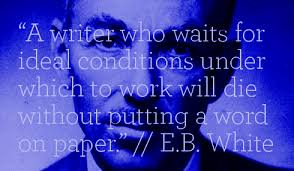 I’m going through one of those seasons of life where I’m not feeling motivated. My mind could go in either one of two directions. I could wallow and give up — allowing myself to succumb to fatigue, discouragement, and fear due to circumstances beyond my control. Or I could remind myself that I am an author, and as such, absolutely everything is potential writing fodder. I’m choosing the latter.
 To maintain any productivity, my way of putting words on the page has changed over the past month. For instance, instead of scheduling hours at a time for writing, I’m snatching snippets and seconds. Scrivener is my friend, as I drop ideas, research links, and summaries of real-time happenings for anecdotal use into project files. Life has required I do things differently, but I refuse to let it stop me.
 I’m also offering myself an extra dose of patience and forgiveness. If I expend emotional energy on unreasonable expectations and unhealthy guilt, I will pay for it in wasted physical and mental energy. It’s taken me years to learn this about myself, but now that I know it, I can approach writing with a healthier perspective.
 Another motivational boost comes from reminding myself that I am a professional. This means I don’t just think about writing, dream about writing, or talk about writing — I do it. A professional writer puts the same integrity, (doing the right thing whether anyone else can see or hear them or not), into their craft as the CEO of a multi-billion dollar company. I refuse to be the amateur Stephen King talks about.
 My past and present circumstances are more than writing fodder, they are also qualifiers. My unique experiences qualify me to speak about subjects, while my role as a professional writer enables me to say what others cannot due to willingness or ability. This is why writing is both privilege and responsibility. This thought alone motivates me to action when I feel unmotivated.
 The answer is yes. After all, I am a professional. And professional authors get to work — one intentional word at a time.




 WordServe Water Cooler