Making Connections

Publishing is a funny beast. The author wears many hats – writer, editor, marketer, publicist, sometimes frazzled human being (all right, maybe it’s most of the time). There are moments when the load seems overwhelming and I feel incapable of wearing every hat with excellence.

Kariss' teamMarketing tends to be my weakest link. I’m passionate about my books, love to talk about them, enjoy sharing the story of God’s faithfulness. But when it comes to selling the idea of why others should read them, I prefer to let people determine the quality on their own.

I know. I know. I’m still learning how to do this well. But the key is that I’m learning. Guest posts, social media, contests, etc. are all great tools that I am adding to my belt, but the most powerful tool in my arsenal is my network. These people fall into multiple categories, and every group is important

  1. Close friends and family.
    You’ve got to love this group. They are your biggest fans and cheerleaders. Occasionally they may be more biased than constructive with their feedback, but enjoy the affirmation. They’ve watched the journey, battled the insecurities and joy with you, and want to celebrate the finished product.
  2. Fringe friends and acquaintances.
    These are the people familiar enough with you to ask about the book every time they see you. They are also the ones who bought the book out of curiosity and support and are excited to watch the journey from a distance. If they love the story, you better believe they will share with their friends and family.
  3. Unknown readers.
    These are the people whose constructive opinion you can count on most. If they love the book, then job well done. They hail from all over the country, sometimes out of the country, and their word of mouth is powerful. They don’t know you, but love the heart in your books and will shout it from the mountaintops and anxiously wait for the next book. I love networking with this group. Their excitement fuels my own.
  4. Critics and commentators.
    These are your influencers, bloggers, Amazon comment critics, etc. I don’t necessarily advocate taking their opinions as gospel. But often, they have a powerful voice in their particular online spheres. Learn what they love and what they don’t, filter it to see if there is truth, and build on these admonitions in your next book.
  5. The unreached.
    The good news is that with all these other groups on board, the unreached are now reachable. Diligently work to add this group to the fold. Build relationships with your readers. Write stories that people can’t ignore. And don’t grow discouraged. This is a journey, not a short-distance sprint. Growth happens over time, and it’s exciting to see.

Shadowed_AUG 1 (1)But there is one connection that is the most important. Talking to the Master Storyteller. He knows your story intimately, and He alone can weave your network into something beautiful.

Prayer is powerful. In moments of frustrated marketing, I’ve prayed that the Lord will get Shaken and Shadowed into the hands of people who need to read them, despite my best efforts.

And He has.

Some of my favorite interactions from readers come from those who never heard about the book but wandered into a bookstore, loved the story, laughed, cried, and found hope in Christ. Every time I read one of these messages, I praise the Master Marketer. In spite of my best efforts, He is still placing these books in strategic places.

More than spinning a great story and growing my craft, I want to make an impact. And that only comes through surrendering my ideas in marketing to the One who knows best. I figure with Him at the wheel, I’ll do what I can and let Him do the rest.

It’s Never Too Late to Write

I started my writing career later than most. At least compared to many of my twenty-first century peers.

And I worried I’d waited too long.

Broodmoor Hotel, Colorado
It’s Never Too Late to Make a New Bed

Actually, I had a lot of strikes against me. I was sure I’d made my bed, and had no opportunity to make another. But I was wrong.

If it hadn’t been for a persistent push from God, I doubt I’d be writing to you now. But He continually convicted me through the Parable of the Talents, Matthew 25:14-30. You see, I was the wicked and lazy servant who’d buried her gift.

However, God truly is merciful — and encouraging. Over a period of a few years, He used five real-life examples to show me it’s never too late to write.

The first lived in Missouri, like I do. Laura Ingalls Wilder and Rose Wilder Lane, two of the most inspirational writers I’ve ever studied, called Mansfield, Missouri home. Rose schooled her mother on how to formally pen those wonderful classic books, the Little House on the Prairie series.

But the most amazing part was learning Laura was sixty-five years old when the first best-selling manuscript went to her publisher.

Strolling through her grounds recently, I imagined her gnarled hands scratching out stories from memory onto pages of paper. She finished her final book at age seventy-six.

Another author who started late was Frank McCourt, also publishing in his mid-sixties. The wisdom of time and experience propelled Angela’s Ashes to the top of global readers’ favorite lists.

At forty-five, Raymond Chandler, (who I share a birth date and month with), finally broke into publishing success, after struggling from the time of his youth to make his professional mark.

In her fifties, Mary Wesley published a few children’s books without notice. However, in her seventies, she took the world by storm with her first novel, Jumping the Queue.

James Michener is a well-known name for those who know writing. But some don’t realize his fifty year Pulitzer-prize-winning career didn’t start until he was fifty, continuing until his death at age ninety. His last book published posthumously.

What's on Your Bucket List
What Does Your Bucket List Say?

No matter what encourages you, whether it’s real-life examples, spiritual promptings, or the example of a writer who did, though I feared I wouldn’t, let something spur you on. Age, location, past failures, naysayers, none of those things matter.

If you are willing to learn, to listen, to do the work, to learn some more, to listen some more, then work some more, you will see results. Maybe not at the caliber of some of the names listed here, but at the level you are supposed to achieve. This leads me to one more thought — actually it’s a question.

Many people tell me they believe in God. But I respond by asking this, “Do you believe God?” A simple change in sentence structure changes the meaning. In Proverbs 14:23 (NIV), it says, “All hard work brings a profit, but mere talk leads only to poverty.”

Maybe your sentence structure will help someone see a familiar statement in a new way. Maybe your profit will result in financial windfalls. But more likely, it will come through a life changed. A life you touch because you never gave up. Because like me, you chose to believe God and say, “It’s never too late to make a fresh start with fresh faith — while I write.”

What encourages you to write on?


The Miserably Fabulous Craft of Writing

I have a confession to make. The only Stephen King book I have ever read is his fabulous book On Writing: A Memoir of the Craft. That said, if you can only read one book about writing, this might be it. Mining some of my favorite gems from this work, I hope to help you polish your own rough stones.

king

“The scariest moment is always just before you start.” I can only echo a hearty “Amen!” Whether I’m working on a term paper, a short article, a book proposal, or an actual book, I always sit down and enter my title, my name, and anything else I know, just to avoid that blank page. Perfection is the enemy of writing. If that’s your initial aim, you’ll procrastinate and you won’t write. You’ll likely never read anything you’ve written and smile to yourself, “Well, there is absolutely NOTHING I can do to improve this beauty!” Nope. Your editor will get a hold of it if you don’t. [Insert evil laugh here.] But when you begin a story, that’s not the time to labor over each word. Get it down. Start. You’ll have lots of time to labor over rewriting and editing later. “The definition of a writer is someone who writes,” declared a now-forgotten workshop leader at my first-ever seminar. Write already.

“If you don’t have the time to read, you don’t have the time or the tools to write.” It’s quite possible that I am addicted to reading. I read at stoplights. I read on a float in the pool, in the bathtub, by the stove while I stir things, on my lunch break when teaching, while taking my mile walks, and the last thing before I turn in at night. Reading sparks ideas, allows you to admire fresh turns of phrase, and inspires you to work that same magic, carrying future readers to your setting, helping them to fall in love with your characters.

“Amateurs sit and wait for inspiration, the rest of us just get up and go to work.” I don’t remember where I read this, but one novelist wrote that he never writes until he’s inspired. “And I see to it,” he continued, “that I am inspired every morning at 9:00 a.m.” Writing is work. Writing is dedication. Writing is a miserably fabulous craft!

“Kill your darlings, kill your darlings, even when it breaks your egocentric little scribbler’s heart, kill your darlings.” When my second book with Harvest House came out, I got the proofs and asked my amazing editor, Hope Lyda, what had happened to some of the quotes and paragraphs I had so lovingly delivered. She was gracious. “Ahem, those went to keep company with some other lonely words and paragraphs.” I see. She had kidnapped and killed my darlings. It was a better book for their absence.

“The road to hell is paved with adverbs.” Taped to the windowsill above my desk is this little gem by Dwight Swain:

Strive for:

The Vivid Noun

The Active Verb

The Colorful Phrase

The Intriguing Detail

The Clever Twist

The Deft Contrast

All of us have fallen asleep during a long paragraph in which the writer has gotten carried away by his own love of (too much) language. She ran her fingers through the water languidly, indolently, lethargically, lazily….All right already! Crisp. Clear. Concise.

“Books are a uniquely portable magic.” Whether we favor Nooks or Kindles or the tactile experience of pages fluttering, bold ink making grand statements and words sweeping us away to other times, other people, other conflicts, when we take books with us, we carry time machines. We carry mini-encyclopedias of knowledge. We carry the life, loves, and losses of characters about whom we are made to care very much. When we write them–ahhh–we are making our own kind of magic.

“Writing isn’t about making money, getting famous, getting dates . . . or making friends. In the end, it’s about enriching the lives of those who will read your work, and enriching your own life, as well. It’s about getting up, getting well, and getting over. Getting happy, okay? Getting happy.” The process of writing is not often fun. But we do it anyway. Why? Because we know what books mean. We know they will never go out of fashion. And we are gluttons for punishment, because that book means magic, housed in the pages of something you have been honored to write; imprinted on the hearts of those who read it and won’t soon forget how your words made them feel. And when we write for God’s glory, we surpass even magic.

What are some writing truths you’ve learned?

A Broken Heart— Repaired

Hi, readers of WordServe Water Cooler! Thank you for having me! I’m Martha Ramirez and though I write for young adults, I have a few children’s stories that have tugged at my heartstrings.

BrokenHeartBroken Heart, my new picture book, was inspired by my own heart journey and having to stay strong and pray for the best.

In 2014, I underwent open-heart surgery to correct a congenital heart defect we never knew I had. Broken Heart is about a brave girl who learns doctors have to mend her broken heart. Seven-year-old Julia goes on an unforgettable heart journey and takes her twin sister along for the ride. Like Julia, my heart defect was not discovered at birth. Unlike Julia, it was discovered many, many years later.

I knew the moment I lay in my hospital bed that I had to write a book about a girl with a broken heart. I also kept a journal, planning to rewrite the memoir I recently finished (super-excited!).

Photo by L.I.L.A. Images

With Broken Heart, inspiration came at me with full force. I couldn’t stop writing until I got to the end. I was so content with the way the story unfolded, it was as if an angel whispered the words to me. When my good friend Mary Jo Prado offered to illustrate the story, I was ecstatic! She’s a talented illustrator and super creative. Without a doubt, I knew she could bring the story to life. I was even more thrilled when she added small but significant touches, such as the actual double doors from the hospital I stayed in.

One of the things I felt strongly about when writing this story was to write from the heart and not to worry so much about how it would turn out. I’m a plotter. An organizer. I always set up my stories beforehand and I always know my GMCs (goals, motivations, and conflict), but not this time. This time it was okay to write like the wind and not worry about the details. Of course, I took the time to go back and make certain all my writing goals were accounted for. But I learned there really isn’t a wrong way to write as long as you follow your heart.

Sean Connery in Finding Forrester says it the best, “You must write your first draft with your heart. You rewrite with your head. The first key to writing is . . .  to write, not to think!”

I sincerely hope Broken Heart touches others as it touched me. It’s truly an honor to be here.

What children’s book has touched your heart?

******************************************************************************************
In addition to writing, Martha Ramirez is a 2012 Genesis Semi-Finalist, a member of ACFW (American Christian Fiction Writers), YALITCHAT.ORG, the Muse Conference Board, CataNetwork Writers, and American Author’s Association. Her articles have appeared in various places including the Hot Moms Club and For Her Information (FHI) magazine. In 2012, her blog was nominated website of the week by Writer’s Digest. She looks forward to expanding her career and is hard at work on her next young adult novel. She currently resides in Northern California where she enjoys gardening and kickboxing (not simultaneously). Visit her blog at: Martzbookz.blogspot.com

Reading as a Writer

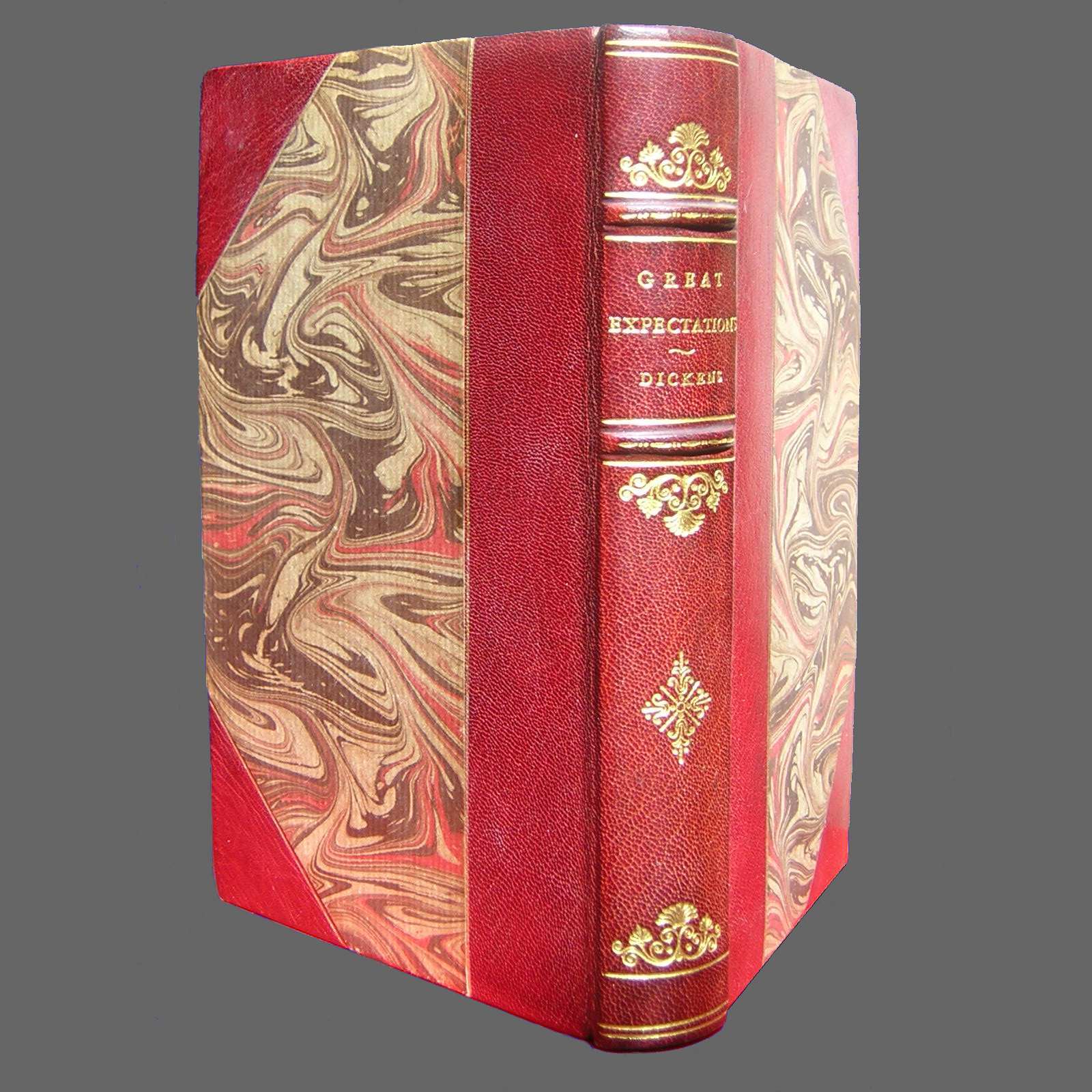
Dickens_Great_Expectations_in_Half_Leather_Binding I just returned from a trip to England during which I read, for probably the fourth or fifth time since my childhood, a book I have always loved: Dickens’ Great Expectations.

Part of my goal for this read was to physically experience the book’s setting. To trace Pip’s steps through the dirty London streets and walk along the Thames where he rows his boat to check on Magwitch. To shop in Covent Garden where Herbert Pocket goes to get the best fruit to welcome his new roommate. To visit the Temple courts where Jagger lives and works. To see with my own eyes Newgate prison—which doesn’t exist anymore, I’m sorry to say, although there is a sign marking where it once stood.

My bigger goal, though, was to read a book I had long loved in a completely new way: as a writer reads. Reading as a writer is a kind of dissection, really—not just of the work, to figure out how it works, but of my own psyche as a reader. What is it that has always enthralled me about this book? I ask myself. Why have I returned to it again and again in the course of a lifetime? I examine the story, the details, the transitions, the very sentences of Dickens’ masterpiece, looking for applicable clues about how to make my own writing successful.

There’s no better writing teacher to be found, no better course of instruction or writing program, than a book you loved as a child and continue to love in adulthood. For me, that’s Great Expectations and Robinson Crusoe, The Good Earth, Laura Ingalls Wilder’s Little House books, and the dark fairytales of Helena Nyblom. And works of nonfiction like Helen Keller’s autobiography and Jade Snow Wong’s account of growing up the fifth daughter of Chinese immigrants in San Francisco, and a hagiography I wore out as a child called Little Pictorial Lives of Saints. There are more, each one a teacher with the rare pedagogical skill of educating not by presenting something new but by confirming and demonstrating old truths.

Reading as a writer, I learned from Dickens that even the most honorable characters are most engaging and memorable in their failures and absurdity. I knew this. We all know this. It’s why Peter and Thomas are my favorites of Jesus’ followers. And it’s why Esau is so impossible to hate. (I don’t know how God manages it!) Through their faults, they become more believable, more real. Jesus himself, though without fault, becomes 100% human in moments when he seems least likeable, such as when he balks at healing the demon-possessed daughter of a Canaanite woman who argues that “even the dogs eat the crumbs that fall from their master’s table” (Matthew 15.27 NRSV).

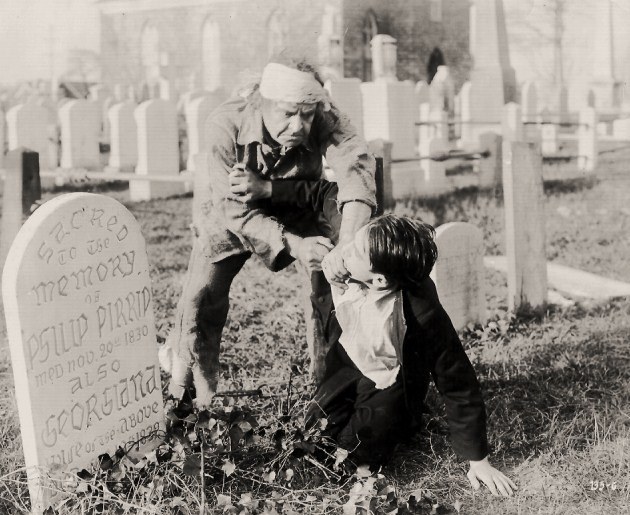
Great_Expectations_(1917)_1Each character in Great Expectations is a surprise. Miss Havisham experiences remorse. Estella confesses genuine emotions to Pip. Jaggers ends up being as much a father to fatherless Pip as he is a heartless professional. Pip moves from fear and repulsion toward Magwitch to concern and compassion. Through such surprises, Dickens helps me find the life-giving contradictions and winsome growth opportunities in my own characters.

Dickens also taught me how to keep my reader focused through blunt meta references to “the last chapter” that I would never have recommended to my own students. He was writing serially, after all, so his readers would have needed more help remembering what had gone on in the previous issue than the contemporary reader of the assembled chapters would need. Still, it’s a helpful technique. And referencing one’s previous remarks and chapters is certainly freeing.

Students in my writing courses often complain about my “reading as a writer” assignments. I’m always wanting them to apply what they learn from their favorite writers—or from one of my favorites—to their own writing, and I’m never pleased with their flowery, laudatory assessments of their favorite books’ writerly techniques.

“You’re reading like a literary critic!” I rant. “You’re reading like a teenager in love. I want you to read like a writer!”

It is the hardest way to read, I think, but surely, once you’ve read a book the first time through, the most useful. Once my students get how to do it, they thank me.

“Don’t thank me,” I tell them. “Thank the author!”

In case you’re wondering, reading as a writer won’t wreck the book for you. To the contrary: Discovering what made you love a book gives you a new appreciation for it—so much so that, if you’re anything like me, you’re eager to read the book again soon.

Note to My Younger Self, On Writing

file6681269982727Dear Dena,

Congrats! I know you’ve written two entire book manuscripts and had some poems published. That’s a big accomplishment, especially for a teenager.

It is a tough one, though, this craft you’ve chosen (or, more accurately, the craft that chose you). I want to give you some advice, since at age 44, I’m a little lot older and—hopefully— wiser than you are.

First, drop the attitude. You are not God’s gift to writing. When your mom suggested that you put your current age on the book manuscripts you were submitting to publishers, you said, “No. I want to be known for the quality of my work, not get attention because of my age.” Sheesh.

Girl, you are taking yourself WAY too seriously. After all, you’re not building the Sistene Chapel. Currently, you write teen romance novels. Just look at the titles of your two books: “Someday, Somewhere” and “Magical Daydreams.” Need I say more?

Yes, you have some talent. But you need to be open to all sorts of editing/coaching if you’re serious about becoming a professional writer. Being humble and teachable will take you further than talent alone.

Second, continue submitting to magazines. Many of them have a much bigger circulation than you realize. Today’s popular magazines, which are mostly read on a crazy/wonderful thing called the Internet, have tens of millions of readers from all over the world! Guideposts, which your parents receive, has hundreds of thousands of faithful subscribers. While you dream of writing books, and that’s a worthy goal, your most powerful legacy might happen when a reader picks up a magazine and finds hope at just the right moment.

Third, keep journaling. The diaries you’re keeping will provide endless sources of ideas in the future. (They’ll also provide your future husband with hours of enjoyment at your expense, but that’s beside the point.) Write honestly about your heartaches and joys. Journal about what you eat and drink, and try to capture in words specific sounds, smells, and tastes. Jot down story ideas, snippets of dialogue, and funny character names. Never forget that everything, even especially the lessons learned in life’s darkest moments, is material.

Fourth, find a community of like-minded artists. The drive to write is both a gift and a burden. At times, your path will be strewn with obstacles, rejections, and discouragement. You’ll need people who “get” you. And over the years, in many different ways, God will bring creative soulmates into your life.Being-wellknown-here

Trust me on this: treasure and maintain those friendships. After more than two decades as a writer, I’ve had six books and hundreds of articles published. Some of the journey has been joyful; other parts have been excruciatingly difficult. But by far, the best part has been the relationships I’ve built with my fellow writers. They have enriched my life far more than any acceptance, contract, or award.

Above all else, keep listening to God’s voice. Never let other people’s voices (especially those of your critics) drown out His approval and love. He gave you the talent and desire to write, and He will be faithful to give you opportunities to hone and use your gift. As Randy Alcorn says, “Being well-known here doesn’t matter. Hearing God say ‘Well done’ does! To be known by God–it doesn’t get any better than that!”

Much love,

Me

Concrete Tips on Book Writing: It’s Like Working a Puzzle

Jigsaw 3 bits out

Just how does one go about writing a book?

Have you ever had that thought?

I am a published author and most days, I still struggle with that question. There’s so much involved in writing a book: craft, connections, moxie, perseverance.

And then there’s this, too: writing is vulnerable. Edna St. Vincent Millay said “a person who publishes a book willfully appears before the populace with his pants down.”

But what else can we do? We must write. And sometimes our efforts turn into a book.

I am in the process of writing my second book, which has pretty much eclipsed everything else in my life. With my first book, I took years writing the whole manuscript before finding an agent and a publishing house. This time, my agent sold the book on proposal with a deadline. I was given eleven months to write and submit it. Yikes.

But how do you actually do it?

I’ve decided that, either way, whether you are on deadline or on your own agenda, writing a book is like doing a puzzle.

I write creative nonfiction. My puzzle pieces are anecdotes and stories from my life. I lurch around in the darkness of my writing cove, type words, peel back memories and scenes from the past, and try to find something salvageable to get down on paper. I try pieces in different places, and attempt to trust that the piece has a place, and that at some point the puzzle will be complete.

Yeah, but, can you answer the question?

Oh, right, I’m supposed to give you a few concrete tips on writing a book.

Let’s assume you are a writer. Here are skills you already possess: you read a lot, you write, you have taken classes or participated in a writing workshop that critiqued your work. Let’s assume you are ready to write a book, and you are looking for a few quick, concrete tips regarding the process.

OK, I can help with that.

-I prepare. I read a chapter from a book I love. I pray about my writing. I block common distractions (i.e. if the kids are home, it is off to the coffee shop I go). I look at my calendar on Google and plan writing time. It is as official as doctor appointments and school functions.

-I write. I can’t tell you how many people have talked to me about writing. “How much of the story do you have down?” I ask. “Oh, I haven’t started writing yet. It’s all up here.” (points to head). Yeah, no, that’s not going to work. I try to find several hours to write. I shoot for 1000 words or two hours editing. I spend time looking off into space, though, too.

-I realize that it takes a lot of work. It took me years to write the first draft of Sun Shine Down. And just so you know, nobody writes wonderful first drafts (if they do, I am going to avoid them and refuse to read their work on principle). Rewriting is key. I hired a professional editor, printed out her suggestions, sat down to the blank page, and re-typed the whole thing.

-I look for tools that will help. I purchased Scrivener, a word processing program specifically for writers. I can pop in and out of chapters easily and I love the cork board feature that helps me see the big picture of my book. I also found an app in Google Chrome based on the Pomodoro Technique. It blocks social media for 25 minutes and then gives me 5 minutes to check email or get up before returning to work. Keep your eye out for tips and tools that will help you and then go a step farther, and utilize them.

-I try to ignore negativity. Beware. Throughout the process you will assume you can’t do it. After, God willing, your book publishes, you still won’t believe you did it or that you could do it again. One of the best ways I know to ignore negativity is to keep writing. I also talk to other writers and attend a monthly writing group.

The second half of Millay’s quote is “If it is a good book nothing can hurt him. If it is a bad book nothing can help him.”

So, here’s to good books! Here’s to puzzle pieces in place, and here’s to us in our writing pursuits!

The Story of My Life

whisperingOne of my favorite parts of speaking to audiences is telling them the true stories behind the stories.

When I talk about my murder mysteries, I talk about the incidents in my own life that inspire plot lines and settings. While I haven’t personally murdered anyone (nor do I plan to), my fictional characters’ motives and subterfuges stem from simple human traits we all share. Who hasn’t experienced confusion, envy, jealousy, greed, the desire for revenge? Just because the extent of my envy might be a girlfriend’s new hair cut doesn’t mean I can’t extrapolate that feeling into the murderous intent of a killer, right?

Okay, that might be quite a bit of extrapolation, but you get my drift.

Where the real fun comes in, however, is sharing with readers the snippets of my experience that I insert right into my novels. For instance, in my third Birder Murder Mystery, my protagonist goes on a weekend birding trip to Fillmore County in Minnesota, which is based on an actual birding trip I took to that county many years ago. Spending time with other birders not only gave me a chance to add to my own life list of birds, but it provided some snappy, funny conversation that I then used in my book. I’ve found more than once that real life makes for the best fiction.

Another example: in my fourth Birder Murder, my characters are in Flagstaff, Arizona on the campus of Northern Arizona University. The setting was inspired by a trip I took with my middle daughter to tour the NAU campus when she was making college plans; the hair-raising flight into the city, the conversation with an old hippie cab driver, and the fact that NAU is surrounded on three sides by graveyards, all come directly from my trip. As a mystery writer, how could I NOT set a murder mystery where everyone KNOWS where the bodies are buried?

The most transparent example of how my writing chronicles my own life is, of course, my new memoir about how my dog helped me overcome anxiety, including a fear of dogs. Yet even since the book was published in April, I continue to find nuggets of meaning in my own story that I didn’t recognize while I was writing it: we adopted Gracie on the day before Easter – the eve of Resurrection. So now I tell audiences that my dog not only helped me experience my own spiritual and physical renewal, but the book about her is also changing my career in unimagined ways. Too bad I didn’t know that part already, because it would have been a nice epilogue…gee, maybe that’s the next book.

When I share my real stories with groups, I realize that the writing advice I first heard as a child is true: write what you know. I just didn’t understand how I could make my own experiences book-worthy…until I threw in the imagination to make my own stories part of someone else’s.

In what ways does your writing chronicle your life?


The Surprising Secret to Juicing Up Your Writing

“Sitting at a computer is the place for taking a clunky sentence and smoothing it out, making it read better. I do some of my best writing in my head before I fall asleep for my afternoon nap. I recommend that!”

—Tony Hillerman, quoted in Tony Hillerman’s Landscape by Anne Hillerman

Business Coaching
What’s Making You Tired?

I don’t know about you, but it seems like I spend at least half of my writing time combating fatigue. Maybe it’s my crazy on-the-road schedule as a national speaker and business coach. It’s possible the myriad of personal problems, some huge, some small, drain my emotions and my body. It could be the anxiety I feel when juggling all of the fine details that go into a professional writing career. Social media — check. Blog — check. YouTube videos — check. Marketing my books — check. Pursue new speaking/coaching gigs — check.

As I view the list, it’s no wonder I’m wiped out. But knowing why I’m tired won’t change the fact that my books and articles won’t write themselves. No one but me can put my words on my pages — the messages I believe God started a burn in my heart to share and show.

But this brings me back to my original problem. What to do when I finally get time to write, but feel too tired to type a word?

The solution is so simple, I’m embarrassed to admit I overlooked it for the longest time. A time-proven technique for juicing up your writing. A secret to turning on the creativity, when your muse is turned off.

And here’s the secret. Take a short nap.

Hot Air BalloonsSounds crazy, right? But it works. One of the reasons I resisted was my fear I’d fall asleep and waste all of that precious time. However, I’ve found it doesn’t happen. Somewhere in the dozing phase, my mind starts whirring with ideas. So much so, after an average of twenty minutes, my inspirations wake me up. Napping has transformed my craft and my process.

I should have known. From the beginning of my writing career, I’ve committed and adhered to taking a weekly sabbath rest. One full day off. No writing. No marketing. No work. It’s one of my secret answers to the question I hear so often, “How do you get so much done?”

You see I learned this secret from the Best-Selling Author of all time. God took the first Sabbath, or shavat vayinafash in Hebrew. The term literally means God rested and got a new soul. And we’re meant to live in His image, so why wouldn’t we renew our souls through rest?

Gold Clock
Resting has a Supernatural Way of Restoring Time

I thought, if it works for a whole day, why wouldn’t a mini-sabbath work for part of one? So I tested the theory, and found a twenty-minute nap can infuse me with as much energy as taking a week’s vacation. Seriously. It’s like gaining an extra day.

Other highly successful authors swear by it. Now I do too.

I believe the quality of my writing has improved from the regular practice of napping, and/or resting in quiet meditation to allow my creative juices freedom to flow. Sabbath renews my soul, clears my mind of clutter, and revives my spirit.

So I challenge you — the next time your eyes droop as you face the keyboard, go against your instincts. Don’t push through. Don’t beat yourself up. Submit. Give your body the refreshing rest it’s crying out for, and feel the juicing begin. Not only will you feel better, but chances are your readers will benefit from your better books.

How do you deal with writer’s fatigue?


Kiss “I Can’t” Goodbye

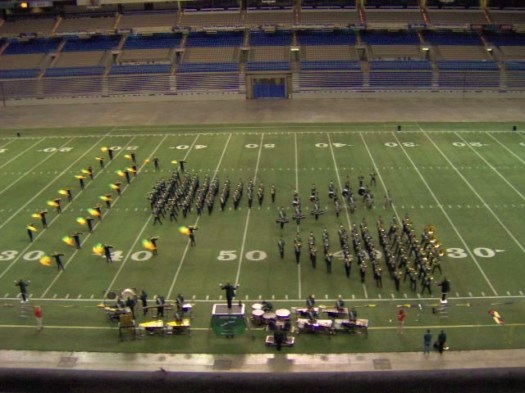
In high school, my band director erased “can’t” from my vocabulary. It was a slow, sweaty, painful process. We had been a championship band, a finalist in the state for 4A high schools. But after two years of mediocre performances, we were left wondering if we were “has beens” that had become “wannabes.”Kariss - band 1

But Mr. C never settled for defeat. He delighted in giving us the most challenging routines and music while watching us rise to the occasion. And he tolerated nothing less than our absolute best, knowing that our greatest potential often lay just below our valid but weak excuses.

It took training. Sweltering hours on pavement in Texas weather, running the routine over and over again until clothes clung to sweaty frames. Then we hit the classroom, fingers meticulously skipping over the keys until we knew every note by heart and could play it standing or running at 160 beats per minute.

I remember trying and trying to get a note set correct and failing miserably (in front of fifty of my peers by the way). After the fifth time, I quit trying.

“I can’t do it.”

“I’m sorry, what?”

“I can’t do it, Mr. C.”

“I don’t understand that word. Try again.”

It’s amazing what I came up with in the absence of that word. I’m having trouble. This is hard. How in the world do I do this? I don’t know how. But not one of those gave me the option to stop trying. And every excuse carried with it the opportunity to discover a new journey in the struggle.

He never let me quit in the classroom or on the marching field. Slow down, sure. Take each note one finger at a time, yep. But NEVER quit. Because he knew I could if I set my mind to it, no matter the challenge.

Success lay just below the “I can’ts,” just waiting to come to fruition with the acknowledgment of “I can…somehow.” And that lesson has shaped my writing journey. Rejections became detours. “Can’ts” became other challenges to conquer.

There have been many moments when I have been tempted to say “I can’t” in the middle of writing or editing or even marketing (I might have even slipped and said it a few times). But somehow, I meet the deadline every time, proud of the finished product.

Much like with marching or learning music, I keep writing until the words become an Kariss - band 2extension and enhancement of the story instead of simply an exploration to jog my creativity. Every time I finish, I know I CAN. I just have to discover HOW. I finally determined that I wanted it much more than I feared it.

Talent and passion may come naturally to a point. But success as a result of those attributes NEVER comes without hard work and a willingness to push past rejection, defeat, and redirection. As soon as you purge the excuses, the story blooms, and it’s only a matter of time before others outside your circle begin to notice the beauty of the finished product.

By the way, when we purged the excuses, our band went on to place first in every competition that season and ended the semester and my high school career as 4A Texas State Champions.

This thing you keep attempting that you think is impossible? It’s possible. It just takes placing one foot in front of the other until you see the results.

Where do you need to erase “can’t” from your vocabulary?