Writing with a Hook

What will make your book fly off the shelves? A good story, high quality writing or a strong Fish-hookvoice won’t help you unless readers know your book exists.  And for that, you need such an interesting premise that readers around the country are chatting up your book. In other words, you need a hook.
Yes, the dreaded hook word. I’ve heard about for years, but it seemed rather elusive. But recently, I’ve been studying my bookshelves to find some broad categories of hooks, and it’s getting clearer. Here are a few concepts I’ve found.

  • Give beloved fairytales, historical figures, novels or paintings center or side stage. The Beekeeper’s Apprentice (Sherlock Holmes), While Beauty Slept (Sleeping Beauty), The Girl with a Pear Earring (Vermeer’s painting), Dear Mr. Knightley (a love for all things Jane Austen) and The Constant Princess (Henry VIII’s first wife) are all examples. Readers want to spend time with favorite characters and art.
  • Tie the story together with a hobby. Ordinary hobbies such as knitting and cooking can certainly draw in readers who enjoy knitting or cooking themselves, but if you can find a twist, this will make it stand out from the crowd. For example, in The Language of Flowers, two characters with a love of gardening send each other messages not with notes, but with flowers, each delivery carrying a symbolic meaning only they understood. Unique hobbies can give your story a little flash as well – i.e., custom shoe design or wild life rescue.
  • Allow readers to vicariously do something they’ve always wanted to do. I bought Forgotten because it was about a character who, after being stranded in Africa for several months, returns to find that her job, her romance and her apartment are all gone. She’ll have to recreate her life. Spoiler alert: the book did not live up to its promise of the heroine of getting a life makeover, but that promise is what made me buy it. What other deep seated desires will connect you to readers?
  • Create zinger beginnings or zinger twists. When an old man in the prologue of The Lost Wife tells a wedding guest she looks familiar, and at last figures out that she was his wife just before the Nazis invaded Prague, that certainly sent readers to Amazon’s checkout cart (me included). In Half Brother, a boy arrives home to find his mother holding a baby chimpanzee, and that’s interesting enough to catch a reader’s attention. Burying a zinger in the middle of the book is a harder sell, since it’s not something readers will see when they browse. But if it’s good enough, it can certainly get people talking about your book.
  • Start with vulnerable characters at risk. The little boy locked in the cupboard in Sarah’s Key is a great example of this. But even more ordinary risks – a teen without adult love or support (Dandelion Summer) or a Puritan woman being coerced to marry a man she doesn’t trust (Love’s Pursuit) are good draws. Readers only need to hear the concept to feel they need to see the character to safety.
  • Create a character the world depends on. High stakes Tom Clancy type novels where the character must stop nuclear bombs from detonating or bring an end to a plague outbreak, or fantasy novels where the hero/heroine holds the key to the coming war (Lord of the Rings, Blue Sword) are examples.
  • Begin the story with profound emotion readers can connect with. Remember, readers don’t know the story or the characters yet, so it must be something they can easily connect with. In Coldwater Revival, the heroine is apparently stillborn at birth, but begins to breathe with the loving attention she receives from her father. In If You Find me, a girl sees her father for the first time a decade after she was kidnapped.

Think about what made you pick up your last book, or even better, what had you chatting up the book to every reader you knew? Once you’ve found the quality that made it so compelling, you’ve probably found the hook.
Finding the Fatal Flaw

It is the core of every struggle. The root cause of many reactions. It is a constant enemy lurking below the surface, waiting to rear its ugly head.

It’s the fatal flaw. Everyone has one. Every character has one, too.

I would argue that fatal flaws never completely go away. They just manifest in different ways as we grow and change and conquer certain circumstances. But what does this really look like?

Kariss Lynch Heart of a WarriorTake Superman. I would say his emotional fatal flaw, or one of them, is a deep desire to belong. It shapes his decisions and actions to blend in at the Daily Planet, settle down with Lois Lane, but still seek the true identity of his parents. We all know his physical flaw is kryptonite. Or Lois Lane, depending on how you look at it.

Choosing and shaping a fatal flaw proved an interesting challenge as I finished out my Heart of a Warrior series. I noticed there are multiple factors I need to account for as I select flaws for my characters.

Timeline

All three of my books take place over the course of fifteen months, which made it a challenge to have a fatal flaw that never disappears but consistently morphs. Kaylan, my main character, struggles with fear. Since our fatal flaws never really go away, I had to figure out how to cause this kryptonite to reemerge as she grew. In Shaken, she fears letting people close to her because of the loss of people she loved in the Haiti earthquake. In Shadowed, she has to learn to love a man she could lose at any second, Navy SEAL Nick Carmichael. In Surrendered, she will learn to accept Nick’s career and the constant danger, and not only accept it but thrive in his absences. The root of every one of her struggles is fear of losing a loved one, but as she accepts growth, the flaw manifests differently. Still always fear.

Complementing Characters

If you are writing romance, what fatal flaw will most threaten the relationship and will cause the characters to have to fight together to overcome? In Shadowed, Nick struggles with anger and detachment. This creates a challenge when Kaylan needs reassurance in her fear and Nick needs her to get over it and let him deploy in peace. Both characters grow as they learn what it looks like to merge two lives into one.

Plot and Theme

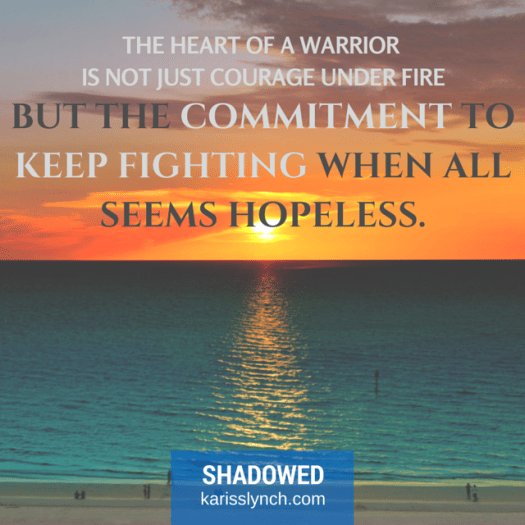
Shadowed_AUG 1 (1)Each book in this series, had to capture the overall theme: Anyone can develop the heart of a warrior if they are willing to have courage and commitment in the face of insurmountable obstacles. My fatal flaw for each character needed to threaten accomplishing this goal. Kaylan’s fear has the potential to stunt the relationship. Nick’s anger prohibits him from being a strong leader in his home and confident and in control in war. My villain’s flaw causes her to sabotage others in an effort to obtain what she secretly desires most but also never wants to have.

The fatal flaws is one of simplest yet most complex aspects of your character. Which flaws will create complicated conflict? How does that flaw force your character to respond? How will your character grow through the flaw?

One of my favorite ways to identify character growth and a consistent flaw is to follow a specific television series. Over time, you will notice a core struggle emerge. This helps me understand how to develop a character over the course of a book and over the course of a series. I’m still learning, but this is becoming one of my favorite parts of creating characters.

How do you identify your character’s fatal flaw?

The Making of a Masterpiece

In every block of marble I see a statue as plain as though it stood before me, shaped and perfect in attitude and action. I have only to hew away the rough walls that imprison the lovely apparition to reveal it to the other eyes as mine see it.” Michelangelo

I’ve spent the past month living as a hermit while I finished a manuscript. (Insert sigh of relief here.) I spent countless hours after my day job writing and fine-tuning every detail. Some days, I couldn’t wait to share the story with the world. Other days? All I saw were flaws, flaws that sent me running to fast food and the newest Netflix series while I processed what to do next.

That’s one of the many fun aspects of writing, though, isn’t it? I’m making the manuscript, but in the process, the Lord is making me. As my character wrestles through a growth point, I wrestle with it, too. Often what my character is learning is a lesson the Lord has spent months instilling in my own heart. From the overflow of my heart to the page…I think the story of The David illustrates this perfectly.

In the late 1400s, a group called the Operai provided blocks of marble for several prominent sculptors and artisans to create twelve statues of characters from the Old Testament. Work began on The David in 1464 but after initial carving, the piece was abandoned to the elements for twenty-five years. Then Michelangelo begged the Operai to allow him to complete The David. For three years, he carved the statue, shaving away the damaged parts and shaping features in great detail.

Kariss Lynch creating a writing masterpiece

If you hate history, I hope you stuck with me because none of that is the reason I love The David statue. Michelangelo took a wrecked, abandoned piece of marble and he turned it into a MASTERPIECE. Where everyone else saw a useless block, he saw potential and beauty, a story waiting to unfold.

I think the writing process is a lot like this. A story idea with little initial substance becomes a piece of art with a lot of effort. Over time, the author chips away the unnecessary and ugly pieces until a beautiful story is left.

I believe that’s what Jesus does with the author as he/she writes. Just as Michelangelo labored over The David and you labor over your manuscript, so the Lord labors over you, writer friend. He is in the process of creating a masterpiece that lasts for eternity, and he wants to do that with your writing, too.

Yours is a message of truth and hope. As you identify impurities and polish your writing to perfection, know the Lord wants to do that with you. He wants your voice for his glory. Sometimes the polishing and chipping are painful. With every bit you allow him to remove, you enable him to speak more clearly through you.

Keep chipping away at that novel while the Lord chips away at the excess around your heart. The beauty becomes more evident with every fallen piece.

Conquering the Blank Page

For most professional writers, the incessantly blinking cursor on the computer screen functions like the blank sheet of paper reminiscent of unfinished homework. This nagging reminder of the writing task awaiting completion dares the writer to rise to the challenge. On days when the needed word count looms large and inspiration falls short, I have learned to pull out my writing bag of tricks to make progress. In this bag, I keep different elements of writing. Selecting the right elements helps me conquer the blank page.

iStock_000027717935Medium

Here are the elements I keep handy in my writing bag of tricks.

Factual Information

When I am not sure how to begin writing a particular passage, I start by listing the factual information relevant to what I will be writing. Often when creating this list, I discover that I need to check a source or gather additional information. Once I have the information entered onto the page, I create an outline and sort the information into its proper place.

Dialogue

While the importance of dialogue in creative writing goes without question, nonfiction writers also should consider the place of dialogue in their passages. Dialogue between two characters adds action and excitement to a scene, drawing the reader into the story more effectively than descriptive language alone. Dialogue also forces shorter paragraphs, helping the reader move forward rapidly and read with greater ease.

When you need to illustrate a point, consider using dialogue, even if the dialogue simply conveys the thoughts going through one person’s mind. A few sentences of dialogue can serve as an ice-breaker for a section of nonfiction writing explaining a concept or offering instruction. Pepper sections of factual information with a few tidbits of dialogue and the blank page will begin to fill!

Sensory Language

Long sentences filled with too many adjectives and adverbs can bog down a reader, but a few well-chosen words that appeal to a reader’s senses can make a paragraph come alive. In everyday life, we form memories that encode the sights, sounds, smells, tastes, and textures we experience. Help your readers enter into the world of your book by supplying them with information that appeals to more than one sense. Instead of appearing dull, your factual information will sizzle with delectable style.

Transitional Phrases and Structuring Elements

By now, your blank page is nearly full. To polish what you have written, make sure that the connections between the various elements of writing are clear and smooth. Use words that convey a sense of order such as first, second, and finally. In addition, weave your thoughts together by picking up a key phrase from one paragraph and carrying it into the first sentence of the subsequent paragraph.

Each project and style of writing requires a different combination of writing elements, but if you think in terms of adding these elements one by one and then stitching them together, you will be well on your way to completing the writing task of the day.

What approaches work for you when you need to conquer the blank page?

How to Avoid the Second-Book Slump

How to Avoid the Second-Book Slump @JanalynVoigtWriting, like marriage, is an odd mixture of passion and duty. The same writers who speak of “falling in love” with a story complain about “having to” edit it. Some marriages are easier than others, and that’s also true of books. Some pearls make it to publication with few edits, but often, by the time a novel reaches readers, its writer is sick of working on it. Given these conditions, it’s not surprising to learn that the second book in a series frequently disappoints readers. Preventing this from happening to your second book requires a look at this syndrome’s causes.

Time Frame  

A debut novel usually benefits from years of labor as its author polishes it over and over in order to land a contract. But a second novel, when contracted from a synopsis and likely written in a matter of months, doesn’t go through as strenuous a process.

Solutions:

  • Simply being aware of this as a problem is half the battle. Commit to giving your second book your all, just as you did with your first.
  • Before you submit your second manuscript, make sure you put it in front of a number of “eyes.” Accept knowledgeable critiques, remarks from beta readers, and/or paid editorial advice.

Interruptions

A writer often has to set aside writing the second book in a series to work on edits and/or promotion for the first. While necessary, interruptions stifle the creative flow. Most writers find returning to a cold manuscript difficult.

Solutions:

  • Have all books in a series written before you submit them for publication. Previously, writers held off on writing a second book until the first had sold. This made sense because publication usually went through traditional publishers. These days it’s harder to win that traditional contract but easier to become published. Take this advice if you would hire an editor and independently publish your work, should it fail to land a traditional contract.
  • Learn to write your first draft quickly so that, by the time edits for the first book hit, you’re ready for them.
  • Dedicate part of your day to writing and part to editing, with a break in between. Your brain will learn to readily switch gears.

Conflicting Emotions

During edits, writers must face, accept, and overcome their own weaknesses. The angst this causes can attach itself in the writer’s mind to the series itself. To draw a parallel from marriage: While undergoing marital counseling , it can be hard to remember first love.

Solutions:

  • Go back over your notes or read earlier entries in a writing journal to remind yourself why you love this series.
  • Reconnect with your novel’s theme, which you hopefully drew from one of your passions.  Prayer and meditation can help.

Eroded Confidence

It’s common knowledge that artistic people are their own worst critics, and that’s certainly true of writers. As a result, while dealing with edits it’s easy to lose confidence and take fewer risks with the second book, which can rob it of zeal.

Solutions:

  • Re-read any endorsements or encouraging comments you received for your first novel.
  • Remind yourself that your publisher believes in you enough to work with you.
  • Give yourself permission to dream about what could happen in your story. Don’t censor your ideas, but simply write them down. And when you go back over your brainstorming session, be wise but bold.

Creative Desire  

When the passion in a marriage fizzles, it’s tempting to look elsewhere for fulfillment. In the same way, when a writer loses that loving feeling for a project, other tempting ideas can siphon creative energy and distract attention. This has an adulterating effect on the work at hand.

Solutions:

  • Rather than ignoring new ideas, write them down (briefly) and save them for later. This keeps them percolating on the back burner until you’re ready for them.
  • Stir your passion for the work at hand by dreaming about the story, exploring the nuances of its characters, and mentally writing the next scene.

If you follow these steps, you’ll soon recapture your passion for your series.

Can you suggest some other ways to revive your writing mid-series?

How to Avoid the Second-Book Slump was first published at Live Write Breathe, Janalyn Voigt’s website for writers.

Lessons I Learned From My Editor

From conception to finish, I spent a couple of years on my first novel, Shaken. I had a mentor who coached me, a professor who professionally edited the manuscript, and an internationally acclaimed novelist who provided a critique. But nothing affected my story quite as much as signing with my publisher and beginning work with my editor.

Writing is difficult. You are bleeding your emotional artery on the page, complete with life experiences, beliefs, and creativity. But editing? That became another playing field entirely. In my military-romance-driven brain, it could be described as surgery to remove shrapnel. Each piece of metal must be plucked for an individual to get back to full health. In a similar way, editing requires painful digging to remove everything that does not add value to the character. After the shrapnel of your story is removed, you are freed to enhance and improve your story until it’s as close to perfection as you can get it this side of heaven.

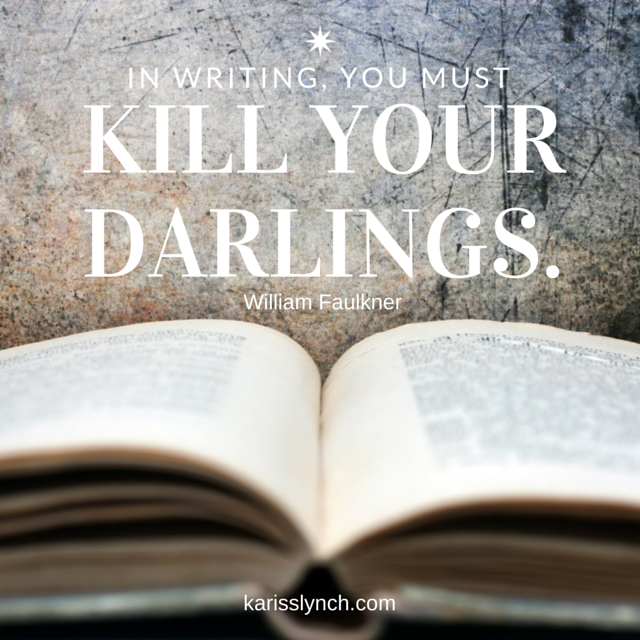
KarissLynch Kill Your Darlings

Working with an editor is refining, a true process of iron sharpening iron (just don’t throw the sword at them if you don’t like what they say), but ultimately, it is a beautiful journey. The longer I work with my editor, the more I am thankful that God gifted her to look at stories differently than I do. She makes me better, and she is constantly teaching me and reminding me of craft tips that just haven’t taken root yet. Over the course of writing The Heart of a Warrior series, here is what my editor has taught me:

  1. Timeline is everything.

By the time my first novel went to my editor, the timeline needed major surgery, something I hadn’t thought about in great detail during crafting. I am a pantser and only use a bullet point outline to guide the major points of my scenes. Everything else just spills out on the page. This can make editing much harder for me. When it came time to edit Shadowed, I had a better timeline in place. Lesson learned? Don’t make the same mistakes on the second novel as you did on the first.

  1. Ground your character. Ground your scene.

Ever heard of floating head syndrome? No? Well, that’s probably because I just made it up. But I have it. Bad. Especially when I am writing in a steady stream of consciousness. Characters speak but you don’t know what they look like or what is going on around them. Thankfully, I am now aware of this ailment and am working to correct it before the manuscript goes to my editor. Each character needs to be firmly grounded in whatever is going on, each person in the scene accounted for, even if only briefly. Your scene also needs to be grounded within the larger story. Your reader should have no question where the character is, what is going on, who the character is with, and what drama is unfolding.

  1. Provide concrete details. Paint the canvas.

I actually love this part of writing, but I also struggle with fear. What if people think that a place or person doesn’t look that way? What if I get a detail wrong? What if, what if, what if? The “what if” game keeps me paralyzed from simply using my imagination and the beautiful tools of my eyes and the Internet to ground a scene exactly as I see it. I use research to make sure I didn’t get a basic detail wrong, but otherwise, I craft exactly what I want the reader to see. They are less likely to question what I paint in great detail than they are a canvas where I leave glaring holes due to my own people-pleasing and insecurity. No fear. Write boldly. Paint that canvas, and give the readers a scene they don’t have to try to imagine. Let it unfold in all of its beautiful detail. And then make that process even better in the next book.

Time for surgery on your manuscript. What weaknesses do you notice that you could improve on next time? What lessons have you learned from your editor (or critique partner)?

Revising Aloud

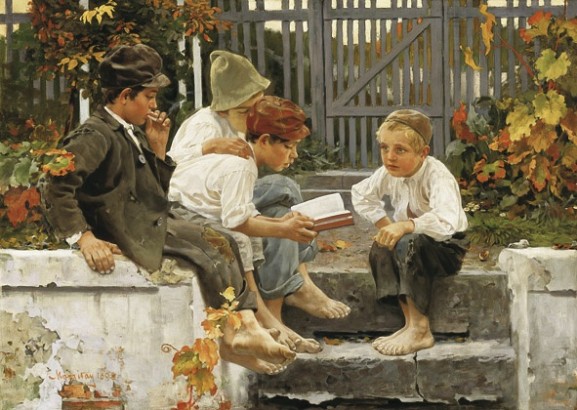
Tihamér_Margitay_Exciting_story“Reading aloud,” I’m always telling my writing students, “is the best way to revise.”

I encourage them—sometimes require them—to find read-aloud partners or start writing groups in which they take turns reading their work aloud.

“Hearing your sentences spoken lets you know whether they’re clear and natural-sounding—whether someone actually could speak them,” I explain. “And it doesn’t work to read to an empty room. You need a warm body, a listener, to complete the communication. Speaking is, after all, a collaborative act.”

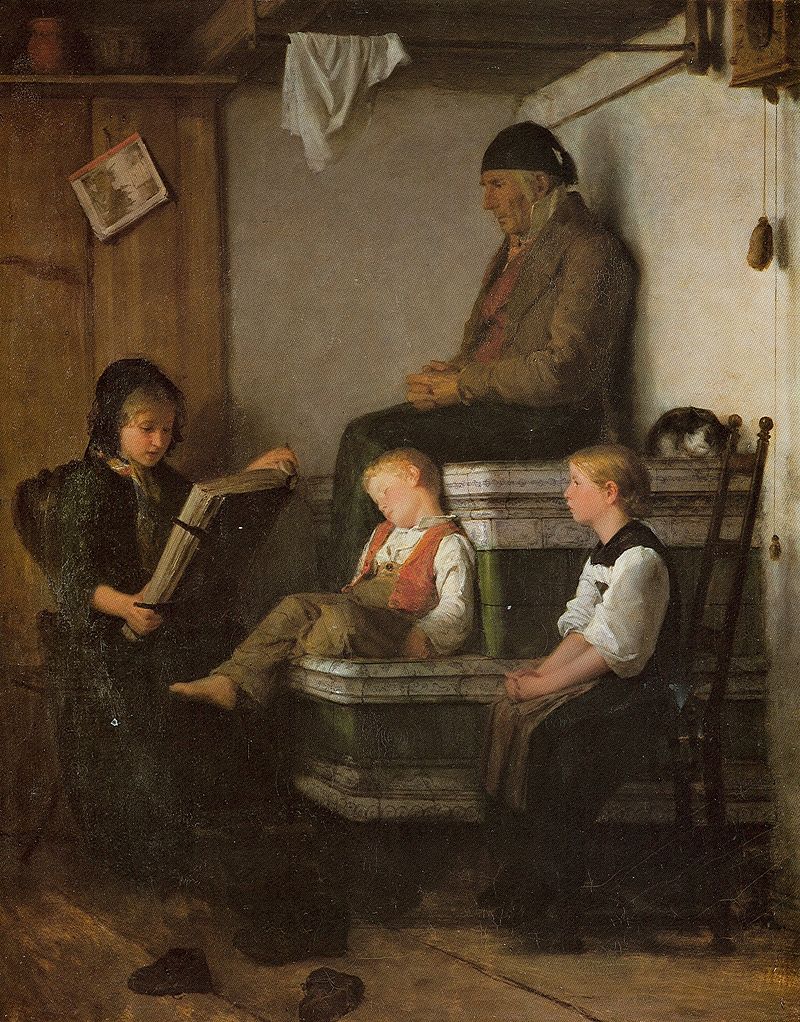
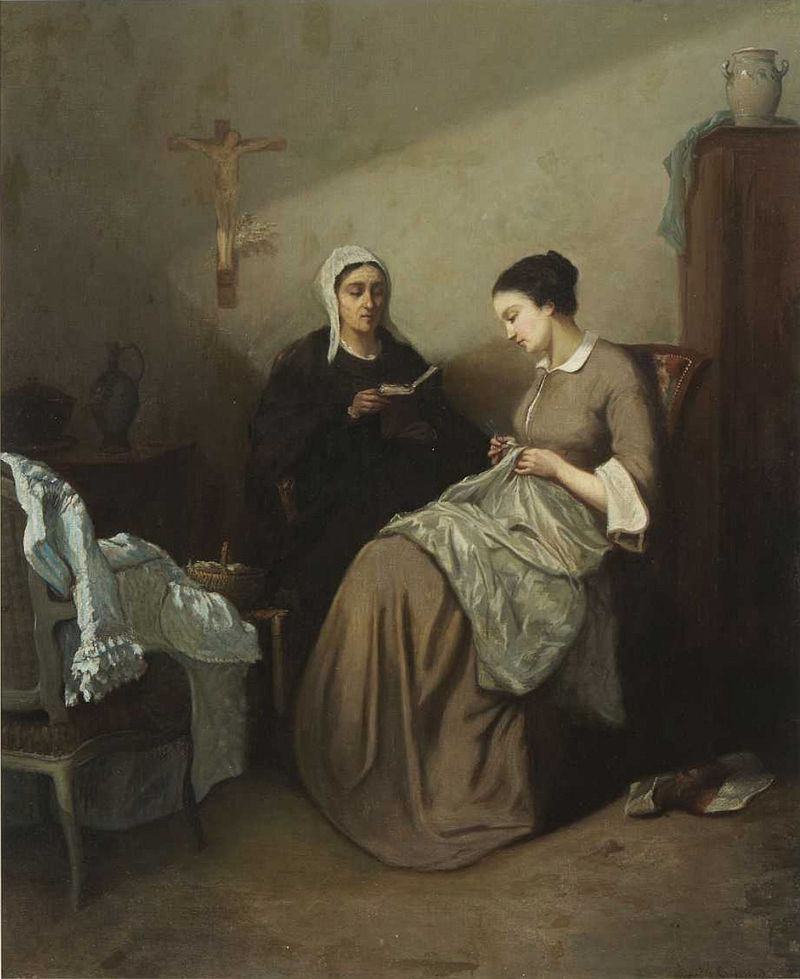
Finding that read-aloud partner is easy at college, where everyone’s engaged in writing all the time. Outside the college setting, though, finding someone willing to listen can be a challenge.800px-Anker_Sonntagnachmittag_1861 People are busy. Few have time to sit still for an hour while some verbose writer drones on. That’s how they’ll imagine it when you propose reading to them. We Americans have lost—or never had—the habit of listening to people read. We had only the shallowest tradition of serial novels, released chapter by chapter as Dickens’ novels were and read to the whole family at fireside. And no comfy pubs—without blaring TVs—like the one where C. S. Lewis, J. R. R. Tolkien, and their writer buddies hung out, drank beer, and read their work to one another. Writers who give public readings these days will tell you it’s hard to get even close friends to attend. Our lives are too busy for read-alouds.

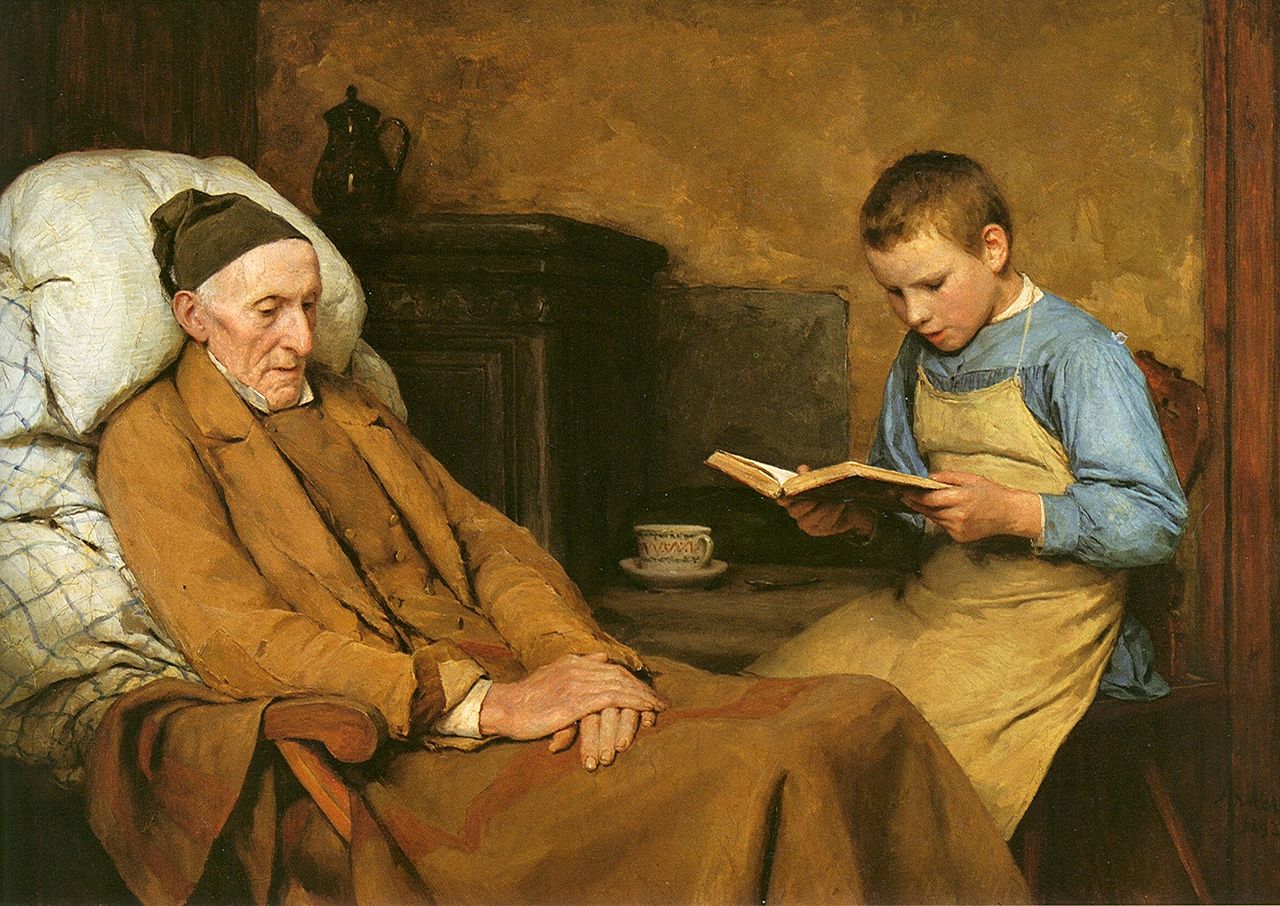
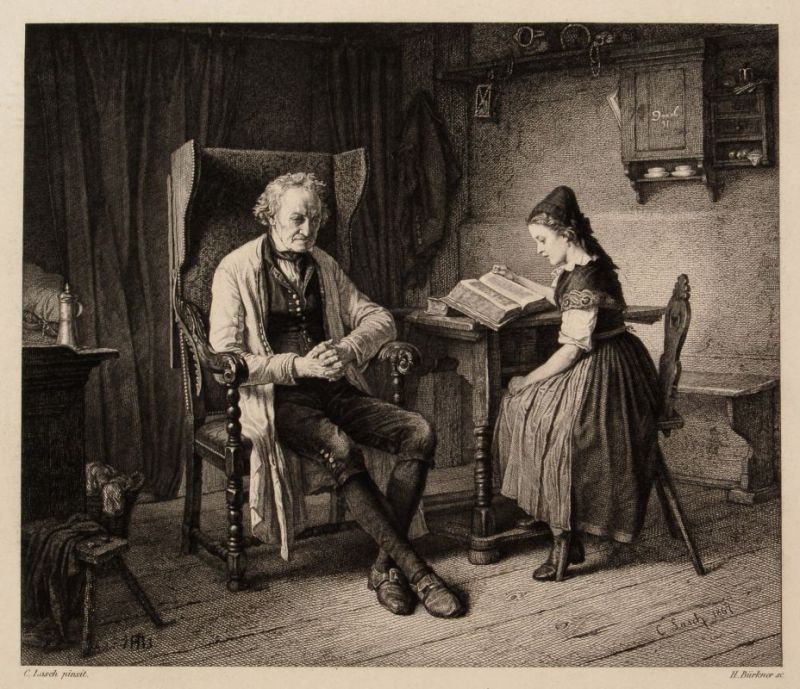
I often recommend to writer friends that they make use of the lonely people in their lives: shut-in relatives, kid-imprisoned friends who wish they had a grownup to talk to, recently retired colleagues with time on their hands. 1280px-Anker-_Die_Andacht_des_Grossvaters_1893It sounds terrible, this “making use” of others, taking advantage of their neediness to assuage your own, but in my experience such mutual exchanges not only helped my writing but also transformed intended acts of mercy—“I should spend more time with my mother-in-law,” I was always telling myself—into pleasurable time together, which we both looked forward to. My mother-in-law not only got longed-for company but also felt needed; I got my warm body but also genuine enjoyment, without having to chide myselfHugo_Bürkner_Lesestunde (usually in vain) to, as Paul recommends, “give what you have decided in your heart to give, not reluctantly or under compulsion, for God loves a cheerful giver” (2 Corinthians 9.7 NRSV). The mutual benefit, I found, guaranteed that cheerfulness, for both of us—because attentive listening and being listened to can’t help but nurture relationships.

My daughter Lulu has been on semester break from college for the past month, with a couple more weeks to go. It’s tricky having a grown daughter home that long. We’ve long since put our Christmas CDs away, but I’m still in the throes of Bing Crosby’s parental prophecy for the season: “And Mom and Dad can hardly wait for school to start again!”

Luckily, Lulu’s engrossed in the final revision stages of her senior project—a hundred-Amédée_Guérard_Bibelstundepage translation of and critical introduction to an East German book—and I’m busy trying to cut 30,000 words from a novel before sending it out, so we have tasks to distract us from the inevitable mother-daughter combat. Also, since we’re in about the same place in our revisions—where what we need most is to hear them aloud and find out if they work—we’ve established a read-aloud schedule: I read her a couple short chapters during her late breakfast, and she reads me one long chapter while I trim vegetables for dinner.

I can’t say it’s the perfect exchange my mother-in-law and I had. Lulu doesn’t end my readings, as my mother-in-law always did, with “That’s the best thing you’ve ever written!” And, as a writer and teacher of writing, I give more critical feedback than Lulu really wants. But our reading fills two hours of our day with mostly pleasurable, mutually beneficial work. More importantly, the listening involved gives us both practice, at this complex juncture of our parental-filial journey, in navigating our new relationship as related but separate adults. As peers, in other words. Equals. Reciprocally heard, appreciated, and loved.

Two Words of Advice: Stop it!

newhartWe were going around the room, introducing ourselves at a recent writers workshop I was leading, when one of the attendees got negative about herself.

I listened to this woman — a two-time winner of our Metaphors Be With You contest — explain why she wasn’t making as much progress on a memoir as she would have liked.

Most of it had to do with her inadequacies.

I couldn’t take it anymore.

“Stop putting yourself down,” I said. “You’re a good writer and you need to stop thinking otherwise.”

I proceeded to explain to her and the 15 others why one of the first ways we sabotage ourselves as writers is to look down on ourselves.

“For starters, writers need two things,” I said. “The confidence to believe they have something to say to the world and the humility to let others help them say it better.”

Instead, too many people write — and live — quite the opposite: with little sense that they’re worthy to be heard or with little openness to accepting help along the way.

As we discussed negativity, another workshop participant chimed in with a reference to an old TV sketch in which comedian Bob Newhart plays a psychiatrist. He listens to a woman’s problem — “I have this fear of being buried alive in a box” — and offers her a two-word solution:

“Stop it!”

Stop worrying about being buried alive in a box.

I love it. In fact, when it comes to advice, you could do a lot worse than offering people those two words — “Stop it!” — and two others: “Start it!”

“Start it,” as in take a risk. Begin your project, even if you believe it might fail. Try something new, even if it might feel awkward at the start.

“Stop it,” as in quit thinking you’re unworthy. Quit sabotaging your success because someone long ago told you you weren’t good enough. Quit believing the inner lie that you’re inferior.

Frankly, you can’t get to the “start” without the “stop.” Or so says Christian-based author Henry Cloud, whose book Necessary Endings (HarperCollins, 2010) I recently read.

Cloud, who mainly writes for a business audience, suggests “stop it” is about more than an attitude. It’s about action — or, more precisely, our unwillingness to take it when necessary.

“In your business and perhaps your life, the tomorrow that you desire may never come to pass if you do not end some things you are doing today,” he writes.

But, some might say, stopping things can be hard.

Habits. Addictions. Relationships.

It’s easier just to stay the course. To not confront the norm. To not risk.

Easier. But seldom better.

“Endings,” Cloud argues, “bring hope.”

Frankly, I’d never thought much about that until a friend recommended the book and I gave it a read. I tend to be in a constant “add” mode. But, Cloud argues, sometimes you need to subtract. Prune. Say goodbye to something in your life — and, yes, in some cases, someone.

Can it hurt? Almost always. But, he argues, there’s a difference between “hurt” and “harm.”

Last week my mother moved out of the house she’d lived in for nearly half a century. It was difficult saying goodbye. But the payoff will be a simpler existence that better fits her life today. It hurt, yes, but to stay could have brought harm, she figured; it was too much house for someone who is 87 years old and slowing down.

It took courage to make the change. But, in sailing terms, to stay moored to sameness simply because change can be challenging is to miss the glories of the wind in your sails.

At the end of the day, my workshop student — the one lamenting not being good enough — offered a piece in the voluntary read-aloud session. The class’s enthusiastic laughter and applause affirmed what I’d felt myself: her story was among the best of the bunch.

I hope she’ll look back on this day as a new start — a new start only made possible by her first being willing to stop.

In Praise of Editors

facebook personPosting a comment online this morning made me suddenly hyperaware of the publicness of published writing. Publishing actually does mean, as I tell my students, making something public.

“Everything you write for a class, even if it’s disseminated no further than the classroom, even if I’m the only one reading it, is public writing,” I tell them. “Don’t tell me you just wrote it for yourself or attach a sticky note saying it’s just for me. Assume that whatever you hand in may be made public. That it’s already public. It was public the moment you printed it up and put it in my hand or clicked ‘attach’ and then ‘send.’”

copyedited manuscriptIt’s easy to forget that writing is public, though. Consider Facebook, where people often post sentiments best kept to themselves. However tempting it might be to rail or even to agree—by liking it—with someone else’s railing, I generally restrict myself to happy birthdays, comments about good-looking photos, and commiserations with others’ suffering.

Today I was doing just that: commiserating with a friend whose autistic child had just “had a huge meltdown . . . complete with yelling, food throwing, and tears running down his face” in front of, as she wrote, “almost everyone I know.”

It was a wonderful post, as those who’d already commented said, because it was so frank. So, as my students say, “relatable.”

“Most of the time I suck it up,” my friend wrote, the “meltdowns, 10+ accidents a day, the stares, rude questions, the incomprehension on the faces of people around me, but today it was all too much, so I walked to the car sobbing my heart out.” She confessed, “it felt, somehow, like it was my fault,” and I sobbed too. For her. For her son. For sufferers of autism and their parents. For parents in general. Is there a more agonizing feeling than the unavoidable conviction that it’s somehow our fault whenever anything goes wrong—even something we didn’t cause and couldn’t have stopped—with a daughter or son?

It’s hard to respond to someone else’s pain in a way that doesn’t compound it, though. I learned that when, in the aftermath of a sexual assault at gunpoint, friends commented, among other intended condolences, that I was “lucky not to be dead.” I didn’t feel lucky and wished I was dead. Being told the contrary merely intensified those feelings.

I was thinking about that as I commented and (hopefully) didn’t make that error. Not this time, anyway—thanks to my best editor, the Holy Spirit, who, I’m convinced, translates our groans not only to God but to everyone else and (with some effort, in my case) bleeps our stupidest words. After telling her I’d cried, I advised her not to blame herself: she was doing the best and only right thing to do—loving her son—and doing it perfectly. So far so good, I thought—or anyway, I didn’t feel that tug in the direction of the delete key at that point.

BloggingI did feel it moments later, though, when I helpfully passed on a reassuring comment from a pastor’s wife eons ago when I was in the throes of parental shame about a problem with one of my toddling daughters: “God chose you, precisely you, for your girls,” she said, “because he knew you’d be the best possible mom for them.”

Sounds safe enough, I thought. And I was mightily comforted by that woman’s words at the time. God chose me to parent my girls. I was the best possible mother they could have. Everything was going to be fine.

But, as I say, the Holy Spirit apparently didn’t think so. In the fraction of a moment before I pressed enter, stories of parental abuse and neglect poured into my brain. A friend whose mom once told her children she hated them. Did God choose those children’s parents, too? What child, grown now but surely still suffering that meanness, might be reading my post?

The public is a tricky sea to navigate alone. Our kindest intentions, our most heartfelt theologies, have as much potential to mislead and hurt as to inform and uplift. Thank God for editors.

The Art in Writing

Strange and wonderful things happen when we keep our eyes peeled, our ears sharp, our hearts welcoming, and our minds creative. This year, I met someone who at first glance was not an obvious fit with my writing life. But first glances are often wrong.

Mary Young Zog the DogI am a Christian non-fiction author. The woman I met at a local women’s expo is a children’s book author. She launched as a self-publisher via Pucky Huddle Books — I have chosen the traditional route as my foundation. I’m a business coach, she married a rock star. Literally.

But we both live in the same tiny county.

Mary Young is married to Rusty Young of country rock group Poco fame. They still play for exclusive events, and tour around the country. But in their desire to escape the crazy life of frenzied fans and intense concert schedules, they built a beautiful cabin nestled about twenty minutes from where I live. On a serene hill overlooking the stunning Huzzah Creek, Rusty gets to relax with his music and Mary peacefully plays with her muse.

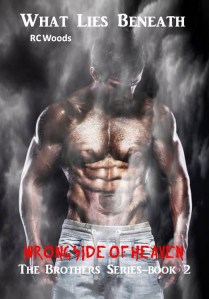
RC Woods What Lies BeneathDue to Mary’s prompting, she and I, along with local Indie author RC Woods, have pooled our talents. Recently, the Crawford County Author’s Group held our first event, called The Art in Writing. Three diverse but driven authors determined to learn from, promote, and support each other.

Until recently, in our small region, we each felt alone. Let’s face it, those of us who put pen to paper or fingers to a keyboard are a strange breed to normal folks — most people don’t get the weird ways our minds work. Or sometimes, the strange hours we keep.

When my brain fries, when my creative juices dry, when I’m too tired to think of new ways to market my books, a couple of hours with fellow writers revives my brainstorming abilities. The art in writing is not magical — it’s intentional. It’s not competitive — it’s cooperative. No matter how similarly or differently we write.

I have other author friends who equally stir my creative brew. They don’t live close, but because of twenty-first century technology, we can call, text, private message, Facetime, or Skype. We can schedule retreats with each other, (my favorite). We can compare marketing efforts, research, and new ideas.

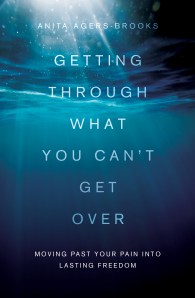
Getting Through
Releasing, April, 2015 through Barbour Publishing

The WordServe Water Cooler is another way to stay in touch with those who get the crazy business of writing. Sharing and learning with folks like you keeps my energy up when it threatens to flag. I often write about difficult subjects, so I need an occasional boost.

No matter whether other writers live near or far, I’ve discovered I don’t do as well without them. For me, the real art in writing is community. A brother/sisterhood of folks who will pick you up when you feel down. An encouraging message, a timely quote, a pertinent fact, a social media shout-out, even insights to help you market like a rock star. The writing community is the magic behind my words.

What infuses the art in your writing?