Dangerous Curves Ahead

You hear a lot in writing circles in regards to the pursuit of publication—just persevere. Keep at it. You’ll get there.

DangerousCurvesI heard this a lot when I was going for my ultimate job in nursing. I really wanted to be a flight nurse. After I got the required experience, I began the application process—something like seven interviews later I still didn’t have a flight nursing position.

I’ve spent lots of time theorizing why and I still would love to do this job, but in my heart I think it’s not going to happen. It’s just not God’s will for my life no matter how much I desire it.

It may not be popular to talk about quitting the pursuit of publicaton on a writing blog. But then ER nurses rarely do what’s popular—we do what’s necessary. I was pursuing flight nursing when I was supposed to be serving God writing. Maybe you’re pursuing publication when God has another dream for your life that will impact people more than what you’re pursuing right now.

But just how do you know? I’ve been obsessed with learning God’s will. I often say I wish I’d wake up with a gold note card on my pillow with the answer, but it is never that easy.
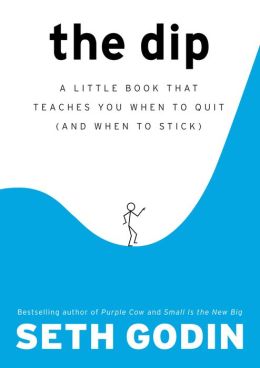
TheDipAll truth is God’s truth no matter who writes it. Isn’t that an amazing statement? I think I found some of God’s truth in a little (literally—it’s seventy-six half-size pages) book called The Dip by Seth Godin.

In the beginning, he makes some pretty profound statements. The phrase all of us learned, “Quitters never win and winners never quit,” is profoundly wrong. Godin says winners quit all the time.

“They just quit the right stuff at the right time.”

The trouble is telling the difference. The dip refers to the process of learning when you’re taking on a new project you’re excited about—like novel writing. The dip is that moment you wonder why you started to write the book. You don’t think you can pull it off. You’ll never finish it.

If you can push through these moments of the learning process, then extraordinary benefits accrue to the tiny minority of people who are able to push just a tiny bit longer than most.

But, Godin states, the opposite is also true. Extraordinary benefits also accrue to the tiny minority with the guts to quit early and focus their efforts on something new.

Again—it’s telling the difference.

To help, Godin discusses three curves.

1. The Dip: The valley of learning. Successful people don’t just ride out the dip. They lean into it. Push harder—changing the rules as they go. Part of knowing you’re on the right path is that you do get small amounts of positive reinforcement along the way. You final in a contest but maybe don’t win it all. You get positive comments from an agent and/or editor.

2. The Cul-de-Sac: This is where you work and work and nothing much changes. For me in my nursing career—I have never gotten any promotion I ever applied for—in twenty years! Honestly, you would think I was the worst nurse ever. I’m actually a very strong nurse but something has kept me stuck. If that hadn’t happened I would have never pursued publication where the doors opened much easier for me. But perhaps this is the pursuit of publication for you. You’re in the cul-de-sac.

3. The Cliff: It’s a situation you can’t quit until you fall off and the whole thing falls apart. The example Seth gives here is cigarette smoking. Cigarettes are highly addicting, but you do get a good feeling even though it’s detrimental to you—which, in the case of smoking, could be lung cancer and then death.

Godin hypothesizes that The Cliff and The Cul-de-Sac both lead to failure and it’s best to quit these pursuits early and move on to the thing you’d be successful at. That thing for which going through the dip would be worth it.

I would never tell anyone to stop writing—ever. Writing is a creative outlet that soothes the soul and spirit. It can ease tension, stress and frustration because spilled words on the page is cathartic. But—the pursuit of publication is a whole other animal. It takes time, money, resources, and sleep.

And perhaps God is calling you to do something else.

What dream have you had where you’ve persevered through the dip and had great success? On the flip side—is there something you’re pursuing that perhaps you are considering quitting and why? Good things to think through.

All italics are quotes from Seth’s book. I hope you’ll take the time to read it.
This blog first appeared at Seekerville. I hope you’ll check it out!

Planning a Book Release Party

I’ve said it once and I’ll say it again, an author does much more than just write. In fact understanding this was my biggest learning curve once I penned my John Hancock on my first contract. You are a writer, editor, marketer, publicist, your own biggest cheerleader, and your own worst critic. Not to mention the fact that you have multiple voices talking to you at one time as you write. Don’t worry…that’s normal. Kind of.

Book Release Party - Shadowed Kariss Lynch
This year, I added “party planner” to my growing writing resume as I prepared for the release of Shadowed just two short months ago. When Shaken released in 2014, my friends planned a sweet party to celebrate. This year, it was my turn to grab the wheel. Only I had no idea where to begin! But like all things in this writing journey, the learning curve is steep, the lessons memorable, and the end result rewarding.

The release party doesn’t have to be stressful! Here are some tips I picked up along the way.

1. Choose a theme.

I planned two different parties with the help of loved ones. I wanted to theme the parties, so I selected decorations and small touches according to the audience. Since some of the major moments in Shadowed are centered around sunsets and the ocean and an opening scene with fireworks, I found decorations that flowed like water and paper décor that resembled the pop of color bursting in a dark sky. It was a fun way to set the stage. For the second party, we decided to go with simple and elegant to fit the audience coming. We chose a room lined with windows overlooking downtown, decorated a center table with roses, set up a sidebar with refreshments, and left an open space for mingling and signing books.

2. Delegate the details.

I still didn’t pull this off on my own. In fact, I had a moment where I almost threw in the towel. But friends and family came to the rescue. Friends volunteered to bring refreshments and plastic ware that fit the beach theme. Others donated door prizes like Fossil watches and a hand-lettered quote from Shadowed framed beautifully. Another friend set up a photo booth complete with reading glasses and chalkboards that represented different plot twists. Party-goers could grab their favorite pair of reading glasses, a chalkboard with their favorite plot twist, and enact the scene on camera.

3. Send the invite.

Gather those around you who weathered the journey with you. Those who sat through the tears and endless plot conversations, the ones who left meals on your doorstep, or talked you off the ledge when you wanted to quit. Let them celebrate this win with you! As excited as your readers will be, these people will be even more excited for you, and let’s be honest, you couldn’t have reached this accomplishment without them. Then, encourage them to bring their friends, friends who may just be curious about you as an author, who may just want to come for the party, and who may just walk away as fans of your work. Use Facebook or Evite to send a mass message so that folks can easily respond

4. Remember the journey.

Don’t forget to hit pause in the craziness and excitement Shadowed Kariss Lynchand remember. Remember from whence you’ve come. Remember the winding road that led you to this point, the road that seemed to never end and had too many bumps to identify. Remember that writing is your calling. Remember the One who gave you the story in the first place.

5. Celebrate!

Bask in the joy of completion, of your baby entering the wide, wide world. Ask a couple of your confidants to keep an eye on the refreshments and remind people to turn in their tickets for door prizes, then cut loose and celebrate. Share your heart, speak of the journey, talk about the story, smile, laugh, sell books, giveaway a few, and praise God for the gift of completion, of release day, and all He taught you along the way.

When all is said and done, clean up, sleep up, then hit the desk. You’ve got another manuscript to finish.

13 “Tells” of a Novice Writer

In the poker-playing world, professional card sharks have a term for a novice player who inadvertently gives away the cards he’s holding through some sort of gesture or tick of which he is unaware. The pros call it a “tell.”

pokerIn the publishing world, professional editors and agents look for the “tells” of a novice writer whenever they scan a manuscript. With practice, we can almost always pick out the amateur from the pro from reading just a page or two. Here’s a list of 13 Common “Tells” of an Amateur Writer that may give you an inside advantage at the publishing table.

  1. Too many clichés. If you find yourself using a common cliché–try changing it up for humor or effect. Instead of saying, “He marches to a different drum,” you might say, “She rhumbas to a different drum-ba.” You want to avoid cliches but they can also be springboards to creative alternatives.
  1. Too much telling, not enough showing. Use scene-setting, dialogue, metaphors and gestures to show your reader an emotion. Instead of, “She felt deep sorrow,” try instead, “She sat down, sighed heavily, staring out the window at nothing at all.  A slow trickle of tears turned to a river as her dam of resolve gave way to reality.”
  1. Too much preaching/didactic tone. Go through any non-fiction manuscript and take out words like “must” and “should” and any other words that feel like a finger-wagging nursery teacher who is scolding the reader.
  1. Sentences don’t vary in length and style.
  1. Manuscript is is too text dense.  Just looking at the page exhausts the eye because there are too many sentences crammed into one long paragraph, followed by another just as long.
  1. Page looks boring. There are not enough “reader treats” to keep today’s reader alert.   Especially in our current hyper-speed world, you want to make liberal use of shorter paragraphs and anything that breaks up and adds interest to the page.  Pull quotes, dialogue, lists, bullet points and stand-alone sentences here and there are some ways to keep the reader engaged.
  1. Dialogue is stiff and unnatural. The writer has not learned the art of professionally written dialogue. One sign of a pro is that they know to use a gesture to indicate the next speaker rather than over-using “he said” or “she said.” For example, rather than writing, “Joy said, ‘I love that crazy squirrel,’” a pro might write, “Joy laughed as she leaned toward the screen door. ‘I love that crazy squirrel.’”
  1. Main character is too unlikable or too perfect. Readers want to root for the protagonist so be careful not to make him appear either beyond redemption or too saintly. Make them flawed, human, and lovable.
  1. Too “Christianeze.” Christians are often blind to the phrases they’ve grown up using in church. Try sharing old religious phrases in fresh ways.  Instead of, “I’ve been redeemed,”  you might say, “I knew that God had taken the mess of my life and given me, in exchange, His love.”
  1. No transitions or weak transitions. This may be the #1 “tell” of a novice. You know what you are saying and where you are going, but your reader needs a very clear bridge from your former thought to the next or they will be confused and frustrated.
  1. Old-fashioned style. We see this in some classically trained, older writers who have not stayed current on how to grab the attention of today’s internet-savvy, fast-paced reader. Read popular blogs and note the style of writing that is reaching today’s generation of readers.
  1. Doesn’t use the art of “hooking the reader.” You don’t have long to grab the reader’s attention, so you want your first two sentences to be irresistibly compelling.
  1. Doesn’t end well. Pay attention to writers who end chapters or articles especially well. There is an art to tying up a chapter or a book. In fiction and non-fiction books alike, write a sentence at the end of the chapter that propels the reader forward, making it hard for them to put your book down. I often refer to the first paragraph when summarizing an article. (See example below where I will refer back to the “poker analogy” that started this post.)

By avoiding these common novice “tells” you will soon come across as a seasoned pro, and your chances in the game of publishing will improve considerably.

What other “tells” have you noticed that indicate an inexperienced writer?

How a Non-Writer Like Me Got Published (Part III)

(Continued from Part I and Part II)

What made me think I could write a book? I mean, really. Book writing is for experts… for people who know things. Important things. My friend’s critical feedback on the early chapters of my manuscript only served to confirm what I already believed to be true: Who would care what I had to say, or if I even had the right to say it?

The wind had been knocked from my sails and I saw no point in continuing my brief writing career.

Yet in the midst of the doldrums, I couldn’t shake the memory of that moment with God many months before. “Write a book about the gifts you were given,” I heard him say in my office. If that was really God, maybe He knew something about me that I didn’t. Maybe He had a reason… a plan.

It was just about this same time another friend of mine traveled to Israel on vacation. She invited me to write a prayer on a slip of paper for her to place between the ancient stones in the Wailing Wall in Jerusalem. I’ve always wanted to do this myself, but sending my prayer with her… a praise, really… was the next best thing to being there. In my note, I thanked God for the time he met me in my garage, and ultimately delivered my daughter, Annie, from the bondage of meth addiction. He had restored our family, and I still could scarcely wrap my mind around it.

Image, Jordan RiverMy friend also asked if there was a souvenir I might like from the Holy Land.

“So, um… yeah,” I replied. “Could you please bring me some of the Jordan River? Just a cup or so will do.”

Within a month, precious holy water and a few tiny river rocks had a new home on my
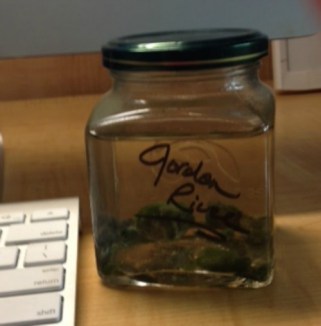
desk, right next to the computer screen. I transferred the water into a small Manzanita olive jar and labeled it “Jordan River” in black felt tip marker.

It was as if God’s presence had returned to my office, and I again found myself back in the business of writing. I needed feedback though. Professional feedback this time. I knew no writing professionals per se, and no one in publishing, yet my new neighbor, John Vawter, had self-published a book… about addiction no less. His book, Hit By a Ton of Bricks, had been in my reading arsenal when Annie was on the streets! John had a friend-of-a-friend with an editing business here in Bend, a fellow by the name of James Lund. He’d once worked for Multnomah Publishing in Sisters, Oregon, and became a freelancer when Random House acquired the company and moved it to New York City.

“Am I delusional to think I can do this?” I asked James Lund when we first spoke early that March. “I mean, is what I’ve written any good, or am I completely wasting my time?”

Jim was working on a project with a tight deadline but said he could give me a couple of hours in about two months.

Two hours in two months? He already sounded too important for a novice like me.

But I did hear from Jim two months later, at which time I sent him my story’s table of contents, two chapters, and a check for his time. A week later, his feedback stunned me. “You’re not wasting your time… keep writing. And I don’t think you’re going to need much help from me.”

Initially, my inner Woody Allen lamented that this James Lund person must not be very good at what he does. However, I secretly delighted in the apparent vindication from my friend’s critical review. I confess to skipping through the house chanting, “neener, neener, neener.”

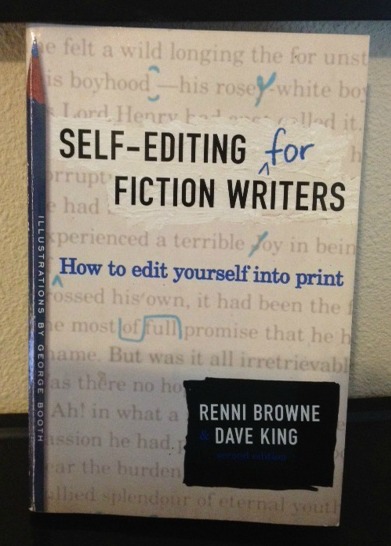
Jim and I agreed to reconnect in five months, at which time I was to have an entire first Image, self editing bookdraft ready for his review. Jim also had a few tips for me. He suggested I read Self Editing for Fiction Writers by Renni Browne and Dave King.

It will help equip you with some fundamentals that will improve your writing,” he said. “Try inserting ‘beats’ in your dialogue to make it more interesting. You also want break up some of the narrative by creating ‘scenes.’ Have you ever heard the term ‘show don’t tell’?”

“Jim… what’s a ‘scene’?”

(Please stay tuned for the conclusion in Part IV, when I go from clueless to published.)

WHY are you Writing?

Today, the WordServe Water Cooler is pleased to host guest blogger Kim Zweygardt. Kim recently attended the Re:Write Conference and is here to give us some insight into what she found so valuable about this conference.

Welcome, Kim!

Writing2“I know I can write.”

“I am a writer.”

Writing is more than something I enjoy or can do well. (All those “A’s” in English Comp surely count for something.)

Writing is my calling.

Even so, after a blistering critique in 2014, I spent more time not writing than writing. Doubt crept in, undermining my call.

“I think I can write.”

“At least I think I’m a writer.”

I floundered, not sure how to regain the confidence to write. What would it take to jump start the flow of words onto the page?

In February, I found my answer in Austin, Texas when I attended a different kind of writer’s conference. Re:Write—The Ragged Edge “aims to tackle issues that writers face every day, offering guidance, insight, and a hefty dose of hope along the way.”

The Ragged Edge conference was filled with power hitters. Some I knew and had heard before: Ted Dekker, George Barna, Jim Rubart, Susan May Warren, Mary Demuth, Sandi Krakowski, Mark Batterson.

Others were new to me: Rusty Shelton, Claire Diaz-Ortiz, Chad Allen, the delightful “tour guide” to the weekend–Julie Carr, Rachelle Dekker, Kevin Kaiser, Ruth Soukup, Derek Webb and the lovely Esther Fedorkevich who founded The Fedd Agency and hosted the conference along with author Ted Dekker.

As I listened, I had my mind bent over and over again.

You see, it wasn’t so much about the how of writing but much more about the why. It wasn’t so much about rules for success but in how we see success. It wasn’t so much about the bad news of the economy and publishing and more e-books and less “real” books and Author Chicken Little crying that the sky is falling and much more about the Good News of Who we write for in the first place!

It made such a difference to me that if I hit the lottery or better yet, had a wildly successful book that made me a bazzilionaire, I would call all my writer friends who are struggling and feel alone with their dream or feel they have been put on the shelf by the times or the particular, maybe-not-mainstream story they have been given to tell, the one that burns in their heart to get out onto the page and reserve their place for the 2016 Re:Write Conference.

Registration? On me! Travel expenses? On me! Need a little cash for BBQ at the airport? On me!

Oh, to dream!

But, just in case I don’t hit the lottery or the NY Times bestseller list, you could start saving now and I’ll see you there.

To whet your appetite, here’s a mash-up of what the speakers said in all their different ways.

Don’t be afraid!

Step out of the shadows and take the plunge!

You are not alone!

You are the Light of the World and no one can tell your story but you!

Don’t listen to the nay-sayers!

Write well! Write compellingly! Go deep! Lean on Jesus!

Write as an act of worship and as a spiritual discipline because He has called you to it. And if you are called and you don’t write, you are disobeying the One who has called you.

So now I write. Because I am a writer.

***********************************************************************************************

KimZweygardtKim Zweygardt always knew she wanted to be someone special.  Her heart’s desire when she was 7 was to be a famous ballerina but when she read their toes bled from dancing on them, it became a less desirable career choice. Then Kim decided to be a famous lawyer solving mysteries and capturing the bad guys just like Perry Mason, but as she got older she discovered sometimes it was hard to tell just who the bad guys were.

Instead Kim chose a career in medicine practicing the art and science of anesthesia as a Certified Registered Nurse Anesthetist in rural Kansas, Colorado and Nebraska.

Kim is married to Kary, the man of her dreams, who has done a fabulous job of making all her dreams come true. They have three children but an empty nest and enjoy conversation with friends over good coffee and great food. They enjoy travel, the arts and taking a nap.

Member American Christian Fiction Writers, International Speakers Network, www.bookaspeaker.netwww.womenspeakers.net

Marketing With A New Mindset


If you’re like me, sometimes the best thing in life is a little change of perspective.

perspective

Last July I got my first taste of publication. After months of hard work, I held the finished product in my hand. Countless drafts had transformed into orderly pages and endless edits changed into final words. It was beautiful. And then came the real work—marketing.

For many of us, the idea of marketing our books makes us a little queasy. Peddling wares and pushing books is not an exciting notion. After all, we are writers. Our gift is with words not a megaphone. In fact, most writers fear the aspect of marketing their own book. Yet, in today’s publishing world self-promotion and book marketing are a must.

If you have written a book, part of your purpose is to bring something meaningful to the reader. How can that reader be reached if there is no one to share it?

Think of the passage in Matthew 25:14-30

In this parable, a rich man who was going on a journey called his three servants together. He told them to take care of his property while he was gone. The master gave five talents to one servant, two to another, and one to the third. Then the master left.

The servant who had received five talents made five more. The servant who received two made two more. But the servant who received one buried his talent in the ground. Later, the master returned to settle his accounts. The master praised the first and second servant. But the master’s response to the third was harsh. He stripped the talent from the lazy servant and gave it to the first servant.

In the parable, the master expected his servants to invest and be proactive, to use and expand their talent instead of passively preserving it. With the first servant, courage to face the unknown was rewarded, and we can see God expects us to use our talents toward productive ends, not only was the first servant allowed to keep what he earned, he was invited to rejoice with his master.

This is such a beautiful illustration of what we should do with our God given gifts.

So, is there a cure for marketing anxiety? Maybe. Maybe it’s time to take a step back and gain a new perspective. Maybe it’s time to stop looking at it as MARKETING and instead, look at it as ADVOCATING Your God Given Gifts.

gifts

You are your work’s greatest advocate. So who better to promote it than you? It’s up to you to reach your audience. Invest yourself. When we share our talents lives are changed!

With the same passion that drove you to write your project in the first place, look at your book marketing plan in a new sense. Instead of marketing, advocate. Use whatever is available to you and proudly declare yourself, your message, and your book. Move forward with certainty that you have something important to share and what you share has the power to change the world.

3 Ways to Build Your Writing Career

IMG_5665

As a pre-teen with literary dreams, I was blessed to have a newspaper editor for an uncle. During a visit to his house, he introduced me to a Writer’s Market and demonstrated how to submit poems and short stories to magazines. That nudge helped me sail my ship. After a few dozen submissions, I received my first byline. I still have the $8 check. 🙂

I’m thankful for my uncle’s mentoring, and I try to help other writers get started and stay motivated. As a result, I’m often asked by excited beginners, “how do I get published?” That’s a good question. But it may be the wrong question. I believe a person who’s serious about writing should instead ask, “How do I build a career?”

As I’ve pondered what that process entails, I’ve uncovered three important steps to building a career as a professional writer. They comprise the chart for navigating the murky waters of publishing.

First–Build Confidence

Confidence is the anchor of a writer’s craft. Repeat after me: “I am a writer.” Now say it again. Then repeat this exercise until you believe what you’re saying.

Another way to build confidence is to join a writer’s group, either locally or online.file0001814083365

Your belief in yourself will also improve as you learn about the ocean that is publishing. Like a fisherman trolling unchartered waters, be adventurous—by attending conferences and by subscribing to unfamiliar online and print newsletters and magazines.

There are two reasons to navigate new territory often: first, markets rapidly change, and second, editors and agents repeatedly change positions. The writer with the advantage is the one who stays abreast of people, publications, and trends.

Case in point: recently, a magazine accepted an article of mine (which they had previously rejected) because I re-submitted it when a new editor came on board. I found out about the opportunity through the “market news” section of a writer’s newsletter.

Second–Build Credits

How do you get those all-important first credits? Author Sarah Stockton, says she took two approaches to building her clip file: “First, I targeted online publications that didn’t pay. These are often easier to break into. Secondly, I queried places where I felt I had something to contribute that I felt passionate about, with an idea directly related to their content and an angle that I hadn’t seen from them before.”

Sand your boat often, by reworking old material. Also, don’t forget to revise your new bread several times before casting it on the waters.

Reprints are another way to beef up your resume. After you have a few excellent articles, try selling them over and over again. Each time, you’ll receive a new credit, as well as payment (whether it be in money or in publicity) for old work.

Third—Build Your Craft

Developing your craft takes perseverance, patience and prayer. Picture Noah, slowly putting the ark together under blue skies.Then feel God smiling on you as you obey Him, even when the rest of the world points and laughs.

Other ways to build your craft: attending a writer’s conference every year, entering contests, listening/reading books on areas in which you’re weak, and completing writing courses, whether in person or online.

Now grab that hammer and a few nails and start building your craft. I’ll see you in the water!

Winning Writing Contests

I’ve both entered and judged several writing contests over the last four years. Not only that, but have been asked to review a myriad of early manuscripts for newer writers.

award-152042_1280Most recently, I entered the Blurb to Book contest sponsored by Love Inspired. I’m happy to report that I made it to Round Two (Go Team LIS!) What I thought was interesting about this particular contest is that the sponsoring editors sent out an e-mail to all the participants before they released the round two results that outlined several reasons why you may not have progressed in the contest.

I found this information highly valuable and also found it to be consistent with entries and early manuscripts I’ve judged/read that didn’t fair too well. So, I thought this list would be interesting to you because it speaks to universal problems among writers. The LI editors should receive credit for these items and I’ll be expanding on their list with thoughts of my own.

1. No strong hook. For this contest, we had to write a blurb (something akin to back cover copy) and were limited to only one hundred words. You realize very quickly how few words that really is. But this comment of the blurb or hook not being strong enough can be carried over into other things. Your cover letter didn’t have enough punch. Each word has to be powerful. A short blurb like this is easy enough for other people to read and critique.

2. Too much back story in the first page. This is so common I almost gave the editors a standing ovation when I read it. This is a very common mishap in writing. In round one of this contest, we submitted the blurb as noted above and just the first page of a first chapter. That’s it. Imagine how strikingly engaging this first page must be! My professional writing opinion is that it takes authors time to “warm up” to their stories and this is a lot of what’s happening in those first pages. It’s really character profiling. My suggestion is to look at page five of your first chapter. The first event that happens is really the start of your story. Back story can be dropped in as the story progresses.

3. Not following the guidelines. Every time you submit something as a writer, there’s likely a document that covers the submission process–whether it be for an agent, an editor or a contest. Read them. Double check them. Even if your writing is fabulous, if you haven’t “followed the rules” you can be kicked out of the contest just for formatting issues. Seriously, don’t let the wrong font drop you from a contest. You also cannot “break the rules” in the sense that if a publisher says a character cannot do such and such–they really mean it. If you don’t like the guidelines of that particular publisher–don’t write for them.

4. No conflict. Every story, regardless of genre, must have tension/conflict. It’s why we read story. Readers don’t want to read about happy people in happy places where nothing ever happens. Even the sweetest romance story has conflict. James Scott Bell has a whole book about it called Conflict and Suspense. Check it out.

5. Telling rather than showing. A common issue for writers. I’ve written a blog post on showing versus telling here that will better illustrate this point.

6. Confusing. Have another writer read your entry. If it’s not clear to a reader, clean it up regardless of how you feel about the passage.

7. Writing . . . not quite there. As the editors said in their e-mail– everyone has to start somewhere. Writing is a craft that must be learned and honed. Did you know just learning a craft takes 6-10 years? Think about musicians, dancers, or painters. Did they succeed at their first attempt? I think people don’t give learning the craft of writing enough credit in the sense that because we know English and can craft a sentence since grade school– we should be able to write a great novel the first time out of the gate.

Have you ever watched The Voice? We can all sing, right? Of course, some better than others. But if you listen to the mentors work with these young singers, you’ll hear them talk a lot about practice, about craft, about emotion in singing. “Come back next year when you practice these things.” You know what? The singers that take this to heart do practice, they do come back, and often times they do better the next time around.

So… keep writing! Keep entering those contests regardless of the result. Take the information from the judges as a learning opportunity to grow.

Have you ever entered a writing contest?

Cutting Out the Frivolous Stuff

song sparrow singingLast week, during a series of presentations on writing-related discoveries, which I always make first-year composition students do at the end of the year, one student said, “I learned that writing shorter is harder than writing longer.”

“Why’s that, do you think?” I asked.

He thought before answering.White-crowned-Sparrow

“Because to make something shorter, you have to make all these decisions. Like, what’s important and what to get rid of. And then, after you take stuff out, you have to change other stuff to make it sound right.”

“You mean, you have to revise—like, you know, re-see it,” another student chimed in.

“Yeah. It is like that,” he said. “Like seeing that it could be a different way and still be what I wanted to say. Maybe even better. I never thought of that. I always used to think revision was just fixing stuff.” The two students grinned with that mixture of embarrassment and pride students always have when using the language of the course.White-Throated_Sparrow

That night I led a professional development session for graduate faculty on the subject of assessing final projects.

“Everything students hand in is a draft,” I remarked in passing, “and drafts are hard to grade. If you want your students to revise, you have to trick them into it.”

Field_Sparrow“How?” one professor asked.

“Lots of ways,” I said, “but the most successful way for me is to give maximum word limits on assignments rather than minimum word limits.”

“How does that make them revise?” she persisted.

I knew that being made to write short did force students to revise, but it took me a second to come up with a reason why on the spot. “I guess it’s like when you fill out an online application and have to answer a question in a little box that limits you to only so many characters, including spaces,” I told them. “What you write is always way too long. So you have to keep paring it down, getting rid of unnecessary stuff, often the parts you’re Harris's Sparrowproudest of, so you can get down to what’s essential. And, in the end, it’s not only shorter but better. Or, anyway, I always think it is. In my experience, the same thing happens with students when I give them word limits. I get all these emails, begging me to let them go longer. But I never do. Not one word. So they have to revise. And what they turn in is lots better than what they turn in when they’re just trying to fill pages.”

Everyone wrote that down—the most useful grading takeaway, even though it wouldn’t be relevant until they started building assignments the next semester.

The next day, at an end-of-year luncheon of honors English students, my department chair asked those about to graduate to share the moment they realized they wanted to study English, and two women talked about learning to write short.

lark sparrow“Being forced to cut made my writing so much better,” one said. “I knew how to improve my writing after learning that.”

“I had this revelation that every sentence matters,” said another. “That was the moment for me.”

Finally, yesterday, my novel workshop students were talking about their revision strategies for the three chapters I’d be grading at the end of the semester.

“I’m cutting out a lot of frivolous stuff,” one said. “That’s the main thing I learned in this class: You don’t need half the stuff you write.”Chipping_Sparrow

As always, whenever I have one of these clumps of similar messages, I figured it wasn’t just coincidence—or the more obvious reality that people were saying back to me what I’d been preaching all semester—but the Holy Spirit weighing in on the ssavannah sparrowubject. It seemed strange, though, that the Holy Spirit was interested in revision.

Then it occurred to me that I’m the one who needed the cutting message I’d been preaching. My own novel is a frivolous (and practically unpublishable for a first novel) 130,000 words.

There’s no getting around it, I told myself. You need to cut another 30,000 words.

That doesn’t begin to answer the question—if you’re still wondering—of why cutting words from my pages might interest the Holy Spirit. Perhaps it’s that, as I like to tell my students, revision is a key part of the creative process, and God has always been into that. Separating light from dark, water from land. Fiddling with it, examining it, considering, until it’s good, or very good.

Or maybe God’s interested in revision for the same reason he pays attention to sparrows: namely, all of his creation—birds, us, our minds, words, our little improvement plans—fascinates and delights him.

(PS: To whatever fellow birdlovers are out there, I saw all the sparrows pictured this morning: song, white-crowned, white-throated, field, Harris’s, lark, chipping, and savannah. I feel so blessed!)

My Indie Story (And Why I still *Heart* My Agent)

myindiestoryThere are a gazillion reasons why authors choose to go the “indie” route. (Wanting to use the word gazillion to the chagrin of every publisher out there might be one of them…. :-))

They want more control over covers and editing, more share of the profit, quicker publication. They may be tired of waiting and/or writing in a niche market that isn’t served by traditional publishers… the reasons are as wide and varied as the genres they write in.

I thought I’d share my story and my motivations, and why I still want, value, and love my agent.

IMG_5199My story is a complicated one. When I signed with my first agent and got that coveted first publishing contract, I was in the throes of a personal trial that was, to say the very least, difficult. My fourth daughter was born in 2010 with half of a heart and spent her first 308 days in the hospital.

About three weeks after she came home from the hospital, on oxygen and twenty different medications, and after four open heart surgeries including a heart transplant, an editor offered me a contract. I was also offered representation by an agent, all in the same week.

On one hand, I was ecstatic. This was my dream come true. And considering I’d given up my pay-the-bills day job to take care of my daughter, it felt like amazing timing.

What I didn’t factor in was a fun case of stress induced depression, ongoing medical issues with my daughter (including one very scary helicopter ride which included CPR… Boo!) and the immense stress of editing on a deadline and trying to market a book–all the while dealing with those deeply difficult, personal trials.

SandwichOnce my book came out, I kinda collapsed. I was exhausted and needed a timeout. I took the next year to recharge and focus on my family. Writing was almost laughable during that time.

When I finally emerged during the fall of 2013 and felt God nudging me to write again, I was met with a few stark and depressing realities regarding my writing career.

1.) Releasing a novel without a follow-up anytime soon does not make for grand sales history.

2.) Trying to market a book well during such a difficult time also doesn’t breed super quality sales either. While my book didn’t totally bomb, it fell much below my expectations, which probably didn’t help my depression either!

3.) Even if I polished up my finished manuscript and had my agent immediately submit it, due to publishing schedules, it’d probably be at least two years or more before it would actually be published, thus making a span of close to three years between book releases. The business side of me knows that isn’t ideal for marketing purposes.

So what to do?Pageflex Persona [document: PRS0000026_00095]

I needed a book release sooner than later, and a way to build back up the platform I lost during my mental-health break. I looked at all those indie authors and wrinkled my nose. No. I’m a writer, not a publisher. That is not what I want at all.

But the more I rejected the idea, the more God pushed me toward it. Then ideas started flowing… what if I did some followups to the first book? Maybe some novellas, then finish out the series with a full-length?

The thought blossomed over a few months. God gave me some fun ideas for books and titles and put some amazing indie-authors in my path to teach me the ropes. I am forever thankful to them!

And you know what?

I don’t regret it for a moment. My sales haven’t been astronomical. My “grand plan” is to release three novellas then a final “full length” to wrap up the series, while my fabulous agent works her magic with a new series.

I’m using the three novellas as trial books, trying different marketing strategies on each to see what works, what doesn’t, and what I can do better. The first book, A Side of Faith, came out in August, 2014, and the second, A Side of Hope, came out March of this year.

Pageflex Persona [document: PRS0000026_00095]A Side of Love will release later this year, and the full length, The Greatest is Love, will release in 2016.

It’s been a lot more fun than I thought it would be. I’d originally dreaded every single step in the process, but the idea of being a hybrid author is intriguing.

At this point, I don’t see myself going “full” indie. I LOVE my agent (waving to Sarah) and LOVE working on a team with a publisher. I know this idea isn’t embraced by all indies, and that’s super okay. What is good for one is not for another.

But this is my Indie story, and I’m very thankful I followed God’s leading and stepped out of my comfort zone. In the end, my hope and prayer is that my indie books and my traditional books can work hand-in-hand to help each other.

What about you? Have you ever thought of indie publishing? Why or why not? While I don’t claim to be an expert, I’m happy to answer what questions I can!