Thoughts on Publishing: What Would the Wright Brothers Do?

“If we worked on the assumption that

what is accepted as true really is true,

then there would be little hope for advance.”

~Orville Wright

A lot of hoopla surrounds the publishing industry, these days more than ever. In the midst of the business, it’s easy to forget the original dream and heart of the artist.

This is not a new phenomenon.

Nor is it unique to the publishing industry.

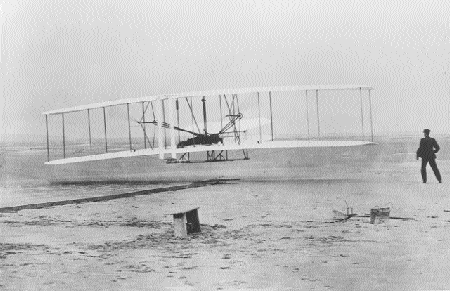
Take the Wright brothers, for example. I wonder if Orville and Wilbur had today’s airplane industry in mind when they first sketched out their dream to fly. I assume they were two wildly imaginative, brilliant brothers who had a knack for ingenuity, and who simply wanted to feel their feet leave the ground. Who simply wanted to fill their lungs with air free from the heavy, constant pull of gravity.

Sure, they must’ve been pleased to see the initial progress of their invention, how flight began to morph into bigger, stronger vehicles which allowed others to feel weightless freedom, too.

But what would they think now?

Of the pushing and shoving and security detail in airports? Of gunfire, like rain pouring from silver wings? Of hijackings? Of crashes? Of bankrupt airlines? Of their beautiful, wooden machine used as weapons of mass destruction on 9/11 nearly a century after liftoff?

Of course, modern-day airplanes are still a marvel. Their massive engines bring orphans into the arms of adoptive parents; soldiers into the embrace of waiting wives and newborns; food to the starving; medicine to the dying; peace to the war-torn; relief to the hopeless.

All of these things–the good and the bad–began with a dream which lolled around the hearts of two gangly boys for years, and which eventually tamed the winds on a lonely, sandy beach.

And so it is with the publishing business. A single page of script begins as it did with the Wright brothers, with a small dream in a great, big heart. From there, the dream takes flight. And after that, it becomes a part of the industry–an industry which carries words to distant places.

Some stories give life and hope.

Others tear down and destroy.

Much ado is made over the various branches of publishing: self, electronic, traditional, mainstream, Christian, small press, large press, and on and on and on. I suppose this is not new. But the industry is merely a vehicle for syntax to take flight.

Our job as authors is to keep the original dream alive, despite commercialism, competition, money, and what all the writing blogs say.

If you’re an author (like me) who follows Jesus, our job carries the even weightier responsibilities of strengthening, encouraging, and comforting. As Christ-followers, we must choose building up over being edgy for the sake of being edgy. We must choose loving accurately over nosediving into the murky waters of what itching ears would have us say.

Write brave, yes.

After all, neither flying nor faith are safe.

But write with prayer, precision, and while feeling the weight of the cross on our wrist.

*************

“The desire to fly is an idea handed down to us by our ancestors who, in their grueling travels across trackless lands in prehistoric times, looked enviously on the birds soaring freely through space, at full speed, above all obstacles, on the infinite highway of the air.”

~Orville Wright

*************

What about you?

How do you stay true to your dreams and the truth you long to pen upon blank pages?

How have the Wright brothers (re)impacted you today?

Be Your Agent’s Dream Client

One thing authors wonder about is how to “behave” once they have a working relationship with a literary agent. Especially if it’s your first agent, you want to be the kind of author an agent wants to keep as a client. Agents understand that—and we want to be the kind of agent you want to work with, too! In fact, I tell my authors that the best partnerships are when the agent and author are president of each other’s fan clubs. That takes time, of course, but it shouldn’t take years if you are intentional about making the relationship great.

The secret to a good agent-author relationship isn’t a mystery. It’s like any other relationship: kindness counts; communication is key; and sometimes it takes a little work to keep things running smoothly. If you follow this commonsense advice, you’ll be well on your way to a positive long-term association with your agent.

We’ll start with the negative: The single most difficult thing that agents deal with is authors’ unrealistic expectations. These expectations fall into lots of categories—everything from the size of your advance (usually compared to others you know) to the amount of marketing the publisher will pay for, to the speed of the process (or lack thereof). It’s important that you develop realistic expectations in all of these areas. How do you do that? By talking with your agent, networking with other authors, attending conferences, and keeping up with happenings in the publishing industry (through key blogs and other news sources). If your expectations are impractical, your publishing journey will be unfulfilling. You’ll be disappointed and likely end up resentful.

I’ve had authors wonder why their advance for their sixth book is smaller than the advance for someone else’s first book. They don’t realize that one or two bad showings in sales hurts a publisher’s enthusiasm. A sales guy makes a call to a retailer, the numbers are brought up on the screen for their last book, and if they’re small they get a tepid response. It doesn’t matter about the quality of the book, it matters what the computer says their last book sold. Sad, but true (and all too common).  A new author, however, doesn’t have one bad book to muddy the waters. The value of their idea and platform can be leveraged into higher advances.

That’s why it’s essential to always keep those expectations in check!

In addition to managing expectations, it’s extremely helpful to agents when you communicate well. There is a balance to good communication—we don’t want you to be afraid to call or e-mail if there’s an issue, but daily phone calls and emails can actually slow the process, stealing time from the things an agent does behind the scenes to get clients’ work to publishers. As a general guideline, check in once a week with questions and updates, if you have them. Most important, when bigger issues do arise (and they will), go directly to your agent rather than to the publisher, your critique group, your Facebook page or your blog. Keep the lines of communication open and talk things out. If you’re not happy with your agent, this may be hard to address directly, but it’s the best way. Always.

Trust is the essence of any relationship, and agents need their authors to trust them. Agents handle the business details so you can focus on your writing and marketing, and we appreciate when you allow us to do this without second-guessing every move. If you’re confused about something, always ask, but unless it’s proven otherwise, trust that your agent has your best interest at heart in all actions, negotiations and decisions.

Today, authors have to be marketers and promoters of their work, and agents are ecstatic when their clients understand this. Many agents offer advice and can steer a writer toward good ideas for platform building, but what we really want is for our clients to have a commitment to the self-promotion mindset, and a desire to learn more about it and get better at it as time goes on. An agent rarely has the time to handhold you through every step of your marketing process, but your agent can be an enthusiastic partner and savvy advisor along the way.

Agents appreciate clients who care about the craft of writing and are always striving to learn and improve. Attend conferences and writing workshops, and work hard to learn from the editorial process. Your value to the industry increases as you improve as a writer. And this probably goes without saying, but we really like it when clients meet their publishers’ deadlines!

Don’t forget the basics: be kind, cordial and professional. And when it’s warranted, feel free to express gratefulness for a job well done.  And Starbucks cards are always appreciated.

Who is My Reader?

Marketing Your Debut Novel Part III

I’ve been doing a series on marketing your debut novel. You can find Part I and Part II by clicking the links.

Briefly, Part I focused on growing your tribe/social media and Part II was about the comparable books section of your book proposal.

In this installment, I’m going to continue on the pre-contract phase of the writer’s life by focusing on another troublesome aspect of the book proposal–the AUDIENCE SECTION. (Cue your choice of scary music.) This section goes before the overall marketing plan that you will design to help the publisher get the word out about your book.

A publisher wants to see that you know who your potential reader is. Are you savvy enough to figure it out? This audience section will help your publisher know how to market your book and how to best reach the reader you’ve identified.

For instance, a novice book proposal writer would say something like: “Proof will be loved by ALL people ages 18-102.”

Really? Everyone? That’s not very discerning. You may not understand your potential readers very well and this will be troubling for the publisher.

EVERYONE is not going to like your book. That’s just fact. And you will waste time trying to market the book to everyone. Did you know the largest group of Christian fiction buyers is women, mostly between the ages of 30-50? In fact, this morsel of truth may translate to the general fiction market as well which are those books published by the ABA. You can watch this fascinating interview with CJ Lyons and Lee Child as they discuss that women purchase most books.

So, when you’re working on this section of your book proposal, think hard about who will be attracted to buying your book. Are they men or women? College educated? What age are they? What do they watch on TV? How popular are those TV shows?

What follows in quotes is my audience section in the book proposal for Proof. For those of you who are not aware, Proof is a medical thriller/police procedural. Equal parts of both. Some romance but not 50/50 romance like a true romantic suspense novel should be.

“Those likely to buy Proof are career men and women age 25-45 who are fans of medical/police procedural television shows and novels. ER ran for 15 seasons and during its first ten years was consistently a top ten show. House, currently in its seventh season, averages 10 million viewers. The DNA mystery in Proof will attract people who watch CSI, as well. CSI has three television shows in its franchise.

Suspense novels with a heavy medical edge do well in fiction markets. Mainstream writers like Robin Cook, Tess Gerritsen, Michael Palmer, and Kathy Reichs consistently hit the New York Times bestseller list. Furthermore, Lethal Harvest by Cutrer and Glahn was a Christy Award finalist. Candace Calvert’s Critical Care was a 2010 Carol Award Finalist. Proof will appeal to these readers.”

What’s been interesting in hindsight is that Library Journal suggested my novel to those who were fans of Robin Cook. Several reviews have specifically mentioned the show CSI as well as Law and Order SVU and Grey’s Anatomy. I carefully marketed the book to those I thought it would appeal to, and ultimately they are indeed the ones who’ve loved the book.

What do you think? Have you tried to write an audience section of a book proposal? How easy or hard was it? What advice helped you write this section?

The 15-Minute Writer (part two): 5 Ways to Get Organized

(Read part one of the series here.)

Are you having trouble writing because you can’t see past the piles of books, Post-it notes, and paper on your desk?

Trust me, I’ve been there. I’m a pile-r by nature, a fact that has frustrated my  husband–and me!–more than once.

If you have limited time to write, though, getting organized is absolutely essential. After all, you don’t want to waste precious minutes you’ve scheduled for writing on finding lost items–or clearing your messy desk.

So here are my top five organizing tips for busy writers:

1. First, figure out your organizing personality. For example, don’t try to use notebooks if you’re not a notebook person. If you love technology and abhor piles of paper, go paperless. Hate Google calendar? Admit it! Don’t try to fit yourself into someone else’s mode. It doesn’t work in the long run. If you’re visual, you might need a big bulletin board or calendar on the wall in your writing area.

2. Set up a system you’ll want to use regularly. Why spend time on something if you’re going to dread it? If you love bright colors, use them in your file folders.  Play your favorite CDs when you’re going through receipts—or watch a funny movie while you’re organizing your calendar and notebook.

3. “Backwards plan.” I learned this handy phrase when my husband took a church administration course during seminary. It’s been invaluable for both of us. Here’s a short explanation of the BP process: Take a deadline (or set one for yourself) and mark it on your calendar. Then take all the tasks you’ll need to complete in order to meet the deadline—interviews, outlining, writing a rough draft, revising—and decide how much time you’ll likely need to complete each one. Then plan backwards, setting yourself mini-deadlines.

4. Set aside a few minutes of each writing session for de-cluttering. You need time to delete old material, back-up files, tame paper piles, recycle books, and throw out trash–or you’ll be on the way to auditioning for Hoarders. Once you’ve gotten organized, five minutes a day is do-able and will go a long way toward keeping your desk, computer, and writing space organized. Believe me, once you make this a habit, you’ll be glad you did!

5.Use OmmWriter. (Thanks to writer Duane Scott for this fabulous tip!) He said, “It blocks out all distractions (email, social media, chat messages, etc…) and provides you with a completely white screen with only a blinking cursor. It also offers different peaceful backgrounds and music to accompany your writing. Another great feature: you can set it to have a manual typewriter sound effect when you type.” The cost for all this? A one-time fee of $4.99.”

Your turn: what are your most effective organizational strategies? I’d love to hear them!

What Food Network Star Taught Me About Author Branding

Marketing your Debut Novel: Part Two

Last month, I started this series on how to market your debut novel. You can find Part One here. We’re going to stick with the same time period of the writer’s life–the pre-contract phase.

In brief, I discussed those things an author should be doing pre-contract phase, which is identifying and building your brand through social media. You are working to build a well-defined tribe. (You are reading Seth’s book by now, right?)

The issue of branding became very apparent to me while watching The Next Food Network Star. Yes, hand straight up in the air, I like reality TV. If you’re not familiar with the series, earnest chefs attempt to win their own show on Food Network by doing next to impossible cooking tasks for a panel of feisty food judges they may work for someday.

The judges want to know what their POV is. This season one contestant, Malcolm, was often heard saying, “I don’t need a POV. I just need to cook great food. That will speak for itself.”

I’d like to indulge a few different words. “I don’t need a brand. I just need to write a great novel! The words will speak for themselves.”

The problem is where do said judges, or in our world, publishers, place you?

If you’re seeking publication and you’ve not been published before (particularly in fiction) you are going to have to 1. finish your novel and 2. write a book proposal.

A book proposal is essentially a marketing tool for your book. It’s the sales plan. It’s the blueprint of how your tribe (again, reading it?!?) will purchase your product.

One section of the book proposal is the dreaded “comparison” section. It can be called other things. Market analysis. Comparable books. In this section, you list books that are like yours (and what sets yours apart in a nice, professional way.) The purpose of this section is to help a publisher identify what type of audience you’re trying to reach. Is there consistency amongst the authors you picked and what type of novels they write? This helps a publisher know that you know yourself pretty well. You have brand awareness and can plug into the group of people who also like those authors.

But say I have little brand awareness. My novel is a Steampunk, alien invasion set during Roman times with a population of Amish quilters–and if a book like this makes it big, you heard it here first! My website looks like a Steampunk machine tossed out a Roman gladiator who just tousled with an alien on the prairie–and throw in a couple of Amish looking bonnets for good measure since those books sell really well.

In your comparable books section, you list these books: Proof by Jordyn Redwood (a medical thriller), The Half-Stitched Amish Quilting Club by Wanda Brunstetter (Amish gives a clue there), Not a Fan by Kyle Idleman (this is Christian non-fiction), and Francine Rivers’s A Voice in the Wind (which is historical fiction).

A publisher is going to be scratching their collective head. How can one fiction book possibly be placed by each of these novels? They’re so different. Not even in the same section.

But, you say, my book will satisfy all of those readers. A publisher shakes their head. No, it won’t. The books above represent very diverse readers. I’ve personally read two: my own and Not a Fan. Not to say the other two by Wanda and Francine are not excellent novels– but they don’t appeal to me and what I like to read.

Don’t be Malcolm. Discover your brand. BE the BRAND (think Miss Congeniality– BE the CROWN!)

So, you may ask, what happened to Malcolm? Voted off midway through the season. Great chef but “we don’t know who he is.” They didn’t know how to brand him.

What about you? How did you like writing your book proposal? How easy or hard was it to write the comparable books section?

Another Brick in the Publishing Wall

FreeDigitalPhotos.net

Inevitably, whenever I read an article about the publishing business lately, Amazon’s name crops up—often to highlight how they’ve become the big, bad wolf trying to blow down the publishers and booksellers with a huff and a puff of discount prices, a far-reaching distribution channel, and the ability to sell direct to consumers. Much heft, in particular, has been placed on pricing as the lynchpin that could make traditional publishers and bookstores obsolete. No doubt (and for good reason) they fret over this more than the average reader, and time will tell if price and reach are the mortar holding it all together. Meanwhile I’d like to explore another factor influencing why and from where customers buy because I don’t believe it’s all about price, and I don’t believe it’s all about marketing and promotion, either. What about convenience? Selection? Fulfillment? What about how well the seller delivers on the overall customer experience at every touch-point and every interaction?

FreeDigitalPhotos.net

Yes, I admit I’m a bit of a harpy about the ‘customer experience’ (call it a hazard of my day job), but it’s the one thing that keeps me coming back again, even if I can get something cheaper elsewhere, and when not done right, it’s the one thing that drives me away faster than I can pluck a hair from my chinny-chin-chin. Why do you think people who buy only from certain bookstores do that? Nostalgia for traditional publishing or because the experience and interactions they have in those places make them feel good? I’m guessing it’s the latter.

And do you think people who buy mainly from Amazon do that solely for the price, or might it have something to do with Amazon’s wide selection, easy to use website, quality packaging, fast (often free) shipping, easy returns, overall solid reputation, and available, empowered customer service? It just might. I’ve been buying everything from books, games, and gifts to guitars, clothing, and Cuisinarts through Amazon since 2004. Every time, they’ve worked hard to build my loyalty by delivering a consistently extraordinary customer experience.

FreeDigitalPhotos.net

When I think about my experiences with other sellers, they’ve been average or infrequent. With publishers (traditional and electronic), it’s a mixed bag. As a consumer, I don’t have many. As a writer, I’ve mostly been rejected or ignored. I realize this is par for the course in the publishing industry, and I don’t doubt I deserved the rejection at the time, but being ignored is memorable. I’m expected to provide thoughtful responses to hundreds of emails a day (and, no, email isn’t central to my day job), so it chafes a little when publishers say they don’t have the time to respond at all, ever. These may be ego-bruising realities for a writer, but as consumers who buy a lot of books (and the occasional Cuisinart, for that matter), engaging us only when it’s self-serving isn’t the way to build a positive, lasting relationship.

On the flip side, Amazon isn’t perfect.  I hear some Indie authors say they’re unhappy with Amazon’s KDP Select customer service, and they feel ignored or unappreciated. Amazon may, in fact, be wading into dangerous territory if they don’t figure out how to deliver the same service excellence to indie writers as they do elsewhere. But given the overwhelming number of positive experiences I’ve had with Amazon, I might be willing to forgive the first lapse or two.

FreeDigitalPhotos.net

If publishers and booksellers intend to compete profitably in a world where customers are ever-evolving in their expectations and where the likes of Amazon exist, they have their work cut out to deliver the kind of experience that builds loyalty (read: profitable behavior). There is no silver bullet. It takes time to build a reputation. Amazon isn’t the only threat to houses of sticks and straw. There’s a hurricane of savvy customers brewing.

What about you? Have you ever decided to purchase from somewhere (or not) solely based on an excellent or poor experience?

Disclosure: I have two contemporary romances published with Avalon Books, which was recently acquired by Amazon Publishing. I had drafted this blog post before I was aware of the acquisition, and it in no way impacted my depiction of Amazon here.

Remember Your Passion

So much of being a writer is weathering rejection. We often hear the advice, “You need to develop a thick skin to survive in this business.”

This is partially true. We can’t let every no beat us down or we’ll spend all of our time getting back up instead of moving forward.

But those rejections do hurt. The more often you experience, the easier it becomes. It’s taken me over ten years to reach the point I can say this honestly.

However, I still don’t like them. I don’t think there’s a writer out there who does. If you do, please share in the comments!

There are a few valuable things rejections teach us. They make us examine why we’re doing what we’re doing. When I feel beat up by the no’s, I have to remind myself why I want to be writer.

It’s not for the fame. Of all the truly awesome writers out there, how many are famous? Not many.

It’s not for the money. Most authors still keep their day jobs or spouses who help supplement their incomes.

I write because I’m passionate about my stories. I have a message God has put on my heart. I write because I don’t feel whole when I stop. I write because God created me to be a writer.

So when you’re faced with a rejection, no matter what step of the publishing ladder you’re on, remember your passion for writing.

When you feel like giving up, ask yourself these questions:

* Why did I start writing in the first place?

* What kept me typing my first story before I even thought about sending it out?

* What message do I want my words to convey?

Write them down on a card, so the next time you receive a rejection letter or a pass on your work you can pull it out to remind yourself. And then start writing your next masterpiece.

Also, feel free to check out these rejections by other writers. Knowing that other writers really are going through the same thing can be helpful.

WordServe News: June 2012

Exciting things have been happening at WordServe Literary!

On the final post of each month you’ll find a list of Water Cooler contributors’ books releasing in the upcoming month along with a recap of WordServe client news from the current month.

New Releases

Will Davis, Enough, Revell (Agent: Greg Johnson)

******************************************************************************

Katie Ganshert, Wildflowers From Winter, WaterBrook Press (Agent: Rachelle Gardner)

******************************************************************************

Ken Gire, Relentless Pursuit, Bethany House Publishers (Agent: Greg Johnson)

******************************************************************************


Lisa Jordan, Lakeside Family, Love Inspired (Agent: Rachelle Gardner)

******************************************************************************


Maureen Lang, Bees in the Butterfly Garden, Tyndale House Publishers (Agent: Rachelle Gardner)

******************************************************************************


Kathi Lipp, Praying God’s Word for Your Husband, Revell (Agent: Rachelle Gardner)

******************************************************************************


Gilbert Morris, The River Rose, B&H Publishing Group (Agent: Greg Johnson)

******************************************************************************

Jordyn Redwood, Proof, Kregel Publishers (Agent: Greg Johnson)

******************************************************************************

Beth Vogt, Wish You Were Here, Howard Publishers (Agent: Rachelle Gardner)

******************************************************************************

Karen Witemeyer, Short-Straw Bride, Bethany House Publishers (Agent: Rachelle Gardner)

******************************************************************************


Mike Yorkey, Tim Tebow, Barbour Publishers (Agent: Greg Johnson)

******************************************************************************

Mike Yorkey, Linspired (Kids Edition, too), Barbour Publishers (Agent: Greg Johnson)

******************************************************************************

New WordServe Clients

Caesar Kalinowski is one of the thought leaders in the missional church movement and a trainer and founder of the Soma Communities in the Tacoma, Wash, area. (Agent: Greg Johnson)

Gillian Marchenko is a small town girl from Michigan who has spent the majority of her married life in big cities: first Kiev, Ukraine and now Chicago, Illinois where she lives with her husband, Sergei, and their four daughters. Gillian writes and speaks about parenthood, stumbling faith, adoption, and special needs. Gillian has written a memoir about the birth of her third daughter, Polly, and her diagnosis of Down syndrome in the former Soviet Union. Her writing has appeared in MomSense Magazine, EFCA TODAY, Four Cornered Universe, CHICAGO PARENT, Story Bleed, and CHICAGO SPECIAL PARENT. Check out Gillian’s website at www.gillianmarchenko.com. (Agent: Sarah Joy Freese)

Laurie Polich-Short, veteran youth speaker and author, is making the leap to adult non-fiction for women. (Agent: Greg Johnson)

New Contracts

Marcus Brotherton signed with Zondervan Publishing House to collaborate and write DiscipleShift with pastors and authors Jim Putman and Bob Harrington. The book will be the lead book for the April 2013 Exponential Conference. (Agent: Greg Johnson)

Julie Cantrell has signed with David C. Cook for two more untitled novels. (Agent: Greg Johnson)

Jan Drexler, a debut author, has signed a contract with Harlequin’s Love Inspired line of Christian fiction for her Amish book Love Bears All Things. With her Anabaptist upbringing and ancestral ties to the Amish church, Jan brings a unique understanding of Amish traditions, doctrine, and theology to her writing. Her ancestors were among the first Amish immigrants to Pennsylvania, fleeing intense religious persecution in Europe in the 17th century, and then continued west, arriving in northern Indiana in the mid-1800’s. Their experiences are the basis for her stories. Jan holds a B.A. in English with a Creative Writing Emphasis from Kalamazoo College in Michigan. She lives with her husband and two of her four children in the Black Hills of South Dakota. (Agent: Barbara Scott)

Pamela Binnings Ewen, an award-winning fiction author, signed a contract with B&H Publishing Group for the second edition of her non-fiction apologetics book titled Faith on Trial: Would the Testimony of Matthew, Mark, Luke, and John Stand Up in Court? The first edition of Faith on Trial was published in 1999 and was listed on many best-seller lists and even used as a textbook at Yale University in a course on Law and Religion. Pamela practiced law for twenty-five years in Houston before retiring in 2004 to write full time. (Agent: Barbara Scott)

Denver Pastor Michael Hidalgo signed with IVP for two books. The first is called Unlost, a book about stopping our search for God and standing still long enough for Him to find us. The second book is untitled. (Agent: Greg Johnson)

Amanda Jenkins recently signed a contract with Tyndale House Publishers for her memoir tentatively titled Confessions of a Raging Perfectionist. Before life as a homemaker and mother of four, Amanda worked in sales and marketing for a number of Christian retailers, as well as in visual communications and advertising. She spent ten years in L.A. alongside her film-making husband Dallas Jenkins, son of bestselling author Jerry Jenkins. Amanda attended Northwestern Bible College and graduated with a degree in Biblical Studies and Communications. She has taught Bible studies for women of all ages for the past fourteen years and is passionate about communicating truth in a culturally relevant and humorous way. (Agent: Barbara Scott)

Our own Becky Johnson and her daughter, Rachel Randolph, have signed a two-book contract with Zondervan Publishing House. The first book will mirror the title of their food blog, We Laugh, We Cry, We Cook.  It’s a book of vignettes about mother-daughter life up to and after the birth of Rachel’s first child.  The second book is tentatively titled Getting Momma Fit, Getting Daughter Relaxed. (Agent: Greg Johnson)

Jerry and Carolyn Parr signed with Tyndale House Publishers to write their memoir. Jerry was a Secret Service Agent for 25 years. Jerry was the agent who pushed Ronald Reagan into the limo after he was shot by John Hinckley and then made the decision to immediately go the hospital, a decision that saved the President’s life. After retiring, he went to seminary, and he and his wife spent more than 15 years serving the poor and homeless of Washington D.C. (Agent: Greg Johnson)

Debut author Amy Sorrells signed a two-book contract with David C. Cook. Her first novel is tentatively titled Canary Song and was the winner of the recent Women of Faith writing contest under the title of Comfort and Salvation. As well as an author, Amy is currently a registered nurse for Indiana University Health North Hospital in Carmel, Indiana. Her professional writing has been featured in numerous national journals. She lives with her husband, three boys, and three golden retrievers in central Indiana.  (Agent: Barbara Scott)

Mike Yorkey and Jesse Florea have signed with Barbour Publishers to do a shorter book on New York Yankees future Hall of Fame closer Mariano Rivera. (Agent: Greg Johnson)

Mike Yorkey signed with Barbour Publishers to write a “Playing with Purpose” book on a broad range of NFL stars. (Agent: Greg Johnson)

Mike Yorkey signed with Harper Collins Publishers as the collaborator for the Eric LeGrand story that will be published this fall. Eric was the Rutgers University football player who suffered a spinal cord injury and yet has inspired millions with his courage. (Agent: Greg Johnson)

What We’re Celebrating!!

Jordyn Redwood received a starred review from Library Journal for her debut medical thriller Proof. Their Verdict: Strong writing, terrific plot twists, and a great premise make this debut medical thriller a must-read. Recommend it to fans of Richard L. Mabry and Robin Cook.

Dave Runyon was featured in the June 2012 issue of Christianity Today. It highlights Dave’s work in the Arvada, Colo., area pulling churches together to be better neighbors. His book, written with Arvada pastor Jay Pathak, The Art of Neighboring, will be releasing in August. (www.artofneighboring.com)

Karen Witemeyer’s book Short-Straw Bride was #14 on the CBA Fiction list for July (May sales).

What can we help you celebrate?

How to Create a Free E-Book for Your Website

People love to receive stuff for free. Ever wandered through Costco in the afternoon? You can always spot the free sample stands by the crowds gathered round.

Our readers are no different. They love to get stuff for free and what better way to encourage or thank them for signing up to your blog posts than with a free e-book.

You may be unsure what content to include in your e-book. Ask your readers. I put a poll on my website asking what subject people would like to see more. This helped me decide what to write my e-book about. Take a look at your web stats; which posts have the highest views?

Once you’ve decided on your topic, start writing it. Keep it on the shorter side; it doesn’t need to be a full book length. Under five thousand words is a good guideline. Remember to offer new content in your book. Because it’s electronic, you can and should link to articles on your blog for further reading and value to the reader.

After your e-book is finished, save it as a PDF file and then upload it to your website. Keep it unassigned (for self-hosted WordPress) and copy the location.

I use Feedburner as my RSS and email subscription service for my website. I downloaded my existing email subscribers addresses to MailChimp and sent them out a free copy thanking them for being with me. You never want to forget your current readers in the search for new ones.

For new subscribers, I included the PDF link in the email they receive from Feedburner when they sign up for my blog. This allowed for free automation and instant access for the reader.

If you use Feedburner and have a sign up box on your website, I highly recommend customizing the sign up box. Even if you don’t have an e-book to offer yet, you should list the benefits subscribers receive when they sign up for your emails. Here’s an example of my homepage and subscriber box. 

By using the Feedburner verification email to send out my free e-book link, I realize people don’t have to verify in order to get the free copy. But if they don’t like my free e-book and choose not to verify to get my posts, then they most likely would have unsubscribed anyway.

Have you ever bought something from a free sample? What makes you subscribe to a blog via email? Do you think having a free e-book has helped your blog numbers?

Advising New Writers Lovingly

Today I received an email from a freshly graduated student about a blog he’d been writing for the past two years that he wants to get published as a book. It was about being an only child—a topic I recommended he consider transforming into a memoir after he turned in a wonderful English 101 essay about growing up alone. Ever since, he said, he’d been writing. He included a link to the blog, clearly hoping—despite assurances to the contrary—that I would read it and somehow singlehandedly applaud it onto bookstore shelves.

This is the first of several such emails that I’ll likely receive this summer, in addition to similar requests I get from faraway former students, colleagues, and even total strangers during the school year. Would be writers email me. They show up in my office door, boxed manuscript in hand. They bribe me with lunch. But something about graduating—commencing Real Life, I guess—translates especially as the supreme opportunity to magically turn what have thus far only been vague dreams—of writing their memoir, of publishing a collection of devotions, of becoming a children’s author—into reality.

For me, though, summer is my big work-time as a writer. As soon as I get my grades in, I’m frantically writing away toward midsummer deadlines. In a little over a week, my college daughters will be coming home, and I’m embarrassed to say—though I love them both dreadfully and have been missing them ever since they returned to school after Christmas break—I’m dreading their return. The summer seems, for me, already used up, with all the things I need to get done during it, and I resent everything—even things I love best, like daughters and gardening—that takes me away from the computer.

So, I’m faced, as most writers are, with a difficult task I’ll probably never get exactly right: How to convey the reality of my summer (indeed, of my life as a writer)—that I have neither the time to read a single post, not to mention four years’ worth of blogging or a manuscript two reams thick, nor the power to circumvent for them or myself the arduous tasks of revising to make a book readable and securing an agent to get the thing sold—while simultaneously heartening and supporting those who, inspired by my own modest successes as a writer, want to follow in my footsteps?

The poet Rainer Maria Rilke models my ideal response in his Letters to a Young Poet. I would like to embody his kind voice and take time away from my own writing to compose letter upon letter of encouragement and advice to those who approach me for writerly advice. But Rilke was writing back before the internet made it possible for would be writers to readily locate and assault him with salvos of manuscripts and queries. And Rilke didn’t seem to have to do any other work in his life besides write poems. And poets write, after all, poems. Short pieces—shorter, quite often, than a single blog post.

I was also much impressed when, after a reading from her memoir, Ellen Gilchrist took on question after question from the would be memoirists in her audience, somehow validating every asker as a writer and spurring each one to keep at it, keep writing, keep sending things out, keep doing—or start doing—the hard, often fruitless but always rewarding work of getting one’s thoughts and stories onto the page and into others’ hands.

My advice, finally, is canned, as were perhaps Gilchrist’s comments at readings and maybe even Rilke’s advice—which was, after all, published in book-form for every wannabe poet to read. I have an email in which I detail the steps I myself took in seeking publication for the first time, and I send it out, slightly personalized, to each asker. I have a spoken version for office door and phone conversations. It’s easier to be kind and encouraging, I find, when I plan it out.

“No breakfast?”

Now, if I could just figure out a loving way to tell Lulu and Charlotte I’m too busy to make them the fantasy breakfast they’ve been dreaming of all semester…

What do you tell aspiring writers who come across your path or your email in box?