How a Non-Writer Like Me Got Published (Part III)

(Continued from Part I and Part II)

What made me think I could write a book? I mean, really. Book writing is for experts… for people who know things. Important things. My friend’s critical feedback on the early chapters of my manuscript only served to confirm what I already believed to be true: Who would care what I had to say, or if I even had the right to say it?

The wind had been knocked from my sails and I saw no point in continuing my brief writing career.

Yet in the midst of the doldrums, I couldn’t shake the memory of that moment with God many months before. “Write a book about the gifts you were given,” I heard him say in my office. If that was really God, maybe He knew something about me that I didn’t. Maybe He had a reason… a plan.

It was just about this same time another friend of mine traveled to Israel on vacation. She invited me to write a prayer on a slip of paper for her to place between the ancient stones in the Wailing Wall in Jerusalem. I’ve always wanted to do this myself, but sending my prayer with her… a praise, really… was the next best thing to being there. In my note, I thanked God for the time he met me in my garage, and ultimately delivered my daughter, Annie, from the bondage of meth addiction. He had restored our family, and I still could scarcely wrap my mind around it.
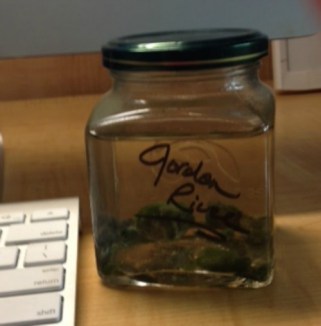
Image, Jordan RiverMy friend also asked if there was a souvenir I might like from the Holy Land.

“So, um… yeah,” I replied. “Could you please bring me some of the Jordan River? Just a cup or so will do.”

Within a month, precious holy water and a few tiny river rocks had a new home on my
desk, right next to the computer screen. I transferred the water into a small Manzanita olive jar and labeled it “Jordan River” in black felt tip marker.

It was as if God’s presence had returned to my office, and I again found myself back in the business of writing. I needed feedback though. Professional feedback this time. I knew no writing professionals per se, and no one in publishing, yet my new neighbor, John Vawter, had self-published a book… about addiction no less. His book, Hit By a Ton of Bricks, had been in my reading arsenal when Annie was on the streets! John had a friend-of-a-friend with an editing business here in Bend, a fellow by the name of James Lund. He’d once worked for Multnomah Publishing in Sisters, Oregon, and became a freelancer when Random House acquired the company and moved it to New York City.

“Am I delusional to think I can do this?” I asked James Lund when we first spoke early that March. “I mean, is what I’ve written any good, or am I completely wasting my time?”

Jim was working on a project with a tight deadline but said he could give me a couple of hours in about two months.

Two hours in two months? He already sounded too important for a novice like me.

But I did hear from Jim two months later, at which time I sent him my story’s table of contents, two chapters, and a check for his time. A week later, his feedback stunned me. “You’re not wasting your time… keep writing. And I don’t think you’re going to need much help from me.”

Initially, my inner Woody Allen lamented that this James Lund person must not be very good at what he does. However, I secretly delighted in the apparent vindication from my friend’s critical review. I confess to skipping through the house chanting, “neener, neener, neener.”

Jim and I agreed to reconnect in five months, at which time I was to have an entire first Image, self editing bookdraft ready for his review. Jim also had a few tips for me. He suggested I read Self Editing for Fiction Writers by Renni Browne and Dave King.
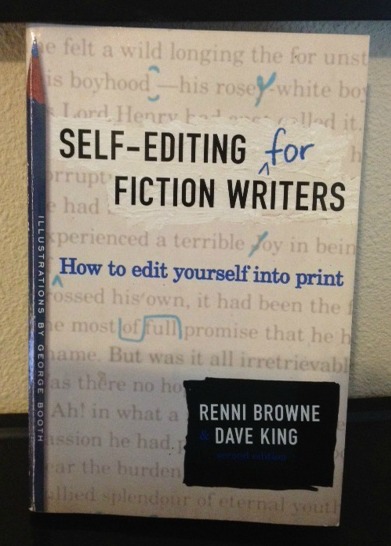
It will help equip you with some fundamentals that will improve your writing,” he said. “Try inserting ‘beats’ in your dialogue to make it more interesting. You also want break up some of the narrative by creating ‘scenes.’ Have you ever heard the term ‘show don’t tell’?”

“Jim… what’s a ‘scene’?”

(Please stay tuned for the conclusion in Part IV, when I go from clueless to published.)

Sharing Insights Through Stories

I first learned the value of stories in sharing insights through public speaking. A fascinating story can captivate an audience, build rapport, illustrate an important point, and make the speaker’s message memorable. In writing, an appropriate story can keep a nonfiction book from becoming dull, and teach truths about life in a work of fiction. So, what makes a good story?

Opened magic book with magic light

1. Vivid and Sufficient Details

In reading along with my daughters several children’s books awarded the Newbery Medal, I found myself transported to a different time and place by the skillful writing of the authors. In these books, the authors provided enough details to help the reader enter into the world described in the book. In describing a food foreign to most American readers, one author provided such vivid descriptions of the taste and smell that I felt as though I, too, was sitting down for dinner next to the characters in the story. In any story, too many extraneous details can cause the impatient reader to start skimming the page to the next section. These award-winning books had the proper balance of information and brevity.

2. Relevance

For a nonfiction writer seeking to illustrate a certain point with a story, relevance is vital. To illustrate the author’s message, the characters and plot must be relevant to the theme of the book, the intended audience, and the point to be made. In writing my nonfiction book, Questioning Your Doubts: A Harvard PhD Explores Challenges to Faith, I learned to edit out parts of a story that slowed down the reading of a passage without further elucidating the concept I was illustrating. In fiction, story lines that do not further the plot may be interesting, but they may also confuse the reader and become a distraction that takes away from the flow of the book.

3. A Story Arc

All stories, even short illustrations contained within one paragraph, need to have a story arc. We need to meet the character or characters in their everyday setting. Next, we learn of an event that brings a challenge to these characters and starts off the story. Then we must see the character(s) grow, learn something new, overcome a hardship, resolve a conflict, or make a difficult decision. Finally, we need a sense of closure as the changed character(s) resume everyday life in a new set of circumstances, perhaps a bit wiser for the experience.

Knowing what elements to include within each section of the story arc is an art. Timing makes the difference between a forgettable story and one that drives home the author’s message. Sometimes I find that reading a passage aloud can help me identify which words can be deleted and what sentences should be smoothed. Feedback from beta readers also can be useful for determining if a story succeeds in illustrating your point.

As a reader, I remember the insights I glean from stories more than those presented through statistics, lists of information, and persuasive language. When writing, I include stories for my readers to make it easier for them to process the insights I hope to share with them.

What do you think makes a good story?

WHY are you Writing?

Today, the WordServe Water Cooler is pleased to host guest blogger Kim Zweygardt. Kim recently attended the Re:Write Conference and is here to give us some insight into what she found so valuable about this conference.

Welcome, Kim!

Writing2“I know I can write.”

“I am a writer.”

Writing is more than something I enjoy or can do well. (All those “A’s” in English Comp surely count for something.)

Writing is my calling.

Even so, after a blistering critique in 2014, I spent more time not writing than writing. Doubt crept in, undermining my call.

“I think I can write.”

“At least I think I’m a writer.”

I floundered, not sure how to regain the confidence to write. What would it take to jump start the flow of words onto the page?

In February, I found my answer in Austin, Texas when I attended a different kind of writer’s conference. Re:Write—The Ragged Edge “aims to tackle issues that writers face every day, offering guidance, insight, and a hefty dose of hope along the way.”

The Ragged Edge conference was filled with power hitters. Some I knew and had heard before: Ted Dekker, George Barna, Jim Rubart, Susan May Warren, Mary Demuth, Sandi Krakowski, Mark Batterson.

Others were new to me: Rusty Shelton, Claire Diaz-Ortiz, Chad Allen, the delightful “tour guide” to the weekend–Julie Carr, Rachelle Dekker, Kevin Kaiser, Ruth Soukup, Derek Webb and the lovely Esther Fedorkevich who founded The Fedd Agency and hosted the conference along with author Ted Dekker.

As I listened, I had my mind bent over and over again.

You see, it wasn’t so much about the how of writing but much more about the why. It wasn’t so much about rules for success but in how we see success. It wasn’t so much about the bad news of the economy and publishing and more e-books and less “real” books and Author Chicken Little crying that the sky is falling and much more about the Good News of Who we write for in the first place!

It made such a difference to me that if I hit the lottery or better yet, had a wildly successful book that made me a bazzilionaire, I would call all my writer friends who are struggling and feel alone with their dream or feel they have been put on the shelf by the times or the particular, maybe-not-mainstream story they have been given to tell, the one that burns in their heart to get out onto the page and reserve their place for the 2016 Re:Write Conference.

Registration? On me! Travel expenses? On me! Need a little cash for BBQ at the airport? On me!

Oh, to dream!

But, just in case I don’t hit the lottery or the NY Times bestseller list, you could start saving now and I’ll see you there.

To whet your appetite, here’s a mash-up of what the speakers said in all their different ways.

Don’t be afraid!

Step out of the shadows and take the plunge!

You are not alone!

You are the Light of the World and no one can tell your story but you!

Don’t listen to the nay-sayers!

Write well! Write compellingly! Go deep! Lean on Jesus!

Write as an act of worship and as a spiritual discipline because He has called you to it. And if you are called and you don’t write, you are disobeying the One who has called you.

So now I write. Because I am a writer.

***********************************************************************************************

KimZweygardtKim Zweygardt always knew she wanted to be someone special.  Her heart’s desire when she was 7 was to be a famous ballerina but when she read their toes bled from dancing on them, it became a less desirable career choice. Then Kim decided to be a famous lawyer solving mysteries and capturing the bad guys just like Perry Mason, but as she got older she discovered sometimes it was hard to tell just who the bad guys were.

Instead Kim chose a career in medicine practicing the art and science of anesthesia as a Certified Registered Nurse Anesthetist in rural Kansas, Colorado and Nebraska.

Kim is married to Kary, the man of her dreams, who has done a fabulous job of making all her dreams come true. They have three children but an empty nest and enjoy conversation with friends over good coffee and great food. They enjoy travel, the arts and taking a nap.

Member American Christian Fiction Writers, International Speakers Network, www.bookaspeaker.netwww.womenspeakers.net

Marketing With A New Mindset


If you’re like me, sometimes the best thing in life is a little change of perspective.

perspective

Last July I got my first taste of publication. After months of hard work, I held the finished product in my hand. Countless drafts had transformed into orderly pages and endless edits changed into final words. It was beautiful. And then came the real work—marketing.

For many of us, the idea of marketing our books makes us a little queasy. Peddling wares and pushing books is not an exciting notion. After all, we are writers. Our gift is with words not a megaphone. In fact, most writers fear the aspect of marketing their own book. Yet, in today’s publishing world self-promotion and book marketing are a must.

If you have written a book, part of your purpose is to bring something meaningful to the reader. How can that reader be reached if there is no one to share it?

Think of the passage in Matthew 25:14-30

In this parable, a rich man who was going on a journey called his three servants together. He told them to take care of his property while he was gone. The master gave five talents to one servant, two to another, and one to the third. Then the master left.

The servant who had received five talents made five more. The servant who received two made two more. But the servant who received one buried his talent in the ground. Later, the master returned to settle his accounts. The master praised the first and second servant. But the master’s response to the third was harsh. He stripped the talent from the lazy servant and gave it to the first servant.

In the parable, the master expected his servants to invest and be proactive, to use and expand their talent instead of passively preserving it. With the first servant, courage to face the unknown was rewarded, and we can see God expects us to use our talents toward productive ends, not only was the first servant allowed to keep what he earned, he was invited to rejoice with his master.

This is such a beautiful illustration of what we should do with our God given gifts.

So, is there a cure for marketing anxiety? Maybe. Maybe it’s time to take a step back and gain a new perspective. Maybe it’s time to stop looking at it as MARKETING and instead, look at it as ADVOCATING Your God Given Gifts.

gifts

You are your work’s greatest advocate. So who better to promote it than you? It’s up to you to reach your audience. Invest yourself. When we share our talents lives are changed!

With the same passion that drove you to write your project in the first place, look at your book marketing plan in a new sense. Instead of marketing, advocate. Use whatever is available to you and proudly declare yourself, your message, and your book. Move forward with certainty that you have something important to share and what you share has the power to change the world.

Winning Writing Contests

I’ve both entered and judged several writing contests over the last four years. Not only that, but have been asked to review a myriad of early manuscripts for newer writers.

award-152042_1280Most recently, I entered the Blurb to Book contest sponsored by Love Inspired. I’m happy to report that I made it to Round Two (Go Team LIS!) What I thought was interesting about this particular contest is that the sponsoring editors sent out an e-mail to all the participants before they released the round two results that outlined several reasons why you may not have progressed in the contest.

I found this information highly valuable and also found it to be consistent with entries and early manuscripts I’ve judged/read that didn’t fair too well. So, I thought this list would be interesting to you because it speaks to universal problems among writers. The LI editors should receive credit for these items and I’ll be expanding on their list with thoughts of my own.

1. No strong hook. For this contest, we had to write a blurb (something akin to back cover copy) and were limited to only one hundred words. You realize very quickly how few words that really is. But this comment of the blurb or hook not being strong enough can be carried over into other things. Your cover letter didn’t have enough punch. Each word has to be powerful. A short blurb like this is easy enough for other people to read and critique.

2. Too much back story in the first page. This is so common I almost gave the editors a standing ovation when I read it. This is a very common mishap in writing. In round one of this contest, we submitted the blurb as noted above and just the first page of a first chapter. That’s it. Imagine how strikingly engaging this first page must be! My professional writing opinion is that it takes authors time to “warm up” to their stories and this is a lot of what’s happening in those first pages. It’s really character profiling. My suggestion is to look at page five of your first chapter. The first event that happens is really the start of your story. Back story can be dropped in as the story progresses.

3. Not following the guidelines. Every time you submit something as a writer, there’s likely a document that covers the submission process–whether it be for an agent, an editor or a contest. Read them. Double check them. Even if your writing is fabulous, if you haven’t “followed the rules” you can be kicked out of the contest just for formatting issues. Seriously, don’t let the wrong font drop you from a contest. You also cannot “break the rules” in the sense that if a publisher says a character cannot do such and such–they really mean it. If you don’t like the guidelines of that particular publisher–don’t write for them.

4. No conflict. Every story, regardless of genre, must have tension/conflict. It’s why we read story. Readers don’t want to read about happy people in happy places where nothing ever happens. Even the sweetest romance story has conflict. James Scott Bell has a whole book about it called Conflict and Suspense. Check it out.

5. Telling rather than showing. A common issue for writers. I’ve written a blog post on showing versus telling here that will better illustrate this point.

6. Confusing. Have another writer read your entry. If it’s not clear to a reader, clean it up regardless of how you feel about the passage.

7. Writing . . . not quite there. As the editors said in their e-mail– everyone has to start somewhere. Writing is a craft that must be learned and honed. Did you know just learning a craft takes 6-10 years? Think about musicians, dancers, or painters. Did they succeed at their first attempt? I think people don’t give learning the craft of writing enough credit in the sense that because we know English and can craft a sentence since grade school– we should be able to write a great novel the first time out of the gate.

Have you ever watched The Voice? We can all sing, right? Of course, some better than others. But if you listen to the mentors work with these young singers, you’ll hear them talk a lot about practice, about craft, about emotion in singing. “Come back next year when you practice these things.” You know what? The singers that take this to heart do practice, they do come back, and often times they do better the next time around.

So… keep writing! Keep entering those contests regardless of the result. Take the information from the judges as a learning opportunity to grow.

Have you ever entered a writing contest?

Seven Key Members of a Writer’s Team

Coxed four from aboveIt’s not any one person. It’s not any one coach. It’s the team. Brian McBride

What is true in sports is also true in writing. Becoming a published writer involves assembling a team of talented individuals who will help you write the best book possible for your readers. Here are seven key members of a writer’s team and the roles they play to help a book succeed:

1. Beta Readers – A beta reader is someone who will read and critique the three chapters of your book that you will include in your book proposal if you are writing nonfiction or the entire manuscript if you are writing fiction. You will use this feedback to improve your manuscript before sending it to an literary agent. Choose a person who loves books, belongs to your target audience, and understands how to give feedback on the big picture of your writing instead of bogging down circling typos.

Give your beta readers a time frame for completing their critique and clarify that your manuscript is confidential and should not be shared with others. A beta reader who is also a writer or who understands the publishing industry is ideal. Send your manuscript to multiple beta readers and pay close attention to feedback that is echoed by more than one beta reader.

2. Agent – Your literary agent presents your book to publishers and negotiates the sale. However, your literary agent often provides guidance and editorial suggestions before your book proposal is submitted. He or she knows the industry, so take the advice. After your book is published, your literary agent can provide marketing advice and help you develop your writing career.

3. Editor – Your editor helps you polish your manuscript to its final form, while also guiding you through the entire publication process – title selection, cover art, book design, copy editing, and choice of reviewers.

4. Reviewers – You will encounter three types of reviewers in the traditional book publishing process. The first set of reviewers, selected by your editor, provide feedback on your manuscript. You can take or disregard their suggestions when writing your final draft. However, their insights help you see your book with fresh eyes and learn how your readers might respond to certain passages. The second set of reviewers read the final manuscript and write short reviews for inclusion on the back cover of your book. You select these reviewers with input from your editor. The last set of reviewers are the readers who bought your book and decided to review it on Goodreads, Amazon, a bookstore website, or their blog. All reviewers are essential for the success of the book and the development of your writing career.

5. Marketing Director – Your marketing director will help your book find its way to readers. He or she will coordinate ad placement, mailing copies of your book to key influencers, and the work of a team of publicists. Touch base with your marketing director if you see a valuable opportunity for getting the word out about your book. Coordinate your author efforts with the marketing plan your publisher develops for your book.

6. Publicists – Publicists may specialize in broadcast, publications or online publicity. If you are fortunate to have a publisher that has a team of publicists working to promote your book, they will arrange radio and podcast interviews and connect you with print and online opportunities to introduce readers to your book.

7. Key Influencers – Key influencers are the individuals who will receive an early copy of your book from your publisher. These individuals should connect with segments of your target audience and be able to create positive buzz about your book. Choose influencers across a wide geographical area and with characteristics that represent the breadth of your likely readers.

Other individuals may join the team to help you create a valuable book for your readers, but these seven key team members make up the core of your team as a writer. Appreciate the expertise that each team member brings, and build a good working relationship with all of them.

How has working with a team enhanced your writing career?

Following the Story to a Different Market

All readers of this blog may not be writing for the CBA market and others may be contemplating writing for the general market when they’ve been in the CBA market for a while.

booksI thought it would be interesting to get the opinion of an author who changed from the Christian market to the general market and what her reasons were for doing so. She brought along two other friends to share their insight as well.

Welcome back, Charise!

Last year, I began to write my first non-Christian marketplace fiction project. It was a kind of one-off idea that I just wanted to try. It was a serial. It was historical fiction; I normally write contemporary. And it was for the general market. It started as a sort of experiment while I plotted my next contemporary novel for the CBA market (as were my first two).

But then something happened. I loved the freedom. The internal editor that kept me from writing what my characters really felt, thought, did and said was silent. And it all felt better. It read better. Frankly, it was better. And I decided I would no longer write with a CBA editor— or CBA reader— in mind.

Instead of being a Christian writer of fiction primarily for Christian readers, I am a writer who is a Christian. It now feels as I am writing with more truth than less; and the struggle with being “Christian enough” is over.

I know two other writers who have made this same switch: Katherine Bolger Hyde and Wendy Paine Miller.

Charise: What made you decide to move toward the general market from the Christian reader market?

Katherine: Even with an agent who believed in my work, I was not able to sell a novel to a CBA publisher. I had the choice of adapting my writing to that market or moving to a different market. Because I felt the adaptations being asked of me would have compromised the artistic integrity of my work, I chose to move.

Wendy: I’ve been honored to be invited to dozens of book clubs, and as I joined in the discussions, it became abundantly clear to me that Christians weren’t the only ones reading and enjoying my books. That was the strongest reason for me. But there’s more. My stories touch upon emotions and depth that reach beyond the Christian market—that are not exclusive to the CBA. When I write I don’t set out to work the gospel into my story arc or I don’t purposefully include a hopeful message. I just follow the story. I trust my faith enough to let it lead where it will.

Charise: I love that, Wendy, “I just follow the story. I trust my faith enough to lead where it will.” I felt the general market would let me be as dark as I needed to be in order to then show how much more blinding the light was when it broke through. And like Katherine, I was not selling in CBA nor entirely comfortable with the editorial limits.

What was the response from your writing network to that decision?

Katherine: My network was mostly supportive—probably because it was pretty obvious to anyone who read my work that it didn’t belong in CBA!

Wendy: So far, so good. As with any change, some have embraced it…

Charise: I think some were surprised and probably a few were relieved. Though I have had longer conversations than I expected about the new content and my choices.

What have been the greatest challenges?

Katherine: Honestly? Almost the minute I made the move, most of my challenges disappeared! The first novel I wrote deliberately for the general market sold to the first agent and the first editor who looked at it. I also got a better advance than I could have hoped for in CBA.

Wendy: Sometimes I feel like I’m straddling an invisible fence. Or quite frankly, I feel too Christian for the ABA market and not Christian enough for the CBA. It’s a strange place to be but more and more I’m feeling I’m on this exact road for a reason.

Charise: Katherine, that is a powerful affirmation! For me, the challenge has been to “sit out” on certain events and conversations because my stories will not fit in with CBA-oriented material. I’m still friends, of course, but there have been challenges.

What have been the rewards?

Katherine: I feel much more free to write what and how I am naturally inclined to do. I found CBA limiting not only in its evangelical worldview (which does not match my Orthodox Christian worldview) but also in its mission-driven approach to fiction. I see fiction as an art form; CBA seems to view it as a tool for evangelism, which can be crippling artistically. As a bonus, I’ve been fortunate enough to land with a publisher who doesn’t object to a little subtle spiritual content in their books.

Wendy: Understanding who I am as an author and establishing a grounded sense of what I want to write. Also, a wider reach. I’m a huge fan of engaging in enriching conversations and this happens at book clubs. When the topic of faith comes up doors open. It’s natural. There’s no budging involved. I learned to trust my voice, to filter through all the ideas of where I thought I’d be and who I thought I was becoming. I took risks. I paid attention, then did things that didn’t feel as safe but ultimately helped me to become a more authentic author.

Charise: I really just want to say “ditto” to Katherine and Wendy’s comments. Having readers who never would have found me in CBA contact me to say “that’s just how I felt!”  The rewards have been to be able tell the story the way I believed it was meant to be told.

Anything else to add on the subject?

Katherine: I have to thank all the people I met in the Christian fiction world for their kindness, generosity, and support. I made many friends there who still put up with me now that I’ve left. I’m not sure I would have had the courage to leap out into the general market if I hadn’t built up my confidence through several years in CBA.

Wendy: I’ll always come alongside other authors no matter who their audience is. This is a crazy calling. And we’d all benefit from doling out more support.

Charise: It can be a hard change, but if it’s the right change for your story and your career and your readers— then it’s the right change to make.

How did you choose your reading market?

Have you changed markets? How did it go?

Have you considered doing so? What’s holding you back?

***********************************************************************************************

Katherine Hyde is an editor by day and a mystery writer by  night. Arsenic with Austen, the first in her mystery series, Crime With the Classics, will launch in 2016. Find out more about Katherine at http://kbhyde.com

Wendy Paine Miller writes women’s fiction and suspense. Her latest release is The Delicate Nature of Love. Meet Wendy and her books at http://thoughtsthatmove.blogspot.com

Charise Olson writes historical fiction under the pen name Leo Colson. The first episode in her serial The Roaring Redwoods is free! For more details and her blog visithttp://chariseolson.com

How to Write a Nonfiction Book that Sells — Pt. 2

Good NewsIn Part One, I talked about the importance of subject, title, and content for writing nonfiction books that sell. All of these are key elements. Missing just one could mean the difference between a publisher’s bite on your bait, or their swimming away.

Equally, if you neglect the power of your marketing strategy, including future books you can write, a publisher might say no instead of yes. Short-cutting is not worth the risk of losing a book deal.

So let’s talk specifics.

  • Intriguing marketing strategies are an integral piece of your non-fiction book proposal. Every author’s heard it, “You must help promote your own book.” But most, even those of us with sales and marketing backgrounds from other industries, can feel overwhelmed at how to effectively boost book sales on paper or in application. So what’s an author to do?

Think outside the industry. How do movies and TV programs promote their wares? What are the big producers doing to move sales? Think Coke, Wal-Mart, Apple, Under Armor, Cabelas, or others you see frequenting the air and radio waves, or filling store shelves. Learn from the big boys while creatively using your small budget.

For instance:

  • Getting Through What You Can't Get Over Book CoverBuild human curiosity into the heart of your sales tactics and specify samples in your book proposal. i.e. Six Secrets to…, How to…, What ______ Want, Three Things Most People Forget that Could Cost You Sales. See the pattern?
  • List all of your speaking events, including those you volunteer for, or that may feel more like family than a professional gig. Any exposure to a potential buying public counts — and those with built-in fans increase the odds of book sales.
  • Look at conferences, organizations, businesses, that don’t immediately seem like a fit for your message. Is there a way to connect your book to their needs? For Getting Through What You Can’t Get Over, I’m promoting the impact personal issues have on the workplace and vice-versa. I’ve booked new speaking opportunities as a result.
  • Include something unique. *Talk about the psychology of color and how you can use it in your marketing materials. Note your intent to attract those looking for peace through shades of green, your strategy to pursue passionate responses with strokes of red, or your ability to stir deeper thinking by adding blue.

*After you’ve made the sale, don’t forget to work with your publisher on appropriate colors when considering cover art for your book.

  • Future books you’d like to write are like adding scent to the lure for a publisher ready to bite. After writing your proposal on a subject matter readers are interested in, brainstorming a dynamite title, writing clear content, and adding unique marketing flavors, offer a list of intriguing future titles, true to your brand. This shows the publisher you are more than a one-hit-wonder. You are an author readers will follow for a long time to come.

In conclusion, I must stress the need for a teachable attitude and patient demeanor. Two common challenges we must overcome if we want to succeed. There is no place for arrogance or impatience in any professional venue. Be a turtle, not a hare, and in time, you will write a nonfiction book that sells.

Have you sold books and if so, can you offer insights I missed?

How a Non-Writer Like Me Got Published (Part II)

(Continued from Part I)

I began writing my memoir by starting near the end. That first night, while sitting in front of a blank computer screen, I tapped out the images closest to memory, and likely closest to my heart. It was the account of a remarkable day… the day I delivered my daughter, Annie, to a drug treatment center in California.

 “It wasn’t at all the institutional setting I’d expected for detox… At that late hour, the street was quiet and still. A woman emerged from the far side of the darkened house, brushing by a wall of hydrangeas that cast an eerie glow of amethyst and silver in partial moonlight. Her hushed tones made it seem a clandestine transfer as she took hold of the pull handle on Annie’s bag and turned to escort her inside… Just before both disappeared into the darkness of an open gate, Annie turned around to me and mouthed the words, ‘Thanks Mom.’ I thought I might burst. “

Within a week, I had one, full chapter completed. “Not bad,” my college-aged son reported after a quick read. He showed all the enthusiasm of dry cement. My husband refused to read it at all.Image, post-its and pens

My brother, Paul, on the other hand, provided terrific support for my intentions with the book. He had been the smart one, the accomplished student. While I was sunbathing and reading Cliff Notes during our college years, Paul studied Comparative Literature as a graduate fellow at a top university. “So Goose,” he asked (yes, he calls me Goose), “are you going to write this sequentially or thematically? You also need to pay close attention to your voice. My what? I struggled with how to continue. What was a “voice” and where could I get one? Was I really capable of writing a book? What initially had seemed nothing more than a quick chronicle of a story I already knew, the magnitude of the task ahead started to overwhelm me.

Image, Book binder

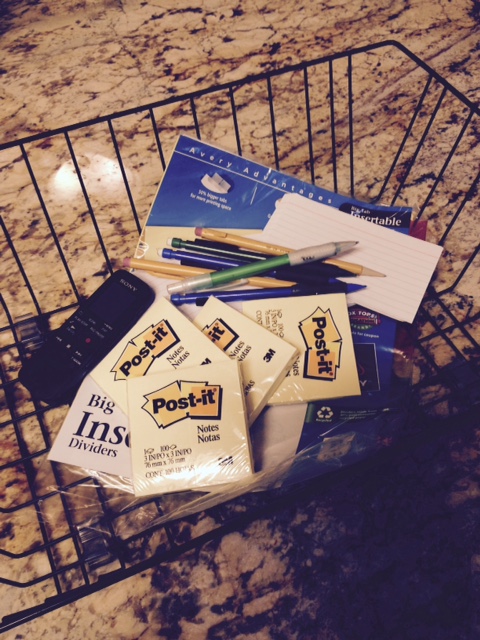
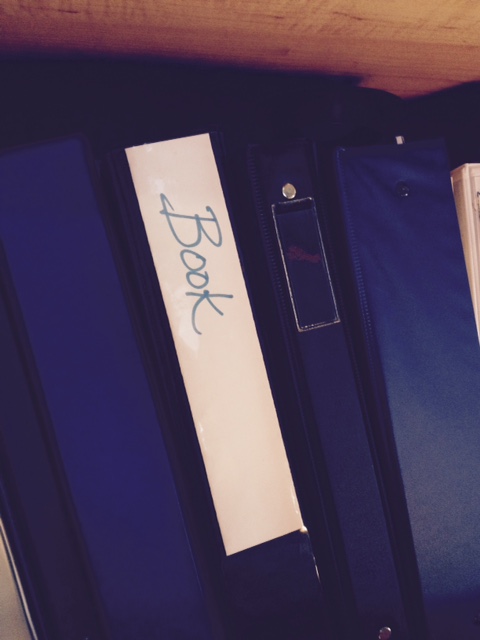
I decided equipment would help. A lover of bins and boxes and anything organizational, I ventured into Office Max and filled my cart with a large black binder, numbered dividers, a year’s supply of yellow sticky notes, white 3×5 cards, and multi-colored mechanical pencils.

Once home, I affixed a sticker to the spine of the binder with the word “Book” written on it in blue felt tip marker. I placed my new materials throughout the house: at my desk, on the coffee table in the great room, at my bedside table, near the bathroom sink, and in both cars. Ultimately finding it perilous to jot notes while driving, I purchased a small recording device. “Don’t forget to tell them what happened in the garage,” I recorded into the mic.

Each night before I sat to write, I filed the day’s sticky note inspirations onto the dividers throughout the binder. Then I prayed. “This was your idea, God. Help, please!” Six months later I had an outline and about six chapters written. This feat coincided with the weekend visit of a close friend, and one of the smartest people I know. Bright, articulate, and extremely well read, my friend-who-shares-the-same-name-as-me, demanded to read what I’d written. She in fact seemed hurt that I hadn’t yet asked for her input and advice.

I knew better than to share my work so early in the process, and especially with someone who tends to be critical, but I yielded to her insistence. I really hoped for some encouragement. You see it coming, don’t you? My friend emerged from our guest room the next morning, with the “Book” binder in hand, avoiding eye contact as she headed to the coffee pot. Oh boy, I thought.

“So Barb,” she finally said, once settled in at the breakfast bar, “I, uh, think, uh, this is an important story for, uh, people to read. It’s not, uhhhhh, gonna be a best seller or anything, but it’s, uh, good.” She then looked up at me and added enthusiastically, “You sure have a great memory!” I laughed. Kind of.

“Memory isn’t exactly what I was going for. But I guess that’s something. Thanks for reading.” Unable to leave well enough alone, she added, “You sure didn’t use many big words, did you?”

At that point my heart went “thunk”… and I stopped writing. (Stay tuned for Part III when I share how the Jordan River helped me start writing again….)

Have You Heard a Good Book Lately?

The WordServe Water Cooler is please to host Becky Doughty again as she shares her experience in creating audio books.

Welcome back, Becky!

AudioBookFrom as far back as I can remember, I have had a TBR (to be read) pile stacked beside my bed, books waiting for me to lose myself in them. As a child, my favorite time of year was summer, because it meant endless hours of uninterrupted reading time. As an adult, my days are now consumed with working for a living. My non-work hours are filled to overflowing with the joys and responsibilities of my family. Family meals, homework, laundry. Bathrooms to clean, dogs to walk, gardens to plant…. I have replaced my TBR pile with a TBD (to be done) pile. Well, actually, I haven’t replaced it. My TBR pile collects dust by my bedside and I stare at it longingly as I lay my head on my pillow, unable to keep my eyes open a moment longer.

Then I discovered audiobooks. No, they don’t replace hands-on reading, but they DO offer an alternative method of consumption, one that allows me to “read” while I cook, fold laundry, clean bathrooms, walk dogs, plant gardens, commute. They make standing in line at the DMV and waiting for an oil change a pleasure. And when a good narrator brings a book to life, it can be a really wonderful literary experience!

Three Tips for Audiobook Enjoyment:

  1. becky-doughy-braveheart-audiobooks-1Narrators can make or break a story. Thankfully, most audiobook resources, such as Amazon, Audible, iTunes, etc., give up to a 5-minute sample to listen to before purchasing. Take advantage of those samples, considering you’ll be listening to him or her for 8-10 hours.
  2. That being said, don’t pass over a wonderful book just because the narrator doesn’t read in a style you’re accustomed to. We humans have the innate capacity to adapt, so give your ears the chance to hear past the extraneous stuff. More often than not, by the end of the audiobook, all those little things that bugged you at the beginning no longer will.
  3. Audiobooks can be expensive. However, there are lots of ways to enjoy audiobooks on a budget. Look for subscriptions that include special offers and discounts like Audible. iBooks (iTunes) always has package deals and special sales on audiobooks . Amazon has their WhisperSync program that gives you a DEEP discount on the audiobooks of many ebooks you purchase. Audiobooks on this program can run as low as $1.99 when you purchase the ebook!

For authors, turning your book into an audiobook can also be a rewarding experience on many levels. Not only is it another format in which to get your story into the hands—or ears!—of readers, but it’s a little like giving your words a third dimension. And it’s a bit of a thrill to hear your book professionally narrated!

Five tips for a turning your book into an audiobook:

  1. Narrators can make or break a story. There are many, many wonderful voice actors in this industry who can breathe new scope into your words. Don’t settle. Be selective.
  2. Make a list of anything important your narrator needs to know up front –pronunciations, dialect, personality traits, etc.—before production begins.
  3. 99% of your listeners will not follow along with the text. Minor narration errors, such as making two words into a contraction, as long as they do not change the meaning or tone of the book, should not be reason to send an audio file back to production.
  4. Although there are many narrators who work on royalty contracts that require little or no money up front, these contracts usually have a term of 7-10 years. Consider paying for the service up front. It can seem costly, however, paying up front gives you a much broader pool of narrators to choose from, and it immediately frees you from any ties to a third party.
  5. Be knowledgeable about the service you’re requesting. If a narrator charges $200 per finished hour, along with their narration expertise and voice acting talent, this is what you’re paying for:
    • Approximately 9000 words = 1 finished hour of audio.
    • 1 finished hour of audio = approximately 6-8 hours of prep and studio time.
    • A 90,000 word novel = approximately 10 finished hours of audio.

6. A 10-hour audiobook = approximately 60-80 hours to produce.

*******************************************************************************************

becky-doughty-author1Becky Doughty is the author of the best-selling Elderberry Croft series, the controversial Waters Fall, and the voice behind BraveHeart Audiobooks. Raised on the mission field among the indigenous tribes of West Papua, Indonesia, Becky’s ministry is through the written word. Her heart is for people living on the edge–that fine line where grace becomes truly amazing. Married to her champion of more than 25 years, they have three children, two of whom are starting families of their own, and they all live within a few miles of each other in Southern California. You can connect with Becky via her website, Facebook,Twitter and Pinterest.