Keywording 101 for SEO Prowess

Three words:  Search Engine Optimization.  They kind of make you want to grab a bag and start hyperventilating, don’t they?

In the world of viral marketing, social media and Google Adwords, SEO has become another one of the things that you’ve probably had to put on your to-do list.  And, if you’re anything like most of the writers I talk to, you probably have no idea where to start.

I was lucky.  Before I got my book deal, I’d spent five years working as a staff writer for a major media company.  And, since we wrote for the web, I spent hours each week honing my SEO skills.  We actually had a team of SEO gurus on staff that hosted weekly SEO boot camps for us—analyzing every article we wrote for SEO viability and nitpicking every teeny tiny keyword on our site.  So, while viral marketing and blogging were new to me, I had the SEO thing down pat.

And, I have to say, it’s worked for me.  While I spend very little time doing viral marketing on my blog—I’m just not a good twitterer—I get fairly decent traffic—and most of it comes from Google referrals.  I chalk that up to having a strong SEO strategy—and knowing where to focus my SEO time.

Obviously, SEO is a tough nut to crack—and there’s no way I can give you even a tenth of the information you need in one post.  Before you create a viable SEO strategy, you’ll need to decide if SEO is even worth your time (in some cases, it’s not), how you’ll use SEO keywords (there are many, many ways that go way beyond simply keywording a post) and how to create relevancy with your keywords on your site (now that’s complicated).

But, in order to put the horse before the cart, the first thing you need to do is come up with a list of keywords that you want to use on your blog or website.  This list can (and will) become your SEO cheat sheet—you’ll have something to focus on, something to consult whenever you’re writing a post, a start to a strategy.  Here are my tips:

  1. Limit your keywords. I’ve had clients who presented me with a list of 100 keywords and then asked me to help them come up with more.  And, while they have the right idea in that they are focusing on specific words instead of just throwing out a random slew of words as they write a post—they are biting off too big of a chunk.  While the Google and Bing algorithms are super complicated, one important aspect is that they search for relevancy—which means in a nutshell they’ll be crawling your site to see how much information on your site is relevant to a specific keyword or idea. So, unless you’re posting dozens of articles every week that are very specifically focusing on all 100 of your keywords, you’re probably not you’re not creating a sense of relevancy with many of them.  So, choose a short list (my recommendation:  between 5 and 15) of keywords that you can focus on with every post, every page and every idea.  By simplifying, you’ll actually create a bigger reach.
  2. Do your research.  Don’t just guess on which keywords people are searching!  I use both Google Adwords and Google Insights all the time to help my clients (and myself!) find appropriate words to focus on.  They’re pretty straightforward tools so you can probably figure out how to use them to your advantage in less than ten minutes.
  3. Know your competition. Remember how I told you that I used to work for a major media website with huge traffic numbers?  And remember how I said we had an entire SEO team on staff?  Let me give it to you straight:  Unless your last name is Grisham or you have a staff of 40 writers and editors helping you with your blog, you CANNOT compete with major sites like that.  It’s a waste of your time to try.  Case in point:  Me!  My book, The Christian Mama’s Guide to Having a Baby, is a pregnancy guide–but I have never spent even a minute focusing on the keywords “pregnancy,” “pregnancy book” or “pregnancy guide.”  Why?  Have you ever heard of “What do Expect When you’re Expecting“?  Or “Baby Center“?  I could spend hours a week creating relevancy on my site around the word “pregnancy” and only move from page 120,000 to page 50,000 on Google.  And, while moving up 70,000 pages is pretty good, I’m pretty sure no one has ever looked past the first two pages of Google results, so it’s absolutely a waste of my time to focus on “pregnancy.”  Instead, choose words that get a decent number of searches every month (target:  between 1,000-10,000 global monthly searches) and low competition (less than 20% on Adwords) and focus on those.
  4. If you don’t talk about it on your site, don’t use it as a keyword.  I see this mistake all the time… my clients throw out a search keyword based on a theme or idea in their books, but when I pull up their website, I see nothing about that particular idea on their website.  It’s not only poor user experience—if someone Googles “Amish recipes” and then comes to your site and finds nothing about Amish recipes, they’re probably not going to stick around—but it also does nothing to create a sense of relevancy around that keyword, which will hurt your SEO.  This does not, however, mean you need to blog only about the topics in your novels.  For example, author Jody Hedlund has a wonderful blog full of tips and ideas for authors (find it here)—however, her latest novel, The Doctor’s Lady, is about the first woman to pioneer the Oregon Trail.  On her website, Jody has done a great job of creating relevancy surrounding the theme of her book by creating a cool “reader fun” page that’s full of facts, quizzes and more surrounding the historical times in her books.   Similarly, author Rosslyn Elliot, a historical romance author who wrote “Fairer Than Morning” maintains a “History” page on her site that adds relevancy surrounding the historical concepts in her novels.
  5. Cater to groupies.  As fun as it would be to be loved by everyone, it’s just not going to happen.  As a pregnancy author, I can’t appease the natural birthers AND the epidural fanatics.  And you can’t appease everyone either.  So, think about your core audience—the people who ABSOLUTELY love everything you do—and work to appease them both with your site content and your keywords.  For example, my friend Cathy West wrote an amazing historical romance called Yesterday’s Tomorrow that’s set in Vietnam during the war.  And, while her book is great for all sorts of populations, you can bet that Vietnam vets and their families find it especially compelling.  My recommendation for Cathy?  To cater to that population, both by creating contests and posts that appeal to Vietnam vets, but also by focusing her keyword reach on words that appeal to that audience.

NOW:  For a chance to win an hour of SEO consulting from me (via phone or Skype, 30 minutes research, 30 minutes talking), respond to this post and tell me how (or if) you’ve developed an SEO strategy for your blog.  Winner will be chosen at random on October 21st and will be contacted by me via email.

*CONTEST IS CLOSED*  Congrats to WINNER Norma Thurston Holtman.
To Market We Go. . .But Why?

I admit, I’m a bit of a marketing geek. I find trends and patterns fascinating. Behind every great or dastardly marketing campaign lies a motivation—a why. And I want to know it, understand it, and pick it apart.

Why did it work? Why didn’t it work?

Some campaigns are obvious from the get go. Take Netflix’s recent adventure of separating streaming video from disc. We witnessed their invention (or misguided intention) of Qwikster. The name didn’t work, nor did there seem to be any reasonable point for separation. Their “why” just didn’t make sense. Thankfully they abandoned the idea before they got neck deep. In fact, I give them kudos for having the courage to admit to their customers that it would have made things more difficult.

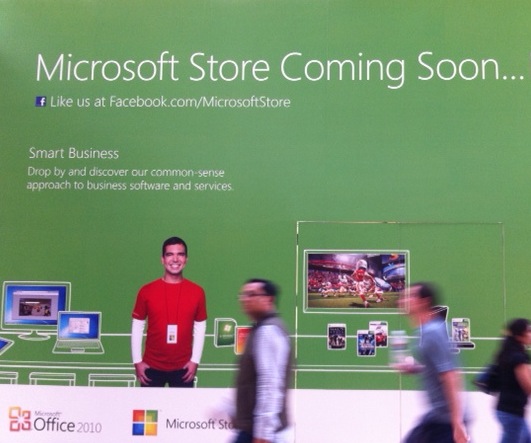
Here’s an example of my latest fascination. Honestly, I stood in the mall laughing at this one.

I freely confess that I’m an Apple geek as well. Microsoft’s obvious attempt to copy Apple could be taken as a compliment, but I could only wonder, is it effective? How effective does our marketing become when we’re simply copying what the other guy is doing?

Yes, we’re talking about similar products and thus overlapping markets. Not identical markets though. And then I’m curious as to how the everyday consumer perceives such a clear attempt to piggyback on another company’s successful model?

Of course, there’s the other side of the argument. Why reinvent the wheel? It worked for them, why not do the same? That’s fine to a point—to use a successful model as a launching point. But don’t we still have to come back to the beginning? Back to the “why?”

I find this especially amusing because of this:

The Apple store is directly opposite this soon-to-be Microsoft store and has been there for years. Their Genius Bar and staff have been serving people for many a season with their gadgets in hand and uniformed colored shirts and badges. (Uh hem. . .)
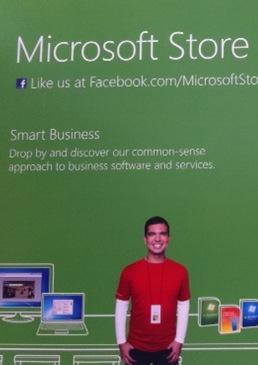

It’s all about service and Apple makes an art of it. Never been in one? Take a field trip one day and check it out. We can learn a lot from Apple’s successful model of creative marketing. To them, it’s not just about the product. It’s about the costumer and how they’ll use it, right down to the feel and experience. It’s all about the “why.”

I wonder if Microsoft thought through their campaign beyond the “well it works for them” to their customers and who they’re trying to connect to. Or are their customers just potential collateral gain or damage in the race to be number one?

So this brings me to my point (yes, I do have one other than finding this Microsoft imitation so very amusing). Do we think about why we are marketing our books or do we just do what everyone else is doing?

And finally, does it work? Now there’s the real question. What do you think?

Creative Marketing – Try Something New

Marketing. The dreaded M word that makes introverted authors like me shudder. It’s a good thing I am contracted with a major publisher. They’ll take care of all that marketing stuff, right?

Pop! Say goodbye to that delusional bubble.

Even though I’ve been blessed with a fabulous marketing and sales team, I’m not immune to the pressure of marketing my books. Publishing is a partnership, and I’m expected to market as much or more than my publisher. After all, they have an entire catalog of new releases to sell. I have only my own.

So when I first waded into the marketing waters, I looked around to see what other authors were doing and followed their example. I had my website professionally designed, I got involved in Facebook and Goodreads, I set up guest blog appearances and interviews to correlate with my release dates, I had a launch party, I offered giveaways and hosted contests, I handed out bookmarks, did book signings, and spoke to groups any time I was asked.

Did any of it make a difference? I think so. It’s nearly impossible to measure the impact of marketing, but occasionally I’ll get reader feedback from someone who mentions that they found my books because of an interview I did on a particular blog, or that they bought my previous books after winning my latest one in a drawing and enjoyed it so much they wanted to read more from me. These little glimmers give me hope.

But now that I’ve gained a year of experience, it’s time to branch out from the crowd. It’s time to aim my creativity brain cells not just at my WIP but at my marketing as well. So when it came time to launch my third novel this spring, I decided to try something new. Something that would engage readers on a more personal level and hopefully entice new ones to give my book a try. I sponsored a fan fiction contest.

I write historical romance, and knowing that romance readers live for happy endings, I thought to give them a chance to create their own. I can’t tell you how many times as a reader or movie watcher I have mentally re-written an ending or continued the story in my mind, imagining how the characters’ lives would play out. I thought it would be fun to give my readers the same opportunity.

Now in To Win Her Heart, my main characters had a very satisfying happy ending, but the secondary love story was left with a little more ambiguity. Therefore, the fan fiction contest challenged readers to create an epilogue specifically for secondary characters Chloe and Duncan. I enticed readers with generous prizes like a $40 gift card from Amazon, an autographed book of their choice from my list, and the privilege of having their winning entry displayed on my website for all to see and enjoy.

I advertised in my newsletter, on Facebook, and in blog posts on sites that catered to writers. I was hoping to snag some readers from the writing crowd who might not usually read historical romance or who hadn’t tried my books before, but who were interested in competing for my prizes.

To Win Her Heart released May 1st so I ran the contest through the end of June. I didn’t have a flood of entries, but I ended up with a wonderful collection of about a dozen epilogues to choose from. More valuable than the number of entries, though, was the amount of personal interaction with readers this contest produced. I even had one lady say that she didn’t realize how powerful a marketing tool the contest was for her until she found herself in a bookstore buying my book just because she wanted to enter my contest. I’m hoping others experienced the same sensation even if they ended up not entering.

In the end, there’s no telling how many actual sales this contest generated, but I’m hoping the effects will continue to ripple. The lady who won has her epilogue on my site, and she’s no doubt sharing that story with all her friends. The quality of her writing was wonderful, and she captured my characters so well, that I was proud to display her work and to point other readers to it as bonus material.

Whether or not this attempt at marketing generated many sales, I’m glad I did it. It was fun to try something different and to interact with readers in a new way. It gave my stale marketing practices a much needed shot in the arm, and I would gladly do it again.

Question for You: What is the most inventive marketing strategy you’ve ever employed or seen employed? What marketing ideas have you toyed with that you’d like to try? What have you seen other authors do that caused you to find yourself in the bookstore buying their book?

To see the winning entry, visit the fan fiction page of my website at: http://www.karenwitemeyer.com

How to Plan a Successful Book Signing

As a first-time author of two children’s books, God is with Me through the Day and God is with Me through the Night, I was surprised to discover that the most challenging part of the journey was marketing.

I had worked as a marketing writer for years; but marketing my own work was…well…icky. As a friend put it: “It’s a bit like standing in front of the mirror with a stranger and asking them to say nice things about you.”

Despite my reluctance, I was grateful to experience many successful book signings after the launch of my children’s books. When I sold more than 100 books at several signings, the bookstore managers were amazed. They couldn’t believe I was having such strong turnouts as a first-time author.

One Barnes & Noble community resource manager hit the nail on the head when he said he’d never had an author market the event as much as I had. That behind-the-scenes work was responsible for the second-largest signing of his career.

When planning your next author event, keep these tips in mind:

1. Your biggest ally is word-of-mouth. Reach out to anyone you know in a community and ask them to invite friends, family, neighbors, church members, school peers, etc. You’d be surprised how interested folks become when they have a personal connection to the author.

2. Send out press releases to local media outlets. Look for television news programs and radio shows that routinely support local events. Contact regional magazines, and reach out to the newspapers for a book review and/or author interview.

3. Post the event on all community calendars, since many media outlets will share the event both online and in print.

4. Contact local churches to invite their church community to join you. You can also offer to visit the church for a personal author event. Some churches have been extremely kind and generous to me by promoting the event in their Sunday Bulletin or weekly newsletter.

5. Use the Internet to locate your target audience and reach out to them via email, direct mail, phone calls, or – of course – word of mouth. Depending on your book, you may want to contact veterans groups, healthcare workers, mothers groups, or schools.

6. Use key social networking tools such as Facebook, Twitter, iGoogle, and a personal blog to boost interest in your books. Also consider pitching high-traffic blogsites to serve as a guest blogger.

7. Don’t be shy. When you’re at the event, engage attendees in conversation. Remember, humor is key. Get people laughing and they’ll want to hear more. Marketing does take time, but the extra hours pay off in most cases.

Now that my first novel, Into the Free, will hit shelves in February, I plan to use these strategies again when planning my upcoming book tour. How do you help ensure your book signing will be a success? Do you provide free giveaways? Tagalong with a larger event? Mail postcards prior to the big day? We invite you to share your ideas to help all of us make the most of our time on the road.

Happy book signing!

Julie

An Author Needs A Web Presence

One of the first marketing tips a writer is given is to make sure she has a web presence–and do it before she’s  published.

Three years before my publishing contract, I created a blog and used it as my author site. For the most part, I was quite happy with it. I updated the site on a monthly basis, along with a newsletter reminder, and had formed a nice reader base, so it served me well. When I received my contract from Zondervan, however, I realized I wanted more. I had two choices–pay someone to build a website, or do it myself.

So began my journey. I began visiting author sites and kept track of those I liked best, paying attention to colors, layout schemes, page descriptions, and author photos. I also studied web designer sites and their client portfolios. For learning purposes, my favorite sites were:

.

From there, I requested price quotes. And that’s when my enthusiasm began to waver. Some of the designers were charging over two-thousand dollars–and I’m sure worth every penny, as their client pages were gorgeous! To add to my dilemma, I’d heard it said that your website must look professional–an outward reflection of who you are as an author (or in other words, not cheap & dowdy). Well that’s great, if you have the money . . . but this gal from Kansas didn’t have that kind of money to spend.

With a sigh, I began searching for less expensive alternatives. I considered updating my blog. Blogs are free, and I already knew how to manage them. But I really wanted a new look. So I set my chin, determined to figure out a way to make it work.

That’s when I discovered a host program called Homestead. Several of my author friends used the program and were quite happy with it. I began studying the tutorial and realized I could create an author site with nearly all the functions I’d requested of the designers–and for a smidgen of the price.

Of course, I would have to design the pages myself–which would take time and creativity. Fortunately, Homestead’s design program has an easy learning curve, and it turned out to be quite fun. Plus, I had the added advantage of being able to update my site whenever I wanted–an option I might not have had if I’d paid a designer. The company also offers a free trial period, to make sure it fits your needs. After 2 weeks, I’d designed a Website that was a reflection of who I am as an author.

Check it out here.

I went into this venture desiring the best, settling for less, and being quite satisfied with the end result.

For those who enjoy the creative aspects of web design (and who are working with a limited budget) this may be a nice option for you, too. Next  time, I’ll visit with you about publicity photos. Until then, enjoy the moments  . . .

Reviewers and Endorsers and Influencers, Oh My!

You didn’t really think those book reviews in the New York Times or the major newspaper in your home town just appeared on their own, did you? Publishers provide advance review copies (ARCs) of  books to the reviewers at these papers. Multiply that by hundreds of publications, from large ones such as Library Journal to smaller or specialized ones such as The Suspense Zone and you see the magnitude of the process. There’s a good bit of decision-making in sending out ARCs to reviewers. But one good review at a major site can result in the sales of hundreds of books. Each publisher has a long list of potential reviewers. It’s the job of the marketing department to match each book with appropriate sites to receive ARCs.

As for endorsers, these are the people who write one- and two-line squibs that appear on the cover or just inside book. For example, the hope is that you’re more likely to buy my novel if you look at the back cover and see that a respected author said, “Lethal Remedy is the perfect cure for boredom: a first-rate medical thriller with humor, engaging characters, and realism that only a seasoned doctor could bring to the story.”

Who lines up endorsers? It varies. Authors, agent, publishers all participate in the process, and it varies with each of them. In my case, I personally contact all my possible endorsers. I make the following stipulations: if they agree, they’ll be sent an ARC with a view to endorsement if they have the time, can read the book, and truly endorse it. So far, the only negative responders have been those with time crunches due to their own writing deadlines.
Then what is an influencer? These are people whom you hope will read the book, like it, and tell others. They’re people with large blog followings. They’re church and public librarians. They’re the heads of book clubs. The list can be huge, but again economics rears its ugly head, so distribution of ARCs to influencers must be limited. I sweat bullets over the list I turn in with each book, knowing that I’ve probably forgotten some important people.

Writing the novel is just the first step. Then you hope to get an agent and eventually a contract. After that comes the editing process. Is that all? No, now you have to think about ARCs and endorsers. The fun never stops, does it?

***

Richard L. Mabry, MD, is the author of the Prescription For Trouble series of medical thrillers. His latest novel is Lethal Remedy. He also serves the ACFW as Vice-President. You can learn more about him at his website and follow him on his blog.

What is “Take Away” Value?

In my post last month I referred to our need to have “take away” value. Sometimes that’s pretty obvious, but other times it’s as subtle as how you’re presenting your product or services. I find at times it’s a fine line that we can easily cross into the “me” zone.

I have a feeling, though, that you’ve seen and know what that looks like. How about Twitter? I get a fair amount of requests but have little time to follow people who are just throwing stuff out there for the sake of being visible. Plus, I want to follow people that I can relate to and connect with. I’m most likely not going to follow a furniture company located in a different state.

Except, this time I did. Why?

Take a look at the Twitter page for Mealey’s Furniture, (@FollowMealeys) located in Warminster, PA. They do a lot of things right.

  1. They don’t over-tweet. Mealey’s tweets about 2 to 3 times a day. When I see a Twitter page loaded with hourly tweets of stuff just thrown out there, I’m not going to pay attention. The delete button is my friend.
  2. Their tweets are helpful. They have take away value. Not only do they have it, they personalize it. They’re not just putting tweets out there about a sale, they’re giving you decorating ideas and hints for better living. They also support causes. Basically, they don’t want to just sell you a piece of furniture. They want to add quality to your life. Again, motivation is key.
  3. They’re not just about the product. Mealey’s presence is clearly not about them. They are about the customer and serving those needs. They’re focused on their audience and serving them, not on themselves.

This is brilliant marketing. Would I buy furniture from Mealey’s? If they had a store in San Jose, CA, you bet they’d be the first place I’d think of next time I needed something.

The key here is they make a lasting and positive impression. You walk away from this page with the understanding that to them, it’s not just about the sale. They want to do more for their customers. They want to connect with them.

Today’s market takes more than just what we have to offer, which in nonfiction is a lot. We have a clear message, an idea, or something to share. But there’s already so much out there. We have to be clear about the “why.” Think about why we write what we write and how we can translate that into connecting with our readers, which in turn translates into word of mouth marketing—the best kind. Just as I’m talking about Mealey’s furniture because they offered me take away value, we want our readers to talk about our books, our message, and what we stand for.

But even that comes back to our motivation. Are we doing it to just sell books? Or are we, like Mealey’s, genuinely trying to give quality to our readers? That’s our origination point in writing these books to help others. Let’s not leave that motivation in the pages of our books. Let’s figure out ways we can we bring that over into our marketing too.

Free Books and Bad Halloween Candy

In today’s free and easy e-book climate, e-texts of traditionally-published books are passed around like wax-paper toffee on Halloween night–you want some of this? Have four! Have six! No one likes ’em anyway. And that’s not even counting the scads of self-published e-books that are either free or 3 cents each. Most of those are the strawberry candies in the red plastic– no one wanted them either.

OK, I’m exaggerating. It’s not that free books are actually bad. Few books are as awfully nasty as wax-paper toffee, and many free books are very good–it’s just that their plentiful availability threatens to devalue them, like so many strawberry candies dumped straight in the trash can.

Seth Godin, prophet of social media and cultural change, thinks free books can be a good promotional tool. In fact, he thinks the way for debut authors to make it in this day and age is to give away their first books for free.

He said so, in this interview with Michael Hyatt of July 6, 2011. It’s well worth watching simply for all the debatable points he raises about where our book culture is headed and how we should handle that change. Seth Godin is an excellent persuasive speaker–but that doesn’t mean he is always right.

Free books have a very serious downside, and the best article I’ve read on that downside is by Janet Kobobel Grant of Books and Such Literary Agency. Here’s one of her main points, paraphrased:

Will free books flood the market to the extent that readers realize they no longer have to pay for their reading material?

Will readers think: “Why should I buy Ms. Ninja-Writer’s book now, when I can wait 9 months and get that same book for free as a marketing ploy for her next book?” In a tight economy, readers may resolve: “I am going to save money by never paying for a book again.”

My husband works in sales, and he is very good at it. He understands you can sometimes give away free stuff, but giving away too much or giving away the wrong products destroys your own customer base. He thinks this free e-book and 99 cent e-book stuff in the publishing industry is going to smash the market to tiny little pieces.

How many corporations can resist the lure of the quick buck?

Here’s the problem: corporations have always been very bad at resisting the lure of short-term gratification (such as temporary increased sales for a certain author) in favor of a wise long-term strategy (such as limiting or refusing the issue of free books). They have to compete, they want to make money in the ways they see others making money, whether it’s going to work in the long-term or not. For many executives, it’s easier to believe those who tell them that the short-term strategy is awesome and won’t cause any problems. Fewer executives want to hear the voice of caution and contrarianism–it’s too inconvenient.

My  question for you: Will the changes caused by free e-books permanently affect the ability of authors and publishers to make a living at their work? Will the major publishers collapse and only the best entrepreneurs rise out of the internet heap… entrepreneurs who may not be the best writers? Or do you agree with Seth Godin that free books are a fabulous strategy and the wave of the future for marketing?

Energize Your Marketing Strategies

On  August 1st I wrote a marketing blog, Marketing Can Be Fun, Really! to coincide with Rachelle Gardner’s Blog, How To Market Your Book, that week. What I want to do today is encourage you as you look for ways to market your product. Yes, our books are products and they are very important for our life’s work.

We need to think like business folks as well as authors. This may not come naturally and then again maybe you’re good at this particular aspect of the business. It’s grown on me.  I met a guy at Mt.Hermon a few years ago. Some of you may know him, Jim Rubart. Listening to Jim made me think a bit harder about my natural instinct to market though I didn’t have much experience because up until I’d sold my novel there hadn’t been a need.

I counsel and teach nursing students at my day job. One of the problems some of them encounter in the college is test anxiety. I start my lectures with the words, “Have courage.” That’s what I want you to do when it comes to marketing your novels, have courage.

I want you to brainstorm marketing ideas with someone you trust. Just sit down and rattle off anything you can think of and then pick three that you really like that will energize you as well as your marketing plan. Think out of the box. I’m going to share three of my ideas that I’ve really liked exploring and working on to promote and market my  first book to it’s best advantage.

  •  Find the biggest book marketing opportunity in your area

          I mentioned Books by the Banks (that’s the riverbanks of Cincinnati), in the blog post on my personal blog. Since Secrets of the Heart was chosen for this opportunity some really cool things have happened. (1) I informed my publisher, Realms/Charisma, about signing at Books by the Banks. They kindly offered to send me 1,200 postcards to use for that day and to help promote my book at the American Christian Fiction Writer’s Conference later this month. That’s awesome! The postcards have my book cover on one side and a nice blurb on the opposite side with my website and the publisher’s website. (2) Dennis Lehane and Judy Collins are now promoting and signing their books at the same event. This will draw an even bigger crowd than expected and last year there were approximately 3,600 attendees.Opportunity galore!

  • Hospital Gift Shops

          I work in a large hospital in Cincinnati,Ohio. I asked the woman who runs our gift shop if she would carry my book. She said YES! Also, a dear friend of ours is the coordinator of volunteer services at the hospital where my husband works. She suggested I talk to the woman who runs the gift shop at there. I did and now they carry my book as well. My husband is an awesome publicist at his hospital and has been wonderful in talking up my book at his hospital. I also have the postcards at the register at both hospitals now. And I’m not stopping there. As time allows I’m asking the other hospital gift shops in the area.

  • Christian Bookstore Week

          When Cara Putman announced information about Christian Bookstore Week on our ACFW loop I got to work and now have a signing at a Kentucky Bookstore the week of the celebration and I’m going to ask one more store near me in Cincinnati if they are interested in having me come sign. So don’t waste time. Get on-line and get on your phone and market your novels.

This is just the tip of the iceberg related to opportunity and marketing savvy. Next month on October 24th, I will report back on what my experience was like at Books by the Banks on October 22nd.

Remember, even if you don’t have a book contract yet, if you’re serious about your writing you need to have an on-line presence, your home on the web. Though it’s hard to draw an audience it’s a good thing to get practice in on how to formulate blog posts, etc. 

What are you doing to energize your marketing plan?

Post Author: Jillian Kent

 Jillian Kent is more than enthusiastic about the release of her first novel, Secrets of the Heart, The Ravensmoore Chronicles, Book One. She’s a full-time counselor for nursing students and holds a masters degree in social work. She’s fascinated with human behavior and thought it would be interesting to explore what might have happened in a lunatic asylum during England’s Regency era, her favorite time period. Jillian hopes you will escape into the past with her and find faith for the future.

Hope for Shrinking Violets

If you follow industry blogs you’ve probably seen advice on how to promote your book or author brand.

You get it. You also probably know social networking is critical to self-promotion these days. If you know this, and you haven’t yet jumped into the fray, could it simply be you aren’t comfortable with it?

Image: dan / FreeDigitalPhotos.n

A Myers-Brigg personality study tells us half the U.S. population consists of introverts. Surprising, right?

Not really.You just don’t always notice them next to the more conspicuous extraverts. Introversion isn’t the same as being shy, though. It’s a natural preference for solitude and reflection. We live in a fast-paced, “noisy” world that expects everyone to keep up. You see the conflict.

It’s not hard to imagine a good number of writers cringe at self-promotion—not because they don’t know what to do, but because the idea is emotionally draining to them. And maybe a wee bit nauseating

While introverts may have a harder time making small talk (hmm, Twitter?) or new friends (ahem…Facebook?), they do enjoy activities with long stretches of solidarity (writing, anyone?). If it makes you nervous to comment on a blog—if you write, edit, then rewrite your Facebook or Twitter posts—if you feel like you must say something witty or nothing at all—if it seems everyone else is having a grand old time with social media but you—you might be an introvert.

You’re not alone. Heck, I’m there right now. But here’s the thing about introverts—we’re in our own heads a lot. We know if we want to succeed, we have to venture out of our comfort zone, like it or not. Fortunately, social media can work in an introvert’s favor:

  • Need time to process information? Great! Rather than being forced to think on your feet, participate in conversations at your own pace. Mull things over to your heart’s content before you engage. Just don’t get stuck there.
  • Enjoy people but prefer them in small doses? Easy! All one has to do is Google to find a number of applications that allow future scheduling of pre-written updates for sites like Twitter, rather than facing them everyday. Or, you could begin by engaging in a site you feel most comfortable with (GoodReads worked well for me), then feed your updates to Facebook or Twitter to help you appear more ‘talkative’ while remaining true to yourself.
  • Trouble making small talk or accumulating friends? Start small. ‘Like’ someone else’s post. ‘Retweet’ a relevant article. Share a link or a picture on tumblr. You don’t have to talk much to say a lot. Just be sure you’re being thoughtful about what you share—no problem for an introvert!

Remember, every move you make in the social media realm makes the next ones easier. The trick is to get moving.

Why not start now? Tell us, what’s holding you back from engaging in social media? If you’ve already passed that hurdle, what worked for you when you were getting started?