The Juggling Act of Marketing While You Write

I learned a lot from the publication and release of my first bookInstead of dwelling on what I did wrong or inefficiently, I’m focusing on improving those areas when Getting Through What You Can’t Get Over releases in April, 2015 via Barbour Publishing.

Authors on Facebook
Mention Tiny Excerpts from Your Work in Progress

For instance, while writing my first release, if I had known then what I know now, I wouldn’t have held my enthusiasm back. I would have let my natural flow of excitement transfer into some of my Tweets, Facebook posts, LinkedIn shares, and Pinterest pins. I wouldn’t have sold to people, but would have offered a few teasers, a new sentence, a punchy line taken from my project, while I was writing it, getting people interested early. Word of mouth is still the best marketing vehicle around.

I would have blogged about the process more. (Something I just started doing on my Writing Wednesday posts.)

Authors on YouTube
Open Yourself Up to Your Audience with YouTube Videos

I would have posted a few videos on YouTube about struggles, victories, disappointments, encouragements, life interruptions, cave-dwellings, along with other writing downs and ups. Adding more visual author media to marketing efforts enhances the experience for readers. This allows audiences to read tone of voice, facial expressions, and body language, as well as words.

I would have listened to Michael Hyatt’s fantastic audio series, Get Published!, while I was writing, not shortly after my book released. Then I would have acted on many of his insider suggestions.

While I juggle writing, marketing my current book, pre-release marketing for my new one, family, friends, speaking, coaching, and the occasional unexpected crisis, I’m also celebrating a few things I did right on the first go around.

Michael Hyatt's Get Published
I Highly Suggest This Audio Series for Publishing and Marketing

I made new connections, and built some solid and life-long relationships with people who can benefit my writing career, but more importantly, are now my friends. We help each other, encourage, pray, and genuinely care about what happens to each other, more than we care about what happens with our careers.

I proved myself capable as a professional writer and marketer. Building credibility and practicing integrity at the foundation of your career provides a solid footing to propel you forward as you move ahead with new books, articles, and posts. I see myself as a slow and steady author, who will win the race through consistency and solid growth. I’d rather experience longevity, versus a fast start that sputters in a flash.

I made some marketing mistakes, but didn’t let them become catalysts for giving up. Instead, I evaluated where things fell apart, and used those insights to make informed decisions and new plans. Some things I need to cut out completely, but most only require a few tweaks, and my updated marketing plans will prove more profitable.

Believe GodBut the most powerful thing I did right the first time, and am continuing to do now, is this: I am not leaning on my own understanding. Instead, I am asking God where to invest my talents. Who are the readers? Where should I market? What is the best use of my energy? When should I time marketing efforts? How should I balance the juggling act of marketing while I write?

In the end, none of us knows the perfect marketing plan. But, those who succeed exhibit similar qualities. Guts, consistency, resolve, humility, a teachable spirit, listening ears, watching eyes, and a quitting-is-not-an-option determination. No matter how much juggling is required.

What do you know now that you didn’t know before about marketing?

Marketing Lessons From My Dog

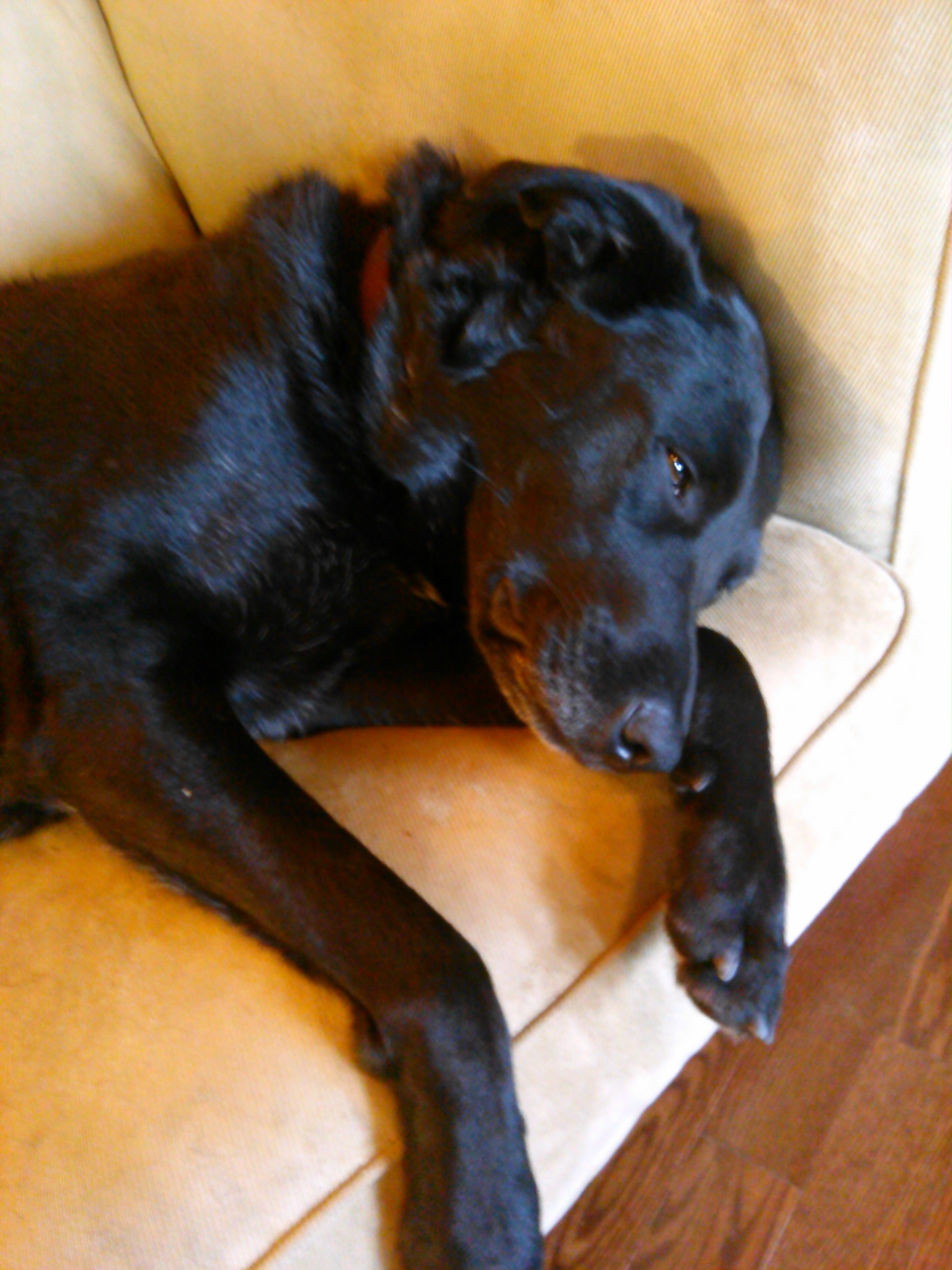
bulldog wearing eyeglasses sleeping over a good novelAlthough my dog knows nothing about online social media, she is a rich inspiration for me when it comes to marketing. Here are the lessons I’m learning from her as I spend this season promoting my humorous memoir, Saved by Gracie, about my life with a four-pawed family member.

1. Persistence pays off. Gracie gets a fresh whiff of ground squirrel in one of the numerous holes in the hillside we walk every day, and for the next three days, she smashes her big nose into that same hole when we pass by. By the fourth day, she tries another approach and begins digging furiously to find the critter she knows is somewhere down there. So far, no squirrel, but she’s produced a mound of fresh dirt to play with. My take-away: keep working a lead until you get what you’re after, or until your work yields other opportunities. It worked for me last week: after a month of trying to get some events press from the alumni office of my alma mater, I tried another approach – I contacted the university’s social media manager, who offered to post and share my events. I knew there was help somewhere, and I found it! And now I have a productive contact in my resource file for future reference. Opossum22. Instead of dancing around an idea, grab it and run with it. Gracie finds an opossum on the edge of our backyard and circles, unsure what to do with it. I try to get her away from the furry ball, but we continue to dance around it until she finally snatches it up in her mouth and tears off for the front yard. She drops it along the way, I snag her collar, and take her into the house. Gracie is unharmed, and the opossum wanders back into the woods. My take-away: be bold and see what develops. I always wondered if there was value in an author book tour, so I decided to put one together myself for Saved by Gracie. It forced me to reach out to new venues and contacts in places I’d never approached, expanding my network of resources and readers. And since I traveled to places where I have family, I got free housing and a chance to visit, too. More importantly, I’ve learned the details that go into a book tour, creating a template for the next time around. (And the book tour didn’t bite me, either.) CC Cookie and Gracie 0533. Take a break. Gracie takes a nap after our morning jog, but by afternoon, she’s eager to go back outside and do it again. My take-away: recharging is just as important as working hard. Like many authors, my to-do lists are long and ever-growing. I have to make myself take breaks, but when I find myself away from my lists, my mind runs free, generating fresh ideas and perspectives. By the time I’m back at work, I’ve got new creative energy to pour into my projects. Which leads me to conclude that whoever said “you can’t teach an old dog new tricks” clearly wasn’t an author. Or at least, not one who sold books…

5 Things the Theater Taught Me About Writing

OLYMPUS DIGITAL CAMERAThe smell of popcorn takes me back…backstage, that is. From 1998 to 2007, my husband and I, along with several other talented individuals, performed thousands of shows to enthusiastic crowds in two small-town Texas theaters. The experience taught me enduring lessons about creativity, professionalism, and making a living through the arts. These tenets apply to your writing life and other creative endeavors, as well. Here are five things the theater taught me about writing, in no particular order:

1. Word of mouth is the best publicity

Our audiences, though small, were passionate. We provided quality entertainment and our most ardent supporters talked about us…a lot. They brought groups, gave their friends tickets, and sometimes drove hours to see us. Though we bought print ads, paid a few publicists, and had a large email newsletter, the theater’s best advertisement was—without a doubt—word of mouth. 

It’s the same with promoting your writing. Today’s readers are consumers, just as our season ticket holders were. They long for quality and consistency. They’re busy, and they need a reason to keep reading past the first few lines. And when they are delighted by what they’ve read? They’re the most loyal, vocal folks around. Because we live in an instant-communication society, bad word-of-mouth spreads fast. Make sure your writing product is stellar, and great publicity will follow.

2. Give the audience what they want

One of the owners of the first theater in which I performed often said, “Give ‘em hamburgers!” He meant that we shouldn’t mess with success. If tickets sold quickly for a 1950s music revue, we wrote another similar show. Of course, we also experimented and pushed boundaries (otherwise, all of us would have grown bored). However, we changed our product in small increments. We also created special experiences—behind-the-scenes tours, holiday packages, giveaways—for avid supporters. Cast members even called our VIPs (those folks who came to the theater over and over) on their birthdays and anniversaries, which the VIPs greatly appreciated.

In your writing, think about creating a memorable experience for the reader. How can you provide extra value (giveaways, incentives, free resources) in a professional, winsome file3691295046962manner? In what ways could you creatively and tangibly thank those who willingly support you and talk about your books?

3. Leave your ego at home

Most of the performers I worked with over the years have been gracious, humble, and diligent. A few, however, turned me off with their arrogance, over-the-top demands, or lack of discretion. The most successful artists, long term, are those who go out of their way to thank people and who treat the sound technician as well as the venue’s owner. Those are the performers who are offered more opportunities.

Ask yourself: am I approachable, warm, and thankful for the opportunities life has given me? Or I am on a mission to impress everyone I meet, in order to “build my brand”?

4. There are no small parts, only small actors

So said Constantin Stanislavski. When you perform a small role with professionalism and excellence, the people in charge notice–and they’ll eventually give you more responsibility.

The same goes for becoming a better writer. If an editor asks for a 400-word piece, I’ve learned to take it seriously and do my best work. In this age of instant access, anyone can read your work at any time, from anywhere. Who knows what small beginnings might lead to larger opportunities?

And, finally, in related wisdom…

5. Know when to stop

On stage and in writing, creatives need to develop an important skill: how to bring a something to a close. In the theater, we say that last line, spin on our heels, and exit, stage left. In writing, we find the right moment, the right phrase, the right word, and that’s it. The end.

This post is a reprint from Tweetspeak Poetry.

Marketing for the Introverted Writer

Sing Your Unique Song via Janalyn Voigt | Wordserve Water Cooler“All you need is you, yourself,” marketing expert and author James Rubart once said with regard to marketing. His comment, given at a meeting of Northwest Christian Writers’ Association, stuck in my mind because I didn’t believe him.

That’s easy for you, Jim, I thought with a touch of asperity. You are an extrovert who can walk into a book store and chat with the owner without breaking into hives. 

I am an introvert. If I had my way, I’d retire to a closet to write, coming out only to eat, sleep, and possibly notice the existence of my family. Okay, I’m exaggerating, but I really do have a closet office. My post describing it spiked visits to my website, which makes me suspect I’m not the only introverted writer. Welcome, and here are some of the lessons I’ve learned along the way.

  • Promoting is not nearly as hard as I was making it. Once I busted through my own resistance and consistently marketed my book, I harnessed the power of routine. I was looking at the whole marketing puzzle at one time, but we really only solve a puzzle one piece at a time.
  • I don’t have to be a social butterfly to effectively market a book. All I need is the willingness to touch people using whatever format I find comfortable. That doesn’t have to be face-to-face, necessarily. The Internet allows me to promote to those I probably will never meet. As a writer, I’m wired to be a communicator, and communicators need listeners. That makes me a people person. Who knew?
  • Marketing is not the same as going to the dentist. It can even be fun. Really. The key is to employ platforms that work well for you and that you enjoy or at least can tolerate. Your platforms can be in-person or online. Sometimes you need to compromise to attain a goal. For example, although I would rather not speak in public, if I want to fulfill my desire to teach other writers, I have to overcome my reluctance.
  • I can market with my writing. I had a Hallelujah moment when I realized I could promote my book by writing related content for magazines, book sites (like Wattpad and Goodreads), or on my website as a subscriber incentive.
  • I don’t have to be at every social site. I have better results when I specialize at one or two sites rather than trying to keep up with them all. As a bonus, I have more time for writing.
  • Keeping track of people is important. I confess. I lose people online. I don’t mean to, but there are too many conversations with so many people. List the most important people to you as an author, and then make sure you engage with them on a regular basis.
  • Push past your fears. This lesson was one of the hardest for me, and something I have to learn all over again on a regular basis. If I let fear stand in the way, I cheat myself of fulfilling my God-given calling. Not only that, but I deprive others I want to reach with my writing. In light of that, my fears don’t seem quite so compelling.

Jim Rubart was right when he said that you only need you, yourself, to market your book. Don’t worry about being someone you are not. Instead, use your talents to sing your unique song to those who need to hear it.


The Shocking Marketing Surprises I Learned After My Book’s Release

A little more than a year ago my first book was published.

In the years before it was released, I made a persistent effort to build my platform.

For instance, nine or ten years ago, I started building a social media platform, first on Facebook, and then on Twitter, LinkedIn, Pinterest, Goodreads, and Instagram.

For about six or seven years, I have been consistently blogging. I have been grateful to be featured as a guest blogger on many sites. Still, I did not fully understand the extent of marketing I would be doing once my book released.

The not knowing was painful at times.

Hopefully this post will give you some of the information I wish I had known ahead of time.

Here are the five biggest marketing surprises, good and bad, I learned after my book released.

wow big sale1. You won’t just market for a month or two, or three, or six.

I didn’t realize I would be expected to market for years. In fact, I think as long as you have a book being sold, you don’t ever get to stop.

2. Most of the time you won’t have any idea how well your book is selling.

I assumed publishers would send reports every month or every six months. That didn’t happen. At least not for me. I guess it’s difficult to determine the exact number of sales, partly because bookstores may order a few dozen copies but then send them back at a later date. I did receive a statement 12 or 13 months after my book released but it’s still not an accurate representation. By the time a statement is compiled and mailed out, more books likely sold. Without knowing how book sales are going, you have to market anyway.

3. You will market 101 ways and you won’t have any idea which marketing ideas will be most beneficial.

You’ll do contests, hold signings, and have book launch parties. You’ll do giveaways and attend conferences. You’ll have write-ups in college alumni newsletters, you’ll give hundreds of books away to potential endorsers and media types. You’ll speak to groups, and give radio and TV interviews, all the while hoping for sales.

amaz1

Here are two of my biggest marketing surprises:

*My pastor gave a sermon on Mother’s Day and mentioned my book. I sold about a 100 books. People rushed into the foyer after church to buy multiple copies for aunts, grandmas, sisters, girlfriends, and moms.

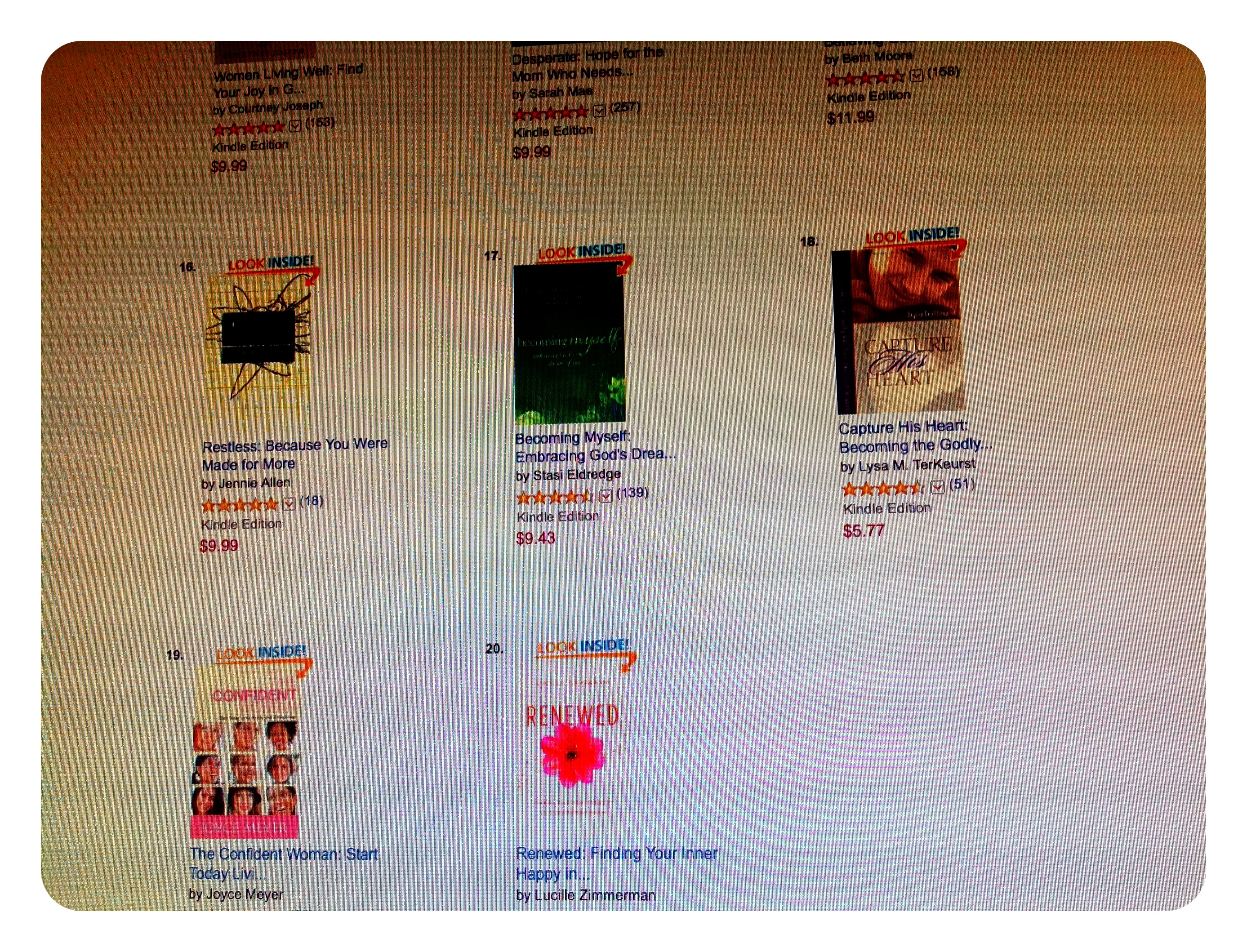
*Ann Voskamp mentioned my book on her list of links one Saturday morning. My book sky-rocketed on Amazon. It was fun to watch the numbers for a day.

Amaz

4. Your publisher is likely to give you books in order to help you market.

When I signed my contract, my agent negotiated a certain number of free books I would receive in addition to my advance. However, I have been surprised with the generosity of my publisher. Several times I’ve headed to conferences and my publisher has given me books to give to the attendees. Also, Goodreads has a program where authors can participate in giveaways within the first six months of a book’s release. My publisher alloted quite a few books for these giveaways.

5. The things that make you the most happy won’t be the sales but the people you touch.

It sounds cliche, but it’s true. I am humbled each time someone sends a thankful email or posts a review on sites like Amazon, Goodreads, or Barnes and Noble. This week I received a letter from someone who said my book encouraged her to go back to school to earn a graduate degree in Christian counseling.

If you’ve marketed a book, what surprised you the most after it released?

Two Writers Walk Into This Bar . . .

Celebratory drinkWhat happens when two writers unexpectedly find themselves with a free evening together?

A nice dinner and a glass of wine? Laughter and bonding? Sharing experiences from both on and off the author trail?

Yes. All that, and new marketing ideas, too.

At least that was my experience two weeks ago when my agency colleague Anita Agers-Brooks made a short-notice trip my way and we were able to spend a few hours together – hours that had no agenda other than getting to know each other. And even though we write in different genres (Anita is a leadership guru, while I write humorous mysteries and memoir), we had much to offer each other in the way of marketing and business ideas. Here are a few nuggets from our impromptu party to spark your own ideas:

  1. Writing is a business. Do you treat it that way? Anita reminded me that I needed to file paperwork to become an LLC (limited liability company) as legal protection of my assets. We live in a litigious world, and a writer must be a good steward of her assets both spiritually and financially. As Anita pointed out, if you wait to protect your business till someone sues you (yes, it can happen!), you’re already too late. (And be sure to include Errors & Omissions insurance while you’re at it.)
  2. Goodreads.com is a publicity goldmine. Are you on it? For my new book release, 658 people entered my giveaway drawing for 3 free copies. That’s a lot of eyes on my book the day it released. And giveaways are just the tip of what you can accomplish on Goodreads. (Read this marketing tutorial on using Goodreads.)
  3. Pay attention to casual comments. After a pastor told Anita her book would be a good topic for a sermon, she found a template online for sermons. She plans to fill it out using her book and then share the template with pastors. She’ll get her message presented by pastors, and she won’t even have to be present! (Does that qualify as bilocation – being in two places at the same time?) I’m going to take her idea and see if I can make it work for me.
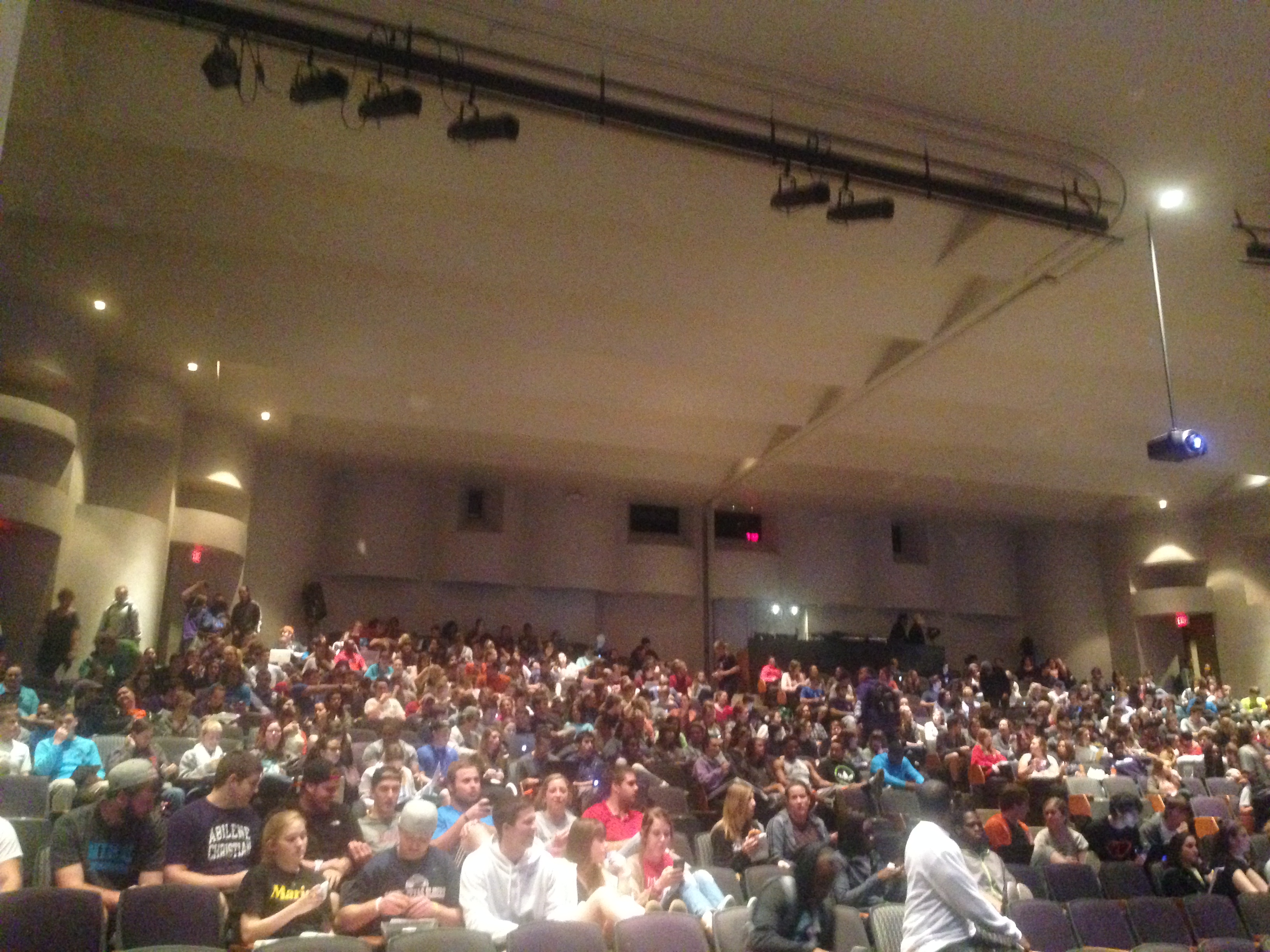
  4. Take ownership for your promotional campaign, because ultimately, the book is your baby. Both Anita and I have been surprised by the limitations even large publishers can have when it comes to marketing; our publishers can pull some big coups for us (Anita spoke to a filled college auditorium thanks to her publisher, and I’m getting phone-in radio interviews thanks to mine), but the local press and on-going events calendar that make up the bulk of your PR efforts remain in your own lap, not to mention getting your launch team recruited and equipped to spread the word.
  5. Learn from each other’s experiences. After spending an evening with a writer in the same phase of our careers, I feel like I may still be in the same boat. But now I know there are other boats traveling along beside me, happy to share their own tips and advice. In fact, maybe a small-group marketing retreat would be a good idea. Hmmm….

(FYI – I was kidding about the walking into a bar. Anita and I did walk around a golf course, however. The air was much fresher.)

Marketing In and Out of the Box for Authors and Speakers

“It’s getting harder to find places to sell books.”

Anita Brooks Conference Speaker
Find an Audience and Speak to their Needs

Public speaking is still the most effective sales tool for book authors according to many professionals. But with conference attendances lowering, and some closing down, the opportunities are dwindling.

And without a strong marketing plan, you often can’t get a publisher to bite on a proposal anyway.

So what’s an author to do?

You’ve probably heard “think outside the box” when it comes to marketing, but what does that mean?

Don’t lose hope, there are still effective things you can do to strengthen your marketing strategy through speaking. For instance, re-slant your messages to fit groups you might not normally speak to, or have never thought of speaking to.

Conference Speaker
Every Celebration & Educational Event Needs a Speaker
  • If you speak on marriage, have you targeted business groups and associations where couples may work together, or have employees who do?
  • If parenting is your theme, have you contacted day-care centers who often spend more waking hours with children than parents?
  • If grief or trauma is your message, what about speaking to Chambers of Commerce, or association conferences about how their members can help the hurting, promote good will, and further their mission as a result?
  • Is there an awards banquet you can connect a presentation to?

When contacting churches and ministry organizations, ask yourself questions like these:

  • What are the biggest problems I see in society today?
  • What are my greatest pet peeves?
  • What do I hear people complain about most often?
  • What do people say they are lacking?

Those are the areas you can target to reach audiences in a relevant way. Many ministries are looking for speakers who can address concerns of a younger crowd growing more jaded, more “accepting,” and more in need of spiritual wisdom than ever. But wrapped in practical twenty-first century applications.

The Whole Earth Needs Hope
People All Over the Earth Need Hope

The fact is, human beings all over the planet are drawn to messages of hope and encouragement, and like-minded people flock together. The key is to develop a strategic marketing plan, do your homework, study potential audiences, make consistent contacts, and follow up on a regular basis. Over time you will begin to get a feel for what works and what doesn’t. Set goals and stick to them.

To help you get started, here’s a link that offers info on associations of all kinds.

Finally, I must mention the most important thing of all. Partnering with God through prayer, trust, AND practical action.

Here’s my real secret to any marketing success. Based on the Parable of the Talents in Matthew 25, I ask God who the bankers are that He wants me to invest my talents with, and then I look and listen. I’m often surprised at the opportunities available; it simply takes looking at things through fresh eyes. Sometimes in the box, and sometimes by stepping out.

Have you discovered any unique ways to market books or sign more speaking events?

Give ‘Em What They Want, Not What You THINK They Want

shop-vac-10-gallon-industrial-wet-dry-vacuum-925-40-100After fumbling around with social networking and reading every marketing article about it that I could get my hands on for the last year or so, I’ve distilled my promotional strategy down to a simple directive: give readers what they want.

I know that sounds obvious, but the tricky part is understanding the ‘what,’ especially once you realize that ‘what’ your readers want may not be the same ‘what’ that you THINK they want.  The key is taking ‘you’ out of the picture, so you can clearly see your reader without your own perspective distorting your vision.

It’s like reflective listening – you want to reflect back what the other person is saying without putting your own spin on his words, so you hear clearly what he said, and not what you think he said. Quick example of doing it wrong: my husband said he wished he’d taken music lessons when he was a kid, so I got him music lessons for Christmas. Two weeks into the lessons, he told me he didn’t want to continue.

“But you said you wished you’d taken lessons as a kid,” I reminded him.

“As a kid, yes,” he said. “But now I have other interests that I’d rather spend my time on. You interpreted my comment as a current wish, which it isn’t.”

Ouch. I should have gotten him the shop-vac he said he needed, which I thought was boring.

Same idea applies to your readers.

Pay careful attention to what they say, or in the case of social media, what they really like to see and with what they engage.

For instance, I thought that as an author, I should be posting on Facebook about my WIP or upcoming events. Those posts, I’ve found, get little notice.

But if I post a photo of me getting kissed by a French bulldog, or a goofy homemade video of me singing (badly) about the cold weather, I get comments galore. Clearly, on Facebook, at least, my writing news is not very interesting to my readers.

Writing news is appreciated very much, however, by my newsletter subscribers, so that’s where it now goes, along with on my website. As for LinkedIn, I post both events and business-related material, such as when my books get a rave review or included in an industry-recognized blogger’s post.

For Twitter, I post quick links to interesting material in my subject areas (birds, nature, dogs, humor) or retweet entertaining posts, because I’ve found that those kinds of communications are most appreciated by my followers. Because it’s a fast and short exposure, I tend to use Twitter more than any other social media platform as more of a shotgun approach – post and hope it spreads wide and far to get my name in front of a greater number of people, because that’s the first step to finding new readers.

My experience has convinced me that connecting with readers, followers, and networks is a necessary piece of expanding my readership, but once I’ve reached new folks, it’s time to shift gears and use social media to build relationships, not solicit sales.

That’s why it’s called social media, and not the shopping channel. Remembering to give the reader what they want is easy when it’s the same thing you want to give your friends.

How do you use the various social network platforms?

How to Maximize Your Social Media Time

Early in my wanting-to-pursue-publication journey, I heard a woman give a talk about maximizing your time. She said, “Nothing you do should go to waste. If I see a movie, I’ll figure out a way to use it in my writing. I’ll write something about it.”

Social media conceptHonestly, at first, I did kind of give a big eye roll. Really? Nothing could be sacred, private, and free? Couldn’t my mind ever just have a void where I didn’t have to think about marketing?

Now, I might have changed my opinion on that somewhat.

Marketing is hard work. Author Richard Mabry once said to me, “It’s a marathon, not a sprint.” And this is the truth. When your book releases, there is usually a flurry of activity to launch your baby. But, there comes a time when you need to begin to focus on the next book while still keeping your other marketing activities going. This may be less about your book and more about growing your platform and social media presence.

Consider all your activities: can they aid in growing your social media? Can they give you a blog topic? Can something you do for fun give you a possible return on your time investment?

I recently read the book Fear Nothing, by Lisa Gardner. I wanted to read this book. Lisa is a favorite author of mine so I put most other books aside to enjoy her new releases.

On the marketing side, this is how I used my leisure time to help my social media.

1. I wrote a Goodreads review on the novel. This is good for authors. It gives people an example of your writing style and can help readers find you. After all, you likely write what you like to read.

2. I pinned it to Pinterest. Some readers/followers are more visual and I do find people repinning books from my boards.

3. I blogged about it– in two different places. My main blog is Redwood’s Medical Edge and it deals with medical accuracy in fiction. Fear Nothing had a character with congenital insensitivity to pain so not only did I blog about this particular medical disorder but I also did a post that was a review of the novel and some of its medical aspects. And now, I’m here blogging about how to use one activity to foster multiple marketing efforts. So, I guess that’s three blog posts.

Your activities should become the ultimate wardrobe, where all pieces can be mixed with one another. Ultimately, a book I read for fun ended up being used to build my platform (a medical nerd who writes suspense novels) and, hopefully, keep up interest in my social media.

What about you? In what ways have you used fun activities to maximize marketing efforts?

WordServe News: March 2014

Exciting things have been happening at WordServe Literary!

On the final post of each month you’ll find a list of Water Cooler contributors’ books releasing in the upcoming month along with a recap of WordServe client news from the current month.

New Releases

Debora M. Coty released The Bible Promise Book: Too Blessed to be Stressed Edition 9781624169885_p0_v2_s260x420with Barbour, a collection of selections from the original Too Blessed to be Stressed book.

*********************************************************************************

9780802409577_p0_v1_s260x420Roberta Kells Dorr released Abraham and Sarah with River North.

*********************************************************************************

SavedbyGracieJan Dunlap released Saved by Gracie with Authentic.

*********************************************************************************
Ken Gire released At Peace in the Storm with Bethany House Publishers.9780764208843_p0_v2_s260x420

*********************************************************************************

9781624168581_p0_v2_s260x420Paul Kent released Playing with Purpose: Baseball Devotions with Barbour.

*********************************************************************************

Tim LaHaye and Craig Parshall released Mark of Evil with Zondervan.

9780310334545_p0_v3_s260x420

*********************************************************************************

9781433683312_p0_v3_s260x420

Ben & Julianna Zobrist with Mike Yorkey released Double Play with B&H Publishers.

*********************************************************************************

9781624166181_p0_v2_s260x420Mike Yorkey released Playing with Purpose: Racing with Barbour.

*********************************************************************************

New WordServe Clients

Shelley Hendricks signed with Alice Crider.

Leticia Yuzefpolsky signed with Greg Johnson.

Linda Znachko signed with Alice Crider.

New Contracts

Anita Agers-Brooks signed a contract with Barbour for her non-fiction project titled, Getting Through What You Can’t Get Over. Alice Crider, agent of record.

What We’re Celebrating!!

The Brotherhood Conspiracy by Terry Brennan is a finalist for Foreword Review’s 2013 Book of the Year Award, in the category of Action & Adventure (Adult Fiction). Foreword Reviews, the only review magazine solely dedicated to discovering new indie books, announced the finalists for its 16th Annual Book of the Year Awards. The winners will be determined within the next two months. The final announcement will be made Friday, June 27, in Las Vegas, during the American Library Association Annual Conference. There are awards in over 60 categories and cash prizes for the best in fiction and nonfiction. Here is the complete list of finalists and the listing for The Brotherhood Conspiracy can be found here.

Amy Sorrells’ debut novel How Sweet the Sound received a fantastic review from USA Today!

Set in the late 1970s and early 1980s, a time when the topic of sexual abuse was not a thing “talked about” in the media and for which victims were still too often treated as “deserving” of the crimes committed against them, this novel refuses to nicey-nice over tough and ugly realities. This story is, throughout, raw — but yet penned with a sweetness of prose that makes you want to keep reading, even when you know it would be easier to curl into a ball and weep for the brokenness of the characters therein.

Poignant switches of point-of-view between Anniston and her aunt, Comfort, show the reach of abuse within generations of the same family and stretch a reader’s heart to its limits. Simply put, it hurts to read this novel. It hurts to watch the characters go through what they do. It hurts to see family secrets exposed, revealing pain upon pain. It hurts to see them abandon true love and it hurts when they are seemingly abandoned by it — but how beautiful the pain when an ending so lovely and right redefines and redeems several futures at once.

This book will turn your emotions inside out and grip your heart with a clawed fist before pouring acid — and then balm — over the wounds. You have been warned. Now, by all means, go buy this unusually edgy and entirely moving inspirational novel and read it for yourself.

What are you celebrating on this writing journey?