Does the World Really Need Your Story?

This week snow fell–again, about a foot, on top of already knee-deep layers. I strapped on skis and went off into a spruce forest near my house, my tracks the first marks on the page of the world.

Starting a new writing project, a book or an article, even a blog post, feels much like this. I see something falling outside my window–an idea, a passion, a glimpse of something true and maybe beautiful. I eagerly strap on metaphorical skis and go out, wondrously lost in a world made strange again. I am confident that I belong here, that I will apprehend something of value and meaning. But the going gets hard. The surface of the snow changes. The skis get stuck. I fall. I discover dozens of tracks before me on the trail, most more graceful than my own. Why am I here?

Doubts track me down no matter where I am. I have learned not to dismiss them. They force me to consider and reconsider. Does the world really need one more story?

Today, I give three responses: two from others, one my own.

1. Your story can bring “healing and illumination” to others.

Katherine Paterson, prolific Newbery award-winning author, says with genuine humility, “I know my gift is limited. I know I cannot stand toe-to-toe with philosophers and theologians and solve for myself or anyone else the problem of evil . . .”  But here’s what we can do, she says, “we who are writers can tell a story or write a poem, and where rational argument will always fail, somehow, miraculously, in metaphor and simile and image, in simple narrative, there are, in the words of Barry Lopez, both ‘healing and illumination.’ Here I see a word of hope and possibility.”

2. Writing your story can preserve your life.

When Madeleine L’Engle’s husband says of her new work, “It’s been said better before,” she responds,  “Of course, it has. It’s all been said better before. If I thought I had to say it better than anybody else, I’d never start. Better or worse is immaterial. The thing is that it has to be said, by me, ontologically. We each have to say it, to say it our own way. Not of our own will, but as it comes out through us. Good or bad, great or little: that isn’t what human creation is about. It is that we have to try, to put it down in pigment, or words, or musical notations, or we die.”

3.  Writing can move us toward the city of God.

If we pursue our stories, honestly and truly, they will send us on a pilgrimage that takes us, like Abraham, from one land to another, from a land of unknowing and darkness, through, of course, wastelands, where the promise of a promised land appears invisible and impossible . . . but the writing inexorably, day by day moves us closer to clarity, to wisdom, to the very city of God, if we allow it.

Don’t waste your doubts. Use them to move you forward into that forest, into the pages of that story that you must write—for yourself, for God and for others.


What Disney Knew That Your Teacher Didn’t: You CAN Do It!

Find me one published author who never received a single “not the right fit” letter, and I’ll show you a fish with feathery wings. Whether at the educational stage, the agent stage, or the publishing stage, most have been told their work is not worthy.

I was lucky when it came to agents and publishers, but my rejection came earlier in life, when a high school teacher read my papers aloud ridiculing me in front of my peers. She teased me relentlessly (today it would be called bullying), and on the last day of my senior year in high school, she said to me, “I hope you don’t waste your scholarship to study writing. You may be able to write a greeting card, but that’s about as far as you’ll ever go.”

I made a mistake that day. I believed her. I put down my pen for nearly a decade and let way too many stories go untold.

That’s why, twenty years later, as Publishers Weekly gives me a starred review for my debut novel, I feel such tremendous excitement. Whether Into the Free sells two copies or two-hundred thousand doesn’t matter one bit to me. I now know one important thing: she was wrong.

Here’s what she didn’t teach us: God gives us each special talents, gifts, and dreams. Who are we, if we are not of God? What are our abilities, if not God-given?

I am a teacher, and I spend every bit of my energy trying to teach my children one lesson: You can do it!

I am tired of teachers telling us who we are and what we will or will not achieve. I am weary of labels and bell curves and standardized tests. I weep for this generation of children who are told you need x, y, z medications to fit into our box. And I mourn the countless souls who believed the people who said, “You’ll never…” or “You can’t…” or “You aren’t good enough…”

I say to you, today. You can. You are good enough. You were born for a purpose, and only YOU know what that is. Don’t let anyone discourage you from living YOUR life to its fullest potential. And if you fail, you’re only one step closer to succeeding.

Watch this little video clip I found on YouTube, and you’ll see…all great minds have a few things in common: failure, rejection, and a willingness to risk it all anyway.

Has anyone ever told you “you can’t”? What one piece of criticism has made you a better, stronger writer? 

When Mom and Dad Split Up

Getting an early morning call from your agent can lead to adrenaline induced heart arrhythmias. Working in the ER, I’m trained to assume and prepare for the worst case scenario. That’s the nurse in me. But, what do you do when you get a cryptic message from your agent?

Me—assume the worst. What could he be calling about? Is it an issue with my publisher? Is he dropping me? What could it possibly be?

Not only am I an ER nurse but a suspense author—so I may lean toward the dramatic.

Quick dial back.

The news was not anything I expected. An agent was leaving the fold as Greg mentioned in late December as part of the agency news. What did that mean? The reason for the call was to discuss what would happen to this agency blog when several contributors were leaving.

The WordServe Water Cooler started in the middle of last year as an agency blog with the focus of helping authors a little further back on their writing journey navigate the publishing road. Since it is an agency blog, professionally, it needed to be maintained as such. Those authors choosing to go with their agent to the other agency would not be able to participate.

Problem was—we had become a family along the way.

Initially, when the blog was set up, a Facebook group was started as a communication tool to facilitate signing up for posts. What it morphed into was a true community of authors supporting, encouraging, and praying for one another’s triumphs and difficulties.

Personally, I didn’t want to lose touch with those who were leaving. It felt like my family was splitting up. Greg had tasked me and another author to take over administrating the blog. We began a conversation with the current overseers about how to handle the change.

How this multi-author blogging group handled this agency change has been humbling and inspiring and I believe has some lessons that can be learned by all—both on a personal and professional level.

Here are a few I’d like to highlight.

1. Do not gossip. On our group Facebook page, there would have been ample opportunity to gossip about the situation. Who was leaving? Why were they leaving? What do you think of such and such agency? Agent? I can honestly say this did not happen. Everyone was professional and supportive and prayed over those having to make tough decisions and over those who were most affected by the change.

2. Your decision is personal. Whether or not you decide to stay with a particular agent/agency is a private matter—not a group discussion. Only a few trusted people should be privy to the reasons. This is handling it professionally. Airing grievances publicly, particularly on social media, will come back to bite you. The world of publishing is small, and people will remember how you acted.

3. Create a neutral meeting ground. To meet the need of maintaining those relationships that developed via the Facebook group—a new private group was created where those who left could still interact with those that stayed. Of course, I can’t tell you the name. It’s a secret.

4. Be open to new opportunities. Change is part of life. The choice you make is how you handle it. You may be presented with opportunities to grow and stretch. Don’t be shy about stepping up and learning new things. This month, you’ll see several new talented authors contributing to this blog—including superstar agents Greg Johnson and Barbara Scott. You’ll learn more about marketing and social media from publicity expert Ingrid Schneider. Ever wonder what it’s like to intern at a literary agency? Check out Sarah Freese’s posts.

Question for you—what’s been the biggest change related to publishing/writing you’ve had to deal with?

The Slow Loris Road to Publishing

I’m what you might call the slow loris of book publishing.

 Are you familiar with the slow loris? I know it sounds like a Dr. Seuss character, but the slow loris is actually a real animal – a tiny primate with big, puppy-dog brown eyes and a round head (so far, nothing in common with me, in case you’re wondering). The slow loris is also described as a slow and deliberate climber.

Yup, that’s me: the slow, deliberate climber.

It took me two and a half years to write my first (and at this point, only) book. In my defense, I also had a toddler and a newborn at the time, as well as a part-time job, so I wrote only in the very early mornings and in the evenings, after the kids were tucked into bed. I wrote every day, slowly and deliberately ticking off chapters one by one until I had a completed manuscript. I marvel at writers who crank out two or three books in a single year. I know people that do this, and they are very good, fast writers. I am not. I am methodical, and my editing is nothing short of painfully laborious.

After I finished writing and editing my book, it took me another two years to land an agent. Again, I was slow and deliberate in the querying process. I purchased The Guide to Literary Agents and The Christian Writers’ Market Guide, and scoured the exhaustive lists of agents, categorizing each with the letters A, B or C. “A” designated a top-choice agent; “B” were the agents I considered good, but second-tier; and “C” was reserved for those I might query in desperation. I researched the agents online and then crafted a personal query letter for each. I queried most of my “A” list and some on the “B” list before Rachelle Gardner (top of the “A” list, by the way) offered me a contract (truth be told, I queried her twice).

 “Whew!” I thought, after I’d finished cartwheeling across the living room the day Rachelle offered me representation. “Now the process will finally start moving along! Let’s roll, baby!”

I assumed once the manuscript was out of my slow loris hands (claws?) that the pace would accelerate.

That was last February.

My memoir has not yet sold to a publisher. I’m not saying it won’t sell eventually. I am simply stating that in the nearly 365 days since I accepted representation from Rachelle, it hasn’t sold. As it turns out, Rachelle chooses the slow loris approach, too, if the market demands it. Sometimes, as she noted in a recent post, publishers aren’t in the market for a particular genre (in this case, memoir), so she puts the manuscript aside and patiently waits for a better opportunity.

I admit, being the slow loris is frustrating at times. I see some of my favorite authors publish one book, and then a second, and I wonder, “What about me? What about my book? Why doesn’t my book sell?” Doubt creeps in. And insecurity. I begin to question my ability as a writer, my story, even my choice to pursue this publishing dream.  I contemplate ditching writing all together and taking up needlepoint.

In the end, though, I continue to stick with it. After all, slow lorises, in addition to their slow, deliberate climbing skills, are also known for their ability to cling to a tree in one spot for an exceptionally long period of time, patiently waiting for the perfect meal to wander into proximity.

“Everything in its own time,” Rachelle reminds me.

I’m patient. I can wait.  I am a slow loris.

{For the record, the slow loris is also the only mammal with a toxic bite. Just saying.}

What animal would you choose as a metaphor for your journey to publishing or your writing style {please don’t say cheetah or I may die a little inside}?

Just Keep Writing

Photo by Lord Marmalade

There’s a reason I keep writing even though monetary success hasn’t found me, yet. Words strung together in books have always given me the ability to dream of bigger things and even the courage to go out and try.

I’ve been blessed to have three books published and each time there have been plenty of readers who have said that I helped them let go of what no longer worked for them and dream, too.

We talk a lot about our purpose for being here in this life and I’ve come to believe mine is to be of service in whatever ways I can figure out. So far, translating the common man’s dream into something worthwhile, something doable and something that’s even full of a little God-magic has been mine. Not the big, change a country, build a corporation dreams. The smaller moments that stay in your heart.

It’s a message that I took in from the very start.

My first experiences with books and stories are three of the strongest memories I have as a child. The very first one was the first time I walked into a library, the Philadelphia library and found out they let you check out as many as you could carry, my father’s rule, read them all and bring them back for more. My world opened up that day and I found out there were a thousand possibilities when it came to living a life.

The second has to be explained a little bit. We were so poor when I was growing up that my father talked a friend of his who worked at a local bank to lend him a hundred dollars so he could buy us a used black and white television. We screamed with delight when Dad brought the set home. So, when a Reading is Fundamental bookmobile came through our neighborhood and the driver told us we could pick out any new book and keep it, I felt like a little big of magic had settled over us that day. I took my time and tried to choose a book that I could read over and over again. I still have it and read it to my son when he was little.

The third memory is my brother, Jeff and myself when we taught ourselves to read, Horton Hears a Who by Dr. Seuss. We had the book read to us so many times we knew what part of the story went with what pictures and on our own figured out which words went with the sounds. That’s when I understood a secret about books. They have their own power to transform. They don’t know if you’re rich or poor, beautiful or an ugly duckling, a wealthy doctor or a poor cabdriver, and they don’t care. A book will take you on an adventure whenever you’re ready, regardless of how you see yourself and as a bonus may even change the definitions.

Books made it possible for me to envision a way to become someone I couldn’t even define yet. They gave me the faith to set out when I couldn’t find it anywhere else and the hope that somehow things would all work out.

I’ve seen it happen just often enough. A lost human being feels like they’re the only one who has ever felt this much pain. They don’t know how to reach out for help but then, inside of a story some writer concocted out of whole cloth they see every emotion or secret or hope-for happy ending that they’ve kept bottled up inside, acted out, and they start to believe – maybe there’s more to this world.

That’s why I keep writing and that’s why I’m so grateful for every writer out there who struggles to tell a good tale. I’m one of your biggest fans, whoever you are, so keep writing. We need every single exciting, cliffhanger, romance, potboiler, science fiction, political thriller that we can get our hands on because even now, sometimes my dreams need a kick start. So please, just keep writing.

Throw Your Spaghetti

Parents are known for their one-liners, and mine were no exception. “Do it once, do it right, then forget about it.” Wise words tattooed on my heart as my military father explained how to mop the kitchen floor.

Now, with four children of my own, I’ve discovered there are a few one-liners I’ve batted around long enough to stick with my four kids as well. My personal favorite?

Throw your spaghetti!

I use these three words to encourage family and friends. Inspiring them to knock on every door in their path and walk through and follow-thru when that door opens.

This saying originates from the traditional Italian way of testing pasta. The cook throws a handful of spaghetti noodles against the wall and if a few strands stick the pasta’s ready. If the noodles fall to the ground—the pasta remains in the boiling water.

Here are a few life examples of what “Throw Your Spaghetti” looks like:

While attending a writer’s conference, I was surrounded by hundreds of wannabee-authors like myself who dreamed of a coveted publishing contract. When I had the chance to talk with some of them, I was amazed by their talent, awed by their creative ideas, and immediately anxious about ever being good enough.

One of those gifted writers spoke with me, “I just got back my edited manuscript. It’s full of red ink. The editor suggested I talk with another publisher.” She moped.

“So, what are you waiting for? There are lots of publishers here you could talk to.” I reminded her.

“I don’t know. I really had hoped this editor would want it for her publishing house. I’m thinking it’s not meant to be for me.” She mumbled.

“Are you kidding? You have a gift, and you’re going to let a rejection from one publisher hold you back from your dream? C’mon get out there and meet with everyone you can. Throw your spaghetti!”

And then there was the time my college-aged daughter called to share:

“Mom, I just found out about another college that offers a fellowship for creative writing. But, the problem is, I’m not sure if I should stick to my number one school choice in Iowa, or try for this one too?”

“Honey, there are no guarantees you’ll get into your first choice, so I’d apply for both. Throw your spaghetti!”

“Throw your spaghetti” is my own silent mantra from time to time. After flying cross-country to attend a women’s conference, I anticipated sharing my book idea with a few publishing houses. By divine miracle, my late registration didn’t hold me back from appointments with publishers.

I called my husband to share my progress. “Paul, I just met with a gal who taught a workshop about pitching my book idea. She said what I have isn’t good enough for a book.”

“I’m sorry, who told you? Did God personally tell you that?” Sarcasm oozed over every syllable.

“No, God did not personally tell me that!” Irritation got the best of me.

“Well then, I suggest you keep your appointments with the publishers and pitch your book idea. Throw your spaghetti!”

He was right. I kept both of my appointments. Each publisher gave me the green light to send in my full book proposal. Months later, those same publishers emailed rejections. But, I did what I do best—I threw my spaghetti and submitted my work over and over again.

What manuscript have you buried for lack of follow-thru? What gift have you ignored because you believe you aren’t good enough, smart enough, or talented enough? Start working on your follow-thru, and perseverance…then throw your spaghetti!

By the way, that book idea I was telling you about? You can find it on Amazon.

What holds you back from trying one more time?

Who encourages you to throw your spaghetti?

Good Writing Comes From a Healthy Soul

Maybe God wants to use my story to help someone else? Perhaps that’s the purpose for the painful life experiences I’ve walked through.

We women feel the need to share story, don’t we? To offer insight and hope, to let others know they are not alone, to debate God’s redeeming hand with Oprah (okay, maybe that’s just me on the last one).

It’s true, though. The sound of story resonates from the caves of ancient culture into the modern storytelling centers of today. Since we could speak, we’ve used our personal experiences to influence, educate, and encourage.

The need for story is primal. It’s part of a selfishly Divine design. God created us for community; we are designed to serve vulnerable slices of our lives, heartrending wedges of emotional pain garnished with sweet slabs of healing. As we do, we nurture the raw places nestled inside of every woman. As others witness God’s transformation in our lives, they want to know more about the Transformer.

Early on I uncovered the need to weave my tale, tragic as it was. Like countless others my back-story is steeped in dysfunction, but it’s also a hope-filled story where God’s grace and mercy run deep. I felt compelled to share that hope and encouragement on a wide scale.

Problem was, as a soul-wounded woman I didn’t have a voice. My own language. I simply regurgitated the style of others, imitating what I imagined my voice should sound like on the other side of emotional wholeness.  Marry that writing style with a need to purge bubbling anger and my early readers cleaned a lot of (emotional) vomit from their computer screens.

Sometimes God calls us to write for publication; other times He simply calls us to write. I had confused the two—telling my story, and selling my story hailed from two different worlds.

I sought the validation of publication while what I desperately needed instead was voice lessons. As a novice writer, I heard much about the importance of voice. My. Own. Unique. Voice. Yet my voice was shadowed by the influence of others; my perspective skewed, buried in pain and not mature enough to be out on its own yet.

But God, in His grace, led me to write through that pain. Sort through the fallout of hurtful life experiences. Cut through the hard stuff. As I wrote I discovered His truth and redeeming principles, while uncovering my voice—my authentic personality. The raw journaling from that journey may never meet publication, but the voice that emerged has since been published nationally and internationally.

Our stories need to be dialogued, written out. An emotionally-expensive tutor, their words often light the path to a whole new perspective of Jesus. One wall of my office holds a well-worn sign to daily remind me, “Good writing comes from a healthy soul.”

What do you want to write about? What story is so important that you must share it?


Jo Ann Fore is an author, speaker, book-freak, and fun friend. She is passionate about making a difference in the lives of women. Most noted for her authentic vulnerability, Jo Ann captivates her audience with faith-filled messages caramelized with a powerful promise of hope. Visit Jo Ann at Write Where It Hurtsa virtual community where women gather for support, encouragement, and practical tools to live a joyful, purpose-filled life. 

Linking Arms

Talk about lousy timing! After accepting the position of president for my local writer’s group, HIS Writers, I was shocked when the Lord asked me to stop pursuing book publication. “Why are you asking me to work for writers if you won’t let me write?” I whined.

His answer was tender, “This is for you–a gift.”

And so it was. As chaos swirled in my life friends in HIS Writers linked arms with me and kept me sane. Though multiple family crises didn’t allow much writing time, staying involved kept me learning, growing, and networking as a writer. As the difficult season drew to a close, HIS Writers cheered as I received my first book contract.

There are many practical reasons to get involved in a writing group. Below are some reasons to connect–and also things to look for as you choose where to belong.

Networking

HIS Writers in 2010

There’s great value in finding support among your peers, but there’s also the business aspect of networking. Because of networking in HIS Writers, I received my first free-lance editing job. I’ve also been in the position to sub-contract part of my free-lance writing, and I looked to the people in my group when it came time to hire. It was a joy to offer a first publishing opportunity to some gifted writers. My first fiction book contract came about through a friend in the group. Never underestimate the power of peer relationships.

In many vibrant writing groups, you don’t only network with peers. Through HIS Writers I’ve met people from across the publishing world–authors, editors, even a publisher! Two agents from WordServe Literary spoke to our group. I also networked with the store manager where we meet. He’s promised me a prime spot during the next holiday season for a book signing!

Education

Good writing groups offer you a chance to develop professionally. Advanced writers and speakers teach craft. Critique groups help members develop. Strong groups also educate  about the business of writing.

HIS Writers board with the speaker of our first Novel Crafters Seminar of the Rockies. Left to right: Donna Schlachter, Susan May Warren, Paula Moldenhauer, Linda Abels, and Jill Hups

Cheerleaders

We’ve all watched eyes glaze over when non-writer family and friends are no longer tracking with us. As excited as our loved ones get as they watch us succeed, they often don’t understand the journey. We need cheerleaders who’ve felt the sting of rejection and know how to get up and try again. We need wise counsel from people who’ve been there.

A Chance to Give Back

As Christian writers we’re on the same team, working toward eternal impact. There are many ways to serve in a writing group. While getting involved with a local leadership team is rewarding, giving back can be as simple as cheering on the person seated next to you.

I recently accepted the position of Colorado Coordinator for the American Christian Fiction Writers. My passion is to see others benefit as I have from strong local chapters. How about you? Have writing groups helped you? How have you given back? What do you wish your local group had to offer?

A Writer’s Pains and Gains: A Birthday Perspective

Today is my birthday. I’m 57 years into my journey. I’ve been taking time to look back like so many of us do at the beginning of a New Year and then looking forward with excited anticipation to 2012. I’ve learned a lot! I went through a bunch of blog posts I’ve done since 2009 when I was just learning to blog. Some of them are hysterical. But the important thing is that I learned to blog. Creating blogs and all the rest that comes with such things is no easy task. I’m proud of this achievement because I never considered myself technologically savvy. I”m getting better.

I found an editor, Debbie Marrie, at Charisma Media/Realms who loved my book and shared it with others in the company and asked me if I wanted to sell my series at a time when they weren’t even looking for Regency era novels.  I SOLD MY SERIES! I sold it by myself and then I GOT AN AGENT! I’m following Rachelle Gardner to Books and Such and am very excited about what this year might bring. So if you are reading this and wondering if you’ll ever get published just remember that it’s still possible no matter what you hear.

In the past twenty-two years I’ve attended at least two Romance Writers of America Conferences, multiple American Christian Fiction Writers Conferences, one Mt. Hermon Christian Writers Conference, and two Blue Ridge Christian Writers Conferences. Along with these conferences I’ve attended a zillion local writers meetings.

I’ve been in a critique group, I’ve received help, given help, and I’ve improved my writing craft more than I thought possible and still have so far to grow. I’ve entered more contests than I could count and I’ve judged a few too. I discovered that I’m stronger than I thought I was.

I’ve learned to depend on God. I’ve prayed along with my husband until we had holes in the knees of our blue jeans for our oldest child who has struggled with severe depression and anxiety for the last eleven years, and for her sister who didn’t get enough attention during that time period. She still found her way through our family’s difficulties and instead of going to college when she graduated high school eighteen months ago she travels the world with, Youth With A Mission, serving others.

I’ve had the honor and privilege of making many new friends since I decided to write; some of you here, some from ACFW, some from RWA,some of you I’ve never met in person but I can always find you on-line, on Face Book, on Twitter.  What you’ve given me is so much more than I could ever give back and I’m so grateful for all of you who have helped me and prayed with me and for me and for my family.

So as I’ve said in the past to those who have been discouraged, don’t ever let anyone tell you that you can’t do something. You must not believe them. You must try.

If you get the chance please come celebrate with me at my blog. I look forward to it.

Post Author: Jillian Kent

Jillian Kent is more than enthusiastic about the release of her first novel, Secrets of the Heart, The Ravensmoore Chronicles, Book One. She’s a full-time counselor for nursing students and holds a masters degree in social work. She’s fascinated with human behavior and thought it would be interesting to explore what might have happened in a lunatic asylum during England’s Regency era, her favorite time period. Jillian hopes you will escape into the past with her and find faith for the future.

A Writer’s Life: Waiting for Vizzini

When things go wrong along the writing road, what do you do?

  • When you face writer’s block as formidable as Fezzik (and please, no debate on whether writer’s block exists) …
  • When rejections attack you like a pack of shrieking eels
  • When your plot collapses like Vizzini’s battle of wits with the Dread Pirate Roberts

What’s your go-to plan for getting back on course?

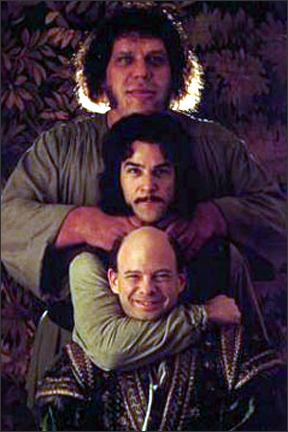
In the much-beloved movie The Princess Bride, Vizzini was the brains, Fezzik the brawn, and Inigo was, well, the swordsman. (Sorry, I couldn’t come up with a “b” word for the guy wielding the sword.) Despite the fact that Plato, Aristotle and Socrates were all morons compared to Vizzini — or so he said — his plan to kidnap and murder Buttercup imploded.

Inigo: bested.

Fezzik: beaten.

Vizzini: plain ol’ dead.

Remember what Inigo did when the plan went south — well, besides drinking himself into a stupor?

He went back to the beginning … and waited for Vizzini.

Smart man, Inigo.

What do you find when you go back to the beginning?

“This is where we got the job, so this is the beginning.”

Inigo may not have been able to see clearly — heck, he couldn’t even stand up straight — but he remembered a fundamental truth: When a plan fails, go back to the beginning.

Are you discouraged? Did that long-anticipated yes turn into an unexpected no? Walk away from it — but don’t abandon who you are. Go back to the beginning and remember your purpose: You are a writer. You have a job to do. Sometimes things don’t go according to plan. You get bested. Beaten. A dream dies.

Catch your breath, renew your heart … and then dream a new dream.

Who do you find when you go back to the beginning?

“I … am … waiting … for … Vizzini.”

Inigo was waiting for someone. For better, for worse, Vizzini was Inigo’s leader — the one he followed.

Going back to the beginning, waiting, doesn’t mean wasting time. Did you round the bend in the writing road and hit a dead end? Don’t be too proud to back up, turn around. Go back to the beginning and remember who you are as a writer. Answer this question: What makes your fingers fly across the keyboard? What keeps you up late and drags you out of bed early because you can’t not write this story?

Can’t remember?

Who is your Vizzini? Who first mentored you (maybe mentors you still)?Who helps nurture your dream? Who believes in you when you don’t? Go back to the beginning and ask them to help you remember.

It’s been fun talking about a writer’s life and the Cliffs of Insanity, the Fire Swamp, the Pit of Despair — and now Waiting for Vizzini. Everyone’s comments have made this more than a blog post — it’s become a conversation. So tell me, what lessons have you learned by going back to the beginning? 

*Just for fun, here’s a YouTube clip of Inigo waiting for Vizzini.

Post Author: Beth K. Vogt

Beth K. Vogt is a non-fiction author and editor who said she’d never write fiction. She’s the wife of an air force physician (now in solo practice) who said she’d never marry a doctor—or anyone in the military. She’s a mom of four who said she’d never have kids. She’s discovered that God’s best often waits behind the doors marked “Never.” She writes contemporary romance because she believes there’s more to happily ever after than the fairy tales tell us.