Risking Rejection

Why are we afraid to fail? Often because we believe rejection exposes a gap in us. It points to something we don’t want others to see. It confirms what our suspicions tell us.

We aren’t acceptable.

As writers, we risk rejection from many different sources. Projects and people alike can make us feel unacceptable, and throw us into a pit of paralyzing despair. Any one of a myriad of things have the power to make us give up on our writing dreams. If we let it.Definition of Rejection

  • Literary agents can reject us.
  • Booking agents can reject us.
  • Publishers can reject us.
  • Editors can reject us.
  • Endorsers can reject us.
  • Influencers can reject us.
  • Reviewers can reject us.
  • Media can reject us.
  • Readers can reject us.
  • And through Self-deprecation, we can reject ourselves.

So how can you empower yourself to feel acceptable when rejection says you’re not?

Author Jim Stovall
Jim Stovall’s Blindness Didn’t Hold Him Back

Challenge your own viewpoint. Take a 180 approach and look at this specific moment as your personal catalyst for change, improvement, and a call to do better work. Jim Stovall, a blind author and movie maker, knows rejection well.

You’ve GOT to watch the video on his link to see what he says about giving up. Here’s a quote to give you a hint of the amazing story you’ll want to hear. “That big dream would not have been put inside of you if you didn’t have the capacity to achieve it.”

Author John Grisham
John Grisham’s Tenacity Made the Difference

Another powerful example of tenacity in the face of rejection comes from an author most of us recognize. Internationally acclaimed novelist John Grisham. He understands what it feels like to fail in front of professionals, but he chose to learn from his mistakes, and keep on keeping on.

Finally, I would be remiss if I didn’t remind you of the greatest victory that came from the greatest rejection of all. A book that was denounced, fought against, and even after publication, faced efforts to utterly destroy it. But yet, the words inscribed inside changed the world, and made it a better place. The book I refer to is The Bible. Aren’t you glad God didn’t give up.

So the next time you get a rejection letter, phone call, email, or text, remember these three things.

Anita Brooks Walking Bridge Photo
Is Success Waiting Around Your Corner?

1. The capacity to make your big dream reality is already inside of you.

2. Rejection prepares us for great things in the future, and reminds us to stay humble when we arrive there.

3.  Just because a few people fight against your efforts doesn’t mean you won’t come out victorious.

Maintain a teachable attitude, then act with integrity, humility, and tenacity. This is your big dream. Take courage, and don’t let anyone convince you it’s unacceptable. Risking rejection can turn that big dream of yours into something real. But only if you don’t give up too soon.

Writing Life Lessons

photoNo matter what stage I’m at in the writing journey, whether it’s researching, plotting, writing, or editing, I continue to learn. Currently, I’m in my last round of edits for my debut novel, Shaken. Man, has it been humbling. I don’t claim to have all the answers to this writing journey, but here are a few tips I’ve learned from trial and error. Like my novels, I’m always a work in progress.

Paint a scene

This seems like a no-brainer, right? I thought it was, too. Except sometimes I don’t write all that is in my head. Thank goodness for an editor who reads the story and asks me to fill in the holes. Use the senses. Again, you would think this is obvious, but too often we forget. In my second book, I open with a beach scene. Can my reader smell the smoke from the bonfire, taste the salt in the air, feel the whip of the sea breeze, hear the lap of the waves, see the fireworks exploding? If not, I need to keep crafting.

Make connections

Link scenes, events, and characters. As my granddad told my brother when he came home from college late one night, “Account for yourself!” Make sure all your elements are accounted for, and again, not just in your head. If a character just spoke yet the scene ends and they are nowhere to be found, make sure there is a clue to the reader of where they went and when they exited the conversation. Again, these should be obvious, but sometimes when I focus on the story line at large, I forget these important little details that further immerse the reader in the story.

Books are not movies

I tend to see my book playing out like one of Nicholas Spark’s movies – sweeping, southern, and characters that tug at your heart. Except, books are not movies. What a viewer can take in in a few seconds of a new scene takes a lot longer to paint in a book. The best movies come from books that paint vivid scenes. Think the party scenes in Gatsby where Fitzgerald describes the house and guests in great detail. If you don’t know what I’m talking about, stop reading this right now and at least read those scenes.

Kill your “darlings”

This is a lesson one my college professors shared with me, and regardless of the time passage, it doesn’t get easier. First, let’s define “darlings.” It is any piece of your story that you are attached to that does not ultimately propel the story forward. You may think a scene is epic, but will your readers care? Does it demonstrate an irreplaceable character quality or scene that is essential to your reader’s knowledge of the story line? Is your attachment greater than the reader’s? If yes, then don’t be afraid to kill that “darling.” Your story will be better for it. Trust me, I know it’s painful, but strike with your red pen and make the page bleed.

You’ll never be completely satisfied

photo copyStop looking at the blinking cursor. Save and send. Your story will never be perfect. If you are waiting for that, choose a different career. I emailed my mentor a couple months ago and told her I thought my story sucked and I wanted to start from scratch. She laughed (I could sense it over email), and told me that it was great for where I’m at now. The next novel will be better than the first, and the third better than the second. If you know you have done all you can do right now, then allow yourself to be satisfied with the results and send that sucker. I still find mistakes in my short stories from college, and I couldn’t count how many times I have edited those pages. But I’ve also increased in my ability and my knowledge since college. I’ll focus on doing my best now and realize that I’m always growing.

What writing tips have you picked up along the way?

Why I Write Inspirational Fiction

People ask me, “Why do you write Christian fiction?” This reminds me of when people ask me, “Why are you just a nurse?”
pragIn reality, they are politely implying that I am too smart and, perhaps, have wasted my time by never going for a medical degree. However, I think the answer to these two questions is the same.

To save lives.

I’m an ER nurse and a suspense author–I do tend toward the dramatic, and this is a dramatic post. But then again, life is dramatic. So is death.

If you’ve ever been in a hospital, you know a nurse is the last line of defense for a patient. We’re the ones that give medication, order tests, make sure patients are at the right place at the right time. Ensure that people who are learning medicine don’t kill you. A seasoned nurse (even if they aren’t super warm and fluffy) is the best asset for a patient next to a competent physician.

What I see in nursing, some days, are last moments. The last moment of life. The last moment of “My life was this…” before hearing a cancer diagnosis. The last moment of peace, maybe for a while.

It surprises me how blase people can be about eternity. They just feel that they know the right answer without having cracked open a Bible or any other holy book. For a Christian, a person who doesn’t invest in investigating life after death is curiously reckless. Like biking without a helmet. Or biking and texting without a helmet (yes, I just saw that last week!).

Since I experience the fragility of life, I want people to be confident in their beliefs about the afterlife. And I know many of us don’t have as many moments left as we think. A novel can be a less threatening way to introduce someone to the concepts of Christianity than handing them a Bible, and yet can still deliver a strong, compelling message.

It’s like pulling someone off the train tracks as the whistle is warning them to move.

Here is my top ten list of why I write Christian fiction:

1. September 11, 2001.
2. The Boston bombing.
3. Sandy Hook Elementary School shooting.
4. The child that died of an allergic reaction.
5. The family I helped give a cancer diagnosis.
6. My friend’s brother, who died after being in a vegetative state for 13 years following a motorcycle accident.
7. Christians who are killed/maimed/imprisoned for their faith.
8. Kids in my ER whose families won’t show up.
9. Driving on ice.
10. Moore, Oklahoma tornadoes.

What I’ve seen is that sometimes I can’t stop the train. I can’t stop that moment. What I can do is offer what I think is hope . . . preventative medicine for the ever after.
We as religious people get so caught up in divisive cultural issues. Pro-life/pro-choice. Traditional marriage. Homosexual marriage. Gun control. And I’ll be the first to say, as a Christian, that while I have strong beliefs on each of these issues, my expressing them can pull people away from the true message of why Christ came.

He died. For. You.

That’s it.

So before you decide, do some reading. Whatever method is the least threatening. A novel. A blog post. The Bible.

Just read and see if His message begins to resonate with you.

Before the train whistle blows on your last moment.

Would You Write A Book Without an Outline?

You probably wouldn’t drive across the country without a map.

You probably wouldn’t cook Thanksgiving dinner without recipes.

Would you write a book without an outline?

The practice of outlining a book in detail takes an enormous amount of discipline. Focusing on the infrastructure of the story is a whole different ball game than writing in free form and letting things evolve as they may. My first book was a result of rambling writing sessions, often resulting in superfluous content which ended up being taken out of the story. Although it was fun to just write and see what happened, it seemed there had to be a more effective method out there, one that would result in a greater yield with less exertion. Most writers have other jobs, and when it comes to writing time, every moment is precious.

Some writing coaches suggest that creating a detailed outline is the most important part of book writing, and the part where most authors struggle. Writers may spend weeks or even months on the outline alone, to provide some frame of reference for how detailed the outline can be. Writing a book is a project, not unlike building a house. There is the foundation, there are the walls, the flooring, the roof, etc. Only when the skeleton of the house is in place can homeowners enjoy working on some of the more aesthetic features of the home – picking out colors, the yard, creating curb appeal, you name it.

A project manager friend who has been intrigued by the writing process asked how my latest book was coming along. Our casual conversation at a wedding evolved into something else when I mentioned being stuck halfway through the book. The project manager asked if she could help me in going back to the drawing board and getting serious about planning it all the way to the end. I started sending her samples of my content and images of people that remind me of my characters. She would go through what I had written so far against our burgeoning outline and provide feedback: “I don’t think the character would say that on page 73,” or “When are the characters ever going to make it to Barcelona? You said that they have been saving up their mileage points for the trip,” etc.

At first I wondered if it had been a little premature to share my work with someone else. She had questions that were not always easy to answer, such as why I chose one title over another. Each time I had to explain an aspect of the story, it helped me figure out how to convey metaphors and messages with much greater clarity. After a few short weeks of this exchange, we finalized the outline. It’s all been downhill from there. Writing to an outline hasn’t seemed restrictive at all. It’s been like driving with a navigational system in the car, so you can better focus on the traffic, the scenery and the passengers.

Compass and Bible
Writing can be a very solitary profession, but creating an outline is a great opportunity to collaborate with others, should you desire to do so. It’s a lot easier to get someone to read an outline than to read a manuscript of 120,000 words or so. If you can have the feedback given to you in a postive way by someone who can deliver it in a manner that makes you comfortable, then your writing will become that much better for having another pair of eyes review it. Having to discuss and explain your work, your ideas, and your story line can be pretty awkward in the beginning. However, writers have to do it eventually anyway, so why not start from the get go?

Writers, do you sit down and just write, or do you use a more formal approach?

Writing In Every Season

485045_10101344113008718_1557147312_n

I don’t know about you, but as a writer, I struggle with managing my time.

I work full time. Serve in my young adults ministry. Belong to a community group. Spend time with my family. Juggle a writing contract. Spend free time with friends. Find time to work out. Sleep somewhere in there.

For those of you who have children, I’m sure this list is much longer. Somewhere in the middle of juggling that mess, I hit seasons of extreme burn out and discouragement. Everything seems to pile on at once, and ultimately my writing suffers.

I once heard that it is vital for a writer to be mentally, spiritually, physically, and emotionally healthy. To be honest, I don’t know how that is humanly possible. I am rarely completely healthy in a couple of these areas at a time, and healthy definitely hasn’t described me the past few months.

In January, I received a three-book contract. I couldn’t express my excitement! But, it went down hill from there. Work demanded all my time, I wrecked my car, edits came in right as I hit the most demanding couple of weeks on the job, and conflict rose in several friendships. With all the stress, I lost my appetite and my ability to sleep. Talk about unhealthy in every area.

I wondered how I could possibly finish the edits. I couldn’t concentrate. Creativity escaped me. But I stubbornly kept plugging away. Signature

Then something clicked. My broken emotions began to pour into my character’s painful moments to a greater degree than they ever had before. Not only did I understand what the editor was requesting, but I finally felt like I could pull it off and be proud of the result!

The Lord used my weak moments to breed creativity. 2 Corinthians 12 says, “But he said to me, ‘My grace is sufficient for you, for my power is made perfect in weakness.’ Therefore I will boast all the more gladly about my weaknesses, so that Christ’s power may rest on me.”

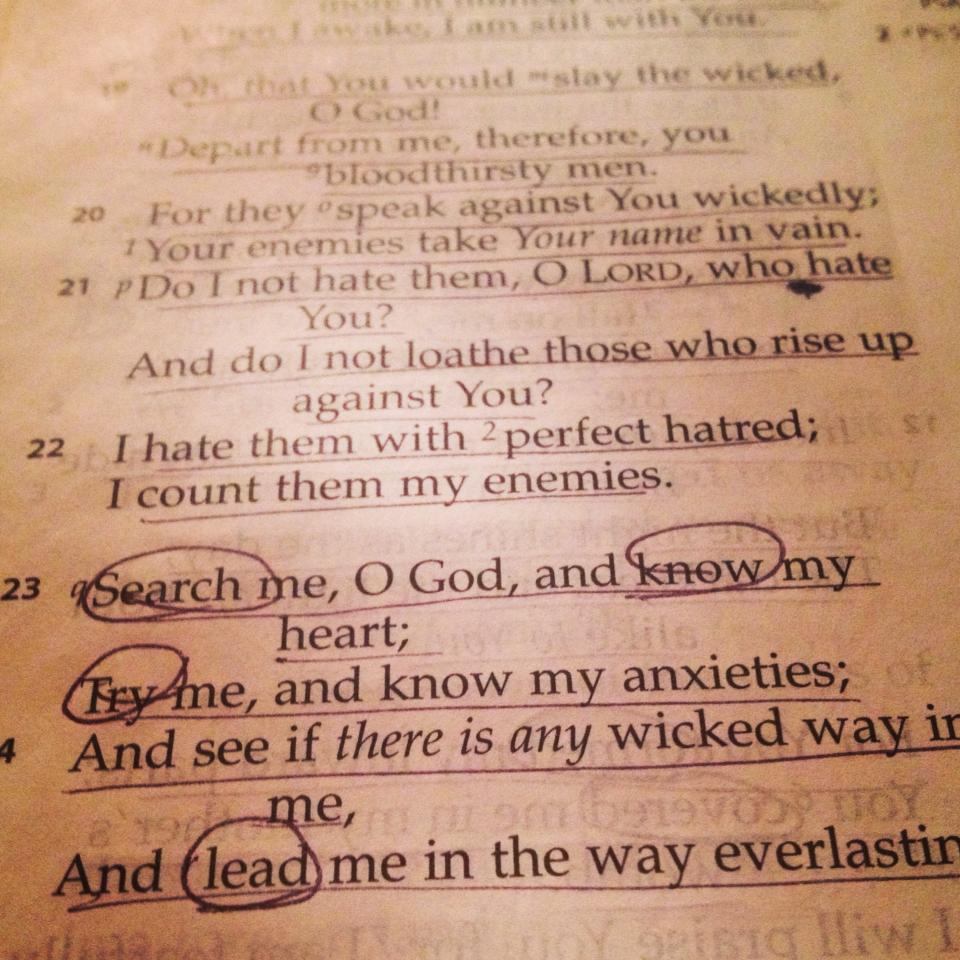
Thankfully, the call and standard of a writer is not to be healthy but faithful. In times of emotional struggle, the Lord uses that brokenness to translate a truth someone can relate to in my writing. I love what the psalmist said in Psalm 139, “Search me, God, and know my heart; test me and know my anxious thoughts. See if there is any offensive way in me, and lead me in the way everlasting.” If God knows our hearts inside and out, surely He can make beautiful writing flow from the inward parts of who we are, for His glory and the good of others.

Just as we labor to create a masterpiece, Jesus is in the process of molding us into His image. Sometimes He uses desert seasons to chip away excess. Sometimes He uses the mountain tops to create epic scenes. But He uses every piece of our story for His glory. We are never disqualified as writers when we can’t get it all together. Trust, obey, and write. Those messy seasons may just be used to encourage a reader, creating a mountain top moment in their life.

The one who calls you is faithful, and He will do it.” 1 Thessalonians 5:24

What areas do you need to focus on in your own life to be healthy? How has the Lord used rough seasons in your writing?

Just Look at Me: Encouragement for the Highly Distractible Writer

file000551198693 (1)

When my sons were toddlers, they were so easily distracted (look: a squirrel!) that I often knelt down and gently placed my hands on their cheeks to help them listen.

“Look at me,” I’d say, waiting until their eyes met mine. Then I asked them, “What did Mommy say?”

Lately, I’ve felt God kneeling down, kindly pressing His hands to my cheeks. “Look at me,” He says. It’s not only a call to attention, but to single-minded devotion.

“Yes, Lord, ” I reply, taking my eyes off Facebook, Pinterest–even the Wordserve Water Cooler–and focusing on Him.

I feel Him kneeling down when I get jealous about other writers’ accomplishments; when I spend too much time clicking and too little time praying; when my tendency to compare Facebook “likes” and Twitter followers distracts me from the reasons I write.

Last week, I let Satan discourage me. Look at that author, he said. She’s your age and has written twice as many books as you have. Plus, she has a radio show, and her speaking resume is much better than yours. 

I started to get insecure, until I remembered the Lord’s hands on my cheeks. “What did I say?” He asks.

“Just look at me,” I respond.

I get it, Lord, I really do.

However, it’s hard to keep my focus when I am required to use social media for my part-time editing job. Plus, our post-recession world of high technology and low discretionary income means that book publishers’ marketing budgets are shrinking, while editors’ expectations are rising.

Sigh. This business is not always good for a highly distractible author…and yes, the apple does NOT fall far from the tree. (Look: a new webinar on building your tribe!)

I know I’m not the only author who struggles with this. Or at least I hope I’m not. So, let’s lean in and focus on our Parent’s eyes for a second.

“Do you hear what I’m saying?” God says.

When we spend time with Him, and hear His perspective on this crazy profession He’s called us to, we realize that He has uniquely called each of us to a highly specialized path.

I don’t have to be like anyone else. Although God calls me to work diligently at my craft and creatively tell people about my books (not for my glory, but His), I shouldn’t obsess about numbers, lists, or honors. All that leads to a place called “Crazy-ville.” And trust me, I can get there on my own.

My fellow scribes, God is calling me–and you–to be faithful and obedient:  “But seek first his kingdom and his righteousness, and all these things will be given to you as well.” (Matt. 6:33)

Just look at me, He says, and write what I’ve told you to write. Write out of the overflow of our relationship, and trust me for everything else.

As a friend says, “God’s got this.” We can trust Him. After all, those heavenly hands on our cheeks are nail-scarred…from His scandalous, all-consuming love for us.

The Best Advice I Could Have Given Myself

SignatureCountry artist Brad Paisley released a song in 2007 titled “Letter to Me,” in which he gives his teenaged self advice for the future. It makes me think about what I would have advised myself thirty years ago when I began my freelance writing career. So, with a tip of my own cowboy hat to Brad, here’s my letter to my younger self!

Dear Jan,

I am you thirty years from now, and I want to give you some advice about writing.

  1. Get a day job. You are never going to be on Oprah talking about your bestseller. (Oprah is a person with a very influential talk show in the future. She has a book club, and Tom Cruise jumps on her sofa. Enough said.) Accept the fact that your writing habit will never financially support you. Fortunately, your husband will, so be sure to say “Yes” when a guy named Tom proposes to you. You’re going to think he’s just trying to cheer you up because your car’s water pump broke down, but he’s serious. DO NOT LAUGH IN HIS FACE, because he will never let you forget it. (Although it will make a great blog post. A blog is …never mind. You’ll find out later.)
  2. No matter what you think, your first and second book manuscripts are trash. Really, they are. It would be nice to just skip writing them altogether to save time and effort, but if you don’t write them, you won’t write your third book, which will find a publisher. Just thought I’d let you know.
  3. You’re going to meet a woman named Belinda. Don’t ever tell her you’ve written a book, because even though she’s going to be one of your best friends, she’s going to drive you crazy with her constant stream of ideas for books SHE wants to write. If she ever brings up that she’s thinking about writing a book, immediately change the subject. (You can thank me later.)
  4. Write a YA romance series about a vampire and a high school girl. Believe it or not, it will sell and launch a publishing trend. I’m serious.
  5. Speaking of serious – stop taking yourself so seriously. There are many, many writers out there. The bad news is that you have to compete with them for contracts. The good news is that the writers you meet will absolutely enrich your life, if not your pocketbook. (Reread #1 above.)
  6. Don’t give up writing. You will get published. You will also get rejections, but that’s part of the package, so get over it and get it out of the way. It will give you more time to write and more confidence in your writing. Writing is your gift, so enjoy it, develop it, invest time and effort in it, and it will reward you in ways you can’t even begin to imagine.
  7. Finally, if you ever have a chance to buy stock in a company named Apple, you might want to do that.

Love you!

Jan

What advice would you give your younger self?

If Ever There Was A Time For Writers . . .

269665_10200995681632023_245803796_n
*****

“It is the miraculous language that drags me back into its delicious kingdom again and again . . . meticulously chosen words . . . I want to enter this kingdom, with such desperation, I am willing to die for it . . . And to enter a book, to let my life course out and stream past me, is to, in a  small way, die.”

On Reading, by Cynthia Cruz, via The Rumpus, 4/29/2013 

*****

If ever the world groaned for hope, it is now.

If ever the world needed writers, artists, poets, and musicians, it is now.

Even a glance through centuries past testifies to the power of artists, those sage interpreters of the soul, to draw hope from the detritus of despair and unveil rainbows from the bleak abyss of injustice.

And so, if God has called you to write, He has called you to deliver His people from this present darkness.

If that sounds like a big job, it is.

If that sounds like it’s too much for your feeble pen to handle, it is.

Because only a Savior can sand down the sharp edges of pain. Only a Savior can sweep darkness away with a great exhale which leaves in its wake a symphony. Only a Savior can deliver us.

So what’s a writer to do?

First, like the brown, peeling bulbs we tuck into the earth in the fall, don’t be afraid to plant the seemingly worthless and ugly. God is smitten with the beauty we allow Him to create with the broken, insignificant and useless parts of our selves. Keep writing, even if there’s no tangible payback or reward. Be faithful with little, and He will be faithful with making much of whatever meager loaves and fishes we lay at His feet. Spring comes, dear one. Spring comes.

Second, take time to celebrate Sabbath. Renew your mind and stretch your imagination by reading a book outside your usual genre, or a book in the Bible you haven’t considered in a while. And as you do, pray God gives you eyes to see and ears to hear what He wants for His lost ones. Look for ways to infuse His whispers into your stories.

Third, if you feel stuck, dig deeper. Press into the words you pen, and let them press into you, that they may make an unmistakable imprint of redemption and hope upon the reader by the time the last page is turned.

Make people want to enter not just any kingdom, but God’s Kingdom, breaking into the world by the surrender of your pen today.

*****

    “I spoke to the prophets,

gave them many visions
and told parables through them.”

Hosea 12:10 (NIV)

*****

How can you let God lead you more in your writing life? In what ways can you more fully surrender your pen for His glory? 

*****

Amy writes words of hope for a hurting world. Look for her debut novel, How Sweet The Sound, coming March 1, 2014 from David C. Cook.

Around The Block With Writer’s Block

do-not-write-in-this-spaceSome people say that writer’s block is what gets the housework done, but if that were true, my house would sparkle and shine.

My vitamins would be alphabetized from A to Zinc, my nightstand drawer would contain no crumpled tissues of questionable provenance, and the frisky lint bunnies behind the dryer would now be reproducing in the rubbish bin.

For me, writer’s block doesn’t get the housework done, but it is what keeps the Internet humming along. And I don’t only turn to the Internet as a writer’s avoidance behavior, either. Hanging out online may prolong the blocked condition somewhat, but if I give the Web even half a chance, it eventually provides the cure I so desperately crave.

First, of course, there’s Facebook. Like other writers, I’m lonely. Ye Olde Writer’s Cave is dank and dreary and its stalagmites stab at my soul. But scrolling through my news feed–replete with photos of gregarious dogs who say funny stuff, sullen cats pictured splayed across Other Writers’ Keyboards, and videos of friends’ new grandbabies–brings me to my senses fast. There are worse things than loneliness.

Like wordlessness. And booklessness. And publisherlessness. Oh, my.

If Facebook somehow fails to snap me out of writer’s block, I click over to Pinterest. Within seconds, I’m immersed in a fantasy world of exotic locations, bohemian wardrobes, hunky men (some of my Pinterest friends are edgy with their pinning!), gorgeous homes, and just desserts.

It’s the desserts that get to me, if anything on Pinterest can. I’ve read that even viewing a luscious treat can cause–in some susceptible individuals–an insulin response with corresponding weight gain.

Let’s just say I’m highly susceptible.

When I literally feel my bottom-in-chair growing larger while innocently viewing the ingredients list for yet another bacon-intensive appetizer, I know I’m a site closer to loosening the block’s grip on me. One more stop on the Internet and I’ll be home free and back to cranking out another chapter.

I know exactly where to go, too.

If I truly can’t find two words to put together, my fingers click over to Craigslist, the piece de resistance in breaking the back of writer’s block.

Now, not just any category on Craigslist will do. I skip the ads for RVs and energy-deficient major appliances and ancient treadle sewing machines. I have no use for the personal ads, and discussion forums about dying and haiku aren’t really my thing.

Instead, I wallow in the hundreds of jobs on offer, immerse myself in the positions I could be applying for that might surreptitiously scratch my writer’s itch, that might anesthetize the pain I experience when I’m not doing my real job. The job I’m meant to do. Putting down glorious words, one after the other, preferably in the best possible order.

Can I hope to find employment as satisfying as writing is on a bad day, a job that could truly replace my need to write?

I pass over the ad for an exotic dancer for bachelor parties, but not without thinking of that Facebook poster that shows two gals dancing—one young and agile and the other old and clumsy. The captions read, “How You Think You Look” and “How You REALLY Look.”

Then I skim this heading: “Bilingual Interpreters Wanted! Spanish and Many Other Languages!” But somehow “many other languages” seems like Triglingual Interpreters Wanted. Or perhaps Quadlingual or Quintlingual, not that it matters. I only speak English with a smattering of adorable French phrases thrown in, mostly on the topic of finding the salle de bain closest to my train’s platform.

Being reminded of my obsession with locating the bathroom (in as many languages as necessary) draws me to another ad, this time seeking a participant in a medical study about urinary incontinence. It offerers $1200 compensation for time and travel expenses, plus a generous Depends allowance. I shake my head in dismay.

“You’re all wet,” I say to myself, a victim of my own dry wit. “These jobs aren’t for you. Maybe you should start with finishing this blog post, and then see what happens next?”

Before I shut down Craigslist, my eyes fall on one last ad.

“Surrogate Mothers Needed! Earn $28,000 and Up!!!!!” I feel a visceral (if latent) nurturing instinct flow through me while reading the job description. The money is certainly tempting, but then it hits me. They’re probably looking for someone with a uterus. There’s always a catch.

So that settles it. I’m a writer, and getting caught in a bad job won’t fix that. Only writing will. Once again, the Internet’s cured me of a vicious case of writer’s block.

This time, I hope, for good.

Do you suffer bouts of writer’s block? Any cures you’d like to share?

Of Making Many Books There Is No End, Dear Me . . .

Last month I attended the Association of Writers and Writing Programs Annual Conference & Book Fair in Boston. With over 11,000 writers in attendance, over 500 readings and sessions on everything from teaching creative writing to getting published, and over 650 exhibitors at the book fair, the AWP is easily the biggest literary conference in North America.

This is the third year I’ve attended. I bring home lots of book fair goodies for my students—writing contest announcements, literary magazine samples, little notebooks and buttons and koozies and USBs with literary slogans on them—and I always learn lots about both teaching writing and the business of writing.

Nevertheless, by day two of the four-day conference—though I’m still looking forward to the panel sessions and readings I’ve highlighted in my AWP planner—I’m impatient for it to be over with. It’s not just my usual introverted person’s conference malaise. It’s the feeling I have every time I enter Barnes & Noble, only 11,000+ times worse. Being in the company of that many fellow writers makes me feel so hopeless.

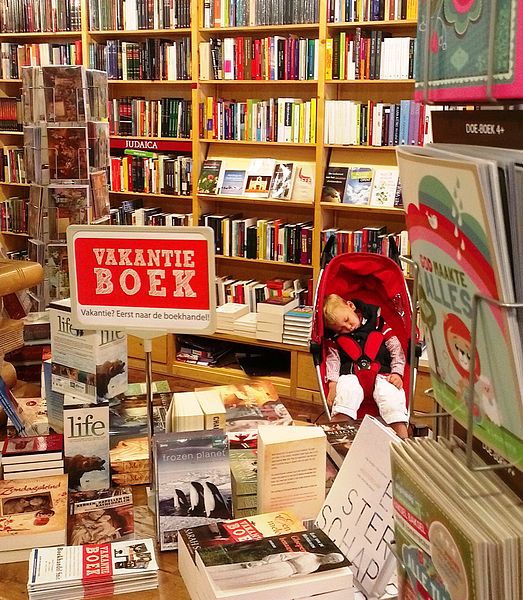
So many authors. So many books. Sleeping_at_the_bookshop_cropWho in the world will ever read all of them? I ask myself. And even in the privacy of my own mind, I don’t allow myself to ask the logical next question: What can I add to the billions of books already on the shelves, the eleven-thou-drillions of books yet to be published? And why bother?

Whenever I am overcome with one of these fits of writerly despair, I reluctantly remember the Wise Teacher’s remark at the end of his book of the Bible: “Of making many books there is no end, and much study is a weariness of the flesh” (Ecclesiastes 12:12 NRSV). The passage is often preached as a disparagement of all writing but the Bible. As the Jamieson, Fausset, Brown Commentary Critical and Explanatory on the Whole Bible explains, the “many books” in question are books “of mere human composition . . . as opposed to . . . these inspired writings,” and it is the study of these “mere human books” which “wearies the body, without profiting the soul.” What could be more discouraging to a Christian writer?

In any case, in hope of uncovering some trace of writerly optimism in the Teacher’s words, I went to Eugene Peterson’s paraphrase of the passage. Here it is in context:

Besides being wise himself, the Quester also taught others knowledge. He weighed, examined, and arranged many proverbs. The Quester did his best to find the right words and write the plain truth.

The words of the wise prod us to live well.
They’re like nails hammered home, holding life together.
They are given by God, the one Shepherd.

But regarding anything beyond this, dear friend, go easy. There’s no end to the publishing of books, and constant study wears you out so you’re no good for anything else. The last and final word is this:

Fear God.
Do what he tells you.

And that’s it. Eventually God will bring everything that we do out into the open and judge it according to its hidden intent, whether it’s good or evil.
(Ecclesiastes 9-14 )

The Teacher—or, the Quester, as Peterson calls him—starts out by describing to his “dear friend” his own writing process: a weighing and examining and arranging not unlike the “orderly account” based on “investigating everything carefully” that Luke tells his own dear friend was his method in writing his gospel (Luke 1:3 NRSV).

Like any good writer, the Teacher seeks to tell the plain truth in just the right words. That, in any case, is what I keep telling my writing students should be their goal as writers.

Beyond that, the Teacher seems to be saying in Peterson’s version, don’t stress about it. Just strive to do what God wants you to do and trust that God will make of it what he wants.

And that, today, is my comfort as a writer, and my prayer: that my hidden intents will be found worthy and that God will make of my efforts what he will.