Dangerous Curves Ahead

You hear a lot in writing circles in regards to the pursuit of publication—just persevere. Keep at it. You’ll get there.

DangerousCurvesI heard this a lot when I was going for my ultimate job in nursing. I really wanted to be a flight nurse. After I got the required experience, I began the application process—something like seven interviews later I still didn’t have a flight nursing position.

I’ve spent lots of time theorizing why and I still would love to do this job, but in my heart I think it’s not going to happen. It’s just not God’s will for my life no matter how much I desire it.

It may not be popular to talk about quitting the pursuit of publicaton on a writing blog. But then ER nurses rarely do what’s popular—we do what’s necessary. I was pursuing flight nursing when I was supposed to be serving God writing. Maybe you’re pursuing publication when God has another dream for your life that will impact people more than what you’re pursuing right now.

But just how do you know? I’ve been obsessed with learning God’s will. I often say I wish I’d wake up with a gold note card on my pillow with the answer, but it is never that easy.
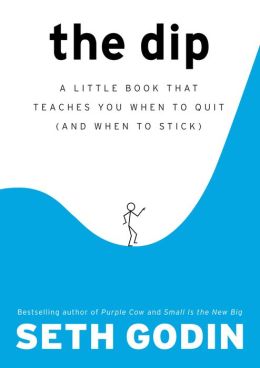
TheDipAll truth is God’s truth no matter who writes it. Isn’t that an amazing statement? I think I found some of God’s truth in a little (literally—it’s seventy-six half-size pages) book called The Dip by Seth Godin.

In the beginning, he makes some pretty profound statements. The phrase all of us learned, “Quitters never win and winners never quit,” is profoundly wrong. Godin says winners quit all the time.

“They just quit the right stuff at the right time.”

The trouble is telling the difference. The dip refers to the process of learning when you’re taking on a new project you’re excited about—like novel writing. The dip is that moment you wonder why you started to write the book. You don’t think you can pull it off. You’ll never finish it.

If you can push through these moments of the learning process, then extraordinary benefits accrue to the tiny minority of people who are able to push just a tiny bit longer than most.

But, Godin states, the opposite is also true. Extraordinary benefits also accrue to the tiny minority with the guts to quit early and focus their efforts on something new.

Again—it’s telling the difference.

To help, Godin discusses three curves.

1. The Dip: The valley of learning. Successful people don’t just ride out the dip. They lean into it. Push harder—changing the rules as they go. Part of knowing you’re on the right path is that you do get small amounts of positive reinforcement along the way. You final in a contest but maybe don’t win it all. You get positive comments from an agent and/or editor.

2. The Cul-de-Sac: This is where you work and work and nothing much changes. For me in my nursing career—I have never gotten any promotion I ever applied for—in twenty years! Honestly, you would think I was the worst nurse ever. I’m actually a very strong nurse but something has kept me stuck. If that hadn’t happened I would have never pursued publication where the doors opened much easier for me. But perhaps this is the pursuit of publication for you. You’re in the cul-de-sac.

3. The Cliff: It’s a situation you can’t quit until you fall off and the whole thing falls apart. The example Seth gives here is cigarette smoking. Cigarettes are highly addicting, but you do get a good feeling even though it’s detrimental to you—which, in the case of smoking, could be lung cancer and then death.

Godin hypothesizes that The Cliff and The Cul-de-Sac both lead to failure and it’s best to quit these pursuits early and move on to the thing you’d be successful at. That thing for which going through the dip would be worth it.

I would never tell anyone to stop writing—ever. Writing is a creative outlet that soothes the soul and spirit. It can ease tension, stress and frustration because spilled words on the page is cathartic. But—the pursuit of publication is a whole other animal. It takes time, money, resources, and sleep.

And perhaps God is calling you to do something else.

What dream have you had where you’ve persevered through the dip and had great success? On the flip side—is there something you’re pursuing that perhaps you are considering quitting and why? Good things to think through.

All italics are quotes from Seth’s book. I hope you’ll take the time to read it.
This blog first appeared at Seekerville. I hope you’ll check it out!

24 Ways to Develop Your Muse

Dickens_dream
Charles Dickens’ Dream

The muse that lives deep in your subconscious is something of a sprite. You can write without her of course, if you don’t mind being methodical. But when the muse shows up, she takes your writing to a whole new level, offering plot surprises, adding in soulful wisdom you didn’t know you possessed, and giving your story a dreamlike quality.

The problem is that your muse is not easily tamed. She comes and goes at her own will. She is notoriously right-brained and knows nothing of schedules and deadlines. And yet, like the stray cat in your neighborhood, she can be lured in.

Over the years, I’ve learned a few things that work with my muse. Your muse, I’m sure, has his own personality, so your mileage may vary.

  • Let your mind drift. When your guard is down, as you take a shower, walk the dog or do dishes, great ideas will surface.
  • Ask yourself tough plot questions before you go to sleep. Your mind will get to work on it without your conscious self even being aware.
  • Flirt with writing challenges that are too difficult for you. Your muse will take the dare, if you give her time.
  • Explore scene kernels. Take a snatch of dialogue or a small piece of action and set your mind to simmer for a few days before trying to expand it into a full-fledged scene.
  • Fire your internal editor. You can invite him back later once your muse has completed her work.
  • Release guilt, self-doubt and worries. The muse likes to play, so be a child at play.
  • Read poetry. It will enrich the word creator within you.
  • Write lists of random evocative words. (See above).
  • Take entire writing days. Send the kids to Grandma’s. Take a vacation from your day job. The longer you immerse yourself in the writing, the more your muse will surface.
  • Take breaks from the writing. Muses need their rest too.
  • Write dangerously. Forget the market. Forget your audience. Break a few conventions. You can always scale back later, but a few writing leaps will give your muse room to expand your story.
  • Do your research. Whether you’re writing about a Viking ship or a modern day heart surgeon, your muse can be more creative if she’s well-informed.
  • Say no. No to committee meetings. No to the internet and solitaire. Writing time is golden, and it has to be protected.
  • Follow rabbit trails. Leave the outline, and see where the what-if leads. Sometimes the muse just knows.
  • Sleep well. A rested muse is more creative.
  • Conversely, stay up late. If you’re on a roll, don’t let the muse leave.
  • Do something you haven’t done before. If you’re not a singer, sing out loud. Cook exotic meals. Dance. Hike. Learn origami. Trying something new, especially something physical, releases another part of you.
  • Let your muse free while you immerse yourself in a new book or movie. She’ll extract ideas that become totally original when they mix in with your story.
  • Put it in writing. Notes have a way of kick-starting your subconscious into action.
  • Twist the story without a clue of how it will resolve itself.
  • Go outside. Sunlight and wind and grass invigorate us, and thus our stories.
  • Live mindfully. Taste what you eat. Turn off the TV and listen to the sounds in your home. Feel the words on your tongue as you talk. Bring your senses alive and it will build new grooves into your story.
  • Be patient. If your story is in knots, work on some other aspect. Meanwhile, your muse will be untangling the story threads under the surface.
  • Most of all, don’t try too hard to design the first draft. Ride the story’s waves. Control has its place, but the stories with the biggest hearts come from a place of freedom.

There is more to the mind than we know. It has multiple levels and works in ways we don’t always understand. Give those deeper levels permission, and your muse will work hard for you.

Don’t Take My Advice

IMG_2494

It’s awkward offering advice in a blog post when your advice is to ignore the advice in blog posts.

But that’s exactly what I’m proposing for fellow writers — at least sometimes.

The problem isn’t that there’s a lack of good advice in such posts. I love nothing better than reading some “Ten-Ways-to-blah-blah” post and finding the suggestions so helpful that I immediately implement half of them.

The problem is that, in this age of easy information, we don’t think enough for ourselves. That we see ourselves as consumers of others’ creativity and not inventors of our own. That we leave too much of the imagination to someone else.

Long ago, I had the privilege of writing a piece for Sports Illustrated on Dick Fosbury, the 1968 Olympic high-jump gold medalist. “Foz,” as we Oregonians dubbed him, was a gangly, uncoordinated high school kid and self-admitted high-jumping failure.

Then he got the audacious idea to scrap the traditional “Western Roll” style of jumping. Instead, he did something nobody had done before: he soared over the bar backward, face to the sky, legs bent as if dangling over an exam table.

The short-term results? Laughter from his teammates. The long-term results? He became the greatest high-jumper in the world.

By literally turning his back on the establishment, Fosbury revolutionized high-jumping; since 1968, virtually all jumpers have adopted his style.

That never would have happened had Fosbury not dared to be audacious and think for himself instead of simply settling for “the way everybody else does it.”

But isn’t that how most of us write, edit, and market — based on others’ advice?

It is for me. Then, every now and then, desperation—the same thing that fueled Fosbury’s “about face”—triggers my own creativity.

The rough draft of my nonfiction book about the first World War II nurse to die after the landings at Normandy had become so unwieldy I couldn’t see the forest for the trees.

I’d written the 70,000-word book on an 11-inch laptop and I realized I had little idea of what it was long on and short on.

Conventional wisdom whispered: Let a handful of perceptive editors weigh in—and, ultimately, I would do that, of course. But I wasn’t ready for that step just yet. I needed some way to see into my story. To be in my story. And then the idea struck.

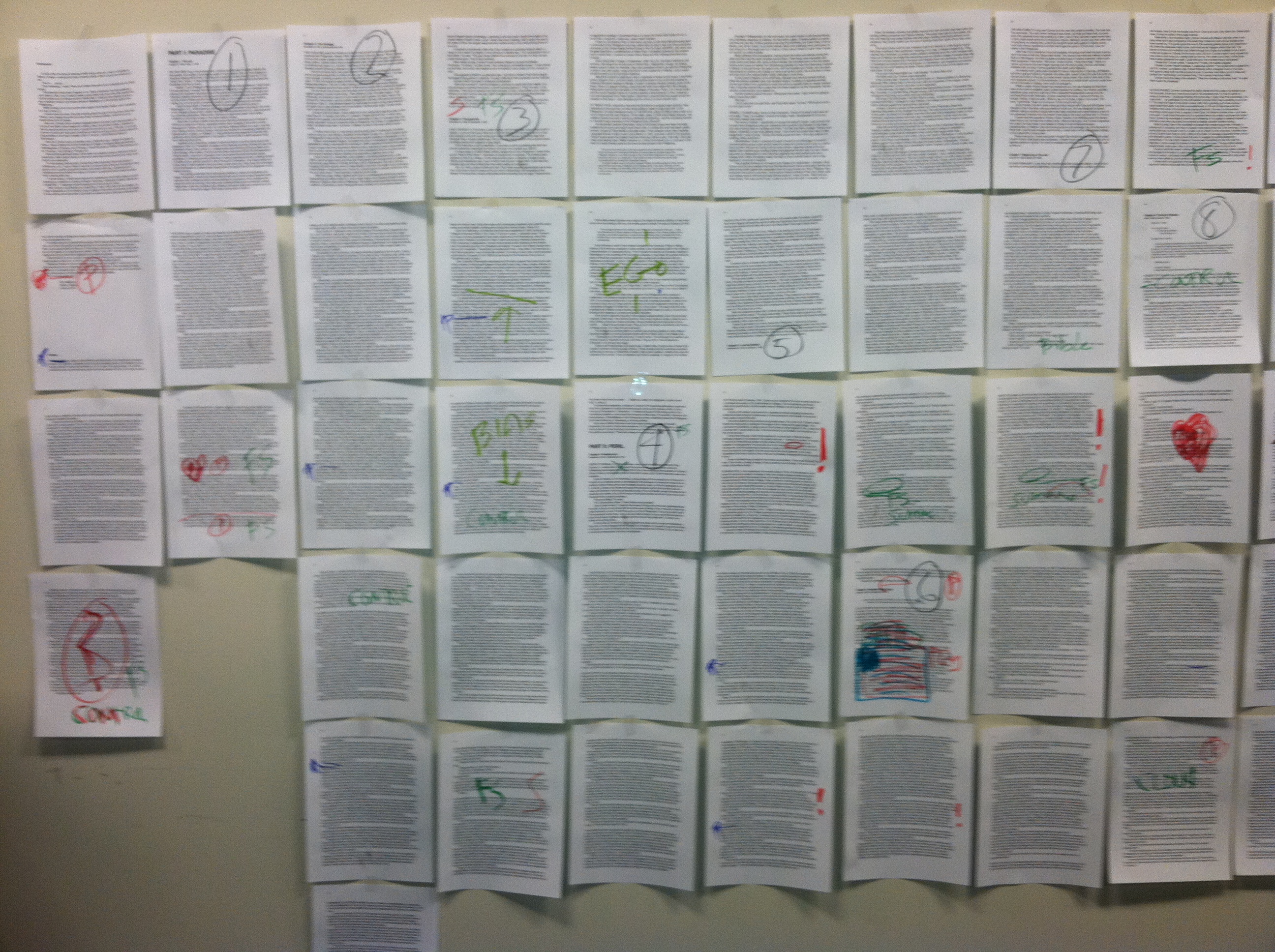
I printed out the book, double-spaced. I used colored felt pens to mark nuances I wanted to make sure were spread consistently throughout the book: dialogue, foreshadowing, action, what war smelled like and sounded like, in addition to the standard “what it looked like” perspective. And more.

A newspaper columnist at the time, I then slapped all 250 pages on three walls of our office’s photo studio—picture a dark-walled racquetball court—and, bingo, I was, indeed, inside my story. Literally.

With this perspective, I could see I had Mojave Deserts of dialogue dearth. I went chapters without letting readers hear the sounds of war. I had some chapters far too long, some far too short. I found all sorts of adjustments that needed to be made.

Never mind that nobody else but me could decipher my felt-penned hieroglyphics. In half a day—and despite a few smirks from newspaper colleagues—my mind’s focus went from fuzzy to sharp on what my book needed.

The experience opened me to other self-invented ideas to help my writing, from walking around the block while doing long edits (exercise, baby!) to discovering the gold mine of information that used bookstores offer and the Internet never will.

Among the best lessons I learned while doing the 452-mile Oregon portion of the Pacific Crest Trail (Cascade Summer) was this: hike your own hike.

And so it should be with writing. Seek wisdom from others, sure. But don’t be afraid to seek it from yourself. Like Fosbury, don’t be afraid to be a tad audacious and turn your back on the establishment.

There. Now, feel free to ignore all the aforementioned advice and come up with something better yourself.

WHY are you Writing?

Today, the WordServe Water Cooler is pleased to host guest blogger Kim Zweygardt. Kim recently attended the Re:Write Conference and is here to give us some insight into what she found so valuable about this conference.

Welcome, Kim!

Writing2“I know I can write.”

“I am a writer.”

Writing is more than something I enjoy or can do well. (All those “A’s” in English Comp surely count for something.)

Writing is my calling.

Even so, after a blistering critique in 2014, I spent more time not writing than writing. Doubt crept in, undermining my call.

“I think I can write.”

“At least I think I’m a writer.”

I floundered, not sure how to regain the confidence to write. What would it take to jump start the flow of words onto the page?

In February, I found my answer in Austin, Texas when I attended a different kind of writer’s conference. Re:Write—The Ragged Edge “aims to tackle issues that writers face every day, offering guidance, insight, and a hefty dose of hope along the way.”

The Ragged Edge conference was filled with power hitters. Some I knew and had heard before: Ted Dekker, George Barna, Jim Rubart, Susan May Warren, Mary Demuth, Sandi Krakowski, Mark Batterson.

Others were new to me: Rusty Shelton, Claire Diaz-Ortiz, Chad Allen, the delightful “tour guide” to the weekend–Julie Carr, Rachelle Dekker, Kevin Kaiser, Ruth Soukup, Derek Webb and the lovely Esther Fedorkevich who founded The Fedd Agency and hosted the conference along with author Ted Dekker.

As I listened, I had my mind bent over and over again.

You see, it wasn’t so much about the how of writing but much more about the why. It wasn’t so much about rules for success but in how we see success. It wasn’t so much about the bad news of the economy and publishing and more e-books and less “real” books and Author Chicken Little crying that the sky is falling and much more about the Good News of Who we write for in the first place!

It made such a difference to me that if I hit the lottery or better yet, had a wildly successful book that made me a bazzilionaire, I would call all my writer friends who are struggling and feel alone with their dream or feel they have been put on the shelf by the times or the particular, maybe-not-mainstream story they have been given to tell, the one that burns in their heart to get out onto the page and reserve their place for the 2016 Re:Write Conference.

Registration? On me! Travel expenses? On me! Need a little cash for BBQ at the airport? On me!

Oh, to dream!

But, just in case I don’t hit the lottery or the NY Times bestseller list, you could start saving now and I’ll see you there.

To whet your appetite, here’s a mash-up of what the speakers said in all their different ways.

Don’t be afraid!

Step out of the shadows and take the plunge!

You are not alone!

You are the Light of the World and no one can tell your story but you!

Don’t listen to the nay-sayers!

Write well! Write compellingly! Go deep! Lean on Jesus!

Write as an act of worship and as a spiritual discipline because He has called you to it. And if you are called and you don’t write, you are disobeying the One who has called you.

So now I write. Because I am a writer.

***********************************************************************************************

KimZweygardtKim Zweygardt always knew she wanted to be someone special.  Her heart’s desire when she was 7 was to be a famous ballerina but when she read their toes bled from dancing on them, it became a less desirable career choice. Then Kim decided to be a famous lawyer solving mysteries and capturing the bad guys just like Perry Mason, but as she got older she discovered sometimes it was hard to tell just who the bad guys were.

Instead Kim chose a career in medicine practicing the art and science of anesthesia as a Certified Registered Nurse Anesthetist in rural Kansas, Colorado and Nebraska.

Kim is married to Kary, the man of her dreams, who has done a fabulous job of making all her dreams come true. They have three children but an empty nest and enjoy conversation with friends over good coffee and great food. They enjoy travel, the arts and taking a nap.

Member American Christian Fiction Writers, International Speakers Network, www.bookaspeaker.netwww.womenspeakers.net

Learning to Listen

Have you ever noticed that there is a deep inner peace that descends when you truly listen to someone? Think about it. You focus on what they are saying, sifting through the verbal noise to the subtext that is being laid bare. You take a back seat, allowing them to drive the conversation so that you can lovingly respond. There is a strength in this passivity, a calm in conceding control.

Isn’t that exactly what we are called to do with the Lord?

My world is loud. My email constantly demands my attention – four different accounts for four different reasons. My job revolves around communication and social media, the deadly noise of an electronic culture.

We’ve forgotten the value of letters and phone calls, the connection that comes with face to face. We’ve forgotten how to have a conversation longer than 140 characters, and we sure don’t remember the bond developed by vocally sharing the depth of our thoughts, our hearts. As writer’s we get to connect the gap, to share vulnerability on the page and communicate with the world around us. All too often, I fight that vulnerability. I fight to speak without letting people see the depths of my heart. But as much as I have been called to use my voice in some form or fashion, I must first be willing to listen to my audience of One.

Kariss Lynch oceanI remember a crowded beach in California. Surfers rode the waves, entertainers lined up around the boardwalk, and this misplaced Texas girl walked with my group enjoying the show. About sunset, I found myself alone near the water, the waves roaring in to kiss the shore over and over. All other noise dissipated, and I truly listened.

I see and hear my Creator in the waves and the ocean – His power, His gentle nature, His vastness, His beauty. And I can hear His still small voice in the waves that lap the sand, asking me to drown out the other noise and just listen. He speaks in the quiet moments. He answers when I truly surrender.

Shadowed Kariss LynchWe can’t discern His voice and direction until we give up our need to control and sit back as He shares His heart and mind. I love the childlike faith of Samuel in the Old Testament and the way he simply answers the Lord with “Here am I.” Then He listens and obeys. I want to be defined as a person who delights to do what God desires, who uses my gifts for His glory, who writes without fear. But my surrender comes first. As I finish up my third book, enter a season in between contracts, and pray through what’s next, I want to make sure I am listening more than I am telling the Lord what I want. I want this in between season to be marked by a quietness of spirit as I rest, dream, pray, and enjoy where the Lord currently has me.

With no beach nearby, I’m learning to find my ocean moments in the roar of the big city. He speaks most when I commit to listen. And I’m tired of the noise. I’m sitting on the shore, listening to His voice whisper in the waves.

The Beauty of Lying Fallow

harvested fieldLying fallow isn’t just for fields. If you want to find kernels of ideas to jumpstart your next writing project, you might be surprised to see how much you can glean from the already harvested fields of your finished projects.

Just as farmers routinely allow sections of their fields to remain unplanted for a season in order to replenish the land’s fertility, writers need to leave past projects alone for a time in order to get a fresh perspective on their work – a perspective that often reveals the kernels of ideas that somehow got hidden beneath the framework of that finished work. Every writer knows many ideas that pop into the head during the research and composing process end up getting tossed out in the pursuit of a tightly woven story or narrative. That’s part of the discipline of self-editing: you mercilessly cut out your own words that you might have lovingly slaved over because you realize that, in the end, they don’t make your work stronger.

Ouch. The truth hurts.

The good news, though, is that those same words, those kernels of ideas, might be able to take on their own life in another season of your career–as long as you can find them again. That’s why it’s a good idea to keep your notes from a writing project after its completion. Yes, it means you’ve got bulky files sitting unused on a shelf, or on your computer, but it doesn’t mean you’re a hoarder who just can’t let go.

sproutIt means you know that as soon as you get rid of those notes, you’ll find yourself looking for that funky little idea that didn’t quite fit the last manuscript, but would be an amazing starting place for a new project…now that you’ve had some fallow time to let that kernel of an idea begin to sprout all on its own in your subconscious.

I used to think that if I wasn’t working on a new project, I was losing time. Now I realize that my imagination needs as much of a rest as any physical landscape that is cultivated for production. What’s even more delightful is to browse through my bulky files of old projects and find new inspiration just waiting to be gleaned from the rubble of a field I thought I had fully harvested. I shouldn’t be surprised – the Biblical injunction to leave the field fallow in the seventh year was not only to improve its productivity for later, but to provide sustenance for the poor who were free to eat of what was left. In other words, the field might have been harvested, but even in its fallow season, it could give nourishment.

For writers who feel depleted after the long haul to publication and market, it’s reassuring to know that imagination is already replenishing itself.

What kernels have you gleaned from harvested fields?

Marketing With A New Mindset


If you’re like me, sometimes the best thing in life is a little change of perspective.

perspective

Last July I got my first taste of publication. After months of hard work, I held the finished product in my hand. Countless drafts had transformed into orderly pages and endless edits changed into final words. It was beautiful. And then came the real work—marketing.

For many of us, the idea of marketing our books makes us a little queasy. Peddling wares and pushing books is not an exciting notion. After all, we are writers. Our gift is with words not a megaphone. In fact, most writers fear the aspect of marketing their own book. Yet, in today’s publishing world self-promotion and book marketing are a must.

If you have written a book, part of your purpose is to bring something meaningful to the reader. How can that reader be reached if there is no one to share it?

Think of the passage in Matthew 25:14-30

In this parable, a rich man who was going on a journey called his three servants together. He told them to take care of his property while he was gone. The master gave five talents to one servant, two to another, and one to the third. Then the master left.

The servant who had received five talents made five more. The servant who received two made two more. But the servant who received one buried his talent in the ground. Later, the master returned to settle his accounts. The master praised the first and second servant. But the master’s response to the third was harsh. He stripped the talent from the lazy servant and gave it to the first servant.

In the parable, the master expected his servants to invest and be proactive, to use and expand their talent instead of passively preserving it. With the first servant, courage to face the unknown was rewarded, and we can see God expects us to use our talents toward productive ends, not only was the first servant allowed to keep what he earned, he was invited to rejoice with his master.

This is such a beautiful illustration of what we should do with our God given gifts.

So, is there a cure for marketing anxiety? Maybe. Maybe it’s time to take a step back and gain a new perspective. Maybe it’s time to stop looking at it as MARKETING and instead, look at it as ADVOCATING Your God Given Gifts.

gifts

You are your work’s greatest advocate. So who better to promote it than you? It’s up to you to reach your audience. Invest yourself. When we share our talents lives are changed!

With the same passion that drove you to write your project in the first place, look at your book marketing plan in a new sense. Instead of marketing, advocate. Use whatever is available to you and proudly declare yourself, your message, and your book. Move forward with certainty that you have something important to share and what you share has the power to change the world.

Writing a Book When Life Gets in the Way

Getting Through What You Can't Get Over Book CoverI should have known when I chose the title, Getting Through What You Can’t Get OverLife threw me plenty of fresh material, as one tough thing piled on top of many little distractions. Anyone relate?

With the greatest of intentions, you plan your life around that contract, basking in the after-glow of signing your name. You cut back, say no, and schedule in ways conducive to writing the next great masterpiece. But then…life.

For me, it started right after I signed the contract in April, with the loss of a dear friend to cancer, and my father-in-law’s diagnosis of a new brain tumor. This aggressive grower would require a second surgery, less than a year after he’d been through the same procedure. Only this time, he would undergo radiation five days every week, for a period of two months. Add other appointments, follow-up visits, side-effects requiring care, and my mother-in-law’s freshly broken ribs. Let’s just say as their main care-giver, it was one rough summer. And all the while, hovering over my shoulders, the contract deadline. September 1st.

So what’s a writer to do when life wants to get in the way of the writing? You take the problems and solutions, questions and lessons, the painful and the purposeful, and you write from the heart of your struggles. But there were a few practical/spiritual tidbits I acquired as I walked that long valley. I pray someone finds a nugget of help here today.

  • Don’t discount the value of brief moments. One of the most inspiring things I’ve ever read was the story of a man who wrote an entire novel two minutes at a time, because that’s all he could muster everyday due to his job/financial responsibilities.
  • This truly is a no-brainer, but bears saying anyway–turn off the social media for a while.
  • No matter how frazzled, far behind, or feverish you feel about the work you need to do, take a Sabbath rest. I can’t tell you how many times I was tempted to pick up my computer and write on Sundays, but I stuck to my commitment to honor God with that day set aside each week. I firmly believe He honored my obedience with supernatural strength and inspiration.
  • Look at your commitments through a microscope. Are there areas you can delegate? Can you humble yourself and ask for help–then accept it? Will you stop people-pleasing and say, “No,” when appropriate? Is there something you can neglect temporarily? Are there troops you can rally to teamwork? In my case, I was able to strategize with family members. We came up with a plan and took turns driving my father and mother-in-law to medical appointments. Not everyone helped, but instead of letting bitterness add to my emotional weights, I expressed gratitude for those who were willing and able.What Satan Means for Evil God Means for Good
  • Remember, what Satan means for evil, God means for good.
  • Crawl in your Writer’s Cave. I explain the process in the post link. But to date, I’ve found no better way to gain the solitude I need when those precious writing moments arrive.

It isn’t easy to pen a book, especially when life conspires to hamper your productivity. But I must say, life holds no power over the One who created it. When I asked God for help, praising Him in advance, He gave the assist. He never let me down.

I slid across the deadline exactly on September 1st. Are there parts of the book I wish I’d written better? Of course. Writing a book isn’t easy when life gets in the way, but if it was, then everyone would do it. When you finish yours, celebrate. For getting through something many never will.

What tips can you offer to those who are struggling to meet their writing commitments?

You’re In My Heart, You’re In My Soul

water droplet pixabayAs the hart (deer) pants and longs for the water brooks, so I pant and long for You, O God.

Psalm 42:1 AMP

When deadlines loom, relationships are challenged, and we get weary in the work to which we are called to perform, our souls can feel like dry, brittle sponges in desperate need of the touch of clear, cold water for refreshment.

Most of us reading this give more than we take or receive. For many of us, our Christian beliefs compel us to give, give, give and then give some more without taking the necessary breaks from performing in order to be nourished and replenished ourselves. Because of this, far too many believers in Jesus are operating out of our fumes, running on an empty tank, rather than out of the overflow of what Christ has for us in His fullness.

When we read the above passage of Scripture, we can easily imagine a deer panting for a drink of water. It isn’t hard to visualize and empathize with a deer who has been chased by dogs in the heat of summer, striving for survival – longing, even crying out, for just a drop of water. While the majority of folks reading this haven’t been in those exact circumstances, it doesn’t take much imagination to know what it feels like to be chased down by the ugly experiences in life like unpleasant financial woes, devastating diagnoses, irritating interruptions, hurtful behaviors by loved ones, and even our own struggles with sin and temptation…just to name a few!

Undealt with Weariness Leads to Unhealed Woundedness

What a refreshing drink of cool water it is to remember that we are no longer like David. We are no longer in need of searching for a place to get a drink of cool water when our throats are parched. While we may need to find a place for our minds and bodies to get necessary rest, our souls are no longer separated from the place of our greatest refreshment!

Here is how I know this: when Jesus came onto the scene and into our humanity, He offered a new way of living, a new way of relating to God and others, and a new way to experience God!

He explained this when he met the Samaritan woman at the well. Take a peek with me into their conversation,

“Jesus answered her, ‘All who drink of this water will be thirsty again. But whoever takes a drink of the water that I will give him shall never, no never, be thirsty any more. But the water that I will give him shall become a spring of water welling up (flowing, bubbling) [continually] within him unto (into, for) eternal life.’” John 4:13-14 AMP

Do you see the difference between David’s experience when he couldn’t get to the temple to worship and what Jesus said He alone could provide to the thirsty woman who had been searching everywhere for love, acceptance, validation, and relationship and never ever experience satisfaction, much less a “continually flowing, bubbling up” source of life?

Read the rest of John 4 and I Corinthians 6:19 (as well as so much of the New Testament) and be reminded that we can now experience God’s refreshment and renewal anytime, anywhere because His very Spirit now resides within us and He has made us one with Him!

niagara-218591_640 pixabay
Our place of quiet refreshment now resides within us!

While I am grateful beyond expression for places like the beach, the mountains, a city park or even a library or local spa to enjoy body/mind refreshment, I am in awe of the reality that those places and those experiences cannot come close to providing my soul what it really needs: a holy moment with the One who created my soul for Himself and is always, always, always available to me in full measure.
(This might be a good time for a “Selah” – i.e. a pause-and-think-about-that moment.)

Dearest Lord Jesus, my friend and Savior, thank you for this new way of relating to you, in the Spirit; this new way that allows me to be with you always; to know I’m never alone, I’m never depleted, I’m never lacking what I truly need and desire. Show me in clearer ways how to tap into this truth for my own life so that I grow and mature in this area of soul refreshment, drinking from the Living Water you’ve placed within me in abundance – and may my life reflect this beautiful reality to others out of the overflow of this ever-fresh spring that is operating in my life.

3 Ways to Build Your Writing Career

IMG_5665

As a pre-teen with literary dreams, I was blessed to have a newspaper editor for an uncle. During a visit to his house, he introduced me to a Writer’s Market and demonstrated how to submit poems and short stories to magazines. That nudge helped me sail my ship. After a few dozen submissions, I received my first byline. I still have the $8 check. 🙂

I’m thankful for my uncle’s mentoring, and I try to help other writers get started and stay motivated. As a result, I’m often asked by excited beginners, “how do I get published?” That’s a good question. But it may be the wrong question. I believe a person who’s serious about writing should instead ask, “How do I build a career?”

As I’ve pondered what that process entails, I’ve uncovered three important steps to building a career as a professional writer. They comprise the chart for navigating the murky waters of publishing.

First–Build Confidence

Confidence is the anchor of a writer’s craft. Repeat after me: “I am a writer.” Now say it again. Then repeat this exercise until you believe what you’re saying.

Another way to build confidence is to join a writer’s group, either locally or online.file0001814083365

Your belief in yourself will also improve as you learn about the ocean that is publishing. Like a fisherman trolling unchartered waters, be adventurous—by attending conferences and by subscribing to unfamiliar online and print newsletters and magazines.

There are two reasons to navigate new territory often: first, markets rapidly change, and second, editors and agents repeatedly change positions. The writer with the advantage is the one who stays abreast of people, publications, and trends.

Case in point: recently, a magazine accepted an article of mine (which they had previously rejected) because I re-submitted it when a new editor came on board. I found out about the opportunity through the “market news” section of a writer’s newsletter.

Second–Build Credits

How do you get those all-important first credits? Author Sarah Stockton, says she took two approaches to building her clip file: “First, I targeted online publications that didn’t pay. These are often easier to break into. Secondly, I queried places where I felt I had something to contribute that I felt passionate about, with an idea directly related to their content and an angle that I hadn’t seen from them before.”

Sand your boat often, by reworking old material. Also, don’t forget to revise your new bread several times before casting it on the waters.

Reprints are another way to beef up your resume. After you have a few excellent articles, try selling them over and over again. Each time, you’ll receive a new credit, as well as payment (whether it be in money or in publicity) for old work.

Third—Build Your Craft

Developing your craft takes perseverance, patience and prayer. Picture Noah, slowly putting the ark together under blue skies.Then feel God smiling on you as you obey Him, even when the rest of the world points and laughs.

Other ways to build your craft: attending a writer’s conference every year, entering contests, listening/reading books on areas in which you’re weak, and completing writing courses, whether in person or online.

Now grab that hammer and a few nails and start building your craft. I’ll see you in the water!