Rewriting: 7 Simple Tips – Part One

file000114214574

When we started The Shepherd’s Song, the ideas came fast and the words flowed.  We didn’t stop that precious flow by asking ourselves questions. Our mother had taught us that. Get the words down, then you can shape them and refine the writing.

Here are some tips for rewriting, and some examples from the first chapter of The Shepherd’s Song.

1. Stick to what the character is personally experiencing.

FIRST DRAFT:  The ambulance doors opened and Kate’s stretcher was pulled out of the back. The wheels hit the ground and they were inside within seconds. Doctors and nurses surrounded her, each performing a different task, all with the goal of saving her life.

This first draft tells us what is happening. We hear the voice of a narrator. But if the scene is from Kate’s POV, we want to show the reader only what she is experiencing. Here’s the rewrite:

FINAL DRAFT:  She felt jarred as the stretcher was pulled forward, then lights and swirls of snow. The wheels hit the ground and they were inside within seconds. Masked faces in white and green hovered over her. Gloved hands touched her.

file0001155126791

2. Do a search for the word “thought.” See if you need it.

FIRST DRAFT:  A brief memory of her car plowing into another vehicle flashed across her mind. ‘A car accident,’ she thought. ‘I’ve been in a car accident.’

Extra words take the reader out of the character’s head. There’s no need to tell the reader that the character is thinking. Just say it.

FINAL DRAFT:  A brief memory came – her car sliding on the slick road, the sound of breaking glass and crunching metal. A car accident.

3.  Limit speech tags

FIRST DRAFT: “What happened?” the young man doing the CT scan asked.

“Car accident,” the nurse said. “A big pile-up on I-95.”

“No kidding. She doesn’t look so good. Is she going to make it?” he asked, helping them roll Kate into the room.

“Too early to tell,” Dr. Belding said.

The nurse shrugged. “You never know with these trauma patients. I’ve seen ones in worse shape make it, but not many. If I were the kind to bet, I’d bet ‘no’ for this woman.”

“Too bad,” the young man said.

Can you see how awkward this is? The tags (he said, she said), are slowing down the action and are reminding us that it is a written story.

FINAL DRAFT: She heard the voices back and forth over her stretcher.

“What happened?”

“A big pile-up on I-95. Twenty-five cars, six semis and one bus.”

“No kidding. She doesn’t look so good. Is she going to make it?”

“You never know with these trauma patients. I’ve seen ones in worse shape make it … but not many.”

Kate closed her eyes again. I might die.

Here’s another place we rewrote, removing the tag.

FIRST DRAFT:  He picked up the receiver and said, “This is John McConnell.”

FINAL DRAFT:  He fumbled for a moment with the receiver, then got it to his mouth with shaking hands. “This is John McConnell.”

Having a checklist for rewrites is helpful and a quick way to review a manuscript. Using search features allows us to quickly find and replace words like “thought” or “said.”

394936_576511685698033_1628795358_n

We’ll share four more tips next time. Do you have tips that you use for rewriting?

Betsy and Laurie

http://www.WritingSisters.com

Grunge ornamental cover for an album with photos

Puppies, Unicorns and Dolphin-Shaped Balloons

notes-md

Have you heard of the term bait-and-switch? Yep. This is one of them, and for good cause. If the title had read “3 Reasons to Outline,” would you seriously have stayed tuned? Not only is the topic of outlining boring, it often causes big hivey welts to break out on some people. So if you need to slug back a few gulps of Benadryl, go for it, and let’s move forward with…

3 REASONS TO OUTLINE

1. To keep from crashing head first into the lack of confidence wall.

Yes, you can write an entire novel without drafting an outline, but the chances of losing steam and curling into the fetal position about midway through are pretty high. What you thought was a plot screeches to a halt. Characters wander around like zombies on steroids. Your narrative is a flaming train wreck of twisted words. Reaching this state of mind has a way of sucking all the confidence marrow from your bones. This is where an outline comes in handy. Think of it as a safety net and/or anti-zombie mega-gun. When you hit midway in your story, you can reach out and grab the outline rope to pull yourself up to the grand summit of a finale.

2. So you know where you’re going.

I’m not a huge map fan. I can’t fold the dang things. I know. I know. There’s this great new invention called MapQuest. Yeah. That’d be great if I had a smart phone—which I don’t. Even so, there have been a few family vacations where I’ve been awfully thankful for a map. That’s what your outline is. Writing a story is a lot like going on a road trip. Sure you can throw your bags in the car and hope for the best, but what happens when you hit construction? Or worse…road closed? That’s when a map is your best friend. Same thing with a meandering story. An outline will keep you on track to end up where you wanted to go.

3. It works out the kinks.

Don’t get me wrong. Writing an outline is not a magic pill that takes you to happy writer land (but if you could market that, you’d make scads of money.) Planning out the major scenes ahead of time, thinking through all the what-if-that-happens scenarios, straightens out your plot so you’ll be less likely to have to rewrite unnecessary chapters.

Convinced yet that outlining is the greatest thing ever? I wouldn’t be, either. Outlining sounds about as much fun as scrubbing the toilet—outlining as in Roman Numerals and sub-points and all that analytical falderal. I say it’s time to start thinking outside that no-fun box and reinvent the outline.

Newsflash: there’s no law that says you have to write a text-on-screen outline.

Maybe you’re a Pinterest type of person who creates story boards. That counts. Perhaps you love the smell of dry erase markers and get off on mind mapping a tale on a large whiteboard. Shoot, I even know some writers who adore 3M sticky notes and plan out a novel by decorating a wall with their scenes. Go ahead and get creative. That’s what fiction is about, folks.

One parting thought to shoot down the scare factor of outlining. You have my permission to outline only chunks at a time. If scribbling down the entire story totally freaks you out, just do the first third, then take a break and write the first chapter. Before you end the first third, however, you should plan the next third. Savvy?

Outlining does not have to steal the joy from your writing. Turn it around to enhance the joy of your writing…and keep from having a nervous breakdown halfway through.

What about you? Are you fans of the outline or more pantsers types?

Showing Vs. Telling

Let me first say I am hardly an expert on show versus tell—every writing teacher’s admonition for every storyteller out there. In fact, I was quite shocked when another author said she was taking notes on some passages in Poison because she thought they were good examples of showing. I am still hoping she will tell me exactly which ones they were so I can admire my own amazing work because I was that surprised.

ActorShowing versus telling can definitely be learned (after all, I did it and was never an English major) so don’t go over the writer’s cliff Thelma and Louise style if some of these points don’t hit home. I am still learning the more advanced points myself and that’s a mark of a true writer—always desiring to learn more.

The concept of showing could also be described as Deep POV. I think these concepts are honestly interchangeable. So if you hear one—think of the other.

The first (and really good) piece of advice I got on showing was to write my scenes as if I was filming a movie. How would I describe what was on the screen to a reader without stating the obvious?

For instance: He was angry. This is telling. It doesn’t leave any room for the reader to use their imagination. Now, more showing. Her husband swore at her and spittle hit her face seemingly to mark a target for his fist to punch her in the jaw. See the difference? I haven’t said the word “angry” at all, but does this man seem fired up?

While editing, you’re likely telling if you name the feeling. He was mad, sad, fearful…etc.

A great tool I’ve used to help me show more visceral reactions is The Emotion Thesaurus. There is also a website by the same author called The Bookshelf Muse. It gives specific bodily actions for tons of different emotions. Use this as a starting point to generate ideas and then improve them for your own manuscript.

Another tip to help show instead of tell is to phrase things as questions. Telling: She wondered if her attacker was walking behind her. Showing: The echo of footsteps matched her high heels as they clipped down the pavement of the dark alley. Was it him? Was it the man who nearly killed her with a quick slash of a knife across her throat two years ago? The one she presumed was now sending her all those threatening letters—just like before. Now he was free.

To show more, add a visceral reaction from the woman from the emotion she is likely feeling which in this instance would be fear.

The echo of footsteps matched the quickened pace of her heart as she broke out into a run down the dark alley. Instinctively, her hand covered the thick scar as a shield from both the memory and the act. Was it him? Was it the man who nearly killed her with a quick slash of a knife across her throat two years ago? The one she presumed was now sending her all those threatening letters—just like before. Now he was free.

I know—future editor. How can she run with her hand set on her throat? Just to illustrate a point. Edit at will.

Also, don’t feel like you have to do this in the first draft. The first draft is all about getting the words on the page. Showing can be added in subsequent editing phases that you do before the manuscript goes to an agent or publisher, but don’t get too hung up on trying to do a lot in the first draft until it becomes more natural for you.

This is just the beginning. There are many more techniques that can be used so keep working at it and you’ll have the reader sitting inside your character in no time.

What are some techniques that have helped you show vs. tell?

Writing Life Lessons

photoNo matter what stage I’m at in the writing journey, whether it’s researching, plotting, writing, or editing, I continue to learn. Currently, I’m in my last round of edits for my debut novel, Shaken. Man, has it been humbling. I don’t claim to have all the answers to this writing journey, but here are a few tips I’ve learned from trial and error. Like my novels, I’m always a work in progress.

Paint a scene

This seems like a no-brainer, right? I thought it was, too. Except sometimes I don’t write all that is in my head. Thank goodness for an editor who reads the story and asks me to fill in the holes. Use the senses. Again, you would think this is obvious, but too often we forget. In my second book, I open with a beach scene. Can my reader smell the smoke from the bonfire, taste the salt in the air, feel the whip of the sea breeze, hear the lap of the waves, see the fireworks exploding? If not, I need to keep crafting.

Make connections

Link scenes, events, and characters. As my granddad told my brother when he came home from college late one night, “Account for yourself!” Make sure all your elements are accounted for, and again, not just in your head. If a character just spoke yet the scene ends and they are nowhere to be found, make sure there is a clue to the reader of where they went and when they exited the conversation. Again, these should be obvious, but sometimes when I focus on the story line at large, I forget these important little details that further immerse the reader in the story.

Books are not movies

I tend to see my book playing out like one of Nicholas Spark’s movies – sweeping, southern, and characters that tug at your heart. Except, books are not movies. What a viewer can take in in a few seconds of a new scene takes a lot longer to paint in a book. The best movies come from books that paint vivid scenes. Think the party scenes in Gatsby where Fitzgerald describes the house and guests in great detail. If you don’t know what I’m talking about, stop reading this right now and at least read those scenes.

Kill your “darlings”

This is a lesson one my college professors shared with me, and regardless of the time passage, it doesn’t get easier. First, let’s define “darlings.” It is any piece of your story that you are attached to that does not ultimately propel the story forward. You may think a scene is epic, but will your readers care? Does it demonstrate an irreplaceable character quality or scene that is essential to your reader’s knowledge of the story line? Is your attachment greater than the reader’s? If yes, then don’t be afraid to kill that “darling.” Your story will be better for it. Trust me, I know it’s painful, but strike with your red pen and make the page bleed.

You’ll never be completely satisfied

photo copyStop looking at the blinking cursor. Save and send. Your story will never be perfect. If you are waiting for that, choose a different career. I emailed my mentor a couple months ago and told her I thought my story sucked and I wanted to start from scratch. She laughed (I could sense it over email), and told me that it was great for where I’m at now. The next novel will be better than the first, and the third better than the second. If you know you have done all you can do right now, then allow yourself to be satisfied with the results and send that sucker. I still find mistakes in my short stories from college, and I couldn’t count how many times I have edited those pages. But I’ve also increased in my ability and my knowledge since college. I’ll focus on doing my best now and realize that I’m always growing.

What writing tips have you picked up along the way?

Are You In the Mood?

When you’re writing a book, you have a purpose. You want to speak to your readers’ emotions, bring them into your story world, and show them ideas that may change their lives.

There are many ways to do that, and one is to be purposeful in expressing the mood of your story.

The mood is different from your setting, theme, plot, or other elements of a story. The mood is the overall feeling your reader gets from your story. It can be happy, tragic, hopeful, desperate, fearful, serene…and everything in between. Your book will have a general mood that permeates your entire story, but each scene may have its own mood, also.

How does a writer convey mood?

There are a couple of very good ways.

First is your choice of words. Consider this excerpt from “The Prodigal Son Returns”:

ImageFrom the simple white house nestled behind a riotous hedge of lilacs to the looming white barn, the Stoltzfus farm was the image of his Grossdatti’s home, a place he thought he had forgotten since the old man’s death when he was a young boy. A whisper of memory rattled the long-closed door in his mind, willing it to open, but Bram waved it off. Memories were deceptive, even ones more than twenty years old. They covered the truth, and this truth was that he had a job to do. Grossdatti and his young grandson remained behind their door.

I tried to convey the feeling of nostalgia in this paragraph, so I chose soft words like “nestled,” “farm,” “home,” “whisper,” and “memory.” As the paragraph reached its end, I wanted Bram to shake himself back to reality – at least his version of it. So I used harsher words like “rattled” and “truth.”

Read your paragraphs aloud, listening to how the words sound. What feeling do they convey? It isn’t only the meaning of words that speak to your readers – the sound does, too.

A second way to convey mood is in the construction of your sentences. Longer sentences set a softer, quieter tone, and shorter, choppy sentences convey a sense of urgency or danger.

Here’s an excerpt where I was trying to show a peaceful summer afternoon:

Once the family buggy was gone, the farm settled into a quiet that Ellie seldom heard. The early summer sun was hot, and the cows had all sought the shade of the pasture. One pig’s grunting echoed through the empty barn, keeping rhythm with the thump and clatter as he rubbed against the wooden planks of the sty.

Ellie wandered to the lilac bushes that surrounded the front porch of the big house, and she buried her face in the blossoms. They were nearly spent, but the scent still lingered. On either side of the front walk Mam’s peony bushes held round pink and green buds. Another day or two, and they would burst into bloom.

The sentences in these paragraphs are complex, with dependent and independent clauses. They are designed to slow down the reader’s pace and feel the mood of Ellie’s afternoon – hot, languorous, and even lazy.

Contrast that with this excerpt:

Kavanaugh’s lip curled in the sneer that was his trademark. “No cop is going to take me.”

The snub nose of Kavanaugh’s gun steadied as the gangster’s finger tightened on the trigger. Bram shot at the same time. His body jerked as Kavanaugh’s bullet hit his chest, and he fell into blackness.

The sentences here are shorter, choppier. Shorter sentences speed up the action and heighten the tension. The mood becomes urgent, dangerous and suspenseful. Interspersing longer sentences with shorter ones can draw out the tension even further.

So, have you thought about the mood of your book? It can be as elusive to pinpoint as your voice, but once you identify it, using these techniques can help you enhance it and will increase the depth of your readers’ experience.

Unpacking a Rebuke

????????????????????????????????????????We’ve all met at least one—the writer who simply cannot take any criticism of his work. Such folk gleefully hand you their writing for review. But when you offer a tiny suggestion about a passage they’ve written, small funnel clouds begin to form over their heads. They’ll have none of it. Their eyes pinch. They are certain you are thick, even dim-witted, and probably don’t floss or exercise. Such writers typically don’t last long in the world of words, because as Justice Brandeis once said,

“There is no great writing, only great rewriting.”

Then however, there are those of us at the other end of the spectrum. We are so certain that the opinions of others must be more credible than our own, that we buy into anything anyone says about our work. This can have us constantly scurrying off in the direction of the most recent advice.

So when evaluating a rebuke or criticism, where is the balance? What questions should we be asking?

Was the rebuke from the wrong person? In my critique group we have a few poets. But I don’t get poetry. There. I said it. Thus, any constructive comments from me must be taken with a grain of salt. In fact, I typically find myself saying the same thing over and over again:  I don’t get poetry, but I love your imagery. Not very helpful. Our poets would be perfectly sane to pause before taking my poetry advice.

But what if the rebuke came from someone a bit higher up? What if a book proposal to an agent was rejected?

Was it a good idea with a bad pitch? I had a great talk in my roster of workshops but no one ever selected it. Finally someone said, “Yes, we want this talk! But you’ve GOT to change the name.” When they explained why, a light bulb went on. My title had completely misled would-be attendees as to what would be presented. Most hadn’t even read the description because the title sent them packing. The same thing can happen in a query or cover letter. You may well have a great idea, and your writing might actually be ready. But if the agent or editor didn’t catch the fever in your pitch, or if it left them confused, they most likely never went on to your writing.

Agents and acquisition editors aren’t magical. They don’t have a clairvoyant wisdom that lets them know exactly what’s going to take off and what’s going to fizzle.  Even with decades of experience and loads of algorithmic analysis, it’s still a highly unpredictable business. Which means they sometimes get it right and they sometimes don’t. (Well, all except for Word Serve Agents. They really do always get it right. Whew. Dodged a bullet there.)

Say what you want about the Harry Potter series; I still cannot imagine anyone reading through some of J.K. Rowlings writing and saying, “Ehhhh. I just don’t see it. This won’t interest a soul.” And yet. . . twelve publishing houses said just that.

Learn to Unpack a Rebuke

Most of the time, we really could improve what we’ve written. Most of the time, our writing needs some work. But don’t chase after every single comment as though it is Gospel. Measure it. Weigh it. Give it reasonable consideration. Develop a mature view of your own work. Most of the time, there is value in the criticism. But in the end, if you think your reviewer got it wrong, stick with the plan a bit longer. Look for the gatekeeper who gets you.

The obvious conclusion of this line of reasoning is that even advice from this writer must be evaluated carefully and perhaps dismissed. I’ll admit, sometimes I get it right. And sometimes I get it wrong. For example, if I had been on the committee to evaluate and select new TV programming, we’d never have heard of World Wide Wrestling or Honey Boo Boo.

Writing a Trilogy

For those of you starting on your writing journey—there are two realms of publishing. The ABA (the American Booksellers Association) and the CBA (the Christian Booksellers Association.) The ABA publishes what would be considered secular novels and the CBA publishes Christian or “inspirational” books. Publishers generally fall under one of these two categories.

Book #1 Bloodline Trilogy

CBA publishers like trilogies. And there is good reason for this. If you can hook a reader on one, they’ll likely buy the rest. There is an inherent marketing value to producing a series. I’ve not quite seen this trilogy trend in the ABA though there are beloved characters (James Patterson’s Alex Cross, Lee Child’s Jack Reacher, and Sue Grafton’s Kinsey Millhone to name a few) that monopolize more than a few books but are not quite designed as self-enclosed three-book sets.

When Proof was first contracted, it was proposed as a trilogy. The publisher didn’t like the first proposed sequels and asked for different plot lines in the subsequent titles, which I provided. Even after that, they still contracted only the first. In a twist and turn of God fingerprinted events, they ended up contracting the trilogy a few months after the initial offer.

Book #2 Bloodline Trilogy

However, having not ever written a trilogy, there are a few things I would do now when planning a series that I thought could benefit future trilogy authors.

  1. Each book stands alone but should be connected to the others: It’s nice for readers if they don’t have to read one book to understand the others but is also nice if certain characters/themes carry through all the books for those sticking with you. This can be challenging because a little information will have to be given (in a creative way) to readers to both clue them in to the previous story(ies) and also serve as a nice reminder to those picking up the next book who may have read the others—considering books release six to twelve months apart.
  2. Book #3 Bloodline Trilogy
    Book #3 Bloodline Trilogy

    Timelines are important: I know—this should have been uber-obvious to me, right? But consider some things that can seriously mess up your timeline—like characters getting pregnant. You have to then backtrack to the time of conception and make sure all story plots support it. Add to that a hostage story (Poison) that deals with younger children that then need to be aged seven years, and a teen pregnancy (yes, I did all of this!) and it can be challenging to make sure all events line up. Graphing out the timeline is a seriously good idea. And then keep it to refer back to until the book is actually in print.

  3. Avoid absolute characterizations: In Proofone character commented that another one never sweats (and it was a blazing hot day and he was in SWAT gear.) It was more to relay how calm the man was under pressure. Well, in Poison, my editor reminded me how often this character was now sweating and how I said in book #1 that he never did. It’s just like a test—never, all, and always are not good picks or preludes to character traits.
  4. Provide a circular moment for the reader: What is a circular moment? It’s something (an event, an emotion) that happens in the beginning that is revisited at the end of the novel that shows how the character has changed. For instance, in Proof, the lead detective, Nathan Long, carries a list of “unforgivables”—acts that he literally writes out that he can’t get over emotionally. There is some forgiveness for Nathan at the end of the first book but it ultimately doesn’t fully happen until the end of Peril, the third book in the series. So each book needs a moment like this as well as the series.

What about you? Do you have tips for planning a trilogy?

Pet Peeves And Grace

????????????????????????????????????????If you’ve been in a writer’s support group for any length of time, you’ve certainly seen it before. It’s an evergreen discussion that makes a pass every year or so. When a professional association has covered all the topics they can think of—Saying No to a Mentor Request, Keeping Social Media from Eating Your Time, How to Have a Book Signing that Doesn’t Look as Though it Occurred Post-Rapture, there eventually comes a lull in which no one can think of a fresh and original topic to pose to the group. So we pull out that good ol’ standby—Grammar and Spelling Pet Peeves. These are words which–if misspelled or misused–will send a usually stout-hearted editor into a quivering literary swoon. Announcing such a topic is a siren call. It’s like the ice cream truck tune of the writing world; it brings everyone running. We gleefully fly to our keyboards, our mental pockets stuffed with dangling participles, contractions that shouldn’t be contracted, and the horror that is the “vulgar singular they” (best delivered with the affectation of English Royalty).

Our pockets soon begin to empty as we showcase our favorites of the misused, abused, and confused of writing errors. Lead instead of led. Its instead of it’s. Less versus fewer. And let us not forget the useless and hapless apostrophe seen with so many CDs, DVDs, Dos and Don’ts. Everyone has a favorite peeve and we share with gusto. (Feel the confetti flutter by your head)

Then we get to the fun of misspelled word crimes.

The police poured over the evidence looking for the culprit, which unfortunately would give them no new insight, but would make for a very messy crime scene.

I turned my paper into my professor. Imagine his surprise. But he’ll thank me later when he notes the ample margin I’ve provided, which as we all know is essential to a balanced and enjoyable life.

She excepted Christ as her savior when she was 9. Her poor parents were horrified to learn that while little Petunia was open to all other gods, she had strangely ruled out Christ at such a young and impressionable age.

I have yet another set of words that can annoy me. These are not words that are misused, but rather which, even when properly used, seem poorly designed. Some words just don’t sound at all like the things they’ve come to mean. I have tried my whole life to grow comfortable with the word “pithy” as meaning “brief, substantive, powerfully expressed.” But all efforts to the contrary, I continue to feel I’m listening to someone with a speech impediment who’s in a really foul mood.

“Bucolic” is another word that instantly goes in the wrong direction. Instead of thinking of lovely farm scenery, I think bucolic, alcoholic, diastolic, metabolic, even vitriolic. You can’t take a word like colic, made up of nasty sharp consonants, and believe you’ve rendered it lovely, peaceful, and rural just by throwing a byoo at the front. If that works, then saying you byoosgust me should be a sign of extreme endearment.

The truth is I love words. But I also love the people who are doing their best to express a new thought or idea by using them, even if they don’t always do so perfectly. So I feel the sting, right along with them, of the language sometimes used in pointing out their errors.

Things like. . .

“I’m so annoyed by. . .”

“I find it unforgivable that. . .”

“It makes my ears bleed to hear. . .”

It strikes me a tad on the haughty side. Certainly there was once a day, many years ago, when each of these purveyors of perfectly used English also had to learn to use led instead of lead. But rather than feeling some sympathy for the person still making these mistakes, they now find themselves in the enviable position of being able to cast literary impropriety stones. They’ll tell us that these folks should be ashamed for not learning their craft before venturing forth. The problem of course is that one often doesn’t know what one doesn’t know until one has ventured forth. I also know that every one of these critics has looked at their own work—work that passed before a minimum of fourteen pairs of eyes before finally making it to print, and always they find something that slipped by them.

I think it’s okay, even important, to point out errors and encourage improvement. But as we each grow in our craft, I hope we also can recall that one word that never annoys, that flows perfectly off the tongue, that has a beautiful lyrical sound when spoken, which perfectly matches the beauty in its meaning. Grace. Ah, may we see and hear (and dispense) more of it. And if that doesn’t suit, I think byoosgust is still up for grabs.

The Power of One Word

“… Words are powerful; take them seriously …” (Matt. 12:36 MSG).

I noticed a small typo within a comment that I had posted on a friend’s blog. Instead of the word “power,” I had typed “poser.”

A minor mistake? Not for a writer! And especially not in this case!

My tiny error distorted the entire significance of this scripture: “But we have this treasure in jars of clay to show that this all-surpassing power is from God and not from us” (2 Cor. 4:7 NIV).

One word shifted my focus and the potential attention of my readers. All I could see was my mistake. I lost sight of the message and power of God’s Word. And my readers may have missed the entire point of my comment.

How many times do we let one word spoil things for us? We speak a single word of profanity in the heat of an argument. Or we whisper a little white lie as we try to cover up a mistake. We often regret the unexpected consequences that result from our words. One negative comment or careless thought voiced in frustration or anger can blind us from seeing God’s blessings in a situation.

As a writer, I cringe when I discover one insignificant word choice that turns a powerful point into a grammatical disaster. And I wince when I read an offensive term that will repel an audience of would-be readers.

As a writing instructor, I notice many writers resisting the editing process. They focus on the goal of finishing their writing task, instead of fine-tuning their grammar and mechanics. They get offended if anyone calls attention to one tiny mistake or unclear point, or someone suggests meaningful change. Then, they get angry or depressed when they receive a lower grade for their work, or the piece is rejected for publication.

As a Christian, I’ve also experienced the power of God’s Word. One word of encouragement can pull me out of the deepest pit of despair. A single promise from God’s Word can offer hope to me, when my circumstances seem overwhelming. My simple confession of faith can produce peace in my heart and mind “which exceeds anything (I) can understand.” (Phil. 4:7 NLT).

So, does one word matter? God’s Word answers this question. “In the beginning was the Word, and the Word was with God, and the Word was God” (John 1:1).

Photo/KarenJordan

Have you experienced the power of one word?

On Beyond Index Cards: A Review of Scrivener Software for Writers

My first novel, slated for publication with David C. Cook in early 2014, involved hours and reams of research. I researched everything from fossils, to barbecue restaurants, the history of Haiti, pecan recipes, and more. I organized text, web links, and photos into dozens of Word documents, which I then had to flip open and closed while writing and editing each chapter. Add this to the half-dozen internet browser screens I had open for research, and, well, my computer was on the verge of crashing.

So was my brain.

At the time I didn’t know any better, so I never lamented the process. But now that I’ve found Scrivener, a software program for writers of any genre, I marvel at how I ever kept my sanity. Currently neck-deep in an intense season of editing, I’m especially glad I can dump my manuscript in there, blow it up, and put it back together again with Scrivener.

Now, I will warn you. What you’re about to read may sound like an infomercial, but it’s not. I downloaded the trial version (highly recommended), quite skeptical about how much easier this could really make my writing life. But after just two days, I bought the software outright. First of all, this little slice of computer engineering GENIUS only cost $45—a small price to pay for sanity. An even smaller price to pay for the time it’s saved me, and the fun it brings to the novel writing process.

What’s so great about Scrivener? Below, I’ve summarized my personal favorite aspects of the program—so far. And I say “so far” because the software has so much depth of capabilities and bells and whistles, I discover something new and even more fun every time I use it.

1. Love me a Trapper Keeper!

I am a true child of the 80s. When I took my kids back-to-school shopping earlier this fall, I teared up, grieving that they shall never know the true beauty of the Trapper Keeper. Oh, sure, we found imitation versions on the shelves, but nothing close to the ultimate office supply nerd’s dream machine contraption, which kept everything in check, even when the bully on the football team rounded the corner and flipped my books in the air, sending everything—including my fragile, Love’s Baby Soft ego—to the floor.

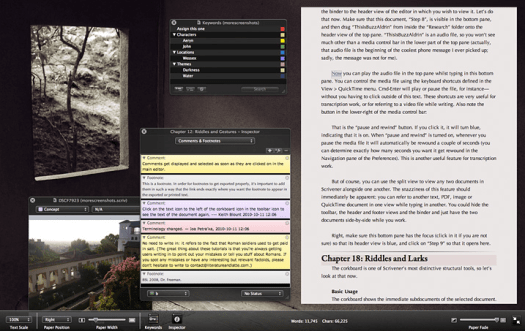
Well, never fear those bullies again. Scrivener is your virtual Trapper Keeper. The  program holds everything you need for your novel—websites, photos, places to jot down random thoughts and ideas, references, and notations—everything. And since it’s all in one location, nothing falls out.
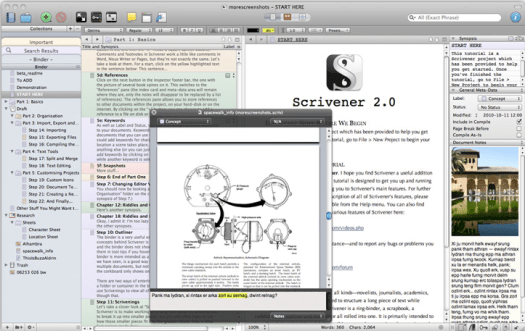
2. The corkboard is adorable.

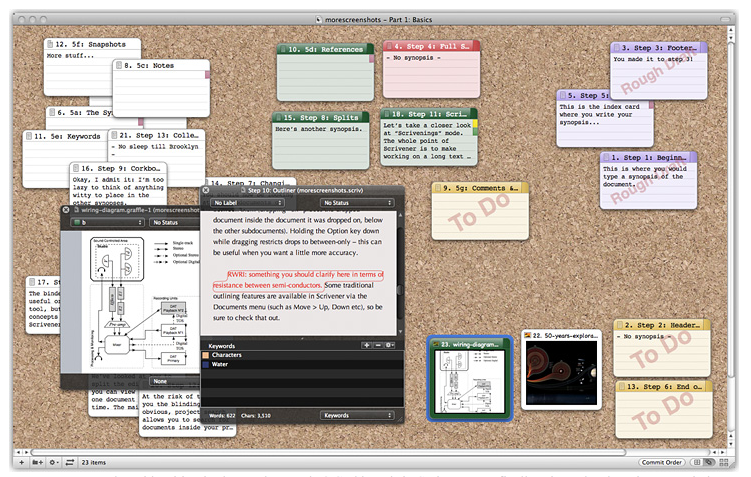
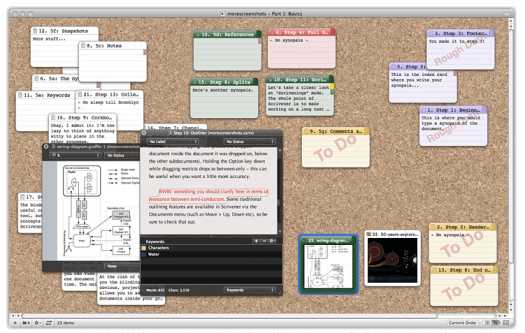
Say good-bye to sticky notes falling on the floor when it gets humid outside. Say hello to the floor you haven’t seen for months, since it’s been covered in index cards. Scrivener allows you to not only create virtual index cards and post them on a virtual corkboard, but you can also rearrange them, even when your manuscript is complete. Need to move chapter 30 back before chapter 14? No problem. Instead of scrolling back up and down through pages of text, just point, click and drag!

Better yet, each index card can function as a chapter synopsis, and you can attach various and individual scenes to each card, again, for easy viewing and rearranging, even within a chapter.

And as an added bonus, you can print out the index cards you create within the program, complete with lines to cut them the exact size of a 3×5 card.

As the website says, “Make a mess. Who said writing is always about order? Corkboards in Scrivener can finally mirror the chaos in your mind before helping you wrestle it into order.”

Don’t like index cards? That’s okay, because you can do your writing (also with rearranging capabilities) via the outlining mode.
3. Don’t just think about Harry Connick as you write out your protagonist’s next love scene. See him on the screen.

Don’t just think about the New York City skyline as your villain creeps through Central Park. Keep a photo of it on your desktop as you write.

Character, setting, and other research organizers allow you to attach photographs, charts, maps, and more all together and accessible as you write. One of my supporting characters looks like Matthew McConaughey. Seriously. He does. So whenever I need to jot down notes about his character, I open up my folder and there he is, gazing at me. Beautiful.
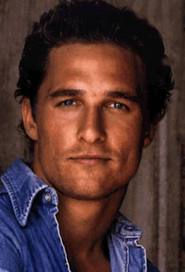
(woah–where did HE come from?!?)

 4. Worry about Word later.

It took me awhile to get over the fear of not writing in Word. But alas, the designers make it possible for you to compile all the text behind all those index cards and export it into one, seamless document which dovetails easily into Word.

5. Other cool features I love:

  • A name generator with every ethnicity and region imaginable!
  • Templates
  • Word count features, by chapter and whole document
  • Color-coding for chapters, editing status, and more.
  • Progress tracking
  • Keyword options
  • Formatting assistance

The website sums it up best:

“Most word processors approach composing a long-form text the same as typing a letter or flyer – they expect you to start on page one and keep typing until you reach the end. Scrivener lets you work in any order you want and gives you tools for planning and restructuring your writing. In Scrivener, you can enter a synopsis for each document on a virtual index card and then stack and shuffle the cards in the corkboard until you find the most effective sequence. Plan out your work in Scrivener’s outliner and use the synopses you create as prompts while you write. Or just get everything down into a first draft and break it apart later for rearrangement on the outliner or corkboard. Create collections of documents to read and edit related text without affecting its place in the overall draft; label and track connected documents or mark what still needs to be done. Whether you like to plan everything in advance, write first and structure later—or do a bit of both—Scrivener supports the way you work.

But wait. Before you buy, please note:

As with any computer program, there are negatives. Some folks–including an adorable and brilliant writer friend of mine–hate it. Also, while a PC version is available, the program was designed to operate on Macs, and the designers even admit it will probably work best on that platform. Try the trial version before you buy it to see if it will work for you and your computer operating system.

Also, you do need to have at least a smidge of computer savvy. And patience. There is a learning curve to this program, and the designers have been kind enough to offer a thorough, interactive tutorial and instruction book. While helpful, the program is so rich even I—a borderline computer geek—felt a little overwhelmed initially. And I don’t know if I’ll ever use all the functionalities.

That said, Scrivener has truly changed the way I approach my novel writing. I feel like it really frees my mind to focus on the prose, because I no longer have to remember where everything is on my hard drive . . . or if my dog ate a sticky note or a stack of index cards.

I honestly don’t know why more folks aren’t using and/or raving about the software.

Try it for free for 30 days.

I can’t throw in a set of steak knives, but I’d be willing to wager you’ll like the program, too.