Fuel Up Your Creativity!

My family is blessed to024 live in a beautiful part of the world – the Black Hills of South Dakota. Even three years after moving here, we’re still not immune to stunning vistas and fabulous sunsets.

This time of year, my husband and I try to get up into the Hills at least once a week. Whether we’re setting out on an evening drive to seek out the Custer State Park bison herd or lacing up our hiking boots to explore a new trail, we’re eager to hit the road.

But before we head up into the wilderness, my husband always stops at the neighborhood gas station to fill up the car’s gas tank.

We wouldn’t want to get half-way out to the back of nowhere and run out of gas, would we?

Writing needs fuel, too.

Every morning, I turn on my computer and head into the wilderness of my imagination. Characters talk to each other, situations develop, conflicts explode – or simmer – and it all gets typed into the file of my current work in progress.

At the same time, another story – or two – or three – simmer on the back burner of my mind. Characters lurk back there, taking on lives of their own.

Meanwhi9780373282777_p0_v1_s260x420le, there’s a book release coming up next month. So marketing plans are being developed in another part of my brain.

With all that energy being expended, I have to make sure I fill up my brain’s gas tank on a regular basis.

But how?

 Rest. A Sabbath rest.

Resting doesn’t mean to unplug, unwind, turn off and disconnect. Doing those things may give us a break from our normal routine, but they don’t refuel. Our minds, bodies, and spirits need re-fueling and re-creation.

We need to rest in God.


God gave us the Sabbath. One day that is His out of our week.

One day to worship, study, connect with His Church, fellowship with other believers, make family memories….

One day to re-fuel our energy and our connection to Him – the source of our creative gift.

It isn’t an easy thing to do. It’s a challenge every week to clear my plate before Sunday morning. It takes planning to be able to put away the normal daily routines and take up the gift of the Sabbath rest.

But when Monday morning rolls around again, I’m so glad I made the effort!

What will you do today to re-fuel your life?

Freedom

American flagAll around the country this week, people are celebrating our country’s independence. Some are enjoying picnics on the beach with their blankets spread across the white sand, others are watching fireworks burst into a neon display over their local community center, and many are cooking burgers and dogs over a pit, the woodsy scent of hickory and charcoal permeating their back yards.

Despite our political views, we all enjoy the freedoms this country offers. As writers we can put pen to paper and say whatever we want because we have freedom of speech, as Christians we can worship in the church of our choice because our constitution gives us freedom of religion, and as citizens, we have the right to bear arms.

The freedoms we enjoy as Americans are indeed precious, but there is one far greater than we can ever imagine—the freedom Christ gave us when he died on the cross.

John 8:36 says, “So if the Son sets you free, you will be free indeed.” By turning our lives over to Christ, we are free men and women. There are no political boundaries, it cannot be rescinded by human standards, and there is no cost. He has taken our sins away and lifted the burden of our actions from our shoulders.

2 Corinthians 3:17 says, “Now the Lord is the Spirit, and where the Spirit of the Lord is, there is freedom.” God’s freedom is for the asking. We don’t have to walk into the crosshairs of the enemy and fight for it—Jesus did that for us. The Lord has paid our debt in full. We only have to step into the outstretched arms of our heavenly Father. And there, in his presence, we will find eternal peace.

Romans 8:1 says, “There is therefore now no condemnation for those who are in Christ Jesus.” This is the best part of all. Once God has taken away our sins, He will never make us accountable for them—ever again. They are gone. Out of sight. He will never come back and remind us of all we’ve done in the past. We are free!
Freedom is a gift. You cannot see it, smell it or taste it. Yet, it is real and incredibly tangible. And it is the very essence of who we are as Americans, but more so—who we are as Christians.

God Bless America. God Bless you!

4 Steps to Defeating Distractions

distraction“We demolish arguments and every pretension that sets itself up against the knowledge of God, and we take captive every thought to make it obedient to Christ.” 2 Cor 10:5

I love this passage from Scripture, because it strikes a chord in me that resonates deeply: I have a hard time managing distractions. I don’t know if my shortcoming is a result of training myself to multi-task (which demands that my attention is spread out over many areas at once – a behavior common to many entrepreneur-authors), or if I’m not mentally disciplined enough to shut out all the noise outside (and inside!) my head.

Either way, I know I need help, and this verse from 2 Corinthians offers a powerful strategy to not only strengthen my focus, but to stamp everything I do with the likeness of Christ.

Step 1: Identify the pretensions in my life.

Pretensions are claims to importance or merit. In Matthew’s gospel, the parable of the workers in the vineyard serves as an example of pretension: those hired early in the day believe they merit more pay than those hired last. Yet the landowner makes it clear he is acting justly by paying the agreed amount to his first employees, while still acting generously to those who came last. When I think I ‘deserve’ more, am I subscribing to pretensions or conventional notions of worth, instead of relying on the goodness of God? Does that pull my focus from what God wants and cause me to obsess on what I think I should get?

Step 2: Demolish the arguments that oppose the knowledge of God.

Wow. Demolish. I’m reminded of the Egyptian army chasing the Israelites into the sea. Only when that opposing force is utterly destroyed can the Israelites move forward with confidence. Do I demolish my distractions, or continue to look back at them, handicapping my ability to set my focus on God?

Step 3: Take captive every thought.

In our information-rich world, it’s easy to let my attention off-leash. I need to be bold and exercise my God-given power to choose what I will think about. That’s not to say that distraction can’t be positive – we all need a break at times from purposeful activity and thinking in order to recharge ourselves and give our minds space and time to rest and play. But excessive distraction denies us the chance to focus on the meaningful work God calls us to in our lives. Do I accept responsibility for what I think, or do I give my thoughts permission to rule me?

Step 4: Make every thought obedient to Christ.

The only way this happens is by knowing the Lord, which means making it a priority to spend time in prayer, reflection, and reading God’s word so He can shape you into His own image. I’ve found that even brief amounts of time dedicated to building my relationship with God have a big impact on my daily routine and help me to stay focused on His priorities. Do I ask Christ for help when I am distracted?

What Scriptures help you battle distraction?

I Wish I Could Google God

Photo/KarenJordanIf only I could “google” God for answers to life’s problems. Then, I could just type a question and get one right answer—the Truth.

As a writer, I don’t always come up with the best questions to ask to find the solutions I need. And at times, I don’t know what to pray when I’m burdened by life challenges.

So, I wish I could enter a word or phrase into my Internet search engine, trusting that God would grant me the exact direction I needed.

As I share in my family’s struggle with their painful issues, I don’t even pretend to know how to help them manage their lives. How can I intercede for someone else, when I don’t know how to pray about my own problems?

Many days, I can’t even express the concerns of my heart. But I’ve discovered some powerful promises in the Bible that help me navigate through the turbulent waters of my worry life.

How can we find rest from our stressful lives?

… Jesus said, “Come to me, all of you who are weary and carry heavy burdens, and I will give you rest. Take my yoke upon you. Let me teach you, because I am humble and gentle at heart, and you will find rest for your souls. For my yoke is easy to bear, and the burden I give you is light.” (Matt. 11:28-30 NLT)

 How can we know that God hears our prayers?

 And we are confident that he hears us whenever we ask for anything that pleases him. And since we know he hears us when we make our requests, we also know that he will give us what we ask for. (1 John 5:15)

What if we don’t know what to pray?

 … the Holy Spirit helps us in our weakness. For example, we don’t know what God wants us to pray for. But the Holy Spirit prays for us with groanings that cannot be expressed in words. And the Father who knows all hearts knows what the Spirit is saying, for the Spirit pleads for us believers in harmony with God’s own will. (Rom. 8:26-27)

What if you don’t believe that you can hear from God? God’s Word answers, “My sheep listen to my voice; I know them, and they follow me … ” (John 10:25 NIV).

What are you worried about today? Philippians 4:6 encourages us, “Don’t fret or worry. Instead of worrying, pray. Let petitions and praises shape your worries into prayers, letting God know your concerns” (MSG).

I still wrestle with how and what to pray at times. I am thankful for the recorded Word of God. It serves as a lifeboat that I can rely on when unexpected storms roll in, or when I need to pray for others who are drowning in their ocean of worries.

Father, we need you, but we don’t know what to say.
Thank You for Your Spirit, Who guides us when we pray.
Holy Spirit, intercede—You alone know our needs. Amen.

Will you share a promise from God’s Word that has helped you find direction?

Is God Talking to Me?

DogAs Christian authors, we often view our books as a way to get God’s Word out in a non-threatening manner. Novels are easier to hand to someone than a Bible and generally an easier way to start a conversation.

However, two recent events are causing me to change my view on that a little. Recently, my minister said that when he’s working on a sermon series, the subject matter is usually something he’s struggling with—something God is trying to teach him.

I had the good fortune to hear Ted Dekker speak during his Outlaw Tour down in Colorado Springs. A big theme of his talk was that his struggles as a Christian come out in his books. His questions about faith. Those uneasy issues that we all contemplate. Is God real? Is He who He says He is? Is there really a Heaven? Is my belief in Christ truly enough?

Perhaps we as authors are actually working through our own issues and the collateral benefit is that we’re frequently able to help other people.

But surely my writing isn’t just about me. It can’t be because my spiritual life is all figured out . . .

I began to think through the books I’d written and the ones I was planning on writing. There were some consistent themes. Truly believing in God’s sacrificial love. Letting God take control. Being submissive to His will for our lives.

If I look honestly at these themes, they are what I struggle with the most. A God . . . people . . . the Lord of the Universe dying one of the most painful deaths ever . . . for me. My heart usually reconciles this easily but my intellectual side waivers occasionally. This is what I believe?

And sometimes with a big gulp . . . I whisper yes.

I’m a control freak by nature. It lends to the job I do every day. As an ER nurse it is expected of me to bring control to chaos. I am stubborn and independent—which is the nature of two out of three of my heroines. They’d rather fix it themselves than reach out for help and yet, when circumstances become insurmountable, they must reach out to survive.

Isn’t this how it is with us? Maybe it is just me and all of you are very good at relinquishing control. If so, please let me in on your tips.

As we write these stories, maybe what we need to do first is read our stories with ourselves in mind and hear what God is trying to say to that person we see in the mirror.

This post first appeared at the ACFW blog. Hope you’ll check it out.

The Value of Advisors

The role advisors have in our writing, our ministries, and our spiritual growth is invaluable.

Proverbs 15:22 tells us: Plans fail for lack of counsel, but with many advisers, they succeed. (NIV)

We set ourselves up for success when we surround ourselves with wise people who have our best interests at heart, cheer us on in worthwhile pursuits, and are willing to tell us what we need to hear. But we have to be open to critical input as well as encouragement if we truly want to develop our writing, be effective in ministry, and experience long term spiritual health.

Writing
Are you open to input or do you become defensive when your editor asks you to make changes to your manuscript? Just this past week I talked with my editor about my newest Bible study, Eyewitness to Glory: Moses, scheduled to be released this summer. We have a great working relationship. He said the writing was clean and the content was good. I was thrilled. But he also mentioned one particular lesson that he thought could be worded better and explained his concern about how it might be misinterpreted. I was grateful for his candor and told him I would look at his comments and re-work the lesson. In addition, he also mentioned a punctuation error I consistently made throughout the manuscript. How embarrassing! This will be my forth published book and I should know better. I am anxious to get the edited manuscript to see my error so I don’t make the same mistake next time. I also plan to run my manuscript by another writer next time, prior to turning it in to my publisher.

We are all growing and when we remain open to input from experienced writers and editors, our manuscripts will be richer and we will become better at our craft.

Business Discussion

Ministry
As Christian writers, we are all in ministry. In Michael D. Miller’s Bible study, Keeping Your Heart for Ministry, Miller says:

“You are on dangerous ground when you construct barriers to prevent others from confronting you with truth. The leader who desires to keep his or her heart for ministry will be open to question or challenge, realizing that ‘iron sharpens iron’. God graciously provides good counsel to help us continue growing through our Christian experience.” (Keeping Your Heart for Ministry, Lifeway Press, 2001)

In order to broaden your perspective and reach more people through your ministry, consider creating a group of advisors. It is easy to develop blind spots along your ministry journey. By choosing wise, spiritually mature advisors who are available for questions (and will give you honest answers), you will enhance the effectiveness of your ministry.

Spiritual Health
As Christian writers, it is important to be connected to other believers and, in my opinion, there is no better (or more biblical) place to do so than in your local church. If you are a believer in Jesus, you are part of the body of Christ.

1 Corinthians 12:27 says: Now you are the body of Christ, and each one of you is a part of it. (NIV)

It is in the context of a local church body that we find accountability to “spur us on to love and good deeds” (Hebrews 10:24). In our local church we learn to encourage one another, to “grow in the grace and knowledge of our Lord and Savior Jesus Christ” (2 Peter 3:18), practice forgiveness, and learn to love one another deeply, as our Lord loves us. Being connected to a church body is important for our long term spiritual health.

My writing friend, “I pray that all may go well with you and that you may be in good health, as it goes well with your soul” (3 John 2 ESV).

Let’s ask God to give us teachable spirits and to help us be open to critical input as well as encouragement. Consider creating a group of advisors to give you honest feedback in your writing and your ministry. And if you aren’t currently involved in a local body of believers, ask God to lead you to the right church; a safe place where you can grow, serve, love, and be loved.

What advisors are you thankful for today?

Words from Another World

“Sticks and stones might break my bones but words will never hurt me!” Wrong.

As an adult I’ve long since conceded that the childhood nursery rhyme we sang to protect ourselves couldn’t be further from the truth. I no longer deny that words can inflict lasting pain but my fascination is with their power to change the world.

This ability of ours to communicate, it’s combustible.

fire

Picture if you will the disciples of Christ sitting in an upper room waiting and praying, praying and waiting. Before leaving in the clouds, Jesus had promised to send them power to take His message to the ends of the earth. He didn’t tell them what this power would look like or how long they’d have to wait for it, only that they must.

Finally, after days and nights of waiting, after all the anticipation and questions surrounding this mysterious force Jesus had spoken of, after weeks of wondering what this supernatural aid might be and how they would wield it, God’s promised fire fell “as cloven tongues of fire.”

How interesting. Fiery cloven tongues of an other-worldly origin.

I find it fascinating that out of all the body parts the writer could’ve used to describe this amazing scene when God’s fire power fell on man, he chose a human tongue. What a visual of God’s plan to employ these fleshy instruments of ours to speak from the understanding of one human to that of another, each witnessing of the consuming fire lit in his or her heart.

In light of such a mission, is it any wonder that we’re so strictly charged to monitor our tongues and the power of language? How can we allow ourselves to use whatever words we want with whomever we want whenever we want-–knowing that God has chosen these same tongues as holy messengers to take His gospel into all the world?

From the same mouth come blessing and cursing. My brothers, these things ought not to be so. James 3:10

For those of us who feel called to write, these questions should weigh even heavier.

My prayer is for our words and our tongues to have fire power because they’re yielded to His will instead of our whim.

Hugs, Shellie

Watch Your Words: A Mother’s Day Reflection from Nature

Photo/KarenJordan

Understand this, my dear brothers and sisters: You must all be quick to listen, slow to speak, and slow to get angry.  (James 1:9 NLT).

I glanced up the hill behind our home, and I had eye contact with a doe as she watched over her fawn. As I continued to water my wilting tomato plants on my wooden deck, the doe stepped closer to check my reaction to her movements.

I remained painfully still while watering my plants. Any sudden movement from me would have caused the doe and her fawn to scamper beyond my sight.

A few minutes later, I turned my head to redirect my hose toward another plant. When I looked back up, I saw the deer walking quietly away from me, grazing on the grass and plucking leaves from the low-hanging branches.

Without any words, I understood this message from nature, loud and clear, “We feel safe here if you don’t make any sudden moves to threaten us.”

Reality check. As I observed the doe and her fawn, I recalled a recent conflict with my daughter Tara, mother of five children.

How many times have I chased away my children with my impulsive words or quick temper? Too many to count.

Without outlining the nitty-gritty details of my personal life, I’ll “plead the Fifth Amendment” here—on the grounds that my answer may be self-humiliating.

Good word. So, I’ll just quote the wisdom of the Bible.

And now a word to you parents. Don’t keep on scolding and nagging your children, making them angry and resentful. Rather, bring them up with the loving discipline the Lord himself approves, with suggestions and godly advice. (Eph. 6:4 LB)

Am I cautious with my movements and reactions as I relate to my own children and grandchildren? I’m working on that one.

After I expressed my concerns and expectations to my daughter about a situation with one of her children, I regretted my hasty response and unsolicited advice. So, I offered a heartfelt apology, hoping and praying for her forgiveness. I realized that my emotional reactions often bring unintended consequences.

Reflection. Sometimes our silence speaks more clearly than our words. I know my voice can scare away an animal or bird, but sometimes I forget that just one inappropriate word can also repel a child, friend, or loved one.

We often use our written and spoken words to express our thoughts and feelings. But at times, we fail to guard our choice of words or listen to others. As a writer, I know the importance of editing my words. But often, I forget to consider the power of my spoken words, and I fail to be quick to listen, slow to speak, and slow to get angry. (Jms. 1:9 NLT)

When the doe appeared in my backyard again, I knew to be quiet. Opening a squeaky door or stepping on the dry, parched leaves would propel her to run to a safer place with her fawn.

As I watched the doe scamper away with her young a few minutes later, I thanked God for the lessons He sends me in nature for my own family and for my writing life. I offered a prayer of thanksgiving for being exposed to His truth expressed in nature and in my everyday life. Then, I asked Him to help me release my children and all of my expectations once again.

What concerns and expectations do you hope to release to God? 

Creation: The Writer’s Privilege and Calling

???????????????????????????????

Easter is over. Strands of pink and yellow plastic grass are strewn all over the living room. Painted eggs will be peeled and mashed into egg salad later today. The kids are shipped off to school bleary-eyed, nursing sugar hangovers. I look around at the disaster of a house I just cleaned for company, sigh, and sit down to write.

The blank page on my computer screen stares back at me, cursor blinking at the top. Write. It is time to write. But I am empty, hollowed out, barren. I am still winter, even though yesterday at church, everything around me screamed spring. I look out the window and notice signs of new life. The lilac tree has fresh buds. The grass is becoming crisp and green.

Easter is my favorite holiday. My heart pumps fast every year. On Resurrection Sunday I get caught up in the story of Jesus in spite of whatever else is happening in my life. I can be downhearted, exhausted, bored, or troubled. Easter morning is bigger than my emotions. Easter is always bigger than me. My knees can’t help but bend. As a person of faith, how can I not be moved by Christ’s sacrifice for me and his ability to conquer death?

But today my life is back to normal. I have my to-do list. I’ll match socks at the bottom of the laundry hamper. I’ll make myself something to eat, and take small bites as I wonder where the excitement went, and how it can leave so quickly. I’ll write because of deadlines. It is my work. It’s what I do.

The blank computer screen studies my face, and I think about my feeble attempts to create something from nothing. The book of Genesis comes to mind.

In the beginning, God created the heavens and the earth. The earth was without form and void, and darkness was over the face of the deep. And the Spirit of God was hovering over the face of the waters.  And God said, “Let there be light,” and there was light. -Genesis 1: 1-3

And God said… God used words to create the world. For writers, this profound truth is even more precious because we are word people. This is what we love and it is baffling and exhilarating that God used the same method. Creation brought order out of chaos through words.

But God doesn’t stop there.

In the beginning was the Word, and the Word was with God, and the Word was God. He was in the beginning with God. All things were made through him, and without him was not any thing made that was made. -John 1: 1-3

Jesus is the Word in the Gospel of John. And through his life, death, and resurrection, God continues to create. He creates new buds on barren trees in the spring. He creates a desire in a person’s heart. He makes us new creations through faith in his Son. And as his creation, we participate in the awesome privilege of proclaiming Jesus, both with words and in being the word to a world that a lot of times looks everywhere but to him.

And we get to sit down at the computer and play with words. We start with nothing and hope it turns in to something. We have all these words and thoughts and try to put them into some kind of order that will hopefully makes sense, and more importantly, bring glory to God.

It doesn’t always happen but when it does, its magic.

Easter. Through Jesus’ resurrection God makes all things new. He creates. He is always creating. Words are an essential part of how he does it. Doesn’t it just blow your mind that we are in the same business?

So, when you go to write and instead sit, look, start, stop, put words down, and erase, do this: Look outside your window for signs of creation. Look for new life because it is always there somewhere. See fresh buds on the trees as the world wakes up to warmer days and the promise of sun-kissed skin.

When you write, when you create, you participate in something bigger than you. You are emulating your creator, the one in whose image you were first created.

The one who started it all with words.

What a privilege.

What a calling.

I open the window nearest to me, and let the warm spring air in.

Loved, Chosen, and Writing (for the Forseeable Future) at 5 a.m.—A Lesson from Anne Lamott

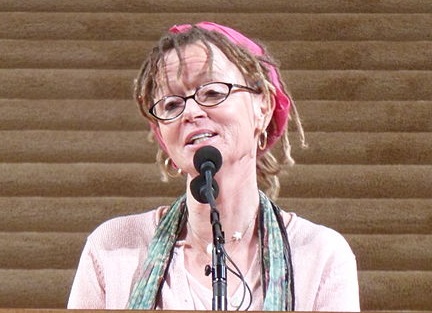
Anne-Lamott-2013-San-Francisco--Wikimedia Commons--ZboralskiI just returned from Calvin College’s Festival of Faith and Writing, featuring such diverse writers as Luci Shaw, Richard Foster, Rachel Held Evans, and Anne Lamott and offering sessions on everything from how to write a book proposal to self-publishing, writing about trauma to writing novels, writing children’s books to writing faithfully about sex. Some sessions were practical, others funny, some heady, some worshipful. All inspired and challenged me. Several offered strategies I’ve taken to heart and will pass on to my students.

The best advice, from Anne Lamott, was the simplest and hardly new or profound. She must have said it twenty times during a characteristically hilarious and solipsistic one-hour interview—which surged pell-mell in and out of her various addictions, the gift of desperation, her cellulite-pocked thighs, people she appreciates (those who give her even more cream for her coffee, for example) and those she avoids (e.g., those who claim you can’t have fear and faith simultaneously), her love of desserts and coffee with massive amounts of cream (Did I mention that already?), the interminably lost and sought jetliner on CNN in her hotel room, and the good news that we’re “loved and chosen” (a refrain I’m already aware of reiterated apropos to nothing that I could tell but nevertheless causing tears to start from my eyes each time)—and it was the same advice I’ve encountered whenever I’ve heard her talk or reread her wonderful book on writing, Bird by Bird. Still, like that loved and chosen refrain, it seized me anew each time she said it. It was this: All it takes to write is to sit down and do it.

She put forth several ancillary recommendations. That you can’t wait for your toddlers to start school or your teens to leave home. That you don’t need an office, just a door that closes. That you have to say no, nicely, to the dogs, cats, and kids at that door, who are attracted like heat-seeking missiles to your lap (or thighs or cellulite, I can’t remember). That all one needs—not only in writing but in everything (“Anything I know about anything,” she observed, “applies to everything else.”) is structure and discipline. That, for the past four years, she’s turned off her cellphone and written every day, at the same exact time (9 a.m.), no matter what.

“Give me an hour!” she kept demanding—as if she were our mom and we her teenage wastrels—and pointing out all the junk we waste our time on each day. Though I’ve written and revised and published five books, I still need this reminder, this goad to get after it.

“You’ve got an hour! Give me that hour!” she yelled, as though we would be writing just for her.

And truly, inspired as I was by that simple call to quit dallying, I really feel as though I’m writing, right now, for Anne alone.

Farmland_and_Airbus_Beluga_near_Cop_House_Farm_-_geograph_org_uk_-_446678I planned out that hour—or maybe two, since, as she said, you’ll really only get forty usable minutes out of an hour, only an hour and twenty minutes out of two—all the way back to Oklahoma. In the seats at my gate, on the tarmac waiting in vain to take off, back in those airport seats after deplaning because of weather in Chicago (Who knew you couldn’t take off on a runway perpendicular to the wind direction?), through the murky clouds over Illinois and Missouri and Arkansas, in the car snailing the empty roads at midnight with my cautious husband.

“I’m gonna write as soon as I get up,” I told him. “Before I run. Before I do any grading or reading. Get me up at five, when you get up, but don’t talk to me. Just give me my coffee and let me write.”

Don’t worry: I’m a morning person. And with our dogs living outdoors and daughters away at college, I can write in my non-office—the living room—without even the closeable door Lamott requires. If my gaze strays from my computer screen, I’ll see the sun turn the horizon pink. Every single day. At this rate, I’ll get my novel drafted before summer’s end and revised and sent off sometime before moving on, loved and chosen, to a heaven of no distractions from what I should be doing.