The Cheater’s Guide to Building Your Author Platform – Part 1

With a glazed look on my face, I obediently handed my phone over to “the expert” sitting beside me. As she looked up my twitter account which had an oval egg shape for my picture, I couldn’t help feeling intimidated by the task of building an author platform.

I had spent my entire life serving in pastoral ministry. When social media first came on the scene, I was suspect of the enemy’s evil intent to use the media to entrap our children.

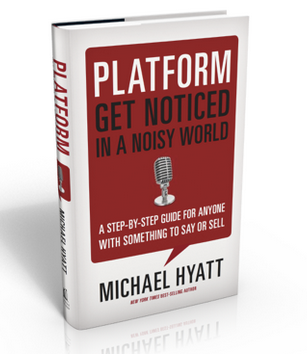
Now here I was, listening to Michael Hyatt talk about the power and necessity of every author building a platform to launch their book. Much of what he was saying went over myplatform head. Yet as I listened for the still small voice of the Holy Spirit to guide me, I simply heard this word: engage.
As I engaged in the social media platform beginning that day two years ago, I grew from 4 twitter followers to over 21,000. I joined the social conversation and found a whole new world of influence.

Since my first book, 9 Traits of a Life-Giving Mom, hit #1 on Amazon’s Hot New Releases for Christian Women’s Issues, I regularly have authors seeking my advice on how to build their own platforms.

Let’s Begin at the Beginning

Watch Michael Hyatt’s simple video on Platform Building.

1. Start with a Blog

Begin to build a following. Give people an opportunity to get to know your heart. Use your blog as a spring board to all of your other social media engagement.

If you are an author of a number of books, you are probably your brand. You may write on a number of blogs. A foundational part of your strategy is your own blog where you can share your passion and build a loyal following. I chose to use my own name for my primary blog at SueDetweiler.com.

2. Develop a Social Media Strategy

You are unique. Social media needs to work for you. As you begin to see the power of social media, use these principles as a guide: 12-28-14 Social Media

  • Use Time Management Tools
  • Link Social Media Posts
  • Strategically Post Throughout the Day

The key to social media is to see it as an ongoing conversation with a friend. You are sharing about all the things that you care about. People who read your tweets will know what you enjoy. Don’t be afraid to share your personal story and pictures. Provide your tribe with ongoing helpful resources.

3. Be Real

Don’t try to appear to be anyone else than who you truly are. You don’t have to be perfect. In fact, one of the ways that people will be drawn to you is when they sense you are transparent. Don’t try to be Barbie or Ken; just be who God made you to be. Let your quirks come through in your social media platform.

Don’t be tripped up by your own perfectionism and fail to launch into a new thing. Allow yourself the freedom to try something new. Stoke the fires of your own adventurous spirit.

4. Use Video

Video can be really simple. The technology on your smart phone will allow you to do video in minutes. As an author, you can use the power of video to sell your book. Here’s a simple book trailer that was created for me on Fiverr.com. Video doesn’t have to cost you a fortune to be effective in telling your story.

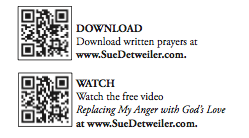
I also used simple video introductions of each chapter of my book as an additionalbuilding your author platform resource. At the end of each chapter a simple code invites the readers to watch the video or download a printable of written prayers that enhance each chapter.
5. A Gateway to Traditional Media

As you build your platform as an author, others will become excited about your message and help get the word out about your book. Build relationships with other authors, radio hosts, and television hosts. Two events that I think are helpful to connect authors to traditional media are National Religious Broadcasters (NRB) and The International Christian Retail Show (ICRS). There may be other events that your publisher encourages you to attend to build relationships with the media.

Next Week

We are just scratching the surface of things that you can do to build your platform as an author. Join me here at The WordServeWaterCooler for part 2 of The Cheater’s Guide to Building Your Author Platform.

Also connect with me on social media! Let’s start a conversation. Let me know if there is any way I can help you get your message out.
Mastering the Essential Query Letter for Writers

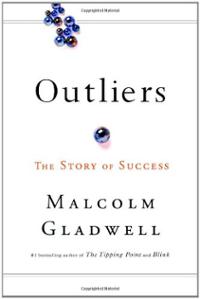
Outlier's The Story of SuccessI finally read the book Outliers: The Story of Success by Malcolm Gladwell. As I devoured the first few chapters, I thought about my quest as a professional writer. And my impatience in the early days. I wrote about it on my personal blog back in 2009.

But reading Gladwell’s research, I realized that even in 2009, I was well on my way to achieving my goals. I simply needed to take every necessary step.

According to studies cited in Outliers, it takes an average of 10,000 hours to master anything. I figure it took approximately five years of incessant practice, posts, and projects for me to near the 10,000 hour mark. Although I haven’t mastered the art, I’m certainly much better than I was six years ago.

And one of the most critical areas of improvement comes in my creation of query letters. Let’s face it, if you can’t write a strong query, you won’t arrest the attention of any agent, editor, or publisher. Early on, I spent a lot of time studying and honing the elements of this crucial piece.

1. Research

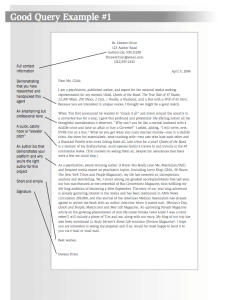
Writer's Digest Query Letter
Image Credit with Permission Writer’s Digest
http://www.writersdigestshop.com
  • Who specifically should you address your inquiry to? Name. Title.
  • Where should you send your query? Do they accept email only? Content as an attachment, or in the body of your email? Are they snail mail lovers? Do you have the correct address?
  • What are they looking for? Does your topic or slant match their needs? Have you formatted your submission according to their guidelines?
  • When are they accepting submissions, and do they have themes tied to calendars?
  • Why did you chose them? Did you read something that made you think you would connect? Are you familiar with their needs and believe your work can support them in their mission? If possible, find a common bond or at least prove you’ve studied what’s important to them.
  • How do they want queries packaged? Some prefer a simple one page letter, clearly stating your concept as it fits within their guidelines. If interested, they’ll ask for a proposal or manuscript later. Others request a proposal or manuscript at the same time you send the letter. Make sure you know what the person you are querying prefers.

2. Hook

No matter how well you’ve written your article or book content, without something to snatch the reader out of their doldrums on the average of the first seven seconds, your work will go no further. Ask that stirring question to make them think. Make a bold statement that flies in the face of an old cliché. Provide a heart-wrenching statistic, forcing them out of the skin of self. Make their belly shake with laughter.

3.  Double Check

Writer's DigestOnce you’ve written what you believe is a strong query letter, I suggest you run it through the Writer’s Digest Do’s and Don’ts of Writing a Query Letter. This brief but powerful list will show you how to write a query letter in the most effective way possible. Also have someone who knows something about professional writing read it.

A family member, or even a high school English teacher, are not going to provide the insights you need when it comes to publishing in the real world. As long as it’s a short, one-time read, many professional writers are willing to do this for someone else who’s starting out. We remember those days. Just respect their time, and if one writer can’t help, try someone else.

10,000 hours sounds like forever when you are starting out as a writer. But with patient and consistent practice, this important landmark will arrive faster than you think. Start small. Master the query letter first. Then one day, you’ll have the honor of mentoring someone else.

How many hours would you estimate you’ve invested in writing so far?

Do You Think I’m Insecure?

OLYMPUS DIGITAL CAMERAI usually feel pretty good about myself when I wake up—for the five minutes I refrain from looking in the mirror. That’s when the voices start: “Your thighs have more dimples than a Shirley Temple look-alike convention!” they say, or “What kind of eighties-wannabe haircut is that?”

Then I take my older son to school and notice the work-outside-the-home moms, all coiffed and stylish. The voices deride my writer’s wardrobe of jeans and T-shirts. Later, my fingers poised at the keyboard while my trusty cup of java grows cold beside me, I hear the little demons again: “That paragraph stinks. How are you ever going to keep getting published if you write stuff like that?”

When I pass through the living room and kitchen to go to the bathroom, the hisses continue: “The kitchen counter is filthy. And when was the last time you dusted?” By the time I grab a mid-morning snack, I’m already defeated, and it’s only 9:30 a.m.

Sigh.

I don’t know who said it, but I believe it’s true: Insecurity is the devil’s playground. Or maybe battleground is a better word. His weapons attack from every side and inevitably leave a wound.

file3991282945508Those of us who struggle with perfectionism find it especially difficult to remember that we are wholly loved by our infallible Heavenly Father. It’s a constant war to not let the “How do I measure up as a parent/writer/Christian?” questions run away with my emotions—and my peace.


Maybe you can relate. If my hunch is right, a lack of security is epidemic. And let’s face it: We have plenty to be concerned about. There are our figures, finances, future, and families—just to name a few.

Recently, while at the grocery checkout line, I noticed the headline on a women’s magazine: “Eat right, get fit, get organized, and relax.” Who are they kidding? I barely have time to take a decent shower each day, let alone have a perfect body or a spotless house. And relax while trying to keep it all together? Ha!

So I’ve decided to go on the offensive in this war on my thoughts and emotions. First, I’m going to stop letting the world’s standards rule my mind. With God’s help, I will tune into His Word and turn off the chatter from social media, print media, and television. I will bathe myself in His approval and love, knowing that while pursuing good health is wise, Jesus cares more about the size of my heart than the size of my jeans (can I get an AMEN?).

Second, I’m going to remind myself regularly that the career I have is God-given, and He controls the future. I don’t need to compulsively check my Amazon stats or fret about future book contracts. Instead, I must focus on fine-tuning my craft and being a good steward of the gift of words with which God has entrusted me.

Similarly, I can rest assured that God knows I am doing the best I can as a mother to two strong-willed, energetic boys. He’s the only perfect parent, and I can turn to Him in my frustrations and foibles. I can lean on Him and learn from Him, trusting that He will fill in the gaps my husband and I will ultimately leave.

The bottom line is this: when I focus on His kingdom, He takes care of the rest. 

Bit by bit, the whispers of doubt and defeat fade. Peace overtakes insecurity, and I can concentrate on living moment-by-moment in His grace. Microsoft Word - Grace_Race-v2.docx

You know what else? I’m betting that since Jesus was a carpenter, He doesn’t mind a little dust.

(This post was adapted from “Grace for the Race: Meditations for Busy Moms,” published by Patheos Press.)

How NOT to Query An Agent

icon-364244_640Working for a literary agent definitely has its moments of hilarity. My most recent reason to LOL? I was pitched to.

Yes. Me. The administrative assistant. And here is the crazy part: I was pitched a manuscript to an email address that really isn’t common knowledge. And on top of that: I don’t get the query emails. Those go to a completely different person.

So why did it come to me, you ask?

I have no idea. Which prompted this post: how NOT to query a literary agent. Sharpen your pencils; get out your note pads, this is going to be riveting (and maybe save you the embarrassment of making common, amateur mistakes).

  • You hear it everywhere. You’re about to hear it here, too: READ THE SUBMISSION GUIDELINES ON OUR WEBSITE. Yes, I just used almost every function on the Word program to emphasize that statement. Seriously, all your problems will be solved if you take a few minutes to get these facts straight. When you do, you’re a sight for sore eyes for those of us who receive the queries (or shouldn’t receive the queries as the case may be…).
  • Don’t put your entire chapter outline/back cover copy/reasons why you wrote this story in the query letter. Take an hour (or two) and Google query letters. Figure out how to write a good one. Have a critique partner give it a once-over (at the least). This is the first impression you’ll make. It needs to be a good—GREAT—one.
  • Don’t tell the agent that you are going to be “the next NYT bestseller” or “Nicolas Sparks” or “Janet Oke”. Yes, these points just came through in a query letter that landed in my inbox. If you are going to claim to be the next hot name, please be sure to at least spell it correctly.
  • Don’t tell the agent that you need them to publish their book. Um, excuse me, but duh. Be humble when you approach an agent. They have a ton on their plate. Usually many, many authors whose books and careers they manage. Reading your synopsis takes a chunk of time out of their day. Realize that it’s not all about your needs and frame the tone of your query accordingly.
  • Don’t give your life story. The reason why you wrote the book. The story behind the story. Don’t go there. Stay away. The agent doesn’t care. Now, if he/she picks up the book, reads it, signs you to their agency and you become friends, well, then yes, you probably will tell them the why behind the book. But right now you’re not BFFs; you’re strangers. You wouldn’t walk up to a handsome stranger-dude at a cocktail party, stick out your hand, and tell him all about your dog dying when you were four, would you? Of course not. Don’t do that to the agent you are querying, either.

Yes, that’s a lot of don’ts. Believe it or not, these all came out of a query letter I should have never gotten this week. So: read the guidelines. Write a pithy, word-catchy query. Have a great product to share with the agent. Be humble. Be patient. Email the right person and you won’t become an illustration on some agent’s blog anytime in the near future. 😉

Multiple Author Events – Yes or No?

Smiling Group of ProfessionalsAs a writer, the weight of book promotion falls on my own shoulders. Since that gets tiring, I’m always looking for ways to maximize the results of the events I do: my current goal is to market smarter, not just harder.

So when a writer friend told me about the great attendance and good sales she experienced at a multiple author event at a book store, I decided to give it a whirl with both of my book lines. That meant gathering other authors who’ve written about dogs (so I could promote my girl-meets-dog memoir Saved by Gracie) and collecting another crew of authors who’ve written about birds (to expand the audience for my fictional series, Birder Murder Mysteries).

This is how it played out:

National Dog Day. I broached the idea for a National Dog Day Night to a local independent bookstore, and they jumped at the concept! I offered to recruit authors to attend, and the store agreed to stock the books, set up chairs and a microphone, and do publicity. They even partnered with a local dog rescue group for more publicity and support. Luckily, three well-known writers with dog books live in my area, and they readily agreed to participate. We all thought it was a smokin’ idea…but only five people showed up. What went wrong? Personally, I attributed it to the lovely summer weather; I myself would have chosen to be outside with my own dog, rather than inside with authors.

My big score, though, came from meeting the other authors, one of whom asked for an excerpt from my book to run in her monthly newsletter that goes out to thousands of readers. I made a hot contact even if the event fizzled.

For the Birds Night. I took this idea to a local Barnes & Noble and again, the events manager thought it was a winner. This time, it was a monumental headache for me to pin down the authors – talk about a flighty bunch! Not that any of them are absent-minded – it just took me a while to catch all these bird-chasing authors between their travels and professional obligations, not to mention the multiple email addresses so many of them use. I managed to round up five of the original ten that I contacted, and even then, I had one drop out at the last minute due to health issues, and one drop in who’d forgotten to confirm with me months earlier.

The event itself, though, was a big hit! We had over 20 people attend, a lively discussion ensued, and every author was signing several books by the end of the evening. Our B&N hostess invited us back for a spring event, and said her district manager had expressed interest in us taking our event to other stores.

After organizing two group events, my conclusion is that it’s worth the effort in terms of both book promotion and author networking. Upfront sales might be disappointing, but as one more tool in your marketing toolbox, I highly recommend giving it a try.

And keep some aspirin handy.

Have you participated in multiple author events? What was your experience?

The Sound of Silence

Hear that sound? No? That’s because it is the sound of silence. The kind of inexplicable, almost supernatural, silence that expands to fill the void left in the wake of a tornado or an eardrum-shattering fireworks display or, in this case, the Christmas season.

prayer and contemplationMuch is made of the fact that Christmas is a time for peace, for reflection on Christ and the greatest gift ever given–his life, death, and resurrection. In reality, though, if they happen at all, those moments of reflection are generally stolen ones, snatched here and there in the midst of rushing through crowded shopping malls, cooking and cleaning madly before friends and family arrive, and squeals of delight as children tear paper off of gifts spilling out from under the Christmas tree.

All good things. Martha things. Things that should be and need to be done. But things that can so easily distract us from the Mary thing. Sitting and listening. Meditating on the words of Scripture. Contemplating the wonder of some of the most profound and stirring words of all, “And the Word became flesh and dwelt among us” (John 1:1).

Emmanuel. God with us. What an incredible, almost incomprehensible thought.

And not one we can only contemplate at Christmas, thankfully. It is in this time, in the deep silence that follows the noise and (mostly) joyful rushing around and checking off of lists and the general chaos and confusion, this almost supernatural time of stillness, hibernation, and rest, that we are finally able to find minutes, sometimes hours, for uninterrupted, undistracted contemplation.

On the words of Scripture. And on the words given to us as a treasured gift, not to hoard but to give, to share, to continue to pass along the powerful message that the Word dwelt among us. That the Word dwells among us. Not just in Bethlehem, not just at Christmas, but here, now, in the silence and stillness that follows the often frenzied celebration of his birth.

So as we enter into this, a new year, a clean slate, an endless stretch of possibility and potential, may the words of our mouths and the meditation of our hearts be acceptable to him. And may the words he gives us to share with others bless them and draw them back to his presence every day of the year ahead.

Let us continue to share the message of Christmas. That hope came when there was no hope. That light came into deep, impenetrable darkness. That joy came into sadness, grief, and loss. It came two thousand years ago. And it comes today when we are finally still enough to know that he is God. When we stop long enough to listen, to meditate, to contemplate and, in the silence, unwrap, discover, and experience for ourselves the greatest gift of all.

The Word with us.

Comfort for the New Year

Photo/KarenJordan“He comforts us in all our troubles so that we can comfort others. When they are troubled, we will be able to give them the same comfort God has given us” (2 Cor. 1:4 NLT).

A New Year offers new opportunities and challenges. As I sense the needs around me, I often think, “What can I do to help those in need?”

Sometimes it’s hard to know how to respond. In fact, some people may say,”the devil is in the detail,” inferring that there’s some mysterious secret hidden in the details. That term comes from the original phrase “God is in the detail,” which reminds us that the details are always important.

Discovering the mysterious details of how to help others requires wisdom. And God promises to guide us in this discovery process. But He wants us to ask for HIS help first.  “If you need wisdom, ask our generous God, and he will give it to you … ” (Jms. 1:5 NLT).

Seek God first. The Lord promises to provide the guidance we need throughout our lives. Psalm 32:8 says, “I will guide you along the best pathway for your life. I will advise you and watch over you” (NLT).

God often uses my experiences—good and bad—when I seek Him for direction in helping others. At times, He prompts me to share small things—like prayers, concerns, and a listening ear.

When my friend, Kathy, struggled with vertigo following her cancer treatments, I felt helpless to help her since she lived in another state. And I knew the misery of vertigo. When Kathy mentioned that she could not even read her Bible, I was able to read scriptures to her by phone.

Later, Kathy told me, “Your calls helped me survive my cancer treatments.”

Listen. In Matthew 11:15, Jesus asks His disciples, “Are you listening to me? Really listening?” (MSG).

As we seek God and ask questions, it’s important to listen for the answers. Sometimes instead of listening to God, I’m tempted to offer unsolicited advice to friends and family.

Have you ever received a gift that you didn’t want or need? Awkward! Our unsolicited gifts might actually offend instead of blessing others. Perhaps they need godly advice, not just a hasty opinion or thoughtless response.

Ask questions. I also ask questions when I’m trying to discern how to encourage others. What matters most to them? How can I discern how to help? What helped me when I faced a similar problem? What do I wish someone else had offered me when I faced my last crisis?

John 14:26 promises, “… the Advocate, the Holy Spirit, whom the Father will send in my name, will teach you all things and will remind you of everything I have said to you” (NIV).

Tell the stories that matter most. As a Christian writer, I never want to lose sight of the needs of my audience. Author Anne Lamott offers this advice: “Write the books you really wished were out there in the world.”

During a crisis, I look for resources to help me find solutions for my current needs. Encouraging words heal my soul when I’m desperate for answers. And I’m grateful for the writers who have poured their lives into helpful devotionals and books for those troubling days.

So, “… even if I am being poured out like a drink offering on the sacrifice and service coming from your faith, I am glad and rejoice with all of you” (Phil. 2:17 NIV).

As you plan your projects for the New Year, consider offering some words that could help meet the needs of others.

“… Words are powerful; take them seriously” (Matt. 12:36 MSG).

Can you think of a book that helped you through a crisis?

Failure Analysis

frame-541745_1280Whenever the New Year rolls around everyone gets caught up in the newness of a potentially fresh start. Many are busy fashioning resolutions or, the new trend, picking a word to focus on for the rest of the year. Commit. Encourage! Lose weight. Oh wait, that’s two words.

It’s known that New Year’s resolutions don’t last very long at all. People who go to the gym know this in spades. Come January, you have to stand in line until someone gives up a piece of cardio equipment. However, in just a few weeks, it will be like crickets chirping again and those aerobic instructors would be happy if crickets did show up to their classes so they’d have someone to teach.

I think in current American society, examining failure is passe. First of all, no one is a failure! Every child gets a trophy. Every child is equally good at everything. Authors are happy to post negative reviews on their Facebook page, not to say, “This person had something valid to say about my novel and I’m going to learn from it,” but rather as proof of how idiotic the reviewer was. Other authors gripe and complain when their book covers get nominated for “Worst Cover” awards. I don’t know. I’ve seen some of those covers and those just might be valid nominations.

Is this really learning? What is the value in learning from our mistakes?

I think we need to get back to not dismissing failure out of hand. My own reasons for failure are, if I’m honest, rarely external. They’re internal. I am the reason I failed.

Let me give one example everyone can attest to: weight loss. I’m not at my goal weight. I haven’t been for years. Why is that? I actually go to the gym regularly. Typically, three days a week. I don’t eat out often. Why am I not a size 4? Or, even a single digit size?

How many times have you heard these excuses? I’m too busy. It’s hormones. Gym memberships are too expensive. I’m big boned! It’s my thyroid. It’s genetic. Everyone in my family is overweight.

What are the real reasons? I’m lazy. I don’t want to cut refined sugar out of my diet. Soda is my one  bad habit (and therefore I should keep it). It’s been a long day–I deserve (insert sugary, decadent treat here).

The reason we’re falling short on all our good intentions is largely because we haven’t accepted the reasons we’ve failed at them in the past.

Why isn’t your book published? These days, there is no reason why you can’t get your words out there with indie publishing. You literally cannot have an excuse.

So what’s holding you back?

What I encourage you to do at the beginning of this year is look at that big dream you’ve been holding onto with everything in you and do an honest analysis of why you haven’t achieved it yet. I challenge you to first list five things that pertain to yourself.

So, if you’re brave, in the comments section share your unachieved dream and give a short failure analysis. How will you change these items to get closer to your dream by the end of 2015?

I think that will be better than picking a new resolution.