Building the Perfect Brand

I recently attended a branding seminar for authors and wanted to share best practices with the WordServe Community. Here are 4 Sizzling Secrets to Branding You and Your Book from speaker Liz Goodgold, Branding Expert for www.RedFireBranding.com:

1. WIIFM: What’s in if for me?

Your audience wants to know what they are going to get out of buying and reading your book. Sell a benefit or a result – think in terms of a call to action. Will your reader learn a skill, come away with increased knowledge, or be entertained? Knowing your endgame is a huge part of selling the benefits and the results.

2. Consistency is Key

Brands have to be consistent. In-N-Out Burgers always taste the same, and they have since the forties. That is consistency at its finest.  Your audience is looking for that kind of consistency. Once you have established your brand it’s important to stay with it. Think in terms of household names like Chicken Soup for the Soul, or the ‘Dummies’ do-it-yourself guides or perhaps the Mars and Venus books. For writers who tackle random subjects without a real sense of continuum, Liz recommended that the books should still appear consistent with regards to style, size, type, and font. Branding by color is a popular way to go.

3. Book Title – Easy Recall

A well-branded book title is catchy and simple to recall; it also carries over easily from one book to the next. In hindsight, my book, Gumbeaux, was probably not the perfect title as it can be considered difficult to pronounce. However, I have the opportunity, based upon Liz’s learnings, to title my next book: “Rancheaux” or something with a similar suffix. The suffix could work as well for me as “itos” does for Doritos, Cheetos, Tostitos, etc.

4.You Are the Brand

You are not building a book, but an empire. Don’t create a website that is only useful to promote a single book unless you are positive you’ll never write another one. It should be fluid enough to support your blog, sales channels, books to come, a potential series, etc. Check out the websites of your favorite authors and notice how they position themselves not just as writers, but as brands. Use jargon that resonates with your writing platform. You are the brand – not your book – so think big.

How are you building your brand?

The Holy Work of Writing

Every year I host a faculty essay reading at my university for our collective entertainment. At the beginning of the semester, I choose and cajole a dozen colleagues from across the curriculum to write personal essays on a shared subject. Then, sometime around Thanksgiving, I invite the rest of the campus to come hear them read the resulting essays aloud. It’s always a fun evening, everyone feeling proud afterward of what they accomplished.

Though the selected essayists have composed entire dissertations of scholarly writing, most have never set out to write for entertainment alone, so getting them to do it necessitates pep talks from me along the way as well as a fair amount of collaborative back-and-forthing between them and the trusted readers I encourage them to seek out. When they report to me on how it’s going and, afterward, on how it went, my colleagues are bashful and sincere and loveably modest as at no other time in my interaction with them.

“I got my daughter—she’s in high school—to read through it and make sure it made sense,” a grizzled professor of engineering tells me.

Another tells me how, in the course of writing about a Picasso painting her autistic son loved but she didn’t, she kept asking him questions and managed, through these exchanges, to get a rare glimpse of the world from his perspective.

Yet another colleague makes an appointment with me after the reading to work on improving his essay even more. He takes away from our discussion an argumentation skill that he is still bringing up in meetings years later: that you can’t convince someone of a truth unless you show it.

That’s the part of the event I like the most—my colleagues’ accounts of the process of composition. It’s so thrilling to watch seasoned writers grow into better writers through the humbling practice of sharpening iron on iron. Hearing the essays read aloud—every one of them so good!—and then witnessing the enthusiasm with which their audience applauds their achievement—yes, very good!—confirms what I am always telling my students: that, we humans having been made in the image of our creative God, our practice of creativity is as holy as the exercise of any of God’s other traits. And as pleasurable.

It often makes me feel a little guilty that my work, both as a teacher of writing and as a writer myself, is so enjoyable. It hardly seems like work at all, much less holy work, as I have come to think of it. But when we write well—when, through our words on a page, we interest and engage an audience in what is true and lovely and admirable and excellent—we are performing the work of God.

When asked what God’s work is, Jesus says, “to believe in the one he sent” (John 6:29). Writing, and teaching others to write, helps me to believe ever more confidently in the One God Sent—through whom, says John, “all things were made; without him nothing was made that has been made” (John 1:3 NIV). Good writing recreates, in words, what has been made through the Word and offers it up to others for their contemplation and enjoyment. What work could be more sacred?

On Beyond Index Cards: A Review of Scrivener Software for Writers

My first novel, slated for publication with David C. Cook in early 2014, involved hours and reams of research. I researched everything from fossils, to barbecue restaurants, the history of Haiti, pecan recipes, and more. I organized text, web links, and photos into dozens of Word documents, which I then had to flip open and closed while writing and editing each chapter. Add this to the half-dozen internet browser screens I had open for research, and, well, my computer was on the verge of crashing.

So was my brain.

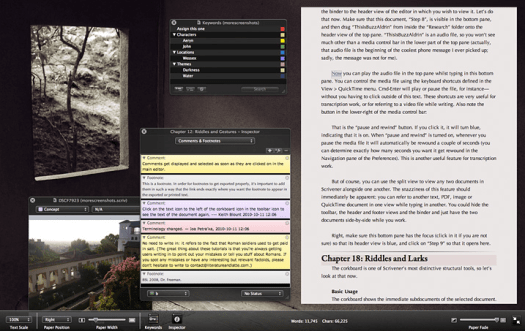
At the time I didn’t know any better, so I never lamented the process. But now that I’ve found Scrivener, a software program for writers of any genre, I marvel at how I ever kept my sanity. Currently neck-deep in an intense season of editing, I’m especially glad I can dump my manuscript in there, blow it up, and put it back together again with Scrivener.

Now, I will warn you. What you’re about to read may sound like an infomercial, but it’s not. I downloaded the trial version (highly recommended), quite skeptical about how much easier this could really make my writing life. But after just two days, I bought the software outright. First of all, this little slice of computer engineering GENIUS only cost $45—a small price to pay for sanity. An even smaller price to pay for the time it’s saved me, and the fun it brings to the novel writing process.

What’s so great about Scrivener? Below, I’ve summarized my personal favorite aspects of the program—so far. And I say “so far” because the software has so much depth of capabilities and bells and whistles, I discover something new and even more fun every time I use it.

1. Love me a Trapper Keeper!

I am a true child of the 80s. When I took my kids back-to-school shopping earlier this fall, I teared up, grieving that they shall never know the true beauty of the Trapper Keeper. Oh, sure, we found imitation versions on the shelves, but nothing close to the ultimate office supply nerd’s dream machine contraption, which kept everything in check, even when the bully on the football team rounded the corner and flipped my books in the air, sending everything—including my fragile, Love’s Baby Soft ego—to the floor.

Well, never fear those bullies again. Scrivener is your virtual Trapper Keeper. The  program holds everything you need for your novel—websites, photos, places to jot down random thoughts and ideas, references, and notations—everything. And since it’s all in one location, nothing falls out.
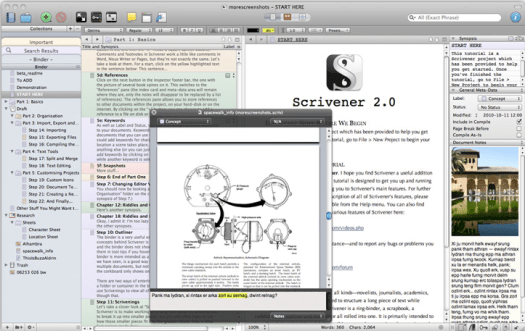
2. The corkboard is adorable.

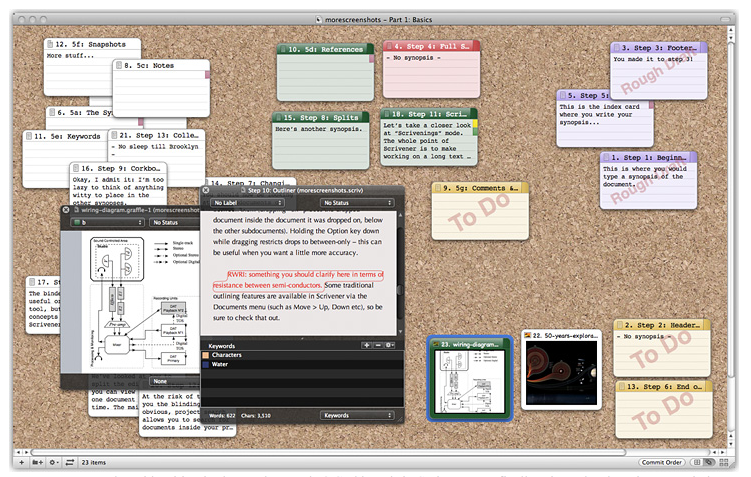
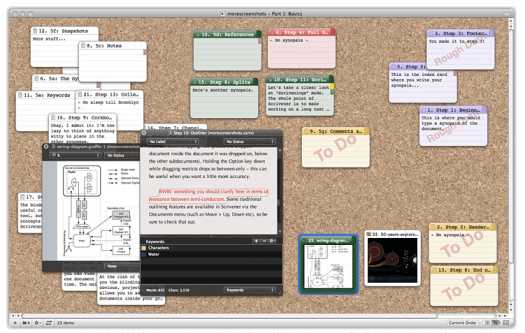
Say good-bye to sticky notes falling on the floor when it gets humid outside. Say hello to the floor you haven’t seen for months, since it’s been covered in index cards. Scrivener allows you to not only create virtual index cards and post them on a virtual corkboard, but you can also rearrange them, even when your manuscript is complete. Need to move chapter 30 back before chapter 14? No problem. Instead of scrolling back up and down through pages of text, just point, click and drag!

Better yet, each index card can function as a chapter synopsis, and you can attach various and individual scenes to each card, again, for easy viewing and rearranging, even within a chapter.

And as an added bonus, you can print out the index cards you create within the program, complete with lines to cut them the exact size of a 3×5 card.

As the website says, “Make a mess. Who said writing is always about order? Corkboards in Scrivener can finally mirror the chaos in your mind before helping you wrestle it into order.”

Don’t like index cards? That’s okay, because you can do your writing (also with rearranging capabilities) via the outlining mode.
3. Don’t just think about Harry Connick as you write out your protagonist’s next love scene. See him on the screen.

Don’t just think about the New York City skyline as your villain creeps through Central Park. Keep a photo of it on your desktop as you write.

Character, setting, and other research organizers allow you to attach photographs, charts, maps, and more all together and accessible as you write. One of my supporting characters looks like Matthew McConaughey. Seriously. He does. So whenever I need to jot down notes about his character, I open up my folder and there he is, gazing at me. Beautiful.

(woah–where did HE come from?!?)

 4. Worry about Word later.

It took me awhile to get over the fear of not writing in Word. But alas, the designers make it possible for you to compile all the text behind all those index cards and export it into one, seamless document which dovetails easily into Word.

5. Other cool features I love:

  • A name generator with every ethnicity and region imaginable!
  • Templates
  • Word count features, by chapter and whole document
  • Color-coding for chapters, editing status, and more.
  • Progress tracking
  • Keyword options
  • Formatting assistance

The website sums it up best:

“Most word processors approach composing a long-form text the same as typing a letter or flyer – they expect you to start on page one and keep typing until you reach the end. Scrivener lets you work in any order you want and gives you tools for planning and restructuring your writing. In Scrivener, you can enter a synopsis for each document on a virtual index card and then stack and shuffle the cards in the corkboard until you find the most effective sequence. Plan out your work in Scrivener’s outliner and use the synopses you create as prompts while you write. Or just get everything down into a first draft and break it apart later for rearrangement on the outliner or corkboard. Create collections of documents to read and edit related text without affecting its place in the overall draft; label and track connected documents or mark what still needs to be done. Whether you like to plan everything in advance, write first and structure later—or do a bit of both—Scrivener supports the way you work.

But wait. Before you buy, please note:

As with any computer program, there are negatives. Some folks–including an adorable and brilliant writer friend of mine–hate it. Also, while a PC version is available, the program was designed to operate on Macs, and the designers even admit it will probably work best on that platform. Try the trial version before you buy it to see if it will work for you and your computer operating system.

Also, you do need to have at least a smidge of computer savvy. And patience. There is a learning curve to this program, and the designers have been kind enough to offer a thorough, interactive tutorial and instruction book. While helpful, the program is so rich even I—a borderline computer geek—felt a little overwhelmed initially. And I don’t know if I’ll ever use all the functionalities.

That said, Scrivener has truly changed the way I approach my novel writing. I feel like it really frees my mind to focus on the prose, because I no longer have to remember where everything is on my hard drive . . . or if my dog ate a sticky note or a stack of index cards.

I honestly don’t know why more folks aren’t using and/or raving about the software.

Try it for free for 30 days.

I can’t throw in a set of steak knives, but I’d be willing to wager you’ll like the program, too.
The Book Review Conundrum

As a newly published author, I’ve found the review game an interesting one. Are all reviews good (1 star to 5 star)? What about paid-for reviews or even fake ones? What does this mean for an author?

I’m hosting book marketing consultant Rachel Simeone, with ZetaBlue Marketing, as she tackles the whole review question. I have not worked with Rachel personally but found her information valuable and am happy to have her guest blogging today.

Welcome, Rachel!

*****************************************

With all the recent news about fake reviews on Amazon, a number of my clients have asked me if it is still useful to worry about getting reviews of their books. It is for several reasons.

First, even though readers are going to look at reviews with a more skeptical eye, they still offer the best “inside information” about your book. Readers who doubt the veracity of the five star reviews will simply begin to look at reviews differently. They will spend more time looking at three and four star reviews, pay closer attention to longer, more detailed reviews, and be more likely to trust reviews by top Amazon reviewers. But these differences will not change the simple fact that they are still reading reviews.

Second, there are a number of book sites out there that will list self-published books for free, provided that they have 10+ reviews with a review average of 4 or higher. Since today’s authors need all the free publicity they can get, these sites are an important source of potential readers, provided that you can get the reviews.

Third, new, positive reviews are newsworthy events that you can share on your blog, Facebook, Goodreads, and Twitter. With each positive review, you are building in the mind of your prospective reader the perception that your book is a quality read.

Finally, good reviews create momentum. The more reviews you get, the more people notice, take a chance, and buy your book. The more sales you have, the better rank you get. The better your rank, the more potential readers see your book. And once those potential readers peruse the reviews, the more likely they are to buy your book, thus continuing the cycle.

So, given that getting authentic reviews is more challenging than ever, what is a poor author to do?

Friends and family
All writers hope that close friends and family will help them out by reading their book and reviewing it. I suggest that you formalize this process. Send out an email to your friends and family offering them a copy of your book in exchange for writing a review by a specific date. Send follow-up emails to those who request a copy reminding them of their commitment and the upcoming date.

Goodreads Goodreads is an important site for a number of reasons, not the least of which is as a source of reviews. Each time you run a Goodreads giveaway, you end up with a list of people who want to read your book. Contact some of them and ask them if they would be willing to write an honest review of your book in exchange for a free copy.

Other authors There are a lot of other authors out there who also need reviews. Find some authors who write in your genre and offer to do an honest review exchange. This approach can be a bit trickier, because you never want to write a completely negative review of a fellow author’s work. To avoid this problem, be sure to read an excerpt of the book before you agree to write a review of a book. If you see poor spelling, bad grammar, or sentence fragments and fear that you won’t be able to leave a semi- positive review, don’t agree to write one.

Don’t leave getting reviews to chance. With new clients, I generally spend the first two months actively pursuing 10 – 15 reviews for each of their books before the real marketing starts. Don’t skip this important step. Start actively pursuing reviews today.

What are your thoughts? What do you think the value is in getting reviews? Do you think an author should pursue paid reviews?

*****************************************************************************************************

Rachel Simeone is a book marketing expert with over 20+years of experience in Internet and consumer marketing. Implementing proven marketing strategies, Rachel develops customized marketing programs that attract readers and deliver sales. She is known for her innovative ideas that exploit hidden opportunities to give authors a marketing advantage. Previously, Rachel held strategic marketing positions at Time, Inc., Williams-Sonoma, and Gump’s, where she developed marketing programs and implemented best practices for America’s leading brands. If you are interested in maximizing your book sales and taking your marketing to the next level, contact Rachel today.

Stranglers or Wranglers? The Super Power of Encouragement

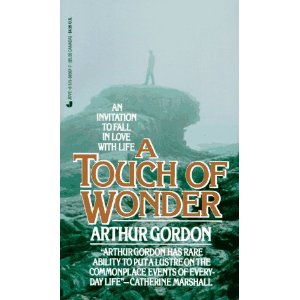
One of my all time favorite books, one that influenced both my writing style and my outlook on life, is A Touch of Wonder by Arthur Gordon. Gordon’s stellar writing peppered “Guidepost Magazine” with inspiration for decades. I remember happening upon the book in a seaside store, then finding a perfect spot on the beach to relax where, over the next two days, I read it from cover to cover. As the ocean waves rolled in the distance, I felt uplifted by true story after story filled with humor, struggle, love, and courage.

In one memorable chapter, Mr. Gordon told a story that created such an “Ah-ha of the Heart” for me that it helped form my basic writing philosophy. He wrote of a friend who belonged to a club at the University of Wisconsin many years ago. It was composed of several talented writers, all brilliant young men. They would each read their prose aloud, then take turns dissecting and criticizing each others’ writing so fiercely, they dubbed their writing group “The Stranglers.”

On the same campus, a group of women formed a writing group, calling themselves “The Wranglers.” But instead of dousing one another with criticism, they spent most of their time encouraging one another. They all left the meetings feeling inspired in their writing journey.

Twenty years after these two groups met, some interesting results were found. For all the brilliance of the writers who made up “The Stranglers,” not one member achieved any kind of literary reputation. “The Wranglers,” on the other hand, produced a half-dozen successful writers, including the Pulitzer Prize winning author of The Yearling, Marjorie K. Rawlings.

From this story I drew two convictions:

1. When choosing a writers’ group (or any support group for that matter), make sure that they lead with a positive spirit. Sure, you want honest feedback, but this can be done with grace in an atmosphere of encouragement. If the group has spiraled into nit-picking negativity, get thee to another group. That is, if you value your future as a writer.

2. Secondly, when you edit someone else’s writing, it is often automatic to skip the good writing and correct what is wrong, like the proverbial teacher with a red pen.  Because I accept this is how my editing brain works, I usually go through a writer’s chapter or manuscript or a proposal twice. The first time I highlight what needs to be changed to make it better. And then, I go back through and put smiley faces on the parts I like the best. You would not believe how writers love those smiley faces and how they make any critique go down easier.

In a little post-script to this story, I searched and found an address for Arthur Gordon, who was at the time quite up in years (he died in 2002 at 89), then wrote him a fan letter. He wrote me back on an old manual typewriter, saying how much he appreciated the bucket of encouragement, that this sort of reader feedback was fuel for his writing soul. I realized in that moment that no matter how old or accomplished a writer is, inside we’re all a little insecure and in need of positive feedback. A part of us is forever the child, giddy over a star or a sticker from the teacher.

So it behooves us to be positive and kind to each other in our critique. Not only does it make the writing life more fun, but in the long run, it also makes it more prolific and profitable.

What sorts of critique groups have you experienced? How did they make you feel? What kind of critique encourages you to excellence without throwing you into a depressing writer’s block?

The Best Advice I (finally!) ‘Got’

I always hated it when writing instructors told me to 1) write what you know, and 2) follow a formula.  How, I wondered, could I write what I knew when I didn’t know anything interesting, and when the only formulas I remembered were from high school math class? I was pretty sure that wasn’t going to be much help in writing anything other than a final math exam.

Now, having finally decoded those two pieces of cryptic advice in the course of my own writing career development, I have only two words to share with would-be novelists: read and outline.

Read books (all kinds!), but also read everything you can get your hands on: newspapers, magazines, the backs of cereal boxes, newsletters, church bulletins. I even read vanity license plates, which inspired me to give one of my series characters distinctive car plates that have played into more than one mystery plot!

The purpose of all that reading is twofold: 1) you accumulate a storehouse of information about the world; and 2) you never know what word, image, or idea will catch fire in your writing process.  Reading feeds you with new material – like ongoing brainstorming.

As for reading books in all genres, I find it’s a great way to broaden my experience. I may not be an expert on scuba-diving or anti-matter research, or know one end of a knitting needle from the other, but if I’ve read about it, I at least have some familiarity with it. And if it might fit into something I’m writing, I can go back for more reading or research.

It wasn’t until I figured this out – that I didn’t have to be an expert about something to write it into a story – that I finally really understood why my teachers insisted you had to ‘write what you know.’ Write what you know – not necessarily what you yourself have experienced. What a relief to know I didn’t have to commit a murder to write about one!

The most important thing I ever did when I was writing my first novel, however, was to outline. And I’m not referring to the outline of my book, either (though I do work from a rough outline when I write). The outline that I found most helpful was the outline I made of my favorite author’s best-seller.

Yes, you read that right – I outlined a book by my favorite author.

It was a tedious task, to be sure, but by the time I finished that chapter-by-chapter outline, I knew more about pacing and plot development than I had ever learned from any teacher or class. My secret was to use a different color marker for each subplot, so that by the end, I had a notebook in which I could visually trace how story threads flowed together and how the notorious ‘red herrings’ of successful plots operated. Deconstructing a best-selling novel taught me how to write my own ‘formula.’

What are you reading/outlining today?