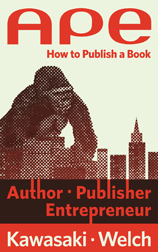
Monkey Read, Monkey Should Do!

apeDoes the acronym HARO mean anything to you?

It should, because it just might be your ticket to free publicity, extensive exposure as a writer, and the means to grow a national reputation as an expert in your field.

HARO stands for Help A Reporter Out, and it’s a website where you register as an expert and news source. There is no fee to register, and while there is no guarantee that you will get tapped for information, it’s a chance you don’t want to miss. For nonfiction writers, it can become one more piece of a marketing plan to become known for their unique expertise, while fiction writers might consider their own research in specific topics as fodder for story ideas. According to HARO’s website, 30,000 members of the media have turned to HARO for assistance in developing stories; is there any reason you shouldn’t be one of those folks helping out a reporter?

Learning about HARO was just one of the things I learned from recently reading APE: Author, Publisher, Entrepreneur-How to Publish a Book by Guy Kawasaki and Shawn Welch. While I have no desire to publish my own books, I still found the book informative and helpful, especially as I’ve grown from an author-wannabe to someone with five years of publication experience. The first section of the book was a good reminder that writers come in all shapes and sizes, with a range of motives, and that’s okay. It made me consider again the tenacious nature of writers who want to publish and gave me a new understanding of why people choose self-publishing. (It also made me realize that if I did decide to do a short ebook as a promotional opportunity for my other books, I could probably pull it off using APE as my guide.)

What I especially appreciated, though, was the book’s insistence that there is no escaping from the truth of today’s book business landscape: authors need to take responsibility for their books’ success, no matter how they are published.  APE gives valuable insight into the entire publishing process, which I’m convinced every author needs. Publishing is a business, and the sooner authors accept that, the more successful they will be! As an early publishing mentor of mine insisted, if you’re going to succeed, you better know how the business works. Kawasaki and Welch have done a fine job in giving readers the essentials of publishing.

Seeing as I’ve spent the last year trying to educate myself about platform and marketing, I found the last part of the book packed with practical suggestions and resources, like HARO, that I can play with as I continue to polish my marketing skills. The authors even include their own list of what they did to publish/market APE itself, providing readers with a basic outline for promoting any book, and offering links to learn more.

What are you APE-ing these days?

(Special thanks to Lucille Zimmerman, my agency-mate, who gave me the book to read!)

The Power of People Watching

“How vain it is to sit down to write when you have not stood up to live.”
Henry David Thoreau

FFISummer092253Almost four years ago, I stood in an apartment parking lot with twenty-three strangers from all over the country. We made awkward conversation, silently sizing one another up and wondering how people so different would ever survive a semester together.

That summer was the best of my life with some of the most unique personalities I’ve ever had the privilege to know. In class, we studied personalities, strengths and weaknesses, character, opinions, and worldview. I knew how each person reacted in the midst of passion, anger, joy, or grief. I knew struggles and victories. Our common denominator was a desire to lead and a heart for the Lord.

And I had to know my characters the same way.

Through these people and because of that summer, I had ideas to propel me into my first book. My characters took on the physical traits and personality of one of my roommates. My supporting characters share names in common with some of the guys.

The best characters are the ones the reader can relate to as a close friend, soul mate, enemy, or victim. The best stories emerge from the people, places, and experiences around us.FFISummer090523

Spending night and day with these people for two months taught me the beautiful complexity of people’s stories. It also taught me the depth of people. The best stories come from people watching, from intimately engaging in life, and embracing the good and bad.

As I work on my current WIP, I watch the people around me. I study emotional reactions, goofy quirks, language patterns, clothing style, facial expressions, and character. Slowly, my characters take shape on the page. Fair warning: if you are in my vicinity, one of your odd habits may make it into my book.

As writers, we tend to isolate. Or at least some of us do. We are content to people watch without interacting. Big problem. As Thoreau said, writing is flat if the writer has not lived.

Get out of your chair. Abandon your laptop. Spend time with friends and family. Sit at your favorite park or Starbucks. Take a note pad and record people’s conversations. Listen to the words they use, how they form sentences. Interact with the guy behind the counter or the people walking their dogs. Engage them in conversation.

Live and live well. Abundantly and fully. Engage with people intimately, not for the sake of a story or character, but because every person we cross paths with has a story that can teach us something about life and the Lord and yes, even writing.

People are weird and quirky and complex. We all have different personalities and reactions. People are full of surprises and opinions. Fashion your characters that way, too. God created people in His own image. Fall in love with them. Embrace the uniqueness. Embrace your uniqueness. Then write with eyes wide open, heart full, and a mind overflowing with memories to make your stories rich.

Have you people watched lately?

Sticks and Stones: The Highly Sensitive Writer Toughens Up

I recently attended a writing seminar about creating compelling titles for books. A burgeoning writer volunteered her book title for the rest of the group to critique. The consensus of the group was that her title wasn’t catchy enough and needed to be reworked. Several people in the group offered sage advice that would probably have helped her a great deal, had she been open to suggestions – but she wasn’t. The novice writer became incredibly defensive (and borderline angry) about the feedback. She was not ready to be objective about her work. The facilitator had to smooth things over and hastily get a more willing participant for the exercise.

Throughout history, even the most successful writers have to deal with criticism, so there’s no reason why we should consider ourselves immune to feedback. Check out these excerpts from actual famous author rejections from http://www.writersrelief.com:

  1. Sylvia Plath: “There certainly isn’t enough genuine talent for us to take notice.”
  2. Rudyard Kipling: “I’m sorry Mr. Kipling, but you just don’t know how to use the English language.”
  3. J. G. Ballard: “The author of this book is beyond psychiatric help.”
  4. Emily Dickinson: “[Your poems] are quite as remarkable for defects as for beauties and are generally devoid of true poetical qualities.”
  5. Ernest Hemingway (regarding The Torrents of Spring): “It would be extremely rotten taste, to say nothing of being horribly cruel, should we want to publish it.”

Ouch! So, how does one not get touchy about his / her work? Writers are still artists, after all. Artists are famous for being highly sensitive. Artists who have to self-promote themselves may find it incredibly awkward to listen to face-to-face or written criticism. Once I gave a book I wrote to a professor friend to review. He said. “Well, perhaps you should focus on writing things you know about, as opposed to rock stars.” It was a fair point well made, and my creative writing has become much more real as a result of sticking to what I know.

Boxer Flexing Her Muscles

Aside from writing, I also like to paint. One time, it took 3 months to finish a large 12×12 foot piece and I needed to get a moving company to deliver it to my showing – longdistancemovingcompanies.co is my favorite long distance moving company for that. At one of my showings, I overheard a man telling his friend that my art might be best displayed at a fast food restaurant. “It’s convenience store art,” he said as I looked on, trying not to have any sort of facial expression. The critic didn’t know I was the artist or that I was in earshot. It stung, but feedback is still feedback and should be regarded as just that. It proved to be a valuable lesson – you can’t win them all. If you will accept nothing less than 100% acceptance, you will be plagued by disappointment. But here is the silver lining: You don’t need to win them all. You just need a percentage, and as long as you keep putting your work out there, the correct audience that appreciates you will find your work. It’s all about maintaining perspective.

Why does one need to develop a thick enough skin to withstand criticism? Because unless you have someone else to promote your writing on your behalf, it’s all going to be done by you. You will be the one going into the front lines to promote and defend and champion your own work. Confidence helps, so if you don’t feel you have any, then act as if you do. Pump yourself up until you start to believe it. If one reader doesn’t appreciate your writing, that’s okay – there will be others who will. Instead of harboring hurt feelings, why not just say, “There are other audience members in the literary sea. Next!”

How do YOU maintain perspective about your writing?

10 Kooky Tips On How To Write A Book

My writing nook at home. Don’t be fooled, it looks Pier One, but really, it’s a hodgepodge of thrift store and Craigslist.

I receive emails from people asking how to write a book.

I have written a book but I haven’t actually published it (yet, God give me patience and faith).

So when I am asked, it feels a bit like someone asking a person coloring a picture in a Strawberry Shortcake coloring book how to paint a still life.

Here are 10 kooky tips that popped into my head about writing a book if you absolutely don’t know how to start:

1) Start with a dangerously low self-esteem

This is vital. If you don’t, you may not be able to handle getting knocked off the height of your perch daily from rejection. It’s much easier to begin writing from the depths of despair.

2) If you have kids, get a lock for your bedroom door

My reasoning is two-fold: 1) my bedroom is where I write, and 2) my bedroom is where I cry when I am convinced that I cannot write, and it seems to upset the children when I cry uncontrollably.

3) YOU PROBABLY NEED TO ACTUALLY ENJOY WRITING

Or at least be able to stomach it, if you want to embark on a long project. Seriously, in order to write a book, you have to spend countless hours writing, which may stop you right there. Luckily for me, I love to write and see where it takes me. I also love to sit!

4) Make sure your writing desk has an economy size box of Kleenex.

I cry when I write. I cry over a beautiful sentence (both other people’s and my own). I cry over the fact that I can’t spell. I cry about God’s work in my life rendered on the page.

5) Listen to Papa Hemingway

I talk about Hemingway often, but I believe the goal is one true sentence.

Sometimes sentences string together perfectly and send shivers up my spine. One true sentence is the payback for locking yourself in your room to write.

6) Read books

Readers usually make good writers. Some of my favorite books include “To Kill a Mockingbird” by Harper Lee, “Les Misérables” by Victor Hugo, “Traveling Mercies” by Anne Lamott, and “Twilight” by Stephanie Meyer. (I’m just kidding about Twilight. Sorry, not a teen vampire fan.)

Read books on craft. For memoir, I love Vivian Gornick’s “The Situation and the Story” and Anne Lamott’s “Bird by Bird.”

7) Join a writing class

Most writing classes will require submissions and offer critique. This forces you to write. For years, I attended a memoir workshop in Chicago.

8) Buy business cards on-line and slap “writer” under your name

Call yourself a writer.

Even if you don’t have anything published, if you write, you are a writer. You may not be an author until you are published, but by golly, you are a writer. Put it out there! (And if you buy 250 business cards and have no one to give them to, the kids love to make up card games with them.)

9) Call or text or email people who love you, often

Writing is solitary. You show up and put words on paper and wonder if you actually have anything of value to offer the world. Call your mom, or your best friend, or Joe, the creepy guy at Starbucks who saw you writing one day and gave you his business card. Call anyone who loves you (OK, maybe not Joe) and ask for encouragement. You need cheerleaders. Buy pompoms and pass them out to friends.

10) Don’t write for attention

Believe me, an easier route for attention would be to hold up a Seven Eleven.

What’s your advice about writing a book?


Extravagant Subsistence: Restocking the Writer’s Shelves (and Soul)

Our freezer is nearly empty. We’ve eaten all of last year’s fish and meat, which constitutes a near emergency. Tomorrow I’ll close my computer, ignore my writing deadlines and head back out by bush plane and boat to an island in the Gulf of Alaska where I’ve worked in commercial fishing with my family for 35 years.  We were so busy with the commercial season this summer we didn’t have time to put up our own fish for the winter, the wild salmon that will feed us luscious Omega-3 saturated flesh weekly through a long season of dark. We also harvest berries, venison, halibut and sometimes caribou. Putting up our own food stores, which goes by the shorthand term “subsistence,” is a normal and necessary part of most people’s lives in rural Alaska.

“Subsistence” is defined  as “The action or fact of maintaining or supporting oneself at a minimum level.” In Alaska, however, where a subsistence lifestyle is as common as wool socks, it’s evolved into almost the opposite concept. We don’t hunt and fish and grow and harvest simply to live—we engage in subsistence to live well. We have access to cellophane-wrapped factory-farmed meat like everyone else—but it is expensive, saturated with antibiotics and hormones, and has been shipped a very long way to get here. We prefer to harvest wild-grown meat from our own piece of the land and sea. It’s one of the reasons we live here.

This last week I began another kind of subsistence: I started re-reading Gilead, Marilynne Robinson’s wise and extraordinary novel. Her profound musings on the worth of life, as spoken through John Ames, an elderly pastor, remind me how empty my writer’s pantry has become. The authors who have sustained me through the decades—Frederick Beuchner, Annie Dillard, Richard Wilbur, Eugene Peterson, Walter Brueggeman, Gerard Manly Hopkins, Emily Dickinson—have become strangers of late supplanted by blogs, social media, and research for other writing projects. These are all quick, short reads full of good information, but I’ve been achingly hungry without knowing it.

I realize that my writing life is little different than my food life. I’m often so busy on the commercial end of the work—the marketing, creating the next book proposal, the social media—that I forget to do the real subsistence work. While I’m as tempted as anyone else to spend my time feeding on strategies to garner audiences and master social media, ultimately, I’ll starve on such a diet. Fifty-seven Ways to Grow Your Platform, while helpful, will do little to awaken mystery, stir my imagination, provoke paradox, unearth wisdom, deepen my humanness, all of which is why I began to write in the first place. I realize if I maintain a steady diet of techniques, I’ll soon be setting an impoverished table for not only myself, but also for my readers, who come themselves needing sustenance.

Subsistence work is not easy. Rather than grabbing cellophane packages of meat and fish from the meat counter, I have to go out into boats, I have to use knives and muscles, I have to cut off heads, pull out guts, spill real blood.

It’s a physical engagement with the material world. Reading the best writers is not unlike this. It takes more effort to read longer works. Blood will be spilled there as well as we wrestle with the deepest, hardest and most profound stories of dying and living. But this is how we will subsist and be sustained as writers for a very long time.

When I sit down to my first meal of grilled salmon this winter, I will remember where it came from, how it felt in my hands. I will be so well-fed, I will want to write about it, and will set the table for others to join me in the feast. I hope my work will feed others as well as I have been fed myself. With some labor, and yes, some blood, it can happen.

What kind of reading are you returning to for “extravagant subsistence”? How can we make more time for this kind of reading (and for sustaining physical labor)?

Marketing with Integrity: 5 Tips On What Not To Do

http://www.stockfreeimages.com/

Most writers prefer to focus on craft instead of marketing. But let’s face it. These days, authors need a platform to jump from in the publishing world. Without flexing the mammoth muscle of the internet, our publishing goals may not materialize.

Humph.

I’m new in the business. I’ve written a memoir about having a baby with Down syndrome while living as a missionary in Ukraine. I’ve landed an agent. I now participate in the shaky step of pitching my project to editors.

And I’ve already committed marketing blunders.

Here are 5 tips on WHAT NOT TO DO in marketing.  

1. Don’t use your kids to get ‘likes.’ 

After my amazing agent Sarah Joy Freese encouraged me to attract more likes on my Facebook Fan page, I went a little nuts. I hosted a giveaway on my blog in exchange for Facebook likes and Twitter followers. I then convinced my four children to write and perform a “likes rap” video. They were cute. It was fun. It killed an afternoon at our house.

Giveaways and videos are great marketing tools. But I went overboard. I posted the video, and re-posted, and re-posted until my kids were even tired of watching themselves perform. My idea morphed into a “look at me” festival until a friend sent me a gentle message saying, “Really, Gillian? This isn’t you.”

2. Don’t spam.

Spam is no longer just canned pork.

According to About.com, “Spam is any unsolicited commercial advertisement distributed online.” If you post links repeatedly on social media without engaging in community and conversation, you may be considered a spammer and people are going to find you annoying.

3. Don’t just ask. Give.

It is better to give than to receive. Let’s face it. People don’t care about us. Readers want a takeaway. They want perspective, a lighter mood, encouragement, escape.

In marketing, it is essential to give. Share links. Retweet. Interview people on your blog. Ask questions on your Facebook page. My writing tribe is best formed through reciprocal interaction and authentic interest.

4. Don’t market without a plan.

My marketing blunders have stemmed from too much excitement and lack of preparation. At first, I had no marketing plan. It’s difficult to have integrity at high-speed. Now, I try to step back and see the big picture. What marketing strategies will best utilize my schedule, gifts, and goals? I am no longer allowed to dream up an idea and run with it before a time of reflection, planning, and prayer.

5. Don’t forget to write.

Marketing pursuits easily swallow work hours. When my time is not structured, I blog, tweet, update statuses, and read about marketing. But I might not write.

Thus enters the need for limits. Some writers allow a half hour in the morning and again at night. Others (insert ME!) require a little extra help. Turning off the internet is a great tip. Author Media, a website dedicated to help writers build their platforms, has a post providing seven apps that assist a writer’s occasional lack of self-control.

What’s your marketing strategy? Do you have a blunder you’d like to share? Where are your boundaries when it comes to marketing integrity?

And would you like to use my children in a rap video? If so, contact me. (God’s still working on me.)

Top 5 Self-Editing Tips: Intention

In my first post last month on the topic of the Top 5 Self-Editing Tips, I covered in detail how a novel is structured and how you can be more aware of how to build the structure of your novel.

This month, let’s concentrate on an aspect of self-editing that writers rarely hear much about:  intention.

Merriam-Webster’s Collegiate Dictionary defines intention as “(1) a determination to act in a certain way: resolve; (2) import, significance; (3) what one intends to do or bring about.”

The definition of intention includes other topics, but for our purposes, we can examine the synonyms for intention and determine how we might find intention in a piece of writing, whether fiction or non-fiction. Synonyms: intent, purpose, design, aim, end, object, objective goal.

Once you finish your first or second draft, ask yourself, “Did I fulfill my overall intention for writing this piece, and did I achieve my intention in each scene or section?”

Whoa! That sounds like a tall order, doesn’t it? You might be thinking, how long am I supposed to spend on an edit? The answer: as long as it takes. Because if you have not fulfilled your intention in writing your book, then how can your reader know what you were trying to say?

Let me make this a little simpler by starting with a chapter or even a part of a chapter. Did you intend to make your character unsympathetic in this scene? If not, then you have not communicated the soul of your character to the reader. You have not fulfilled your intention. The reader might even think, “Marsha would never say that. Why is she being so rude?”

On a greater scale, your story or your non-fiction book should have an over-arching aim or goal. It is the road that connects you to the reader and pulls the story along. Yes, even a non-fiction book is more successful if it tells a story that persuades your reader to believe in what you’re writing about.

Your road will twist and turn in a novel, but you, as the author, should always keep the goal in mind. You don’t want to tell your reader up-front what your intention is, but you should know where you’re headed. If you take readers down a rabbit trail and nothing of significance happens, they will soon stop following you through the brush.

Only you know what you want to achieve in your book. If you’re leading your reader down a “road less traveled,” the trip may be leisurely or it may zip along. You may travel on a super highway, on a country lane filled with potholes, or you may walk with your reader down a garden path.

But if you veer off that highway/road/path just because you have a sudden inspiration, your book may be filled with pointless arguments (non-fiction) or characters who pop out of nowhere to deliver a useless piece of dialogue (fiction).

My intention in this post is not to say that plotters are better writers than pantsters. You can write your book as you please, but if you know your beginning and where you aim to end—intention—then the journey will be that much sweeter.

To be continued…

How will you self-edit your novel or non-fiction book to make sure your intention is clear and that you have achieved your goal in every chapter? 

A Writer’s Flash-Point

Life is packed with flash-points, moments of ignition, moments when something contagious is sparked.

A few years back as a freelance writer for national and international magazines, I nurtured an until-then-dormant desire in the recesses of my heart: I wanted to write a book. I had no idea what book, but it sure sounded glamorous. Jo Ann Fore – Author.

I envisioned days penning words in a secluded cabin surrounded by soaring mountains and pristine lake waters—which would lead to countless fans, best-seller lists, and media engagements, of course.

My fantasy lived a number of quiet years before I joined the ranks of thousands of others who had made writing a book an official goal. I was proud of my fearless move. I did it. I set the goal! That much closer to authorhood.

Funny thing though, verbalizing that goal always led to the inevitable question: What are you writing?

What am I writing? (Flashpoint One.)

I really didn’t know.  All I knew was someday I was going to write a book. I had dreamed of writing a book probably since I held my first crayon.  But, someday.  Someday when I had more time, when my daughter was grown, when life wasn’t so hectic.

My husband, Matt, taught me a valuable lesson about the word “someday.” When he and I dated, I was extremely commitment-shy after having escaped a not-so-great (okay, horrific) marriage. Today Matt and I joke about the countless pre-proposals he tossed out before he got to the real one. Consistently he asked, “Will you marry me?” This both warmed my heart and petrified me. Feeling a bit bi-polar each time he asked, I simply smiled and said, “Someday.”

Until the day Matt called me out. “Maybe you dangle it just far enough out of reach to avoid the reality. There’s really nothing intentional about the word someday.”

Once he was serious about his proposal, he let me know that “someday” was going to have to move to a set date. We just celebrated our seventh anniversary. If I kept saying “someday” I may have lost this amazing husband.

I was unknowingly sabotaging one of my greatest desires. (Flashpoint Two.) And now, I was doing the same thing with my aspirations to write a book.

It was time to drill this thing down. What am I writing? I want to help hurting women. I want to offer lasting hope and practical application. So, what is my message?

Once I articulated that, I could move forward. After I settled the premise of my work I was ready to write. (Flashpoint Three.) That was the day the book became more than a dream, more than a goal. It became an intentional laser-focused choice.

Along these lines, Huffington Post’s Complete Guide to Blogging offers a great exercise we can use to nail down the focus of our book: “What is your point? How would you explain your point to a batty, slightly deaf relative in one sentence? Write that sentence down. This is the gist of your piece.”

I would love to see your answers in the comments section below.

Top 5 Self-Editing Tips: Structure

Writing is rewriting, and rewriting is self-editing. “But isn’t that the job of the editor after I’ve made the sale?” No. Some writers think running spell-checker is self-editing. Not so much.

“But won’t rewriting my work edit the life out of it?” No, but it will catch the eye of an agent or editor as a well-written manuscript and may lead to a sale.

Obsessive editing during the writing process will destroy your work. However, after you’ve written the first draft, gain some distance and perspective on your manuscript by setting it aside for a few weeks or a couple of months. Now it’s time to rewrite.

Here are my top 5 self-editing tips in their order of importance for polishing your work to a high sheen.

  1. Structure: Think of the structure of your work as an arched bridge spanning a great river. If the contractor takes short cuts (such as using less cement, steel, or fewer bolts) because she’s bored with the process and rushes to the end, the bridge is weakened and will collapse.  The same holds true for both ends of the bridge. If too much cement is used at either end of the bridge, it will collapse from the added weight.

For the purposes of this post, I’ll concentrate on the structure of novels. If the structure of your story is solid, the reader will continue to turn the pages until the ending scene.

The material of the structure is comprised of the elements of the story arc (the basic story thread) held in place by a beginning, middle, and end. Pretty simplistic, huh? Yet the three-act structure has worked since Aristotle’s days whether you write plays, scripts, short stories, or novels.

Sydney Harbor Bridge

Some authors maintain they have a four-, five-, six-, or even eight-act structure. I maintain if you break down the parts of their story arcs, you will discover classic Aristotelian structure.

Using the bridge analogy, a car drives onto the bridge. This is the point in the novel when you can lose a reader in the first page or two. I’ve thrown many a book (or manuscript) on the pile beside my bed if nothing happens right away. The author might as well have written “blah, blah, blah-blah, blah.”

A novel that piques the reader’s interest starts as far into the story as possible. I don’t want to know that the protagonist’s parents left him stranded in a snowstorm when he was a toddler and that’s why he’s terrified of snow (or abandonment). That’s back story. The story should begin with stasis (a state of equilibrium) and then the main character, pressed with conflict, reveals her goal.

One of my favorite movies is Indiana Jones and The Raiders of the Lost Ark. The story throws you into the action, and the back story―Indy’s character, profession, the setting, and the antagonist―are revealed as Act 1 plays out.

As the story progresses into the middle (Act 2) and the bulk of the novel, you should have rising and falling tension as your protagonist encounters numerous obstacles or crises.

The main turning point, or big surprise, comes in the middle of the novel. By this time the reader believes he has the story figured out. You need to turn his assumptions on their head. The major turning point should be such a shock that no one sees it coming. It should keep your reader up at night turning pages.

The crises continue. Will he? Won’t she? Oh, no! What will happen to this character your reader has invested her time in? Will everything turn out all right? How will the story ever end on a happy, satisfying note now?

Tension mounts and we reach another major turning point before we head into the final third act. Every turning point should be a surprise to the reader.

The crises are unrelenting until we reach the climax halfway through the third act. The protagonist faces off against the antagonist. The clash of the titans ensues. A woman faces her attacker or her paralyzing fear. The antagonist is not always a person. A man pushes his wife out of the path of a stampeding herd of cattle. Will he live? You get the picture.

Tie up all the loose ends of your storyline in the denouement―the final resolution of the plot or story arc. Is your ending satisfying? Does the main character live happily ever after? If you live and write in America, trust me, she better if you want to succeed as a professional author. Americans are eternal optimists.

To be continued…

How will you self-edit your novel to make sure your structure is strong enough to carry your storyline through to the end?

Photo credit: Sydney Harbour Bridge with the Opera House in the background by Ian.

Writing Giants

Surf the web and you will see that the subject of writing is well-charted territory. No matter what your goal, a how-to manual is there to support it. Need to write grant proposals, company newsletters, technical manuals, instructional design or academic materials? Industry experts abound to provide a sea of knowledge about any aspect of writing imaginable. For advice on how to create fiction, it seems logical to consult some of the successful authors and writing giants among us.

As I began researching books on writing by authors, Stephen King’s On Writing: A Memoir of the Craft kept appearing on the horizon. I extrapolated all that I could from that book and have started recommending it to other writers. Some of his tips include writing the first draft of a manuscript with door closed, consulting an ‘ideal reader’ that represents the audience, writing consistently each day (1,000 words or more), and writing about what the writer really knows, because that is what makes a writer unique. I’ve been applying King’s techniques into my writing regimen whenever possible. With over fifty worldwide bestsellers in his wake, clearly he knows what he’s doing.

Another writing giant willing to share his techniques is Ray Bradbury, who still cuts quite a swath. The Illustrated Man, Fahrenheit 451, Dandelion Wine and his other stories will forever swim in the waters of literature.  Bradbury’s book for aspiring writers Zen in the Art of Writing is full of sage advice. He suggests that people write about what they love or what they hate because that conviction and passion is crucial to the story. He advises authors to run after life with fervent gusto, to pursue their interests, and write about the things that make them happy.

Starting out, even surfing small literary waves can feel like riding giants. I’m getting more comfortable with what lies beneath (although it’s harder than it looks).  King and Bradbury cared enough to show the rest of us that it’s possible to conquer the sea, and when you do, an ocean of opportunity awaits. Besides, what one person can do, another can do.

Are you ready to paddle out?